

Taking proper care of an oak tree isn’t a one-and-done task; it’s about understanding its natural rhythm throughout the year. True, lasting health comes from paying attention to what the tree needs as the seasons change, from the first buds of spring to the deep sleep of winter. It's this year-round, proactive approach that keeps these incredible trees standing strong for generations.
The Year-Round Rhythm of Oak Tree Health
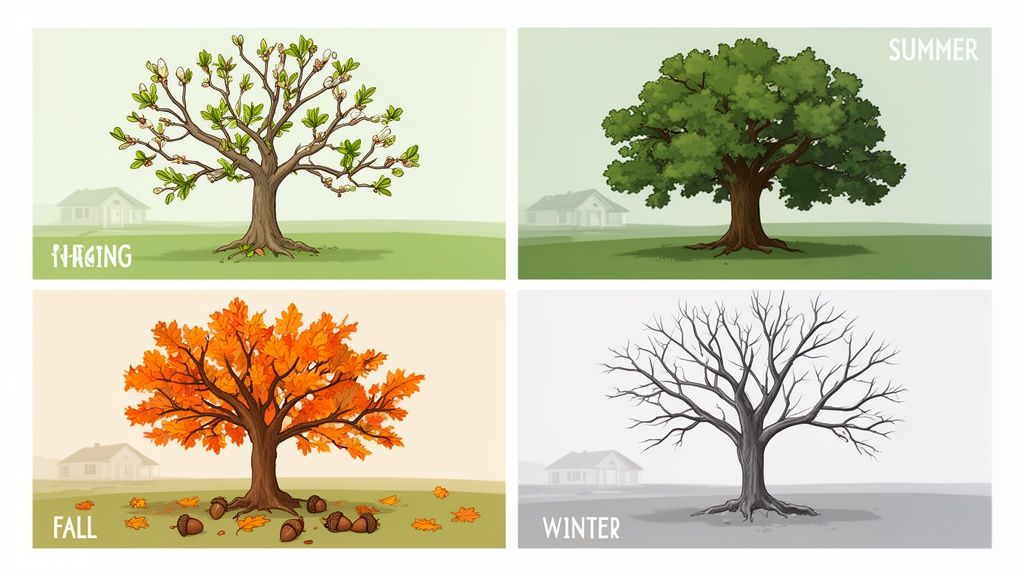
Caring for an oak is a continuous cycle. Each season presents its own set of challenges and opportunities to support the tree’s long-term strength. For homeowners across North Georgia—from Cumming and Alpharetta to Milton—these legacy trees are more than just part of the landscape. They're valuable assets that deserve dedicated stewardship.
When you understand this annual flow, you can give your oak the right support at the right time. It's always better to be proactive than reactive. Preventing common issues before they take root saves you from dealing with bigger, more expensive problems down the line.
Seasonal Priorities for Your Oak
An oak's needs shift dramatically from the burst of new life in spring to the quiet dormancy of winter. If you align your care schedule with this natural calendar, you'll have a much stronger, more resilient tree.
Here's a breakdown of what a year of proper acorn tree care looks like:
- Spring: The main focus is fueling new growth. This is the time to apply a light fertilizer if a soil test shows it’s needed. You’ll also want to keep an eye out for early signs of fungal issues common in our humid climate, like oak leaf blister or anthracnose.
- Summer: Your goal here is to reduce stress. That means making sure the tree gets enough water during dry spells, especially if it’s young. It's also critical to avoid compacting the soil around the tree's base with heavy foot traffic or equipment.
- Fall: As the tree gets ready to go dormant, it's the perfect time for a general health check. Look for any weak limbs or deadwood that could snap off and become a hazard during winter ice and wind storms.
- Winter: This is the best season for structural pruning. With the tree dormant, pruning causes minimal stress and significantly lowers the risk of spreading diseases like the dreaded oak wilt.
"An oak tree tells a story through its seasonal changes. Paying attention to its needs during each chapter—spring's awakening, summer's labor, autumn's preparation, and winter's rest—is the secret to its long and healthy life."
For a quick reference, here's a simple breakdown of what to focus on each season here in the Atlanta metro area.
Seasonal Oak Tree Care at a Glance
| Season | Primary Focus | Key Activities |
|---|---|---|
| Spring | Growth & Prevention | Inspect for new growth, monitor for pests/fungus, light fertilization if needed. |
| Summer | Stress Reduction | Provide deep, infrequent watering during droughts, maintain mulch layer, avoid soil compaction. |
| Fall | Health Inspection & Prep | Check for dead or weak branches, clean up fallen leaves to reduce disease risk. |
| Winter | Structural Care | Prune for structure and safety while the tree is dormant. |
Keeping this simple calendar in mind helps you stay ahead of potential issues and provide consistent care that your oak will thank you for.
Identifying Issues Early
Being vigilant is half the battle. Just taking a walk around your property to really look at your trees can help you spot subtle changes that signal an underlying problem. Catching things early usually means the fix is simpler and less invasive.
For example, noticing that leaves are turning yellow or branches are dying back in the middle of summer is an early warning sign something is wrong. If you're not sure what you're seeing, a good tree disease identification guide can help you figure out the next steps and decide if it's time to bring in a certified arborist.
Fueling Spring Growth and Summer Resilience
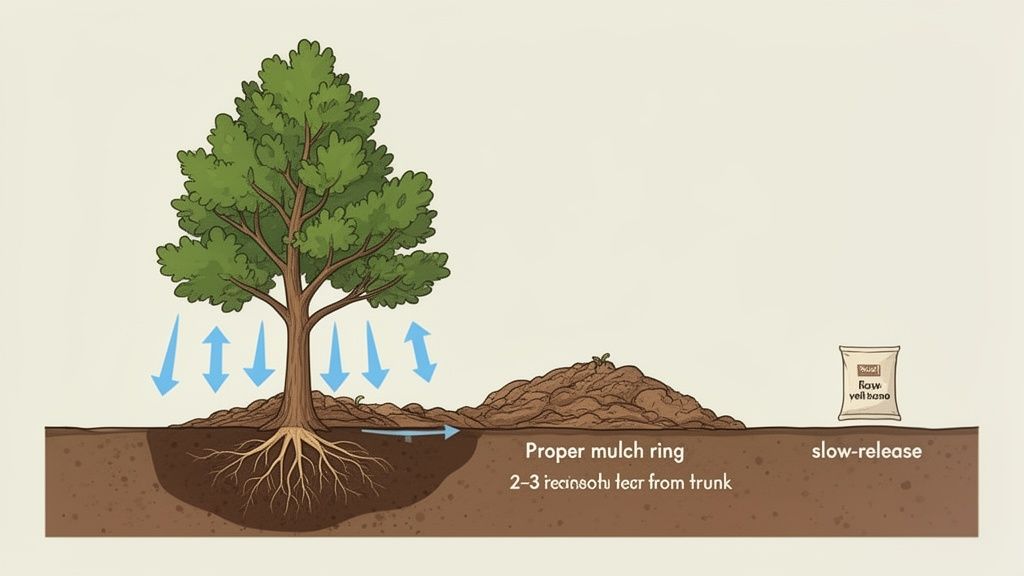
As the days get longer and the Georgia sun really starts to beat down, your oak tree kicks into high gear. Spring and summer are seasons of incredible work for a tree, from pushing out a whole new canopy of leaves to photosynthesizing like crazy. Your job during this time isn’t just maintenance—it's about actively supporting all that hard work to build up resilience for the heat that’s coming.
That support starts from the ground up, with the two things that matter most: water and nutrients. How you handle these can be the difference between a tree that just survives our hot summers and one that truly thrives.
Mastering the Art of Deep Watering
Here in places like Roswell and East Cobb, summer often means long stretches of intense heat with rainfall you just can't count on. The natural instinct for a lot of homeowners is to grab the hose and give their trees a little sprinkle every day. But that's probably one of the worst things you can do. It actually encourages a weak, shallow root system that’s the first to suffer in a drought.
You want to mimic a deep, soaking rain. That means giving the tree a huge drink less often, letting the water penetrate way down into the soil. This forces the roots to grow downward searching for that moisture, creating a strong, drought-proof foundation.
A young oak, one you’ve planted in the last three to five years, is completely dependent on you for this. Its root system just isn't big enough yet to find water on its own when things get dry.
- For Young Trees: During those hot, dry spells, a deep watering every 7-14 days is a solid game plan. The best way? A soaker hose spiraled around the tree's base, left on a low drip for several hours.
- For Mature Trees: A big, established oak can pretty much fend for itself. Its root system can stretch out two to three times wider than its canopy. You really only need to step in during a prolonged, serious drought.
The biggest mistake I see is watering too often and too shallow. Think of it as giving your tree one giant, satisfying meal that will last a week, not a tiny snack every day. That’s how you build real, long-term strength.
The Mulch Method That Actually Works
Mulch is an oak tree’s best friend in the summer, but only if you use it right. A good mulch ring is like a protective blanket. It holds in soil moisture, smothers weeds that steal nutrients, and keeps the soil temperature stable, protecting the roots from getting baked.
But application is everything. You have to avoid the dreaded "mulch volcano"—piling mulch high up against the tree trunk. It’s a common mistake that traps moisture right against the bark, creating a perfect environment for rot, disease, and pests to move in.
Instead, just follow this simple method:
- Lay down a layer of organic mulch, like pine bark or wood chips, about 2-4 inches deep.
- Spread it out over the root zone, ideally all the way to the edge of the canopy (the dripline), or at least as far out as you practically can.
- This is the most important part: Pull the mulch back 3-6 inches from the trunk itself. You want to create a little donut-shaped gap so the trunk can breathe.
Feeding Your Oak in Georgia's Clay Soil
The heavy clay soil we have all over Forsyth and Gwinnett counties is loaded with minerals, but it can also be dense and drain poorly. While mature oaks are pretty well adapted, they can sometimes show signs that they’re missing key nutrients, especially if the soil is compacted or was scraped away during construction.
Keep an eye out for tell-tale signs like pale green or yellowish leaves (chlorosis), stunted new growth, or a canopy that just looks thin. If you spot these symptoms, a slow-release fertilizer designed for trees and shrubs can provide a gentle, steady source of food. The best time to put it down is in early spring, right as the tree is waking up for its big growth spurt.
Whatever you do, don’t use fast-release lawn fertilizers near your oak's root zone. They deliver a massive jolt of nitrogen that forces weak, leafy growth instead of strong roots, and they can even burn the tree's delicate feeder roots.
Monitoring for Warm-Weather Pests and Diseases
The warmth and humidity of a classic Georgia summer also happen to be perfect for certain fungal diseases and insect pests. Staying vigilant helps you catch problems early before they get out of hand.
- Oak Leaf Blister: This common fungus shows up as raised, blister-like bumps on new leaves in the spring. It looks ugly, but it’s mostly a cosmetic issue on mature trees and rarely needs to be treated.
- Powdery Mildew: This looks just like its name—a white, powdery film on the leaves, usually in late summer. It loves humidity and can be managed by improving air circulation with some strategic pruning.
- Bacterial Leaf Scorch: This one is more serious. It makes the edges of the leaves turn brown and look scorched, and the problem gets worse every year. If you think you see this, it’s a definite sign to call a certified arborist for a proper diagnosis.
Ultimately, a healthy tree is its own best defense. A tree that is well-watered, properly mulched, and getting the right nutrients is far less likely to be bothered by these seasonal problems. The health of a tree directly impacts its acorn production, and a mature, healthy oak will dramatically outproduce a young or stressed one—a vital fact for our oak-filled landscapes in Georgia. Healthy trees hit peak output, but problems like girdling roots, diseases, or bad soil can slash those numbers. A great year might see 250,000+ acorns per acre, while a poor one can drop to just 20,000-65,000. For Atlanta suburbs like Milton and East Cobb, where majestic oaks define property value, getting this right is essential. You can discover more insights about improving tree health and dealing with issues like girdling roots on acorntreecare.com.
Decoding Your Tree's Acorn Production
Have you ever spent an entire autumn raking up what feels like a million acorns, only for the next year to be almost bare? That boom-or-bust cycle isn't just a quirk of nature; it's a brilliant survival strategy hardwired into every oak tree. Figuring out this natural rhythm is a huge part of proper oak tree care, as it helps you tell the difference between a normal "off year" and a tree that's trying to tell you something is wrong.
This phenomenon is called masting. It's a synchronized effort where oaks across a whole region coordinate their acorn production, leading to massive bumper crops every two to five years and very lean years in between. Think of it as the tree's way of outsmarting squirrels, deer, and blue jays. By flooding the market one year, they produce far more acorns than predators can eat, giving the next generation of oaks a real shot at taking root.
The Science Behind the Acorn Boom
So, what flips the switch for a mast year? It’s not one single thing but a perfect storm of ideal conditions. The process actually starts long before any acorns hit your lawn. Weather is a massive factor, especially during the spring pollination window. A late frost, a week of heavy rain, or high winds can easily wipe out the delicate oak flowers (known as catkins), guaranteeing a poor acorn crop months later.
Beyond the weather, it really comes down to the tree's own energy reserves. Producing thousands of acorns is incredibly draining. A huge crop one year often means the tree needs a recovery period for a year or two, where it shifts focus to growing stronger roots and branches. It's basically rebuilding its energy stores before it can pull off another major reproductive push.
An oak tree’s acorn production is like its annual energy budget. In a mast year, it spends lavishly on making seeds. In the years that follow, it’s in saving mode, investing that energy back into its own health and growth.
This cycle is baked into the DNA of oaks, including the white oaks and southern red oaks we see all over the Atlanta area. The swings can be dramatic. Studies have shown that in a peak year, a single acre of oak forest can drop over 250,000 acorns. In a bad year, that same acre might only produce 20,000 to 65,000. You can dive deeper into the science behind this fascinating strategy with findings from the International Oak Society.
When Scant Acorns Signal a Deeper Problem
While a lean year is perfectly normal, a mature oak that consistently fails to produce acorns can be a major red flag. It might be the tree's way of signaling that it's under serious stress and simply doesn't have the spare energy to reproduce. This is where your observations and proactive care really matter.
Several common stressors in our suburban landscapes around Alpharetta and Johns Creek can shut down acorn production:
- Soil Compaction: All that foot traffic, heavy lawn mowers, and nearby construction can squeeze the life out of the soil, robbing roots of the oxygen and water they need.
- Nutrient Deficiencies: Our dense Georgia clay isn't always the most forgiving. It can lack key nutrients, or other soil issues might prevent the tree from absorbing what's there.
- Root Issues: Problems below ground are out of sight, out of mind—until the tree starts to suffer. Girdling roots that choke the trunk are a common, and serious, culprit.
- Disease or Pest Pressure: A tree that’s constantly fighting off a fungal disease or an insect infestation is in survival mode. All its energy goes toward defense, with nothing left for making acorns.
If your mature oak hasn't produced a decent crop in several years—especially when you see neighboring oaks dropping acorns like crazy—it’s a clear sign that something is off. An arborist can diagnose these hidden problems. Something as straightforward as professional soil aeration, for example, can decompact the earth around the roots, giving them immediate access to oxygen and water and giving a struggling tree a new lease on life.
Pruning In Fall And Winter For A Stronger Future
As the vibrant canopy of summer fades and the stark, honest silhouette of winter emerges, our focus in acorn tree care shifts from simple maintenance to smart architecture. There's no question about it: the dormant season is the absolute best time for structural pruning. When the branches are bare, an arborist can see the tree’s true form, giving us the perfect opportunity to build a stronger, safer, and healthier future for your oak.
With a clear view of the tree's skeleton, it's so much easier to spot and correct fundamental issues that are hidden by leaves the rest of the year. This is when problems like crossing branches that rub together creating wounds, weak V-shaped attachments that could split under pressure, and hazardous deadwood become glaringly obvious. Tackling these issues in winter is a proactive investment in your tree's long-term stability.
The Strategic Goals Of Dormant Pruning
Winter pruning isn't about randomly lopping off branches; it's a calculated process with specific goals tailored to what your oak tree actually needs. Each type of cut serves a distinct purpose, from improving the tree's health to enhancing your family's safety. This strategic approach ensures every single cut benefits the tree.
These goals often overlap, but knowing the primary objective helps you communicate exactly what you want with your arborist.
- Crown Cleaning: This is the most basic and essential type of pruning. We go in and remove any dead, dying, or diseased branches from the canopy. This doesn't just improve the tree's appearance—it also gets rid of potential hazards and removes entry points for pests and decay.
- Crown Thinning: This is a more selective process aimed at improving light penetration and air circulation throughout the canopy. By carefully removing certain branches, an arborist can reduce the "sail effect" that makes a tree so vulnerable to high winds, which is crucial for storm prep here in places like Marietta and Cherokee County.
- Crown Raising: This just means we remove lower branches to provide clearance for buildings, cars, or walkways. It’s a common request in residential settings to create more usable space under a large oak's sprawling canopy.
- Structural Pruning: This is especially critical for young and middle-aged trees. The goal here is to encourage a strong central leader and well-spaced, durable branches, correcting structural defects early before they become major liabilities down the road.
A tree pruned in winter is a tree set up for success. We're not just removing what's broken; we're guiding its growth for the next 20 years, ensuring it can withstand storms and thrive for generations.
The link between a healthy structure and a tree's ability to produce a solid acorn crop is direct. A stressed, poorly formed tree just won't have the resources. This diagram shows how different elements, including the tree's overall health, contribute to the final acorn yield.
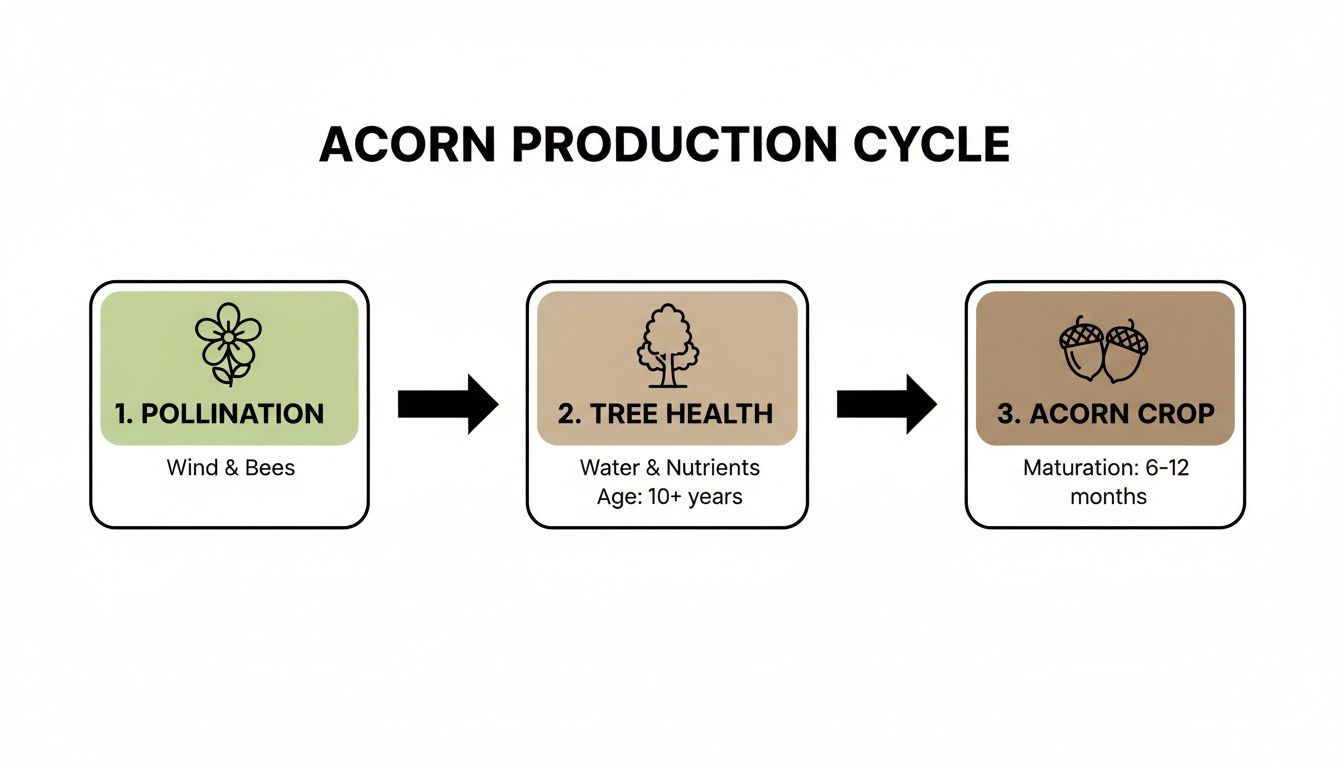
As you can see, a strong, healthy tree—often maintained through proper pruning—is a prerequisite for successful pollination and a robust acorn harvest.
Why Timing Is Everything
Let me be blunt: pruning an oak tree during its active growing season (spring and summer) is a huge risk in Georgia. Fresh cuts release sap that attracts the tiny beetles responsible for spreading oak wilt, a devastating and often fatal fungal disease. That risk is highest from early spring through mid-summer.
By waiting until the tree is fully dormant in late fall and winter, you drastically reduce this threat. The tree isn't actively transporting water and nutrients, sap flow is minimal, and the disease-carrying insects are inactive in the cold. Understanding this is a critical part of proper acorn tree care. For a deeper dive, you can explore detailed guides on the https://richmondtree.com/best-time-to-prune-trees/ to make sure you're protecting your oaks.
Preparing Your Oak For Winter Storms
Winter in North Georgia can bring some truly unpredictable weather, including ice storms and high winds that can wreak havoc on large trees. Dormant season pruning is your absolute best defense. An arborist can spot and mitigate risks before a storm ever hits.
This proactive approach involves looking for specific red flags:
- Large Dead Branches: These are the most common culprits for storm damage, snapping easily under the weight of ice or wind.
- Cracks or Splits: Deep cracks where large limbs meet the trunk are tell-tale signs of structural weakness that need immediate attention.
- Co-dominant Stems: This is when two large stems grow together, forming a weak, V-shaped union that is extremely prone to splitting apart.
- Over-extended Limbs: Long, heavy branches that reach far out from the trunk are under immense leverage and can fail during a storm.
To prune your oaks cleanly and precisely, it helps to have the right gear. Knowing about the essential tree pruning tools will make a big difference, as clean cuts heal faster and reduce stress on the tree.
By removing these hazards, an arborist doesn't just clean up the tree; they make your property significantly safer for the winter months and beyond. It’s the most effective storm-proofing you can do for your landscape.
Knowing When to Call an Arborist
While good, proactive care can head off a lot of problems with your oak trees, some situations are just too complex or dangerous to tackle yourself. Knowing how to spot the subtle (and not-so-subtle) signs that a tree is in real trouble is one of the most important skills a homeowner can have. These are the red flags telling you it’s time to hang up the pruning shears and call a professional.
Think of it this way: you can handle a common cold on your own, but you’d see a doctor for a stubborn, high fever. It’s the same with your trees. You can manage the small stuff, but certain symptoms point to deep-seated issues that need an expert diagnosis. Ignoring them can lead to losing a priceless tree or, even worse, creating a major safety hazard on your property.
Obvious Signs of Distress
Some warnings are impossible to miss. If you see any of these clear indicators on your property in places like Cumming or Johns Creek, it’s a non-negotiable sign to get a professional assessment right away.
- Large Dead Branches: Any dead or dying branch over two inches in diameter is a serious risk. Arborists call them "widowmakers" for a reason—they are significant falling hazards.
- Fungus on the Trunk: Seeing mushrooms or other fungal bodies (often called conks) growing on the trunk or near the main roots is a sure sign of internal decay.
- Sudden Leaning: If a tree that has always stood straight suddenly starts to lean, especially after a big storm, its root system could be failing.
- Deep Cracks or Splits: Large cracks running down the trunk or major limbs seriously compromise the tree's structural integrity, making it dangerously vulnerable to splitting apart.
These are not "wait and see" problems. Each one is an active risk to your home and family, and they all demand the trained eye and specialized equipment of a certified arborist.
Uncovering Hidden Problems
More often than not, the most serious threats to an oak are the ones you can’t easily see. They might be lurking just below the surface or masquerading as something minor. An ISA Certified Arborist is trained to see what the average homeowner misses, connecting subtle clues to diagnose complex issues before they become catastrophic.
A classic example we see all the time is girdling roots. These are roots that, instead of spreading outward, grow in a circle right around the base of the trunk. Over the years, they tighten like a tourniquet, slowly strangling the tree by cutting off the flow of water and nutrients. The symptoms you see above ground—maybe a thinning canopy or fewer acorns—can look like a dozen other things, but an expert knows to check for the true cause at the soil line.
"A certified arborist doesn't just look at a tree; they read its history. From the color of its leaves to the structure of its roots, every detail tells a story about its health. Our job is to interpret that story and write a healthy next chapter."
Fixing these kinds of issues is delicate work. Correcting girdling roots, for example, often involves careful excavation with specialized tools like an air spade to remove the offending root without damaging the tree’s essential support system.
The Value of an Expert Diagnosis
At the end of the day, the most critical step in saving a struggling tree is getting the diagnosis right. Misidentifying a problem leads to the wrong treatment, which wastes your time and money while the tree just gets sicker. For instance, bacterial leaf scorch can look a lot like simple drought stress to the untrained eye, but the treatments are completely different.
This is where a professional, scientific approach is invaluable. Even something as simple as acorn production is now analyzed with precision. US Forest Service scientists, for example, validated the Percentage Bearing Acorns (PBA) method to reliably track crop fluctuations. It just goes to show why expert oversight is key; a certified arborist can assess the underlying health factors, like those hidden girdling roots that strangle a tree, which directly impact things like acorn production. You can read more on the science of predicting acorn crop size from the US Forest Service.
When you’re facing a complex tree issue, don’t guess. Bringing in an expert ensures you get the right diagnosis and the most effective game plan. If you think your oak is showing signs of deep-seated trouble, you can learn more about what a certified arborist in the Atlanta area can do to help.
Common Questions About Oak Tree Care
When you’re looking after the big, beautiful oaks on your property, a little bit of know-how can make all the difference. Homeowners across the Atlanta area, from Cumming to Marietta, often run into the same questions about what’s normal, what’s a red flag, and when to act.
Here are some straightforward answers to the questions we get asked the most. Think of this as a quick guide to help you make confident decisions for your trees, keeping them healthy and strong for decades to come.
Are All These Acorns in My Yard a Bad Sign?
Nine times out of ten, it’s actually a great sign! A massive acorn drop usually means you have a healthy, mature oak in what’s called a "masting" year. It's a natural boom-and-bust cycle trees use to outsmart squirrels and other critters, ensuring some acorns survive to sprout.
The only time you might need to worry is if this huge acorn crop comes from a tree that also shows other signs of stress, like thinning leaves or dead branches. Sometimes, a stressed tree will put all its remaining energy into one last reproductive effort. If you're seeing other worrisome symptoms, a quick professional look can give you peace of mind.
A sudden, massive acorn crop on a tree that has looked stressed for years can sometimes be a final, desperate act of reproduction. It’s always worth paying attention to the tree’s overall health, not just its acorn production.
How Often Should I Water My Big Oak Tree in Summer?
This is a great question, and the answer surprises many folks. For a large, established oak, you probably don't need to water it at all, even in the summer heat. Its root system is massive and incredibly efficient at finding water deep underground, far beyond where your sprinkler reaches.
Your focus should really be on the younger oaks, especially any you've planted in the last 3-5 years. Their root systems aren't established yet. During those dry summer spells, they'll thank you for a deep, slow watering every 7-14 days.
- Best Practice: Don't just spray it with a hose. Instead, use a soaker hose spiraled around the tree's base, starting a foot or so away from the trunk and extending out to the edge of its canopy.
- Goal: The aim is to moisten the soil deeply, not just wet the surface. This encourages the roots to grow down deep, building real drought resistance for the long haul.
Can I Trim the Oak Branches Overhanging My Driveway?
It depends. If you're talking about a small, low-hanging twig you can reach from the ground with a pair of loppers, go for it. But for anything bigger, it’s a job best left to a pro. Making the wrong cut on a larger limb can do permanent damage, creating a wound that invites rot and disease right into the heart of the tree.
Even more importantly, it's a huge safety risk. Any branch more than a couple of inches thick, or anything that requires you to climb a ladder, is a clear sign to call in a professional. An ISA Certified Arborist has the training, insurance, and proper gear to do the job safely and correctly—protecting both you and your tree.
What Is the Green Powder on My Oak Leaves in Spring?
If you're seeing a yellowish-green dust coating your car, your porch, and pretty much everything else, you're looking at oak pollen. It comes from the tree's male flowers, called catkins, and it’s a perfectly normal part of an oak's spring cycle. A nuisance for allergy sufferers, but harmless to the tree.
But if what you're seeing is a white, powdery film that sticks around into the summer, that’s likely powdery mildew. It's a common fungus here in our humid Georgia climate. The best way to manage it is by improving air circulation with professional, structural pruning. Knowing the difference is key to proper oak tree care.
When you need professional, reliable guidance for your oak trees, trust the team with deep roots in Georgia. Richmond Tree Experts GA has provided expert arborist services to homeowners in Cumming, Johns Creek, and across the Atlanta metro area since 1985. Contact us today for a consultation.
Learn more about our tree care services at https://richmondtree.com.
Need a tree taken down safely? Richmond Tree Experts has worked on Marietta and Metro Atlanta trees since 1985, and every job is looked at by an ISA Certified Arborist before it is priced. Start with tree removal, or see everything we do: tree removal, stump grinding and arborist services across Cobb, Fulton, Cherokee, Gwinnett and DeKalb counties (service areas).
Call (770) 974-3964, 7am to 11pm every day, or request an estimate online.

