

That sinking feeling you get when you see a storm-damaged tree leaning a bit too close to your house? That’s your intuition telling you something important. Finding the best tree company near me isn’t about chasing the lowest bid; it’s about finding a certified, insured, and reputable team that can protect your property from a potential catastrophe.
Choosing the right experts means you’re prioritizing safety and genuine expertise over a quick, cheap fix that could cost you dearly down the road.
Why Hiring the Right Tree Service Is Crucial
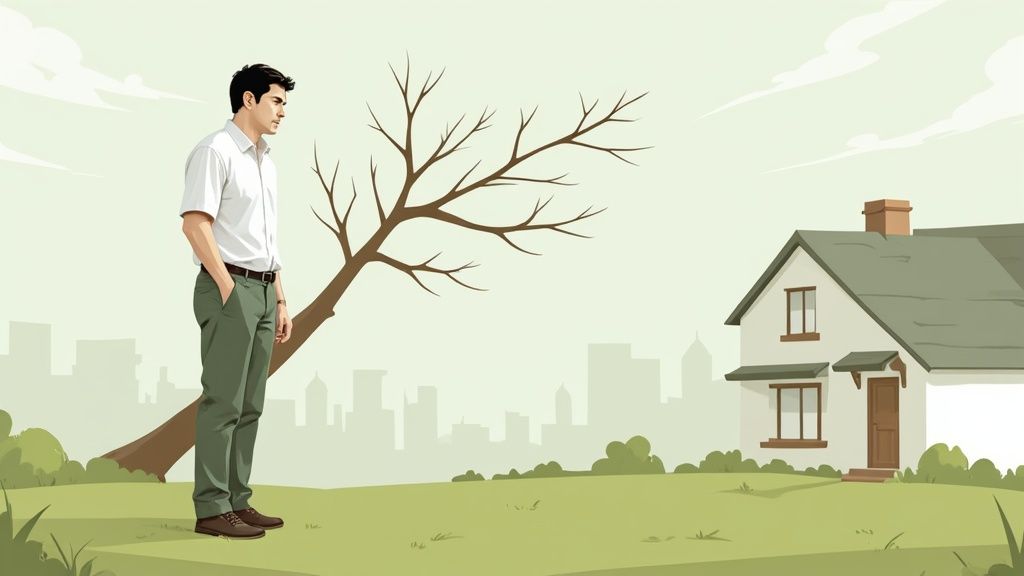
It’s incredibly tempting to just focus on the cost, but let me tell you, hiring the wrong tree service can lead to disastrous consequences that make any initial savings completely worthless.
Think of it this way: you aren’t just paying to have a branch removed. You’re investing in the protection of your most valuable asset—your home. An unqualified crew can cause thousands in property damage, from a crushed roof to a flattened fence, in the blink of an eye.
This guide is your roadmap to move beyond simple price shopping. I’ll walk you through how to spot a true professional who will protect your property, prioritize safety, and preserve the value of your landscape.
What’s Really at Stake
The risks that come with shoddy tree work are no joke. A poorly executed job can leave you with a lot more than just a messy yard.
Just consider a few of the potential outcomes:
- Property Damage: Incorrect cutting techniques can send massive limbs crashing down on your house, car, or landscaping. It happens more often than you’d think.
- Personal Injury: Tree work is one of the most dangerous jobs out there. If an uninsured worker gets hurt on your property, you could be facing a personal lawsuit.
- Long-Term Tree Health: An amateur might use harmful shortcuts like “topping,” which can permanently mutilate or even kill a beautiful, mature tree that took decades to grow.
Hiring a certified arborist is really all about risk management. You’re entrusting someone with a task that, if done wrong, has severe financial and safety implications.
By following the steps in this guide, you’ll learn how to confidently vet local companies. You’ll be able to choose a team that is qualified, insured, and reputable—so you can solve your tree problem without accidentally creating a bunch of new, more expensive ones.
Verifying Credentials and Insurance
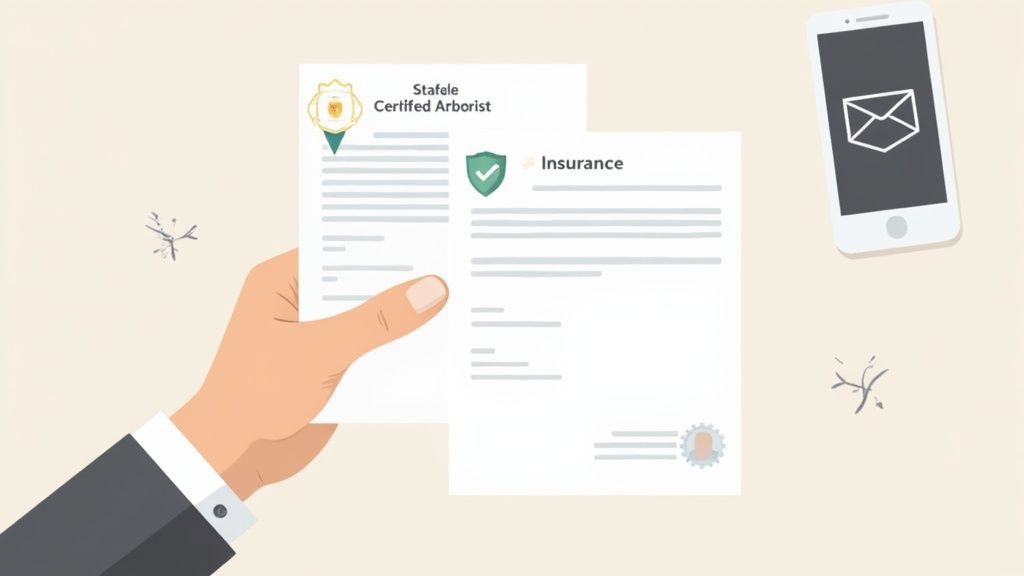
Before you start talking price or schedule, there are a few non-negotiables you need to get out of the way. Think of it like this: you wouldn’t let someone perform surgery without a medical license, so why let an unqualified crew operate chainsaws around your home?
Skipping this verification step is a huge gamble. The right credentials are your only real protection against accidents, property damage, and the kind of lawsuits that can turn into a financial nightmare.
The tree trimming industry in the U.S. is massive, valued at around $39.5 billion. That number shows just how much demand there is for professional work, but it also means the market is flooded with operators. Your job is to weed out the risky ones from the true professionals.
The Gold Standard: ISA Certification
Let’s be clear: not all qualifications are created equal. A basic business license just means they paid a fee to the city; it says absolutely nothing about their skill in tree care.
The one credential you should always, always look for is an ISA (International Society of Arboriculture) Certified Arborist.
This isn’t just a certificate they print online. It’s proof that an arborist has passed a comprehensive exam covering everything from tree biology to complex rigging and safety protocols. It shows a genuine commitment to their craft and to staying current with the best practices in the industry. Any reputable company will also have their act together with things like efficient scheduling practices, which tells you a lot about their overall professionalism.
Here’s a classic horror story we hear all the time: A homeowner hires an uninsured crew for a cheap “cash-only” deal. A worker falls, gets seriously hurt, and because the company has no workers’ comp, the homeowner’s insurance is now on the hook for all the medical bills. It’s a devastating—and completely avoidable—situation.
To help you keep track of what to ask for, here’s a quick checklist.
Essential Credentials Checklist
This table breaks down the key qualifications you need to verify before hiring any tree service.
| Credential | What It Means | Why It’s Critical |
|---|---|---|
| ISA Certification | The arborist has proven expertise in tree health, safety, and care through a rigorous exam. | Guarantees you’re getting expert advice and work, not just a “guy with a chainsaw.” |
| General Liability | Insurance that covers any damage their work might cause to your property (roof, fence, etc.). | Protects you from having to pay for repairs if an accident happens during the job. |
| Workers’ Comp | Insurance that covers the company’s employees if they are injured while working on your property. | Shields you from being held personally liable for medical bills and lost wages. |
Treat this checklist as your first line of defense. A professional company will have all this information ready and will be happy to provide it.
Insurance Is Your Safety Net
If certification is about skill, insurance is about protection. A legitimate, professional tree service will carry two critical types of coverage and should provide proof without you even having to push for it.
- General Liability Insurance: This is what pays for repairs if a limb crashes through your garage roof or takes out your prized Japanese maple. Without it, you’d be footing that bill yourself.
- Workers’ Compensation Insurance: This one is the big one. It protects the company’s crew members if they get hurt. If they don’t have it, you could be held liable for an injured worker’s medical bills and lost wages if the accident happens on your property.
Don’t just take their word for it. Ask for a current certificate of insurance for both policies, and have it sent to you directly from their insurance provider. This ensures the policy is active.
For a more detailed breakdown, you can read our guide on essential tree service insurance requirements. Taking a few minutes to verify these things upfront gives you peace of mind and saves you from massive potential risk down the road.
What to Look For During the On-Site Estimate
Once you’ve sorted out the essentials like insurance and certifications, the real test begins: the on-site consultation. This is your chance to see who you’re really dealing with. You can quickly tell the difference between a genuine arborist and someone who just owns a chainsaw.
A true professional doesn’t just walk up, eye the tree, and throw a number at you. They approach it like a doctor making a diagnosis. They’ll want to know the tree’s history, look for subtle signs of disease or structural weakness, and take in the entire surrounding area to map out the safest game plan.
Their Process Tells You Everything
That first meeting is a window into their entire operation. If they seem rushed or vague, that’s a massive red flag. It often points to inexperience or, worse, a company that cuts corners.
Here’s what a top-notch consultation should look like:
- They Ask Smart Questions: A pro will want to know your goals. Are you worried about a branch over the house? Are you trying to save the tree? Or is it purely about aesthetics?
- They Talk Safety First: They should be the ones pointing out the power lines, the fence, your neighbor’s shed, or anything else that could be a risk. More importantly, they’ll tell you exactly how they plan to work around those obstacles.
- They Give You a Clear Plan: You shouldn’t just hear, “We’ll take it down.” A real expert will walk you through their strategy, explaining the specific rigging and cutting techniques they’ll use to dismantle the tree piece by piece, ensuring nothing comes crashing down on your property.
This kind of detailed planning is what separates the best tree company near me from the rest. It shows they value safety and precision over just getting the job done fast.
A seasoned arborist will lay out a detailed strategy to protect your home, your yard, and their crew. If a company just says, “Yeah, we can get that done Tuesday,” without discussing the how, you should cross them off your list immediately.
A Quick Look at Their Gear
Finally, take a glance at their equipment. Professional-grade tools aren’t just for looks—they’re non-negotiable for safety and getting the job done right. A crew that pulls up in a beat-up pickup with a ladder and one chainsaw isn’t prepared for anything remotely complex or dangerous.
You want to see the signs of a serious, well-invested operation. Look for a bucket truck (also called a cherry picker), a powerful wood chipper to handle the debris, and proper personal protective equipment (PPE) for every crew member. That means helmets, harnesses, and specialized climbing gear. This investment in their tools is a direct reflection of their commitment to safety and quality.
How to Get and Compare Written Estimates
Let’s be blunt: a vague, verbal quote for tree work is a major red flag. A price scribbled on the back of a business card won’t protect you and it certainly doesn’t guarantee quality. To make a smart, informed decision, you need to get a minimum of three detailed, itemized estimates in writing.
This isn’t just about shopping around for the lowest price; it’s about getting total clarity on what you’re paying for. A professional quote is essentially a preliminary contract. It forces the company to think through every step of your project, from the first cut to the final cleanup, leaving no room for those dreaded “surprises” on the final bill.
The arboriculture market is growing fast—it’s expected to hit nearly USD 655.3 million by 2033. This means more and more companies are jumping into the business. Detailed estimates are your best tool for separating the seasoned pros from the newcomers who might cut corners.
This infographic breaks down what a professional arborist is looking at during a consultation, and these are the details that should be reflected in your written estimate.
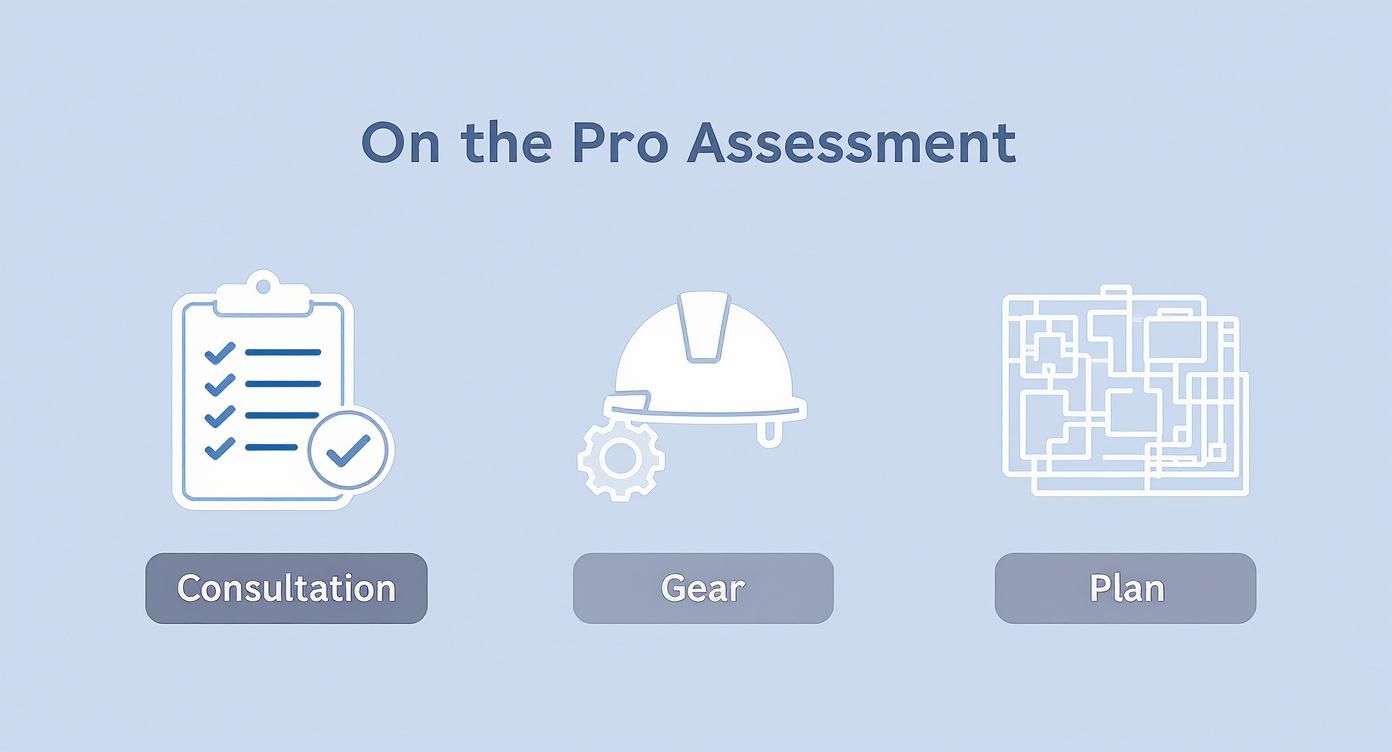
As you can see, a proper estimate isn’t just a number. It’s the result of a thorough on-site evaluation, careful equipment planning, and a clear project strategy.
What to Look for in a Quote
A solid estimate lets you compare apples to apples. If one quote comes in suspiciously low, it’s often a sign that critical services are missing or, even worse, that the company is skimping on proper insurance.
Here’s what every single written estimate should include, no exceptions:
- Specific Tasks: The language should be crystal clear. Look for “Removal of one 60-foot dead oak tree” instead of vague terms like “tree work.”
- Debris Removal: Does the price cover chipping and hauling away all wood and branches? Some outfits will charge extra for this, so make sure it’s specified.
- Stump Grinding: This is almost always a separate line item. If you want that stump gone, you need to see it explicitly included in the quote.
- Property Protection: The document should mention how they plan to protect your property, like using protective mats to avoid tearing up your lawn.
A vague quote leaves you vulnerable to hidden fees and incomplete work. A detailed, itemized estimate is a sign of a transparent and professional company you can trust.
When you have these detailed documents side-by-side, your choice becomes much easier. You’ll quickly spot which company offers the most comprehensive service for the money. For a deeper dive into how these services are priced, check out our guide on the cost to remove a large tree.
Digging Into Reputations and Real Customer Reviews
A company’s online footprint tells a story, and you need to know how to read between the lines. When you’re hunting for the best tree company near me, don’t just glance at the star rating and move on. You need to dive deeper into the actual comments people leave on Google, Yelp, and even the Better Business Bureau.
Look for patterns. Are you seeing multiple customers rave about the crew’s professionalism, how they showed up on time, and left the yard cleaner than they found it? Those are huge green flags. It shows they have a consistent, reliable process.
On the flip side, a pattern of complaints is a serious warning sign. If you see repeated comments about hidden fees, damaged sprinklers, or a crew that disappeared without finishing the job, you should probably run the other way, no matter how cheap their quote is.
Going Beyond the Screen
While online feedback is a great starting point, nothing beats a real conversation. Any company that’s truly confident in its work won’t hesitate when you ask for local references.
Pro Tip: Don’t just ask for references—ask for ones from recent jobs they did right in your neighborhood. Speaking directly with a past customer gives you an unfiltered perspective that you just can’t get from an online review.
This gives you a chance to ask specific, pointed questions about their experience. The tree services market is a massive industry, valued globally at an estimated USD 1.3 billion in 2024, which means there are a lot of players out there. Taking this extra step ensures your money is well spent.
And don’t stop at the big-name sites. You can also explore customer feedback on goodkudos to get an even broader picture of a company’s track record. Blending solid online research with a few real-world conversations is the best way to find a team you can trust and get total peace of mind before you sign anything.
Making Your Final Decision with Confidence
You’ve done the legwork. The credentials check out, you have a few itemized quotes lined up, and you’ve gotten a feel for each company’s reputation. Now it’s time to pull all that research together and make the final call. This isn’t just about picking the cheapest quote; it’s about choosing the right long-term partner to keep your property safe and your trees healthy.
Before you put pen to paper, give that written contract one last, thorough review. Does it line up perfectly with what you discussed during the on-site visit? Make sure every detail is there—from the exact trees being worked on to the specific cleanup methods. If you asked for stump grinding, double-check that it’s explicitly included.
The Final Gut Check
Beyond the paperwork and pricing, take a moment to trust your intuition. How did the company’s arborist or sales rep make you feel? A true professional, the kind you’d expect from the best tree company near me, will be patient with your questions, knowledgeable, and respectful of your home from the first phone call. They should communicate clearly and never make you feel pressured.
If a company’s communication has been consistently clear, professional, and transparent throughout the entire process, it’s a strong indicator of how they’ll perform once the work begins.
Ultimately, your choice should boil down to a balance of three critical things:
- Qualifications: They must have that ISA certification and be fully insured. No exceptions.
- Clarity: The written estimate needs to be detailed, transparent, and easy to understand.
- Professionalism: Their communication and on-site behavior should make you feel completely at ease.
When you find a company that hits all three of these marks, you can sign that contract feeling good about your decision.
Still Have a Few Questions?
Even after you’ve done your homework and narrowed down your choices, a few lingering questions almost always come up. This is perfectly normal. Getting these last details ironed out is what separates a decent experience from a great one, giving you total confidence before the crew ever shows up.
Let’s start with the big one: cost. The price for tree work can be all over the map, and for good reason. It all comes down to the tree’s size, where it’s located, and how much risk is involved. Removing a small, easily accessible tree in your front yard might only be a few hundred dollars. But that giant, dying oak leaning precariously over your house? That’s a complex, dangerous job that could easily run into the thousands. This is exactly why you need multiple, detailed estimates.
Do I Need a Permit to Remove a Tree?
This is a huge one, and the answer is: it depends entirely on where you live. Many cities and counties, especially in places like Alpharetta and Roswell, have specific tree ordinances designed to protect mature or “heritage” trees.
Any truly professional, local company will be an expert on these regulations. They should know instantly if your project requires a permit and either handle the process for you or walk you through exactly what needs to be done.
Don’t just take a company’s word for it if they casually say, “Oh, you don’t need a permit,” especially for a large, established tree. A quick phone call to your city or county planning department is all it takes to avoid thousands of dollars in fines. Verifying this is just as critical as confirming their tree removal insurance coverage before any work starts.
Finally, people often ask about the difference between pruning and “topping.” It’s a simple distinction. Proper pruning, performed by an ISA Certified Arborist, is a science that improves a tree’s health, safety, and structure. Topping, on the other hand, is an outdated and incredibly harmful practice that essentially butchers the tree, creating long-term weakness and future hazards. A real expert will never suggest topping a tree; they’ll always recommend selective pruning for its health.
When you need certified arborists who put your property’s safety and your peace of mind first, trust the team at Richmond Tree Experts GA. For professional tree care in Cumming, Johns Creek, Milton, and the surrounding areas, contact us for a free estimate.
Need a tree taken down safely? Richmond Tree Experts has worked on Marietta and Metro Atlanta trees since 1985, and every job is looked at by an ISA Certified Arborist before it is priced. Start with tree removal, or see everything we do: tree removal, stump grinding and arborist services across Cobb, Fulton, Cherokee, Gwinnett and DeKalb counties (service areas).
Call (770) 974-3964, 7am to 11pm every day, or request an estimate online.

