

If you've ever bought firewood, you've probably heard the term "cord." But what exactly does that mean? Is it just a fancy name for a big pile of wood?
Not at all. A cord of firewood is a legally defined, standardized unit of measurement, just like a gallon or a pound. It was created to make sure everyone—from the seller to the buyer—is talking about the same amount of wood. Without it, you’d just be guessing how much fuel you're actually getting.
When you buy a full cord, you should be getting a tightly stacked pile of wood that measures 128 cubic feet in volume. The classic image is a stack that is 4 feet high, 4 feet deep, and 8 feet long. Think of it as a guarantee of volume. It doesn't matter how the wood is delivered; a cord is always a promise of 128 cubic feet of fuel.
Full Cord Versus Other Common Terms
Here’s where things can get a little tricky. While a "full cord" is the official standard, you'll run into other terms that can trip you up if you aren't paying attention. The most common one you’ll see in the Atlanta area is the "face cord," which also goes by the name "rick."
Don't let the names fool you—they are not the same thing. Knowing the difference is your best defense against accidentally paying for a lot less wood than you thought you were getting.
A face cord sounds like a lot, but it’s only a fraction of a full cord. Let’s break it down:
- Full Cord: This is the big one. It measures 4 feet high by 8 feet long by 4 feet deep. The total volume is always 128 cubic feet.
- Face Cord (or Rick): This one measures 4 feet high by 8 feet long, but the depth is only the length of a single log. That's typically 16 inches (or about 1.33 feet).
A face cord contains only about one-third of the wood of a full cord. If a supplier offers you a "cord" at a price that seems too good to be true, it’s time to ask a clarifying question: "Is that a full cord or a face cord?"
This isn't just a minor detail; it's critical for planning how much wood you'll need to get through the winter. It takes roughly three face cords to equal one full cord. Always, always confirm the exact dimensions and total cubic footage with your firewood supplier before you hand over any money.
Visualizing Firewood Measurements
Sometimes, seeing the numbers side-by-side is the best way to make sense of it all. This quick comparison table should help you visualize exactly what you’re buying and avoid any confusion at the woodpile.
Firewood Measurements at a Glance
| Measurement | Dimensions (H x W x L) | Total Volume (Cubic Feet) |
|---|---|---|
| Full Cord | 4 ft x 4 ft x 8 ft | 128 cu. ft. |
| Face Cord (16" logs) | 4 ft x 1.33 ft x 8 ft | Approx. 42.5 cu. ft. |
| Half Cord | 4 ft x 4 ft x 4 ft | 64 cu. ft. |
As you can see, the difference is huge. A full cord is a serious amount of wood, designed to provide a substantial fuel supply. By getting comfortable with these terms and dimensions, you can compare prices accurately and make sure you get exactly what you pay for every single time.
How to Properly Measure and Stack Firewood
When a truck pulls up and dumps a giant pile of firewood in your driveway, it can look pretty impressive. But let's be honest, a loose, scattered pile doesn't tell you much about how much wood you actually got. If you want to verify you received a full cord of firewood, you'll have to do a little hands-on work—that means stacking and measuring it the right way.
Stacking isn't just about making your woodpile look tidy for the neighbors. It’s the only way to get a true measurement. The whole point is to pack the logs together tightly and minimize the air gaps. A properly stacked cord is dense, stable, and easy to measure, which guarantees you’re not just paying for a bunch of empty space.
The Foundation of an Accurate Measurement
Before you even think about pulling out the tape measure, you need a well-built stack. The best technique is to create solid ends to support the rest of the wood, almost like bookends for your firewood pile.
- Start with a level surface. Find a spot on the ground that's relatively flat. Trying to build a stable stack on a slope is a recipe for disaster.
- Create sturdy end posts. At each end of where you plan to build the stack, place two logs parallel to each other. Then, lay the next layer on top in the opposite direction, creating a crisscross or "tic-tac-toe" pattern. Keep building these towers up to your desired height.
- Fill in the middle. Now, just place your firewood snugly between these two end towers. Keep the logs parallel and pack them as tightly as you can. It helps to mix in different log sizes to fill any major gaps.
This method gives you a sturdy, self-supporting structure and, more importantly, squeezes out a lot of those air pockets. A loosely thrown pile can easily fool you into thinking you have more wood than you really do.
Calculating the Volume of Your Firewood Stack
Once your wood is stacked up nice and neat, the measurement part is actually pretty simple. All you need is a tape measure and a little basic multiplication.
The formula for calculating the volume of your woodpile is straightforward:
Height (in feet) x Width (in feet) x Length (in feet) = Total Cubic Feet
Let's walk through a real-world example. Imagine you've stacked the wood from your delivery, and the pile measures 4 feet high, 4 feet wide (that's the depth from front to back), and 8 feet long.
Using the formula, the math looks like this:
4 ft (H) x 4 ft (W) x 8 ft (L) = 128 cubic feet
And there you have it—a full cord of firewood! If your final number is a lot less than 128 cubic feet, then you didn't get what you paid for. This simple check gives you the confidence to have a clear, factual conversation with your supplier.
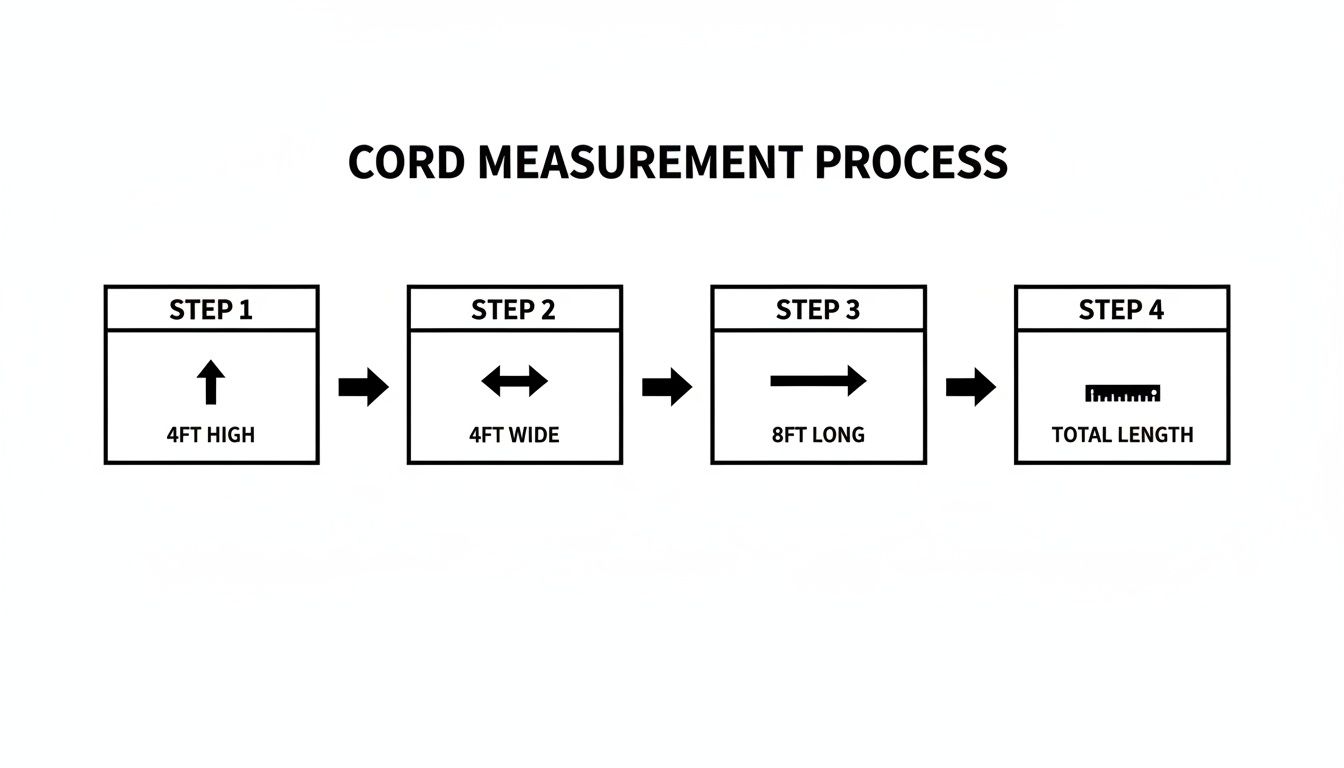
The key takeaway is that you have to measure all three dimensions—height, width, and length—to get the true volume.
Common Stacking Mistakes to Avoid
A dishonest or even just an inexperienced seller might stack wood in a way that puffs up its appearance. Keep an eye out for these common tricks that make a delivery look much bigger than it is:
- Excessive Crisscrossing: While crisscrossing is great for the end posts, some people will crisscross wood through the entire pile. This creates huge, unavoidable air gaps that dramatically cut down on the actual amount of wood.
- Leaving Large Gaps: Wood that’s just haphazardly tossed into a pile without any care for tightness will always look bigger. Make sure the logs are nestled closely together.
- Using Round Logs as Fillers: Big, round, unsplit logs take up a ton of space but give you less burnable wood and create massive air pockets around them. A good delivery should be mostly split, manageable pieces.
By knowing how to stack and measure your wood properly, you can confidently verify every delivery. It’s the final step to make sure you get every cubic foot of that cord of firewood you bought.
Estimating Your Firewood Needs for a Georgia Winter
Okay, so you can now confidently size up a cord of firewood. The next big question is, how much do you actually need? Getting this right is key. Buy too little, and you'll be scrambling for more wood in the middle of winter, which is never fun. Buy too much, and you're dealing with storage headaches and wasted cash.
Ultimately, the perfect amount comes down to how you plan to use it. A mild Georgia winter is a far cry from a brutal northern one, but that doesn't mean you won't get plenty of mileage out of your fireplace or wood stove. It’s all about matching your supply to your lifestyle.
What’s Your Firewood Usage Profile?
Think about which of these common categories you fall into. Are you just looking for the cozy vibe of a few weekend fires, or are you counting on that wood to make a real dent in your heating bills?
- The Occasional User: If your main goal is to light a fire on a chilly Friday night or during holiday get-togethers in your Alpharetta home, you won’t need a massive stack. A half-cord (64 cubic feet) is usually the sweet spot here, giving you more than enough fuel for a whole season of casual, relaxing fires.
- The Supplemental Heater: A lot of folks in places like East Cobb use their fireplace or wood stove to keep the main living area warm, letting them dial back the central thermostat. If this sounds like you, you’ll probably want one to two full cords to get you comfortably through the colder stretch from November to February.
- The Primary Heat Source: Live in a more rural part of Cherokee or Forsyth County? If you’re relying on a high-efficiency wood stove as your main heat source, your needs are going to be a lot higher. For this kind of heavy lifting, you should plan on needing anywhere from two to four full cords to stay toasty all winter.
It's always a smart move to have a little extra wood left over in the spring than to run out during an unexpected January cold snap. Any surplus just becomes the start of next year's seasoned supply.
Figuring out your usage pattern is the first and most critical step to making a smart purchase.
Key Factors That Influence How Much You'll Burn
Beyond your general habits, a few other things can seriously change how fast you go through your woodpile. You could have two homes with the exact same fireplace but completely different firewood needs because of these factors.
Your home’s insulation and draftiness make a huge difference. An older, less insulated house loses heat like a sieve, meaning you'll have to burn more wood just to keep things comfortable. On the other hand, newer, well-sealed homes hold onto that warmth way more efficiently.
The efficiency of your fireplace or wood stove is also a game-changer. A modern, EPA-certified wood stove can wring out over 75% of the wood's heat energy and put it into your room. A traditional open-hearth fireplace? It might lose up to 90% of its heat right up the chimney. That difference alone can easily double or triple how much wood you go through.
This focus on efficiency is part of a bigger picture. The global firewood market is growing, with some projections showing it could hit USD 1,611.10 million by 2032. This trend reflects a shift as homeowners in Atlanta and beyond start to recognize the real value of sustainable and efficient heating. You can read more about the growth of the firewood market for more details.
By taking an honest look at your home's efficiency and your burning habits, you can stop guessing and start making an informed estimate. It's a practical approach that ensures you'll have just the right amount of wood to keep your home warm and cozy all winter long.
Navigating Firewood Prices and Delivery in Atlanta
So, you’ve figured out how much wood you’ll need. The next big step is tracking down a quality supplier in the Atlanta area. You'll quickly find that the price for a cord of firewood isn't a simple, flat number—it can swing quite a bit depending on a few key factors. Knowing what goes into that final price will help you snag the best deal without skimping on quality.
It’s a lot like buying produce at the farmer's market. The type of wood, how it's prepared, and what services are bundled in all shape the cost. A pile of freshly cut, mixed wood is going to be cheaper than a perfectly seasoned stack of premium oak that’s delivered and neatly arranged right by your back door.
Factors That Shape Firewood Costs
Several moving parts come into play when you get a quote for a cord. Across metro Atlanta, from Marietta to Johns Creek, prices shift based on exactly what you're buying.
- Wood Type: This is the big one. Premium hardwoods like oak and hickory are the gold standard. They're dense, burn hot, and last a long time, so they naturally command a higher price. A mixed cord, which might have softer hardwoods like poplar or sweetgum, will be more budget-friendly.
- Seasoning Level: You’ll always pay more for fully seasoned, ready-to-burn wood compared to "green" or semi-seasoned logs. That extra cost covers the time, space, and effort the supplier put into properly drying the wood so it burns clean and hot.
- Delivery Fees: Most sellers will deliver for free within a certain radius. But if you're a bit further out in Forsyth or Cherokee County, you might see a small surcharge to cover the extra gas and drive time.
- Stacking Services: Getting a cord of wood dumped in your driveway is one thing. Having it neatly stacked and ready to go is a huge time-saver. Most suppliers offer stacking for an extra fee, usually somewhere between $50 and $100 per cord.
The firewood market has a lot of regional quirks. North America is a top consumer, and here in Georgia, our abundant oak and hickory trees make the hardwood segment the top choice for home heating. It's also worth noting that online channels have become a really common way for folks to buy their wood these days. You can discover more insights about the firewood market to see how things are trending.
Typical Firewood Prices in Metro Atlanta
To give you a ballpark idea of what to expect, let's break down some average price ranges you'll see around the Atlanta area. Just remember, these are estimates. Prices can definitely fluctuate with supply, demand, and the specific vendor you choose.
Pro Tip: Your first question should always be whether the price is for a full 128-cubic-foot cord. Some sellers use a low price to advertise a "cord," but what they're really selling is a smaller face cord or rick.
Here’s a general rundown of what you can expect to pay for a full cord delivered in counties like Cobb, Gwinnett, and Fulton.
Estimated Firewood Costs in Metro Atlanta
This table gives a snapshot of typical pricing for firewood and related services in our area.
| Service/Product | Typical Price Range (Full Cord) |
|---|---|
| Mixed Hardwoods (Seasoned) | $300 – $400 |
| Premium Oak/Hickory (Seasoned) | $400 – $550 |
| Delivery Fee (if outside range) | $25 – $75 |
| Stacking Service (optional) | $50 – $100 |
Keep in mind that these services often come from the same companies that handle other tree care needs. For example, cleaning up after a storm is a common job, and it helps to know what that might cost. You can learn more by checking out our guide on Atlanta brush removal costs.
Key Questions to Ask Your Firewood Supplier
Before you pull the trigger, make sure you’re armed with a few smart questions. Any reputable seller will be happy to give you straight answers. Getting this sorted out upfront can save you a world of frustration.
- Is this a full cord (128 cubic feet)? This is non-negotiable. Always start here to make sure you're both on the same page.
- What type of wood is included? Find out if it’s all oak, a mix of hardwoods, or something else entirely.
- Is the wood fully seasoned and ready to burn now? A good supplier can tell you exactly how long the wood has been split and dried.
- What is your delivery fee to my address? Get confirmation on any travel charges before you finalize the order.
- Is stacking included, or is it an extra charge? Never assume stacking is part of the deal.
By asking these simple questions, you can make sure there are no surprises. You'll end up with the right amount of quality wood at a fair price, all set to keep you warm through the winter.
The Importance of Seasoned Firewood and Proper Storage
You’ve measured your space, found a great local supplier, and now a beautiful cord of firewood is sitting in your yard. Before you even think about loading it into your fireplace, there’s one critical detail that makes the difference between a roaring fire and a smoky, frustrating mess. That all-important detail is seasoning.
So, why won't freshly cut "green" wood burn well? Think of it like trying to light a wet sponge—it’s just not going to work. Freshly cut wood is saturated with water, which can make up over 50% of its total weight. When you try to burn it, a huge amount of energy gets wasted just boiling off that internal moisture before the wood can produce any real heat.
Understanding Seasoned Firewood
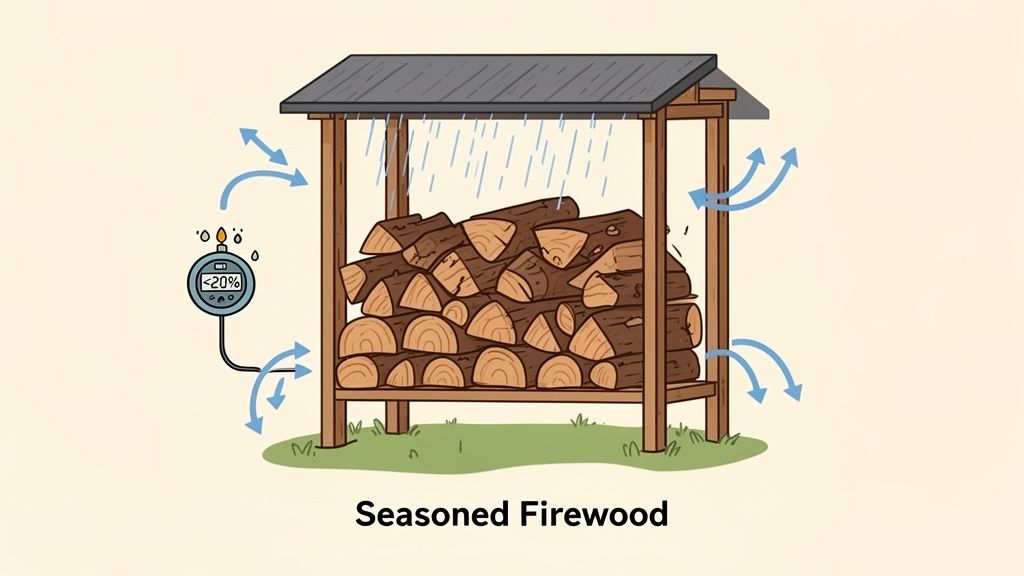
Seasoned firewood is simply wood that’s been left out to dry for a good while, usually somewhere between six and twelve months. The whole point is to get its moisture content down below 20%. This drying process completely transforms how the wood performs in your fireplace.
Properly seasoned wood is far more efficient. Because the fire isn't fighting to evaporate water, it burns hotter, cleaner, and gives off way more heat to warm your home. That efficiency matters more now than ever.
Fuelwood represents a massive chunk of the global timber harvest, playing a huge role in the worldwide energy economy. In fact, fuelwood and charcoal recently accounted for around 1.9 billion cubic meters of timber use annually, a number that's expected to climb. This makes it crucial to get the most out of every cord of firewood through proper seasoning. You can learn more about global timber consumption trends to see the bigger picture.
The Dangers of Burning Unseasoned Wood
Beyond just being a waste of good wood, burning wet logs is a really bad idea for your chimney and your family’s safety. When unseasoned wood smolders at low temperatures, it releases a nasty cocktail of unburned particles that form a dark, tar-like gunk called creosote.
Creosote is highly flammable and is the number one cause of chimney fires. A thick buildup can ignite from a single stray spark, leading to a dangerous and potentially devastating fire inside your chimney. Clean-burning, seasoned wood drastically reduces this risk.
How to Properly Store Your Cord of Firewood
Once that wood is delivered, storing it correctly is just as important as the seasoning process itself. The goal is simple: protect it from rain and snow while letting air circulate freely. An improperly stored woodpile can soak up moisture from the ground and rain, completely undoing all the time it spent drying out.
Here are the three golden rules for storing your firewood:
- Elevate It: Never stack your wood directly on the ground. Use a firewood rack, old pallets, or even just a couple of 2x4s to create a platform. This keeps the bottom layer off the damp earth, preventing rot and letting air flow underneath.
- Cover the Top: Use a tarp or a purpose-built firewood cover to shield the top of the stack from the elements. Just make sure the cover only drapes over the top—don't wrap it all the way down the sides.
- Leave the Sides Open: This is the step most people forget. You have to leave the sides of your stack exposed to the air. This constant airflow is what allows the wood to continue drying and stay seasoned. A fully wrapped pile just traps moisture, creating a perfect environment for mold and decay.
Following these storage tips ensures that your investment in a cord of firewood pays off with warm, efficient, and safe fires all winter long. Proper storage also helps keep pests away, which can be an unwelcome side effect of a damp, neglected woodpile. For other backyard maintenance tips, like what to do with a stubborn tree stump, check out our guide on how to properly burn a tree stump.
Sourcing Quality Firewood from a Local Tree Service
Now that you can measure, estimate, and properly store your wood, the final piece of the puzzle is finding a trustworthy source. You could scroll through countless online ads, but one of the best and most reliable options is often right under your nose: your local professional tree service.
Think about it for a second. A tree service works with wood every single day. They aren't just resellers trying to make a quick buck; they're hands-on experts who understand the entire lifecycle of a tree, from its health while standing to its value as premium fuel. This direct connection to the source is what sets them apart.
The Arborist Advantage
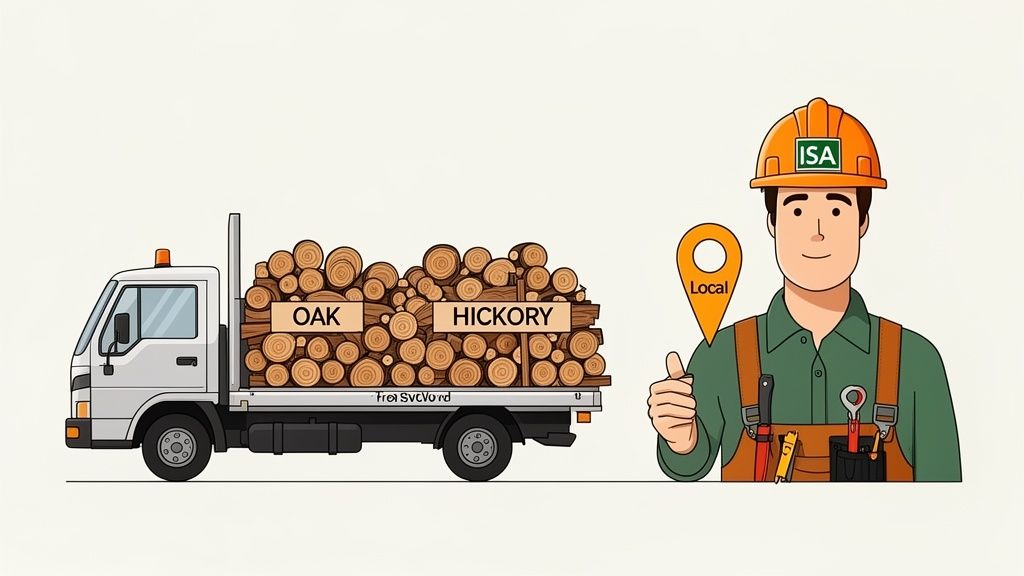
When you buy a cord of firewood from a reputable tree care company, you're getting a product sourced directly from local tree removal and pruning jobs. This isn't just a sustainable choice—it’s a quality guarantee. An experienced arborist knows exactly which trees make the best firewood.
During their daily work in areas like Roswell and Marietta, they identify and remove trees that are often prime hardwoods. An old oak that needs to come down for safety reasons is the perfect candidate for becoming high-quality, long-burning firewood.
A professional tree service reframes tree removal. It's not just about disposal; it's about responsibly repurposing a valuable natural resource. The logs from a single large oak can provide a substantial portion of a full cord.
This process ensures your firewood is sourced from healthy, local trees, not from some questionable, far-off woodlot.
What to Expect from a Tree Service Supplier
Beyond the quality of the wood itself, working with a tree service brings a level of professionalism and expertise to the whole transaction. They understand the nuances of wood species and the importance of proper seasoning because their reputation literally depends on it.
- Expert Wood Identification: They can tell you exactly what you're getting. An expert can easily distinguish dense oak and hickory from less desirable species, ensuring you get the high-BTU fuel you paid for.
- Knowledge of Seasoning: They understand the entire drying process and can confidently tell you whether a batch of wood is ready to burn efficiently and safely in your home.
- Sustainable Sourcing: You know your firewood comes from trees in your own community, which cuts down on the environmental impact of long-distance transportation.
When you buy from a tree care provider, you're not just getting wood; you’re connecting with an expert who can answer your questions with real authority. To truly appreciate the difference, it helps to understand what an ISA Certified Arborist brings to every job, from routine trimming to supplying your winter fuel. That expertise guarantees a better product and a more reliable buying experience from the ground up.
Common Questions About Buying and Using Firewood
Even after you've got the basics down, a few questions always seem to come up when buying firewood. Getting solid answers can be the difference between a decent woodpile and a great one that keeps you warm all winter. We’ve pulled together some of the most common questions to help you feel totally confident with your next firewood purchase.
And this isn't just about heating your home. For those who love cooking outdoors, knowing the right wood is also key for the best BBQ fire pits and smokers.
How Long Will a Cord of Firewood Actually Last?
This is the big one, and the honest answer is: it really depends on how you burn it. Your personal habits are the biggest factor in how fast you’ll work through a stack of wood.
Let’s break it down into a few typical scenarios:
- For Occasional Fires: If you're mostly lighting the fireplace for cozy weekends or holiday get-togethers, a full cord of firewood can easily get you through an entire winter, maybe even two.
- For Supplemental Heat: Using a fireplace or wood stove to keep the main living area toasty and give the furnace a break? A cord will probably last you 6 to 10 weeks during the coldest stretch of a Georgia winter.
- As a Primary Heat Source: If your wood stove is your home's main source of heat, you'll obviously go through wood much faster. In this case, expect a cord to last about a month, give or take, depending on your home's insulation and how efficient your stove is.
Think of it like gas mileage in a car—it all comes down to how you drive.
What’s the Best Type of Wood to Burn in Georgia?
We're lucky here in Georgia to have plenty of excellent hardwoods, which are exactly what you want for firewood. Dense hardwoods are always the best choice because they burn hotter and longer, all while producing less smoke.
Your top picks in our area are:
- Oak: Many consider oak the king of firewood. It's dense, burns incredibly hot, and leaves a great bed of long-lasting coals.
- Hickory: Another premium firewood, hickory actually burns hotter than oak and gives off that classic, pleasant aroma everyone loves.
- Maple: This is another solid hardwood that gives off great, steady heat and burns cleanly.
Now, what about softwoods like pine? Pine has its uses—it’s fantastic as kindling to get a fire roaring quickly. But it shouldn't be your main fuel because it burns up fast and produces more creosote, that sticky, flammable gunk that can build up in your chimney. For the main fire, stick with hardwoods.
Can I Burn Wood from a Tree I Had Removed?
Absolutely! In fact, this is one of the smartest and most sustainable ways to get your firewood. If you're having a tree taken down on your property, it's the perfect time to stock up for winter.
Using a removed tree for firewood is a great way to recycle a natural resource right in your own backyard. Nothing goes to waste, and you get a truly local, cost-effective source of heat.
Just have a quick chat with your tree service provider before they get to work. They can tell you if the tree species is good for burning and can often cut the logs into fireplace-ready lengths for you as part of the removal service.
At Richmond Tree Experts GA, we don't just care for living trees—we help you make responsible use of every part of them. If you have a tree that needs to be removed in the Atlanta area, we can turn it into high-quality firewood for your home. Contact us today to learn more about our complete tree care services.
Need a tree taken down safely? Richmond Tree Experts has worked on Marietta and Metro Atlanta trees since 1985, and every job is looked at by an ISA Certified Arborist before it is priced. Start with tree removal, or see everything we do: tree removal, stump grinding and arborist services across Cobb, Fulton, Cherokee, Gwinnett and DeKalb counties (service areas).
Call (770) 974-3964, 7am to 11pm every day, or request an estimate online.

