

Properly pruning a crepe myrtle is the single most important thing you can do for its health, beauty, and long-term stability. This guide will walk you through the right way to care for these iconic Southern trees, ensuring they thrive for years to come in your Marietta landscape. If you're seeing weak branches or poor blooms, don't wait for the next storm. Call Richmond Tree Experts for a free pruning estimate today.
Why Proper Pruning Is So Important for Marietta Crepe Myrtles
If you’ve driven through East Cobb or the surrounding Cobb County communities, you’ve definitely seen it: the unfortunate result of what we call 'crape murder.' This aggressive, harmful practice involves hacking crepe myrtles back to thick, ugly stubs. For homeowners from Marietta to Woodstock, understanding why this method is so damaging is the first step toward having healthy, beautiful trees that can withstand Georgia's storm season.
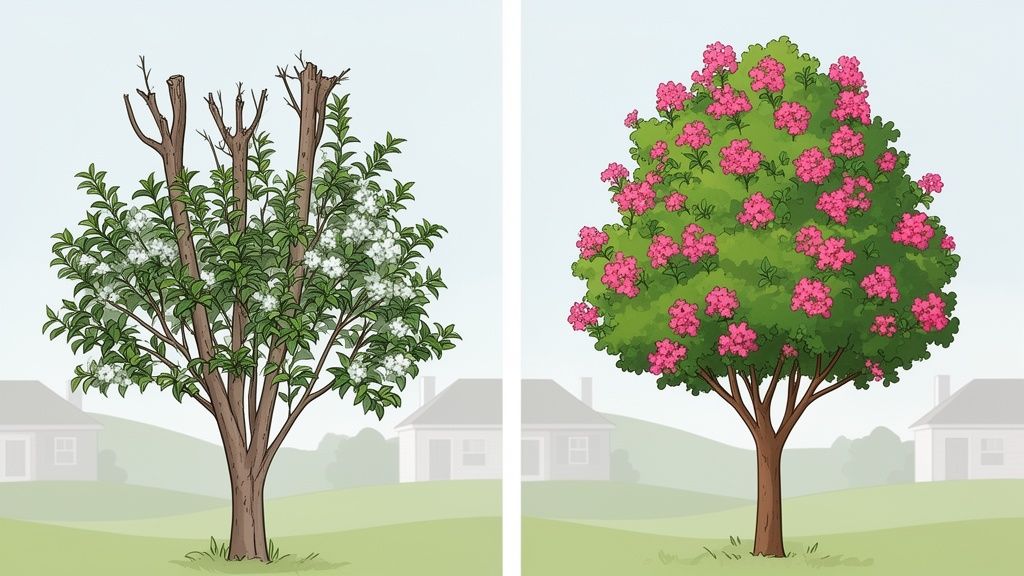
This kind of aggressive chopping doesn't just look bad; it fundamentally weakens the tree. It forces the plant to send up a cluster of weak, spindly shoots from the cut, which are poorly attached and prone to breaking off. These flimsy new branches simply can't support the weight of heavy summer blooms, especially after a classic Metro Atlanta thunderstorm rolls through and leaves them snapped and broken.
The Problem with 'Crape Murder' in Marietta
The term 'crape murder' really isn't an exaggeration—it perfectly describes the destructive outcome of this widespread pruning mistake common in Marietta. Far from helping, this technique creates a host of long-term problems. The large, blunt wounds it leaves behind are wide-open doors for pests and diseases, which can seriously compromise the tree's health over time, especially in our humid Georgia climate.
This bad habit all stems from a major misconception: the idea that crepe myrtles need to be cut back severely to bloom. That’s just plain wrong. According to the experts at the University of Georgia, the practice leads to weak growth and makes trees more vulnerable to pests. In East Cobb and across Cobb County, we see once-graceful trees turned into gnarled, knobby poles all the time. You can learn more about this destructive practice from the UGA College of Agricultural and Environmental Sciences.
Promoting Health and Preventing Storm Damage in Marietta
Correct pruning is really about promoting the tree’s health, not just shaping it for looks. In our humid Georgia climate, getting good airflow through the canopy is one of the most critical things you can do to prevent common fungal diseases and strengthen the tree against wind.
Here’s why doing it the right way matters so much for your Marietta property:
- Disease Prevention: Thinning out crowded branches dramatically improves air circulation. This is the best defense against powdery mildew, a frequent headache for crepe myrtles in Marietta, Roswell, and Acworth.
- Structural Integrity: Selective pruning encourages strong, well-spaced branches that can handle high winds and heavy rain from summer thunderstorms. This greatly reduces the risk of limbs falling on your property, a common issue in East Cobb.
- Abundant Blooms: A properly pruned crepe myrtle actually produces larger, more impressive flower clusters on strong, new wood, which is exactly what you want for amazing curb appeal.
- Longevity: By avoiding large wounds and encouraging a natural shape, you protect the tree from stress and disease, extending its life for decades.
As seasoned arborists serving Cobb County, we know that proper pruning is an investment. It protects your property, enhances its value, and ensures your landscape's most vibrant trees remain a source of beauty, not a liability. Don’t wait for a storm to reveal a weak tree structure.
The Right Time to Prune Crepe Myrtles in Marietta
Timing is everything with crepe myrtles, especially here in the Metro Atlanta climate. Get it wrong, and you could be looking at a summer with disappointing blooms. For homeowners all across Marietta and East Cobb, knowing when to pick up the pruners is just as critical as knowing how to make the cut.
The sweet spot for pruning crepe myrtles in our area is during the dormant season. We’re specifically talking about late winter, from about mid-February into early March. The tree isn't actively growing, which means it’s far less prone to stress or disease from the cuts. Plus, with the branches completely bare, you get a clear look at the tree's natural shape, making it much easier to make smart, effective cuts.
The Risks of Pruning at the Wrong Time in Georgia
We see a lot of well-intentioned but poorly timed pruning from Kennesaw to Smyrna, and it almost always comes down to two big mistakes.
Cutting too early in winter—say, back in December or January—is a huge gamble. If you prune and then we get one of our classic late-season cold snaps, any new growth spurred by those cuts can get zapped by the frost. This really sets the tree back and leaves it weak heading into spring.
On the flip side, waiting too long is just as bad. Crepe myrtles bloom on new wood, which is the growth that shoots out in the spring. If you start pruning after that new growth appears, you are quite literally snipping off this summer's flowers. This is one of the most common reasons we’re called out to properties in Roswell and Vinings to figure out why a tree isn't blooming.
The key takeaway for any homeowner in Cobb County is simple: patience pays off. Wait until the last real threat of a hard freeze is gone, but get the job done before the leaf buds start to swell. That’s the perfect window for a healthy, bloom-heavy crepe myrtle.
Your Seasonal Pruning Calendar for Marietta
To make it dead simple, here’s a quick guide for what to do—and what not to do—with your crepe myrtles throughout the year. This applies whether you're in a Marietta subdivision or have a larger property in the North Atlanta suburbs.
Seasonal Crepe Myrtle Pruning Calendar for Marietta GA
| Season | Pruning Action for Marietta & East Cobb | Reasoning |
|---|---|---|
| Winter (Late Feb – Early Mar) | This is your prime pruning season. Make all structural cuts. Remove dead, crossing, or weak branches. | The tree is dormant, reducing stress and sap loss. The branch structure is fully visible, allowing for precise cuts. |
| Spring (Late Mar – May) | Avoid all major pruning. You can snip off any suckers that pop up at the base of the tree. | The tree is actively pushing out the new growth that will carry this year's blooms. Pruning now will sacrifice flowers. |
| Summer (Jun – Aug) | Light deadheading only. Snip off spent flower clusters to potentially encourage a second, smaller bloom. | Major pruning can stress the tree in the summer heat. Deadheading sends energy to new flowers instead of seed pods. |
| Fall (Sep – Nov) | Do not prune. Let the tree wind down and prepare for dormancy on its own. | Pruning in the fall can trigger a late spurt of growth that won't have time to harden off before the first frost. |
Following this calendar will keep you on the right track for maintaining beautiful, healthy trees.
Proper timing is a cornerstone of good tree care. If you want to dive deeper into the best seasons for different kinds of tree work, you can learn more about the best time to prune trees in our comprehensive guide. This is the kind of expert advice that ensures you're helping, not hurting, your landscape's most valuable assets.
Your Essential Toolkit for Pruning Crepe Myrtles Safely
Using the right tools for pruning your crepe myrtle isn’t just about making the job faster; it's about the health of your tree and, most importantly, your own safety. In our work across Cobb County, from Marietta to East Cobb, we’ve seen countless trees struggling because of damage from dull or improper tools.
A clean, precise cut is the key to helping your tree heal quickly and ward off disease. Before you even think about the first snip, let’s make sure you have the right equipment ready to go.
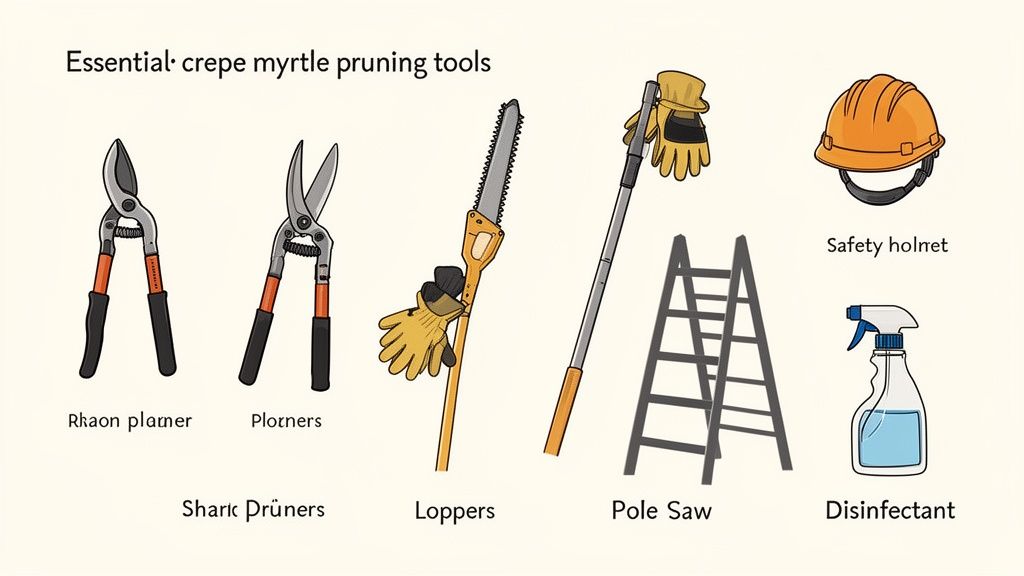
For most homeowners with younger, manageable crepe myrtles, a few key pieces will get the job done right. The most important thing? Make sure every blade is sharp. Dull blades crush and tear branches, creating ragged wounds that are an open invitation for pests and fungus, especially in the Georgia clay soil where roots can be stressed.
The Right Tools for Clean Cuts
A small investment in quality tools pays for itself many times over in the long-term health of your trees. Forget the one-size-fits-all approach. Different branches need different tools to get that clean, healthy cut.
Here's what your core pruning toolkit should look like:
- Bypass Hand Pruners: These are your workhorse for any small branches up to about a half-inch in diameter. Their scissor-like action makes a clean slice that heals fast. Perfect for detail work and snipping off small suckers.
- Bypass Loppers: When you get to branches between a half-inch and 1.5 inches thick, you’ll need the extra leverage from a good pair of loppers. The long handles give you the power to cut through thicker wood without a struggle, avoiding a messy, damaging cut.
- Pole Saw or Pruner: To safely reach higher branches without pulling out a ladder, a pole saw is a must-have. This tool lets you thin the upper canopy while your feet are firmly on the ground—which is always the safest place to be.
Professional Tip: Always keep your blades sanitized. We carry a simple spray bottle with isopropyl alcohol or a 10% bleach solution. Wiping down your blades between cuts, and especially when moving from one tree to another, is a critical habit. It prevents the spread of invisible diseases like powdery mildew from one Marietta yard to the next.
Safety First When Pruning in Marietta
Now we get to the most important part of this guide: knowing your limits. While pruning a small crepe myrtle can be a satisfying weekend project, there are very clear lines where a DIY job becomes dangerous. The risks involved with tree work are serious, and your safety is never worth the gamble.
We strongly urge homeowners in Powder Springs, Vinings, and across Cobb County to call a professional for any of these situations:
- Working Near Power Lines: This is a non-negotiable red line. The risk of electrocution is severe and life-threatening. Our crews are specially trained and equipped to work safely around utility lines in Marietta and East Cobb neighborhoods.
- Using a Ladder for Pruning: If you can't reach a branch from the ground with a pole saw, don't get on a ladder with a cutting tool. The combination of an unstable ladder, reaching, and operating a saw is a recipe for a terrible accident.
- Removing Large Branches: Any limb thicker than a few inches in diameter is a serious hazard. These branches are incredibly heavy and can fall unpredictably, causing severe injury or property damage. We use specialized rigging to lower large limbs with complete control.
- Dealing with a Diseased or Unstable Tree: If your crepe myrtle looks weak, shows signs of disease, or seems structurally unsound, you need a certified arborist to assess it before anyone starts cutting.
For homeowners in Marietta and East Cobb, making the call to a professional is the smartest, safest move when any of these conditions apply. At Richmond Tree Experts, we have the experience, training, and equipment to handle these hazardous jobs safely and correctly. Request a free estimate for your tree service needs near me.
How to Prune for a Healthy Natural Shape in Marietta
Alright, you’ve got your tools cleaned and ready. The next step is to start thinking less like a landscaper with a hedge trimmer and more like a tree surgeon. Proper pruning isn't about following a rigid set of steps; it's about making deliberate, selective cuts that guide the tree toward its natural form and ensure its health for years.
For the gorgeous crepe myrtles that are a staple in landscapes across Marietta and East Cobb, our goal is always a strong, open, vase-like shape. This is the exact opposite of the dreaded "crape murder." Our approach is all about promoting long-term health, not just lopping off the top. Let's walk through the same process we use, whether we’re shaping a new tree in Smyrna or carefully thinning a decades-old specimen in a Roswell garden.
Start with the Three Ds
Before you even think about shaping the tree, your first job is cleanup. We call this pruning for tree hygiene, and it's the foundation for every other cut you'll make. The rule is simple: remove anything that is Dead, Damaged, or Diseased.
- Dead Wood: These branches are easy to spot. They’ll be brittle, often a pale or gray color, and will snap without much effort. They do nothing for the tree and can be an open door for pests.
- Damaged Wood: Look for any limbs that are cracked, split, or broken. These are often casualties from past storms, and they create weak points that are a hazard, especially during the high winds we can get in Cobb County.
- Diseased Wood: Any branch with signs of fungus, ugly cankers, or strange discoloration needs to go. This helps stop the problem from spreading. Always remember to wipe your pruning tools with alcohol after cutting out diseased wood.
Just getting this first pass done will instantly make the tree look better and be healthier. You'll probably be surprised how much clearer your next moves become once the "Three Ds" are gone.
Target Problem Branches Next
With the obvious junk out of the way, you can now focus on the tree's overall structure. This is where you start correcting bad growth habits and preventing future issues. You're trying to create good airflow and light penetration, directing the tree's energy into the branches you want to keep.
Here’s what to look for:
- Suckers: Those thin, whip-like shoots popping up from the base of the trunk or the nearby roots are just robbing the main tree of energy. Cut them off completely flush with the trunk or the ground.
- Crossing or Rubbing Branches: Find any branches that are growing into each other. That constant friction creates wounds that are an open invitation for decay and disease. Of the two, always remove the weaker or more poorly placed branch.
- Inward-Growing Branches: A healthy tree grows up and out. Any branch that decides to turn back and grow into the center of the tree is only going to create a crowded mess, blocking light and air.
Pruning this way is as much about what you decide to leave as what you take away. Every single cut should have a clear purpose—improving health, strengthening the structure, or simply showing off the tree's natural beauty.
Shaping Young vs Mature Crepe Myrtles in Cobb County
How you prune depends a lot on the age of the tree. A young tree needs guidance to build a solid framework, while a mature tree mostly needs thinning to stay vibrant.
For Young Trees (1-3 years old):
The primary goal here is to establish a strong "scaffold" of main trunks. Crepe myrtles look their best with an odd number of trunks—usually three, five, or seven.
Pick the strongest, most evenly spaced trunks to be your keepers and cut the rest off right at the ground. From there, start removing the small side branches from your chosen trunks, clearing them up to a height of about four or five feet. This is what gives you that classic, elegant shape and shows off the beautiful bark.
For Mature Trees in East Cobb:
Mature crepe myrtles, like the ones you see in established neighborhoods from Kennesaw to Acworth, tend to get dense and overcrowded. For these trees, the work is all about thinning.
Your mission is to selectively remove whole branches to open up the canopy. This allows sunlight and air to get into the middle of the tree, which is absolutely critical for fighting off powdery mildew in our humid Georgia summers. It also helps the tree produce flowers all over, not just on the very tips. Never just snip the end of a branch; trace it all the way back to where it connects to a larger limb or the trunk and remove it cleanly.
When you design an outdoor living space, a beautifully pruned tree isn't just a plant—it's a living sculpture. Taking this thoughtful approach ensures your crepe myrtles in Marietta will be a stunning, healthy asset to your property for many years.
How to Fix a Previously 'Crape Murdered' Tree in Marietta
It’s a sight we see all too often on properties from Marietta to East Cobb: crepe myrtles that have been victims of “crape murder” year after year. The result is always a sad one—thick, ugly knuckles at the top of the main trunks that erupt in a weak, broom-like spray of skinny branches every spring.
If you’ve inherited a tree like this, don't despair. These trees are tougher than they look, and you can bring them back. It’s not a one-and-done fix, though. This is a multi-year recovery mission, a process of corrective pruning to undo the damage and restore the tree’s natural, elegant shape.
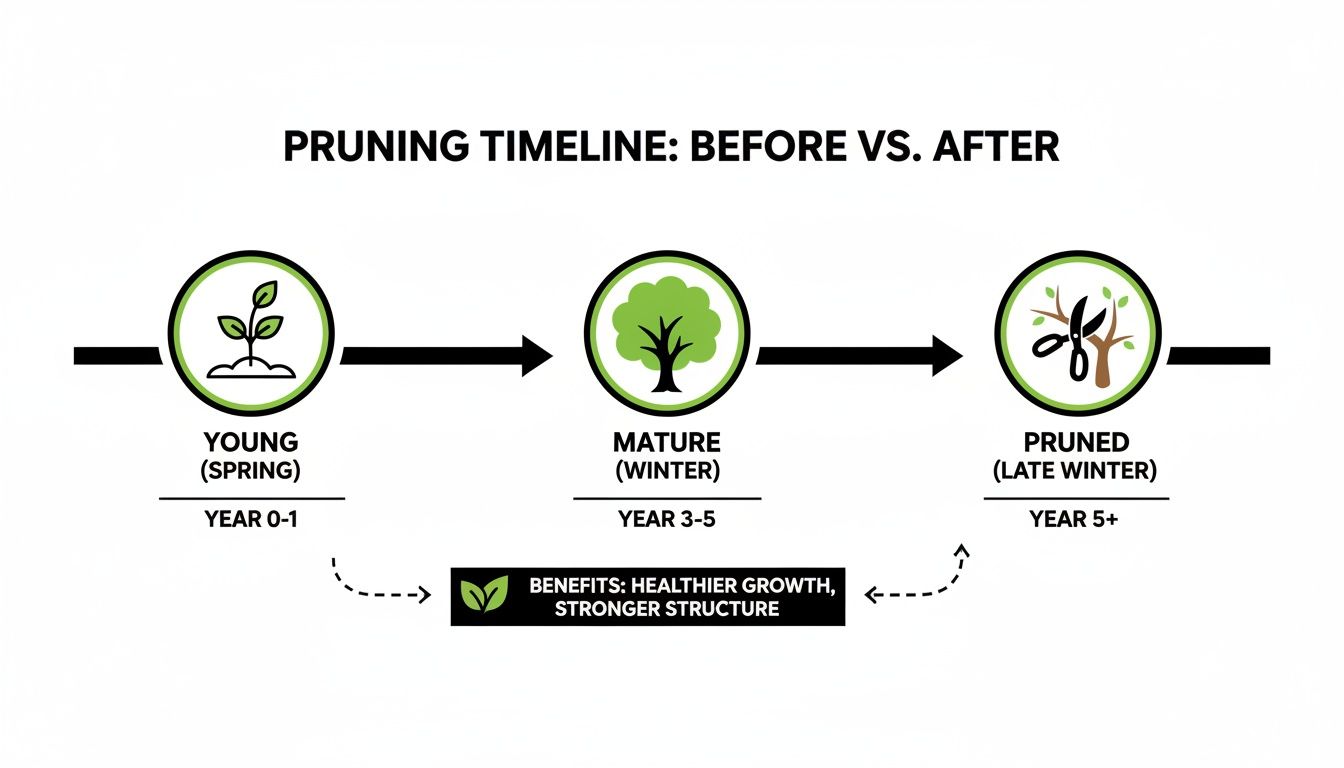
Think of it as hitting the reset button. Over a few seasons, you'll guide the tree back to a strong, healthy structure. This corrective work is a specialty of our team at Richmond Tree Experts.
The First-Year Turnaround
Your first dormant season is all about making some tough choices to establish new leaders. That topped tree is going to push out dozens of new shoots from each knuckle. Your job is to pick the winners that will become the tree’s new main branches.
Here's the game plan:
- Find the Strongest Shoots: Look at the cluster of new growth on each main trunk. You’re searching for the thickest ones that are growing up and out in a good, open direction.
- Pick Your Champions: On each trunk, select just one or two of the most vigorous, well-placed shoots to keep. These are the foundation for the new canopy.
- Cut Everything Else: Now for the hard part. Prune away every other spindly shoot, cutting them off clean and flush with the knuckle.
The tree will look pretty bare after this first major cut. But what you've really done is focus all its energy into the branches that matter, setting the stage for a real comeback.
The Following Years: A Patient Restoration
Years two and three are about refining that new framework and slowly erasing the evidence of past topping. We’re playing the long game here to avoid shocking the tree. Aggressive cuts are what caused the problem in the first place, and you can see exactly why in our guide on what tree topping really does to your trees.
During the second winter, you'll want to thin out the new growth on your chosen leaders. Get rid of any branches that are crossing, rubbing, or pointing back toward the center of the tree. This helps build a strong, open structure. If the tree is growing strong, you may also be able to cut off one or two of the old, gnarled stubs.
Bringing a "crape murdered" tree back to life is one of the most rewarding parts of our job. It's a testament to how resilient these plants are and what good arboriculture can do. You have to see the tree for what it can be. We tackle this exact challenge for folks in Acworth and Woodstock all the time.
By the third winter, you can usually remove the last of the old knuckles. The main branches you picked back in year one should now be the dominant, established structure. From here on out, you can switch to the simple, selective pruning a healthy crepe myrtle deserves.
This kind of restorative work takes a practiced eye. If you’re looking at a severely butchered tree in your Marietta yard and feeling overwhelmed, giving a professional a call is the surest way to guarantee a beautiful result.
Why Choose Richmond Tree Experts for Your Marietta Tree Service
When it comes to the health and safety of your trees, you need a team you can trust. For homeowners, HOA communities, and commercial property managers in Marietta and East Cobb, that means choosing a crew with real-world experience handling local tree risks, not just a landscaping company that happens to own a chainsaw.
Let’s be clear: we’re not landscapers. We are skilled, safety-obsessed tree professionals who specialize in tree removal and pruning.
Our team at Richmond Tree Experts knows the unique headaches that come with tree work in Cobb County. We have the right equipment and decades of experience to navigate the tight property lines of subdivisions from Kennesaw to Smyrna. We’re the team that gets called for large-scale pruning jobs on community properties in Roswell and Acworth or to safely handle dangerous limbs hanging over power lines after a storm.
Local Expertise and Professional Standards in Marietta
Choosing Richmond Tree Experts is about more than just getting a job done; it's about partnering with a local, seasoned company that’s committed to doing things the right way. We bring a level of professionalism and arboricultural knowledge that sets us apart. Our crews are trained to work safely and efficiently, protecting what matters most—your home, your family, and your property value.
We’re the people you call to fix what others broke. We specialize in:
- Corrective Pruning: We can undo the damage from years of "crape murder" and finally restore the beautiful, natural form of your trees.
- Hazard Assessment: We’re trained to spot the weak limbs and structural problems that look innocent now but could become a disaster during the next big storm.
- HOA Compliance: Our team is familiar with the aesthetic and safety standards required by many local community associations in East Cobb and Marietta.
- Large-Scale Projects: We have the manpower and equipment to manage the extensive tree care needs of commercial properties and entire subdivisions across the Metro Atlanta area.
Trusting your trees to an unqualified crew isn't just a gamble—it’s a real risk to your property's value and safety. We’ve been serving this community for decades, providing the kind of expertise homeowners in Woodstock and Powder Springs rely on for their peace of mind.
This commitment to professional standards is everything to us. It's why we always stress the importance of working with qualified experts. To see for yourself what that expertise really means for your property, take a look at our guide on the role of a certified arborist in our detailed guide.
For professional pruning and all your other tree service needs in Marietta, East Cobb, and the surrounding areas, call Richmond Tree Experts for a free estimate.
Frequently Asked Questions About Pruning Crepe Myrtles in Marietta
For homeowners and property managers throughout Marietta and East Cobb, understanding the proper care for crepe myrtles is essential to maintaining a beautiful landscape. To address common concerns, we have gathered answers to the most frequent inquiries we receive from local residents. This information is designed to provide clear, actionable guidance for ensuring your trees remain healthy and vibrant in the North Georgia climate.
How much does professional pruning cost in Marietta GA?
The cost for professional crepe myrtle pruning in Marietta depends on the tree's size, its current condition, and the level of corrective work needed. A small tree may be inexpensive, but a large, mature tree in East Cobb that has been "crape murdered" for years will require more skill and time to restore. Access on your property can also be a factor. We provide free, detailed estimates for all tree services.
Can I kill my crepe myrtle by pruning it wrong?
It's very difficult to kill a crepe myrtle by pruning, but you can ruin its structure and make it unsafe. The "crape murder" style of topping creates weak, flimsy branches that break easily in Metro Atlanta's summer storms. The large wounds also invite pests and diseases, which can weaken the tree over time, especially when combined with the stress from heavy Georgia clay soil.
What are the white powdery spots on my crepe myrtle leaves?
That is likely powdery mildew, a common fungus in Cobb County's humid climate. It thrives in poor air circulation. Proper pruning is the best defense. By thinning out the canopy, we increase airflow, making it harder for the fungus to grow. We see this often in Kennesaw and Smyrna. Planting in a spot with at least six hours of direct sun also helps prevent this issue.
Why didn't my crepe myrtle bloom this year in Marietta?
The most common reason for a crepe myrtle not blooming in Marietta is improper pruning timing. If you prune in late spring after new growth starts, you're cutting off the flower buds. Another major reason is not enough sun; these trees need full sun. Finally, too much nitrogen-rich fertilizer will give you lots of leaves but very few flowers. Our certified arborists can diagnose the exact issue.
Should I cut off the old seed pods in the fall?
No, do not prune your crepe myrtle or remove seed pods in the fall in Georgia. Pruning in autumn can trigger new growth that won't have time to harden off before the first frost, leading to cold damage. It's best to leave the tree alone after it finishes blooming and perform all structural pruning during the dormant season in late winter (February to early March).
If you have additional questions or a tree that requires professional attention, the certified arborists at Richmond Tree Experts GA possess decades of experience with crepe myrtles and other trees specific to the North Georgia landscape. For a free, no-obligation estimate for your property in Marietta, East Cobb, or the surrounding communities, call us today.
Contact Richmond Tree Experts GA for a Free Estimate
Not sure what your tree needs? Richmond Tree Experts has worked on Marietta and Metro Atlanta trees since 1985, and every job is looked at by an ISA Certified Arborist before it is priced. Start with an ISA Certified Arborist evaluation, or see everything we do: tree removal, stump grinding and arborist services across Cobb, Fulton, Cherokee, Gwinnett and DeKalb counties (service areas).
Call (770) 974-3964, 7am to 11pm every day, or request an estimate online.

