

The trees that define Marietta’s beautiful neighborhoods, from the mature hardwoods in East Cobb to the tall pines throughout Cobb County, are a defining feature of our landscape. They provide shade, character, and value to our homes. However, a failing tree can become a significant liability. It poses a direct threat to your home, your family, and nearby power lines, especially during Georgia's unpredictable storm seasons. Understanding the warning signs is not just about landscape maintenance; it is about proactive safety for your Marietta property.
For homeowners in Marietta, Kennesaw, and Smyrna, knowing how to spot a hazardous tree before it fails is critical. Heavy Georgia clay soil can mask root problems, and a seemingly healthy canopy can hide a dangerously hollow trunk. This guide provides a comprehensive list of specific, actionable signs a tree needs to be removed. We'll move beyond generic advice to give you a clear, locally-focused checklist. You will learn how to inspect your trees for everything from subtle disease indicators common in our area to significant structural damage that demands immediate attention.
Don't wait for a leaning tree to fall. If you see a potential hazard on your property, call Richmond Tree Experts now at (404) 419-5770 for a free, no-obligation estimate.
Why This Matters for Marietta Homeowners
In Marietta and East Cobb, our mature tree canopy is both an asset and a risk. Towering oaks, sweetgums, and pines that have stood for decades can fail suddenly, especially after summer thunderstorms, hurricane remnants, or winter ice. The dense Georgia clay soil can become saturated, destabilizing root systems and leading to uprooting. A single falling limb can cause thousands in damages to homes in established subdivisions, while a full tree failure can be catastrophic. Identifying a problem tree early is the most critical step you can take to protect your home and family.
1. Dead or Dying Branches
One of the most visible signs a tree needs attention is the presence of significant dead or dying branches. In East Cobb and Marietta, where mature oaks and tall pines dominate the landscape, a tree with deadwood is a serious liability. Dead branches are weak, brittle, and can break off without warning, especially during the high winds and heavy rains common to Metro Atlanta's storm season.
How to Identify Deadwood in Marietta
How can you spot dead branches on your property? Look for wood that lacks the signs of life you see elsewhere on the tree or on neighboring healthy trees.
- No Leaves in Spring: A branch that fails to produce leaves or buds during the growing season is almost certainly dead.
- Brittle and Gray Appearance: Dead wood loses its color, often appearing grayish or faded. The bark may become loose, peel away easily, or fall off completely, exposing smooth wood underneath.
- Year-Round Bareness: While all deciduous trees lose their leaves in winter, a dead branch will remain bare and lifeless even as the rest of the tree leafs out in spring.
For example, a homeowner in a Roswell subdivision might notice a large oak branch that remains bare while the rest of the canopy turns green. This is a classic indicator. Similarly, the top of a tall pine tree in Kennesaw that has turned brown and dropped all its needles signifies a dying crown, a condition that poses a significant fall risk.
Expert Insight: If more than 25-30% of a tree's canopy consists of dead branches, the tree's underlying health problem is likely severe. At this point, the entire tree’s stability is compromised, and removal is often the safest solution.
Our Process for Addressing Deadwood
Ignoring deadwood is a gamble. A falling limb can damage your roof, crush a vehicle, or cause serious injury. In densely populated areas like Marietta and Smyrna, the risk to neighboring properties is also a major concern.
If you spot dead branches, contact Richmond Tree Experts for a professional assessment. Our ISA Certified Arborists can determine the cause of the dieback—whether it's from disease, insect infestation like the pine beetle, or storm damage—and advise on the safest course of action. While minor deadwood can sometimes be pruned, attempting to remove large, heavy branches yourself is extremely dangerous. We have the proper equipment and experience to safely handle tree services in the tight-access lots common throughout Cobb County.
2. Significant Lean or Structural Damage
A tree that suddenly begins to lean or shows obvious signs of structural damage is an immediate red flag and one of the most dangerous signs a tree needs to be removed. While some trees grow with a natural, gentle lean towards sunlight, a sudden shift indicates a critical failure. In places like Marietta and East Cobb, where heavy Georgia clay soil can become saturated after intense rain, root systems can lose their grip, causing trees to become dangerously unstable. This isn't just a cosmetic issue; it's a direct threat to your property and safety.
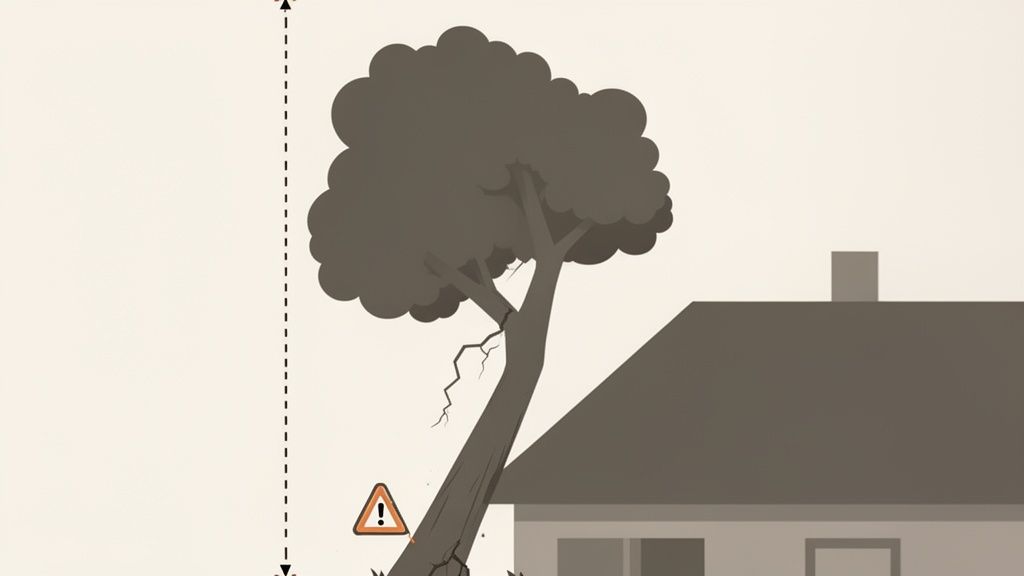
Identifying a Dangerous Lean in Cobb County
How can you distinguish a stable, natural lean from an active failure? A sudden change is the key indicator. Look for these warning signs on your property.
- Sudden Shift: A tree that was once upright and is now leaning, especially after a storm, is a top-priority hazard. A lean greater than 15-20 degrees from vertical is highly concerning.
- Exposed or Heaving Roots: Look at the base of the tree on the side opposite the lean. If you see soil mounding up or roots pulling out of the ground, the root plate has fractured, and the tree is in the process of uprooting.
- Cracks in the Trunk: Deep splits or cracks in the trunk compromise the tree’s structural integrity and can lead to catastrophic failure, particularly on a leaning tree.
For example, a tall pine in Powder Springs that starts leaning over a driveway after a week of heavy Metro Atlanta rainfall is a classic sign of root failure. Likewise, a mature hardwood in Vinings that shifts after nearby construction has damaged its root zone is at immediate risk of falling.
Expert Insight: Any tree that has started to lean suddenly is an emergency. The forces of gravity are actively working against it, and failure can occur without any further warning. This is not a "wait and see" situation; it requires immediate professional evaluation.
Our Removal Process for Unstable Trees
A leaning tree poses a clear and present danger. Its fall path can often be predicted, but the timing is impossible to know. It can fall on your home, a neighbor’s property, or a public street, creating a massive liability.
If you have a tree that is leaning or structurally damaged, call Richmond Tree Experts immediately for an emergency assessment. Our ISA Certified Arborists are trained to evaluate structural integrity and determine the level of risk. In some rare cases, corrective measures like tree cabling and bracing services might be an option, but for a tree with a compromised root system or a severe lean, removal is the only safe solution. We are equipped to handle these high-risk removals safely, even in the tight-access subdivisions found throughout East Cobb and Roswell.
3. Pest Infestation or Disease Signs
A tree under attack from pests or disease is in a battle for its life, and it's a critical sign that it may need to be removed. In Georgia's warm, humid climate, pests like bark beetles and fungal diseases like root rot can spread rapidly, turning a healthy Marietta tree into a hazard. For homeowners in Woodstock, Acworth, and across Cobb County, identifying the early signs of biological stress is key to protecting your property and other trees. When an infestation or disease becomes widespread, the damage is often irreversible.
Identifying Pest and Disease Issues in East Cobb Trees
How can you tell if your tree is sick or infested? You need to look for symptoms that indicate the tree's systems are failing. Identifying common tree diseases is a crucial step in understanding why a tree's health might be failing.
- Unusual Holes and Frass: Look for small, D-shaped holes in ash trees, a tell-tale sign of the emerald ash borer. Bark beetles leave behind tiny, round holes often accompanied by a fine, sawdust-like material called frass around the base of the tree.
- Fungal Growths: Mushrooms or shelf-like fungi growing on the trunk, at the base, or on major roots are a serious red flag. These often indicate internal rot, compromising the tree’s structural integrity from the inside out.
- Discolored or Dying Foliage: Look for leaves that are wilted, yellowing, or have dark spots during the growing season. Oak trees in Roswell and Marietta often show signs of anthracnose with blotchy, brown leaves during wet springs.
- Cankers and Oozing: Cankers are dead sections of bark on a branch or trunk, often appearing as sunken, discolored areas. Some diseases cause the tree to ooze liquid or resin, a symptom known as gummosis.
Expert Insight: If a disease like root rot is confirmed or if a pest infestation has impacted more than 40-50% of the tree's canopy, the chances of recovery are slim. At this stage, the tree is not only likely to die but also becomes dangerously unpredictable.
Our Process for Diseased Tree Removal
A diseased or infested tree is a weak tree. It’s more susceptible to breaking apart in the high winds of a Metro Atlanta thunderstorm and can spread its affliction to neighboring healthy trees, creating a wider problem in your community.
If you see these warning signs, contact Richmond Tree Experts for an expert diagnosis. Our ISA Certified Arborists are trained to identify the specific pests and diseases common to North Georgia. We can assess the extent of the damage and determine if the tree can be saved with treatment or if removal is the safest option. For a more detailed look at what could be affecting your trees, see our comprehensive tree disease identification guide.
4. Hollow Trunk or Major Cavities
A hollow trunk or the presence of large cavities is one of the most serious and high-risk signs a tree needs to be removed. These openings indicate advanced internal decay, often caused by fungal growth that took hold after an injury from storm damage or improper pruning. While trees can compartmentalize small wounds, Georgia's humid climate accelerates decay, and a large, hollow cavity signals that the tree’s structural integrity is critically weakened. For property owners in Marietta and East Cobb, a hollow tree is a silent threat that can fail suddenly.
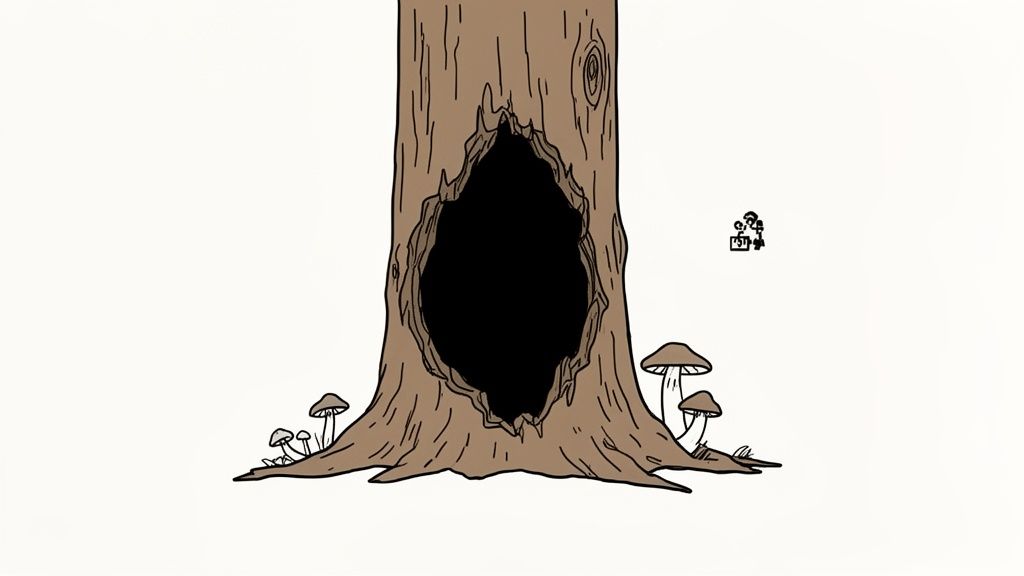
Identifying Cavities in Marietta Trees
Spotting a cavity is a clear sign to take immediate action, as the internal damage is almost always more extensive than what is visible.
- Visible Openings: Look for deep holes or large, dark hollows in the trunk or where major limbs meet the trunk.
- Fungal Growth: The appearance of mushrooms on the trunk, especially near a cavity, confirms active decay.
- Peeling Bark: Bark may peel away around the cavity, exposing rotting or soft wood underneath.
- Animal Activity: While not a direct sign of decay, cavities often become homes for animals. Their presence can alert you to the hollow.
A mature oak in an East Cobb backyard with a large cavity at its base is a prime candidate for failure. A tree that is 50% hollow has lost far more than 50% of its strength and cannot be trusted, especially with summer thunderstorms on the horizon.
Expert Insight: Never attempt to fill a tree cavity with concrete or foam. This outdated practice does not add strength, traps moisture, accelerates decay, and makes a future professional removal more dangerous and difficult.
Our Process for Removing Hollow Trees
A hollow tree is a ticking time bomb. It lacks the internal wood structure needed to support its own weight, let alone withstand the force of Metro Atlanta’s high winds. Such a tree can split apart or collapse entirely without warning, causing devastating damage to your home, vehicles, or neighboring properties in dense communities like Kennesaw and Smyrna.
If you discover a cavity in your tree, call Richmond Tree Experts immediately for an emergency assessment. Our ISA Certified Arborists have specialized tools to evaluate the extent of the internal decay. We can determine if removal is necessary and execute the work safely, even in the tight-access lots common throughout Cobb County.
5. Root Damage or Soil Heaving
The foundation of a healthy tree is its root system, and when it's compromised, the entire tree is at risk. In developing areas across Cobb County, root damage is one of the most serious and often overlooked signs a tree needs to be removed. Damaged roots cannot effectively absorb water and nutrients, and more critically, they lose their ability to anchor the tree's immense weight in our heavy Georgia clay soil.
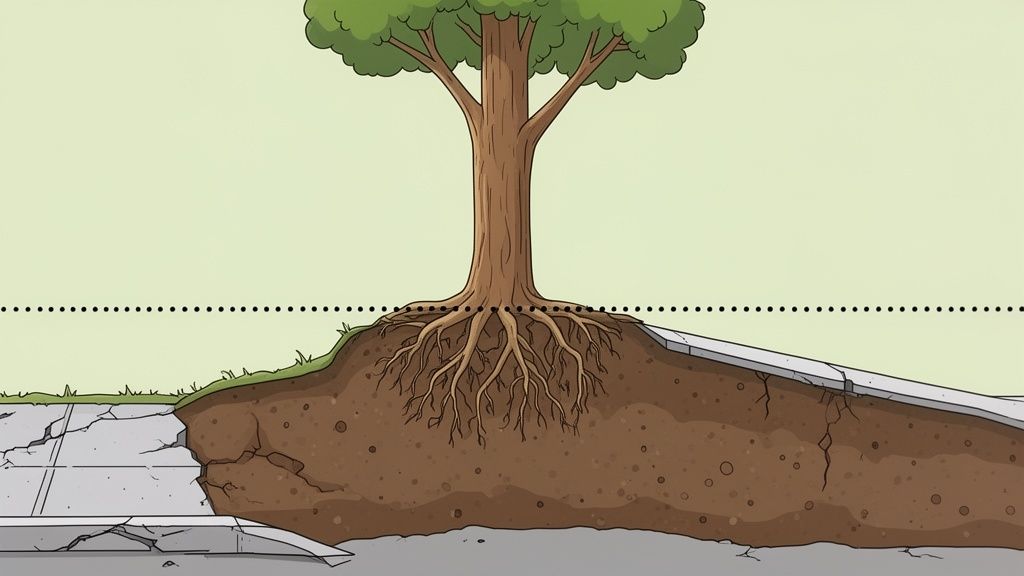
Identifying Root Issues in Your Cobb County Trees
Root problems can be subtle at first but often present clear physical evidence around the tree's base. Look for these warning signs:
- Exposed or Damaged Roots: Construction, trenching for utility lines, or even soil erosion can sever or expose major anchor roots. If you see large, frayed roots at the surface, the tree's stability is questionable.
- Soil Heaving or Mounding: The ground lifting or cracking on one side of the tree's base is a critical warning sign. This indicates the root plate is detaching from the soil and the tree is beginning to uproot.
- Fungus Growth at the Base: The appearance of mushrooms or other fungal bodies on the roots or soil at the base often points to root rot, a decay that destroys the tree's support system from below.
Expert Insight: Any sign of soil heaving around a tree's base is an emergency. It means the tree is in the process of failing. The structural integrity is gone, and the tree could fall at any moment, especially during a Metro Atlanta storm. Immediate professional assessment is non-negotiable.
Our Process for Root-Damaged Trees
A tree with a failing root system is one of the most dangerous hazards on a property. In densely populated Marietta and East Cobb neighborhoods, a falling tree can cause catastrophic damage to homes, cars, and power lines.
If you observe soil heaving, prominent new cracks in the ground, or major severed roots, call Richmond Tree Experts immediately for an emergency assessment. Our ISA Certified Arborists are trained to evaluate root system stability and determine the level of risk. Significant structural root damage is irreversible. We possess the expertise to safely execute a controlled removal, even in the tight-access lots common throughout Smyrna and Kennesaw.
6. Major Storm Damage
Few events expose a tree’s vulnerability like a classic Metro Atlanta storm. The combination of high winds, tornado warnings, and saturated Georgia clay soil can cause catastrophic failure. A tree that has sustained major storm damage, such as the loss of a primary limb or a split trunk, is one of the most urgent signs a tree needs to be removed. This isn't just cosmetic damage; it's a structural crisis that compromises the tree's immediate safety.
Identifying Critical Storm Damage in Marietta
After a severe weather event, it’s crucial to assess your trees for damage that warrants professional attention. While a few broken twigs are normal, significant structural harm is a red flag.
- Loss of a Major Leader or Limb: If a tree loses one of its main upright stems (a leader) or a large, primary branch, its structure is compromised. The open wound is also a major entry point for disease and insects.
- Split or Cracked Trunk: Vertical cracks or splits in the trunk are extremely dangerous. This indicates the core wood has failed. This is a common sight in oak and pine trees throughout Cobb County after high winds.
- Excessive Canopy Loss: A tree that loses more than 50% of its canopy in a storm may not have enough foliage left to produce the energy needed for survival and recovery.
Expert Insight: Immediately after a storm, stay clear of any tree with visibly hanging or broken branches, often called "widow-makers." These limbs are unstable and can fall without warning, posing a deadly risk. Document the damage with photos for your insurance claim, but do not approach the tree.
Our Emergency Storm Damage Service
A storm-damaged tree is an immediate and unpredictable hazard. It can fall onto your home, a neighbor’s property, or public infrastructure like power lines.
If you have a storm-damaged tree, contact Richmond Tree Experts immediately for 24/7 emergency tree service. Our ISA Certified Arborists are trained to evaluate storm-damaged trees and determine if the tree requires removal. Attempting to remove large, broken branches yourself is extremely dangerous. We have the specialized cranes, rigging, and expertise to safely dismantle and remove even the most hazardous trees in tight-access Marietta lots, ensuring your property is secure.
7. Significant Decline in Tree Health
A tree that is visibly weakening over time is broadcasting a serious distress signal. This significant decline in health, often a slow and progressive process, is one of the most conclusive signs a tree needs to be removed. In areas like Roswell and East Cobb, where established hardwoods are prized, a steady decline signals that the tree is losing its fight against underlying stressors like soil compaction or drought. Once a tree enters this state, it becomes a growing liability.
Identifying Progressive Decline in Your North Atlanta Trees
How can you tell if a tree is in a state of irreversible decline versus just having an off-year? You need to observe a pattern of worsening symptoms over multiple seasons.
- Thinning Canopy: The tree produces fewer or smaller leaves than it did in previous years, making the canopy look sparse.
- Reduced Growth: New twig and branch growth is minimal or nonexistent.
- Widespread Discoloration: Leaves may appear yellowish (chlorotic) or scorched, and this condition affects a large portion of the tree.
- Early Leaf Drop: The tree drops its leaves significantly earlier in the fall than other trees of the same species nearby.
Expert Insight: A persistent, multi-season decline indicates the tree's root system or vascular system is failing. Stressors like root rot from Georgia's heavy clay soil can cause this. Once more than 50% of the canopy is lost to decline, the tree likely cannot be saved and removal becomes the safest option.
Our Process for Declining Trees
A tree in decline is structurally weak and becomes more susceptible to pests, diseases, and breaking apart during Metro Atlanta's frequent storms. The longer it is left standing, the more hazardous the eventual removal will be.
If you suspect your tree is in decline, call Richmond Tree Experts for a comprehensive health assessment. Our ISA Certified Arborists can analyze the soil, inspect the root collar, and identify the stressors causing the decline. If the decline is too advanced, we will recommend removal and execute it safely, protecting your property and restoring peace of mind.
8. Proximity to Homes and Power Lines
Sometimes, a tree's health is not the primary reason for removal; its location is. A tree that poses a direct safety hazard to your home, family, or public infrastructure may require removal regardless of its condition. In densely populated communities like Marietta and East Cobb, where mature oaks can tower over residential structures, even a healthy tree can represent an unacceptable risk. This is a critical sign that focuses on proactive safety rather than reactive cleanup.
Identifying Hazard Trees on Your Marietta Property
How can you determine if a tree on your property is a hazard? It's about evaluating proximity and potential impact. A professional tree hazard assessment is always best, but homeowners can begin by identifying high-risk scenarios.
- Proximity to Structures: Is a large tree or a heavy limb directly over your roof, garage, deck, or a child's playground?
- Overhanging Public Areas: Does the tree lean over a sidewalk, street, or a neighbor's yard? In commercial areas of East Cobb and Marietta, this creates significant liability.
- Near Utility Lines: Trees growing into or near power lines are extremely dangerous. This is a common issue with fast-growing pines in our service area.
Expert Insight: Insurance providers are increasingly scrutinizing tree-related risks. Documenting your property's trees with photographs and having a professional hazard assessment completed can be crucial for compliance and for validating a claim if an incident occurs.
Our Safety-Focused Removal Process
Ignoring a hazard tree is a dangerous gamble with your property and safety. A single fallen limb from a healthy tree can cause thousands in damages, and a full tree failure can be catastrophic. The legal and financial liability for damage to a neighboring property in Smyrna or Kennesaw can be immense.
If a tree's location concerns you, call Richmond Tree Experts for a formal assessment. Our ISA Certified Arborists are trained to evaluate the specific risks posed by trees in our local environment. In some cases, strategic pruning may reduce the risk, but for trees posing a clear and present danger, removal is the only responsible choice.
Safety and Equipment: Our Top Priority
Removing a large or hazardous tree, especially in the tight confines of Marietta and East Cobb subdivisions, is not a job for amateurs. It requires a skilled crew, specialized equipment, and an unwavering focus on safety. At Richmond Tree Experts, we use state-of-the-art cranes for large tree removal, advanced rigging techniques to control every piece of the tree as it's dismantled, and a highly trained team that follows strict safety protocols. This commitment ensures we protect your home, your property, and our crew on every job.
Why Choose Richmond Tree Experts in Marietta?
Choosing a tree removal company is a decision about safety and trust. Richmond Tree Experts is not a fly-by-night operator. We are a locally owned and operated company deeply familiar with the challenges of maintaining trees in Cobb County. Our team of ISA Certified Arborists and skilled tree removal professionals is dedicated to providing safe, efficient, and reliable service to homeowners and commercial properties in Marietta, East Cobb, Kennesaw, and throughout Northwest Atlanta. We are fully licensed, insured, and committed to protecting your property as if it were our own.
Frequently Asked Questions (FAQ) about Tree Removal in Marietta
Q: How much does tree removal cost in Marietta, GA?
A: The cost of tree removal in Marietta depends on tree height, trunk diameter, proximity to structures, and access limitations common in East Cobb neighborhoods. A simple, accessible tree might cost several hundred dollars, while a large, dangerous oak over a house could cost several thousand. We provide free, detailed estimates.
Q: Do I need a permit to remove a tree in Marietta or Cobb County?
A: In most cases, removing a dead, dying, or hazardous tree on a single-family residential lot in Marietta or unincorporated Cobb County does not require a permit. However, certain "specimen" trees or trees in designated historic districts may have protections. We can help you navigate any local ordinances during our assessment.
Q: Is it safe to have a large pine tree near my house in East Cobb?
A: Many East Cobb homes have large pines. While healthy pines are generally safe, they are vulnerable to high winds and lightning. Look for signs of trouble like browning needles at the top, significant lean, or pine bark beetles. A professional hazard assessment is the best way to determine the specific risk to your home.
Q: What is the best time of year to remove a tree in Georgia?
A: Trees can be removed year-round. However, the dormant season (late fall and winter) is often ideal as the ground is firmer, and there's less impact on surrounding landscaping. Emergency tree removal due to storm damage or immediate risk must be done at any time of year, regardless of the season.
Q: What happens if my tree falls on my neighbor's house in Marietta?
A: In Georgia, liability is typically determined by negligence. If your neighbor can prove you knew the tree was hazardous and did nothing (e.g., it was visibly dead or leaning), you could be held liable for damages. This is why proactive removal of dangerous trees is so important for protecting yourself financially.
Q: Can you help with my insurance claim for a storm-damaged tree?
A: Yes. We regularly work with homeowners throughout Marietta and Metro Atlanta on insurance claims for storm damage. We can provide detailed documentation of the damage, a written estimate for the removal, and communicate directly with your insurance adjuster to help streamline the claims process and ensure the work is covered.
Your Actionable Next Steps
Empowered with this knowledge, your path forward is clear. If you have identified one or more of these troubling signs on your property in Marietta, East Cobb, or surrounding communities like Kennesaw, Roswell, or Smyrna, the time for observation is over. The next step is to get a definitive, expert opinion. Document what you see and take clear photos. Waiting for the problem to worsen or for the next tornado warning is a risk not worth taking.
When you need a clear, honest assessment of a potentially hazardous tree on your property in Marietta or East Cobb, trust the local experts. Contact us today for a free estimate or call us at (404) 419-5770. Let our certified arborists give you the answers you need to keep your property safe.
Need a tree taken down safely? Richmond Tree Experts has worked on Marietta and Metro Atlanta trees since 1985, and every job is looked at by an ISA Certified Arborist before it is priced. Start with tree removal, or see everything we do: tree removal, stump grinding and arborist services across Cobb, Fulton, Cherokee, Gwinnett and DeKalb counties (service areas).
Call (770) 974-3964, 7am to 11pm every day, or request an estimate online.

