

Your trees are more than just landscape features; they are valuable assets that enhance your property's beauty and value, providing shade, improving air quality, and boosting curb appeal. However, trees in the Atlanta area, from the sprawling oaks in Marietta to the elegant maples in Johns Creek, are susceptible to a range of diseases that can turn them from assets into dangerous liabilities. Recognizing the early warning signs of tree disease is crucial for saving a sick tree, preventing the spread of infection, and protecting your property from the risk of falling limbs or entire trees. Many homeowners overlook subtle changes, mistaking them for seasonal shifts or minor issues that will resolve on their own. This often leads to a delayed response, allowing diseases to progress to a point where treatment is no longer effective.
This guide is designed to empower you with the knowledge to identify the 7 most common and critical signs of tree distress before they become irreversible problems. We'll provide specific, actionable advice tailored for North Georgia's unique climate and the common issues affecting trees in communities like Alpharetta, Roswell, and Cumming. You will learn not just what to look for, but what each symptom means, how to perform quick on-site checks, and exactly when to call a certified arborist for a definitive diagnosis and professional intervention. By learning to read your trees and spot these warning signs early, you can take proactive, informed steps to ensure their long-term health, safety, and vitality for years to come.
1. Leaf Discoloration and Abnormal Leaf Spots
One of the most immediate and visible signs of tree disease is a change in the appearance of its leaves. Foliage serves as a tree's primary energy factory through photosynthesis, so any discoloration, spotting, or premature browning can signal an underlying health issue. These symptoms often indicate that the tree is struggling with a fungal, bacterial, or viral infection that is disrupting its vital functions.

For homeowners in the humid Atlanta metro area, from Marietta to Johns Creek, these signs are particularly prevalent. The high moisture levels in spring and fall create a perfect breeding ground for foliar diseases. It is crucial to distinguish between normal seasonal changes, like autumn color, and the erratic, unhealthy patterns of disease.
How to Recognize Abnormal Leaf Discoloration
Healthy leaves typically have a uniform color. When you notice deviations, it's time for a closer look.
- Yellowing (Chlorosis): Leaves turn a pale green or yellow while the veins may remain green. This can signal nutrient deficiencies but is also a common symptom of many root rot diseases.
- Brown or Black Spots: You may see distinct, often circular or irregular, spots that can be brown, black, or tan. These spots might have a yellow halo around them.
- Blight: This appears as a rapid browning or blackening of leaves, shoots, and flowers, often making them look scorched.
- Powdery Mildew: A white or grayish powdery coating develops on the leaf surface, common on dogwoods and crape myrtles.
Common Examples in North Georgia
The University of Georgia Extension Service frequently documents specific leaf diseases affecting our local canopy. Homeowners in Forsyth and Cobb counties often see Oak Anthracnose on their white oaks, causing irregular brown spots and blotches along the leaf veins. In residential landscapes throughout East Cobb and Roswell, Dogwood Anthracnose is a serious concern, while Tar Spot creates distinct black, tar-like spots on maple trees across Gwinnett County.
Quick On-Site Checks & Actionable Tips
If you spot concerning leaf issues, here are immediate steps you can take:
- Document Everything: Take clear photos of the affected leaves, noting the pattern and timing of the symptoms. This documentation is invaluable for a professional arborist.
- Practice Good Sanitation: Rake up and dispose of fallen, diseased leaves. Do not compost them, as this can allow fungal spores to survive and reinfect the tree next season.
- Improve Airflow: Prune lower branches and thin the canopy where appropriate to increase air circulation, which helps leaves dry faster and reduces fungal growth.
- Adjust Watering Habits: Avoid overhead watering that wets the foliage. Water at the base of the tree in the morning so the surrounding area can dry during the day.
While these steps can help manage the problem, many foliar diseases require professional diagnosis and treatment to prevent them from spreading or causing long-term damage. If more than 30% of the tree’s leaves are affected or the problem returns year after year, it is time to call a certified arborist. To better understand the specific diseases that may be affecting your trees, you can review this helpful tree disease identification guide.
2. Cankers and Bark Lesions
Another critical and often overlooked sign of tree disease is the presence of cankers and lesions on the tree’s bark. A canker is a localized area of dead tissue on a branch or trunk, often appearing as a sunken, discolored, or cracked patch of bark. These wounds are typically caused by fungal or bacterial pathogens that invade the tree, disrupting the vital flow of water and nutrients through its vascular system.
For property owners across the Atlanta metro area, from Milton to Cumming, cankers are a serious red flag. Our region’s weather patterns, including periods of drought followed by heavy rain, can stress trees and make them more susceptible to these opportunistic infections. A canker is a clear signal that a tree's primary defense, its bark, has been breached and its health is compromised.
How to Recognize Cankers and Bark Lesions
A tree's bark should be relatively uniform in texture and color for its species. Cankers create distinct interruptions in this pattern.
- Sunken or Flattened Areas: You may notice distinct depressions on a branch or the main trunk where the bark seems to be missing or has collapsed inward.
- Discoloration: The bark within the canker may be a different color, such as darker brown, black, or even an unusual orange or reddish hue, compared to the healthy surrounding bark.
- Cracking and Peeling: The edges of a canker are often defined by cracked, peeling, or flaking bark as the tree attempts to wall off the diseased area.
- Oozing or Bleeding: Some active cankers may ooze sap or a dark, discolored liquid, a symptom often referred to as "bleeding."
Common Examples in North Georgia
According to the University of Georgia College of Agricultural and Environmental Sciences, several canker diseases pose a significant threat to our local trees. Homeowners in Cobb and Cherokee counties should be particularly vigilant for Hypoxylon canker on oak trees, a severe stress-related disease that appears as dark, crusty patches and can rapidly kill a tree. In Forsyth County and Alpharetta, stressed Leyland cypress and pine trees often fall victim to Botryosphaeria canker, while Cytospora canker is a common issue for spruce and pine in landscape settings.
Quick On-Site Checks & Actionable Tips
If you discover a canker on one of your trees, here are some immediate actions you can take:
- Inspect the Area: Carefully examine the canker. Note its size, location, and whether it appears to be growing or oozing. Take clear photos from multiple angles for documentation.
- Prune Small Infected Branches: If the canker is confined to a smaller branch, you can prune it off. Make your cut at least 6 to 12 inches below the visible canker into healthy wood to remove all infected tissue.
- Sterilize Your Tools: After each cut, sterilize your pruning saw or loppers with a 10% bleach solution or rubbing alcohol to prevent spreading the pathogen to other branches or trees.
- Do Not Apply Wound Dressing: Avoid using wound paints or sealants. Research shows that these products can trap moisture and inhibit the tree's natural ability to compartmentalize and heal the wound.
Cankers on the main trunk or on major limbs are not a DIY project and can severely compromise the tree's structural integrity. When a canker is active or large, it is a definitive sign to seek professional help. To ensure an accurate diagnosis and a safe course of action, it is essential to have a certified arborist in Atlanta, GA evaluate the tree’s condition.
3. Wilting and Branch Dieback
One of the more alarming signs of tree disease is sudden wilting or the progressive death of branches, known as dieback. Wilting occurs when a tree's vascular system fails to transport enough water to its leaves, causing them to droop, curl, and eventually turn brown. This is often a symptom of serious root problems or aggressive diseases that clog the very arteries of the tree, starving its canopy of essential resources.
For property owners across the Atlanta metro, from Alpharetta to Marietta, seeing a tree wilt during a hot summer can be terrifying. While drought stress is a common culprit, persistent wilting despite adequate soil moisture often signals a life-threatening condition. Dieback typically follows, starting from the tips of the branches and progressing downward, indicating that sections of the tree are already dead or dying.
How to Recognize Wilting and Dieback
Distinguishing between temporary stress and a serious vascular disease is key. Healthy trees may droop slightly on a hot day but will recover overnight.
- Sudden Widespread Wilting: Leaves on an entire branch or a large section of the canopy suddenly droop, yellow, and brown, often in a matter of days or weeks.
- Progressive Dieback: The problem often starts at the top of the tree or on individual branches. You will notice bare branch tips while the rest of the tree appears healthy.
- "Flagging": This term describes a single branch or a few scattered branches that wilt and die while the surrounding foliage remains green. It is a classic sign of certain vascular diseases.
- Discolored Sapwood: If you peel back the bark on an affected branch, you may see brown or black streaks in the wood, a tell-tale sign of a vascular infection.
Common Examples in North Georgia
Several aggressive diseases prevalent in our region cause these symptoms. The University of Georgia Forest Resources Extension warns homeowners about Laurel Wilt, a devastating fungal disease that has killed countless redbay and sassafras trees in Gwinnett and Cherokee counties. Likewise, while less common, Dutch Elm Disease can cause rapid flagging and death in elm trees in established landscapes in Johns Creek and Roswell. In the heavy clay soils of East Cobb, Phytophthora root rot can suffocate roots, leading to crown thinning, wilting, and dieback in azaleas, dogwoods, and many other species.
Quick On-Site Checks & Actionable Tips
If you notice wilting or dieback, immediate and careful assessment is crucial.
- Check Soil Moisture: Before assuming the worst, dig down 4-6 inches near the base of the tree. If the soil is dry, the issue could be drought. If it is moist or soggy, disease is more likely.
- Avoid Overwatering: If you suspect a root disease, do not flood the tree with water. Oversaturated soil can worsen the condition by creating an anaerobic environment that favors fungal pathogens.
- Inspect the Trunk and Branches: Look for cankers, unusual sap flow, or small holes that could indicate insect borers, which often introduce diseases.
- Document and Call for Help: Take photos documenting which parts of the tree are affected and how quickly the symptoms are progressing. Sudden wilting affecting more than a quarter of the canopy is a tree emergency requiring immediate consultation with a certified arborist.
4. Unusual Insect Activity and Pest Indicators
While insects are a natural part of any ecosystem, a sudden surge or specific type of pest activity is often a significant sign of tree disease or severe stress. Healthy trees typically have robust defense mechanisms to ward off pests, but when a tree is weakened by drought, disease, or injury, it becomes a prime target. Many insects, especially wood-boring types, are drawn to these vulnerable trees, making their presence a secondary symptom of a deeper, underlying problem.
For property owners in North Georgia communities like Cumming, Milton, and Alpharetta, recognizing these indicators is crucial. The region's diverse tree canopy is susceptible to both native opportunists and highly destructive invasive species. Ignoring signs of pest infestation can lead to rapid tree decline and create a safety hazard on your property.
How to Recognize Pest-Related Stress
Differentiating normal insect life from a dangerous infestation requires careful observation. Look for these specific clues on your tree's trunk, branches, and leaves.
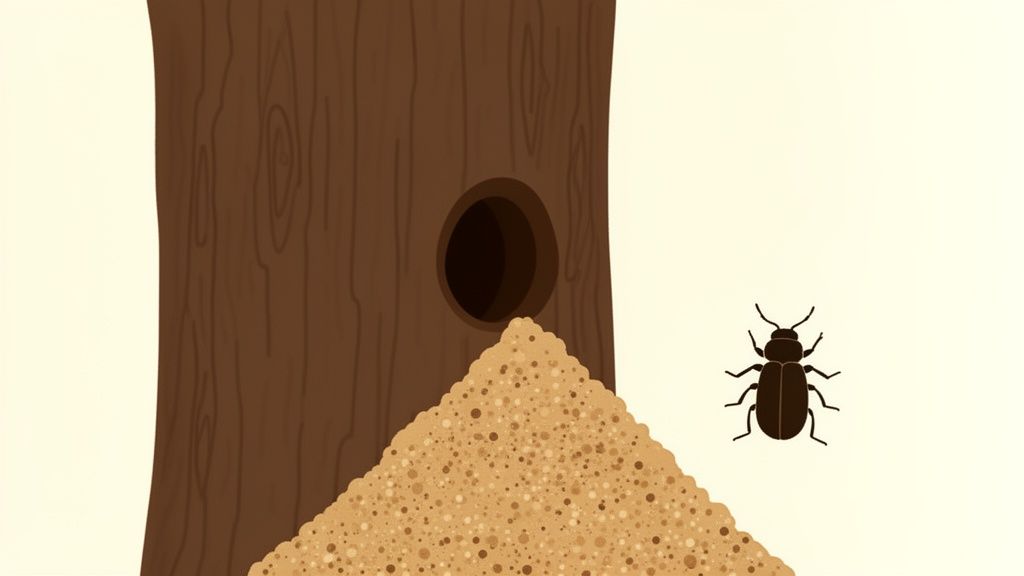
- Exit Holes: Small, often D-shaped or perfectly round holes in the bark are tell-tale signs of wood-boring beetles that have matured and emerged from the tree.
- Sawdust (Frass): Piles of fine, sawdust-like material at the base of the tree or in bark crevices indicate active boring insect larvae tunneling within the wood.
- Scale Insects: These appear as small, immobile bumps on twigs and branches, often leading to a sticky "honeydew" substance that can cause sooty mold to grow.
- Heavy Defoliation: While some leaf-chewing is normal, the rapid stripping of leaves by caterpillars or sawfly larvae can severely stress a tree by robbing it of its ability to photosynthesize.
Common Examples in North Georgia
The Georgia Forestry Commission and UGA Cooperative Extension regularly issue alerts for specific pests in our area. Homeowners in Cobb and Gwinnett counties must remain vigilant for the Emerald Ash Borer (EAB), an invasive beetle that is fatal to all native ash trees if left untreated. In Forsyth and Cherokee counties, stressed pines are frequently attacked by Southern Pine Beetles, especially during drought conditions. Additionally, ornamental trees in residential landscapes throughout Roswell and Johns Creek often suffer from various scale insects and sawflies.
Quick On-Site Checks & Actionable Tips
If you suspect a pest infestation is harming your tree, take these immediate steps:
- Inspect Closely: Walk around the tree and look for the specific signs mentioned above. Check the trunk from the ground up to the main branches for exit holes or frass.
- Document and Report: Take clear photos of the insects and the damage. For suspected invasive species like EAB or the Asian Longhorned Beetle, report your findings to the Georgia Forestry Commission immediately.
- Remove Infested Limbs: If the infestation appears localized to a specific branch, carefully prune and remove it. Be sure to dispose of the wood properly and do not move it off-site, as this can spread the pests.
- Boost Tree Vigor: Ensure the tree is properly watered, especially during dry periods, and apply a layer of mulch around its base (without touching the trunk) to help it conserve moisture and improve its natural defenses.
Pest infestations, particularly from boring insects, often indicate that a tree's health is already compromised. A professional arborist can diagnose the underlying cause of stress and recommend an effective treatment plan. To better understand how professionals approach these issues, you can learn more about the principles of Integrated Pest Management.
5. Mushrooms, Fruiting Bodies, and Fungal Growth
One of the most alarming signs of tree disease is the appearance of mushrooms or other fungal structures on the trunk, branches, or near the base. While some fungi are harmless, the presence of these "fruiting bodies" often indicates a significant internal wood-decay problem. These organisms feed on the structural components of the tree, like cellulose and lignin, progressively weakening its wood and creating a serious safety hazard.

For homeowners in Atlanta's humid climate, from Marietta to Roswell, wood-decay fungi thrive during our wet seasons. By the time you see a mushroom or a hard, shelf-like conk, the fungus has already been colonizing the tree for a considerable time. This visible growth is merely the reproductive part of a much larger, hidden infection that may have already caused extensive internal damage.
How to Recognize Wood-Decay Fungi
These fungi can appear in various forms, and their location on the tree is a key indicator of the decay's position.
- Mushrooms: Soft, gilled fungi often found in clusters at the base of the tree or on surface roots. A classic example is the aggressive Armillaria, or honey mushroom.
- Conks or Shelf Fungi: Hard, woody, or leathery growths that stick out from the trunk or branches like shelves. These are perennial and can grow larger each year.
- Fungal Mats (Mycelium): You might see a dense, web-like mat of fungal growth under the bark or around the root collar, sometimes accompanied by a distinct mushroom-like smell.
Common Examples in North Georgia
The University of Georgia Extension often helps identify fungal species that are notorious for causing structural failure in our local trees. Homeowners in Forsyth and Cobb counties frequently encounter Armillaria mellea, which causes root collar rot on stressed oaks and maples. In residential areas around Johns Creek and Milton, the bright orange "Chicken of the Woods" (Laetiporus) is a common sight on large oak trees, signaling significant heartwood rot. The distinctively layered Turkey Tail fungus is also widespread, typically appearing on dead or dying hardwood trees throughout the Atlanta metro.
Quick On-Site Checks & Actionable Tips
If you find fungal growth on your tree, immediate and careful assessment is critical.
- Document and Identify: Take clear photos of the fruiting bodies and their location on the tree. Note their size, shape, and color. This is essential for a professional arborist to make a preliminary identification.
- Do Not Remove: Avoid knocking off or removing the mushrooms or conks yourself. While they are just the "fruit" of the fungus, they are a vital diagnostic clue for an expert.
- Check for Wounds: Inspect the base of the tree for old wounds from lawnmowers, string trimmers, or construction, as these are common entry points for decay fungi.
- Assess the Tree’s Stability: If large conks are present on the main trunk or major branches, the tree's structural integrity is highly suspect. Consider this a significant safety risk, especially before storms.
The presence of wood-decay fungi is not a DIY issue. It is a definitive signal that the tree's structural health is compromised and requires a professional risk assessment from a certified arborist to determine the extent of the decay and whether the tree poses a danger to people or property.
6. Girdling Roots and Poor Root Development
One of the most insidious and often overlooked signs of tree disease is a problem that starts below the ground: girdling roots. These are roots that grow in a circular pattern around the base of the trunk instead of spreading outward. As both the trunk and the problem root expand, the girdling root acts like a tourniquet, slowly strangling the tree by cutting off the flow of water and nutrients between the roots and the canopy.
This condition is a serious, long-term threat that can lead to a slow, unexplained decline and eventual death. For homeowners in North Georgia communities like Alpharetta, Johns Creek, and Roswell, girdling roots are a common issue, often originating from improper planting techniques where nursery-grown trees were planted too deeply or the root ball was not properly addressed.
How to Recognize Girdling Roots
Since the problem is often hidden by soil and mulch, identifying girdling roots requires careful observation at the tree's base.
- No Visible Root Flare: A healthy tree should have a visible flare at its base where the trunk widens before entering the soil. If the trunk goes into the ground straight like a telephone pole, it's a major red flag.
- Flattened Trunk Sides: You may notice one side of the trunk appears flattened or indented just above the soil line where a large girdling root is constricting it.
- Asymmetrical Canopy Decline: The tree may show signs of stress, like leaf scorch, dieback, or poor fall color, on only one side or in one section of the canopy. This often corresponds to the side of the tree being strangled by the root.
- Leaning Tree: A tree may start to lean as its structural root system is compromised on the constricted side.
Common Examples in North Georgia
Improper planting practices in landscaped suburban areas contribute heavily to this issue. It is common to see landscape trees in new Alpharetta developments showing decline after a few years because they were planted too deep. Similarly, Crape myrtles in Johns Creek neighborhoods often develop girdling roots when the tightly bound root ball from the nursery container is not broken up at planting. In Marietta, established street trees sometimes exhibit a mysterious, one-sided dieback that arborists later diagnose as a severe girdling root.
Quick On-Site Checks & Actionable Tips
If you suspect your tree has girdling roots, here are some proactive steps you can take:
- Expose the Root Flare: Carefully pull back any mulch and excavate the soil from the base of the trunk. Your goal is to expose the point where the main structural roots begin to branch off the trunk.
- Inspect Root Direction: Observe the roots at the surface. Are they growing straight out from the trunk, or do any circle back and press against it?
- Check Planting Depth: When planting new trees, ensure the top of the root ball is level with or slightly above the surrounding ground. Never pile soil or heavy mulch against the trunk.
- Correct at Planting: Loosen and straighten out any circling roots on a new tree's root ball before placing it in the ground. This prevents the problem from ever starting.
Correcting established girdling roots on a mature tree is a delicate procedure that requires professional expertise to avoid damaging the trunk. If you uncover a large, constricting root or your tree shows significant signs of decline, it is crucial to call a certified arborist for a professional root collar excavation and corrective pruning.
7. Crown Thinning and Sparse Foliage
A gradual loss of leaves throughout a tree's canopy, known as crown thinning, is another critical sign of tree disease that often develops slowly. Unlike sudden defoliation, this symptom results in a sparse, see-through appearance where branches become increasingly visible. This indicates the tree is under significant stress and cannot support a full, healthy canopy, pointing to potential root problems, vascular diseases, or environmental pressures.
For homeowners in the Atlanta area, especially during the hot, dry summers often experienced in Cumming and Forsyth County, crown thinning can be an early warning of decline. It is vital to differentiate this unhealthy thinning from a deciduous tree’s natural preparation for winter dormancy, as mistaking one for the other can delay crucial intervention.
How to Recognize Crown Thinning
A healthy tree canopy should be dense and full during the growing season. Crown thinning is the progressive loss of that density.
- Increased Skylight: You can see more daylight through the tree’s canopy than in previous seasons.
- Sparse Appearance: The foliage looks thin and wispy, and the tree’s inner branch structure is more exposed.
- Reduced Leaf Size: In some cases, the remaining leaves may be smaller than normal or have poor color.
- Dieback at the Tips: The thinning may be accompanied by dead twigs and small branches at the very top and edges of the canopy.
Common Examples in North Georgia
Certified arborists across the Atlanta metro area, guided by standards from the ISA and the University of Georgia Extension, frequently diagnose issues based on canopy density. In Gwinnett County, laurel wilt causes rapid crown thinning in redbay and sassafras trees. In Marietta and East Cobb, severe drought can trigger significant canopy decline in mature oaks. Homeowners in Alpharetta might notice thinning caused by heavy infestations of pests like Japanese beetles, while trees in poorly drained parts of Johns Creek often exhibit thinning due to root rot diseases.
Quick On-Site Checks & Actionable Tips
If you notice your tree's crown is looking sparse, here are some immediate steps:
- Monitor and Compare: Take photos of the tree’s canopy monthly during the growing season. Compare them to photos from previous years to track the rate of thinning.
- Assess the Pattern: Determine if the thinning is uniform throughout the crown or concentrated in one specific area. Localized thinning can point to specific limb or root issues.
- Check for Other Symptoms: Look closely for other signs of tree disease, such as unusual insects, leaf spots, or damage to the bark and trunk.
- Evaluate Environmental Factors: Consider recent changes in the tree’s environment. Has there been nearby construction, soil compaction, or a change in your watering schedule?
Because crown thinning can be caused by a wide range of issues, from soil problems to systemic diseases, a professional assessment is highly recommended if the condition persists or worsens. An arborist can properly diagnose the underlying cause and determine if the tree's health can be restored.
7-Point Comparison of Tree Disease Signs
| Sign / Issue | 🔄 Implementation complexity | ⚡ Resource requirements | ⭐ Expected outcomes | 💡 Ideal use cases | 📊 Key advantages |
|---|---|---|---|---|---|
| Leaf Discoloration and Abnormal Leaf Spots | Low — visible to homeowners; may need lab confirmation for ambiguous cases | Minimal — photos, regular monitoring; occasional lab tests or fungicide treatments | Moderate ⭐⭐ — high recovery if detected early and treated promptly | Routine spring/fall monitoring in humid climates; early prevention programs | Easily detected; non‑invasive assessment; multiple treatment options |
| Cankers and Bark Lesions | High — requires professional diagnosis and careful pruning/management 🔄 | Significant — arborist inspection, sterile tools, possible lab ID, branch removal | Variable ⭐ — limited once advanced; containment possible if caught early | Trees with sunken bark, oozing sap, or progressive dieback | Clear indicator of systemic issues; enables targeted removal to limit spread |
| Wilting and Branch Dieback | High — urgent, often requires root/vascular investigation 🔄 | High — soil moisture tests, root excavation, lab analysis, immediate arborist action | Low–Moderate ⭐ — rapid progression; some causes irreversible if delayed | Sudden canopy wilting or rapid branch death; suspected vascular/root pathogens | Strong urgent signal prompting immediate intervention; visually obvious |
| Unusual Insect Activity and Pest Indicators | Medium — visible signs but accurate species ID needed for treatment 🔄 | Moderate — traps/monitoring, insect ID, chemical/biological controls, ongoing management | Variable ⭐⭐ — early control can be effective; invasives may be hard to stop | Exit holes, frass, pitch tubes, or visible borers; suspected invasive pests (EAB, ALB) | Allows targeted treatments; early detection prevents spread to neighboring trees |
| Mushrooms, Fruiting Bodies, and Fungal Growth | High — indicates established decay; requires structural assessment 🔄 | Significant — arborist stability evaluation, possible removal, lab ID | Low ⭐ — usually signals advanced decay; limited restoration options | Fruiting bodies on trunk/roots or large conks; pre‑storm safety assessments | Confirms wood decay and structural risk; guides safety/removal decisions |
| Girdling Roots and Poor Root Development | Medium — detection may need careful excavation and specialist pruning 🔄 | Moderate — root excavation, corrective root pruning or replanting, arborist expertise | Moderate ⭐⭐ — good outcomes if corrected early; poor for large, established girdles | Newly planted or young trees with asymmetrical decline or visible root circling | Correctable when early; prevention via proper planting greatly effective |
| Crown Thinning and Sparse Foliage | Low–Medium — visual assessment straightforward but cause identification needs expertise 🔄 | Moderate — canopy inspection, soil/root checks, possible pruning or soil remediation | Moderate ⭐⭐ — treatable if underlying cause addressed; recovery may be slow | Gradual foliage loss across canopy; early warning of stress, pests, or root problems | Early indicator allowing intervention before severe structural decline |
Your Next Step: Partnering with a Pro for Tree Health
Throughout this guide, we've navigated the complex landscape of tree health, equipping you with the knowledge to become a more observant and proactive guardian of your property's most valuable living assets. You now understand how to spot the subtle and not-so-subtle signs of tree disease, from the tell-tale discoloration of leaves to the ominous appearance of fungal fruiting bodies. We've explored the implications of branch dieback, the silent threat of girdling roots, and the urgent warnings communicated by cankers on the bark.
This knowledge transforms you from a passive observer into an active participant in your tree's lifecycle. Recognizing these symptoms early is the single most effective action you can take to prevent minor issues from escalating into major, costly, and potentially hazardous problems. A tree that appears healthy to the casual eye might be sending out distress signals that you are now trained to see, such as a thinning crown or unusual insect activity concentrated on a specific area.
From Observation to Action: The Critical Handoff
While your role as an informed first responder is invaluable, it’s crucial to recognize its limits. Identifying a symptom is one thing; accurately diagnosing the underlying cause and prescribing the correct treatment is another entirely. This is where professional expertise becomes not just beneficial, but essential.
Misdiagnosing a problem can lead to ineffective or even harmful interventions. For example, applying a fungicide for what is actually a pest-related issue or attempting to prune away a systemic bacterial infection will not solve the core problem and may stress the tree further. An ISA Certified Arborist brings a level of diagnostic precision that simply isn't available to the average homeowner. They understand the intricate relationships between different signs of tree disease, local environmental factors, and the specific vulnerabilities of tree species common to the Atlanta metro area.
Key Insight: The goal of homeowner observation isn't to replace an arborist, but to know precisely when to call one. Early detection by you, followed by expert intervention, creates the most successful formula for long-term tree health and safety.
Why a Local Expert Matters for Atlanta-Area Trees
For residents in areas like Cumming, Johns Creek, Milton, and Alpharetta, local context is everything. The clay soil, humidity levels, and specific pathogens prevalent in Forsyth, Cobb, Gwinnett, and Cherokee counties present unique challenges. A certified arborist working in this region possesses critical local knowledge:
- Regional Disease Pressure: They know that oak wilt, anthracnose, and fire blight behave differently here than in other parts of the country.
- Pest Cycles: They are familiar with the life cycles of local pests like the southern pine beetle or ambrosia beetles, which are often vectors for disease.
- Species-Specific Care: They have hands-on experience managing the health of native Georgia trees like magnolias, dogwoods, and various oak and pine species.
By partnering with a professional, you are not just getting a diagnosis; you are investing in a strategic, localized health and safety plan for your trees. This proactive approach protects your landscape investment, enhances your property value, and, most importantly, mitigates the risk of tree failure, which can have devastating consequences for your home and family. You've done the hard work of learning what to look for; now, take the most important step and entrust the treatment to an expert.
Don't let uncertainty compromise the health and safety of your trees. If you've noticed any of the signs of tree disease discussed in this guide, contact the ISA Certified Arborists at Richmond Tree Experts GA for a comprehensive, professional assessment. Our team specializes in diagnosing and treating the specific challenges facing trees in the greater Atlanta area, ensuring your landscape remains beautiful and secure for years to come.
Not sure what your tree needs? Richmond Tree Experts has worked on Marietta and Metro Atlanta trees since 1985, and every job is looked at by an ISA Certified Arborist before it is priced. Start with an ISA Certified Arborist evaluation, or see everything we do: tree removal, stump grinding and arborist services across Cobb, Fulton, Cherokee, Gwinnett and DeKalb counties (service areas).
Call (770) 974-3964, 7am to 11pm every day, or request an estimate online.

