

When a tree comes crashing through your roof, that first wave of panic is almost always about the cost. So, let’s get straight to the good news: in most situations, your homeowners insurance absolutely does cover damage from a fallen tree. If a storm, high winds, or a lightning strike is the culprit, your policy is designed to step in and handle the repairs.
How Homeowners Insurance Protects You from Fallen Trees
Think of your homeowners insurance policy as a financial first responder. When a tree hits your house, it’s rarely just a simple hole in the roof. The impact can ripple through your home's structure, damage your personal belongings, and even take out a detached garage or shed. A standard policy is built to handle these cascading problems.
The key concept you'll hear is a "covered peril." This is just the insurance world's term for an event or disaster your policy agrees to cover. When it comes to trees falling, the most common covered perils are:
- Windstorms and tornadoes
- Lightning strikes
- Hail or the sheer weight of ice and snow
- Vandalism
If one of these events causes a tree to fall, your insurance should kick in. It doesn't matter if it was your tree, your neighbor's, or one from city property. The policy follows the damaged property—in this case, your home.
This quick flowchart breaks down how coverage usually works when a storm is involved.

As you can see, a covered event like a windstorm sets off the chain reaction that leads to a successful insurance claim for the damage that follows.
For a clearer picture, here’s a quick breakdown of how the different parts of your policy work together after a tree falls.
Fallen Tree Insurance Coverage At a Glance
| Coverage Area | What's Generally Covered | Important Considerations |
|---|---|---|
| Dwelling | Repairs to the physical structure of your house—roof, walls, windows, foundation. | Coverage is limited to your policy's maximum. Your deductible will apply. |
| Other Structures | Damage to detached structures like garages, sheds, or fences on your property. | This is usually a percentage (often 10%) of your dwelling coverage. Check your policy for the exact amount. |
| Personal Property | Replacement or repair costs for your belongings inside the home, such as furniture, electronics, and clothing. | Coverage may be for "Actual Cash Value" (depreciated) or "Replacement Cost." Your deductible applies here as well. |
| Tree Debris Removal | The cost to remove the tree from your house, garage, or other insured structure. Limited coverage for yard cleanup. | Most policies cap debris removal at $500 to $1,000, especially if the tree didn't hit a structure. |
| Additional Living | Costs for temporary housing, food, and other essentials if your home is unlivable during repairs. | There are usually limits based on a time frame or a percentage of your dwelling coverage. Keep all your receipts! |
This table simplifies things, but always remember to pull out your specific policy documents to understand the exact limits and conditions that apply to your situation.
What Your Policy Typically Covers
Your insurance isn't just a single bucket of money; it's a bundle of different protections that work together. When a tree strikes your house, here’s what you can generally expect your policy to cover:
-
Dwelling Coverage: This is the core of your policy. It’s what pays to repair or rebuild the actual structure of your house—the roof, the walls, the foundation, everything that makes it a home.
-
Other Structures Coverage: Did the tree also take out your detached garage, a tool shed, or a section of your fence? This part of your policy is specifically for structures on your property that aren't physically attached to the main house.
-
Personal Property Coverage: This is for everything inside your home. It helps you replace belongings that were damaged in the incident, from your living room sofa and flat-screen TV to the clothes in your closet.
Understanding Your Policy for Tree Damage Claims

Trying to read an insurance policy can feel like you’re solving a puzzle in another language. But when you’re dealing with a tree falling on house insurance claim, knowing how the key pieces fit together is everything. Let's cut through the jargon and get straight to what it means for your wallet.
Think of your policy as having a few layers of protection. Dwelling coverage (often called Coverage A) is the big one—it's what pays to fix the actual structure of your house. Then you have other structures coverage (Coverage B), which handles damage to things like a detached garage, a shed, or your fence. This is typically set at about 10% of your dwelling coverage.
Finally, there’s personal property coverage (Coverage C). This helps you replace belongings inside your home that got ruined when the tree came down. These three parts are designed to work together to get your home, and your life, back to normal.
How Your Deductible Works
Before your insurance company cuts a check, you have to pay your deductible. It's basically your share of the repair bill. Let’s say you have a $1,500 deductible and the total damage comes to $20,000. You’ll pay the first $1,500 out of pocket, and the insurance company will cover the other $18,500.
The good news is that you only pay this once per incident. Your deductible applies to the total claim, not each individual part—it covers the damage to your house, fence, and belongings all at once.
Choosing a higher deductible is a common way to lower your monthly premiums, but it’s a trade-off. You save money month-to-month, but you'll have to come up with more cash upfront if something bad happens. It’s a classic balance of short-term savings versus long-term financial risk.
The Critical Details of Tree Removal Coverage
This is where things can get a little tricky. One of the biggest points of confusion for homeowners making a tree falling on house insurance claim is debris removal. Many people are shocked to learn about the very specific—and often surprisingly low—limits on this part of their coverage.
Your policy will almost always pay to get the tree off your house, garage, or driveway. That’s priority number one, since you can’t make repairs until it's gone. But what about the massive pile of logs and branches now sitting in your yard? That's a different story.
Most standard homeowners policies put a firm dollar limit on tree debris removal, usually capping it somewhere between $500 to $1,000 for the whole incident. This money is intended to cover the cost of lifting the tree off the damaged structure, not necessarily hauling every last twig off your property.
This is a really important distinction to understand. The cost to remove a huge, mature oak or pine can easily soar into the thousands. Your policy might cover the first $1,000, but you could be on the hook for the rest of the bill to get your yard completely cleared.
Before you ever have to file a claim, it's a smart move to find the "Debris Removal" section of your policy and see exactly what your limits are. Knowing this one small detail can save you from a major unexpected expense when you're already stressed out.
It’s a sound every homeowner dreads: a deafening crash, a splintering of wood, and the shocking sight of your neighbor’s huge oak tree sitting in the middle of your living room. After the initial shock wears off, one question always comes first: "Who's paying for this?"
The answer almost always catches people by surprise.
In the insurance world, the policy follows the property that was damaged, not the tree that caused it. This means that even though it’s your neighbor’s tree, your own homeowners insurance policy is the one you need to call. It doesn't matter where the tree came from; it landed on your house, so your policy is on the hook for the repairs.
This is the standard rule for what insurers call "acts of nature." If a nasty thunderstorm, a tornado, or even the sheer weight of a heavy ice storm brings a tree down, it’s generally a no-fault situation. You’ll file a claim with your own insurance company, pay your deductible, and they’ll cover the costs to fix the structure and get that tree off your house.
The Critical Exception: Negligence
There is, however, one massive exception to this rule: negligence. If you can prove that your neighbor knew their tree was a ticking time bomb and did absolutely nothing about it, the financial responsibility can swing back to them.
So, what does negligence actually look like? It’s not just an ugly tree; it’s a tree that posed an obvious, undeniable risk.
- Visible Decay: We’re talking about large dead branches, fungus blooming on the trunk, or gaping hollow spots.
- A Dangerous Lean: The tree was leaning precariously over your property, looking like it was ready to give up the ghost.
- Previous Warnings: This is the big one. You had already notified your neighbor—in writing—that you were seriously concerned about the tree's condition.
If you can tick these boxes, your insurance company will likely still front the money for your repairs to get your life back to normal quickly. But behind the scenes, they’ll almost certainly go after your neighbor’s insurance company for reimbursement. That process is called subrogation.
How to Protect Yourself from Neighbor Negligence
Proving negligence isn't about what you thought; it's about what you can prove. Just telling your insurer you were worried about the tree won't cut it. You need documentation.
If a neighbor's tree has you worried, the single best thing you can do is send them a certified letter. This creates a formal, dated record that you officially notified them of the hazard. In it, you should calmly and clearly outline your specific concerns about the tree’s health and the risk it poses to your property.
That letter becomes your golden ticket if the worst happens. Should that tree fall, your certified mail receipt and a copy of the letter prove the owner was put on notice and failed to act. This gives your insurance company the ammunition they need to hold the right party accountable. Without that proof, shifting the financial burden is nearly impossible.
Your Step-By-Step Action Plan After a Tree Falls
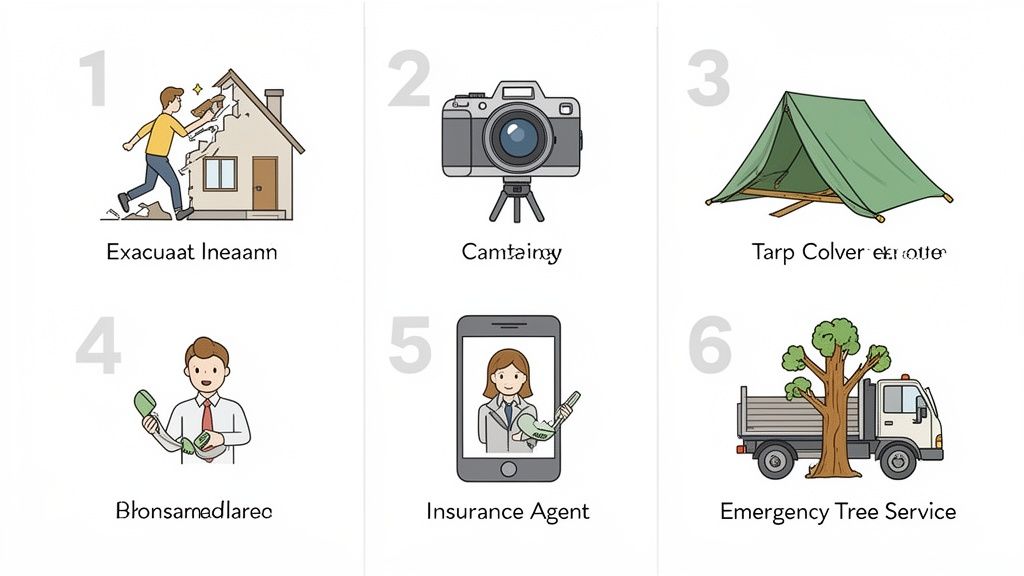
The sound of a tree crashing into your home is something you never forget. In those chaotic first minutes, it’s completely normal to feel overwhelmed and unsure of what to do. Having a clear plan is your best tool for managing the situation safely and setting yourself up for a smooth tree falling on house insurance claim.
Think of these next steps as a simple checklist to follow in order. Tackling them one at a time will help you protect your family, document the damage properly, and get the recovery process started on the right foot.
Step 1: Prioritize Safety Above All
Before you do anything else, your absolute first priority is making sure everyone in the house is safe. If the damage looks severe—you see sagging ceilings, deep cracks in the walls, or hear groaning sounds from the structure—evacuate immediately.
Get everyone to a safe spot far away from the house. Do not go back inside until a professional has confirmed it's structurally sound. A damaged roof is incredibly unstable, and there’s always the hidden risk of downed power lines.
Step 2: Document Everything
Before a single thing is moved, pull out your smartphone and start documenting the scene. This is a critical step for your insurance claim.
- Take Wide Shots: Get photos and videos of the entire scene from several different angles outside.
- Get Close-Ups: Zero in on the specific points of impact, like where the tree smashed through the roof or shattered windows.
- Record Interior Damage: If it's safe, take pictures of the damage inside—crushed ceilings, broken drywall, and any ruined personal belongings.
This visual proof is gold for your insurance adjuster. It creates an undeniable record of the initial damage before any cleanup starts.
Key Takeaway: Fight the urge to start cleaning up right away. Your insurance claim begins the moment the tree hits, and moving things can make it harder for the adjuster to assess the full scope of the damage.
Step 3: Mitigate Further Damage
Your insurance policy expects you to take reasonable steps to prevent the situation from getting worse. In insurance-speak, this is called "mitigating damage." When a tree has punched a hole in your roof, this usually means covering it up to keep the rain out.
If you can do it safely, place a tarp over the damaged area. Make sure to keep the receipts for any supplies you buy, like tarps or plywood, because these are almost always reimbursable expenses under your claim.
For a more detailed walk-through, this What to Do If a Tree Falls On Your Roof Step By Step Guide is a great resource.
Step 4: Contact Your Insurance Agent
With everyone safe and the initial damage documented, it’s time to get the official claims process rolling. Call your insurance agent or the company's 24/7 claims hotline. Have your policy number handy and be ready to give them a clear, simple description of what happened. They’ll assign a claims adjuster and tell you exactly what comes next.
Step 5: Call for Emergency Tree Services
Finally, you need to get that tree off your house, and this is absolutely not a DIY job. You need a professional crew with the right cranes and equipment to lift the tree away without causing even more damage. Getting a specialist to handle storm damaged tree removal is the only safe way to proceed.
The Financial Reality of a Fallen Tree Incident
When a tree crashes through your roof, the first thing you see is the obvious stuff—the gaping hole, the shattered window, the mess. But that initial shock is just the tip of the iceberg when it comes to the real cost.
The emergency tree removal alone can be a serious hit to the wallet. We're often talking thousands of dollars right out of the gate, especially for those big, old trees that need a crane and a specialized crew to safely lift them off your home.
That first bill is just the beginning. From there, you're looking at structural repairs, fixing water damage, and replacing personal items that got ruined. It turns one bad afternoon into a long, complicated, and expensive recovery. To get through it without getting taken advantage of, you need to understand your rights and know what your insurance company won't tell you about fallen tree claims.
The Hidden Costs of Tree-Related Storm Damage
You might be surprised to learn that the insurance industry often lumps tree damage into a general "storm damage" category. This really downplays how much risk unhealthy or poorly maintained trees actually pose to homeowners.
A perfect, and staggering, example of this happened after Hurricane Ike. The Ohio Insurance Institute reported that of the $550 million in structural damage claims, a massive chunk—about 50,000 incidents adding up to $300 million—was caused directly by falling trees.
This shows that what gets brushed off as generic storm failure is often a huge tree failure problem. That’s a critical piece of information for homeowners, especially here in Georgia where we see our fair share of intense weather.
Understanding the Full Financial Picture
To put some real numbers on it, let's walk through a common scenario for a large oak tree falling on a typical suburban Atlanta house:
- Emergency Tree Removal: This can easily run you $2,500 – $7,500+, all depending on the tree's size and how hard it is to get to. You can get a deeper dive in our guide on the cost to remove a large tree.
- Structural Roof Repairs: Fixing the bones of your roof—the trusses, sheathing, and shingles—often lands in the $10,000 – $25,000 range.
- Water Damage Mitigation: If a good storm rolls through before the roof is properly tarped, you could be looking at another $3,000 – $5,000 just to dry everything out and prevent mold.
Add it all up, and a single downed tree can quickly soar past $30,000 in damages. This is exactly why proactive tree care isn't just about keeping your yard looking nice. It's a crucial financial strategy to protect your biggest investment from a massive, and often preventable, disaster.
Proactive Tree Care to Prevent Disaster
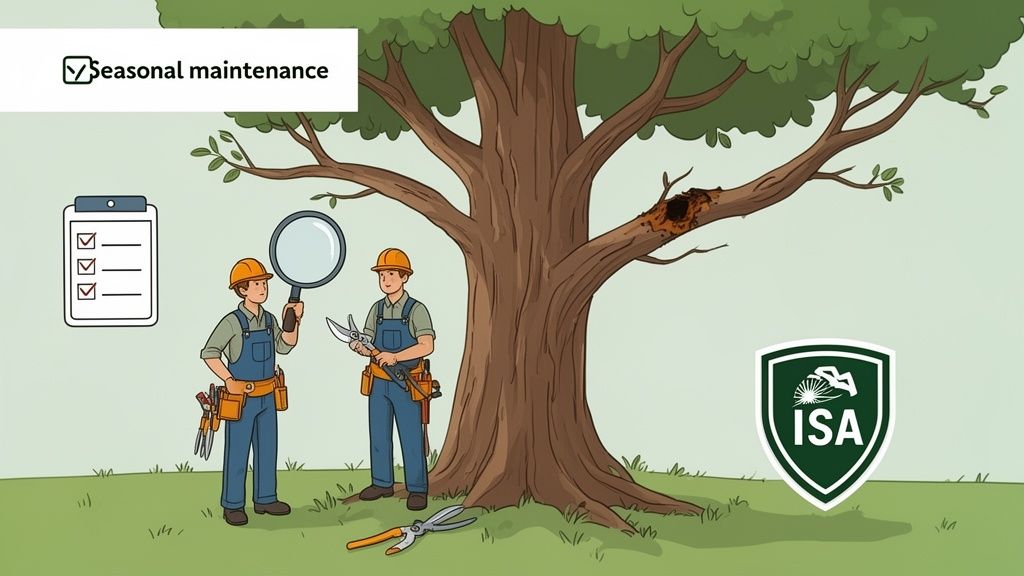
Dealing with the aftermath of a tree crashing through your roof is a chaotic and expensive nightmare. The good news? Many of these disasters are entirely preventable. The best way to protect your home and sidestep a complicated insurance claim is to get proactive instead of reactive. It all starts with treating your trees like any other valuable asset—one that needs regular check-ups.
Think of an annual inspection by an ISA Certified Arborist as a small investment that can save you tens of thousands of dollars down the road. These pros are trained to spot the subtle signs of trouble most of us would miss, like hidden decay, structural weaknesses, or diseases that could compromise a tree’s integrity during the next big Georgia storm.
Your Seasonal Maintenance Checklist
Keeping an eye on your trees throughout the year helps you catch problems before they become catastrophes. Here’s a simple checklist to follow with the seasons:
- Winter: Once the leaves are gone, a tree's structure is on full display. This is the perfect time to look for cracks, dead or broken branches, and any unusual leaning. It's also an ideal window for pruning to improve its shape and strength.
- Spring: As new leaves emerge, keep an eye out for branches that remain bare—a clear sign they're dead and need to be removed. Also, check for any new signs of pests or disease taking hold.
- Summer: Make sure your trees are getting enough water, especially during those long, dry spells. Watch for sudden changes in leaf color or leaves dropping prematurely, as these can be signs of stress or sickness.
- Fall: Before the winter winds kick in, do one last check for any weak branches that could easily snap under the weight of ice or snow.
This isn't just about protecting your property; it’s about safety. The Occupational Safety and Health Administration (OSHA) reports that on average, over 100 fatalities occur annually from landscape and tree fall incidents, which really underscores why professional maintenance is so critical. For a deeper dive, check out some more insights on tree-related risks on forthepublicadjusters.com.
Expert Insight: A good arborist doesn’t just look for what’s wrong; they find ways to make your trees stronger. Professional pruning, for example, can strategically lighten a tree's load and improve its resistance to wind, turning a potential liability into a resilient part of your landscape. For trees showing signs of structural weakness, our specialized tree cabling and bracing services can provide the critical support they need to stand tall.
Your Fallen Tree Insurance Questions, Answered
Even after getting the basics down, you might still have a few "what if" scenarios running through your mind. Let's tackle some of the most common questions homeowners have when a tree comes crashing down.
Will My Insurance Rates Go Up After a Fallen Tree Claim?
This is the big question on everyone's mind. Filing any insurance claim comes with the risk of your premium going up when it's time to renew. However, there's a key distinction to make.
Insurers tend to look at claims from widespread weather events, like a massive thunderstorm that took down trees all over town, differently than an incident where you might be considered at fault. The whole point of having insurance is to protect you from a major financial hit, so don't let the fear of a rate hike stop you from using your policy for significant damage. The best thing to do is simply talk it over with your agent to understand the potential impact.
What if a Tree Falls but Doesn’t Hit Anything?
It's a common and frustrating situation. A huge oak topples over in your backyard, but thankfully, it misses the house, the shed, and the fence. So, who pays for the cleanup?
In this case, standard homeowners insurance typically does not pay for debris removal. The cost of chopping it up and hauling it away is usually on you. This is exactly why getting a professional opinion on large, older trees is such a smart move—paying for preventative maintenance now can save you a much bigger headache and expense later.
The Bottom Line: Your insurance policy is there to cover damage to structures it insures. A fallen tree in an open yard, while a massive inconvenience, is generally seen as a landscaping problem, not a property damage claim.
Does Homeowners Insurance Cover Tree Damage to My Car?
Nope, this is where your auto insurance steps in. The comprehensive coverage portion of your car insurance policy is what's designed to handle events like a tree falling on your vehicle.
It doesn't matter if the tree was in your yard or your neighbor's; the claim goes to your auto insurer. You'll file a separate claim with them and be responsible for whatever deductible is on that specific policy.
When a storm hits and you're left with a mess, you need an expert you can count on. Richmond Tree Experts GA has been serving the Atlanta community since 1985, with ISA Certified Arborists ready to handle any emergency. For fast, safe, and professional storm damage response, contact us today.
Need a tree taken down safely? Richmond Tree Experts has worked on Marietta and Metro Atlanta trees since 1985, and every job is looked at by an ISA Certified Arborist before it is priced. Start with tree removal, or see everything we do: tree removal, stump grinding and arborist services across Cobb, Fulton, Cherokee, Gwinnett and DeKalb counties (service areas).
Call (770) 974-3964, 7am to 11pm every day, or request an estimate online.

