

A typical single-tree removal in the North Atlanta suburbs runs roughly $400 to $2,500, while crane-assisted or hazardous work can reach $3,000 to $8,000 or more. The final tree removal rate depends less on height alone than on access, species, lean, nearby structures, utility lines, cleanup, and whether the stump is included.
A homeowner in East Cobb may discover that two companies can quote the same water oak thousands apart without either contractor necessarily being dishonest. One crew may be able to drive a bucket truck beside the trunk, chip brush directly into the truck, and lower limbs into an open driveway. Another may need to work through a narrow backyard gate, rig every branch over a roof, carry logs to the street, and bring in a crane. The tree looks identical from the road, but the job is not.
This guide focuses on 2026 tree removal rates across Marietta, Roswell, Kennesaw, Woodstock, Acworth, Canton, Cobb County, Cherokee County, Forsyth County, and nearby North Metro Atlanta areas. It also covers emergency tree removal, tree trimming, tree pruning, stump grinding, stump removal, storm damage tree cleanup, fallen tree removal, hazardous tree removal, land clearing, and the questions that produce a defensible written quote.
| North Atlanta job type | Practical 2026 rate range | What usually changes the price |
|---|---|---|
| Small, accessible removal | $400 to $900 | Height, trunk diameter, chipper access |
| Standard residential removal | $800 to $2,500 | Climbing, bucket access, species, cleanup |
| Large removal | $2,000 to $5,000 | Crane time, rigging, trunk weight, haul-off |
| Hazardous or emergency removal | $3,000 to $8,000+ | Structure risk, utility lines, storm conditions |
| Stump grinding | $100 to $400 | Stump diameter, roots, access |
| Standard permit fees | $25 to $150 | Jurisdiction and protected-tree status |
The rate ranges above reflect the North Atlanta conditions that matter on site, including tight suburban access and heavier hardwoods. Pricing references for stump grinding and standard permits are summarized in current tree removal cost guidance, while regional pricing data identifies access, structures, and hazardous equipment as major cost drivers in 2026 tree service pricing data.
What Tree Removal Looks Like in North Atlanta
After a March storm, a homeowner in an East Cobb subdivision may find a 60-foot water oak leaning toward the roof. The trunk is still standing, but a crack has opened at the root flare, limbs hang over the garage, and the only staging area is a sloped driveway between two houses. That combination changes the work plan before a saw reaches the tree.
A crew may need two or three climbers, a ground crew, a chip truck, and either a bucket truck or a 30-ton crane. Climbers remove smaller branches first while the ground crew controls ropes, redirects limbs, and keeps material away from siding, gutters, fences, and vehicles. If the street and driveway can support a crane, the operator can lift sections clear of the roof and reduce climbing time. A narrow or blocked driveway creates the opposite trade-off. Workers may have to carry brush and logs to the chip truck by hand.
Tight suburban access is a major North Metro cost factor. Cul-de-sacs in Roswell and Johns Creek restrict truck placement, while Georgia Power lines often follow streets and rear easements. Oak-heavy lots in East Cobb and Forsyth also produce dense, heavy wood. Large trunk sections can weigh more than two tons, so crews must rig and lower them rather than drop them.
The same tree can receive quotes that differ by 1,500 dollars when one crew includes crane time, full debris hauling, and stump work while another prices only the removal. City of Atlanta permit requirements may also differ from work in unincorporated Cobb or Cherokee, so the written scope matters.
For a standard removal in Cobb, Gwinnett, Forsyth, or Cherokee, expect roughly $400 to $2,500. Crane work, hazardous rigging, or storm-damage overtime can raise the invoice to $3,000 to $8,000 or more, consistent with North Atlanta tree removal pricing data.
If a storm leaves a tree on a roof, fence, or driveway, stay clear of suspended limbs and call a qualified emergency crew. This fallen tree removal reference image shows the type of storm hazard that requires controlled removal.
What Drives the Price Up or Down
Two trees of similar height can produce very different North Atlanta quotes. Height starts the estimate, but species, decay, access, targets, equipment, hauling, and stump work determine how the crew can complete the removal.
The tree itself
A 30-foot dogwood in Alpharetta may be a short ground-and-climb job. A 90-foot tulip poplar in Cherokee County can keep a full crew busy much longer because its sections are larger, landing zones are tighter, and the trunk may need controlled lowering.
Species changes the handling plan. Oak, hickory, pecan, and other dense hardwoods take more effort to cut, move, and process. Pine and Bradford pear often separate more quickly, though a tall pine with a back lean can still become a high-risk removal. Industrial mechanized systems may process more wood per productive machine hour than motor-manual work, according to mechanized tree-felling productivity research. That research describes plantation operations, not residential pricing. A North Metro crew is usually limited by homes, fences, utilities, access, and safe landing space rather than saw speed.
The target and the path
Lean, decay, and target exposure determine the rigging plan. A hollow silver maple over a Forsyth County driveway requires a different sequence from a sound oak standing alone in a back field. A backyard tree behind a vinyl fence in a Marietta cul-de-sac may add $600 to $1,200 when workers must carry brush and log sections to the chip truck instead of placing them beside it. That range reflects observed regional pricing conditions.
Roswell and Marietta properties often restrict truck placement. Georgia Power lines, septic fields, swimming pools, roofs, and neighboring fences can eliminate a simple drop zone. Crews may need smaller cuts, additional ground workers, ropes, a lift, or a crane. Those choices protect the property but increase labor and equipment time.
Stump grinding and debris hauling are frequently separate line items. Emergency or after-hours work also costs more, particularly when several Cobb and Gwinnett properties need storm cleanup at once. A quote that includes only cutting and leaving the wood on-site should not be compared directly with one that includes chipping, haul-off, and stump removal.
| Pricing factor | Typical cost impact | North Atlanta example |
|---|---|---|
| Height and diameter | Raises labor and equipment needs | A tall Cherokee tulip poplar needs larger sections and more rigging |
| Species and wood density | Increases handling and disposal difficulty | East Cobb oak and pecan are heavier than many pines |
| Lean and decay | Can require advanced rigging | A hollow maple over a Forsyth driveway cannot be dropped freely |
| Access | May add hundreds or thousands | A Roswell backyard behind a narrow gate requires manual hauling |
| Utility and structure exposure | Raises safety planning and insurance risk | Georgia Power lines or a roof can eliminate a simple drop zone |
| Stump work | Adds a separate service | Grinding may be quoted after the trunk and brush are removed |
| Disposal and urgency | Expands labor, truck, and scheduling costs | Storm cleanup may require additional hauling or after-hours response |
Practical rule: Compare the work plan, not just the bottom line. Check whether each quote includes rigging, crane time, debris haul-off, traffic control, stump work, and cleanup. A lower number may describe a smaller job.
2026 Rate Ranges by Tree Size and Risk
A useful North Metro rate card describes the crew, equipment, and production limits behind the quote. For unincorporated Cobb, Gwinnett, Forsyth, and Cherokee work, the written scope matters more than a size label. Two trees with similar height can require very different plans in Marietta, Roswell, East Cobb, or near Lake Lanier.
| Removal condition | Crew and equipment commonly used | What changes the price |
|---|---|---|
| Open-access, smaller tree | Two-person ground crew, chipper, basic rigging | Clear drop zone and short haul distance keep labor contained |
| Residential tree with controlled lowering | Three-person climbing crew, bucket truck, ropes, chipper | Fence lines, pools, roofs, and service lines require smaller sections |
| Large tree with limited staging | Four-person crew, crane when needed, haul-off trucks | Crane setup, travel distance, and debris volume add time |
| High-risk or structure-adjacent tree | Specialty rigging crew, crane or lift, additional site coordination | Each limb may need to be lowered, rather than dropped, to protect the property |
A small pine or maple with open access may need only basic rigging. The same tree behind a fence or beneath a utility line moves into a more labor-intensive plan because the crew must dismantle it in controlled pieces. Chainsaw systems can process 20 to 60 cubic meters per productive machine hour, but suburban restrictions usually determine the schedule more than saw speed, as shown in harvesting benchmark data.
A backyard oak in Marietta may require a climber, ground technician, bucket truck, chipper, and controlled lowering. A tall pine in Roswell with no driveway access may justify a crane because carrying every section through a side yard takes more labor and creates more handling exposure.
Intown Atlanta work and Lake Lanier shoreline removals can price above comparable county jobs because staging, traffic, shoreline access, or permit coordination limits the crew's options. North Atlanta pricing guidance reflects those conditions in its regional comparisons, as shown in North Atlanta pricing guidance. Treat any adjustment as job-specific. The contractor should identify the exact constraint, expected crane or haul-off time, and equipment included in the written quote.
Permits and Protected Trees Across Counties
Permit rules can change the schedule before a saw ever starts. The clearest benchmark is the City of Atlanta, where a permit is required to remove, destroy, or injure any tree on city-owned property regardless of size. On private property, a permit is required for a tree measuring 6 inches or greater in diameter at breast height, and the city states that dead trees also require permission for removal, as explained by the City of Atlanta tree work permit application.
Atlanta's private-property rules distinguish between hardwoods and pines. A hardwood at 6 inches DBH or larger requires a permit, while a pine reaches the stated threshold at 12 inches, with DBH measured 4.5 feet above ground, according to Atlanta's permit guidance. The city also identifies arborist inspection and building permit pathways for processing tree removal.
A practical jurisdiction check
| Jurisdiction | DBH trigger | Protected species | Replacement required | Typical lead time |
|---|---|---|---|---|
| City of Atlanta | Hardwood at 6 inches or larger, pine at 12 inches or larger | City-protected trees and regulated specimens | May apply under city review | Confirm with the city before scheduling |
| Unincorporated Cobb County | Confirm local overlay and development conditions | May apply to protected or regulated specimens | Depends on approval pathway | Confirm with county staff |
| Unincorporated Gwinnett County | Confirm local overlay and development conditions | May apply to protected or regulated specimens | Depends on approval pathway | Confirm with county staff |
| Forsyth County | Confirm local overlay and land disturbance conditions | May apply to regulated specimens | Depends on approval pathway | Confirm with county staff |
| Cherokee County | Confirm local overlay and development conditions | May apply to regulated specimens | Depends on approval pathway | Confirm with county staff |
| Marietta or Roswell | Municipal rules may add local requirements | Check city-specific protections | Depends on local review | Ask before accepting a removal date |
An arborist inspection should document species, DBH, condition, defects, targets, and whether removal or pruning is justified. It isn't merely a formality. The inspection helps separate a hazardous tree from a healthy tree that needs tree trimming or tree pruning, and it gives the permitting office a defensible record.
Homeowners handling removal, cleanup, and exterior repairs can also use this homeowners exterior cleaning checklist to organize gutters, roofs, siding, walkways, and other areas affected by falling limbs.
Don't assume an emergency erases the paperwork. A tree on a house may require immediate stabilization, but permit obligations can still apply after the site is safe.
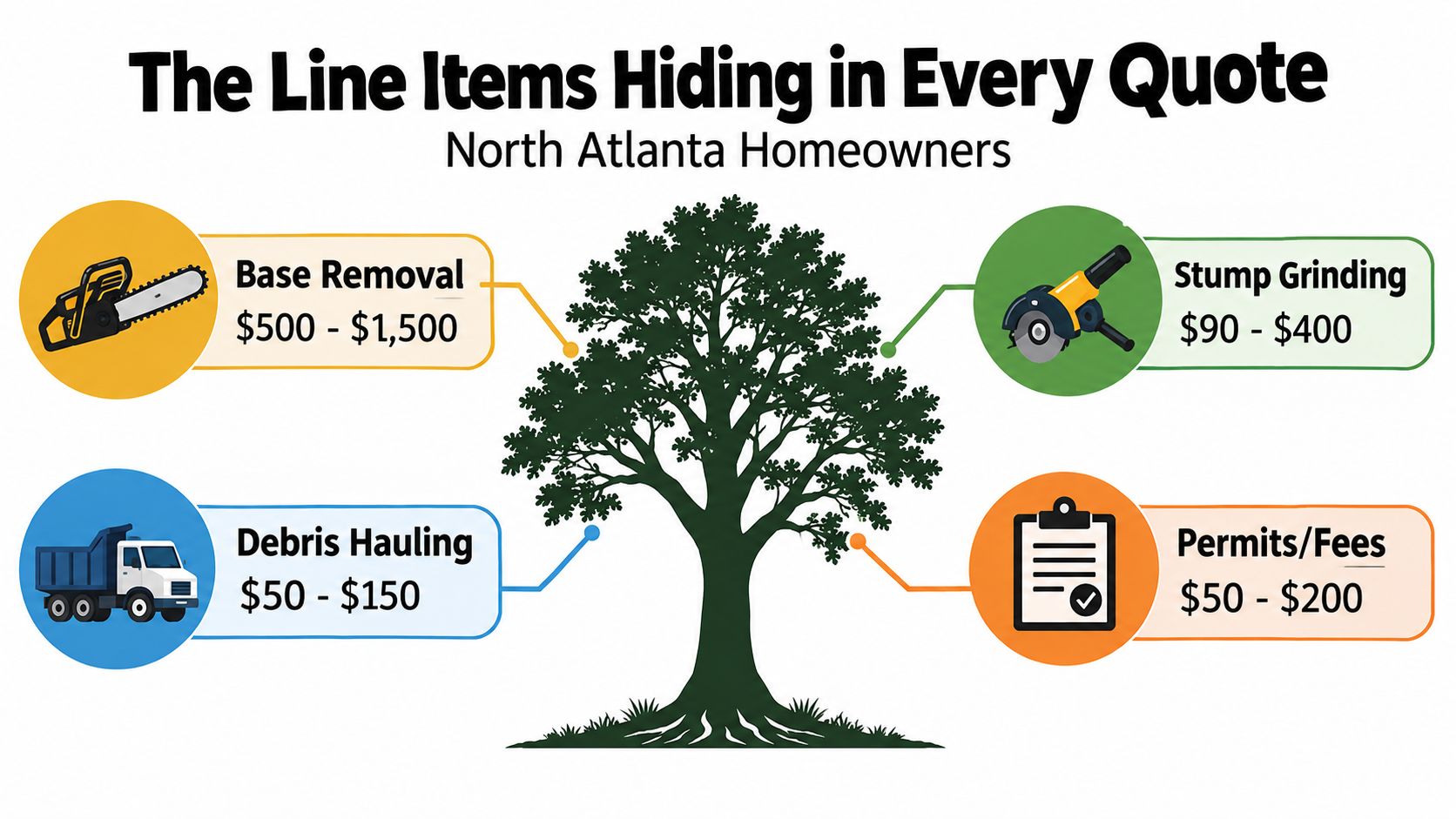
The Line Items Hiding in Every Quote
A removal quote can look reasonable until the crew finishes cutting and leaves the stump, logs, brush, chips, and damaged turf behind. Two prices for the same North Atlanta tree can differ by $1,500 because one covers a complete project while the other covers cutting only.
Stump and debris
Stump grinding commonly adds $100 to $400, depending on diameter, root flare, and machine access, according to 2026 stump and removal cost guidance. Grinding leaves chips in the cavity. Full stump removal requires excavation, additional root handling, soil management, and backfilling, so it belongs in a separate line item.
Debris handling can change the final invoice. Crews may chip brush on site, haul large trunk sections separately, or stack usable firewood where you specify. Confirm whether the estimate includes brush, logs, chips, raking, blowing, and final haul-off. Tight access in Marietta or Roswell can also require hand-carrying material to the truck, adding labor even when the tree itself is straightforward.
Emergency and crane charges
A storm-damaged tree in Cobb or Gwinnett may trigger a minimum charge and an after-hours premium. The first task may be stabilization, especially when a tree contacts a roof, blocks a roadway, or pulls against a utility line. Cleanup follows once the immediate hazard is controlled.
Crane work is often the largest add-on. A tall East Cobb pine over a house or a Roswell oak with no equipment path may justify one, but the estimate should separate mobilization, operator time, rigging, traffic control, and cleanup. Permit fees may add $25 to $150; protected-tree review can cost more.
Ask before signing: Is the price for cutting only, or does it include stump grinding, disposal, cleanup, permits, and protection for the driveway and landscape?
Matching Crew Type to Job Type
The cheapest crew isn't automatically the economical choice. A two-person operation with a chipper may handle a small maple, sapling, or accessible pine under 40 feet efficiently, but that setup isn't appropriate for a leaning oak over a roof. Low overhead doesn't replace lowering ropes, qualified climbers, or liability coverage.
An established mid-tier firm typically brings an ISA Certified Arborist, trained climbers, a bucket truck, a chipper, and documented insurance. That configuration suits many suburban removals, storm-damaged limbs, standard backyard oaks, and tree pruning jobs where the tree can be reached without a crane. Ask to see a certificate of insurance rather than relying on a verbal assurance.
A crane-equipped specialty outfit makes sense when the tree is tall, brittle, structurally compromised, or positioned within striking distance of a home, pool, power line, or neighboring structure. The crane lifts sections vertically or swings them into a controlled landing area, reducing the number of pieces that must be lowered through a confined yard. It costs more to mobilize, but the right crane can contain risk and shorten difficult work.
| Service tier | Crew and equipment | Typical price band | Best-fit jobs | Watch for |
|---|---|---|---|---|
| Budget two-person crew | Chipper, saws, basic rigging | Lower end of local range | Small, open-access trees | No proof of insurance, vague cleanup scope |
| Established mid-tier firm | ISA Certified Arborist, climbers, bucket truck, chipper | Midrange | Suburban removals, pruning, storm limbs | Confirm who performs the inspection and who supervises |
| Crane-equipped specialty outfit | Specialty rigging crew, crane, traffic control | Upper range | Tall trees, tight yards, structures, utility exposure | Ask for mobilization, hourly, and standby terms |
For work near electrical conductors, treat safety as a separate category, not an optional upgrade. This power-line tree trimming and pruning example illustrates why crews need a controlled work zone and a clear utility plan.
ANSI A300 provides a concrete performance benchmark for pruning specifications and work practices, making it more useful than a generic claim that a company follows “industry standards,” as described in ANSI A300 pruning guidance.
How to Get an Honest Quote and Avoid Surprises
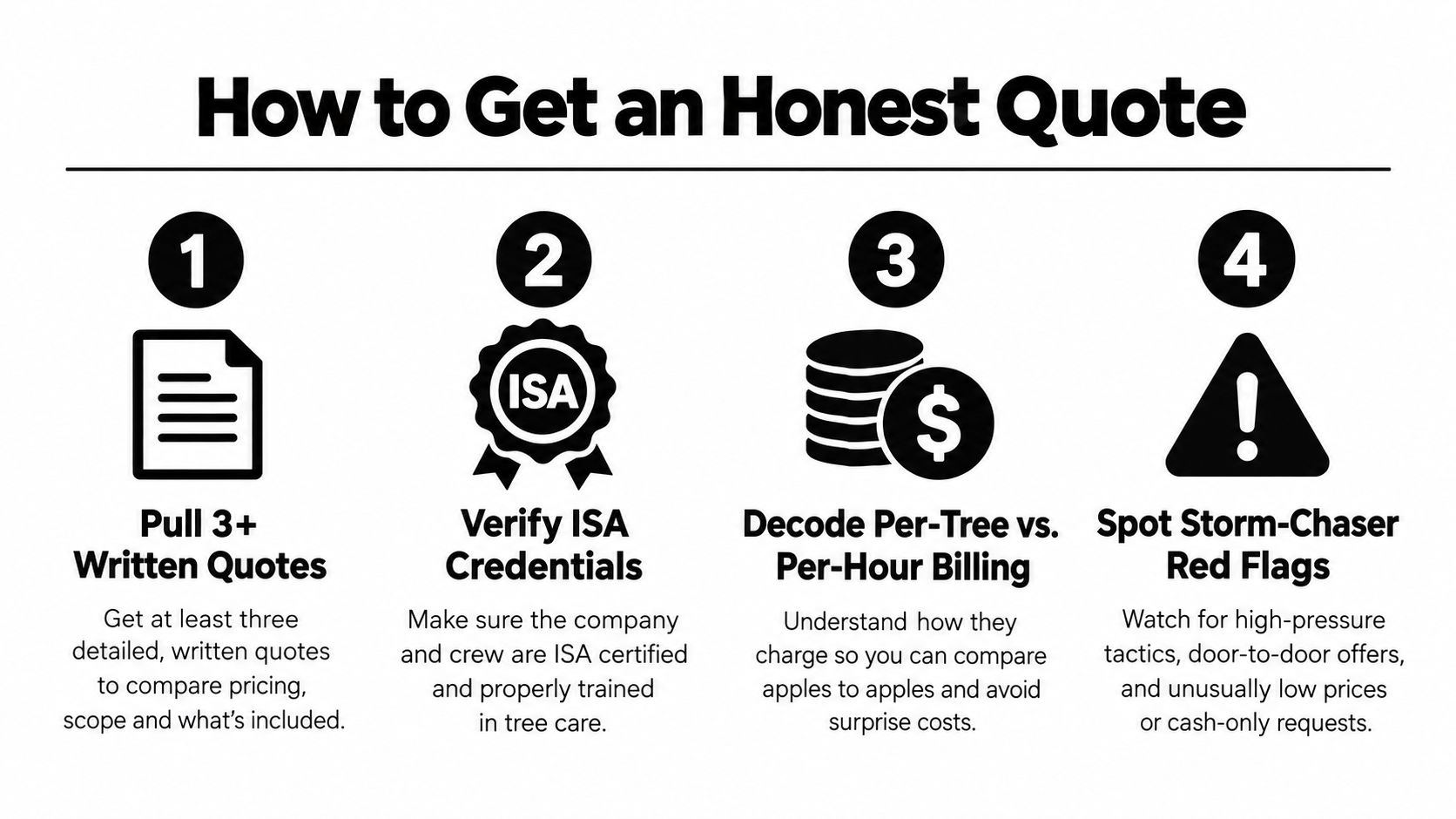
Start with a site visit. Satellite images rarely show the narrow gate, saturated soil, septic field, fence panel, pool equipment, or service line that determines whether a crew can use a bucket truck. Pull at least three written quotes, but make them comparable by giving every company the same requested scope.
- Request a written scope. Require the estimate to identify the tree, removal method, crew size, equipment, protection plan, brush handling, trunk disposal, stump treatment, and final cleanup.
- Verify qualifications and insurance. Ask for the ISA credential of the person evaluating the tree and a current certificate of liability and workers' compensation insurance.
- Decode the billing method. A per-tree price may include a defined scope. An hourly price should state the crew, equipment, minimum, and what happens if access changes.
- Separate emergency work from ordinary scheduling. Ask whether the response includes after-hours premiums, temporary stabilization, traffic control, and return visits.
- Check stump language. “Cut to ground” isn't the same as stump grinding, and stump grinding isn't the same as full stump removal.
- Tie payment to milestones. Avoid unexplained deposits over 25%, and don't accept a door-to-door “today only” price after a storm.
- Document hazardous leans. For a dangerous tree in Marietta, Roswell, or East Cobb, ask whether the arborist will provide written defect notes or pull-test documentation when appropriate.
A storm-damaged tree can also create an insurance documentation problem. Photograph the tree, roof, fence, and access area before work begins if doing so is safe, then keep the estimate and final invoice together. This tree damage and insurance reference shows why the work scope matters beyond the removal itself.
The following video offers another visual reference for evaluating tree work and quote details.
Richmond Tree Experts GA provides tree removal, stump grinding, arborist evaluations, emergency response, and written estimates for homeowners across North Atlanta. If you need a site-specific tree removal rate rather than a satellite guess, visit Richmond Tree Experts GA and request an estimate that separates removal, cleanup, stump work, equipment, and permit-related items.


