
When you get a tree service estimate, you're getting more than just a number. It's easy to think of it as a simple price tag, but a professional quote is really a detailed blueprint for the entire job. It should lay out everything from the labor and equipment involved to the safety plan and how cleanup will be handled. Knowing how to read this document is the first step toward making a smart, confident hiring decision.
Decoding Your Tree Service Estimate
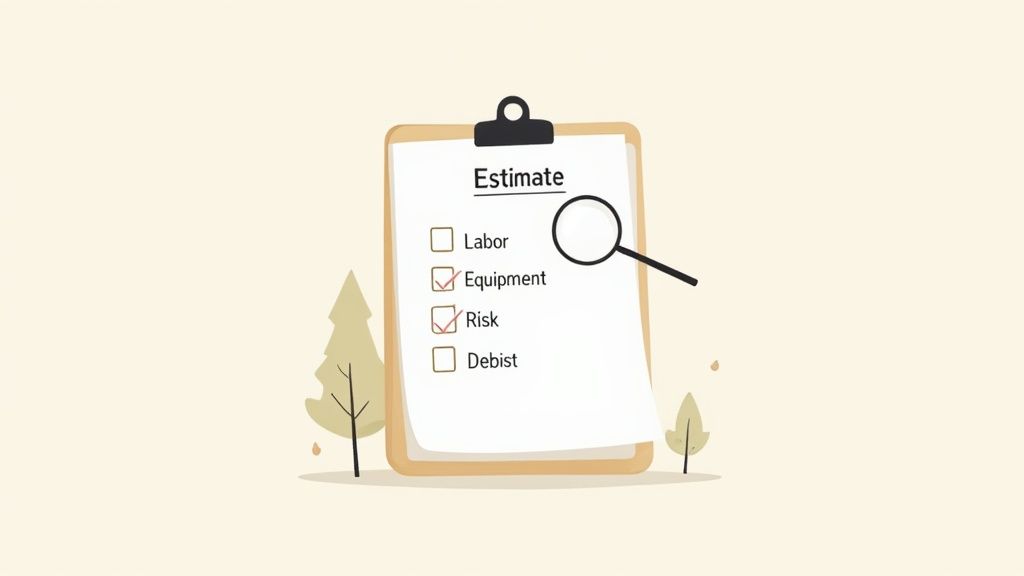
A good tree service estimate tells a story. It doesn't just list a final cost; it walks you through the scope of the project and shows you the company's level of professionalism. By breaking down the process into clear, understandable parts, it gives you a complete picture of what you're paying for. This kind of transparency is key—it helps you compare different offers fairly and spot potential hidden costs before they become a surprise.
The need for professional tree care is growing right alongside our cities. The global tree maintenance market was valued at around $15 billion in 2025 and is expected to keep climbing as urbanization continues. As more people live in and around cities, keeping our green spaces safe and healthy becomes that much more important.
Key Components of a Professional Quote
Every solid estimate should be a written, itemized document. If you get a vague, verbal-only price, consider that a major red flag. You want to see a clear breakdown of a few key areas so there's absolutely no confusion about what's included.
A good estimate will typically cover:
- Labor Costs: This is the pay for the crew's time and expertise, from the grounds crew to the certified arborist overseeing the work.
- Equipment Fees: This section details the specific machinery needed for your job, like bucket trucks, cranes, wood chippers, or stump grinders.
- Risk Assessment: A true professional will note any potential hazards, such as nearby power lines, buildings, or other obstacles that make the job more complex and affect the cost.
- Debris Removal: This clearly states whether hauling away all the logs, branches, and wood chips is part of the deal.
When it comes to understanding what you should see on a quote, here's a simple breakdown of the most important parts.
Key Components of a Standard Tree Service Quote
| Component | What It Covers | Why It Matters |
|---|---|---|
| Contact & Company Info | Company name, address, phone number, and proof of insurance/licensing. | Confirms you're dealing with a legitimate, insured business, protecting you from liability. |
| Detailed Scope of Work | A clear, step-by-step description of the services to be performed (e.g., "remove one 60ft oak," "prune deadwood"). | Prevents misunderstandings. You know exactly what work will be done and what won't. |
| Itemized Costs | A breakdown of costs for labor, equipment, debris removal, and stump grinding (if applicable). | Provides transparency and helps you understand where your money is going. |
| Project Timeline | An estimated start date and the expected duration of the project. | Helps you plan accordingly and sets clear expectations for when the work will be completed. |
| Terms & Conditions | Payment schedule, cancellation policy, and any guarantees or warranties offered. | Outlines the legal and financial obligations for both you and the company. |
Looking at this table, you can see why a detailed quote is a sign of a professional operation. It proves the company has done its homework, carefully assessed the job, and is committed to clear communication. Ultimately, that protects both you and their crew.
The Role of Modern Technology in Estimates
Getting an estimate right starts with understanding the tree itself—its size, health, and exact location. Today, this critical first step is often powered by impressive tech. Tools like 3D mapping with drones and LiDAR allow arborists to measure a tree's height, canopy spread, and closeness to your home with incredible accuracy.
This isn't just for show. This technology helps the team create a safer, more efficient work plan from the very beginning, ensuring the quote you get is built on solid data, not guesswork.
What Goes Into a Tree Service Quote? The 7 Key Factors
Ever get a few quotes for a tree job and wonder why the numbers are all over the map? It’s not random. A professional tree service estimate is a lot like looking under the hood of a car—what seems like one big job is actually a system of moving parts, and each one affects the final price.
And it's a big industry. In the U.S. alone, tree trimming services are projected to hit a massive $39.5 billion market size in 2025, mostly from homeowners like you. That tells you a lot of people are investing in their properties, making it more important than ever to know what you’re paying for. You can review market research on tree trimming services to get a better sense of the industry's scale.
So, let's pull back the curtain and break down the seven core factors that really drive the cost on your estimate.
Tree Size and Condition
This one’s the most obvious starting point. A towering, 80-foot oak is a completely different beast than a 20-foot decorative cherry tree. The sheer height and spread of the canopy directly translate to more hours on the clock for the crew, more equipment, and more risk to manage.
But it’s not just about size; the tree's health is a huge variable. A dead, diseased, or decaying tree is a liability. It's unpredictable and far more dangerous to work on. Arborists have to approach it with extra caution, often using specialized rigging to bring it down piece by piece safely. That extra care and risk naturally add to the cost.
Job Complexity and Site Accessibility
Where the tree is standing is just as critical as the tree itself. If it’s out in the middle of an open field with nothing around, that’s a straightforward job. But a tree leaning precariously over your roof, a neighbor’s fence, or—worst-case scenario—power lines? That's a high-stakes operation requiring surgical precision.
Then there’s the issue of access. Can the crew get a bucket truck or crane right up to the tree? If they have to navigate a narrow backyard gate, a steep hill, or a prized rose garden, all that heavy equipment and debris has to be moved by hand. That manual labor can dramatically increase the time and physical effort involved, and you'll see that reflected in the quote.
The Specific Service You Need
Not all "tree work" is created equal. The actual service you’re requesting will fundamentally shape the price tag.
- Tree Removal: This is usually the most expensive service. It involves the most risk, labor, and heavy equipment to safely dismantle and haul away an entire tree.
- Tree Trimming and Pruning: This is generally less intensive and costs less. The final price depends on the goal—are we just removing a few dead branches, thinning the canopy for better sunlight, or clearing limbs away from your house?
- Stump Grinding: This is almost always quoted as a separate line item. It requires a specific machine to grind the stump down below the soil level. The cost is typically based on the stump's diameter and how easy it is to get the grinder to it.
A professional estimate should always break these services down clearly. If stump grinding isn't included in the removal price, it needs to be explicitly stated. That kind of transparency prevents nasty surprises on the final bill and is a true mark of a reputable company.
Equipment and Crew Requirements
The tools for the job have a direct impact on your quote. A simple pruning job might just need some climbing gear and chainsaws. A large-scale removal, on the other hand, could call for a bucket truck, an industrial-sized wood chipper, or even a crane—all of which have significant operational costs.
The crew itself is also a major factor. A complex removal needs a larger, more experienced team, including skilled climbers, a ground crew for safety and cleanup, and a certified arborist overseeing the whole operation. Your quote accounts for their specialized training, their safety, and the high-cost insurance required to cover this kind of high-risk work. While it's a different trade, this ultimate guide to cost estimation and budgeting for roofing projects offers great parallels, showing how labor, materials, and risk all come together to determine a project's final cost.
Average Tree Service Costs In The Atlanta Area
Alright, now that we've covered the moving parts that shape a tree service estimate, let's talk real numbers here in the Atlanta metro area. Getting a feel for the typical price range is one of the best tools you can have. It helps you instantly spot a quote that's fair, one that's suspiciously low, or one that's just plain overpriced. Think of these figures as a solid starting point for your budget.
Estimated Tree Service Costs in Atlanta
To give you a clearer picture, we've put together a quick summary of what you can generally expect to pay for common tree services around Atlanta. Keep in mind these are averages—the unique details of your job will ultimately determine the final price.
| Service Type | Average Cost Range (Low) | Average Cost Range (High) | Key Influencing Factors |
|---|---|---|---|
| Small Tree Removal | $250 | $650 | Height under 30 ft, easy access, minimal risk. |
| Medium Tree Removal | $700 | $1,400 | Height 30-60 ft, may require more crew/equipment. |
| Large Tree Removal | $1,500 | $3,000+ | Height over 60 ft, high risk, crane often needed. |
| Tree Trimming/Pruning | $150 | $1,000+ | Tree size, number of branches, complexity of cuts. |
| Stump Grinding | $125 | $450 | Stump diameter, root system, equipment accessibility. |
As you can see, the final cost is a blend of the service type and several on-the-ground factors that an arborist will assess during your consultation.
Local Atlanta Tree Removal Averages
Tree removal is usually the biggest-ticket item when it comes to tree care. The price really boils down to the tree's size and how tricky the job is going to be. For a much deeper dive, you can check out our complete guide on tree removal costs in Atlanta.
But for a quick reference, here are the general price brackets you'll encounter:
- Small Trees (under 30 feet): You're typically looking at $250 to $650. These are often straightforward jobs with lower risk.
- Medium Trees (30 to 60 feet): The cost usually lands somewhere between $700 and $1,400. This size often requires better crew coordination and more substantial equipment.
- Large Trees (over 60 feet): Prices can start at $1,500 and go up to $3,000+. These are the complex, hazardous projects that demand specialized machinery like cranes and a highly skilled team.
Atlanta Costs For Trimming and Stump Grinding
Trimming and stump grinding are priced a bit differently. While they aren't as costly as a full removal, factors like size and accessibility still play a big role.
A smaller tree might only cost $150 to $400 to trim up, whereas a massive, overgrown oak requiring intricate pruning could easily top $1,000. Stump grinding is almost always priced by the stump's diameter, with Atlanta averages falling in the $125 to $450 range per stump.
One crucial tip: Never assume stump grinding is included with a tree removal. It's a separate service. If you want it done, make sure it’s listed as its own line item on your written quote.
This infographic does a great job of showing how all these different pieces of the puzzle come together to form your total estimate.

It makes it pretty clear: while things like accessibility and complexity matter, the sheer size of the tree is almost always the single biggest driver of the final price tag. It's a useful visual to keep in mind when you start collecting quotes.
How To Compare Tree Service Quotes Like An Expert
Getting a few tree service estimates can leave you scratching your head, especially when the prices are all over the map. But here’s something I’ve learned over the years: choosing the right company is about way more than just grabbing the lowest bid. A cheap quote can be a red flag for some major risks, so learning to read between the lines is key to protecting your property and making sure the job gets done right.
The first rule of thumb? Always, and I mean always, get at least three written quotes. This is your baseline. It gives you a feel for the going rate for your specific job. A single estimate tells you nothing, but three lets you instantly spot the outliers—both the quotes that seem way too high and, more importantly, the ones that are suspiciously low.
Provide Clear Information Upfront
If you want accurate quotes you can actually compare, you have to give every arborist the exact same information. Think of it like handing three different builders the same blueprint. The clearer you are upfront, the more consistent and reliable their numbers will be.
When you call for an estimate, have this info ready:
- The specific trees involved: Point out exactly which trees need attention.
- The exact services needed: Are we talking removal, pruning, or stump grinding? Be specific.
- Your primary concerns: Let them know about that big dead branch over the driveway, the proximity to your house, or any weird spots you’ve noticed.
- Cleanup expectations: Do you want every last twig and leaf hauled away? Say so.
Getting this right ensures everyone is bidding on the same scope of work. It’s the only way to make a true apples-to-apples comparison.
Look Beyond The Bottom Line Price
Once you have the estimates in hand, it’s time to do a little digging. The final price is just one piece of the puzzle. A professional quote is a window into how a company operates, from its commitment to safety to the quality of its work. Vetting your options is a critical step; our guide on how to find a trustworthy contractor online has some great tips that are just as relevant for finding a top-notch tree crew.
The cheapest bid is often cheap for a reason. It could signal a lack of proper insurance, underpaid and inexperienced workers, or a plan to cut corners on safety and cleanup.
A higher price often covers the essentials—the things that protect you from liability and guarantee the job is done to professional standards.
The Non-Negotiable Checklist For Every Quote
Use this checklist to vet every single estimate you get. If a company hesitates or can't provide everything on this list, consider it a major warning sign.
- Proof of Insurance: This is non-negotiable. Ask for current certificates for both general liability and workers' compensation. This is the most important factor because it protects you financially if an accident happens on your property.
- Detailed Scope of Work: The quote should spell everything out. It needs to clearly describe all the tasks, the kind of equipment they plan to use, and exactly how they’ll handle debris removal.
- Professional Certifications: Look for credentials. Does the company have an ISA (International Society of Arboriculture) Certified Arborist on staff? This is a huge indicator of real expertise and a commitment to industry best practices.
- Clear Timeline: A pro will give you an estimated start date and tell you how long the project should take. It shows they respect your time and know how to plan their work.
Warning Signs To Spot In A Tree Service Quote
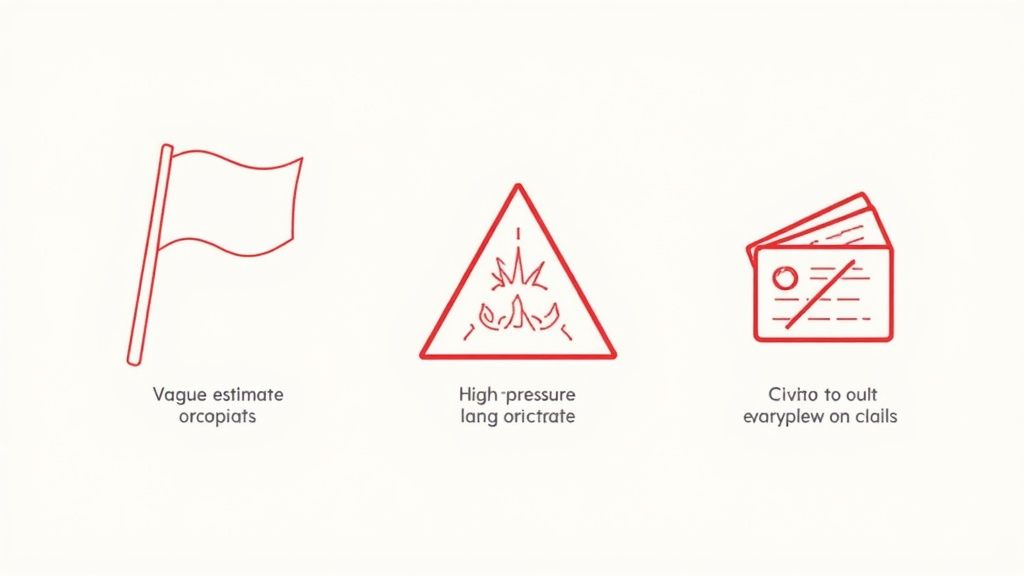
A cheap quote can quickly turn into an expensive, property-damaging mistake. We all love a good deal, but when it comes to tree work, a price that seems too good to be true usually is. An unbelievably low tree service estimate is often a major red flag.
It can be a dead giveaway for a company cutting corners—maybe they lack proper insurance, employ unqualified workers, or use unsafe practices that put your home at serious risk. Learning how to spot these warning signs is the key to telling the real pros from the risky operators. Your goal here isn't just to find the cheapest price, but to find a company that values safety and professionalism over making a quick buck.
A quality estimate is almost always a sign of a quality business.
Vague Verbal-Only Quotes
One of the biggest red flags you'll encounter is a company that won’t put anything in writing. A price casually scribbled on the back of a business card or tossed out over the phone? That’s not a contract. It leaves you totally exposed if they suddenly change the scope of work or try to tack on hidden fees later.
A professional, trustworthy company will always provide a detailed, itemized document. It should clearly outline:
- The exact work to be performed
- The total cost and payment terms
- Proof of their insurance and credentials
This written agreement protects both you and the company, making sure everyone is on the same page before a single branch is cut.
High-Pressure Tactics And Large Upfront Payments
Be very wary of any company that tries to rush you into a decision. If you hear things like "this deal is only good for today" or they claim to have "leftover materials from a job down the street," your alarm bells should be ringing. Those are common tactics used by less-than-reputable outfits.
A true professional will give you the space and time you need to review their quote and compare it with others.
A demand for a large upfront payment or the full amount in cash is another serious warning sign. While a small deposit can be normal, paying more than 10-20% before the job is complete is a huge risk. Reputable companies have the financial stability to cover their initial operating costs.
Lack Of Credentials And Unsafe Practices
Finally, and this is a big one, pay close attention to the company’s qualifications and the methods they plan to use. A legitimate tree service will have no problem showing you proof of their liability insurance and workers' compensation coverage. If they hesitate, get defensive, or just can't provide it, walk away. Period.
Also, listen for suggestions of harmful practices like "tree topping"—a brutal method of just chopping the entire top off a tree—or using climbing spikes on a tree that isn't being removed. These techniques cause serious damage and are a clear sign of an untrained crew.
For any complex job, your best bet is to work with a team led by a certified arborist in Atlanta. They have the training to understand proper tree biology and the highest safety standards in the industry.
You've done the homework and now you know what goes into a tree service quote. With a solid grasp of the cost factors and the red flags to watch out for, you’re in a great position to move forward. The real goal isn't just to find the cheapest price, but to find a true partner who values safety, transparency, and doing the job right.
Let's quickly recap the essentials for getting solid tree service estimates:
- A good estimate is a detailed game plan, not just a number on a piece of paper.
- The tree's size, its location on your property, and the complexity of the job are always the biggest drivers of cost.
- Always, always get at least three written, itemized quotes to compare apples to apples.
- Checking for proper insurance and certifications isn't just a suggestion—it's the most critical step you can take.
Armed with this knowledge, you're ready to make a smart, informed decision that protects both your property and your wallet. It’s about looking past the price tag to find a professional you can genuinely trust with the safety of your home.
The final step is to reach out and connect with a team that lives by these principles. We invite you to contact us at Richmond Tree Experts for a clear, comprehensive estimate. You'll be partnering with a team that believes in straightforward communication from the first look at your tree to the final branch being cleaned up, giving you complete peace of mind.
Of course. Here is the rewritten section, crafted to sound like it was written by an experienced human expert, following all your specified requirements.
Still Have Questions About Tree Service Estimates?
Even after breaking down all the factors that go into a tree service estimate, you probably still have a few questions rolling around. That’s perfectly normal. Let's tackle some of the most common ones we hear from homeowners right here.
Are Free Estimates Actually Free?
Yes, they absolutely should be. Any reputable, professional tree care company sees a free, no-obligation estimate as a fundamental part of doing business. It's the only way for us to get on your property, properly assess the complexity of the job, spot any potential hazards, and give you a quote that's actually worth anything.
Honestly, you should be a little skeptical of any company that wants to charge you just to come out and give you a basic quote.
Why Are the Quotes I'm Getting for the Same Job So Different?
This is a big one. When you see a huge gap in pricing, it often tells you a lot about a company's professionalism and how thoroughly they're planning the job. A higher quote isn't just a bigger number; it’s usually accounting for the crucial things that protect you and your property.
What are those things?
- Comprehensive insurance coverage (this includes both liability and workers' compensation—non-negotiable).
- Investing in safe, modern, and efficient equipment that won't tear up your yard.
- Paying for a highly skilled and properly trained crew who knows what they're doing.
- Guaranteeing a complete and total site cleanup after the work is finished.
A suspiciously low bid is almost always a red flag that corners are being cut on one or more of these vital components. And when that happens, you're the one taking on all the risk.
Do I Really Need to Be Home for the Estimate?
While it's technically possible for an arborist to do a quick assessment from the outside, it is always, always better if you're there. When you can walk the property with the expert, you get to point out that one specific branch that worries you or ask direct questions about how they plan to tackle the job.
This face-to-face conversation is the single best way to make sure everyone is on the same page. It eliminates misunderstandings and guarantees you get the most accurate, reliable tree service estimate possible.
Ready to get a clear, transparent, and accurate estimate for your tree care needs? The team at Richmond Tree Experts GA is here to help. Contact us today for a free, on-site consultation and partner with Atlanta's trusted arborists.
Need a tree taken down safely? Richmond Tree Experts has worked on Marietta and Metro Atlanta trees since 1985, and every job is looked at by an ISA Certified Arborist before it is priced. Start with tree removal, or see everything we do: tree removal, stump grinding and arborist services across Cobb, Fulton, Cherokee, Gwinnett and DeKalb counties (service areas).
Call (770) 974-3964, 7am to 11pm every day, or request an estimate online.
