

In the high-stakes world of tree care, your insurance policy is the single most important piece of safety gear you own. The absolute essentials for any tree service are General Liability to cover property damage, Workers’ Compensation for your crew's injuries, and Commercial Auto for your work vehicles. Together, they form a protective shield against a financially devastating event.
Why Insurance Is Your Most Important Safety Gear
Would you ever send a climber up a towering oak without a rope and a safety harness? Of course not. But operating a tree service business without the right insurance is just as reckless.
In an industry where one small miscalculation can lead to catastrophic property damage or severe injuries, insurance isn't just another business expense—it's the very foundation of your company's survival. It acts as a financial safety net, making sure one bad day doesn’t bring your entire operation crashing down.
The financial stakes are incredibly high. The average annual cost for comprehensive tree service insurance is around $5,869, a number that truly reflects the high-risk nature of our work. This investment covers the essential policies that protect you from the unique and costly dangers arborists face every single day. You can find more detailed cost breakdowns on MoneyGeek.com.
Without this protection, your business and even your personal assets are completely exposed.
The Core Policies of Protection
Think of your insurance portfolio like specialized gear in your truck. Each policy is designed to protect you from a specific type of hazard. You wouldn't use a delicate pruning saw for heavy felling, and in the same way, you need distinct coverages for different kinds of risk. These foundational policies work together to create a comprehensive defense.
This diagram breaks down the primary types of "insurance safety gear" every tree service absolutely needs to have.
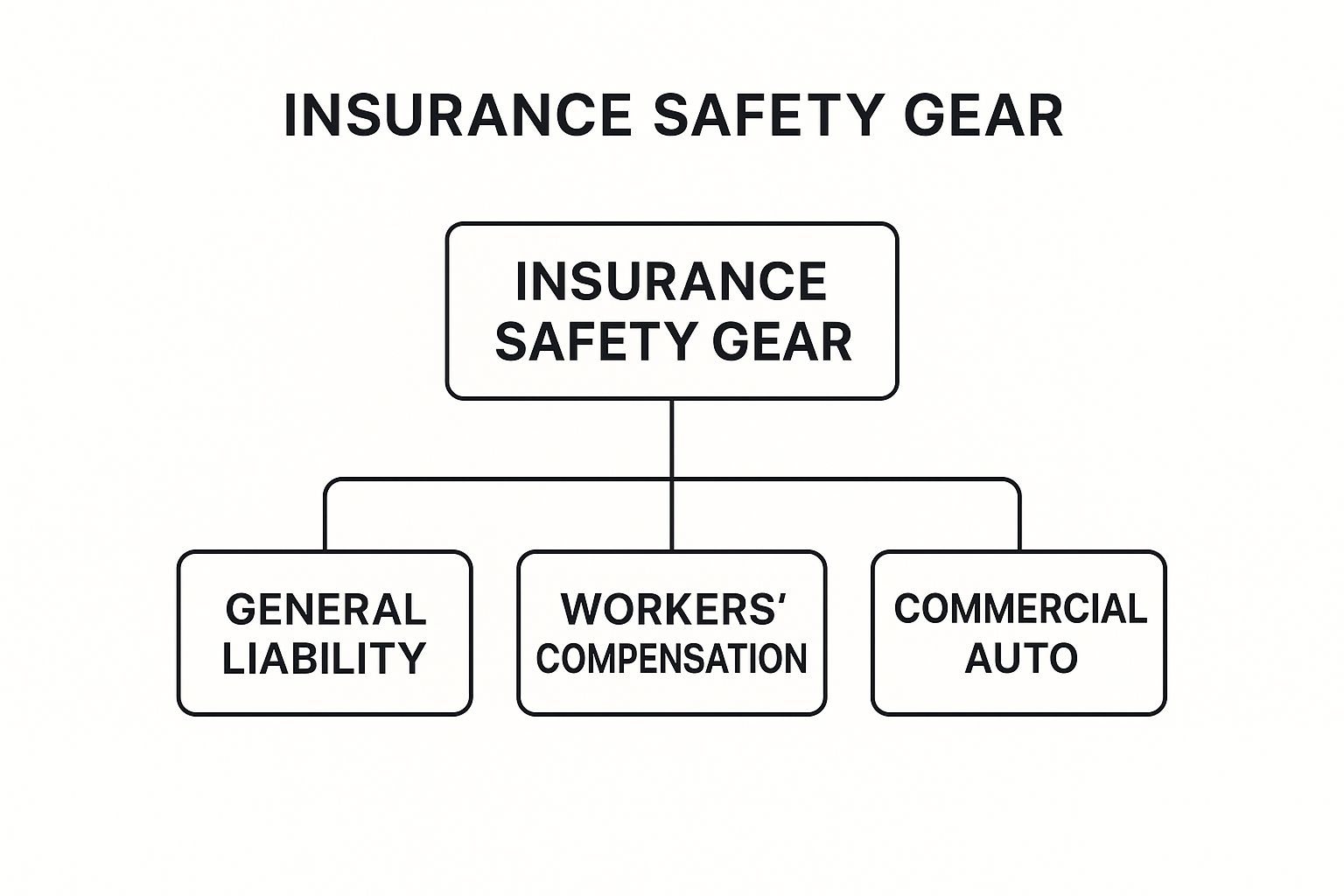
As you can see, General Liability, Workers' Comp, and Commercial Auto form the essential trio of protection for any arborist business.
To quickly summarize these core coverages, here’s a table breaking down what each policy is designed to handle.
Essential Insurance for Tree Service Professionals
| Policy Type | What It Protects You From |
|---|---|
| General Liability | Third-party property damage (e.g., a branch falling on a client's roof) and bodily injury to non-employees. |
| Workers' Compensation | Medical expenses and lost wages for employees injured on the job. A must-have for your crew's safety. |
| Commercial Auto | Accidents involving your work trucks and vehicles, covering liability, damage, and injuries. |
| Inland Marine | Damage or theft of your specialized equipment (chainsaws, chippers, stump grinders) while in transit or on a job site. |
| Umbrella Liability | Extra liability coverage that kicks in when the limits of your other policies are exhausted by a major claim. |
This combination is what it means to be truly protected in the tree care industry.
For a tree care professional, being "fully insured" means having a robust combination of policies that address every potential angle of risk, from a falling branch hitting a neighbor's roof to an employee injury on the job site. This comprehensive approach is non-negotiable for long-term success and client trust.
Understanding General Liability Insurance for Arborists
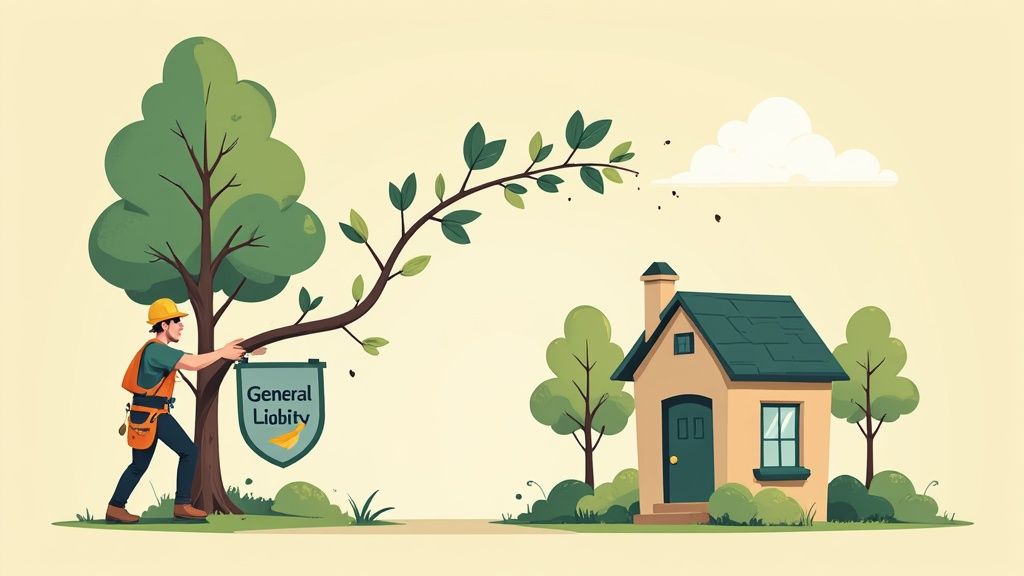
If there’s one non-negotiable piece of your insurance puzzle, it’s General Liability (GL). Think of it as the foundational shield protecting your tree service business from the accidents that can happen when you're working on someone else's property.
Forget the generic "slip-and-fall" scenarios you hear about for other businesses. For an arborist, the risks are far more dynamic and potentially destructive. This is your first line of defense when your work causes unintended harm.
Imagine a heavy oak limb unexpectedly snaps during removal, crashing right through a client’s roof. Or maybe a sudden gust of wind sends debris flying from your wood chipper, striking a neighbor or cracking their car's windshield. Without GL insurance, the cost of those repairs, medical bills, and any lawsuits would come straight from your pocket.
This coverage is designed to handle claims of bodily injury or property damage to others. It’s the bedrock of any solid tree service insurance plan because it directly addresses the biggest risks of your job.
Decoding Your Coverage Limits
When you look at a policy, you’ll see numbers like "$1 million per occurrence / $2 million aggregate." It sounds like insurance jargon, but it’s actually pretty simple.
- Per Occurrence Limit: This is the absolute maximum your insurance will pay out for a single incident. So, if that falling limb causes $50,000 in roof damage, it’s comfortably covered by a $1 million per-occurrence limit.
- Aggregate Limit: This is the total amount your policy will pay for all claims combined during your policy period, which is usually one year.
It helps to think of it like a bank account. The "per occurrence" limit is the most you can write a single check for. The "aggregate" is the total balance you have in the account for the entire year. To get a deeper look at how this all works, there are great resources explaining what liability insurance for contractors entails.
A strong General Liability policy isn't just a good idea—it's essential. It’s the firewall between a manageable accident and a disaster that could shut down your business for good.
What General Liability Typically Excludes
Just as important as knowing what your policy covers is knowing what it doesn't. GL insurance isn’t a catch-all, and you need to be aware of the common gaps.
You’ll typically find that these things are not covered by a standard GL policy:
- Employee Injuries: If one of your crew members gets hurt on the job, that’s what Workers' Compensation is for.
- Damage to Your Own Gear: Your stump grinder gets damaged? You’ll need a different coverage, like Inland Marine, to handle that.
- Professional Mistakes: Let’s say you give some bad advice about a tree's health and it dies. That would fall under a Professional Liability (or Errors & Omissions) policy. This is why it’s so important that a certified arborist in Atlanta, GA carries this specific coverage for consulting work.
- Vehicle Accidents: Any incident involving your work trucks on the road is handled by your Commercial Auto policy, not GL.
Understanding where one policy ends and another begins is the key to building an insurance strategy that truly protects your business from every angle.
The Unbreakable Rule of Workers' Compensation
If General Liability insurance is the shield that protects your business from the outside world, then Workers' Compensation is the armor that protects your own crew. For any tree service in Atlanta with employees, this isn't just a smart idea—it's a non-negotiable legal and moral requirement.
Think of it as the ultimate safety net for the people doing one of the most dangerous jobs out there. This policy is built specifically to cover medical bills and a chunk of lost wages if an employee gets hurt on the job. With all the risks in tree work—falls, equipment accidents, you name it—the chance of a serious injury is always just one slip away. Workers' Comp ensures your team can recover without going broke, and it shields your business from the kind of lawsuit that could shut you down for good.
How Your Premiums Are Determined
Workers' Comp is a different beast than other insurance policies. The cost is tied directly to your payroll and how risky your industry is. Unsurprisingly, the tree care profession gets one of the highest risk ratings out there. Insurers know the likelihood of a claim is far greater for an arborist than for someone working in an office.
That high-risk status hits your wallet hard. The cost is usually calculated as a percentage of your payroll, often falling somewhere between $15 and $25 per $100 of payroll. Let that sink in. A company with a $500,000 annual payroll could be looking at an insurance bill of $75,000 to $125,000 a year. It's a massive operational cost, and as claims get more complicated, those premiums just keep climbing. You can find more details on these tree business insurance costs at Arbornote.com.
In the tree care industry, Workers' Compensation is the ultimate expression of accountability. It demonstrates a commitment to your team's well-being and is a non-negotiable component of any legitimate, professional operation.
The Consequences of Non-Compliance
Trying to operate without Workers' Compensation is a high-stakes gamble you can't afford to lose. Georgia, like other states, has strict rules for any business with employees, and ignoring them will bring a world of hurt down on your company.
Failing to carry the proper coverage can lead to:
- Crippling Fines: State agencies won't hesitate to slap you with huge daily fines for every single day you operate without the required policy.
- Business Shutdown: The authorities can—and will—issue stop-work orders, bringing your entire operation to a screeching halt until you get compliant.
- Personal Liability: This is the big one. If an employee gets injured and you don't have coverage, you could be held personally responsible for all their medical bills and lost wages. We're talking about the kind of debt that can bankrupt your business and put your personal assets on the line.
At the end of the day, meeting these tree service insurance requirements isn't just about following the law. It’s about protecting the very people who make your business possible. Taking care of your team is the smartest and most effective way to protect your entire company.
Essential Coverages Beyond the Basics
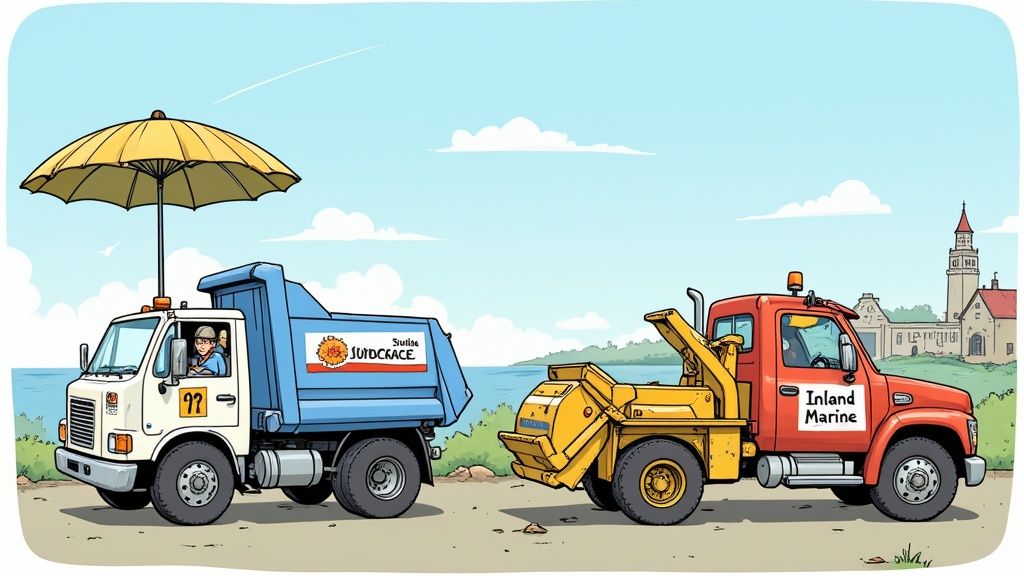
Think of General Liability and Workers' Comp as the foundation of your insurance house. They’re absolutely critical, but they won't keep the rain out on their own. To build a truly solid shield around your tree service business, you need to add a few more specialized policies to the mix.
These extra coverages are designed to handle the unique risks arborists run into every single day. We're talking about everything from a fender bender on the way to a job to having thousands of dollars of equipment stolen overnight. Without them, you're leaving some huge, costly gaps in your protection.
A smart insurance strategy knows that risk doesn’t just stay on the client's property. It’s right there with you in the truck on the highway and follows your gear from one site to the next.
Commercial Auto Insurance: Your Personal Policy Won’t Cover It
See that heavy-duty pickup with your logo wrapped on the side? As soon as you start using it for work, your personal auto insurance policy wants nothing to do with it. Driving to a quote, hauling a chipper, or even just grabbing supplies—it all requires a dedicated Commercial Auto policy.
It's a common mistake, but a costly one. Personal policies have crystal-clear exclusions for business use. If you get into an accident while you're on the clock, a claim on your personal insurance will be denied flat-out. That leaves you on the hook for every last penny of the damages.
A Commercial Auto policy gives you much higher liability limits built for business risks and covers the essentials:
- Bodily Injury Liability: For when you cause an accident that injures someone else.
- Property Damage Liability: To fix or replace the other person's car or damaged property.
- Collision Coverage: For repairs to your own work truck after an accident.
Inland Marine: Protecting Your Most Valuable Gear
Here’s one of the biggest misunderstandings in the tree care business. Your General Liability policy covers the damage your work causes, not damage done to your expensive equipment. So, if your $50,000 wood chipper gets stolen from a job site or damaged while you're hauling it, GL won't pay a dime.
That’s where Inland Marine insurance saves the day.
The name is a little weird, but just think of it as property insurance for your tools and equipment once they leave your shop. It protects your gear from theft, damage, or loss, whether it’s sitting on a trailer, being used on a job site, or in transit between locations. For any arborist with a serious investment in chainsaws, stump grinders, and chippers, this coverage isn't just nice to have—it's essential.
Protecting your equipment is just as critical as protecting your liability. Inland Marine insurance is the policy that ensures a stolen chipper or a damaged stump grinder is a temporary setback, not a financial catastrophe.
Specialized Policies for Unique Risks
Beyond your trucks and tools, some tree services need even more specific protection, depending on the kind of work they do. These policies cover you for the professional advice you give and prepare you for the absolute worst-case scenarios.
Professional Liability Insurance is a must-have for certified arborists who do consulting. If you diagnose a tree's health, give advice, and that tree later fails and causes damage, this policy protects you. It's also known as Errors & Omissions (E&O) insurance, and it shields you from claims of negligence or just plain bad advice.
Umbrella Insurance is exactly what it sounds like: a giant safety net. It kicks in after your other policies—like General Liability or Commercial Auto—have paid out their maximum limit. One catastrophic accident or lawsuit can easily blow past a standard $1 million policy. An Umbrella policy is the affordable way to stack millions more in coverage on top, preventing a single massive claim from shutting your business down for good.
Meeting Client and State Insurance Requirements
The insurance policies you carry aren't just for your own peace of mind—they're often your ticket to winning bigger and better jobs. The specific insurance requirements you'll need to meet can feel like a moving target. They shift depending on state laws and, more often than not, the demands of your clients.
While a residential homeowner might not think to ask for proof of insurance, it’s a whole different ballgame with commercial clients, municipalities, and property management associations. These larger organizations are extremely risk-averse and will almost always require a Certificate of Insurance (COI) before your crew even steps onto their property. This document is your golden ticket, proving you have the right coverage to handle the job.
Why Clients Demand Higher Limits
It's common for commercial clients to set minimum liability limits, often starting at $1 million but frequently asking for $2 million or more. Why the high bar? They get it. They understand the immense potential for damage in tree work and want to know your policy is big enough to cover a catastrophic event without the liability falling back on them.
On top of that, these clients will usually ask you to name them as an "additional insured" on your policy. This is a crucial step that extends your liability protection to cover them for any work you perform. It’s a standard request, and being prepared for it shows you’re a professional who can play in the big leagues.
Your Certificate of Insurance is more than just a piece of paper; it’s a powerful marketing tool. It instantly communicates professionalism, builds trust, and gives clients the confidence to hire you over less-prepared competitors.
Staying Ahead of Regulations
Compliance isn't a "set it and forget it" kind of thing. As the tree care industry grows, regulatory bodies are tightening safety requirements, which has a direct impact on insurance. For instance, OSHA is always advancing new safety standards, and failing to keep up can lead to denied claims, higher premiums, or even losing your insurability altogether.
Ultimately, having solid insurance coverage is a massive competitive advantage. It opens doors to more lucrative contracts and gives clients the reassurance that they're making a safe choice. For clients, vetting a contractor's credentials is just as important, which is why we've detailed how to find a contractor online safely and effectively.
How to Lower Your Insurance Premiums
Watching your insurance premiums climb can feel like just another unavoidable cost of doing business, but it doesn't have to be. Your rates aren't set in stone. With the right game plan, you can take control and bring those costs down without ever sacrificing the quality of your coverage.
Think of it like preventative maintenance for your business's finances—a little proactive effort now can save you a ton of money down the road.
The single most powerful way to lower your insurance costs is to show insurers you're a safe bet. That all starts with a rock-solid, well-documented safety program.
Build a Real Safety Culture
A formal safety program isn't just about ticking a box or avoiding accidents; it's one of your best negotiating tools. Insurance companies are far more willing to offer better rates to businesses that can prove they're serious about managing risk. This means moving beyond casual warnings and creating a tangible safety culture your whole crew lives by.
What does that look like in practice?
- Written Safety Manuals: Get everything down on paper. Document all your procedures, from daily chainsaw checks to your emergency response plan.
- Regular Tailgate Meetings: Kick off each day with a quick, consistent safety talk. It keeps safety at the front of everyone's mind before the first cut is ever made.
- Zero-Tolerance PPE Policy: Make sure every single crew member uses their required personal protective equipment on every job. No exceptions.
This documented, consistent approach proves to insurers that you are actively working to prevent the very claims they dread paying out.
Your claims history is your greatest asset. Your Experience Modification Rate (EMR) for workers' comp is basically a report card on your safety record. A score below 1.0 tells insurers you're safer than the average tree company and can unlock some serious premium discounts.
Invest in Your Team and Your Network
Certifications are another powerful signal to insurers that your team is made up of professionals, not amateurs. When you encourage and help fund credentials like the Certified Treecare Safety Professional (CTSP), you're demonstrating a commitment to the highest industry standards. That investment in your people often pays for itself through lower insurance premiums.
Finally, don't try to navigate this alone. Partner up with an insurance broker who actually specializes in the tree care industry. They live and breathe the unique risks you face and have connections with carriers who offer programs built specifically for arborists. Their expertise helps you find the right coverage at the best possible price, ensuring you're fully protected without overpaying.
It's always smart to see how other high-risk industries handle their coverage, too. For a different perspective, you can find some interesting parallels in articles about managing drone insurance costs and coverage.
Common Insurance Questions Answered
When you're running a tree service, a few insurance questions seem to pop up over and over again. It's totally understandable. Getting straight, simple answers is the only way to make sure your business is actually covered, without any of those confusing gray areas that can come back to bite you.
Let's break down a few of the most common terms and sticky situations you'll run into.
Subcontractors and Workers Comp
This is a big one: "Do I really need workers' comp for my 1099 guys?" The answer couldn't be more critical. If a subcontractor working under your company name gets hurt and doesn't have their own workers' comp policy, guess who's on the hook? You are. Your business could be held liable for all their medical bills and lost wages.
Here's a non-negotiable rule of thumb: Always, always get a Certificate of Insurance from every single subcontractor before they even think about stepping onto a job site. It's a simple piece of paper that protects your entire business from being financially wiped out by their injuries.
Bonded vs Insured Explained
You see "bonded and insured" everywhere, but they aren't the same thing. They protect against completely different problems.
- Insured: This is all about your liability insurance. It’s there to protect your business by covering the costs if your work accidentally damages someone's property or injures a person. A branch falls on a car? That's what insurance is for.
- Bonded: A surety bond is designed to protect your client. Think of it as a financial guarantee that you’ll do the job right and operate ethically. If you take a deposit and disappear or commit fraud, the bond is there to pay your client back.
Choosing General Liability Limits
So, how much general liability coverage is really enough? A $1 million policy is a decent starting point for most residential jobs, but in the world of professional tree care, it's often just the bare minimum.
Plenty of commercial clients, municipalities, and HOAs in places like Alpharetta and Roswell won't even look at your bid unless you carry at least $2 million in coverage. Stepping up to higher limits does more than just get your foot in the door for bigger contracts. It sends a clear signal that you are a serious, professional operation ready for anything—including the high-stakes, complex jobs that come with storm-damaged tree removal.
Need a tree taken down safely? Richmond Tree Experts has worked on Marietta and Metro Atlanta trees since 1985, and every job is looked at by an ISA Certified Arborist before it is priced. Start with tree removal, or see everything we do: tree removal, stump grinding and arborist services across Cobb, Fulton, Cherokee, Gwinnett and DeKalb counties (service areas).
Call (770) 974-3964, 7am to 11pm every day, or request an estimate online.

