

When you start searching for a "tree transplant service near me," you're doing more than just looking for someone to dig up a tree. You're trying to save a valuable, living piece of your landscape. Professional tree transplanting is a highly specialized service, a world away from simple tree removal. It demands a deep understanding of tree biology, the right heavy-duty equipment, and meticulous planning to give a tree the best shot at not just surviving, but thriving in its new home.
Your Guide to Professional Tree Transplanting

Think of professional tree transplanting like a delicate surgical procedure for one of your property's most cherished landmarks. It's a true blend of art and science, all aimed at preserving the character, shade, and value that only a mature tree can provide. Unlike planting a tiny sapling and waiting decades for it to grow, transplanting delivers an immediate, dramatic impact.
This guide is designed to be your complete resource, walking you through everything you need to know. We’ll break down the process from start to finish, talk about typical costs, and give you the key insights you need to make a confident decision. Our goal is to pull back the curtain on this service and show you why saving a mature tree is often the smartest choice for your property and the local environment.
Why Homeowners Choose to Transplant Trees
There are a lot of practical, real-world reasons why you might consider moving a tree instead of just cutting it down. Seeing if your situation fits one of these common scenarios can help you decide if this service is right for you.
Here’s what we see most often:
- Home Renovations or Construction: A planned home addition, a new pool, or an expanding driveway might be on a collision course with a beloved tree's current spot. Transplanting saves the tree from becoming a casualty of construction.
- Landscape Redesign: Sometimes you just have a new vision for your yard. You might want to create a new garden layout, open up your sightlines, or move a tree to a spot where it can get the sunlight and space it needs to truly flourish.
- Improving Tree Health: A tree can simply be in the wrong place. Maybe it's too close to your home's foundation, getting crowded out by other trees, or stuck in poor soil. Relocating it can literally give it a new lease on life.
- Preserving a Sentimental Tree: It could be a tree planted by a grandparent or one that's been a silent witness to your family's history. Moving it means you get to keep that history right there with you.
A successful tree relocation is a testament to careful planning and expert execution. The process respects the tree as a living organism, focusing on minimizing stress and creating the ideal conditions for it to thrive in its new home.
Ultimately, choosing a professional tree transplant service near me is an investment in the future of your landscape. It's a proactive step that protects a major asset, ensuring your mature tree continues to provide beauty, shade, and value for many years to come. All across the area—from Cumming and Johns Creek to Marietta and East Cobb—homeowners are discovering just how rewarding it is to preserve their established trees.
Why Transplant a Mature Tree Instead of Removing It?
When a big tree is in the way of a new patio, a home addition, or a landscaping overhaul, the first thought is usually to just cut it down. It feels like the quickest, most straightforward fix. But that thinking skips over a much better alternative that saves decades of growth and preserves a massive asset on your property: transplanting.
Choosing to move a mature tree instead of turning it into firewood is a lot like saving a historic building instead of demolishing it. You're preserving its character, its history, and all the benefits you can't get back overnight. A tiny new sapling will take 20, 30, or even 50 years to offer the same cooling shade, commanding presence, and ecological benefits that a mature tree provides right now.
The Instant Value of a Mature Tree
A large, healthy tree is one of the most valuable things on your property. It’s not just nice to look at; it's a working part of your home's ecosystem. Cutting it down erases that value in an afternoon, while transplanting carefully relocates and protects it.
This decision has real financial and environmental consequences. The upfront cost of a professional tree transplant might seem high, but it’s an investment that pays you back immediately in several huge ways.
- Property Value: It’s no secret that mature trees make a property more desirable. They can boost a home's value by as much as 15%. Saving that beautiful old oak or magnolia keeps your curb appeal and marketability sky-high.
- Energy Savings: The deep shade from a large tree can slash a home's summer air conditioning costs by up to 30%. A small replacement tree won’t be able to do that for decades.
- Environmental Impact: An established tree is a carbon-eating, air-filtering machine. It absorbs incredible amounts of CO2, pulls pollutants from the air, and helps manage heavy rainfall.
Moving a tree is an act of preservation. It acknowledges that some things of value simply cannot be replaced quickly. It’s a commitment to maintaining the established character and ecological health of your landscape.
This choice is especially important in our rapidly growing suburbs. As areas like Cumming, Alpharetta, and Milton expand, we lose a lot of our valuable tree canopy. Professional transplanting is a direct way to fight that trend. A single mature tree can absorb around 48 pounds of CO2 every year, while a young sapling might only manage 10 pounds. You can read more about how tree preservation supports climate and biodiversity goals to see how local actions make a big difference.
Navigating Local Ordinances and Regulations
Here in North Georgia, the decision to remove a large tree often isn't just up to you. Many of our local governments have tree ordinances in place to protect the urban canopy. In counties like Forsyth, Cobb, and Gwinnett, you can face hefty fines—sometimes thousands of dollars—for cutting down a "specimen" tree without the right permits.
Transplanting often presents the perfect solution, satisfying both your project goals and these local rules. For a commercial property manager in East Cobb or Marietta, this is a game-changer. Relocating a large-caliper tree on-site can fulfill 100% of ordinance requirements, helping you avoid costly penalties and frustrating project delays. An experienced local firm like Richmond Tree Experts GA knows these regulations inside and out and can handle the permitting process for you, ensuring your project stays on track and fully compliant.
Transplant vs Remove and Replant a Quick Comparison
So, how do you make the final call? It helps to lay the options side-by-side. While removing and replanting a small tree might seem cheaper at first glance, the long-term value of transplanting often makes it the smarter financial and environmental choice for Atlanta homeowners.
This table breaks down the key differences to help you decide.
| Factor | Tree Transplanting | Remove & Replant |
|---|---|---|
| Aesthetic Impact | Immediate. You keep the full, mature look of the tree. | Delayed. It takes decades for a sapling to mature. |
| Property Value | Preserves or increases existing property value instantly. | Temporarily decreases value until the new tree grows. |
| Environmental Benefits | Maintains high levels of shade, CO2 absorption, and air filtering. | Resets benefits to near zero, slowly rebuilding over time. |
| Initial Cost | Higher upfront investment due to specialized equipment and labor. | Lower initial cost for removal and a small replacement tree. |
| Ordinance Compliance | Often the preferred method for satisfying local tree preservation laws. | May require significant fees or planting multiple new trees to comply. |
When you look at the whole picture—from immediate curb appeal and energy savings to long-term property value—transplanting a beloved mature tree often proves to be the wisest investment. It keeps your landscape beautiful and your property valuable without missing a beat.
The Professional Tree Transplanting Process Step by Step
Moving a big, established tree isn't just a matter of digging a hole and plopping it in. It’s less like weekend gardening and more like a carefully planned surgical procedure. When you bring in a professional tree transplant service, you're hiring a team that gets the delicate mix of biology, heavy machinery, and precise timing needed to pull it off.
The whole operation revolves around one critical goal: minimizing transplant shock. This is the stress a tree goes through when it's uprooted, and it can seriously affect its chances of survival. A seasoned arborist has a step-by-step process designed to protect the tree at every turn, reducing that shock as much as possible.
From the first soil test to the last watering, every move is intentional. This isn't just about getting the tree from point A to point B; it's about making sure it thrives for years to come. Knowing that experts are handling the details gives you peace of mind and lets you focus on how great that tree will look in its new home.
This flowchart lays out the big decisions in tree management. It shows how transplanting stands out as the choice for preserving a tree you already love, rather than starting over.

As you can see, transplanting keeps the immediate value and beauty of a mature tree. The alternative—removing it and planting a new one—means waiting years for it to grow back to its former glory.
Stage 1: The Full Site and Tree Assessment
Before a single shovel hits the dirt, a certified arborist needs to do a thorough evaluation. This is the blueprint for the entire project. The arborist will look closely at the tree itself—its species, age, overall health, and structure. A strong, healthy tree is always a better candidate for a move.
At the same time, they’re scoping out both the current spot and the new one. This involves:
- Soil Testing: They'll check the soil's makeup, pH, and drainage in the new location to make sure it's a good home for that specific tree.
- Access Check: Can the big equipment, like a massive tree spade, get to both sites without tearing up your lawn, driveway, or other landscaping? This is a huge logistical piece of the puzzle.
- Utility Location: This is a non-negotiable safety step. They'll mark out all underground lines—water, gas, electric—to prevent a dangerous and expensive accident.
Getting this planning phase right from the start prevents major headaches down the road.
Stage 2: Preparing the Root Ball
The real secret to a successful transplant is in the roots. The team's goal is to keep as much of the root ball intact as possible, since that's where the tree holds its energy and soaks up water. For really large trees, pros might even start root pruning months ahead of the move.
This isn't as scary as it sounds. They dig a trench around the tree to trim the longer roots, which encourages a dense web of smaller feeder roots to grow closer to the trunk. It’s like giving the tree a heads-up that a move is coming, so it can build a more compact, travel-ready root system.
The rule of thumb for the root ball is pretty standard in the industry: you need about 10 to 12 inches of root ball width for every one inch of the tree's trunk diameter. This ensures you're taking enough of the vital root system with you to give the tree a fighting chance.
Stage 3: The Big Lift and Transport
Once everything is prepped, it's time for the main event. This is where the specialized machinery earns its keep. For most mature trees, a hydraulic tree spade is the go-to tool. This beast uses huge steel blades to slice into the ground, encircle the root ball, and lift the entire thing out in one clean scoop.
The tree is then carefully tilted and secured on a truck. The root ball is typically wrapped in burlap and wire to hold it all together and keep it moist during the trip—whether that's 50 feet across your yard in Cumming or a few miles to a new property in Alpharetta. Every bump in the road is handled with care to avoid snapping branches or damaging the trunk.
Stage 4: Replanting and Aftercare
When the tree arrives at its new home, the crew reverses the process with the same level of precision. The new hole is dug to the exact size of the root ball to ensure the tree sits at the right depth. Planting too deep is one of the most common mistakes and can slowly kill a tree.
After the tree is gently lowered into place and positioned for the best sunlight, the soil is filled back in, tamping it down to get rid of any air pockets around the roots.
But the job isn’t done yet. The last step is arguably the most important: a detailed aftercare plan. This always includes:
- Deep Watering: The tree will be thirsty. It needs a consistent, deep watering schedule to help its roots get established in the new soil.
- Mulching: A good layer of mulch around the base helps hold in moisture, keeps the soil temperature stable, and stops weeds from competing for nutrients.
- Staking: If the tree is a bit top-heavy, it may be staked to keep it stable against strong winds while its new roots anchor it down.
A good tree company will give you a clear, written guide for aftercare and often schedules follow-up visits to check on the tree’s health, making sure your investment is well-protected.
Local Factors for Transplanting Trees in North Georgia
Finding the right "tree transplant service near me" goes way beyond just checking out a company's equipment and experience. It really comes down to deep local knowledge. A tree’s survival isn't just about how it's moved, but also when and where it's moved to. Here in North Georgia, our unique climate, clay soil, and local rules play a huge part in whether a relocation project will succeed.
Think of it this way: a world-class surgeon wouldn't start a procedure without knowing the patient's full medical history and environment. It's the same for a top-tier arborist in Georgia. We have to know the local playbook—our hot and humid summers, our specific red clay soil, and the patchwork of city and county rules that govern our trees. This is the kind of expertise that separates a standard service from a true partner who can guide your project to success in places like Cumming, Roswell, or Milton.
Timing Your Tree Transplant in Georgia
The single most important factor for success in our region is timing the move with the seasons. Hands down, the best window for transplanting in North Georgia is during the tree's dormant season. This is the period from late fall, after the leaves have dropped, until early spring, just before new buds start to pop. For us, that's roughly November through early March.
Why is this time of year so critical?
- Less Stress on the Tree: During dormancy, a tree’s metabolism slows right down. It’s basically hibernating, which means it can handle the shock of being uprooted far better than it could during the peak growing season.
- A Head Start for Roots: Moving a tree in the winter gives its root system a chance to get settled. The roots can start to acclimate and grow into their new home for a few months before the brutal heat and high energy demands of a Georgia summer kick in.
- Water Is Easier to Manage: A dormant tree has no leaves, so it needs a lot less water. This makes it much easier to keep it properly hydrated after the move and reduces the immediate risk of the tree drying out.
Trying to move a big tree in the middle of a July heatwave in Alpharetta would be a recipe for disaster. It puts an incredible, and often fatal, amount of stress on the tree. A true professional will always build the project plan around this vital dormant window.
The success of a tree transplant is deeply tied to the calendar. By working with the tree's natural cycle of dormancy, we give it the best possible advantage to re-establish itself and thrive for decades to come in its new location.
Best Native Species for Relocation
While many trees can be moved successfully, some species native to our area are just tougher and respond better to transplanting when it's done right. Their natural adaptation to Georgia's red clay and climate gives them a serious leg up.
Some of the best candidates we see in local landscapes include:
- Oaks (like White Oak and Red Oak): These strong, iconic trees have powerful root systems. They're a challenge to move, but they recover incredibly well with professional care.
- Magnolias: Southern Magnolias are famously hardy. They can be transplanted with very high success rates, preserving their timeless beauty.
- Dogwoods: As a smaller understory tree, the Dogwood is a fantastic candidate for being moved around during a landscape redesign.
- Maples (like the Red Maple): These native trees grow quickly and adapt well to new spots, as long as the soil conditions are a good match.
On the other hand, some species like pines or trees with a single, deep taproot can be much trickier. An expert arborist can take a look at your specific tree and give you a realistic assessment of its chances.
Navigating Metro Atlanta's Tree Ordinances
This is where things can get complicated. You can't just dig up and move a large tree without checking the local rules first, especially in counties like Cobb, Forsyth, Gwinnett, and Cherokee. Many cities and counties have specific tree protection ordinances for "specimen" or "heritage" trees, which are defined by their size and species.
For example, the City of Marietta and parts of East Cobb have very strict regulations. Moving a large oak might require a permit, a detailed site plan, and an official arborist's report. If you don't follow the rules, you could be looking at steep fines and major project delays.
This is where a knowledgeable local company is worth its weight in gold. We understand the differences between jurisdictions and can handle the entire permitting process for you, making sure your project is fully compliant from start to finish. If your project also involves taking care of other trees on your property, our guide on proper branch and tree service offers some great additional context.
Understanding the Costs of Tree Transplanting Services
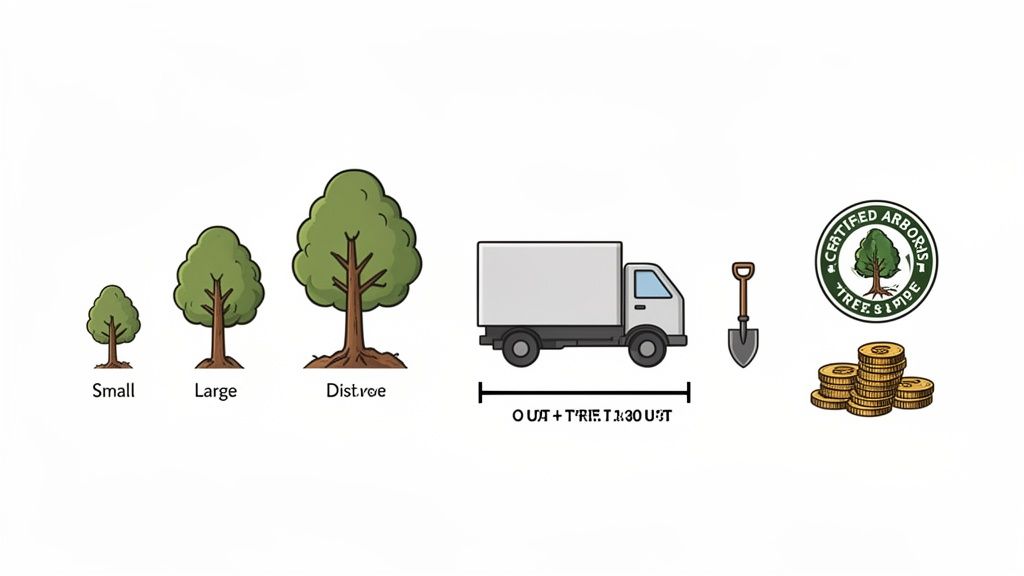
When you're thinking about moving a mature tree, one of the first questions that pops into mind is always, "So, what's this going to cost?" It's a fair question, but the answer isn't a simple price tag. The investment in a professional tree transplant is a reflection of a highly specialized operation that involves heavy machinery, skilled arborists, and meticulous planning.
Think of it less like buying something off the shelf and more like commissioning a custom piece of work. No two tree moves are ever the same because every tree and every property has its own unique set of circumstances. The final price is carefully built around the specifics of your tree, your yard, and the logistics of the move itself. This custom approach is what gives your tree the best possible shot at a long, healthy life in its new spot.
Our goal here is to give you a transparent look at what that investment entails. By breaking down exactly what goes into a comprehensive quote, you can set a realistic budget and know what a fair price for a top-notch service looks like here in the greater Atlanta area.
Key Factors That Influence the Price
A handful of core variables have a direct and significant impact on the final cost of moving your tree. When an arborist comes out for an assessment, they're looking closely at each of these to build an accurate, detailed estimate.
- Tree Size and Caliper: This is, without a doubt, the biggest factor. The trunk's diameter, or caliper, determines the size of the root ball we need to dig. A larger tree requires a much larger root ball, which means we need bigger, more expensive equipment—like a massive 90-inch tree spade—and a more experienced crew to handle it.
- Tree Species and Health: Some trees are just easier to move than others. A tough, hardy Magnolia, for example, is often a more straightforward transplant candidate than a species with a sensitive or deep taproot system. A tree that’s already in peak health will also fare better and might require less prep work than one needing a little TLC before the move.
- Site Accessibility: This is a huge logistical piece of the puzzle. Can we easily get a large truck and tree spade to the tree's current location and its new home? Tight squeezes, steep hills, fences, or nearby buildings—common in neighborhoods across Roswell or East Cobb—can add a lot of complexity, labor, and time to the job.
- Distance of the Move: Relocating a tree 50 feet across your yard is a whole different ballgame than transporting it several miles to a new property. Longer distances mean more time, more fuel, and potentially navigating road permits, all of which will be reflected in the cost.
So, how do all these moving parts come together in your final quote? The table below gives you a quick snapshot of the most common cost factors we see in the Atlanta area.
Estimated Tree Transplanting Cost Factors in Atlanta
| Cost Factor | Description | Impact on Price |
|---|---|---|
| Tree Size (Caliper) | The diameter of the tree's trunk. This dictates the size of the root ball and the equipment needed. | High Impact. Larger trees are significantly more expensive to move. |
| Accessibility | The ease of access for heavy machinery at both the old and new locations. Obstacles add time and labor. | High Impact. Poor access can dramatically increase the cost. |
| Travel Distance | The distance the tree needs to be transported from its original spot to its new home. | Medium Impact. Moving across a yard is cheapest; moving to a new property costs more. |
| Tree Species | Some species have delicate root systems or are less tolerant of stress, requiring more careful handling. | Medium Impact. Hardy, shallow-rooted trees are generally less expensive to transplant. |
| Site Preparation | Work needed before the move, like clearing the new site or performing pre-move root pruning on the tree. | Low-to-Medium Impact. Depends on the amount of prep work required. |
Ultimately, a personalized quote is the only way to get a firm number, but this gives you a great idea of what an arborist is evaluating during their visit.
What Is Included in a Professional Quote
A trustworthy quote from a professional tree transplant service near me should be clear, itemized, and leave no room for questions. A high-quality operation isn't just about digging a tree up and dropping it in a new hole; it’s a comprehensive service that covers every single step.
A detailed quote is a sign of a professional company. It demonstrates that the arborist has thoroughly assessed the project and is transparent about the work required, from initial site prep to crucial aftercare planning.
Here’s a quick rundown of what a truly comprehensive estimate should cover:
- ISA Certified Arborist Consultation: The initial expert assessment and the entire project plan.
- Specialized Equipment Costs: The use of hydraulic tree spades, cranes, and transport trucks.
- Skilled Labor: The crew's time for site prep, any necessary root pruning, the lift, transport, and replanting.
- Permitting Fees: We'll handle any required local permits, whether you're in Forsyth, Cobb, or another county.
- Post-Transplant Materials: Things like the initial deep watering, a fresh layer of mulch, and any staking needed to support the tree.
- Insurance and Guarantees: Full coverage that protects your property and, in many cases, a survival warranty for the tree itself.
When you see all these components laid out, it’s much easier to understand the true value packed into the price. For a specific breakdown tailored to your tree and property, getting personalized tree service estimates is the best next step.
How to Choose the Right Tree Relocation Expert
Picking the right team for the job is hands down the most important decision you’ll make for your tree's survival. A professional tree transplant is a delicate, complex operation, and honestly, not every company has the specialized equipment or the deep-rooted expertise it takes.
Choosing a general landscaper over a certified arborist is a bit like asking your family doctor to perform open-heart surgery. They might understand the basics, but they just don't have the focused training and tools needed to pull it off successfully.
When you search for a "tree transplant service near me," you need to narrow your focus to true specialists. That means finding a team that lives and breathes arboriculture, knows the local soil and climate in areas like Forsyth and Cobb County, and can show you a portfolio of mature trees they've successfully moved. The right expert is an investment in your tree's future.
Vetting Your Potential Arborist
To make a smart choice, you've got to ask the right questions. Think of it like a job interview—after all, this team will be holding your tree’s life in their hands. Any reputable company will be happy to give you clear, confident answers.
Here’s a quick checklist of must-ask questions for any service you're considering:
- Are your arborists ISA Certified? The International Society of Arboriculture (ISA) certification is the gold standard in the tree world. It’s proof that the arborist has a high level of knowledge in tree biology, health, and safe work practices.
- Can you provide proof of insurance? Don't be shy about this one. Ask for certificates showing both liability insurance and workers' compensation. This is what protects you from any financial fallout if an accident happens on your property.
- What's your experience with my specific tree species? Different trees have very different needs. Whether you have a massive oak in Marietta or a delicate dogwood in Roswell, their experience with your specific tree type is absolutely critical.
- What kind of equipment will you use? A pro service will roll up with specialized machinery, like a hydraulic tree spade, that's properly sized for your tree’s caliper.
A confident and transparent arborist will welcome your questions. Their willingness to talk through their credentials, insurance, and process is a huge green flag—it shows they’re professional and committed to doing quality work.
Guarantees and Aftercare Policies
The work isn't over just because the tree is back in the ground. That post-transplant period is the most critical phase for survival, and a top-tier company will stand by its work with clear aftercare policies and guarantees.
You should always get an answer to these two questions:
- Do you offer a survival guarantee or warranty? The best companies often offer a warranty. It shows they're confident in their process and are just as invested in the tree's long-term health as you are.
- What does your aftercare program include? The service should give you a detailed watering and care schedule. Some even include follow-up visits to check on the tree's health and make sure it's adapting well.
Getting these policies sorted out upfront sets clear expectations and gives you much-needed peace of mind. To dig deeper into what sets a true professional apart, check out our guide on what it means to be a certified arborist in Atlanta, GA. A little homework now will help you confidently hire an expert who will treat your valuable tree with the care it deserves.
Have Questions? We Have Answers.
Even after laying it all out, you probably still have a few specific things you're wondering about. It's totally normal. Here, we've gathered some of the most common questions we hear from homeowners across Metro Atlanta to give you direct, no-nonsense answers.
Think of this as your quick-reference guide. We want to clear up any lingering questions so you can feel completely confident about your tree transplanting project.
What Is the Best Time of Year to Transplant a Tree in Georgia?
Hands down, the best time to move a tree here in Georgia is during its dormant season. That window typically runs from late fall, once the leaves have dropped, all the way to early spring before you see any new buds popping. For our area, that's roughly November to March.
Transplanting a tree while it's "asleep" dramatically reduces the shock and stress it experiences. This gives the roots a chance to get settled in their new home before the Georgia summer heat cranks up and demands a ton of energy for new growth.
What Are the Chances My Transplanted Tree Will Survive?
When a move is handled by an ISA Certified Arborist with the right professional gear and techniques, the survival rates are incredibly high—we're talking over 90%. A successful transplant isn't just luck; it's about a series of crucial factors.
It really comes down to the tree's health before the move, its species, the time of year, and most importantly, how well it's cared for afterward. Any reputable tree company will give you a detailed aftercare plan, focusing heavily on a strict watering schedule to protect your investment.
A high survival rate isn't a matter of luck; it's the direct result of a scientific process executed with precision. From preserving the root ball to ensuring proper aftercare, every step is designed to maximize the tree's long-term health.
Do I Need a Permit to Move a Large Tree on My Property?
This is a big one, and the answer is: it depends. Permit requirements can vary wildly between cities and counties. Many municipalities in Forsyth, Cobb, Gwinnett, and Cherokee counties have local tree ordinances in place to protect what they call "specimen" or "heritage" trees.
These rules often mean you need a permit even if you're just moving a large tree from one spot to another on your own property. A good local arborist will be dialed into the specific regulations for places like Marietta or Alpharetta and can handle the entire permitting process for you. This saves you from surprise fines and project delays.
How Long Does It Take for a Transplanted Tree to Get Established?
Getting fully established is more of a marathon than a sprint. A good rule of thumb arborists use is to plan on one year of recovery for every inch of the tree's trunk diameter. So, if you move a tree with a six-inch trunk, it could take about six years before it's fully settled and thriving on its own.
The first one to two years are the most critical. This is the period where consistent, deep watering is absolutely essential to encourage new, strong root growth and secure the tree's future health and stability.
Ready to give your cherished tree a new home? The experts at Richmond Tree Experts GA have the local knowledge and specialized equipment to ensure a successful transplant. We proudly serve homeowners across Cumming, Johns Creek, Milton, Alpharetta, and the greater Metro Atlanta area.
Contact us today for a professional consultation and estimate.
Need a tree taken down safely? Richmond Tree Experts has worked on Marietta and Metro Atlanta trees since 1985, and every job is looked at by an ISA Certified Arborist before it is priced. Start with tree removal, or see everything we do: tree removal, stump grinding and arborist services across Cobb, Fulton, Cherokee, Gwinnett and DeKalb counties (service areas).
Call (770) 974-3964, 7am to 11pm every day, or request an estimate online.

