

You hear a branch scrape the gutter during a storm, then notice roots beside the foundation the next morning. Suddenly, the shade tree you've barely thought about becomes a question: does it need pruning, or does it need to come down?
Trees too close to a house need an assessment, not an automatic removal order. Most nearby trees don't damage buildings, and proximity alone doesn't identify the cause of a crack or predict a failure. For homeowners in Marietta, Roswell, Kennesaw, Woodstock, Acworth and Canton, the sensible approach is to measure the tree, identify the actual defect and verify local permit rules before cutting.
Safe Distances from a House by Tree Size
A 15-foot gap may suit one tree and be too tight for another. For new plantings, Purdue Extension's tree-placement guidance recommends starting at least 20 feet from a house, with up to 40 feet for large shade trees.
Typical planting distances from a house
| Tree size | Typical distance from walls |
|---|---|
| Medium trees | 15–25 ft |
| Large shade trees | 20–40 ft |
| Any tree | At least half its mature canopy width |
The ranges are planning guidance, not pass-or-fail rules for established trees. Oklahoma State University Extension recommends placing a tree at least half its mature canopy width from a building. Its roots may extend two to three times beyond the canopy, so a suitable branch gap does not mean roots will stay outside the building's soil zone.
Power lines need separate consideration. Follow the utility's clearance requirements rather than applying a house-distance guideline to wires.
Apply the table to your yard
Identify the species, measure the trunk, and record the distance to the nearest wall. Estimate the tree's mature canopy, not just its current pruned outline.
- For a new planting: Choose a species that can reach mature size without repeated crown reduction.
- For an existing tree: Compare its mature size with the available space, then check its structure and whether branches contact the building.
- For a difficult site: Consider how compaction, poor drainage, or shallow foundations affect the planting location.
An older oak overhanging a bungalow in East Cobb may have little room between trunk and wall. That distance is a reason to assess the tree, not proof that it is unsafe.
Practical rule: Use planting distances to reduce future conflicts. Decide what to do with an established tree based on its condition and the space around it.
How a Close Tree Damages Roofs, Gutters and Walls
A tree continues extending branches while the house stays fixed. Without suitable clearance, a previously harmless limb can begin striking the roof whenever wind moves the crown.
The consequences aren't equally urgent. A hanging limb above an entrance needs a different response from leaves collecting in a gutter.
Rank the damage pathways
Storm failure comes first. A dead branch, cracked leader or failing union can strike a roof, vehicle or person. According to Insurance Information Institute figures cited by SimpleDecider, approximately 1 in 500 U.S. homes experienced damage from a falling tree or large branch in 2023. That national figure isn't a prediction for your yard, but it puts the concern in context.
Repeated contact comes next. Branches can abrade shingles, scrape siding and strike gutter edges. Look for polished bark on the branch and matching wear on the building. Pruning should create usable clearance while retaining appropriate branch structure, not shave the crown into the outline of the roof.
Debris and pest access usually require maintenance rather than emergency removal. Leaves and twigs can obstruct drainage, while touching branches provide access toward soffits and attic openings. Squirrels and rodents may use those routes; carpenter-ant activity also warrants checking for damp or deteriorated wood rather than assuming the tree is the entire problem.
For a useful explanation of drainage maintenance, Pine Country Window Cleaning's guide to gutter cleaning benefits for Flagstaff homes describes why keeping gutters clear matters. The maintenance principle applies here, although Flagstaff's climate isn't North Atlanta's.
Avoid creating the next defect
Repeated severe corrective cutting can leave a poorly structured crown and large wounds. Removing every branch on the house-facing side can also produce an unbalanced result without addressing decay or root instability.
- Act urgently: Keep people away from broken, suspended or visibly separating limbs.
- Schedule clearance work: Address rubbing branches before they damage roofing or siding.
- Maintain drainage: Clear debris safely and inspect downspout discharge.
The deciding question isn't whether branches overhang the roof. It's whether those branches have defects, make contact, or create maintenance demands you can reasonably manage.
Telling Foundation Damage Apart From Surface Roots
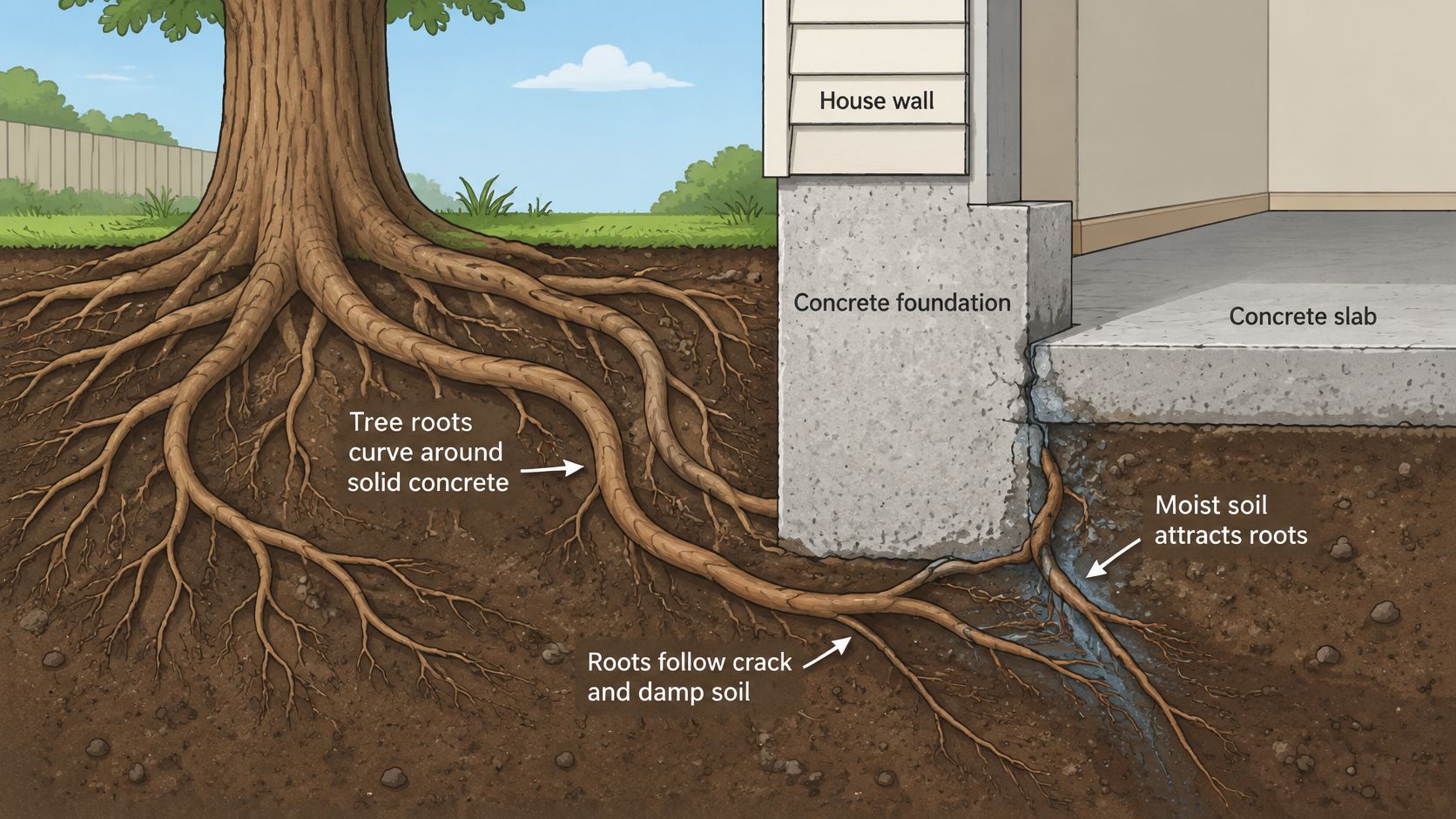
Roots don't ordinarily crush a sound foundation. They commonly change direction around solid obstacles and take advantage of existing openings or moisture pathways instead.
Purdue Extension's explanation of roots and foundations distinguishes that behavior from indirect damage associated with soil drying; the cited arboricultural review reports foundation-damage distances averaging approximately 8.2 feet for cypress in one body of research, not a safe-distance rule for every species.
The important mechanism is often shrink–swell soil movement. A high-water-demand tree can remove moisture from clay beneath a shallow foundation during drought, allowing the soil to shrink and the building to settle unevenly. Species, soil, foundation depth and weather matter more than a single clearance measurement.
Protect roots while investigating
The same Purdue guidance gives a planning radius of approximately 1 foot per inch of trunk diameter for tolerant trees, or 1.5 feet per inch for sensitive trees. The calculated examples below describe root protection during work, not mandatory building setbacks.
Root-protection radius by trunk diameter
| Trunk diameter | Tolerant tree radius (1 ft per inch) | Sensitive tree radius (1.5 ft per inch) |
|---|---|---|
| 6 in | 6 ft | 9 ft |
| 10 in | 10 ft | 15 ft |
| 12 in | 12 ft | 18 ft |
| 18 in | 18 ft | 27 ft |
Don't trench beside the house or cut a large root just to see where it goes. Excavation can damage the tree you're trying to diagnose and may compromise its anchorage.
Separate observation from diagnosis
A surface root beside a slab isn't proof of structural damage. Neither is an isolated hairline crack that hasn't changed. Widening stair-step cracks, sticking doors and a sloping slab warrant a building assessment, particularly when several symptoms appear together.
Plumbing leaks, poor grading and construction defects can resemble tree-related movement. The Canada Mortgage and Housing Corporation's guidance on trees and foundations also explains why removing a tree can change soil moisture and create further movement.
For a homeowner-oriented explanation of movement symptoms, Corinthian Surveyors London LTD discusses when to call a surveyor; use a locally qualified structural or geotechnical professional for a Georgia property. Our guide to tree roots damaging a foundation offers additional context for coordinating the tree and building investigations.
How to Assess a Tree Near Your House
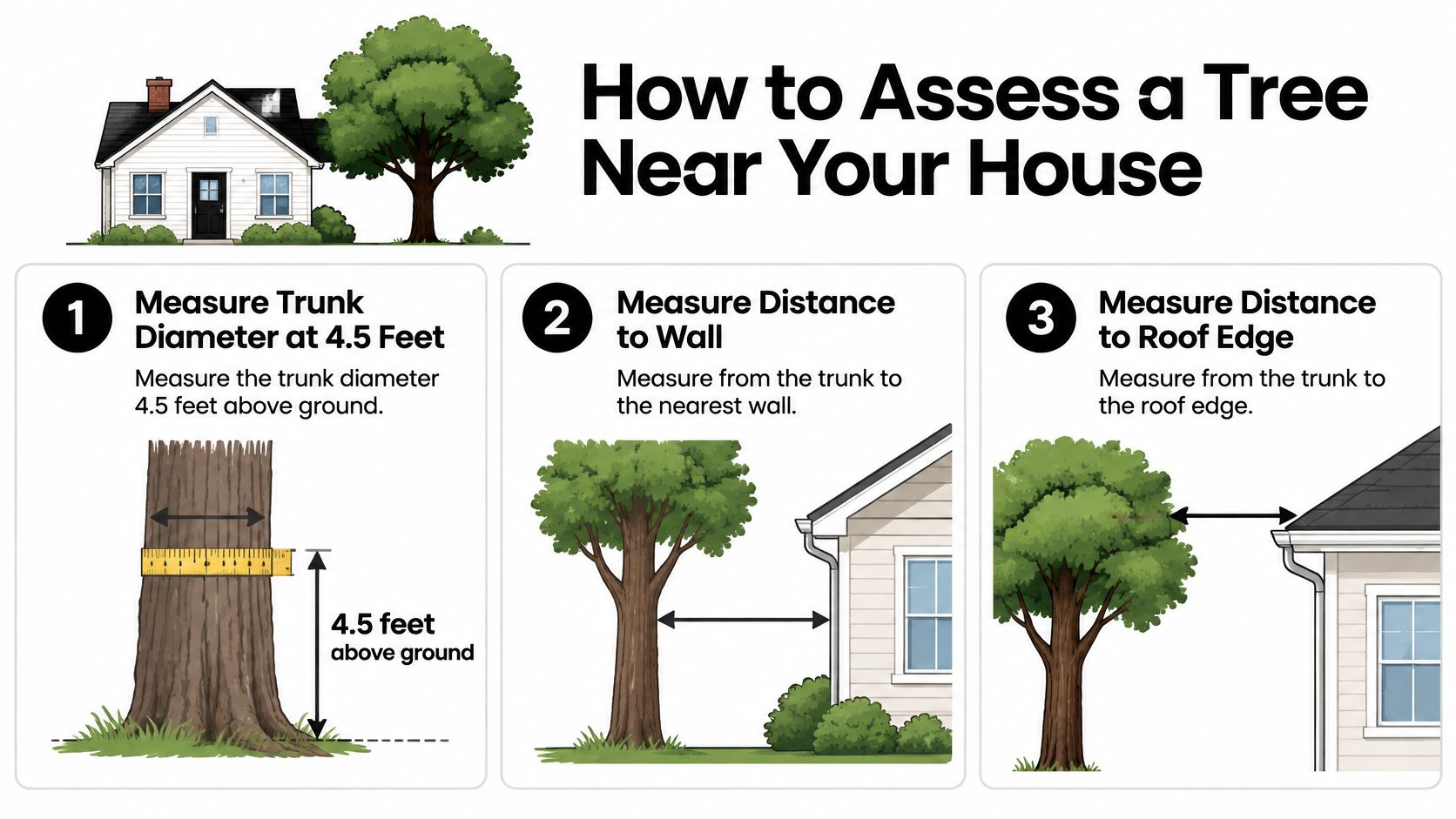
Start from the ground with a tape measure, binoculars and a phone camera. Don't climb onto the roof, stand beneath hanging branches or approach a tree that appears to be actively moving.
Record measurements and visible defects
Measure trunk diameter. Use a diameter tape, or measure circumference and convert it to diameter. Record the measurement height so an arborist can interpret it correctly; Atlanta's official permit measurement height is specified in the jurisdiction table below.
Measure the building gaps. Record the horizontal distance from the trunk to the nearest wall and roof edge separately. A deep eave can leave branches much closer to roofing than the wall measurement suggests.
Identify the likely mature crown. Confirm the species using local extension guidance or an arborist's identification. A repeatedly pruned crown isn't a reliable picture of the tree's natural space requirement.
Inspect trunk and branch structure. Look for an increasing lean, open cracks, cavities, deadwood, fungal brackets and tight unions where bark is trapped between stems. Note moss or other growth, but don't treat moss alone as evidence of decay.
Check the ground without digging. Photograph fresh soil heaving, exposed roots, lifted paving and persistent wet areas. Roots disappearing toward a foundation need investigation, not exploratory cutting.
Check the roof and utilities. Flag branches that scrape siding or gutters and limbs close enough to contact the roof as they move. As a hypothetical screening exercise, you might mark every limb within six feet for review, but that isn't a universal clearance standard; anything near electrical conductors belongs with the utility or qualified line-clearance personnel.
Escalate concerning findings. Arrange an ISA Certified Arborist assessment when you find structural defects, fresh ground movement or consequential building contact. Keep dated photographs so changes can be distinguished from longstanding conditions.
What the assessment should deliver
Our arborists use a structured inspection of the tree and the targets around it, with a written summary of defects, likelihood of failure, fall-zone contents and a recommendation. That makes the result more useful than a verbal statement that a tree looks dangerous.
A tree-risk assessment should connect the defect to what could be struck. A questionable limb above an unused planting bed presents a different management problem from the same limb above a bedroom or busy driveway.
A lean is an observation. A new lean accompanied by lifted soil is a reason to keep clear and seek prompt professional help.
Permit Rules in Atlanta and the North Metro
A tree's permit requirements depend on the property's jurisdiction, not just its mailing address. Check the city or county that governs the parcel before authorizing removal.
The City of Atlanta's official guidance requires permits for hardwoods at least 6 inches in diameter and pines at least 12 inches, measured 4.5 feet above ground. An arborist inspection and report are required and carry no charge. A permit is not required for a tree that has already fallen.
Roswell's code-enforcement guidance requires a permit to remove any tree larger than 3 inches in diameter on private property. Property owners within 2,000 feet of the Chattahoochee River must contact Planning and Zoning before removal.
Tree-removal permit triggers by jurisdiction
| Jurisdiction | Permit trigger | Extra requirement |
|---|---|---|
| City of Atlanta | Hardwood at least 6 in and pine at least 12 in, measured 4.5 ft above ground | Arborist inspection and report required at no charge; no permit for an already fallen tree |
| Roswell | Any tree larger than 3 in in diameter on private property | Owners within 2,000 ft of the Chattahoochee River must contact Planning and Zoning before removal |
Verify before authorizing the cut
Roswell generally cannot require removal of a private tree unless it threatens public property, such as a street, sidewalk or park. A neighbor's concern alone does not automatically make tree removal a city enforcement matter.
Before signing a tree-cutting agreement, identify the office with authority over the parcel. Provide the property address, tree location, species if known and photographs, then ask:
- Is approval required before work starts? Request the answer in writing.
- Do site restrictions apply? Ask about buffers, rights-of-way and protected areas.
- Does the project involve more than removing one tree? Land clearing and lot preparation may have separate requirements.
Before cutting a tree in Duluth, Richmond Tree Experts GA checks whether it is in a required buffer or right-of-way. The same parcel-specific check helps prevent work from proceeding before applicable restrictions are understood.
Pruning, Cabling, Root Barriers or Removal Compared
Removal isn't the automatic first step. The right treatment addresses the defect that creates the risk rather than treating every close tree alike.
Mitigation options and when each one fits
| Option | Best when | Main limit |
|---|---|---|
| Crown pruning or deadwooding | Dead, rubbing or overextended limbs over the roof or drive | Must follow ISA standards; topping weakens the tree |
| Cabling or bracing | Split unions or heavy horizontal limbs worth saving | Supports the structure but does not remove the defect |
| Root barrier or soil care | Roots lifting paths or compacted soil near the foundation | Correct installation is essential; established roots are hard to redirect |
| Moving the target | A patio, fence or other exposed feature can be relocated | Works only when the target is movable |
| Full removal and replacement | Decay, increasing lean or failure risk cannot be reduced | Permanent; check permits and replace where feasible |
The International Society of Arboriculture's risk-management guidance recognizes pruning, structural support, routine care, target removal and tree removal as distinct responses. It warns that inappropriate pruning can weaken trees, recommends an ISA Certified Arborist for pruning and encourages replacement where feasible.
Match the intervention to the problem
Tree trimming and tree pruning can resolve building contact when suitable branches remain to support a healthy crown. Topping isn't a substitute for clearance pruning, and pruning cannot reverse extensive trunk decay.
Cabling may help retain a worthwhile tree, but a split union isn't automatically a good candidate. An arborist must assess the remaining wood, attachment points and consequences of failure.
A tree-root barrier installation needs similar judgment. Installing a barrier beside an established tree may require root cutting, so the proposed cure can be more harmful than a lifted path. Moving the path may be the better option.
Our scoping arborist tells customers whether the tree needs to come down, can be pruned back to health or is fine to leave alone.
Compare complete costs, not headline prices
How much does tree removal cost? A useful answer requires the actual tree, access route and work method. Height, roof proximity, crane requirements and tight-access handling affect the scope; pruning and cabling also depend on crown size and the limbs involved.
Compare written estimates that identify:
- Tree work: The exact branches, support system or removal method.
- Site protection: Equipment access and lawn, fence and hardscape protection.
- Cleanup: Hauling, debris handling and final site condition.
- Below-ground work: Stump grinding, stump removal and restoration.
- Approvals: Who handles permits and any associated charges.
Stump grinding reduces the stump below the surface; full stump removal involves more excavation. For a future building footprint, coordinate that choice with the grading or foundation plan rather than assuming grinding alone prepares the lot.
Fix the defect when a sound, maintainable tree can remain. Choose hazardous tree removal when acceptable risk reduction isn't achievable.
Document the Hazard, Then Call a Certified Crew
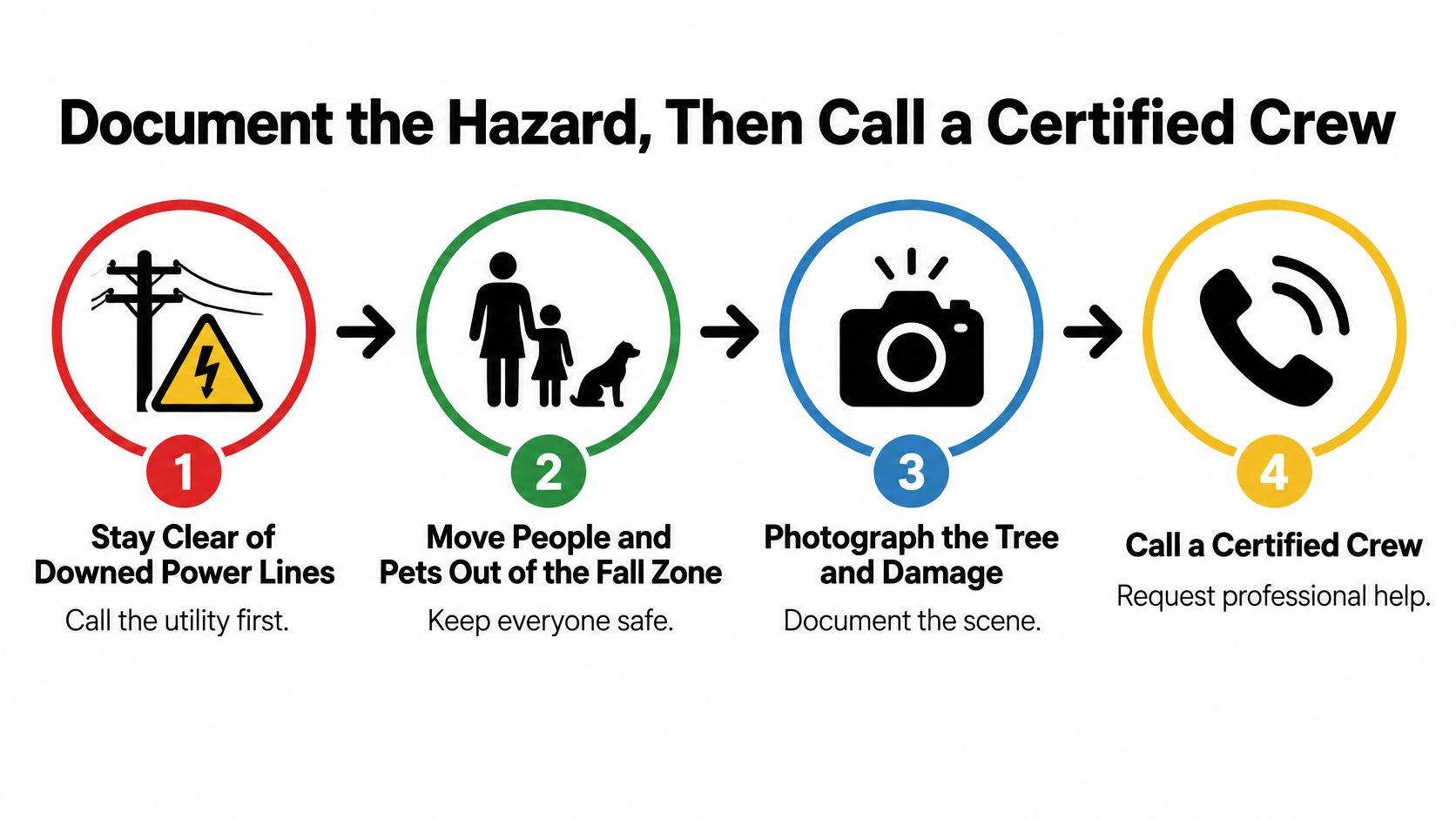
Stay clear of downed power lines and call the utility first. A tree, fence or wet ground near damaged electrical equipment may be energized. Move people and pets out of the potential fall zone, and don't enter a damaged room beneath a tree resting on the house.
Follow a safe documentation sequence
The Atlanta Tree Conservation Commission's emergency procedure allows immediate removal of an imminent hazard during non-working hours, with a message describing the circumstances, two photographs documenting the condition and permit follow-up within five working days after removal. That pathway applies to Atlanta, not automatically to surrounding municipalities.
Photograph from safe positions. Capture the overall tree and the specific defect or damage before cutting begins. Don't approach an unstable trunk just to obtain a better angle.
Notify the governing office. Where the emergency procedure requires a message, describe the address, hazard and circumstances. Preserve the message or confirmation with your records.
Arrange qualified emergency tree removal. For trees on roofs, the work plan may require a crane or controlled rope-and-rigging rather than ordinary felling. Verify applicable licensing and current liability and workers' compensation coverage before authorizing work.
Keep the paperwork. Save receipts, dated notes, photographs and the written assessment. Separate emergency stabilization from later repairs so the work remains clear for insurance review.
Complete required follow-up. An emergency doesn't erase documentation obligations. A standing, dangerously leaning tree isn't the same situation as an already fallen tree, so confirm the applicable local procedure.
Ask for a realistic response plan
If you're searching for tree removal near me, distinguish arrival for assessment from arrival with the equipment needed to complete removal. Ask whether the first visit will stabilize a hanger, reopen access or undertake the full storm damage tree cleanup.
For a tree service in Marietta, tree service in Roswell, or emergency work in Kennesaw, Woodstock, Acworth and Canton, give the dispatcher concrete details: tree on a home, blocked driveway, split leader, hanging limb or changing lean. Include access restrictions and electrical involvement immediately.
Fast cleanup matters, but fallen tree removal can involve loaded branches and trunks that shift when cut. Don't begin cutting to speed up the job. Schedule an assessment promptly when a tree starts leaning, cracks or contacts the house, before another storm makes access and handling harder.
Richmond Tree Experts GA offers free, no-pressure estimates, usually given the same day, to help you decide whether a tree near your house needs pruning, removal or no intervention. Call 770-974-3964 or visit Richmond Tree Experts GA to request an assessment, and describe any storm damage or immediate safety concern when you get in touch.

