

So, you're staring at an overgrown patch of your yard, wondering what it's going to take to clear it all out. Getting a straight answer on brush removal costs in Atlanta can feel tricky, but it boils down to a few key factors. For a small job, like a single truckload of yard debris, you might be looking at $150 to $500. But for larger-scale projects, like clearing a whole lot, costs can run anywhere from $800 to $3,000 per acre.
What really drives the price is the size of the job, how dense the brush is, and the way your contractor decides to bill for the work.
Decoding Brush Removal Costs In Atlanta
Before you can really budget for reclaiming your backyard in Marietta or prepping a commercial lot in Forsyth County, you need to understand how companies price these jobs. Think of it like ordering at a restaurant—sometimes you pay per dish (per cubic yard), sometimes you pay for the chef's time (per hour), and other times you pay a flat fee for the whole meal (per acre). Each method makes sense for different kinds of projects.
Knowing these pricing models is the first step to getting a quote that makes sense. A simple residential cleanup might be priced by the truckload, while clearing a sprawling, undeveloped acre will almost always be priced by the acre.
Common Pricing Models
To give you a clearer idea, most professionals calculate the cost of brush removal in one of three ways. This helps keep quotes consistent and shows you exactly what you're paying for. Nationally, costs have been on the rise due to higher demand and operating expenses. For some context, a single pickup-truck load of brush can run between $150 and $200, while clearing an acre can range from $800 for light brush to $3,000 for the really thick stuff. If you're curious about national averages, you can learn more about brush pile removal costs on HomeGuide.com.
Here's a quick look at how these models typically break down right here in the Atlanta area.
Atlanta Brush Removal Cost At A Glance
This table gives you a snapshot of the common pricing structures you'll encounter when getting quotes for brush removal in our area.
| Pricing Model | Typical Atlanta Cost Range | Best For |
|---|---|---|
| Per Hour | $250 – $450 (for a 2-3 person crew) | Small, tricky jobs with a lot of unknowns or difficult access. |
| Per Truckload | $300 – $600+ (depending on truck size) | Standard residential cleanups where the amount of debris is fairly clear. |
| Per Acre | $800 – $3,000+ | Large-scale land clearing projects and commercial properties. |
As you can see, the right model really depends on the project's specifics.
Key Takeaway: The pricing model a contractor uses is a direct reflection of your project's scale and complexity. A neat, easy-to-access pile of brush is simple to quote by the truckload. But a tangled, overgrown thicket on a steep slope? That’s where an hourly rate makes more sense.
Key Factors That Influence Your Final Price
Ever gotten two quotes for the same job that were wildly different? It’s a common story in home services, and brush removal is no exception. Understanding what makes these prices tick is the key to setting a realistic budget and picking the right crew for your property. The final cost isn't just about hauling away a pile of branches; it's a direct reflection of the labor, equipment, and risk involved in getting the job done right.
Think of it like this: clearing a few small bushes from a flat, easy-to-reach front yard is a simple job. But tackling a steep hillside tangled with thorny vines and thick undergrowth? That’s a whole different beast. Every project has its own unique variables that directly impact the bottom line.
This infographic gives a great visual breakdown of the common pricing models you'll encounter.
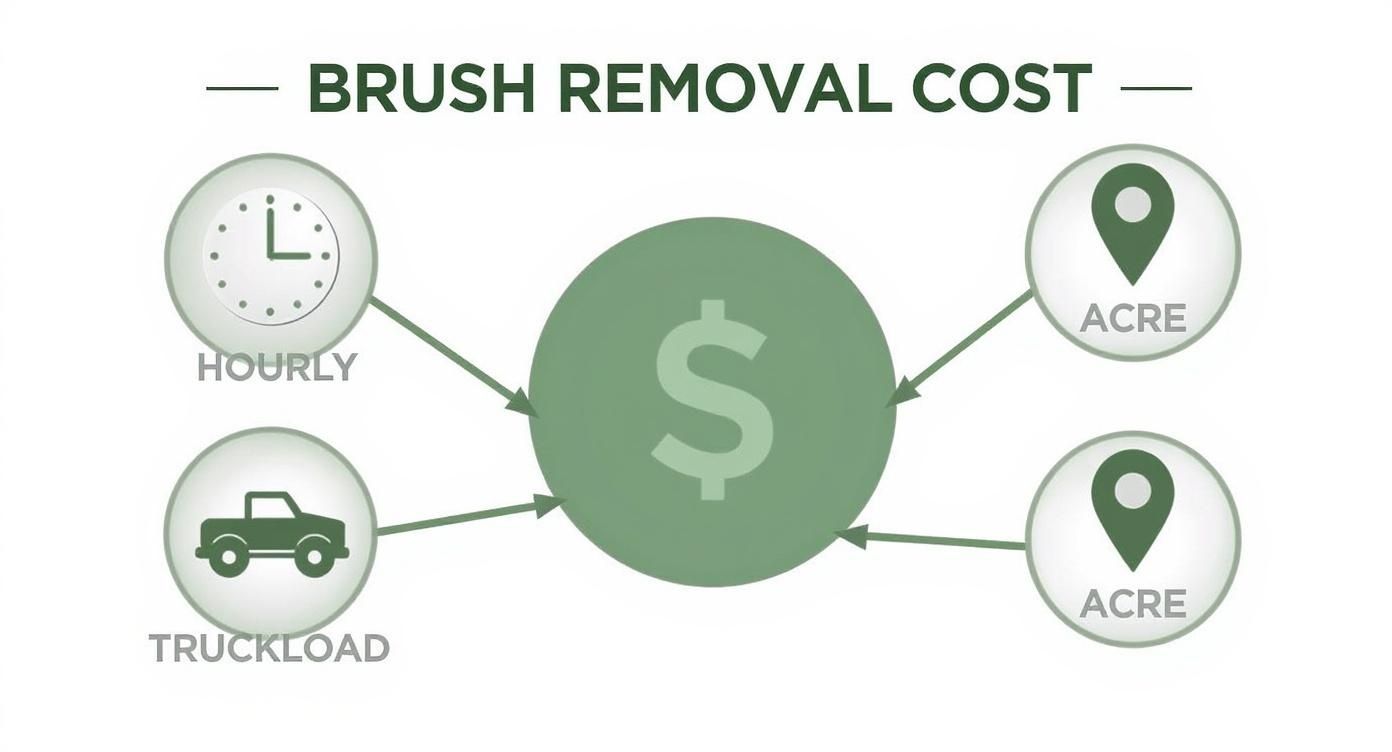
As you can see, whether a company quotes by the hour, the truckload, or the acre really depends on the project's size and how predictable the work is. Now, let’s dig into the specific details that will place your project in one cost bracket or another.
How Different Factors Impact Your Brush Removal Quote
The table below breaks down how specific conditions on your property can swing the final price up or down. A job that seems simple on the surface can quickly become complex—and more expensive—due to one or two challenging factors.
| Cost Factor | Low-Cost Scenario (Example) | High-Cost Scenario (Example) | Potential Cost Impact |
|---|---|---|---|
| Vegetation Density | Clearing sparse, soft weeds and small saplings. | Removing a dense, established thicket of thorny bushes. | High |
| Vegetation Type | Grassy overgrowth and non-woody plants. | Mature, woody shrubs like privet or holly. | Medium to High |
| Property Access | Wide, open access for trucks and chippers. | Narrow gates, fences, or delicate landscaping nearby. | High |
| Terrain | A flat, level, and dry work area. | A steep, rocky hillside or a soggy, wet area. | High |
| Additional Services | Basic cut-and-haul brush removal only. | Bundling stump grinding, tree trimming, and hauling. | Medium |
Ultimately, a straightforward job with easy access will always be more affordable than one with multiple obstacles. The more manual labor and specialized equipment required, the higher the quote will be.
Vegetation Density And Type
The first thing any pro will look at is what exactly needs to go. A patch of soft, light greenery is one thing; a dense wall of well-established, thorny monsters like holly or stubborn privet is another entirely.
Heavier, woodier vegetation demands more powerful equipment—think forestry mulchers and heavy-duty chippers—and a whole lot more manpower. The type of plant material is just as important. Chewing through thick shrubs and small trees is a much tougher and slower process than clearing out soft weeds.
Property Access And Terrain
This one is huge: how easily can the crew and their machinery actually get to the work area? If you have a wide, flat driveway that leads right to the brush pile, you’re in great shape.
On the other hand, a few key obstacles can quickly drive up your brush removal cost. These are the big ones:
- Steep Slopes: Working on hills is slow, dangerous work that requires special safety gear and sometimes different equipment. It adds time and risk.
- Limited Access: If a big chipper or skid steer can't fit through a narrow gate or navigate around delicate landscaping, the job suddenly becomes manual. That means more time, more labor, and a higher bill.
- Rocky Ground: Trying to work on rocky terrain is tough on equipment and makes certain tasks, like stump grinding, a real challenge.
A project’s complexity is often defined by its terrain. A flat, open acre in Milton is a completely different job than a sloped, wooded acre in the hilly parts of Cherokee County, even if the vegetation is identical.
Scope Of Work And Additional Services
The basic job is cutting and hauling, but that’s rarely the whole story. Do you also need the stumps ground down so you can plant grass? Are there a few small, annoying trees you want gone at the same time? These are separate services that will be added to the project total.
Often, bundling services like stump grinding or tree trimming with your brush removal can be a smart move, saving you money compared to hiring different companies for each task. When you’re ready to see how it all adds up, you can learn more about how we build our free tree service estimates and assess these factors on-site.
For bigger jobs, you might be looking at land clearing, which is a much more involved service. In 2025, clearing lightly wooded land can run from $500 to $1,500 per acre. But if that land is dense, rocky, or on a steep grade, costs can jump all the way up to $10,000 per acre. Modern bulldozers help keep costs down, but the starting condition of the property is always the biggest price driver.
Comparing Project Costs From Backyards To Entire Acres

It’s one thing to talk about pricing models, but what you really want to know is what a job like yours will cost. Seeing how these numbers play out in real-world Atlanta-area projects is the best way to get a feel for the budget.
The difference between clearing out a few overgrown shrubs and prepping an entire acre for development is night and day. It's not just about the size—it's about the crew, the equipment, and the time it takes to get it done right.
Let's walk through two very different but common scenarios. This will help you picture where your own project lands on the spectrum.
Scenario 1: The Suburban Backyard Overhaul
Picture a classic single-family home in Roswell or Marietta. The front flower beds have gone wild, with a dozen big, woody shrubs like privet and holly swallowing the walkway and blocking the windows. The homeowner wants them gone—cut down, roots ground out, and everything hauled away to get their curb appeal back.
- Scope of Work: Removing 10-12 mature, dense shrubs (4-6 feet tall) from a front yard.
- Access: Easy peasy. The yard is flat with a big driveway, giving us plenty of room for a chipper and truck.
- Likely Pricing Model: For a clear-cut job like this, you’ll likely get a flat project fee or a per-bush rate. Hourly isn't as common when the scope is so well-defined.
- Estimated Cost: You can expect a professional crew to charge somewhere between $800 and $1,400 for this kind of work. That price covers the labor, stump grinding for each shrub, and hauling away every last bit of debris.
This lines up with what we see across the country. While the national average for a full removal project is about $770, most people pay between $380 and $1,170. The cost often depends on the size of the shrubs, with larger ones (4 to 6 feet) running $70 to $150 each to remove. You can see a great breakdown of shrub removal costs over on LawnLove.com to understand all the factors involved.
Scenario 2: The Commercial Lot Preparation
Now, let's zoom out to a much bigger project. A developer has just bought a one-acre lot in a booming area like Cumming or Alpharetta. Before they can break ground on a new building, they need the land cleared of all its dense undergrowth, small nuisance trees, and tangled brush.
This is a totally different ballgame. It's less about careful pruning and more about brute-force efficiency. A job of this scale calls for a different strategy and much bigger toys. If you're tackling something this large, our guide on how to clear land effectively is a must-read.
- Scope of Work: Clearing one full acre of thick brush, saplings, and heavy undergrowth.
- Access: Generally good since it's an open lot, though the terrain might be a bit rough or uneven.
- Likely Pricing Model: Per acre. This is the industry standard for large-scale land clearing.
- Estimated Cost: In Forsyth or Gwinnett County, an acre with moderate to heavy brush will typically cost between $1,800 and $3,500 to clear. This estimate assumes the use of heavy machinery like a forestry mulcher or skid steer, which tears through the job quickly.
The Bottom Line: The equipment is the great divider. Small jobs can be handled with chainsaws and a chipper. Large jobs require industrial-grade machinery, which significantly impacts the overall project cost but drastically reduces the time involved. Your project's scale is the number one predictor of the final price.
Smart Ways To Manage Your Brush Removal Budget
Getting a handle on your final brush removal cost really boils down to efficiency. While bringing in a professional crew is always the safest and most effective way to go, you can actually take a few practical steps to make the job easier for them, which can trim down your total bill. A little bit of prep work on your end can make a huge difference in the hours and labor a crew needs.
Think of it like setting the stage before a big performance. The less time our team has to spend just getting set up or navigating around obstacles, the more time they can spend on the actual clearing and hauling. That efficiency translates directly into savings for you, especially if you're working with an hourly rate.
Prepare Your Property Before The Crew Arrives
One of the smartest things you can do to manage your budget is to tackle some simple prep work yourself. No, you don't need to go rent a chainsaw, but a few small actions can have a big impact. Your goal is simply to remove anything that might slow the professionals down once they get started.
Here are a few things you can do that really help:
- Clear Small Debris: Got a bunch of small, easy-to-handle branches, twigs, or loose leaves? Rake them into a few piles. When you handle the lightweight stuff, you free up the crew's energy for the heavy lifting and technical work.
- Create a Clear Path: We need a clear, wide, and unobstructed path from the street right to the work area. Take a few minutes to move cars, patio furniture, kids' toys, and garden hoses. Anything that could get in the way of large equipment like chippers or skid steers needs to be moved.
- Contain Pets and Inform Neighbors: For everyone's safety, please make sure all your pets are secured safely inside for the entire time the crew is there. It's also a nice touch to give your neighbors a quick heads-up about the noise—it's a courteous gesture that helps prevent any unexpected delays.
This prep work just makes the whole operation run faster and safer, which is always a win for your wallet.
By handling the simple tasks, you allow the expert crew to focus their time and specialized equipment on what they do best—efficiently removing the heavy, difficult brush. It's a smart way to get the most value out of every dollar you spend.
Bundle Services For Greater Savings
Here's another powerful strategy: think bigger than just one task. Do you have a tree that's been bugging you and needs pruning? Or maybe an old, ugly stump that's become a tripping hazard? Bundling these services together with your brush removal can often lead to some pretty significant savings.
Tree care contractors love full-day projects because it cuts down on their travel time and the costs of setting up and breaking down equipment between different job sites. They can often pass a portion of those savings right on to you in a package deal. For example, pairing brush clearing with stump grinding is a very common and cost-effective combo. You can find out more about what goes into the cost of professional tree stump grinding to see how well these two services fit together.
When you call for a quote, be sure to ask about bundling options. You might be surprised at how affordable it becomes to tackle several projects at once, making your property safer and more beautiful while being smart with your budget. It's also worth asking about scheduling work during the off-season, which is usually late fall or winter, as lower demand can sometimes lead to better pricing.
Why Expert Brush Removal Is A Smart Investment
It's easy to look at brush removal cost as just another line item on your property maintenance budget. But that's a mistake. In reality, bringing in a professional team is one of the smartest investments you can make for your home or business. This isn't just about cleaning up an overgrown patch of land; it's a strategic move that directly impacts your property's safety, health, and value.
That tangled mess you've been putting off dealing with is more than just an eyesore—it’s a liability waiting to happen. Expert brush removal takes that risk and turns it into a genuine asset.
Enhancing Property Safety And Health
Let's be blunt: overgrown brush is a magnet for trouble. That dense, unmanaged vegetation is the perfect hiding spot for pests like snakes, ticks, and rodents, bringing them way too close for comfort. This is a direct health hazard for your family, kids, and pets.
Beyond pests, there’s the very real danger of fire, especially during those hot, dry Georgia summers. A thick patch of dry brush is basically kindling. A single stray spark can turn into a blaze that spreads with terrifying speed. Clearing it creates a critical defensible space around your home, which can make all the difference in an emergency.
But the benefits go deeper. An ISA Certified Arborist doesn't just clear everything in sight. They know how to selectively remove invasive plants and unhealthy growth, which gives your desirable, mature trees a new lease on life. Suddenly, they have access to the sunlight, water, and nutrients they were being starved of.
Investing in professional brush removal is an act of proactive property management. It systematically reduces risks from fire and pests while simultaneously improving the ecological health of your landscape.
Boosting Curb Appeal And Property Value
You only get one chance to make a first impression, and a clean, well-maintained landscape speaks volumes. Overgrown brush makes a property feel neglected and look smaller than it is. The moment you clear it away, the entire space opens up. Your yard instantly feels bigger, more inviting, and a whole lot more valuable.
This isn't just about looks; it translates to real dollars. A well-cared-for landscape can boost a home's resale value by 5% to 15%. In competitive markets like Johns Creek or Milton, that kind of curb appeal can be the very thing that sets your property apart for potential buyers.
- Reveals Hidden Features: You might uncover beautiful rock outcroppings or gentle slopes you never knew you had.
- Creates Usable Space: That impassable thicket can become a new garden, a play area for the kids, or the perfect spot for a fire pit.
- Showcases Your Home: With the brush gone, the view of your home's architecture is no longer obstructed, making the whole property pop.
The Professional Advantage
Sure, a DIY approach might seem tempting to save a few bucks. But the advantages of hiring an expert crew like Richmond Tree Experts are undeniable. We show up with the right heavy-duty equipment, the right safety protocols, and a deep understanding of local Georgia plant life. Our certified arborists get the job done efficiently and correctly, protecting your property from accidental damage.
Working with a qualified team means the job gets done right the first time. It’s the difference between just hacking down some bushes and truly enhancing your property for the long haul.
Of course. Here is the rewritten section, crafted to sound like an experienced, human expert while maintaining the original content's core information.
Got More Questions About Brush Removal? We’ve Got Answers.
Even with all the numbers laid out, you probably still have a few questions about how this all works in the real world. That’s perfectly normal. Getting a handle on the logistics, like permits and what you can and can't do with the leftover debris, is just as crucial as the final price tag.
This is where we clear up some of the most common things we hear from property owners all across the Atlanta area. Let's dig into the questions that pop up time and again, from East Cobb to Forsyth County.
Do I Really Need a Permit to Clear Some Brush?
For most homeowners, the answer is no. If you're just doing some routine cleanup—getting rid of overgrown bushes, pesky vines, and small saplings to tidy up your yard in places like Cobb, Gwinnett, or Cherokee County—you typically won't need a permit.
But, the moment your project gets bigger, the rules change. You'll almost certainly need to talk to the county if your job involves:
- Taking down large or "specimen" trees. Most towns around here, like Roswell and Alpharetta, have tree ordinances to protect our beautiful, mature canopy.
- Working near any streams or wetlands. Environmental rules kick in when you're close to waterways, and you'll need special permission to do any clearing.
- Clearing a lot for construction. If you're prepping a site to build a home or a new commercial building, you'll have to go through the full permitting process with the local planning and zoning department.
The bottom line? When in doubt, always make a quick call to your city or county office before you start a major clearing project. It's a lot easier than dealing with a fine later.
Isn't Brush Removal Just a Fancy Term for Land Clearing?
It's a common mix-up, but they're two completely different jobs. Think of it this way: brush removal is like weeding and tidying up your garden, while land clearing is like bulldozing the whole garden to build a patio.
Brush removal is all about surgical cleanup. We’re targeting the overgrown shrubs, invasive plants like kudzu, and thickets of small trees that are choking out your usable space. It’s about maintenance and making your current landscape healthier and more attractive. We're managing what you already have.
Land clearing, on the other hand, is the heavy-duty, start-from-scratch option. It means removing everything—mature trees, stumps, boulders, you name it—to get a piece of land ready for something new, like a building or a road. It’s a total reset that calls for heavy machinery like excavators and bulldozers.
The real difference comes down to intent. With brush removal, we’re improving your existing landscape. With land clearing, we’re creating a blank slate for something brand new. The equipment, the cost, and the final result are worlds apart.
Can't I Just Save Money and Burn the Brush Myself?
It sounds like an easy, free solution, right? Unfortunately, in the Atlanta metro area, it’s a lot more complicated than that. Most counties, including Forsyth and Cobb, have very strict seasonal burn bans, usually running from May 1st through September 30th. This is to prevent wildfires when everything is hot and dry.
Even when burning is allowed, it’s not a free-for-all. You’ll often need a permit and have to follow a long list of safety rules about where you can burn, what the weather is like, and having someone watch the fire at all times.
Honestly, with all the legal hoops to jump through and the very real danger of a fire getting out of control, professional hauling and chipping is the safest and most reliable way to go. It takes all the risk and hassle off your plate and ensures your property is cleared out the right way.
Ready to transform your overgrown property into a clean, safe, and beautiful space? The certified arborists at Richmond Tree Experts GA have the skills and equipment to handle any brush removal project, big or small. Get your free, no-obligation estimate today!
Need a tree taken down safely? Richmond Tree Experts has worked on Marietta and Metro Atlanta trees since 1985, and every job is looked at by an ISA Certified Arborist before it is priced. Start with tree removal, or see everything we do: tree removal, stump grinding and arborist services across Cobb, Fulton, Cherokee, Gwinnett and DeKalb counties (service areas).
Call (770) 974-3964, 7am to 11pm every day, or request an estimate online.

