

That iconic maple leaf shape is universally recognized, but did you know it represents over 132 different species? It’s true. While most share that classic, pointed silhouette, telling them apart is all in the details—the unique shape, size, and edges of the leaves. Think of it like learning the specific handwriting of each tree in your yard.
How to Quickly Identify Different Maple Leaves
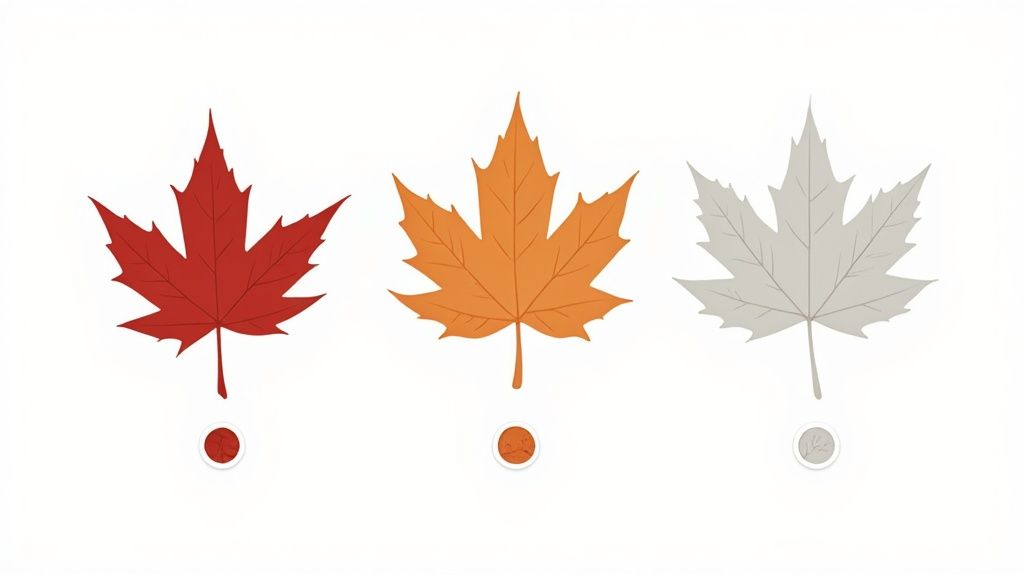
Ever stood in your Atlanta-area yard and wondered if that towering tree is a Sugar Maple or a Red Maple? It can feel like a tough puzzle, but you really only need to train your eye to spot a few key visual clues. Moving beyond the generic maple shape is the first step toward confidently identifying the trees on your property.
This guide will give you the foundational toolkit to tell common maple species apart. You don’t need to be a botanist—you just need to know what to look for.
The Three Core Features for Identification
To start identifying different maple leaves, let’s focus on three main characteristics. Get these down, and you'll be able to narrow down the possibilities in no time.
- Lobes (The Points): These are the main "fingers" of the leaf. First, count them. Most maples you'll see have either three or five major lobes. The depth and sharpness of these points are also big clues.
- Sinuses (The Valleys): Look at the gaps between the lobes. Are they deep and rounded like a "U," or are they sharp and pointy like a "V"? This single detail can often solve the puzzle.
- Margins (The Edges): Now, inspect the very edge of the leaf. Is it smooth all the way around, or does it have tiny, tooth-like serrations? The pattern along the margin is a dead giveaway for certain species.
Here's a quick tip for two maples common in Atlanta: Sugar Maples have smooth margins with rounded, U-shaped sinuses. Red Maples, on the other hand, have toothed (serrated) margins with sharp, V-shaped sinuses.
To make things easier, here's a quick reference table summarizing these features.
Key Maple Leaf Identification Features at a Glance
| Feature | What to Look For | Common Examples |
|---|---|---|
| Lobes | Count the main points (usually 3 or 5). Note if they are sharp or rounded. | Red Maple: 3-5 sharp lobes. Japanese Maple: 5-9 deeply cut, delicate lobes. |
| Sinuses | Check the shape of the valley between lobes—is it a sharp "V" or a smooth "U"? | Sugar Maple: U-shaped sinuses. Silver Maple: Very deep, sharp V-shaped sinuses. |
| Margins | Examine the leaf's outer edge. Is it smooth or toothed (serrated)? | Norway Maple: Smooth margins. Red Maple: Serrated/toothed margins. |
This table is a great starting point, but remember that nature loves variety. Sometimes the best clues aren't on the leaf at all.
Secondary Clues Beyond the Leaf
While the leaf is your go-to guide, other parts of the tree provide excellent, year-round confirmation. When you’re trying to lock in an ID, don't forget to look at these secondary features.
For instance, bark texture is a huge indicator. A young Red Maple often has smooth, light gray bark that gets much rougher and more plated as it ages. A mature Silver Maple, in contrast, is famous for its shaggy bark that peels away in long, vertical strips.
The iconic "helicopter" seeds, officially called samaras, also offer clues in their shape and the angle at which the two wings meet. And of course, modern tools can help; using a good plant identification app can confirm your suspicions in seconds. By combining all these observations, you build a complete and confident picture of the tree's identity.
To really get good at telling maple leaves apart, you need to learn how to look at them like a pro—but let’s skip the dense botanical textbook language. Think of it as learning a leaf’s basic anatomy. Once you can spot the key parts and know what they're telling you, you can "read" just about any maple tree you come across.
Let's break down the essential features of a maple leaf, piece by piece. This simple framework will give you the vocabulary you need to confidently identify the specific trees we'll cover next.
Lobes: The Fingers of the Leaf
The first thing you’ll notice on a maple leaf are its lobes. These are the main points that stick out from the center, kind of like the fingers on your hand. Around the Atlanta area, most of the maples you'll find will have either three or five main lobes.
Right away, the number and shape of these lobes give you a massive clue. A Red Maple, for instance, usually has three distinct lobes and a couple of smaller, less-defined ones near the stem. A classic Sugar Maple, on the other hand, almost always sports five very clear, well-formed lobes.
Picture it this way: Hold your hand up and trace its outline. Your five fingers create a specific shape. Now, tuck in your thumb and pinky—that makes a totally different, three-pointed silhouette. That simple difference is exactly how you should start comparing maple leaves.
Just by counting the lobes, you've already started to narrow down the possibilities before getting into the nitty-gritty details.
Sinuses: The Valleys Between the Fingers
Okay, now look at the empty spaces between the lobes. Botanists call these indentations sinuses. The shape of these gaps is one of the most reliable ways to distinguish between common maple species that otherwise look very similar.
I like to think of a sinus as the valley between two mountain peaks. Is that valley a gentle, curved "U" shape, or is it a sharp, pointy "V" shape?
- U-Shaped Sinuses: This is the tell-tale sign of a Sugar Maple. The gaps between its lobes are smooth and rounded, giving the whole leaf a softer, flowing outline.
- V-Shaped Sinuses: Those sharp, angular gaps are a dead giveaway for Red and Silver Maples. The Silver Maple takes it to an extreme, with incredibly deep, dramatic V-shaped cuts that can slice almost all the way to the leaf's center.
Honestly, this one detail can be the tie-breaker when you're stumped between two look-alikes.
Margins: The Unique Pattern on the Edge
Finally, let's zoom in on the very edge of the leaf. This outer border is called the margin. Just like the edge of a quarter is ridged while a penny's is smooth, a leaf’s margin has its own distinct pattern.
With maples, we're mostly looking for two textures: serrated (toothy) or entire (smooth).
- Serrated Margins: A Red Maple leaf has little teeth all along its edges, almost like a tiny saw blade. It feels rough to the touch.
- Entire Margins: In contrast, a Sugar Maple leaf has a mostly smooth edge. It might have a few large, wavy points, but it lacks that fine, jagged texture.
By putting these three clues together—lobes, sinuses, and margins—you're building a complete profile of the leaf. You're moving beyond a confusing jumble of green shapes and starting to decode the visual evidence in front of you. You’re not just guessing anymore; you’re systematically identifying the tree. With this foundation, you're ready to start naming specific species with real confidence.
Alright, you’ve got the basics down—you know your lobes from your sinuses and can spot a toothed margin from a mile away. Now, let’s put those skills to the test right here in our own backyards. You're about to become the go-to tree expert in your neighborhood by learning to identify the specific maples that thrive across the Atlanta metro area.
From the fiery blaze of a Red Maple in the fall to the delicate, sculptural leaves of a Japanese Maple, our local landscapes are a living gallery of these amazing trees.
Most people associate maples with Canada and syrup, but the family tree is surprisingly diverse and global. The vast majority of maple species actually come from Asia. In fact, China is home to a staggering 58% of all known maple species, and East Asia as a whole contains over 80% of the world's total. North America has about 13 native species, but many of them—like the ones we see all over Georgia—are absolute staples of our local ecosystem. You can learn more about global maple diversity and conservation efforts online.
This is your field guide. We're going to dig into the most common species you'll find around town, looking beyond just the leaves to other key clues like bark, fall color, and the shape of those classic "helicopter" seeds.
Red Maple (Acer rubrum)
The Red Maple is hands-down one of the most common and recognizable trees you'll see around Atlanta. It’s a popular choice for its hardiness and, of course, that absolutely spectacular autumn color.
A Red Maple leaf usually has three to five lobes separated by sharp, V-shaped sinuses. The real giveaway, though, is its edge—the margin is distinctly serrated, or "toothy," like a little saw blade. If you run your finger along it, it feels noticeably jagged. The lobes themselves are also angular and pointy.
When they’re young, Red Maples have smooth, light gray bark, which can make them tricky to distinguish from other saplings. But as they get older, the bark transforms, becoming much darker and rougher with shaggy plates or long, narrow ridges. In the fall, they truly earn their name, turning a brilliant, consistent scarlet. Their samaras are fairly small and form a tight V-shape.
Silver Maple (Acer saccharinum)
You'll often spot Silver Maples near creeks and in low-lying areas. These are the fast-growing giants of the maple world, known for their elegant, deeply-cut leaves.
If you find a maple leaf with five lobes and sinuses so deep and sharp they nearly touch the center of the leaf, you’re almost certainly looking at a Silver Maple. The "silver" part of its name comes from the underside of the leaf, which is a pale, silvery-white that flashes beautifully when the wind blows. The margins are also very deeply toothed.
A mature Silver Maple's bark is its other classic tell: it’s shaggy and peels away from the trunk in long, thin vertical strips. Its fall color is usually a more subdued (but still lovely) yellow, and its samaras are the largest of our native maples, forming a very wide, almost horizontal V.
Homeowner Tip: Silver Maples are notorious for their weak wood and have a bad habit of dropping large branches during storms. If you have a big one near your house, it's a smart move to have an ISA-Certified Arborist check its structural integrity.
Norway Maple (Acer platanoides)
While it's not a Georgia native, the Norway Maple is everywhere in urban and suburban landscapes because it's tough enough to handle pollution and compacted soil. The downside? It's considered an invasive species in many places because it aggressively outcompetes native trees.
At first glance, a Norway Maple leaf looks a lot like a Sugar Maple's, with five sharp-pointed lobes. But there are a couple of dead giveaways. First, the leaf is usually much wider than it is long. Second, while the margins are mostly smooth, the lobes end in a few large, pointy, almost thread-like teeth.
But here’s the foolproof test: snap the petiole (the leaf stalk). If a milky white sap oozes out, you've got a Norway Maple. Sugar Maples produce a clear, watery sap. The bark is a grayish-brown with tight, interlacing ridges that often form a diamond-like pattern. Come autumn, they reliably turn a bright, sunny yellow.
Boxelder (Acer negundo)
The Boxelder is the black sheep of the maple family. It is a true maple, but its leaves will throw you for a loop, looking nothing like the classic shape we all recognize. People often mistake it for an ash tree or even poison ivy.
Instead of a single, classic leaf, the Boxelder has compound leaves. This means each leaf is actually made up of three to seven smaller leaflets arranged along a central stalk. The leaflets themselves have coarsely toothed edges and can be pretty irregularly shaped.
The one thing that screams "maple" is its fruit. It produces those unmistakable paired, V-shaped samaras that hang in long, droopy clusters. The bark is pale gray or light brown and develops shallow furrows with age. Its fall color is typically a simple yellow.
Japanese Maple (Acer palmatum)
A true star in landscape design, Japanese Maples are prized for their graceful shapes and absolutely stunning foliage. While there are hundreds of different cultivars, most of them share a few key features.
Their leaves are the most delicate and intricate on our list, usually featuring five to nine very deep, slender lobes. The sinuses are cut extremely deep, and the margins are finely serrated, giving the whole leaf a lacy, almost feathery look.
Of course, the color is a huge part of their appeal. Foliage can range from deep burgundy and vibrant red to bright lime green and even variegated patterns all season long. Their fall color is often a breathtaking show of fiery crimson. The samaras are small, and the bark on most types is smooth and gray.
This diagram helps break down the main clues—points, valleys, and edges—for telling these maple leaves apart.
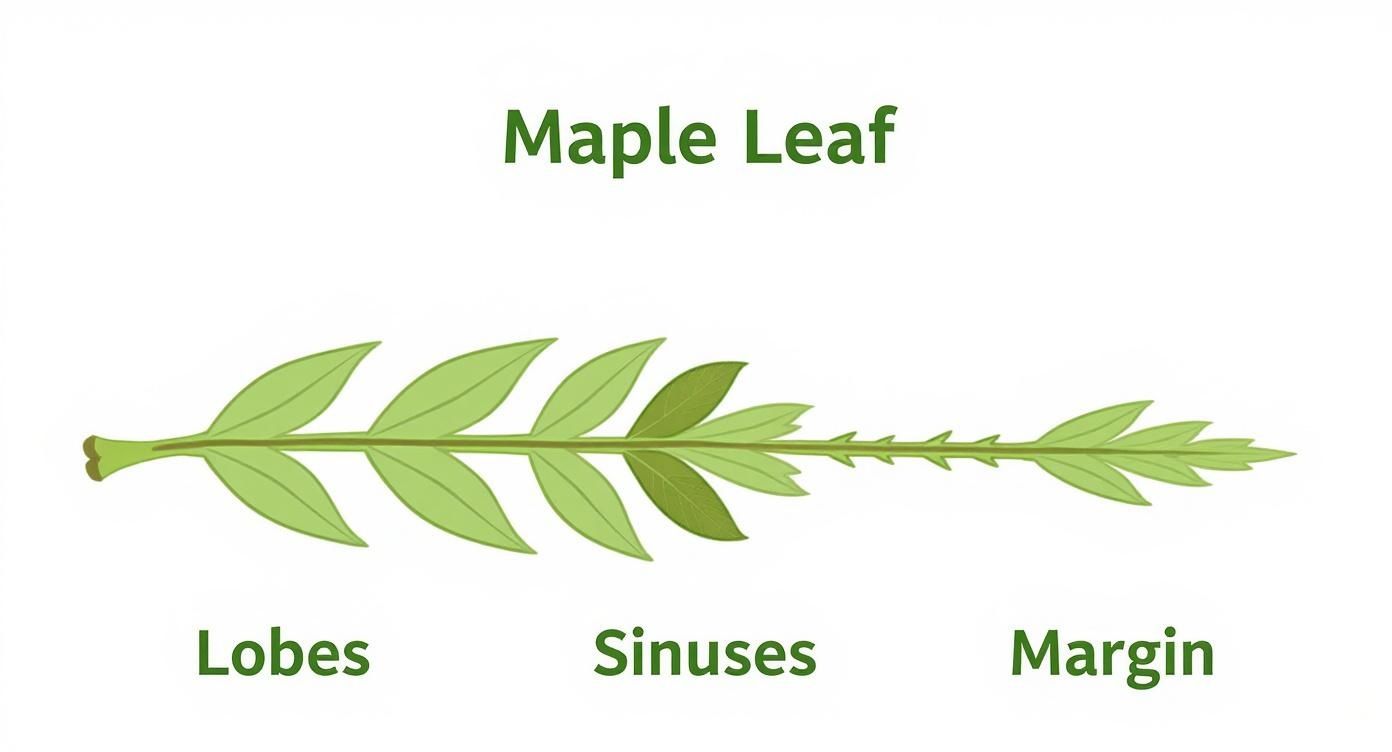
As you can see, once you know to look for the lobes, sinuses, and margin, you have a clear system for figuring out which maple you're dealing with.
Comparing Common Maple Trees in the Atlanta Area
To make things even easier, here's a quick side-by-side comparison of the key features for the maple trees you'll most frequently encounter in and around Atlanta.
| Maple Species | Leaf Lobes & Sinuses | Leaf Margin | Bark Texture | Fall Color | Samara (Helicopter) Shape |
|---|---|---|---|---|---|
| Red Maple | 3-5 lobes, sharp V-shaped sinuses | Coarsely toothed/serrated | Young: Smooth gray Mature: Dark, shaggy plates | Brilliant scarlet or deep red | Small, narrow V-shape |
| Silver Maple | 5 lobes, very deep V-shaped sinuses | Deeply and sharply toothed | Shaggy, peels in long vertical strips | Muted yellow | Large, very wide V-shape |
| Norway Maple | 5 lobes, pointed tips, milky sap from petiole | Mostly smooth with a few large, thread-like points | Tight, interlacing ridges (diamond pattern) | Bright, reliable yellow | Wide V-shape, almost horizontal |
| Boxelder | Compound leaf with 3-7 leaflets | Coarsely toothed | Pale gray with shallow furrows | Simple yellow | Long, drooping clusters |
| Japanese Maple | 5-9 deep, slender lobes | Finely serrated, lacy appearance | Typically smooth and gray | Fiery crimson, scarlet, or orange | Small, delicate |
This chart is a great cheat sheet to have on hand, whether you're in your own yard or walking through a local park. It highlights the subtle—and not-so-subtle—differences that will help you identify these trees like a pro.
Looking Beyond the Leaf for Year-Round Clues
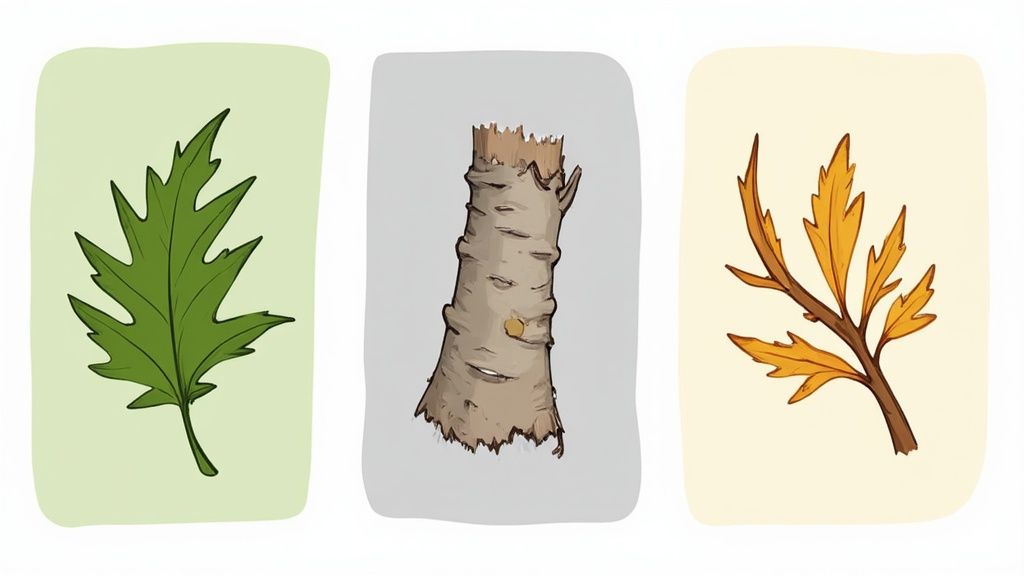
While the unique shapes of maple leaves are fantastic clues, they disappear every winter, leaving a lot of homeowners stumped. But true tree identification is a year-round skill. By learning to read the other signs a tree gives you, you can become a tree detective in any season, confidently picking out maples even when their branches are totally bare.
Think of it like recognizing a friend from a distance. You might first spot them by their coat, but you can also tell who they are by their walk, their height, or their voice. Trees are the same—their bark, seeds, and even their autumn colors are distinct signatures that tell their story long after the last leaf has fallen.
Decoding the Story Told by Bark
Bark is basically a tree's fingerprint. It offers one of the most reliable clues to its identity, especially in the dead of winter. It also changes dramatically as a tree ages, so it’s important to know what you’re looking for at different life stages. A young tree's smooth skin can become rough and deeply textured over the decades.
A young Red Maple, for instance, often has smooth, light gray bark that’s easy to mix up with other species. As it matures, though, this bark darkens and starts developing long, shaggy plates or narrow ridges.
In stark contrast, a mature Silver Maple is famous for its shaggy, almost messy appearance. Its bark peels away in long, vertical strips that curl at the ends, making it look like it's constantly shedding. This is a dead giveaway, even from a hundred feet away.
The Science and Spectacle of Fall Color
The brilliant colors of autumn are more than just a pretty display; they're a chemical conversation happening inside the leaf. The specific colors a maple produces can be a major clue to its species, all because different maples produce different pigments as the green chlorophyll breaks down.
- Reds and Purples: Species like the Red Maple and Sugar Maple produce pigments called anthocyanins in the fall. These are created when sugars get trapped in the leaves, and their production gets a boost from sunny days and cool nights. This is why these trees can turn a fiery scarlet or deep crimson.
- Yellows and Oranges: All maple leaves contain pigments called carotenoids year-round, but they're completely masked by the dominant green chlorophyll. When that green fades, these stable pigments finally get to shine through. This is why Norway Maples almost exclusively turn a bright, clear yellow.
The vibrancy of fall color can change year to year based on the weather. For spectacular reds, the best conditions are sunny fall days to help produce those anthocyanin pigments, followed by chilly but not freezing nights.
This means you can often distinguish between different maples just by their autumn wardrobe. A Sugar Maple often shows off a brilliant mix of yellow, orange, and red on the same tree, while a Red Maple tends to go for a more uniform, stunning scarlet.
Reading the Wings of Samaras
Those iconic "helicopter" seeds, officially called samaras, are far more than just fun toys to spin. The size, shape, and angle of their wings are highly specific to each maple species. They are the tree’s reproductive signature, carefully designed for wind dispersal.
Just looking at how the paired wings connect can instantly help you narrow down the options. The angle they form is a key identifier that you can find on the ground long after they fall.
Let’s compare a few common examples:
- Sugar Maple: Produces samaras that form a distinct, U-shaped or tight V-shaped angle, roughly 60 degrees.
- Red Maple: The wings are a bit more spread out, forming a V-shape at an angle of about 90 degrees.
- Norway Maple: Has the widest spread of them all. Its samara wings are almost completely flat, forming a nearly horizontal line at a 180-degree angle.
By combining these year-round clues—the texture of the bark, the signature fall colors, and the specific architecture of the samaras—you build a complete profile of the tree. This holistic approach moves you beyond summer-only identification and empowers you to understand the trees in your landscape in every season.
Caring for Your Specific Type of Maple Tree
Figuring out which maple leaves you have on your property is step one. The real game-changer is understanding what each tree needs to thrive. Think of it this way: every maple species has its own personality, with unique strengths and weaknesses. Giving them the right care starts with knowing exactly who you're dealing with.
For instance, the fast-growing Silver Maple is notorious for its weak wood. That makes it a prime candidate for dropping branches during one of Atlanta's signature thunderstorms. On the flip side, the sturdy Sugar Maple can handle a storm but gets stressed out by compacted soil or road salt.
When you know these species-specific quirks, you can stop problems before they start. It's the key to making sure your trees stay a beautiful, safe part of your landscape for the long haul.
Common Issues for Specific Maples
Every maple has an Achilles' heel. Knowing what to watch for is your best defense. Here are a few common vulnerabilities for maples we see all the time in the Atlanta area.
- Silver Maple (Acer saccharinum): Their brittle branches are the biggest headache. Having a professional arborist come out for regular structural pruning can thin the canopy to let the wind pass through and remove weak limbs before they snap.
- Norway Maple (Acer platanoides): This species is a magnet for tar spot, a fungal disease that leaves big, ugly black spots on the leaves. While it's mostly a cosmetic issue, a bad infection can really stress the tree. The best defense is a good offense: rake up and get rid of all the fallen leaves each autumn.
- Japanese Maple (Acer palmatum): Our hot, dry summers can be tough on these beautiful ornamental trees. They often suffer from leaf scorch, which makes the edges of their delicate leaves turn brown and crispy. The fix is to make sure they get consistent water and, ideally, are planted where they get some shade from the brutal afternoon sun.
Best Practices for Pruning and Maintenance
When it comes to pruning maples, timing is everything. These trees have a ton of sap, and if you prune them at the wrong time of year, they can "bleed" all over the place.
The absolute best time to prune most maple trees is when they're dormant, from late fall into mid-winter. If you wait until late winter or early spring, you're going to see a lot of sap flow. It won't usually hurt the tree, but it looks messy and can attract pests.
Good old-fashioned maintenance is just as critical. Spreading a 2- to 3-inch layer of mulch around the base of your tree is one of the best things you can do. Just be sure to keep it from piling up against the trunk. This simple step helps the soil hold moisture, keeps the roots cool, and smothers weeds—a win for any maple.
Keep an eye out for the early signs of trouble, like leaves turning yellow in the middle of summer, a thinning canopy, or strange fungal growth on the bark. Spotting these issues is your cue to dig a little deeper. By staying observant and tailoring your care to your tree's specific needs, you can ensure it doesn't just survive—it thrives.
Knowing When to Call in a Certified Arborist
Getting to know the maple leaves on your property is a great first step, but let's be honest—sometimes a tree's problems are way beyond a DIY fix. Knowing the red flags that call for a professional eye is one of the most important things you can do to protect your trees, your home, and your family.
Some issues are impossible to ignore. If you spot huge dead branches hanging overhead, deep cracks running down the trunk, or a tree that’s dropping its leaves way out of season, it's time to pick up the phone. These aren't just cosmetic problems; they're often signs of serious structural weakness or severe stress that could end in disaster during the next big storm.
Why a Professional Assessment Is So Important
Another major warning sign? Mushrooms or other fungi sprouting from the trunk or around the base of your tree. They might look innocent, but they're often just the tip of the iceberg—the visible evidence of extensive internal decay. An arborist has the tools and training to figure out just how bad the rot is, something you simply can't see from the outside.
Getting ahead of problems is even better. Some of the more advanced predictive plant disease detection methods are giving us new ways to spot trouble early, which can help you decide when it's time to bring in an expert. The truth is, even a maple that looks perfectly fine can be hiding serious issues.
Don't Settle for Less Than ISA-Certified
When you hire an ISA-Certified Arborist, you're not just getting someone with a chainsaw. You're bringing in a pro who has passed a tough, comprehensive exam on tree science and is bound by a strict code of ethics. That certification is your guarantee that they know what they’re doing and will prioritize safety and the health of your tree.
Thinking About Long-Term Tree Health
Even seemingly healthy tree populations can face big challenges over time. Take Canada's sugar maples, for instance. While they're generally in good shape, experts have seen periodic dieback events hit the older stands. With about 10% of these forests now over 100 years old, it's clear this aging population needs careful management to keep it healthy. You can learn more about the health of these iconic maple forests and the work being done to protect them.
Ultimately, calling an arborist is about peace of mind. They can map out a long-term care plan, spot potential hazards you’d never notice, and handle the big, dangerous jobs safely and correctly. If you have any doubt at all about the health or stability of a large maple on your property, making that call is always the smartest, safest move.
Common Questions About Maple Leaf Identification
Even after you get the hang of lobes, sinuses, and margins, a few tricky maples can still throw you for a loop. Let's walk through some of the most common questions and mix-ups homeowners run into when trying to identify the maples in their own backyard.
Think of this as a quick-reference guide to clear up those lingering doubts.
Sugar Maple vs Red Maple Leaves
What's the difference between a Sugar Maple and a Red Maple leaf? This is, without a doubt, the most frequent point of confusion. The secret is to ignore the general shape and focus on the small details.
The two easiest tells are the sinuses (the valleys between the points) and the margins (the very edge of the leaf).
- A Sugar Maple has broad, rounded, U-shaped sinuses. Its edges are also mostly smooth.
- A Red Maple has sharp, jagged, V-shaped sinuses. The entire margin is serrated, like the edge of a saw blade.
Come fall, Sugar Maples often put on a spectacular show with gradients of yellow, orange, and fiery red all on the same leaf. Red Maples, true to their name, usually turn a more uniform, brilliant scarlet.
Do All Helicopter Seeds Come From Maples?
Do all trees that drop those "helicopter" seeds belong to the maple family? While maples are famous for their winged seeds, technically called samaras, they aren't the only trees that produce them.
You’ll see similar-looking winged seeds on trees like Ash and Elm. The big difference is that maple samaras almost always grow in pairs, creating that classic V-shape that spins so perfectly as it falls. In fact, the angle and size of these paired wings are fantastic clues for identifying the exact species of maple.
For example, a Norway Maple's paired samaras spread out in an almost perfectly flat, 180-degree line. A Sugar Maple's pair forms a much tighter U- or V-shape. That one little detail can solve the puzzle.
What Tree Has Maple Like Leaves in Clusters?
I found a tree that looks like a maple, but the leaves grow in clusters. What is it? Chances are you've stumbled upon a Boxelder (Acer negundo). It's a true maple, but it’s definitely the black sheep of the family.
Unlike every other maple, the Boxelder has compound leaves. This means each "leaf" is actually a collection of three to seven smaller leaflets. Because of this strange structure, people often mistake it for an ash tree or even poison ivy.
To be sure it's a Boxelder, look for the two key traits it shares with all its maple cousins: an opposite branching pattern and those unmistakable paired, V-shaped samaras.
At Richmond Tree Experts GA, our ISA Certified Arborists have been helping homeowners in the Atlanta area identify and care for their trees since 1985. If you have questions about a specific tree on your property in Cumming, Alpharetta, or Roswell, or need professional advice on tree health and safety, we're here to help. Contact us today for a consultation.
Not sure what your tree needs? Richmond Tree Experts has worked on Marietta and Metro Atlanta trees since 1985, and every job is looked at by an ISA Certified Arborist before it is priced. Start with an ISA Certified Arborist evaluation, or see everything we do: tree removal, stump grinding and arborist services across Cobb, Fulton, Cherokee, Gwinnett and DeKalb counties (service areas).
Call (770) 974-3964, 7am to 11pm every day, or request an estimate online.

