

The storm has passed, but a tree is lying across your driveway and a heavy limb is resting on the garage. You can't tell whether the cable underneath it is a service wire or a power line. You need help quickly, but the first call isn't always to a tree cutting service.
When you need emergency tree service in Atlanta, the right sequence matters more than the first available chainsaw. Get people out of danger, resolve electrical hazards, and then arrange an assessment that separates urgent removal from cleanup that can wait.
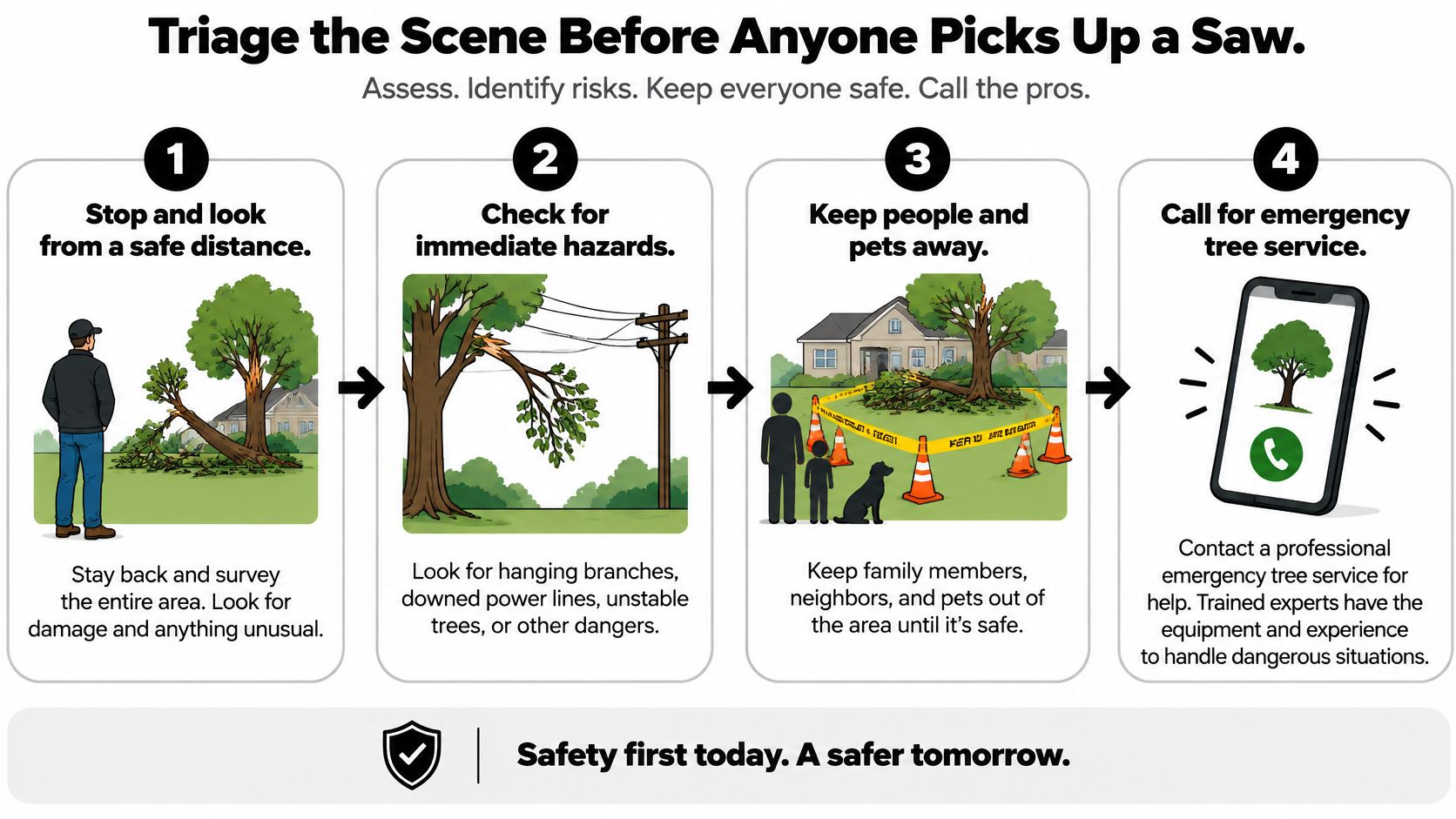
Triage the Scene Before Anyone Picks Up a Saw
A tree across a driveway can wait if a wire is down nearby. Start by checking the scene from a safe place, then make the calls that determine whether anyone can approach it.
If someone is injured, trapped, or in immediate danger, move to safety and call 911. Tell the dispatcher if the tree has hit a building or blocked emergency access. A blocked public road should be reported to emergency responders or the responsible road authority. Don't try to drag the tree clear.
Make the calls in the right order
- Immediate danger: Call 911 for an injury, entrapment, or another life-threatening condition.
- Possible electrical involvement: Report downed or low-hanging lines to your electric provider. Stay away and treat every line as energized until the utility clears the hazard.
- Tree assessment: Contact an emergency tree professional after utility hazards have been addressed and the site is safe for tree work. Explain what the tree is touching, not only its size.
- Documentation: Photograph the damage only from a safe position. Records can wait if getting them means entering the hazard area.
The utility call comes before removal when wires may be involved. During metro-Atlanta storm recovery, Georgia Power reported about 56,000 customers still without service after restoring more than 60,000, with fallen trees complicating restoration, according to local coverage of storm damage and outages. An ordinary tree crew cannot resolve an electrical hazard. Wait for utility clearance before tree work begins.
Use this sequence to keep the first decisions clear.
Give commercial properties a separate response plan
At a home, the priority is keeping the household away from the hazard. A commercial property manager also has to control tenant access, deliveries, parking, and pedestrian routes. Assign someone to communicate closures before tenants or visitors encounter the blocked area.
Give the contractor specific site details: which entrances are blocked, whether another entrance is usable, and where equipment can be staged. A cleared path is not automatically safe to reopen. Have the crew confirm the area is safe first.
Once immediate hazards are under control, use what to check after a summer squall as a prompt for checking broader property damage. Keep that building inspection separate from the decision about whether the tree itself is safe to approach.
Save this sequence: Get people to safety. Call emergency responders when needed. Report wires to the utility. Arrange tree work after electrical clearance. Take photographs only from a safe position.
Protect Your Home and Family Until Help Arrives
Consider a blocked driveway in Roswell: a fallen trunk crosses the pavement, its crown rests against the garage, and a smaller branch presses against the fence. It's tempting to cut the small branch so a car can squeeze past. Leave it alone.
A branch that looks minor may be supporting another part of the tree or holding tension. Fallen tree removal isn't ordinary firewood cutting when the tree is resting on a structure or tangled with other debris.
Keep the damaged area unused
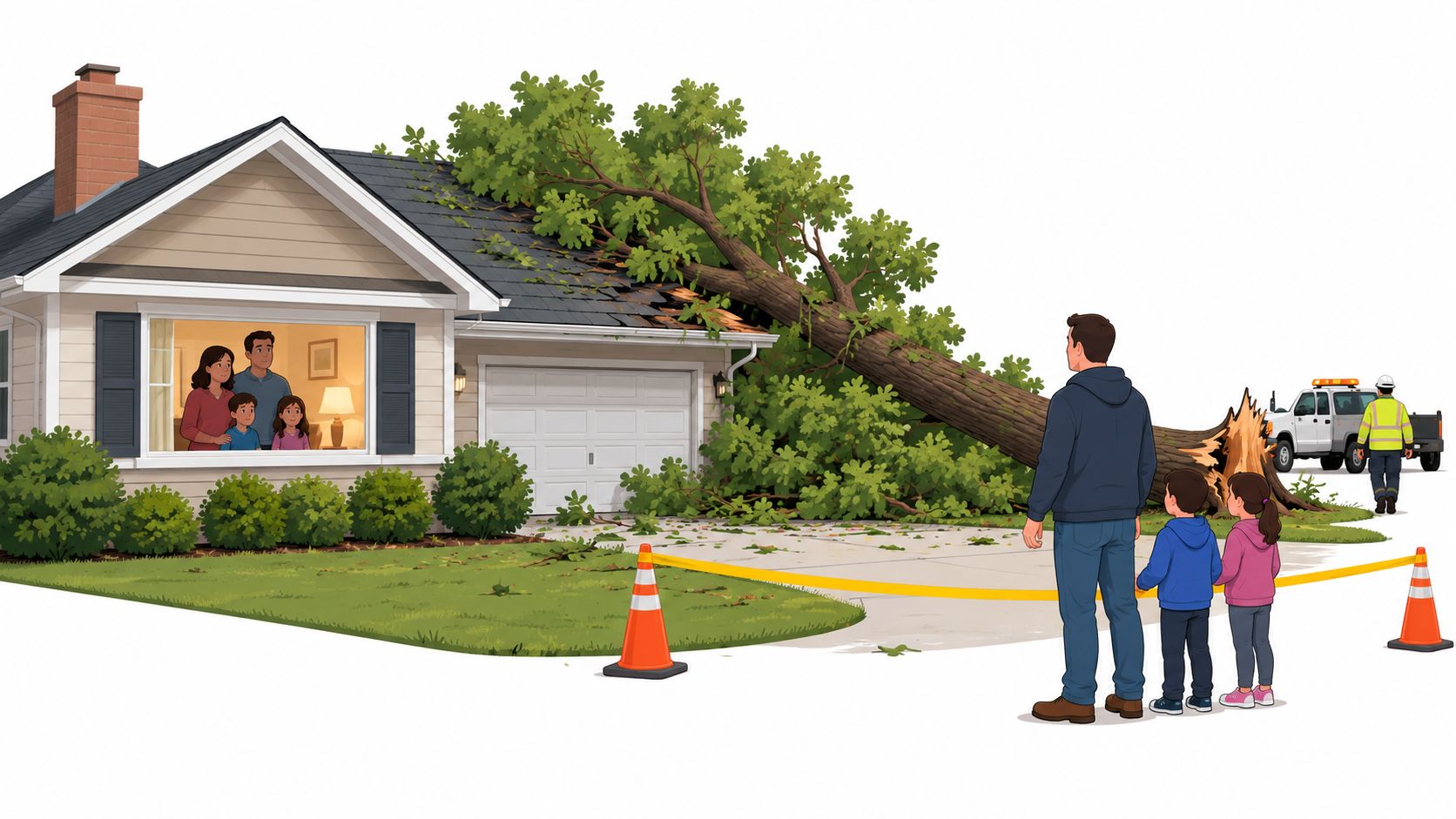
Keep children, pets, neighbors, and delivery drivers out of the affected space. Don't walk under hanging limbs, climb onto the trunk, or enter a garage just to retrieve tools. Tell the dispatcher if you can't leave the property without passing through the hazard.
A tree on a roof also creates a second work area inside the building. Keep people away from the affected rooms until the appropriate professionals assess conditions.
This is the kind of scene where standing back is more useful than trying to start cleanup.
University of Georgia Extension's Forsyth County guidance on storm-damaged trees calls for assessing the damaged tree, neighboring trees, and surrounding area before work begins. That assessment includes clearing debris from the base and checking for exposed roots and disturbed soil.
Those are inspection tasks, not instructions to enter an unstable root zone yourself. If the base is hidden or inaccessible, tell the arborist rather than pulling debris away.
Record what you can see without moving anything
From the safe side of the driveway, useful observations include:
- Contact points: Note where the trunk or limbs touch the roof, fence, vehicle, or pavement.
- Changes at the base: Report visible soil lifting, exposed roots, or a new gap around the trunk.
- Remaining overhead damage: Identify broken branches still caught in neighboring trees.
- Access limitations: Explain whether a gate, narrow side yard, retaining wall, or parked vehicle limits equipment access.
For electrical questions beyond the immediate response, review this explanation of tree trimming near power lines. It's a planning resource, not permission to approach a conductor.
Once the tree hazard is controlled, arrange a separate assessment of roof damage. JA Edwards of America Roofing's resource on roof repairs for Orlando homeowners is relevant to that building-repair phase, though local repair requirements need local verification.
Don't stop the inspection at the tree that fell. Ask the arborist to examine nearby standing trees before the cleanup crew leaves.
How to Choose an Emergency Tree Service
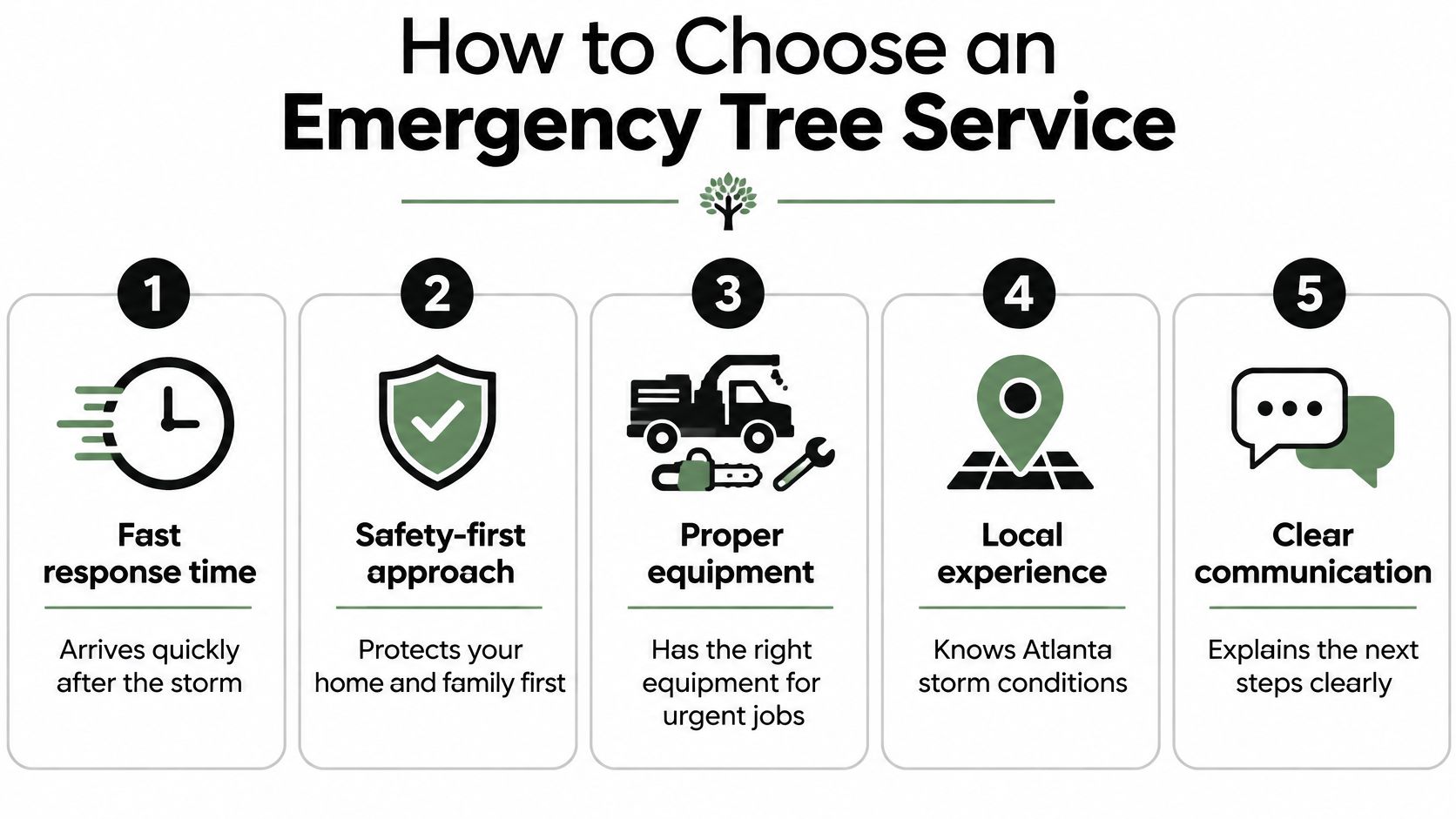
Compare the proposed work, not just the arrival time. A contractor who promises fast cleanup but can't explain electrical clearance, equipment access, or insurance hasn't answered the important questions.
Use this checklist to organize the first conversation.
Separate credentials from job-specific capability
Ask for current licensing and insurance documentation, including general liability and workers' compensation. Then ask who will assess the tree and who will supervise the removal. An ISA Certified Arborist's evaluation and a crew's ability to perform a difficult removal are related, but they aren't interchangeable.
Electrical work adds a separate qualification. OSHA's tree trimming and removal guidance requires work within 10 feet of a power line to be performed by trained line-clearance tree trimmers and directs workers to treat downed lines as energized until the utility de-energizes and grounds or shields them.
| Compare this | A useful answer | An answer that needs clarification |
|---|---|---|
| Response time | An arrival window and explanation of what could delay it | “We'll get there fast” |
| Assessment | A named evaluator and a clear hazard assessment | Removal recommended without examining the scene |
| Equipment | A plan for controlled lowering, lifting, and access | Equipment selected before access is discussed |
| Insurance | Current documents you can verify | A verbal assurance alone |
| Scope | Written removal, cleanup, and stump-work details | A single price with no included tasks |
Richmond Tree Experts GA is one local option with ISA Certified Arborists who diagnose and treat tree problems, licensed and insured crews, professional equipment, free estimates, competitive pricing, and financing options. Evaluate those offerings against the same job-specific questions you'd ask any contractor. Don't assume a company's general credentials establish line-clearance qualifications for your particular scene.
Understand what changes the price
If you're asking how much tree removal costs, a useful estimate needs more than a photograph of the trunk. Ask how the price accounts for structural contact, restricted access, rigging, lifting equipment, debris hauling, and any emergency mobilization.
Separate emergency stabilization, complete removal, and finish work. Stump grinding may be scheduled later without delaying the urgent work, while stump removal may belong in a different scope if excavation or site redevelopment is planned.
Use these questions to ask a tree removal service to keep the conversation specific. For an adjacent trade, HIBCO ROOF LLC's guide to compare roofing estimates in central Ohio offers a comparison reference, not a source for Atlanta tree-removal prices.
This video provides another company reference before you discuss the job.
Before authorizing work, ask:
- Arrival: “When can you assess the property, and when could cutting begin?”
- Scope: “Does this include hauling, final cleanup, and stump work?”
- Changes: “How will you approve additional work if the assessment changes?”
A fast assessment is useful. A rushed commitment to an undefined removal isn't.
Permits and Insurance Claims After a Storm
Atlanta Permit Trunk-Size Thresholds
| Tree Type | Permit Trigger (DBH) |
|---|---|
| Hardwood | 6 inches or more |
| Pine | 12 inches or more |
These thresholds come from City of Atlanta Ordinance Section 158-26 and its removal-permit guidance, which also provides a separate process for dead, dying, diseased, or hazardous trees. DBH means diameter at breast height.
The table applies to the City of Atlanta, not automatically to every Atlanta-area address. A Marietta mailing address, a Roswell property, or an unincorporated Cobb County parcel needs its own jurisdiction check.
Verify the rule before expanding the job
After immediate safety concerns are handled, ask the contractor to identify the applicable permitting authority and explain the process for the tree's condition. Don't assume that storm damage makes every removal exempt.
Keep emergency work distinct from optional cutting. Removing a tree resting on a building and clearing additional healthy trees for a future project are different decisions, even if the same equipment could perform both.
For healthy trees removed through Atlanta's tree-protection process, the city's replacement-tree requirements call for an approved plan replacing the removed DBH inches, generally using trees with at least a 2.5-inch nursery caliper. The same guidance identifies a typical planting period of November 1 through April 1, a 15-calendar-day posting period after preliminary approval, and orange X markings on proposed removals.
Those requirements matter when emergency cleanup turns into land clearing or lot preparation. Confirm the additional scope before authorizing it.
Build an insurance record that explains the work
Contact your insurer and ask what documentation it needs, what your policy covers, and how it wants emergency mitigation recorded. Don't rely on a contractor's general statement that insurance will pay.
Keep a record that distinguishes damage from the work performed:
- Before cleanup: Save safely obtained photographs showing the whole scene and individual contact points.
- Assessment: Request written observations describing the defect, affected structures, access restrictions, and recommended action.
- Invoices: Separate stabilization, removal, hauling, stump work, and any unrelated maintenance.
- Communications: Retain approvals, scope changes, utility updates, and correspondence with the insurer or property manager.
This guide to insurance when a tree falls on a house can help you prepare questions for your adjuster. Your policy and insurer's determination control the claim, not an online example.
Document promptly, but don't delay necessary life-safety action for photographs. Ask the contractor to record conditions during the work when your own access would be unsafe.
Preventing Repeat Storm Damage Without Losing Healthy Trees
Atlanta's canopy is substantial, not incidental. A Georgia Tech and City of Atlanta canopy assessment found approximately 47.9% tree coverage in 2008, representing about 40,524 acres, while the follow-up using 2014 imagery estimated 47.1% coverage.
That density helps explain why storm planning belongs in routine property maintenance. It doesn't justify removing every tree near a house.
Prioritize defects and targets together
A tree's movement in wind isn't, by itself, a removal diagnosis. Ask an arborist to distinguish normal movement from a new lean, root movement, a split, or a partially failed limb.
USDA Forest Service storm-damage guidance estimates that roughly 80% of tree damage during natural disasters is associated with preexisting defects, including decay, cavities, weak unions, codominant stems, and damaged roots. The practical response is to document defects before the next storm rather than judge trees solely by height or proximity.
| Assessment finding | Response to discuss |
|---|---|
| Damaged branches on an otherwise retainable tree | Targeted tree pruning and follow-up inspection |
| A structural defect that may be manageable | Arborist evaluation of support, pruning, or monitoring |
| Serious failure potential over an occupied area | Hazardous tree removal or staged risk reduction |
| A damaged tree without a clear immediate target | Documented monitoring rather than automatic removal |
| Conflict with a planned landscape project | Coordinate tree care with the design before construction |
The decision should account for what the tree could strike. A defect over an unused corner of a lot isn't the same management problem as a similar defect over a bedroom, playground, or business entrance.
Coordinate the tree plan with the landscape plan
Review trees near roofs, driveways, retaining walls, artificial turf, and utility corridors before approving yard work. Ask the arborist and contractor to agree on access routes and root-zone protection.
Tree trimming and tree pruning should have a defined objective, such as addressing damaged branches or improving structure. “Cut it back hard so it won't fall” isn't a sufficient prescription.
Stump grinding, stump removal, and land clearing also need separate decisions. Ask what material will remain, how the area will be finished, and whether the next use involves planting, sod, turf, drainage, or construction.
Removing a hazardous tree can be necessary. Removing a salvageable tree can also mean giving up shade and taking on erosion-control and replacement work.
Keep a property-specific inspection record with photographs, recommended actions, and follow-up notes. That gives homeowners, real-estate professionals, and commercial managers a basis for scheduling work without starting over after every storm.
Request Help from Richmond Tree Experts GA
Once the scene is safe for assessment, make a clear call rather than sending only “I need tree removal near me.” The dispatcher needs to understand the hazard, the location, and the access problem so the company can discuss an appropriate response.
For tree service in Marietta or Roswell, identify whether the problem is a tree on a home, a dangerous lean, suspended limbs, or a blocked entrance. If you're calling from Kennesaw, Woodstock, Acworth, or Canton, confirm availability for your address and ask what response window the company can offer.
Have the job details ready
The company's stated service communities include Cumming, Johns Creek, Milton, Alpharetta, Roswell, Marietta, Forsyth County, East Cobb, Cobb County, Gwinnett County, and Cherokee County. Give the complete property address rather than relying on a neighborhood name.
Prepare the information that helps separate an emergency dispatch from a routine estimate:
- Current condition: Describe what has fallen, what remains standing, and what the tree is touching.
- Utility status: Explain whether wires are involved and what the utility has told you.
- Safe photographs: Provide available views without returning to the hazard for a better angle.
- Equipment access: Mention gates, slopes, narrow drives, retaining walls, and surfaces you want protected.
- Property contact: Identify who can authorize work and who will meet the crew.
- Desired scope: Distinguish urgent removal from later stump grinding, pruning, hauling, or lot preparation.
A useful opening sounds like this: “A tree is resting on my detached garage, the driveway is blocked, and I have photos from the street.” Follow that with the utility status and access details. You don't need to diagnose the failure yourself.
Ask for the next commitment
For commercial properties, provide the site manager's contact information and any restrictions on work areas or deliveries. For homeowners, explain whether anyone needs assistance leaving the property so the company understands the access concern.
The phone line is (770) 974-3964, available 7am to 11pm every day. Ask for the current assessment window, whether a separate removal visit may be needed, and what the free estimate will include.
You can also request an estimate through the company website. For an urgent hazard, use the phone to explain conditions directly rather than assuming an online submission confirms dispatch.
Richmond Tree Experts GA offers emergency tree removal, storm damage tree cleanup, arborist assessment, and follow-up tree care for North Metro Atlanta properties. Once immediate hazards are addressed, visit Richmond Tree Experts GA to request a free estimate and discuss a removal and recovery plan for your property.

