

That sinking feeling you get when you see yellow leaves in June or a favorite tree looking thinner than last year—we know it well. For homeowners in Cumming, Alpharetta, and all over North Georgia, it’s a common worry. But before you jump to the worst conclusion, take a breath. A tree might just be stressed, not on its last legs.
A quick five-minute health check can tell you a lot. It helps you separate normal seasonal quirks from genuine red flags, preventing you from making a panicked mistake that could actually harm your tree.
Knowing the difference between a tree heading into dormancy and one in true decline is the first hurdle. A dogwood dropping leaves in October is perfectly normal. A pine tree shedding a ton of brown needles in May? That’s a sign something is wrong.
How to Tell If Your Tree Is Actually Dying
So, how do you play detective? It’s all about looking for clues, from the top of the canopy all the way down to the hidden roots.
Inspect the Canopy from a Distance
First, just step back. Stand across the yard and really look at the tree's overall shape. A healthy tree, for its species, should look full and vibrant. You're trying to spot what we call "canopy dieback"—bare, leafless branch tips, which usually start right at the top.
- Is it looking thin? Can you see way more blue sky through the leaves than you remember from last year? A progressively thinning canopy is a classic symptom of a tree under serious stress.
- Wrong-season colors? Are leaves turning yellow, browning, or dropping way before fall? That’s a cry for help, signaling it’s not getting the water or nutrients it desperately needs.
- Are the leaves shrinking? Compare this year's new leaves to older ones. If they’re noticeably smaller, the tree is probably trying to conserve energy to fight off a bigger, unseen problem.
Examine the Trunk and Branches Up Close
Now, get in close and check out the tree’s core structure. The trunk and main branches tell a story. Carefully run your hand over the bark and look for anything that feels off.
You're on the hunt for deep cracks, sections where the bark is peeling away, or soft, spongy spots. Those are big indicators of internal decay. Also, keep an eye out for any fungal growth, like mushrooms popping out of the trunk or those shelf-like conks. They often show up when wood is already rotting from the inside.
A tree can look surprisingly healthy from a distance while hiding serious internal decay. Finding mushrooms or conks on the trunk isn't an early warning—it's often a late-stage sign that a structural issue has been festering for a while.
To help you connect the dots, we've put together a quick checklist. Use this to match the symptoms you're seeing with the most common culprits we find here in Georgia.
Quick Diagnosis Checklist: Symptoms vs. Potential Causes
| Symptom Observed | Common Cause in Georgia Climate | Immediate Action to Consider |
|---|---|---|
| Leaves yellowing in summer | Nutrient deficiency (iron chlorosis) or overwatering (root rot) | Test soil pH; check for standing water or poor drainage |
| Brown, curling leaf edges | Drought stress or underwatering | Deep, infrequent watering; add a 2-3 inch layer of mulch |
| Bare branches at the top of the tree | Canopy dieback from root damage, borers, or systemic disease | Call an ISA Certified Arborist for a professional diagnosis |
| Small holes in the bark | Borer insects (e.g., Emerald Ash Borer, Pine Bark Beetles) | Identify the pest; consult an expert for targeted treatment |
| White powder or dark spots on leaves | Fungal diseases like powdery mildew or anthracnose | Improve air circulation with pruning; apply fungicide if severe |
| Mushrooms or conks on the trunk | Significant internal decay (rot) | Assess for structural failure risk; this often requires an expert |
This table is a great starting point, but remember that multiple issues can happen at once. A tree weakened by drought is an open invitation for pests.
Look for Signs of Pests and Disease
Pests and diseases are a constant battle for trees in Georgia. If you catch them early, they're often manageable. Look closely at the bark for tiny, D-shaped exit holes—a telltale sign of borers. Check the leaves for dark blotches, a powdery white coating (mildew), or strange-looking growths called galls.
The unfortunate truth is that our local climate can make things worse. Drought and intense heat waves put immense stress on trees, weakening their natural defenses. We've seen how widespread tree mortality can be linked to these factors. According to data, tree mortality rates have skyrocketed in areas hit hard by climate stressors—in California, for example, an estimated 62 million trees died in 2016 alone, a massive jump from 3 million in 2010. For more details, you can read more about the connection between climate stressors and forest health.
Don’t Forget the Roots
Finally, look down. The roots are the tree's engine room, but problems there are easy to miss. Check the ground around the base of the trunk. Is the soil heaving or mounding up? That could mean the root system is failing, making the tree dangerously unstable.
Think back—has there been any recent construction, digging, or even heavy equipment driving over the area? Severing major roots or compacting the soil will slowly suffocate a tree. The symptoms might not show up in the canopy for months or even years, which is why catching these ground-level clues is so critical.
First-Aid for a Stressed Tree
Once you’ve figured out what’s wrong, you need to act fast. Think of it as triage for your tree—these first moves can stabilize its condition and set it up for a real recovery. The idea here is to reduce stress quickly with some simple, high-impact steps you can take right now.
This systematic process lets you check for the most obvious signs of trouble, starting from the top and working your way down.
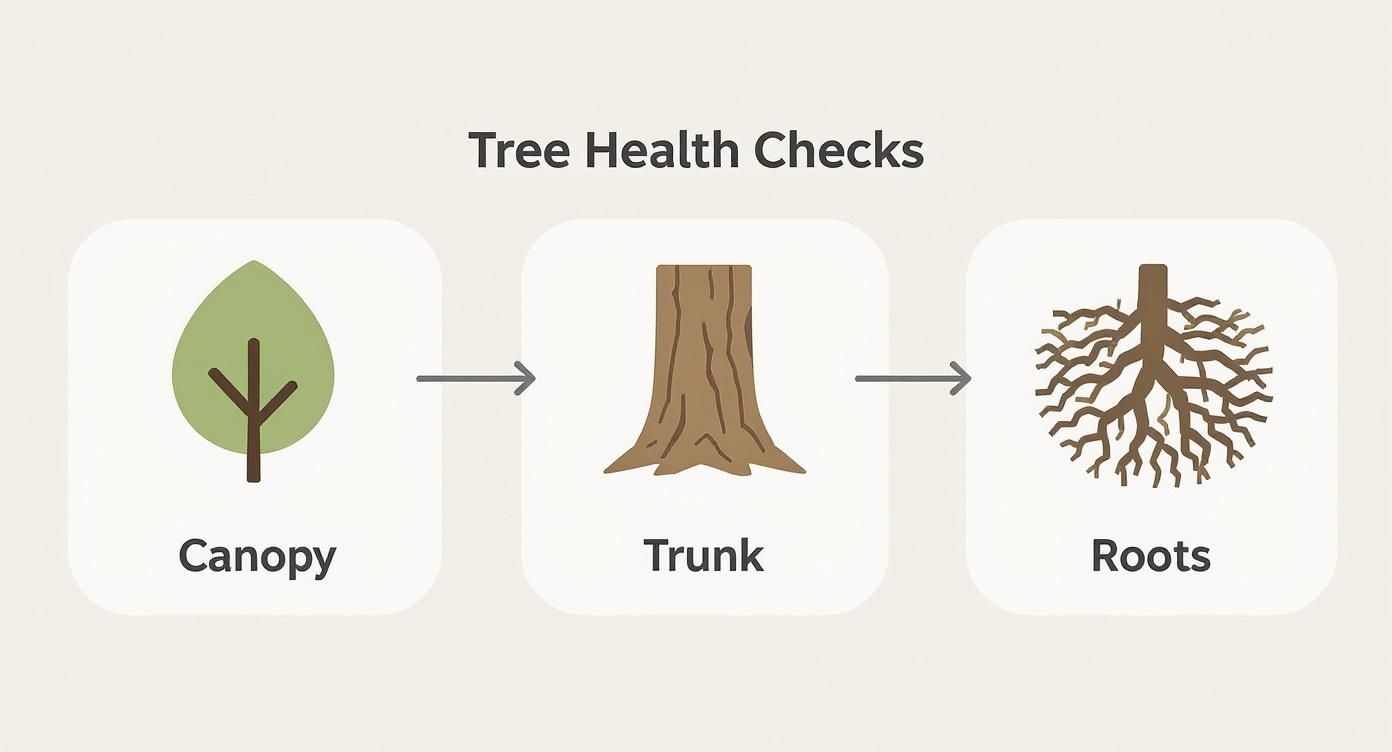
This visual guide breaks down the critical inspection points—canopy, trunk, and roots—giving you a clear roadmap for your rescue mission.
The Critical Role of Proper Watering
Without a doubt, the most important first-aid step is to fix the water situation. Here in Georgia, with our scorching heat and dense clay soils, trees often get either way too much water or not nearly enough. The tricky part is that both problems can look surprisingly similar, showing up as wilting or yellowing leaves.
Before you even think about turning on the hose, get your hands dirty. Dig a small hole, maybe six inches deep, a couple of feet away from the trunk. If the soil is dusty and just crumbles, your tree is desperate for a drink. But if it’s muddy or has a sour smell, you’re looking at overwatering and the potential for root rot—a huge problem in our compacted clay.
The goal is deep, infrequent watering. A quick daily sprinkle does more harm than good, encouraging a weak, shallow root system. Instead, you want to use a soaker hose or just let a regular hose trickle at the base for several hours. This allows the water to soak 12-18 inches down into the soil where it counts.
This method forces the roots to grow deeper in search of moisture, which makes the tree far more resilient during those long, dry summer stretches. For a mature tree, you might only need to do this deep soak once every few weeks during a drought.
Harnessing the Power of Mulch
Mulch is one of your best allies in the fight to save a dying tree. A good layer of organic mulch, like pine bark or wood chips, is like a protective blanket for the tree's entire root zone.
It does several critical jobs all at once:
- Holds Moisture: It dramatically slows down evaporation, keeping that precious water in the soil where the roots can access it.
- Regulates Temperature: It insulates the roots, protecting them from the brutal summer heat and sudden winter freezes.
- Blocks Weeds: It stops sunlight from reaching the soil, preventing weeds from popping up and stealing water and nutrients.
How you apply it is just as important as what you apply. Whatever you do, never pile mulch up against the trunk. We call this a "mulch volcano," and it’s a common mistake that traps moisture against the bark, practically inviting rot, pests, and disease.
The right way is to apply a 2-4 inch layer in a wide circle. Start about 6 inches away from the trunk and spread it all the way out to the tree's dripline (the very edge of its canopy).
Clearing Out the Competition
A tree that's already stressed needs every drop of water and every nutrient it can get. That patch of grass and those pesky weeds growing right up to the trunk are direct competitors, stealing those vital resources before the tree’s roots have a chance. This is especially damaging for young or recently planted trees.
Your immediate action plan should be to get that competition out of there. Carefully clear away all the grass and weeds from the area under the tree's canopy—basically, the same area you're planning to mulch. This creates a protected, competition-free zone where the tree can focus all its energy on healing.
And a word of caution: stay away from the trunk with a string trimmer. Even a small nick in the bark can become an open door for pests and diseases, adding another layer of stress the tree just can't handle.
Fixing Problems Below the Surface
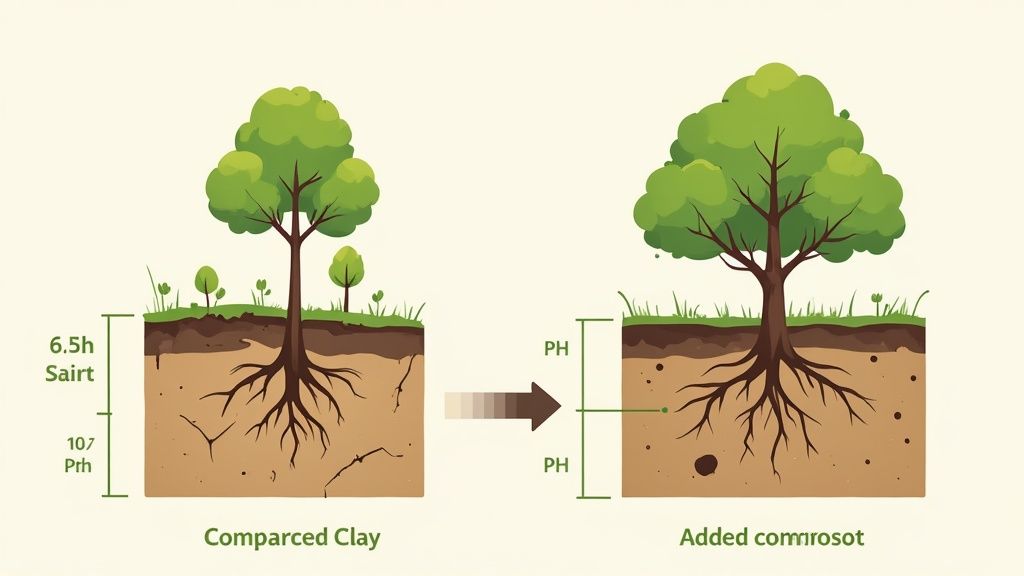
While you might spot the first signs of trouble high up in the canopy, the real story of a sick tree almost always starts underground. A tree’s vitality is directly connected to the soil it lives in. For those of us in Forsyth, Cobb, and Gwinnett counties, that often means dealing with our infamous dense, red clay—a major source of tree stress.
This heavy soil gets packed down incredibly easily from everyday life: foot traffic, lawnmowers, or nearby construction. When soil gets compacted, it’s like asking the tree's roots to breathe through a clogged filter. Water can't get in, oxygen can't reach the roots, and the roots themselves physically struggle to grow.
Diagnosing Your Soil Health
Before you can start fixing things, you have to know what you’re up against. A quick visual check can actually tell you a lot. Do you see puddles forming after it rains instead of soaking in? Is the ground so hard you can barely push a screwdriver into it? Those are classic giveaways of soil compaction.
But there’s more to it than just density. The soil's nutrient profile and pH level are just as important. Georgia clay is notoriously acidic and can be low in key nutrients like iron or manganese. This is why you might see yellowing leaves (a condition called chlorosis) even on a tree that gets plenty of water. The only way to know for certain is to run a soil test.
You can pick up a simple, affordable soil testing kit from your local UGA Extension office or any decent garden center. The report gives you a precise roadmap, showing you exactly which nutrients are missing and whether the pH needs adjusting.
Taking the time to do a soil test is one of the single most valuable things you can do to save a dying tree. It takes the guesswork out of the equation and ensures you give the tree what it actually needs without accidentally causing more harm.
Fighting Soil Compaction and Poor Drainage
If compaction and poor drainage are the culprits, your first mission is to help the roots breathe again. Soil aeration is one of the best ways to do this. For smaller areas, a manual core aerator that pulls out small plugs of soil can work wonders. For larger, mature trees, we often use a specialized tool called an AirSpade, which safely fractures the compacted soil with pressurized air without shredding the delicate root system.
After opening things up, it’s time to improve the soil for the long haul. The key here is adding organic matter.
- Top-dress with compost: Spread a one-inch layer of good, organic compost over the entire root zone—from the trunk all the way out to the edge of the canopy (the dripline). Over time, this compost will work its way into the aeration holes, improving drainage and feeding the soil.
- Work in aged pine bark: Pine bark fines are fantastic for breaking up heavy clay. They create little air pockets that give roots the space they need to thrive.
These additions do more than just add nutrients. They create a welcoming home for beneficial microbes and earthworms, which continue to improve the soil structure long after you’re done.
Applying Targeted Fertilization
Fertilizing a stressed tree is a delicate balance. Dousing it with a heavy, quick-release nitrogen fertilizer is like trying to feed a steak dinner to someone with the flu—it's too much, too soon. This can actually trigger a burst of leaf growth that the weakened root system can't possibly support, causing even more stress.
Instead, let your soil test be your guide. Choose a slow-release, balanced fertilizer that’s formulated with the micronutrients your test showed were missing, like iron and manganese. Applying it in the early spring or late fall gives the tree a chance to absorb the nutrients slowly as it focuses on recovery.
The bigger picture of our local climate also plays a huge role. Stress from drought and extreme heat is a leading cause of tree death worldwide. Some studies suggest that climate change is a factor in 10% to 50% of observed tree mortality on a global scale, which makes smart soil and water management more critical than ever. The work you do to improve the soil right under your tree directly helps it build the resilience it needs to withstand these larger environmental pressures. You can learn more about how climate change impacts global tree mortality and challenges reforestation efforts.
Pruning and Pest Control That Helps, Not Hurts
When a tree is struggling, it's tempting to grab the pruning shears or a bottle of pesticide and feel like you're taking immediate, decisive action. But honestly, these powerful tools can do a lot more harm than good if you're not careful. A stressed tree is running on fumes, so every single cut and treatment needs to be strategic. It has to help, not hurt.
Think of it like surgery—you only remove what's absolutely necessary to help the patient heal. This means focusing your pruning exclusively on branches that are dead, clearly diseased, or broken. Cutting these off frees up the tree's limited resources, allowing it to redirect that precious energy toward healthy new growth.
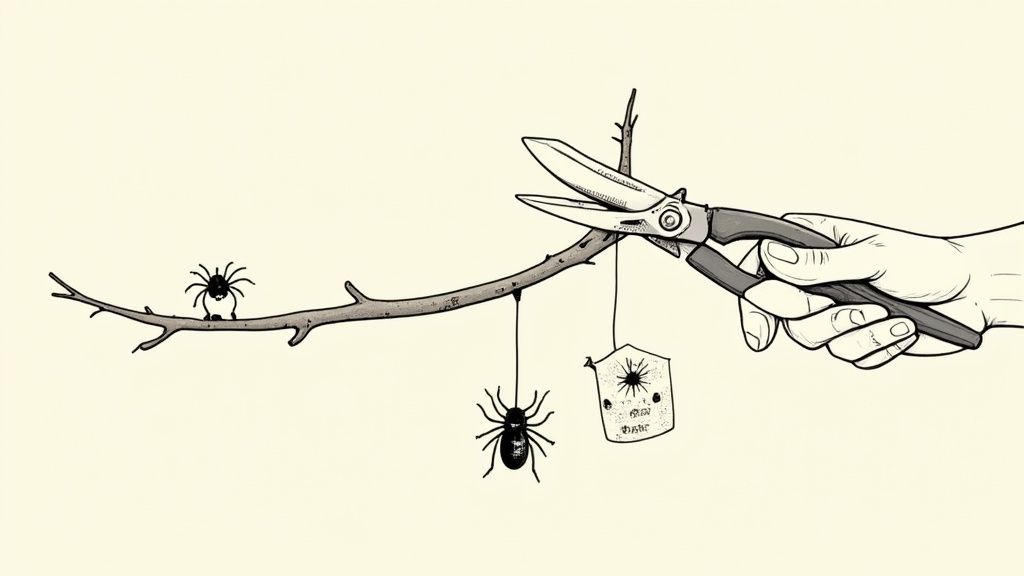
Strategic Pruning The Right Way
Before you even think about cutting, you have to be positive a branch is actually dead. A living branch has some flex to it, but a dead one will snap clean off. You can also do a quick scratch test: just use your thumbnail to scrape away a tiny bit of bark. If you see green underneath, it’s alive. Brown and dry? It’s gone.
Once you’ve confirmed a branch needs to go, how you cut it is everything. One of the worst mistakes we see homeowners make is a single, flush cut right up against the trunk. This creates a massive wound the tree can't easily seal, leaving it wide open to pests and rot. The correct approach is the three-cut method, which stops the branch from ripping bark off the trunk as it falls.
- The Undercut: Go about 1-2 feet out from the trunk and make a cut from the bottom up, about a third of the way through the branch. This is your safety cut that prevents tearing.
- The Relief Cut: Move a couple of inches further out from that first cut and saw straight through the branch from the top down. It will break away cleanly at your undercut.
- The Final Cut: Now you just have a short stub left. Make the final cut just outside the branch collar—that slightly swollen, wrinkled area where the branch meets the trunk. Whatever you do, don't cut into that collar.
Following this method leaves the branch collar intact. That's crucial because it contains specialized cells that will quickly grow over the wound, sealing it off and protecting the tree from infection.
Identifying Pests and Diseases in North Georgia
Trees here in Forsyth, Cobb, and Gwinnett counties have their own set of local enemies. When a tree is already weakened by something like drought or poor soil, it’s basically an open invitation for opportunistic pests and diseases. Spotting an infestation early is absolutely key.
Some of the usual suspects we see around here include:
- Bark Beetles: Look for tiny, D-shaped exit holes in the bark. You might also see a fine, sawdust-like powder (called frass) at the base of the tree. These little guys bore right under the bark, cutting off the tree's circulation of water and nutrients.
- Fungal Infections: Our humid climate is a breeding ground for fungus. Keep an eye out for powdery mildew (a white, dusty coating on leaves), anthracnose (dark, sunken spots), or cankers (dead patches of bark on branches or the trunk).
- Aphids and Scale Insects: These pests suck the sap right out of the tree. They leave behind a sticky mess called "honeydew," which often leads to a secondary problem: a black, sooty mold that grows on top of it.
We always recommend an Integrated Pest Management (IPM) approach over just blasting everything with chemicals. IPM is smarter. It focuses on fixing the root cause of the problem—like improving soil health or air circulation—to make the tree a less inviting target in the first place.
A Gentle Approach to Pest Management
Before you reach for a harsh chemical, always try the gentler options first. You can often knock pests like aphids right off with a strong jet of water from your garden hose. For fungal problems, sometimes just improving air circulation by carefully thinning out a few inner branches can work wonders.
If you do need to use a treatment, look for solutions like insecticidal soaps or horticultural oils. These are much more targeted and have a lower impact on beneficial insects like ladybugs and bees that are actually helping your tree. The goal should always be to manage the pest, not to sterilize your entire yard.
Taking these focused, careful steps is more important than ever. Global research, analyzing nearly 1,700 tree mortality events, shows that forest recovery is getting tougher and taking longer, especially since the 1990s, due to rising temperatures and water shortages. This makes every effort to save an individual tree in your yard incredibly meaningful. You can read the full research about these global tree recovery challenges to see just how much proactive care matters.
So, you've done the basic first aid—the watering, the mulching, the careful pruning of those small, easy-to-reach dead twigs. That's fantastic, and it's often the first line of defense in saving a stressed tree. But there are times when your best efforts just aren't going to cut it.
Knowing when to step back and call in a professional is just as important as knowing how to mulch properly. Some problems are deeper, more complex, and frankly, too dangerous for a homeowner to tackle alone.
That's where an ISA Certified Arborist comes in. Think of us as tree surgeons. You can handle a scrape or a minor cut on your own, but for a deep wound or a broken bone, you see a doctor. It's the same principle for your trees.
Red Flags That Demand a Professional Eye
There are certain symptoms that should immediately have you reaching for the phone instead of the pruning shears. These aren't just signs of stress; they're indicators of serious structural or systemic issues that need an expert eye, and fast.
Look out for these major warning signs:
- Large Dead Branches High Up: If you see big, dead limbs in the upper canopy, that’s a serious hazard. These are what we call "widow-makers" for a reason. Getting up on a ladder to tackle those is a recipe for disaster without the right training and safety gear.
- Trouble at the Trunk: Big cracks, deep cavities, or fungi like mushrooms and conks growing on the main trunk are bad news. This often points to internal decay, which means the tree's core strength is compromised.
- Shifting Ground: Is the soil around the base of the tree heaving up or cracking? Are major roots suddenly more exposed? This is a huge red flag that the root system is failing, making the tree unstable and a prime candidate to fall over in one of our famous Georgia storms.
Here's a hard truth I've learned over the years: if more than 50% of the tree looks dead or severely damaged, the odds of saving it plummet. Calling for help early on gives us the best possible shot at a successful recovery.
How an Arborist Diagnoses and Treats Your Tree
When a certified arborist from Richmond Tree Experts shows up at your property—whether you're in Cumming, Alpharetta, or East Cobb—we're not just there to look at the leaves. We become a partner in your tree's health, digging deep to figure out exactly what's going on.
Our first step is always a comprehensive, on-the-ground assessment. We look at everything: the soil, the bark, the branch structure, the surrounding environment. We’re like detectives looking for clues that tell the full story.
Sometimes, we need to bring out specialized tools. We might use a resistograph, which is a thin drill that measures wood density to detect internal decay without seriously harming the tree. We'll also often take soil samples to test for nutrient deficiencies or pH imbalances, which are incredibly common in the dense clay soil we have across North Georgia.
Once we have a solid diagnosis, we build a treatment plan specifically for your tree. There's no one-size-fits-all solution in this line of work. Your plan could include:
- Structural Pruning: This is about more than just aesthetics. We strategically remove hazardous limbs to improve the tree's overall architecture and take stress off weak points.
- Deep Root Fertilization: We use specialized equipment to inject a custom-blended mix of nutrients directly into the root zone where the tree can absorb it immediately.
- Pest and Disease Control: We can identify the exact pest or fungus causing the problem and apply targeted, effective treatments that are safe for your family and property.
- Cabling and Bracing: For trees with structural weaknesses, like co-dominant stems, we can install support systems to add stability and prevent failure.
Making Expert Tree Care Work for Your Budget
We get it. The idea of "calling in an expert" can sound expensive, especially for homeowners in communities like Roswell and Johns Creek. But at Richmond Tree Experts, we believe saving a mature, valuable tree shouldn't break the bank. We provide clear, upfront pricing and even have financing options to make it manageable.
Think of it this way: investing in a professional consultation can save you a fortune down the road. It can prevent the catastrophic cost of a tree falling on your home or the significant expense of having a large, dead tree removed. Knowing when to make that call is half the battle.
This table should help you figure out when it's time to put down the tools and pick up the phone.
DIY vs Professional Arborist: When to Make the Call
| Symptom or Task | Generally Safe for DIY | Recommended to Call a Professional |
|---|---|---|
| Watering & Mulching | Applying water and a proper mulch ring. | Diagnosing chronic moisture issues related to site drainage. |
| Pruning | Removing small, dead branches reachable from the ground. | Any pruning that requires a ladder or involves large limbs. |
| Fertilizing | Spreading a slow-release granular fertilizer on the surface. | Deep root fertilization or diagnosing specific nutrient deficiencies. |
| Pest Control | Hosing off aphids or using insecticidal soap for minor issues. | Identifying and treating boring insects or widespread disease. |
| Tree Assessment | Noticing yellow leaves or a few dead twigs. | Assessing structural stability, trunk decay, or significant canopy loss. |
Ultimately, bringing in a pro isn't admitting defeat—it's giving your tree its best chance to survive and thrive for years to come.
Got Questions? We've Got Answers
Once you've diagnosed the issue and started a rescue plan, the questions usually start popping up. It's totally natural. Seeing a tree you love struggling is stressful, and honestly, the road to recovery isn't always a straight line. We get a lot of the same questions from homeowners all across Alpharetta, Roswell, and Marietta, so let’s get right into the most common ones.
Right now, your job is to be patient and work on the tree's timeline, not your own. Giving it the right help at the right time makes all the difference.
How Long Until I See Improvement?
This is, without a doubt, the number one question we hear. And the most honest answer is: it really depends.
If a tree is just thirsty from a dry spell, you might see it perk up within a few weeks of consistent, deep watering. But for a tree fighting its way back from serious root damage, compacted soil, or a major pest problem, it's a marathon, not a sprint. For those deeper issues, you need to be looking for subtle signs of progress over an entire growing season—sometimes even two.
- Look at the new leaves: When new leaves emerge next spring, are they a healthier color? A more normal size?
- Check for dieback: Is the canopy thinning finally stopping? Are you seeing fewer dead twigs by the end of the season?
- Assess its overall vibe: Does the tree just look less stressed and more vibrant than it did last year?
Think of it this way: a tree's health is measured in seasons, not days. If you've fixed the core problems with its soil and watering, you're giving it the best shot possible. Just be patient and keep an eye out for those small, positive changes over time.
Can a Tree with a Hollow Trunk Be Saved?
Seeing a hollow in a trunk is definitely alarming, but it doesn’t automatically mean the tree is doomed. Many mature trees, especially our big Georgia oaks, can develop hollows and stand strong for decades. The most vital part of the tree for moving water and nutrients is the cambium—a thin layer of living tissue right under the bark.
The real concern isn't the hollow itself, but the tree's structural integrity. As long as there's enough solid, healthy wood forming a "shell" around that hollow to support the tree's weight, it might be perfectly fine.
But this is one area where a professional opinion is non-negotiable. An ISA Certified Arborist has specialized tools to measure the thickness of that remaining wood and determine if the tree is a risk. Never assume a hollow tree is safe on your own, especially if it’s anywhere near your house, driveway, or a place where people walk.
What Is the Best Time of Year for Tree Recovery Work?
Timing is everything, especially with our distinct Georgia seasons. While you should tackle urgent needs like watering right away, other tasks are much more effective when done at specific times of the year.
A Seasonal Guide for Tree Care in North Georgia
| Task | Optimal Time | Why It Matters |
|---|---|---|
| Pruning | Late Fall to Early Spring | The tree is dormant, making pruning far less stressful. Plus, it's much easier to see the branch structure without all the leaves. |
| Fertilizing | Early Spring or Late Fall | This timing works with the tree's natural growth cycles, helping it absorb nutrients efficiently without forcing new growth at the wrong time. |
| Soil Aeration | Spring or Fall | The soil is usually moist and not frozen, so it's easier to work with. This also avoids the added stress of scorching summer heat. |
| Pest Treatment | Varies by Pest | Timing is critical and pest-specific. Some fungal sprays, for instance, only work in early spring before the buds open. Always identify the pest first. |
Doing major work like heavy pruning in the middle of a hot summer can push an already struggling tree over the edge. By working with the tree's natural rhythm, you give your rescue efforts the best possible chance to succeed. It's a powerful strategy that respects the tree's energy cycle and ensures you're helping, not hurting, its fight for survival.
Are you seeing serious warning signs and feel out of your depth? Don't wait. A professional consultation can be the difference between recovery and removal. The ISA Certified Arborists at Richmond Tree Experts GA have been serving communities like Cumming, Johns Creek, and Milton since 1985. We have the expertise to diagnose the root cause of the problem and create a targeted plan to give your tree its best chance. Schedule your tree health assessment today at https://richmondtree.com.
Not sure what your tree needs? Richmond Tree Experts has worked on Marietta and Metro Atlanta trees since 1985, and every job is looked at by an ISA Certified Arborist before it is priced. Start with an ISA Certified Arborist evaluation, or see everything we do: tree removal, stump grinding and arborist services across Cobb, Fulton, Cherokee, Gwinnett and DeKalb counties (service areas).
Call (770) 974-3964, 7am to 11pm every day, or request an estimate online.

