A lightning strike in North Atlanta rarely gives a homeowner a clean answer. One tree may split open immediately, while another still looks healthy from the driveway. That second tree can be the more dangerous one, because lightning may have damaged the cambium, roots, or internal wood without creating an obvious blowout.
Treat lightning damage to trees as a safety and risk-assessment problem, not a cosmetic pruning job. If a tree is leaning toward your house, has hanging limbs, touches a utility line, or shows a trunk split, keep people away and arrange professional help. A certified arborist can determine whether the right response is monitoring, tree pruning, emergency stabilization, or hazardous tree removal.
The Night the Sky Hit Your Yard
The storm rolls over Marietta or Cumming after dark. A flash turns the backyard white, followed by a crack that sounds like a rifle shot. Bark chips scatter across the deck, the dog disappears into the laundry room, and your phone fills with neighbors' porch-camera videos.
By morning, the white oak behind the deck has a long strip of missing bark. Another tree across the yard appears untouched. That's where homeowners make the costly mistake. The visibly split tree demands attention, but the apparently healthy one may contain ruptured vascular tissue, damaged roots, or a weakened trunk that fails weeks or months later during a summer gust or ice event.
Lightning damage can remain hidden beneath intact bark. The Georgia Forestry Commission's field guidance explains that shock waves can split bark and damage bark, phloem, cambium, and xylem. It also warns that external appearance may not reveal the full extent of internal injury.

A major field study in Panama found that one lightning strike directly killed an average of 3.5 trees larger than 10 centimeters in diameter and damaged 11.4 additional trees. The researchers also estimated that lightning caused 40.5% of short-term deaths among the largest trees over 60 centimeters in diameter, compared with about 4.5% among all trees over 10 centimeters. Those findings come from a systematically monitored tropical forest, not a suburban yard, but they demonstrate the central point: a strike can affect more than the trunk you can see. (Smithsonian field study)
Practical rule: If lightning hit near a tree, assume the tree needs assessment until a qualified professional proves otherwise.
The correct question after a storm isn't “Does it look bad?” It's “Can this tree remain safely loaded beside a home, driveway, play area, or parked vehicle?”
How Lightning Actually Injures a Tree
Think of a tree as a water-filled pipe surrounded by dry material. Lightning seeks a fast path to ground, and sap-filled living tissue conducts electricity more readily than dry wood or siding. The current may enter at the crown, travel down the trunk, jump through roots, or move toward another conductive object.
The damage usually develops through three connected mechanisms.
Steam expansion
Lightning heats water and sap almost instantly. The resulting steam expands beneath the bark and can blast bark fibers, cambium, and wood outward. An extension explanation from Auburn University's Alabama Cooperative Extension System notes that lightning can reach up to 100 million volts and about 50,000°F, conditions capable of boiling sap and stripping bark or wood from a trunk.
A predictive model published in PNAS states that peak lightning current is typically 15 to 30 kA. Higher peak current drives greater power into the vascular cambium, where steam explosions can create longitudinal bark scars or shatter parts of the trunk.
Shock-wave splitting
The current creates more than heat. The Georgia Forestry Commission describes an acoustic shock wave radiating from the lightning channel. That wave can split bark, create radial cracks, shear cellular connections, and bounce within the stem. Multiple strokes in one lightning event can repeat the damage.
The result may be a vertical groove, a partial bark strip, a deep longitudinal crack, or a trunk blowout. A tree can retain a mostly intact silhouette while its internal structure has lost continuity.
Vascular injury
The third mechanism is quieter. Electricity follows the path of least resistance through phloem, xylem, and cambium, cooking living tissue without necessarily blowing the bark away. The pith and heartwood may remain visually stable while the outer conducting tissues die.
Species don't respond identically. Oaks, pines, sweetgums, and tulip poplars common across Forsyth and Cobb counties may show different bark separation, crown dieback, or structural failure patterns than maples. Tree form, moisture content, decay, canopy position, and strike path all matter.

Lightning can also move through the root zone. A nearby tree may have no scar but still suffer underground injury, so a proper inspection covers the trunk, crown, root flare, and surrounding soil.
Symptoms You Can See and the Ones You Cannot
Start the inspection from the ground. Don't climb, cut, pull on hanging limbs, or stand beneath a leaning trunk. Walk the property with a camera, and record the tree from several angles in consistent light so you can compare changes over the following days.
The International Society of Arboriculture research archive notes that more than 20% of trees along a lightning strike path show no visible injury, even though hidden stress can weaken defenses and increase vulnerability to pests and disease. That makes an apparently healthy tree an assessment problem, not a clearance signal.
Immediate red flags
Call a professional tree service promptly if you see:
- Trunk separation: A vertical split, open cavity, loosened bark plate, or trunk section that has shifted.
- Crown failure: Fractured limbs, hanging branches, broken leaders, or a canopy that has twisted.
- Root disturbance: A lifted root plate, fresh soil cracks, exposed roots, or a tree that has started leaning.
- Burn evidence: Scorched leaves, blackened bark, damaged root flare, or a visible strike channel.
- Target exposure: Any damaged tree over a roof, driveway, sidewalk, play area, utility, or regularly occupied space.
A tree that has lost bark in a vertical strip deserves particular attention. Partial stripping can mean the current traveled through living tissue rather than merely scorching the surface.
Delayed symptoms
Hidden injury may appear as leaf wilt, crown dieback, bark separation, fungal growth, or new cracks. Roots may decline while the canopy initially looks normal. The University of Maryland Extension guidance emphasizes that lightning injury can range from no visible damage to complete destruction and that roots may suffer considerable harm even when trunk damage appears minor.
| Symptom | Visible, Days 1-7 | Hidden, Weeks to Months |
|---|---|---|
| Trunk | Bark strips, cracks, blowout, scorch marks | Cambial death, internal separation, expanding fissures |
| Crown | Broken limbs, wilted leaves, scorched needles | Progressive dieback, weak attachments, delayed limb failure |
| Roots | Lifted soil, exposed roots, unstable root flare | Root decline, reduced anchorage, stress mistaken for drought |
| Bark | Loose plates or missing sections | Separation that worsens as injured wood dries and contracts |
| Nearby trees | Fresh scars or scorch | Root-zone injury without an obvious trunk mark |
Photograph the strike point, every side of the trunk, the canopy, root flare, soil, nearby structures, and all hanging limbs. Mark nearby trees for inspection rather than assuming only the tallest or most visibly damaged tree matters.
What to Do in the First 72 Hours After a Strike
The first decision is not whether to save the tree. It's whether the area is safe to enter.
Establish a 30-foot perimeter around the suspected strike point. Keep children, pets, neighbors, lawn crews, and curious helpers outside it. Don't approach a leaning trunk, hanging branch, damaged root plate, or tree touching a line. Downed electrical conductors must be treated as energized.
Make the right call first
- Call 911: Report downed power lines, a fire, a tree that has struck a structure and created an immediate danger, or any injury.
- Call the utility: Contact Georgia Power when a tree or branch is touching a power line, or when the line's status is uncertain. Stay away until the utility confirms the area is safe.
- Call an arborist: Arrange an assessment for trunk splits, hanging limbs, root movement, crown damage, or unexplained decline.
- Call a tree service: Use a qualified crew for emergency tree removal, storm damage tree cleanup, fallen tree removal, hazard reduction pruning, or controlled tree cutting service after the danger has been assessed.
Don't use a chainsaw on a lightning-damaged tree. Tensioned limbs can move unpredictably, and a compromised trunk may fail while someone is climbing or cutting. Shut off irrigation in the immediate root zone until the area has been assessed, and don't drive equipment across disturbed soil.

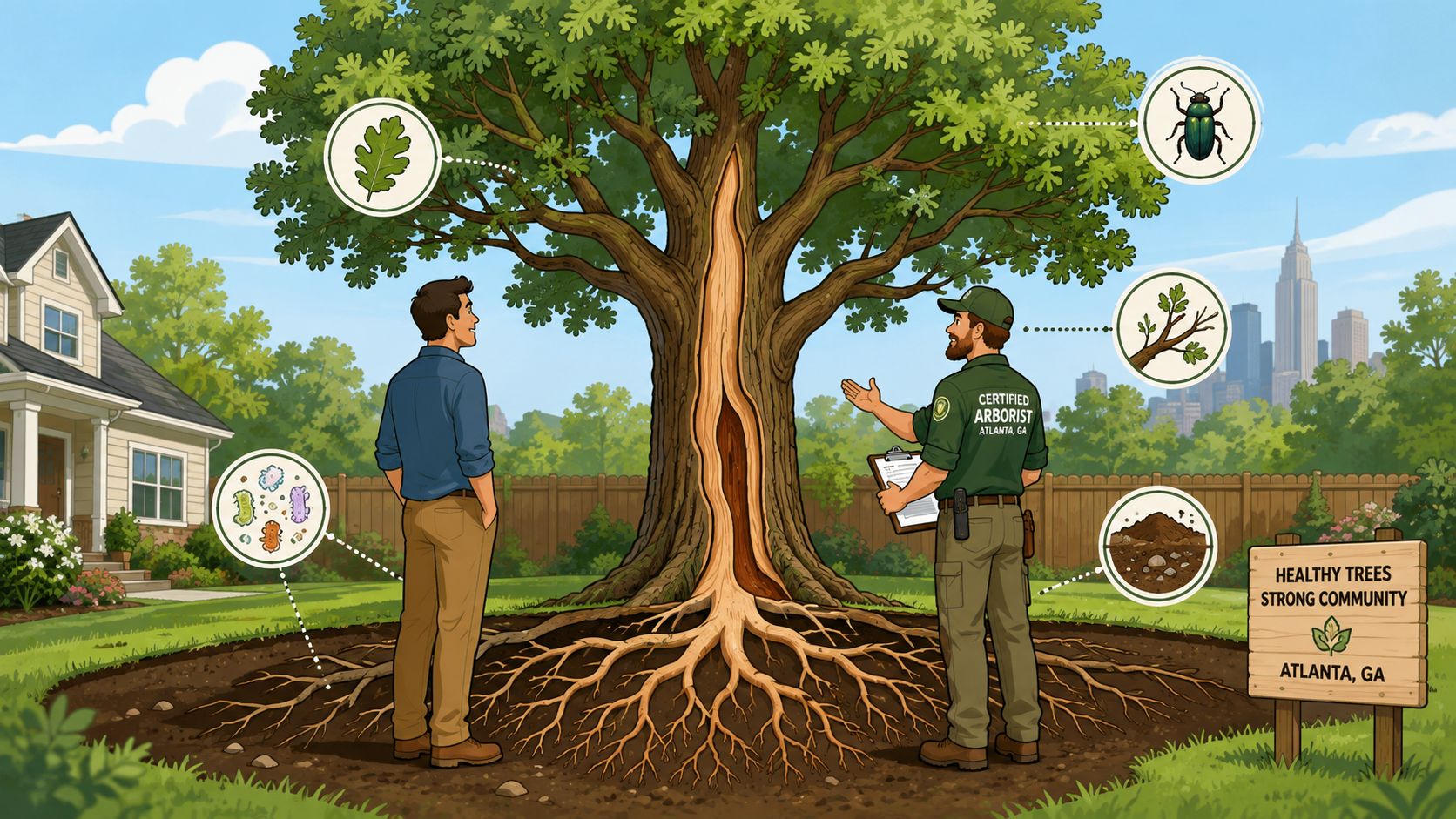
Photograph the property before cleanup, including wide shots and close-ups. Capture the date and time, storm conditions, utility involvement, roof or vehicle damage, and the tree's relationship to structures. Store the images with your insurance claim documents. A visual reference such as this arborist assessment guide can also help you understand what a professional inspection should examine.
For Cumming, Johns Creek, Milton, Alpharetta, Roswell, Marietta, and nearby Forsyth, Cobb, Gwinnett, and Cherokee County properties, the sequence stays the same: emergency services or utility first when lines or fire are involved, then an arborist, then the insured tree removal or cleanup crew.
Deciding Between Monitoring, Pruning, and Removal
A lightning-struck tree has three realistic outcomes. Monitor, prune and possibly cable, or remove. The decision depends on structural integrity and target exposure, not on whether the tree still has green leaves.
Monitoring
Monitoring is appropriate only when an assessment finds cosmetic bark injury, intact cambium, no structural fracture, stable roots, and limited crown impact. A practical threshold for a monitor decision is under 25% canopy scorch, provided the tree has no target-facing defect or movement. Document the baseline and schedule reviews at 30, 90, and 180 days.
Monitoring does not mean ignoring the tree. It means recording crown density, bark position, new cracks, fungal growth, leaf condition, and lean. A tree beside a bedroom, driveway, or power service deserves a lower tolerance for uncertainty.
Pruning and cabling
Prune-and-cable may fit a tree with upper-limb loss but an intact main stem and stable root plate. The planning thresholds here are decay below 20% of trunk diameter, no trunk split through the pith, and a static-rated cabling system designed to redistribute load. Pruning should remove actual hazards while preserving sound structure, not reshape the crown for appearance.
A general arborist shouldn't make that call from a bucket. The arborist must evaluate attachment points, decay, remaining crown weight, and the direction of likely failure.
Removal
Removal is the safe recommendation when the trunk is split through the pith, wedges have formed, the root plate has lifted, more than 30% of the crown is lost, or the tree leans toward a structure after the strike. Those conditions create a poor risk profile, especially when the tree is over a home or access route.
| Pathway | Qualifying Conditions | Red Flags | Estimated Cost, North Atlanta | Follow-Up Schedule |
|---|---|---|---|---|
| Monitor | Stable trunk and roots, cosmetic injury, under 25% canopy scorch | New cracks, dieback, bark separation, movement | Requires a written estimate, not a reliable phone guess | Reinspect at 30, 90, and 180 days |
| Prune and cable | Upper-limb loss, decay below 20% of trunk diameter, stable stem | Cable attachment failure, progressive decay, heavy lean | Requires site inspection and written scope | Inspect after severe weather and on the arborist's schedule |
| Remove | Pith split, lifted root plate, wedges, over 30% crown loss, structure-facing lean | Any active movement or line involvement | Requires a site-specific removal estimate | Complete hazard reduction, then stump grinding or stump removal |
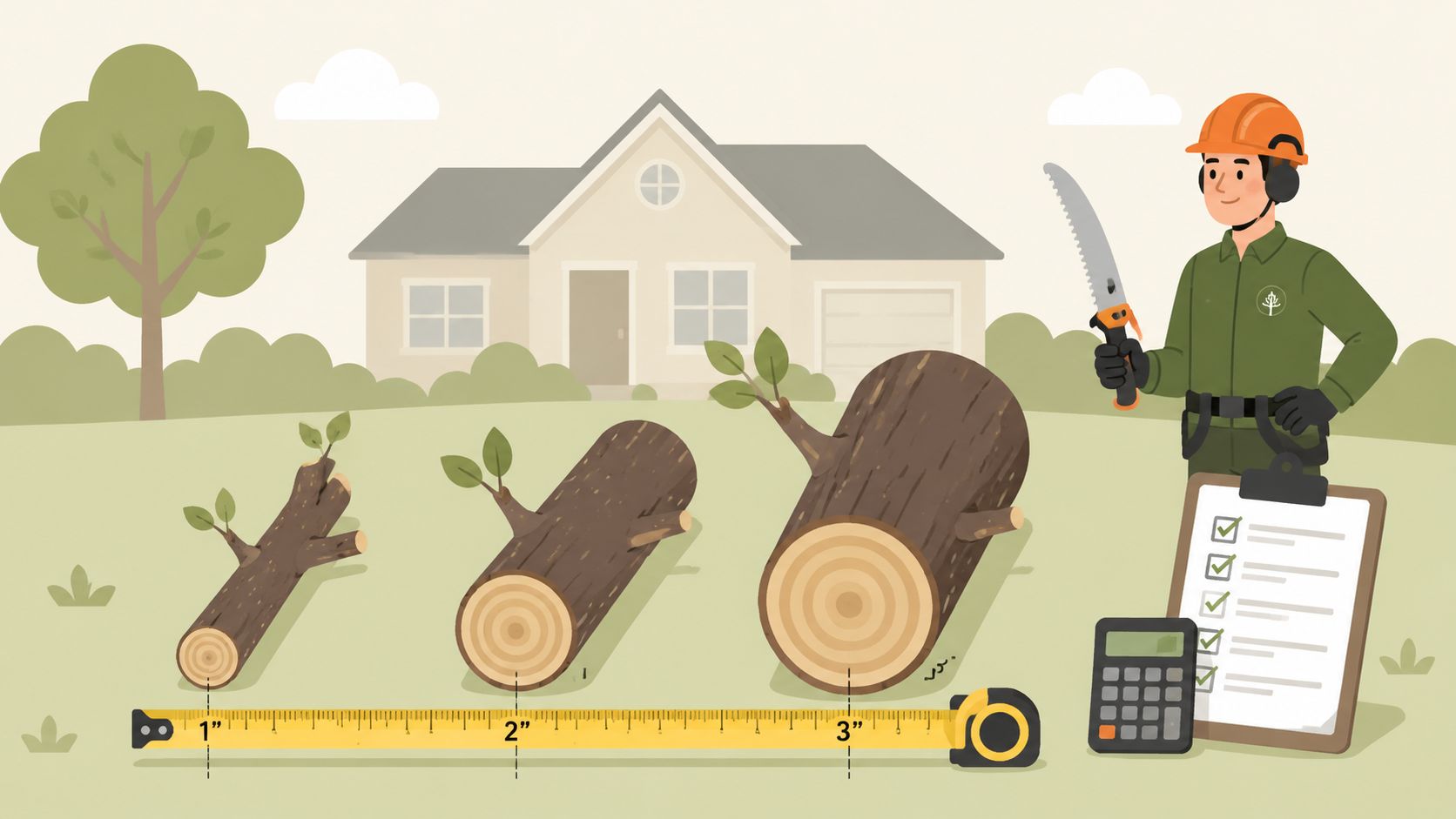
A tree branch removal and tree log reference may help you understand why debris volume, access, rigging, and haul-away change the scope. Waiting becomes most expensive when a compromised tree has a clear target and the owner postpones action until a limb damages the roof.
Why an ISA-Certified Arborist Is Worth the Call
A general tree crew can remove a tree. That doesn't mean the crew should decide whether a lightning-damaged tree is safe to retain.
An ISA Certified Arborist brings tree biology, pruning standards, risk assessment, and structural evaluation to the decision. The certification exam tests knowledge relevant to tree care, while ISA's Tree Risk Assessment Qualification, commonly called TRAQ, provides a framework for evaluating likelihood of failure, consequences, and overall risk. Lightning assessment requires that kind of judgment because the visible wound may represent only one part of the failure system.
What a useful assessment includes
Ask for a written report that identifies:
- Tree condition: Species, size, defects, crown condition, trunk condition, root-zone observations, and target exposure.
- Structural findings: Crack locations, bark separation, decay evidence, lean, root-plate movement, and hanging limbs.
- Diagnostic methods: Decay sounding where appropriate, and resistograph or tomographic data when internal decay requires further investigation.
- Treatment guidance: Pruning, cabling, monitoring, removal, and wound-care recommendations. Avoid unnecessary wound coatings and request clear, picloram-free guidance where herbicide exposure is a concern.
- Risk rating: A written explanation of the hazard, recommended action, urgency, and reinspection needs.
Use the report for insurance documentation and, where required, permit support. Don't accept a removal decision based solely on a contractor's phone quote.
Before anyone climbs a struck tree in Cumming, Johns Creek, Milton, Alpharetta, Roswell, Marietta, or nearby counties, verify ISA credentials, current insurance, workers compensation coverage, company identification, and the written scope of work. Ask who will perform the assessment and who will operate the crane, lift, or chainsaw.
A professional arborist inspection reference shows the level of visual and structural review homeowners should expect. The right professional may recommend removal, but they should explain why the tree cannot be safely retained.
Permits, Insurance, and Liability in North Atlanta
Paperwork matters before the crane arrives. A lightning strike may create an urgent hazard, but urgency doesn't automatically erase local tree regulations.
Inside the City of Atlanta, the code prohibits removing or destroying a regulated private-property tree with a diameter at breast height of six inches or more without a permit. The city also provides a dedicated application for private contractors removing dead, dying, or hazardous trees. Check the applicable city or county office before scheduling tree removal, especially if the property sits within municipal limits rather than unincorporated territory. (Atlanta tree ordinance)
Rules can differ in Sandy Springs, Alpharetta, Roswell, Marietta, and unincorporated Cobb, Gwinnett, Forsyth, and Cherokee County. Don't rely on a crew's assumption that a storm makes every removal exempt. Ask the permitting office whether the hazard qualifies for emergency treatment and whether photographs, an arborist report, or a contractor application is required.
Build the claim file before cleanup
Photograph the tree, strike path, roof or vehicle damage, utility involvement, stump area, and fallen debris. Timestamp the images if your phone supports it, and preserve the original files. Request a written cause-of-loss letter from the certified arborist that describes observed lightning injury without overstating what the inspection can prove.
Homeowners insurance may treat a tree that fell on a covered structure differently from a tree that fell in an open yard. Coverage can also distinguish between dwelling damage, tree removal connected to a covered loss, and debris-only coverage. For a practical explanation of the coverage questions to ask, review does homeowners insurance cover lightning before authorizing non-emergency work.
| Jurisdiction | Emergency Removal Permit? | Insurance Documentation Needed | Typical Removal Coverage Limit |
|---|---|---|---|
| City of Atlanta | Verify locally, the six-inch rule applies to regulated trees | Photos, arborist report, cause-of-loss documentation, contractor invoice | Policy-specific |
| Sandy Springs, Alpharetta, Roswell, Marietta | Verify with the city before cutting | Photos, written assessment, permit records if required | Policy-specific |
| Unincorporated Cobb, Gwinnett, Forsyth, Cherokee | Ask the county whether the hazard qualifies for emergency treatment | Photos, arborist findings, invoices, proof of damage | Policy-specific |
Keep permits, estimates, invoices, credential records, and communication in one file. A documented professional inspection helps establish who assessed the hazard and what scope the contractor accepted. DIY inspection and cleanup around a compromised tree can expose a homeowner to preventable liability, especially in HOA or shared-access settings.
Your Lightning-Strike Action Checklist
Save this list in your phone and print it for the utility room. The goal is to stop a frightened homeowner from making the one decision that turns a manageable hazard into an injury or property claim.
First 60 minutes
- Clear the area. Keep people and pets at least 30 feet from the suspected strike point, trunk, root flare, hanging limbs, and possible ground-current paths.
- Assume lines are live. If a conductor is down or touching the tree, leave the area and call 911 or the utility. Don't move the line, tree, branch, fence, or metal equipment.
- Stop DIY cleanup. Don't climb, cut, pull bark, drive under a hanging limb, or use a chainsaw.
- Record the scene. Photograph the tree, structures, vehicles, utility lines, root zone, and debris before anyone disturbs them.

Within 24 hours
Call your insurer and request claim instructions. Contact an ISA Certified Arborist for a structural assessment, then obtain a written scope from an insured tree service for emergency tree removal, storm damage tree cleanup, tree pruning, or fallen tree removal.
If you smell ozone or smoke, see a split trunk, notice fresh soil movement, or find the tree leaning toward the house, treat the property as an active hazard. Keep irrigation off near the strike area and mark the perimeter with high-visibility tape.
Within one week
Have the arborist document the trunk, crown, roots, targets, and nearby trees. Decide whether the tree belongs in monitoring, pruning and cabling, or removal. If removal is required, ask about stump grinding or stump removal, log hauling, access protection, and restoration of the work area.
A qualified crew can also identify related needs such as tree trimming, land clearing, or lot preparation if the strike exposed broader site hazards. Request a free estimate that separates emergency work from optional cleanup and future maintenance.
At 30 days
Reinspect any retained tree after the initial monitoring period. New leaf wilt, bark separation, fungal growth, crown dieback, or movement changes the recommendation. Don't let a green canopy overrule a documented structural concern.
Richmond Tree Experts GA offers tree removal, stump grinding, arborist assessments, and storm-related cleanup for North Atlanta properties. Visit Richmond Tree Experts GA to request a free estimate and discuss the safest next step for a lightning-struck tree in Cumming, Johns Creek, Milton, Alpharetta, Roswell, Marietta, Cobb County, Forsyth County, Gwinnett County, or Cherokee County.
Need a tree taken down safely? Richmond Tree Experts has worked on Marietta and Metro Atlanta trees since 1985, and every job is looked at by an ISA Certified Arborist before it is priced. Start with tree removal, or see everything we do: tree removal, stump grinding and arborist services across Cobb, Fulton, Cherokee, Gwinnett and DeKalb counties (service areas).
Call (770) 974-3964, 7am to 11pm every day, or request an estimate online.