

A limb cracks during a windstorm. A lean appears after a wet week. Then you notice roots lifting the soil beside the driveway, a dead branch over the roof, or a tree touching a power line. Suddenly, you're asking whether the tree has to come down, whether tree trimming could solve the problem, and how quickly a crew can respond.
Most removals begin with a moment like this. The decision isn't always obvious because a tree may still have healthy leaves while its trunk, roots, or major limbs are failing. A professional assessment separates a manageable defect from a hazardous tree that could damage a home, vehicle, road, utility, or occupied area.
These are the most common reasons for tree removal across Marietta, Roswell, Kennesaw, Woodstock, Acworth, Canton, Cobb County, Cherokee County, and nearby North Metro Atlanta communities. Each one includes what a homeowner can see first, how urgent the situation is, and when an ISA Certified Arborist should be called.
1. Hazardous Dead or Dying Trees Posing Structural Failure Risk
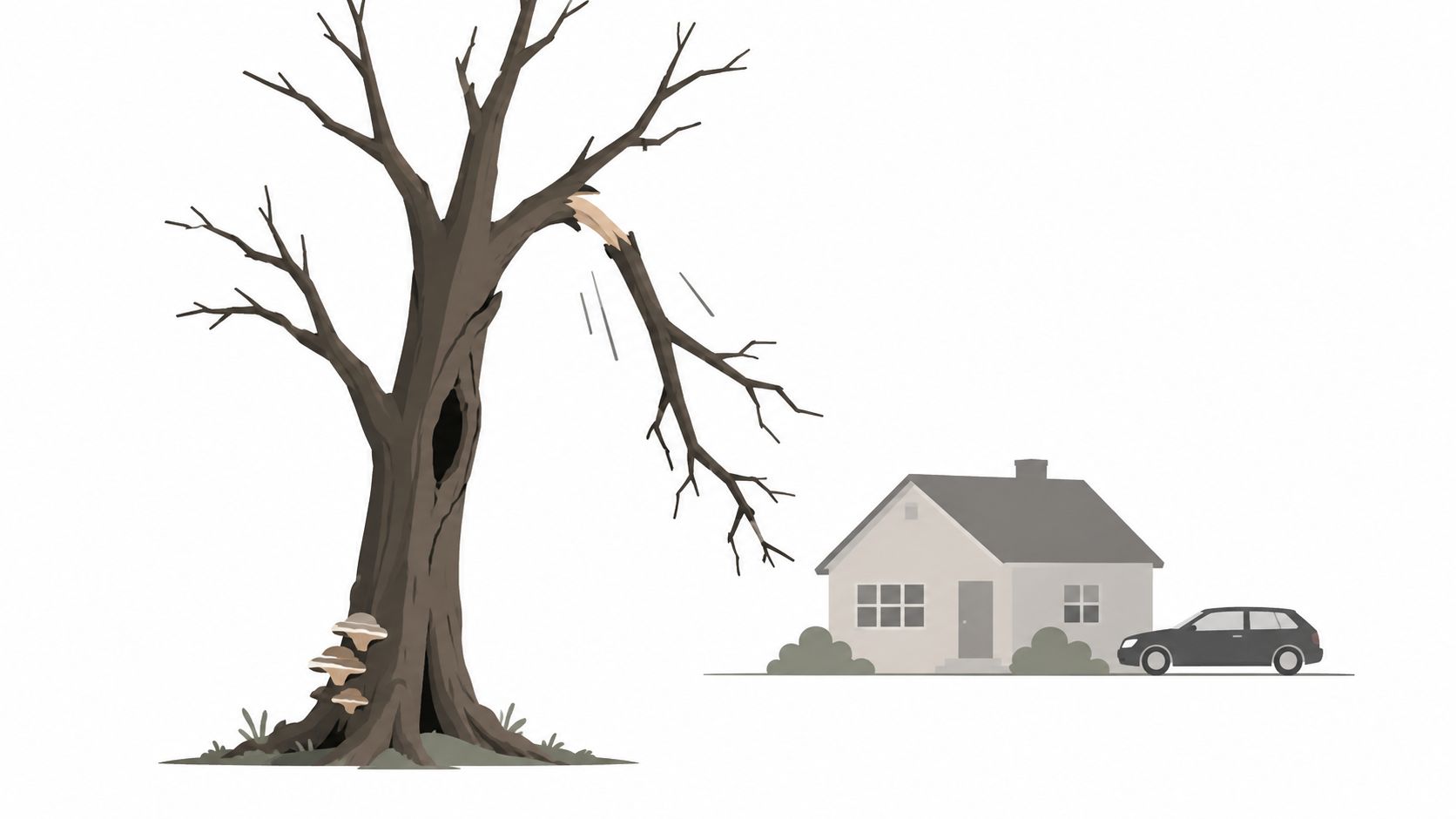
A tree with sparse foliage, dead limbs, peeling bark, or extensive dieback may be losing the strength that holds it upright. Dead wood becomes brittle. A branch can fail without much warning, especially when it extends over a roof, driveway, sidewalk, vehicle, or play area.
The danger isn't limited to a tree that looks completely dead. A living tree can have internal decay, a hollow trunk, or weakened roots while its canopy still appears partly green. Urban tree losses are driven by both land-use decisions and health or safety concerns. In a U.S. Forest Service study of 1,427 tree losses, 50.4% were associated with human land-use choices and 48.7% with health decline or risk management, while 0.9% had unknown causes (U.S. Forest Service research).
What to check before you call
Look up into the canopy, not just at the trunk. Dead branch ends, hanging limbs, missing bark, mushrooms at the base, cavities, and a sudden lack of leaves all deserve attention. Storm damage can also expose internal decay that wasn't visible before the weather event.
- Urgency: High when dead wood hangs over a target. Emergency tree removal may be appropriate if a major limb is suspended or the trunk is visibly splitting.
- Call an arborist: Schedule an assessment when dieback is spreading, the trunk has cavities, or large dead limbs are too high to inspect safely.
- What works: A written risk assessment can distinguish selective tree pruning from complete removal.
- What doesn't: Cutting only the obvious dead limb may leave a decayed trunk or unstable root system in place.
In Marietta, Kennesaw, East Cobb, and surrounding neighborhoods, an ISA Certified Arborist can inspect the tree and explain whether removal, tree pruning, monitoring, or treatment makes sense. Take dated photographs after storms and before cleanup if the tree has damaged your property. A qualified tree cutting service can also quote stump grinding and debris removal so the hazard isn't replaced by a trip point or obstruction.
2. Trees Leaning Dangerously or With Root Failure
A mature tree may naturally grow with a slight angle. A new or worsening lean is different. If the soil has lifted on one side, roots are exposed, or the trunk has shifted after heavy rain, the tree may be losing its anchorage.
Root failure often follows saturated soil, erosion, construction damage, compaction, or root decay. A lean toward a house, road, parked vehicle, fence, or utility corridor deserves prompt attention. The risk depends on the defect, the likelihood of failure, and what the tree could strike if it falls. Technical tree-risk guidance treats those factors together rather than judging a tree by size or appearance alone (tree-risk evaluation guidance).
Read the ground, not just the trunk
Look for fresh soil cracks, exposed roots, root lifting, a new gap beneath the root plate, or a canopy that has become unbalanced. Photograph the tree from the same position over several days if the lean appears to be changing. Don't stand beneath it to take close-up pictures.
Practical rule: A tree that has moved recently needs an assessment before the next storm, not after it falls.
Keep vehicles and people away from the fall zone. Don't place a shed, play structure, or temporary work area beneath the canopy. Large or severely tilted trees may require rope-and-rigging work or crane-assisted removal, particularly in tight yards near homes and fences.
A tree with intact roots and limited damage may sometimes be stabilized or monitored. A tree with root movement, a cracked stem, or a heavy lean toward an occupied target may need hazardous tree removal. Ask the crew whether the scope includes stump grinding, root-ball management, soil grading, and a replacement-tree plan. Those details matter in Woodstock, Roswell, Alpharetta, Canton, and other areas where a failed tree can block access or damage neighboring property.
3. Trees Growing Into or Damaging Structure Foundations and Utility Infrastructure
The first sign may not be the tree. It may be a cracked driveway, a lifted sidewalk, recurring plumbing trouble, roof damage, or branches rubbing against siding. Roots can exploit weak points in soil and hardscape. Limbs can scrape roofing, fill gutters, strike windows, or press against utility infrastructure.
A tree near a structure isn't automatically a removal candidate. Pruning, root barriers, drainage changes, or target protection may solve the conflict. The decision changes when the tree has repeatedly damaged the property, cannot be pruned without destroying its structure, or continues growing toward a critical utility or building component.
Confirm the cause before removing the tree
A foundation crack doesn't prove that a nearby tree caused it. Soil movement, drainage, construction defects, and plumbing failures can produce similar symptoms. Have the relevant issue evaluated by a foundation, plumbing, or structural professional, then ask an arborist to assess root location and tree condition.
The same approach applies to roof and gutter damage. A properly planned tree trimming or tree pruning service may clear a roofline while preserving the tree. Repeated cutting of branches that grow back into the same conflict usually isn't a long-term answer.
- Roof or gutter contact: Request a structural pruning assessment before choosing removal.
- Cracked pavement or lifted slabs: Identify whether roots are active and whether the surface can be repaired without destabilizing the tree.
- Roots near utilities: Coordinate with the utility provider and qualified contractors before digging or cutting.
- Trunk contact: Removal becomes more reasonable when the trunk is pressing against siding, a wall, or another structure.
Replacement planning is part of good land clearing and property preparation. Choose a species and location based on mature size, root behavior, overhead clearance, and future maintenance. If you're researching related exterior repairs, a Phoenix roof repair service illustrates why roof damage should be evaluated separately from the tree itself. For properties in Marietta, Roswell, Alpharetta, Canton, and East Cobb, a coordinated scope should state whether it includes stump removal, stump grinding, soil repair, and cleanup.
4. Storm-Damaged or Split Trees Creating Immediate Hazards
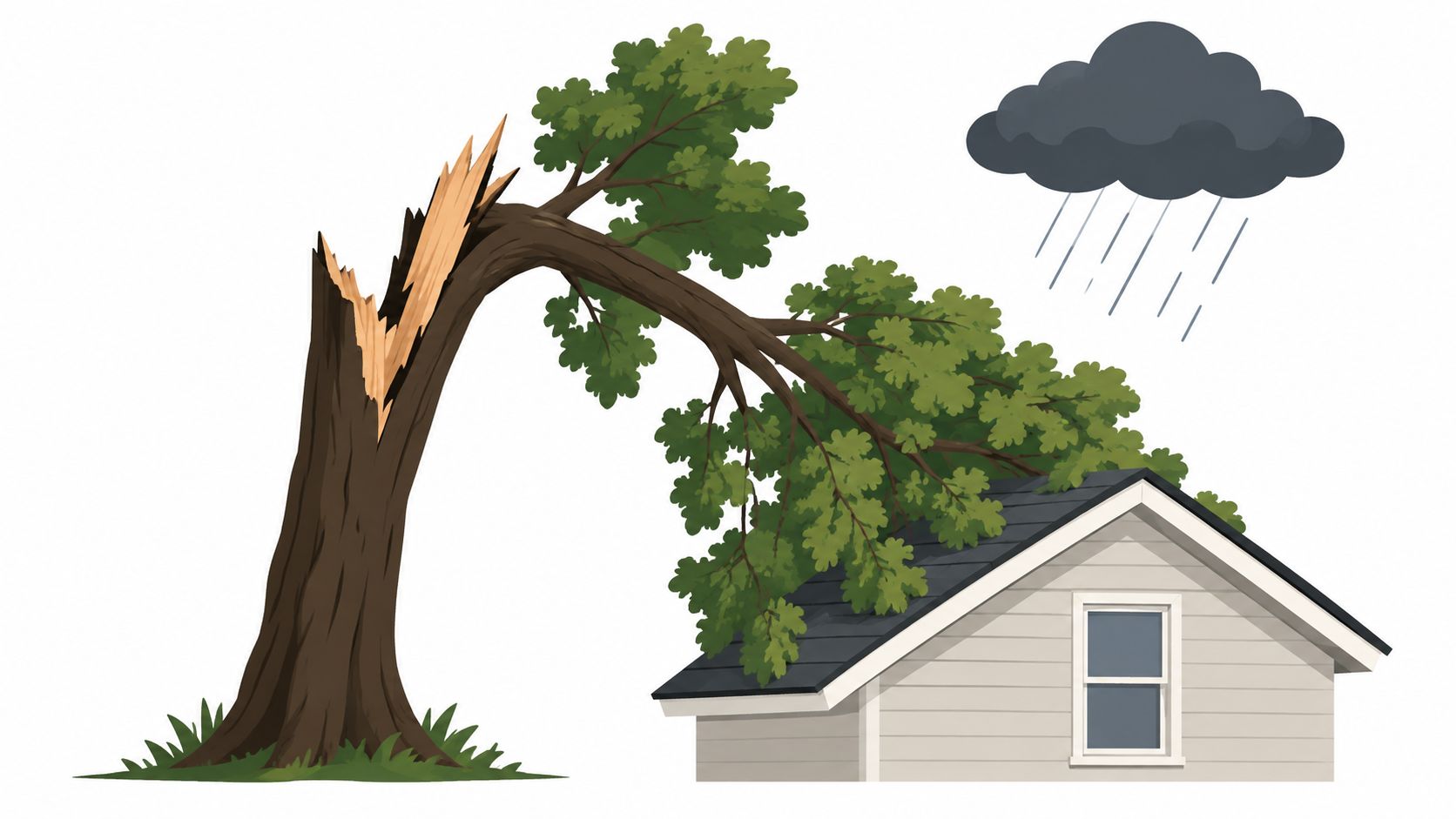
A split trunk changes the situation immediately. So does a tree lying across a roof, driveway, road, or utility line. Storm damage can leave compressed wood, hanging limbs, cracked stems, and unstable root plates that may move again when the wind returns.
UGA Extension warns that hanging broken branches, saturated soil, and trees entangled with structures or wires can create serious hazards. Stored energy in bent or compressed limbs can release suddenly during cutting, which is why homeowners shouldn't attempt fallen tree removal near buildings or electrical lines (UGA guidance for storm-damaged trees).
Treat these conditions as urgent
Call the utility company first if a fallen tree is touching or near an electrical line. Keep everyone away until the line has been made safe. A licensed and insured emergency tree removal crew can then assess access, rigging, equipment, and the safest sequence for removing the tree from the structure or roadway.
UGA Extension reports that a tree with more than 50% of its branches and leaves damaged or gone is unlikely to survive through the next growing season (UGA guidance on damaged trees). A mature tree that loses one major limb may still be worth retaining after professional pruning, but a split trunk, extensive canopy loss, or root lifting can make removal the safer choice.
For a full post-storm assessment, use storm tree removal services that can address the tree, branches, stump, and debris rather than only cutting the section blocking your driveway. Photograph the damage before cleanup when it's safe to do so, and check your policy or adjuster about fallen tree insurance coverage.
5. Trees With Severe Disease, Pest Infestation, or Fungal Decay
Disease and insects don't always announce themselves with a dead canopy. Early symptoms can include thinning leaves, branch dieback, unusual bark damage, fungal growth, sawdust-like material, or small holes in the trunk. The bigger concern is what the problem has done inside the wood.
A tree can sometimes be treated, pruned, irrigated, or monitored. Removal becomes more reasonable when decay has reached a major stem, roots are compromised, the canopy is declining rapidly, or the tree can spread a serious problem to nearby trees. A professional diagnosis matters because a fungal fruiting body, bark symptom, or leaf spot doesn't tell the whole story by itself.
Don't confuse treatment with cosmetic pruning
Cutting away visible dead branches may improve the appearance without correcting internal decay. Conversely, removing a tree immediately may waste a treatment opportunity if the problem is manageable and the structure remains sound.
Ask for a clear diagnosis and scope. The assessment should identify the suspected issue, affected parts of the tree, nearby targets, treatment options, and the point at which removal becomes necessary. If removal is chosen, ask whether infected wood will be chipped or hauled away. Leaving contaminated material beside healthy trees can prolong the problem.
Diseased tree removal can be part of a broader plan for Roswell, Marietta, Cumming, Milton, Forsyth County, Cobb County, and Cherokee County properties. Inspect neighboring trees after the work, especially when they share crowded planting conditions or similar symptoms. Replacement trees should fit the site and offer appropriate resistance for local growing conditions.
A tree weakened by pests or decay can fail during ordinary weather, but the risk becomes more serious near homes, sidewalks, parking areas, and business entrances. That's where an ISA Certified Arborist should make the removal-versus-treatment recommendation, rather than relying on a quick visual guess.
6. Weak-Wooded Species or Trees With Naturally Poor Structure Prone to Breakage
Some trees become recurring maintenance problems because of their form and wood characteristics. Bradford pears, willows, poplars, silver maples, and empress trees can develop weak unions, crowded branches, or heavy growth that splits under wind or ice.
The first clue is a history of breakage. If the same tree drops large limbs during ordinary weather, annual tree pruning may only reset the problem. Pruning can reduce weight and correct young structure, but it can't turn a severely compromised mature tree into a structurally sound one.
Compare recurring work with a permanent correction
An arborist should inspect branch unions, codominant stems, cracks, included bark, dead limbs, canopy balance, and targets below. Cabling or bracing may help in selected cases. It won't make every weak union safe, and it requires follow-up inspections.
- Young tree with correctable form: Structural pruning may improve future development.
- Mature tree with repeated failures: Removal and replacement may reduce long-term exposure.
- Large tree beside a roof or driveway: Request a risk assessment before the next storm.
- Tree with one defective limb: Targeted pruning may be enough if the trunk and roots remain sound.
The trade-off is practical. A removal costs more at one time, while repeated emergency pruning, debris cleanup, property repairs, and disruption can continue for years. That doesn't mean every weak-wooded tree should be removed. It means the recommendation should account for breakage history, tree condition, target occupancy, and the cost of preserving it safely.
A replacement plan should avoid recreating the same conflict. In Marietta, Roswell, Kennesaw, Woodstock, Alpharetta, and Cherokee County, select a species suited to the site and leave enough room for mature roots and branches. A qualified tree service can combine selective pruning, removal, stump grinding, and replanting advice in one property plan.
7. Trees Blocking Emergency Access, Sightlines, or Creating Traffic Hazards
A tree can become hazardous because of where it stands, even when the wood is healthy. Low branches may force vehicles into another lane. Dense growth can hide a driveway entrance, street sign, house number, or intersection. A trunk or root flare can narrow a route used by emergency responders.
These conflicts matter on residential streets, commercial properties, apartment sites, and development parcels. A blocked driveway can delay access during a medical emergency. An obscured sightline can increase the chance that drivers, cyclists, and pedestrians won't see one another in time.
Separate pruning from removal
Start by asking whether raising the canopy or removing selected branches will restore clearance. A healthy tree may not need to come down. Removal becomes more likely when the trunk sits in the access route, roots have lifted the sidewalk, the tree repeatedly regrows into the obstruction, or pruning would leave an unstable or disfigured structure.
Check with the relevant city or county department about sightline, sidewalk, and right-of-way rules before scheduling work. Requirements can differ between Marietta, Roswell, Alpharetta, Kennesaw, Woodstock, and unincorporated parts of Cobb and Cherokee counties. A professional crew should also identify underground utilities, traffic control needs, and property boundaries.
A tree doesn't have to be dead to create a life-safety problem. Location and clearance count.
Photograph the obstruction from the driver's or responder's approach. Include the driveway, road, sidewalk, address marker, or intersection in the frame. For commercial property managers and real-estate professionals, keep the assessment and completed scope with the property records. Proper tree cutting service, land clearing, and stump removal can restore access without leaving a low stump that still interferes with mowing, parking, or pedestrian movement.
8. Trees Growing Over Power Lines or Creating Electrical Fire Hazard
A branch touching a power line is an emergency safety issue, not a routine tree trimming job. Wind can move the branch into contact, and a tree that looks clear today may grow into the line later. Contact can create electrocution, fire, outage, and equipment risks.
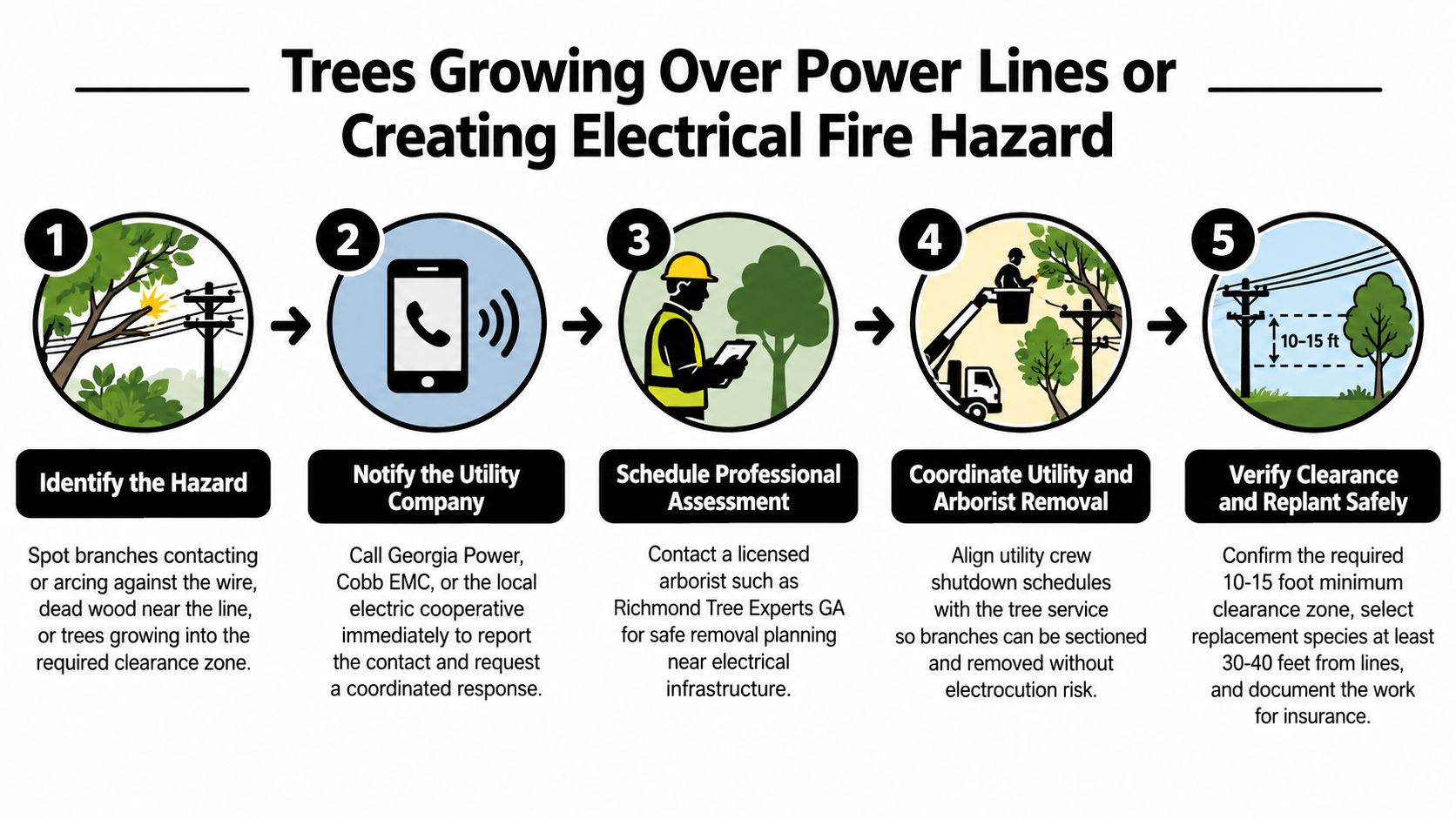
Never climb, cut, or pull a tree near electrical infrastructure yourself. Keep people and pets away, contact Georgia Power, the relevant electric utility, or Cobb EMC, and ask how the line will be de-energized or made safe. Utility ownership and easement rules may affect who performs the work and whether the utility handles part of the removal.
Use the right sequence
First, report the hazard. Next, arrange an assessment by a qualified arborist familiar with line-clearance work. Then confirm the removal plan, access requirements, traffic protection, debris handling, and stump grinding.
Tree removal near power lines may involve specialized rigging, insulated equipment, or coordination with the utility. A tree in an easement may be handled by the utility, but don't assume that without confirmation. Private property work still needs a safe, documented scope.
For replacement planting, choose a location and species that won't recreate the conflict. Low-growing options may work beneath or near lines, while taller trees need appropriate separation. The best solution isn't just cutting the branches back every year. If the trunk is already under the line, the tree has repeated contact, or root and structural defects add to the risk, complete removal may be the safer long-term choice.
8-Point Comparison: Reasons for Tree Removal
| Hazard | Implementation Complexity 🔄 | Resource Requirements ⚡ | Expected Outcomes ⭐ / Impact 📊 | Ideal Use Cases 💡 | Key Advantages |
|---|---|---|---|---|---|
| Hazardous dead or dying trees posing structural failure risk | High 🔄, dangerous to fell; professional expertise required | Arborist crew, rigging, removal equipment, possible permits; moderate–high cost ⚡ | ⭐⭐⭐⭐, removes imminent fall risk; prevents property/injury losses 📊 | Dead/hollow trunks, fungal conks, brittle limbs near homes or lines | Eliminates immediate hazard; stops pest/disease spread; peace of mind |
| Trees leaning dangerously or with root failure | Very High 🔄, progressive failure; complex rigging/crane work | Crane/heavy equipment, root/stump removal, soil stabilization; high cost ⚡ | ⭐⭐⭐⭐, prevents catastrophic toppling and major structural damage 📊 | Trees >15° lean, exposed/heaving root plates near structures | Prevents toppling and liability; allows soil/drainage correction |
| Trees growing into or damaging foundations & utilities | Medium–High 🔄, requires structural assessment & coordinated work | Arborist + structural engineer, excavation, stump grinding, possible foundation repair (cost-saving) ⚡ | ⭐⭐⭐⭐, prevents costly foundation/plumbing repairs; long-term savings 📊 | Visible root cracks, sewer backups, trunks/branches contacting foundations/roof | Eliminates ongoing structural damage; protects property value |
| Storm-damaged or split trees creating immediate hazards | High 🔄, emergency conditions; unstable sections | Emergency crews, chainsaws, rigging, coordination with utilities; urgent response, higher rates ⚡ | ⭐⭐⭐⭐⭐, immediate hazard removal; prevents injury, secondary damage 📊 | Split trunks, hanging limbs, trees on structures or lines after storms | Fast, safe extraction; restores access and aids insurance/repairs |
| Trees with severe disease, pest infestation, or fungal decay | Medium 🔄, diagnosis determines treat vs remove | ISA arborist diagnosis, possible treatments or safe removal & disposal; moderate cost ⚡ | ⭐⭐⭐, contains spread and removes structural weakness; protects nearby trees 📊 | Fruiting bodies, EAB signs, oak wilt symptoms, canopy dieback | Disease containment; prevents neighborhood outbreaks; informed action |
| Weak-wooded species or trees with poor natural structure prone to breakage | Low–Medium 🔄, assessment; pruning or removal decision | Pruning crews or removal team, replacement planting; ongoing maintenance cost vs one-time removal ⚡ | ⭐⭐⭐, reduces recurring damage and maintenance; improves safety over time 📊 | Bradford pear, willow, poplar, silver maple near homes or high-use areas | Eliminates chronic breakage, lowers long-term emergency costs |
| Trees blocking emergency access, sightlines, or creating traffic hazards | Medium 🔄, may require permits and municipal coordination | Arborist, pruning/removal equipment, municipal permits; moderate cost ⚡ | ⭐⭐⭐⭐, restores emergency access and legal compliance; reduces accident risk 📊 | Driveways/entrances blocked, intersections with obscured sight lines, low road clearance | Restores life-safety access, avoids fines, improves traffic/pedestrian safety |
| Trees growing over power lines or creating electrical fire hazard | Very High 🔄, specialized, coordinated work with utilities | Utility coordination, certified arborist crews, possible power shutdowns; urgent and high cost ⚡ | ⭐⭐⭐⭐⭐, eliminates electrocution/fire/outage risk; critical public safety impact 📊 | Branches contacting lines, visible arcing, trees within clearance zone | Prevents fires/outages, meets utility codes, protects public safety |
Decide Before the Next Storm Forces the Choice
Most tree removals that go badly were decided in a rush. A homeowner waited through several warning signs, then a storm turned a manageable project into a roof repair, blocked driveway, damaged vehicle, or emergency access problem. The safest decision is usually made while the tree is still standing and the crew can plan the work.
Walk the property after every major storm. Photograph any lean, split, dieback, fungal growth, exposed root, or hanging limb with the date included. Note anything touching a roof, driveway, sidewalk, building, vehicle area, or power line. Don't climb the tree or move unstable storm debris to get a better view.
If you see one of these signs, book an ISA Certified Arborist assessment while crews have availability. Ask for the recommendation in writing. A useful assessment should explain the defect, the likely failure exposure, whether tree pruning or other mitigation could work, and why removal is or isn't necessary.
Get the complete scope before accepting a quote. Confirm whether it includes:
- Tree removal: Cutting, rigging, loading, and hauling.
- Storm damage cleanup: Fallen branches, trunk sections, and material blocking access.
- Stump grinding or stump removal: Treatment of the remaining stump and surface roots.
- Site protection: Measures for roofs, fences, landscaping, driveways, and irrigation.
- Permits and clearance: Confirmation of local rules, rights-of-way, and utility coordination.
Ask whether the crew is licensed and insured, what equipment the site requires, and how quickly they can respond. Crane-assisted removal may be appropriate for a large tree in a tight location, while rope-and-rigging methods may protect nearby structures when machine access is limited.
Local rules can affect work in Marietta, Roswell, Kennesaw, Woodstock, Acworth, Canton, and surrounding counties. Check permit and clearance requirements before cutting begins, particularly for protected trees, public rights-of-way, and development or land clearing projects. Commercial property managers should also document tenant access, parking control, and emergency routes.
A sound decision doesn't treat every stressed or damaged tree as disposable. Climate stress, drought, heat, compacted soil, pests, and disease can reduce vitality before obvious decay appears. A 2025 review links intensified environmental stresses with increasing numbers of underperforming and dying urban trees, while a separate 2025 study identified heatwaves and drought as influential stressors associated with declining tree vitality and mortality (urban tree stress review). Correctable site problems may justify preservation. Irreversible structural failure near an occupied target may justify removal.
For homeowners and businesses across Cumming, Johns Creek, Milton, Alpharetta, Roswell, Marietta, East Cobb, Forsyth County, Cobb County, Gwinnett County, and Cherokee County, the practical goal is simple. Remove trees when the evidence shows unacceptable risk or irreversible decline. Preserve them when pruning, treatment, soil improvement, monitoring, or target management can reasonably control that risk.
Professional arborist services in Crown Point can also illustrate the value of getting a qualified assessment before committing to removal. Richmond Tree Experts GA offers tree removal, stump grinding, emergency response, and arborist services for Atlanta-area properties, with scopes suited to storm damage, hazardous trees, structures, and difficult access.
Richmond Tree Experts GA can assess hazardous, leaning, storm-damaged, diseased, and utility-conflicting trees, then explain whether removal, pruning, or monitoring is the right next step. Visit Richmond Tree Experts GA to request an assessment for tree removal, emergency cleanup, stump grinding, or related tree service in North Metro Atlanta.

