

So, the tree is down, but the stump remains. Now what? The big question every Atlanta homeowner faces is how to deal with that final piece. The core difference between stump grinding vs removal is actually pretty simple: grinding essentially shreds the stump down below ground level, leaving the roots to decay naturally, while removal yanks the entire stump and its root ball right out of the earth, leaving a massive crater behind. Your choice here will directly impact the cost, the time it takes, and what you can do with that spot in your yard later on.
Stump Grinding vs Removal: An Initial Comparison
After a tree comes down, that leftover stump can be both an eyesore and a practical headache. Picking between grinding and removal is a critical decision because each method is designed for a totally different outcome and will affect your property in very different ways.
Think of grinding as the less invasive option, perfect for a cosmetic fix. On the other hand, removal is a full-blown excavation project, usually reserved for times when you have specific construction or major landscaping plans.
For most residential properties around Atlanta, stump grinding is the go-to choice. It's faster, easier on the wallet, and doesn't tear up your whole yard. It effectively gets rid of the visible part of the stump, clearing the way for you to lay new sod or plant a shallow flower bed over the top. It gets the job done without a massive fuss.
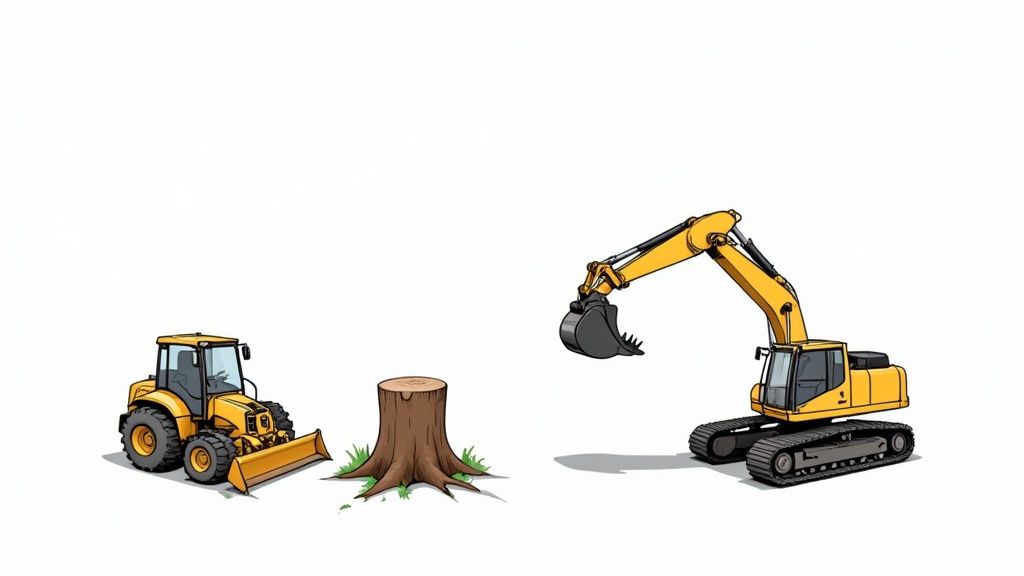
Complete stump removal, however, is a much bigger deal. This is a heavy-duty operation. We're talking about bringing in powerful machinery to literally pull the entire root system out of the ground. While this is the only way to guarantee zero regrowth and clear the ground for a new foundation, patio, or driveway, it’s also significantly more expensive and time-consuming. Plus, you’ll be left with a huge hole that needs to be filled with fresh soil.
Quick Comparison: Stump Grinding vs Stump Removal
To give you a bird's-eye view, this table breaks down the key differences. It's a great starting point to see which method might align better with your immediate needs and budget.
| Factor | Stump Grinding | Stump Removal |
|---|---|---|
| Process | Shreds the stump below ground level with a grinder. | Extracts the entire stump and major roots. |
| Site Impact | Minimal; leaves a small hole and a pile of wood chips. | High; creates a large crater that requires backfilling. |
| Future Use | Best for planting grass or shallow-rooted gardens. | Necessary for construction, paving, or deep planting. |
| Cost | More affordable; often priced per inch of diameter. | More expensive due to intense labor and equipment. |
| Time | Fast; usually finished within a couple of hours. | Slower; can easily take up a good part of the day. |
Ultimately, the right choice isn't just about getting rid of the stump—it's about setting your yard up for what comes next.
The Stump Grinding Process From Start to Finish
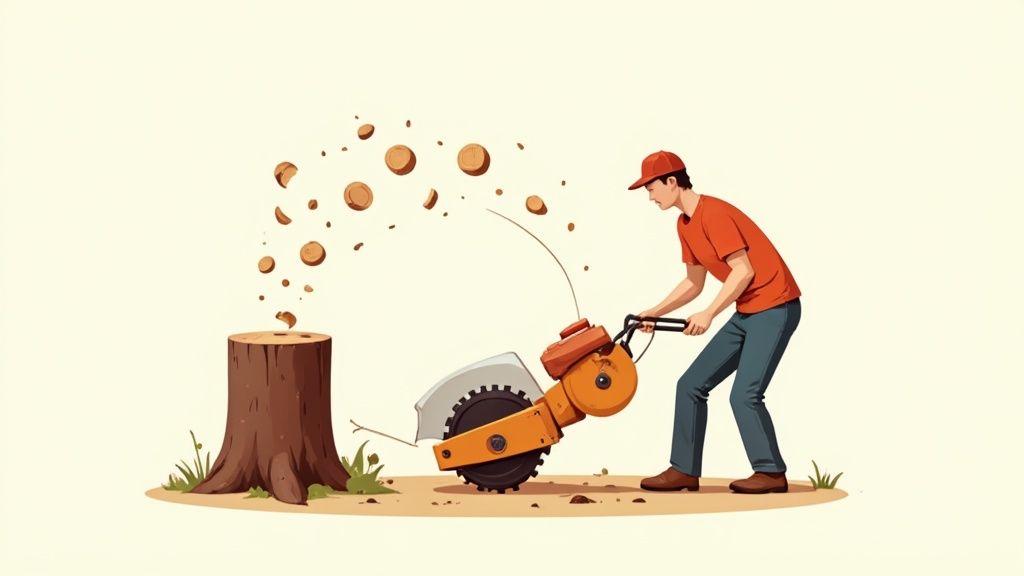
Stump grinding is a far more precise and less invasive method than yanking a stump out of the ground with heavy machinery. The whole operation hinges on one key piece of equipment: the stump grinder. This machine uses a powerful, high-speed rotating wheel studded with sharp teeth to methodically chew through the wood.
The operator carefully lowers the cutting wheel onto the stump, moving it back and forth to chip away at the wood, layer by layer. This continues until the entire stump is ground down to a specific depth, disappearing below the surface of your lawn.
Grinding Depth and Its Importance
One of the most critical details of any grinding job is how deep the machine goes. Most stumps are ground to a depth of 4 to 12 inches below ground level, but the right depth for you really depends on what you want to do with the space afterward.
- Shallow Grind (4-6 inches): This is usually enough if you just want to get rid of the eyesore and tripping hazard. It’s perfect for planting grass or laying new sod right over the top.
- Deep Grind (8-12+ inches): If you're thinking about a new garden bed with shallow-rooted plants or other light landscaping, you'll want to go deeper. This ensures more of the main stump mass is gone for good.
Unlike a full removal, the grinding process leaves the core root system buried deep underground. With the stump gone, these roots are cut off from their source and will simply rot away naturally over the next few years, slowly enriching the soil as they decompose.
Key Takeaway: Stump grinding is designed to eliminate the visible stump and prepare the ground for surface-level projects like planting grass or mulch beds. It's not intended for deep construction, which is a vital distinction in the stump grinding vs removal conversation.
The Final Outcome and Cleanup
After the grinder has done its work, you'll have a hole where the stump once stood, filled with a mix of wood chips and dirt. This leftover material, which we call grindings, is actually quite useful. Many Atlanta homeowners spread it in their flower beds as organic mulch. You can also simply use it to fill in the hole and level the area.
While the process is incredibly effective, it's not something the average person should try on their own. Stump grinders are powerful machines that demand a skilled hand for safe operation. For anyone curious about the machinery involved, it’s worth looking into stump grinding equipment rental to understand what the pros use. And if you don’t want to deal with the pile of wood chips, any professional service can haul them away, leaving you with a perfectly clean slate.
Understanding the Complete Stump Removal Process
If stump grinding is a targeted strike, then complete stump removal is the full-scale ground operation. This isn't just about getting rid of the stump you can see; it's an invasive excavation designed to pull the entire root ball clean out of the earth. We're talking about the most thorough method there is, leaving absolutely nothing behind.
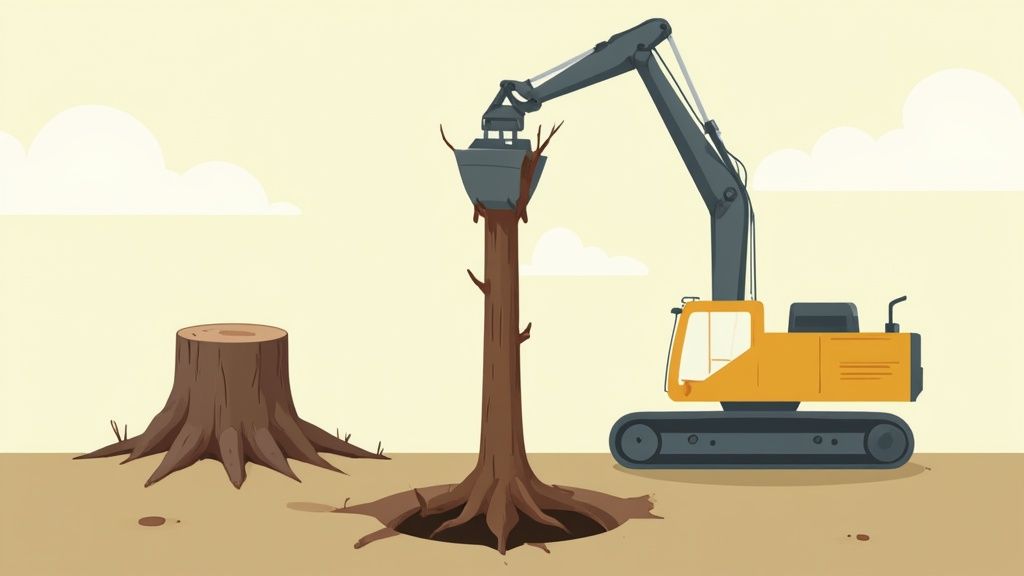
This is a job for heavy-duty machinery. A skilled operator will bring in an excavator or a backhoe to start digging around the stump, methodically cutting through major roots and clearing away the surrounding soil. The whole point is to completely loosen the root structure before yanking the entire thing from the ground.
The Scale of Site Disruption
Unlike the neat and tidy approach of grinding, removal is messy and disruptive. The process will churn up a significant portion of your lawn, leaving a massive crater where the stump and its roots used to be. The size of this hole can be a real shock—it’s often several times wider and deeper than the stump itself.
Because it's so invasive, we typically only recommend this method for specific situations where the ground has to be totally clear of any underground obstacles. It's an absolute must before you break ground on any new construction.
Complete stump removal is the only option that creates a truly clean slate. If you plan to pour a foundation, install a patio, or build a retaining wall, you must remove the entire root system to ensure ground stability and prevent future issues.
Preparing the Ground for Future Projects
The real upside to this all-out approach is that it preps the site for major structural work. Once the stump and its sprawling root network are gone, the ground is finally ready for projects that need deep, stable soil, like:
- New Construction: Building a garage, shed, or home addition.
- Hardscaping: Installing a new driveway, walkway, or concrete patio.
- Deep Planting: Planting a large, mature tree in the exact same spot.
After the giant stump is hauled away, the crater it leaves has to be backfilled with fresh soil and compacted properly to keep it from settling. This critical step ensures the ground is level and stable for whatever you have planned next. This method is the final chapter of a complete tree removal, tackling every last piece of the old tree. The significant labor, machinery, and disposal logistics involved definitely make it the more complex and costly choice in the stump grinding vs removal debate.
Comparing Cost, Time, and Site Impact
When it comes to deciding between stump grinding and stump removal, the choice really boils down to three things: your budget, your timeline, and how much you're willing to tear up your yard. These aren't minor details; they represent two totally different ways of tackling the same problem.
Grinding is the hands-down winner for anyone looking for a quick and affordable fix. On the other hand, removal is a major project, both in terms of the time it takes and the hit to your wallet. Getting a handle on these trade-offs is key to making the right call for your Atlanta property.
This infographic breaks down the core differences in cost, how long each job takes, and the mess it leaves behind.
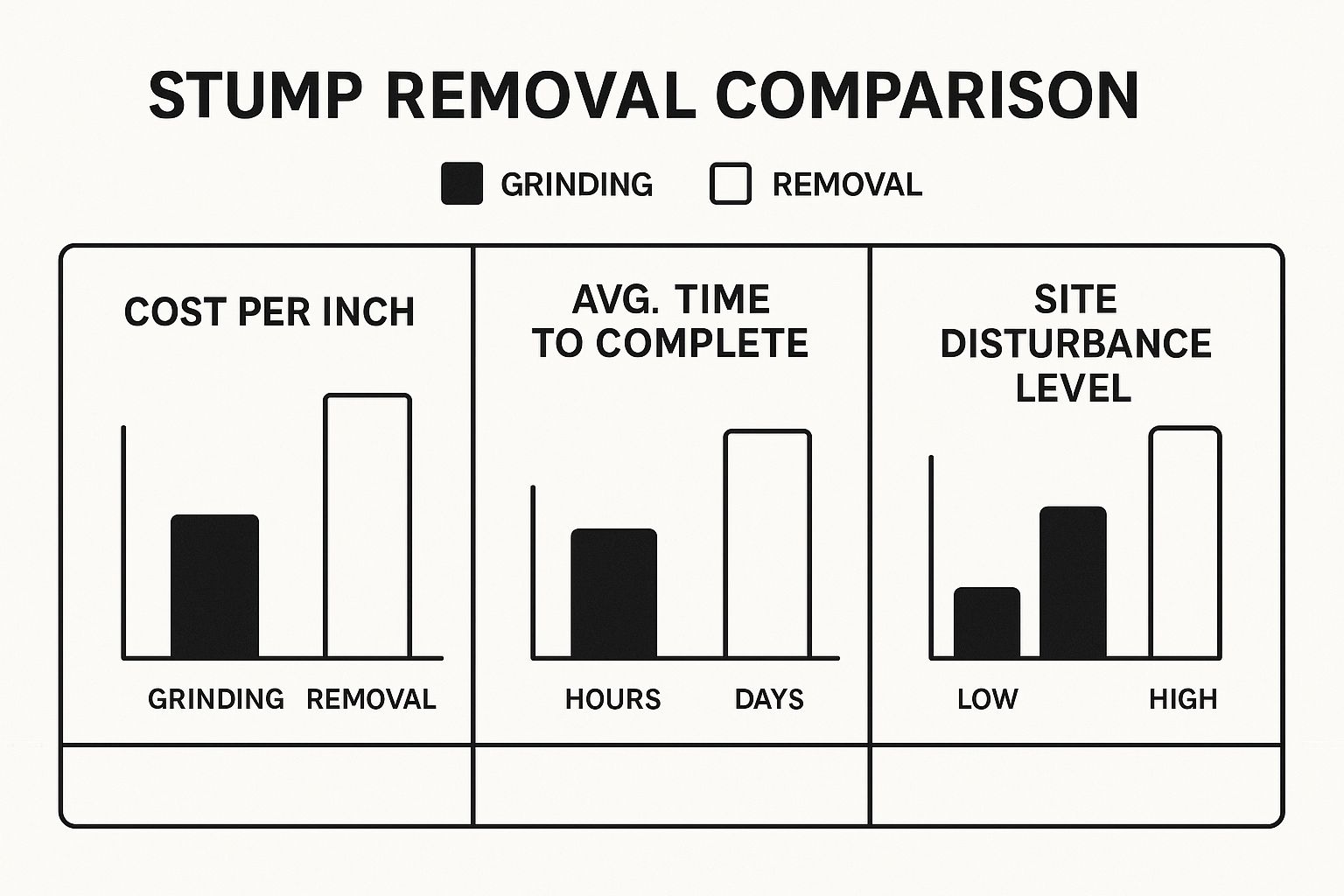
As you can see, stump grinding is a much less intense process from start to finish. That’s why it’s the go-to choice for most homeowners who just want the stump gone with minimal fuss.
Breaking Down the Financial Investment
Stump grinding is, almost without exception, the more budget-friendly route. The pricing is usually pretty straightforward and often calculated per inch of the stump's diameter, which makes the cost easy to predict. A smaller stump costs less than a bigger one, but the process is just as efficient either way.
Full stump removal, however, is a much bigger financial commitment. The higher price tag reflects the need for heavy-duty machinery like an excavator, the sheer amount of labor needed to dig out the entire root ball, and the logistics of hauling away a massive, heavy stump. It's a multi-step job that often includes backfilling the crater with fresh soil, tacking on even more to the final bill. You can get a better sense of these costs by exploring a detailed breakdown of the tree removal cost in Atlanta.
The scale of this industry shows you're not alone in making this decision. The tree stump services market in North America is valued at around $2.5 billion each year, with residential properties accounting for about 60% of that. This shows just how often homeowners invest in clearing their yards for looks or for new projects.
Comparing Timelines and Labor
Time is another huge factor separating these two methods. A typical grinding job is surprisingly fast—we're often talking just a few hours. The whole process is self-contained. Once the grinder does its work and the wood chips are dealt with, the job is done.
Stump removal is a different story. It’s easily a multi-day affair. The excavation alone can take up most of a day, and that's before the stump is even hauled off your property. After all that, you’re still left with a huge hole that needs to be filled and graded before you can use the space again, stretching the project out even longer.
To give you a clearer picture, let's put these two methods side-by-side.
Stump Grinding vs Removal In-Depth Analysis
Here’s a detailed look at how these two approaches stack up against each other across the most important criteria for any homeowner.
| Criteria | Stump Grinding Details | Stump Removal Details |
|---|---|---|
| Cost | More affordable. Typically priced by stump diameter. | Significantly more expensive due to heavy machinery, labor, and disposal. |
| Time | Fast. Usually completed in 1-3 hours. | A multi-day process, including excavation, hauling, and site restoration. |
| Equipment | Requires a stump grinder, which is powerful but relatively compact. | Needs heavy equipment like excavators or backhoes. |
| Site Impact | Minimal disruption. Affects only the immediate area around the stump. | Highly disruptive. Creates a large crater and can damage the surrounding lawn. |
| Best For | Quickly removing an eyesore, preparing for grass/sod, or when budget and time are tight. | Prepping land for construction, driveways, or patios where ground stability is critical. |
This table makes it easy to see that the right choice truly depends on what you plan to do with the space afterward.
Assessing the Impact on Your Property
Maybe the most obvious difference is the mark each method leaves on your yard. Think of stump grinding as a surgical procedure. It causes very little collateral damage, leaving your lawn and landscaping mostly untouched. The end result is a pile of wood chips where the stump used to be, and that's about it.
Removal, in contrast, is an excavation. It's messy. The heavy machinery can leave deep tracks in your grass, and digging out the root system churns up a massive area of soil. You're left with a substantial hole that takes a lot of work—and new soil—to fix. It’s a far more disruptive option, no question about it.
When Stump Grinding Is Your Best Option
Figuring out whether to grind or remove a stump really comes down to what you’re planning for your property, your budget, and how much disruption you can handle. If what you want is a fast, budget-friendly, and fairly tidy solution, stump grinding is almost always the answer.
This approach is perfect for Atlanta homeowners who just want to get rid of an ugly stump, stop tripping over it, and get their lawn back. You’re not looking at a massive landscaping overhaul; you just want the problem gone. Grinding gets it done, often in just a couple of hours.
Scenarios Perfect for Grinding
Stump grinding really proves its worth in a few common situations we see all the time around Atlanta. It’s definitely your go-to option if you’re:
- Working with a limited budget. Let’s be frank: grinding is significantly cheaper than a full removal. For most homeowners, it’s the most practical and affordable choice.
- Dealing with a hard-to-reach stump. Big excavators need space. Grinders are much more compact, meaning they can get to stumps in tight backyards, on sloped ground, or in other spots where heavy equipment just can’t go.
- Planning to plant grass or a shallow garden. Grinding a stump 8-12 inches below ground level is more than enough for new sod. It also leaves the area ready for flowers, shrubs, and other plants that don't have deep root systems.
Choose grinding for a fast, cost-effective solution when you have no immediate plans for construction. It resolves the immediate problem of the stump without the cost and disruption of a full-scale excavation.
The preference for this efficient method is growing, and you can see it in the market for the equipment itself. The global stump grinder market is expected to grow from around $100 million in 2025 to $135 million by 2032. North America is the biggest player, holding a huge 48% of that market. This trend just underscores how much homeowners value less disruptive landscaping solutions. You can dig into more of the numbers on the global stump grinder market and its growth projections.
Bottom line: if your goal is purely cosmetic and you aren't about to pour a foundation for a new deck or dig a pool, grinding is the most logical way to go.
When You Should Choose Complete Stump Removal
While stump grinding solves the problem for most Atlanta homeowners, some situations call for a more thorough approach. Complete stump removal isn't just a different technique; it's the right solution when specific, non-negotiable project goals mean leaving anything behind simply isn't an option.
This is the only real choice when your plans involve breaking ground for new construction. You absolutely have to go with full removal if you're prepping a site for a new foundation, driveway, pool, or patio. Leaving roots in the ground would seriously compromise the structural integrity of any concrete or paving you lay, leading to cracks and heaving down the road. The ground has to be totally clear of all old tree matter.
Preventing Future Yard Problems
Beyond building projects, complete removal is also a critical step in keeping your landscape healthy. If a tree was taken down because of a disease, like a fungal infection or a nasty pest infestation, grinding might not be enough to fix the problem for good. Pathogens and pests can easily hang around in the leftover root system and spread to your other healthy trees and shrubs.
- Disease Control: Ripping out the entire stump and root ball gets rid of the source of the infection, protecting the rest of your yard.
- Replanting Large Trees: If you want to plant another large tree in the exact same spot, removal is a must. The new tree’s roots need plenty of space and stable soil to grow strong.
- Eliminating Regrowth: Some tree species are incredibly stubborn and will keep sending up suckers from leftover roots. Only full removal guarantees that the tree won't try to make a comeback.
Opt for removal to ensure a clear site for any construction or to eliminate disease and regrowth risks. It's an investment in the long-term stability and health of your property.
The decision to invest in a more intensive service like stump removal is becoming more common, especially with increased urbanization and landscaping projects. The global market for these services is projected to hit $3.8 billion by 2033, driven by the growing need for clear, usable land. You can find more insights into the stump removal and grinding service market to understand these trends. At the end of the day, when your project's success hinges on what’s happening underground, the thoroughness of complete removal is essential.
Got Questions About Stump Grinding or Removal?
Once the tree is gone, you're left with the stump. It's a common crossroads for homeowners, and knowing what to do next can be tricky. Deciding between stump grinding vs removal really comes down to what you plan to do with your yard afterward. We get these questions all the time from folks in Atlanta, so we’ve put together some straightforward, expert answers.
Can I Plant a New Tree Right Where the Old One Was?
This is easily one of the most common questions we hear, and the simple answer is no—not in the exact same spot, at least. When we grind a stump, the bulk of the root system is left deep underground where it starts to break down.
This decomposition process isn't great for a new tree. It creates air pockets and messes with the soil's chemistry. On top of that, the wood chips from grinding temporarily suck nitrogen out of the soil as they decay, which is like taking food away from a young, hungry tree. To give your new tree the best shot, you’ll want to plant it at least 3 to 5 feet away from the old stump's center.
Grinding clears what you can see, but it's the underground environment that makes replanting in the same spot a bad idea. It's a classic case of what you can't see having the biggest impact on your new tree's health.
Will the Stump Grow Back After Grinding?
For the vast majority of trees, grinding the stump 6-8 inches below the surface is a death sentence for the root system. It effectively cuts the tree off from its ability to produce energy, and it will die off.
But then there are the stubborn ones. A few notoriously tough species like elms, willows, and some poplars might try to send up new shoots, often called "suckers," from their remaining roots. It’s a bit of an annoyance, but these are usually easy to handle. Just snip them off as they appear, and you'll eventually starve the root system of its last energy reserves. If you want a 100% guarantee against any kind of regrowth, though, complete stump removal is the only way to go.
What Am I Supposed to Do with All These Wood Chips?
The mix of soil and wood chips left over after grinding is actually pretty useful stuff. A lot of homeowners love using it as a natural, organic mulch in their garden beds or around other trees. It’s fantastic for holding in moisture and keeping weeds down.
Another popular option is to just rake the grindings back into the hole where the stump used to be. It helps level out the ground. But if you’d rather have a completely clean slate, just let us know. Most professional tree companies, including us, can haul all the material away for an extra fee.
Ready to get that stump out of your yard for good? For professional stump grinding and removal in Atlanta, Cumming, and Johns Creek, you can count on the certified arborists at Richmond Tree Experts GA. Contact us today for a free estimate!
Have a stump you want gone? Richmond Tree Experts has worked on Marietta and Metro Atlanta trees since 1985, and every job is looked at by an ISA Certified Arborist before it is priced. Start with stump grinding, or see everything we do: tree removal, stump grinding and arborist services across Cobb, Fulton, Cherokee, Gwinnett and DeKalb counties (service areas).
Call (770) 974-3964, 7am to 11pm every day, or request an estimate online.

