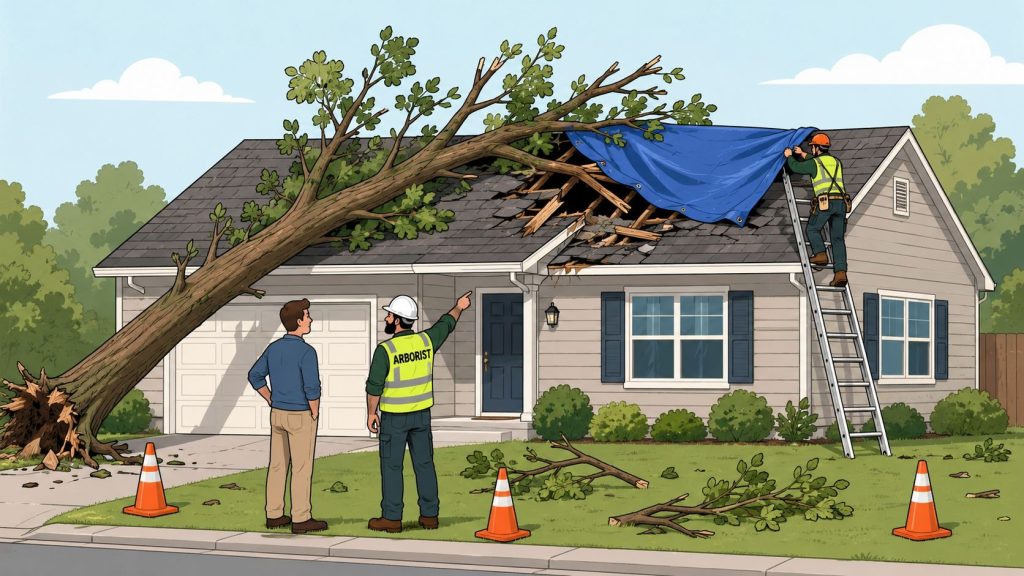
The morning after a July thunderstorm, a Marietta homeowner may find a cracked oak leaning toward the driveway, wet leaves covering the yard, and one urgent question: call someone now or wait for the tree to settle? Waiting is the wrong default when a trunk has shifted, the root plate is moving, or a broken limb hangs over a home, vehicle, or walkway.
A tree health assessment translates visible symptoms into a practical risk decision. It helps determine whether the right next step is tree pruning, tree trimming, structural support, emergency tree removal, storm damage tree cleanup, or continued monitoring. The same decision applies whether you're searching for tree service in Roswell, tree removal near me in Kennesaw, or hazardous tree removal in Cherokee County.
What a Tree Health Assessment Actually Is
A tree health assessment isn't a casual glance at leaves and bark. It evaluates three separate questions:
- Structural condition: Could the trunk, roots, or branches fail?
- Biological vitality: Is the tree maintaining healthy foliage, growth, and defenses?
- Site risk: What people, buildings, vehicles, utilities, or activities could be affected if failure occurs?
That distinction matters after storms. A tree can still have green leaves while carrying hidden decay, a cracked union, or a compromised root plate. Conversely, a tree with sparse foliage may be stressed without presenting an immediate danger. Health and safety overlap, but they aren't the same diagnosis.
The homeowner view and the arborist view
A homeowner can perform useful triage. Look for fresh cracks, exposed roots, soil heaving, hanging limbs, fungal growth, sudden lean, and deadwood over a roof or driveway. Those observations help you decide whether to keep people away and call a professional.
An ISA-qualified arborist goes further. The ISA Tree Risk Assessment Best Management Practice is designed to help arborists assess risk as accurately and consistently as possible, evaluate that risk, and recommend measures that achieve an acceptable level of risk. The process documents targets, defects, likelihood of failure, consequences, and mitigation options.
A target is anything that could be harmed by a failure, including people, homes, cars, roads, and regularly used outdoor spaces. A tree in an empty back corner isn't evaluated the same way as a cracked tree over a busy driveway.
What you should do with the answer
Don't decide on tree cutting service based only on disease symptoms. Decide based on the combination of defect, likelihood, and consequence. The recommendation might be selective tree pruning, removal of one hazardous limb, cabling, improved site conditions, stump grinding after removal, or complete tree removal.
Practical rule: If a tree is leaning toward a structure and the soil or root plate has moved, keep clear and arrange an urgent professional inspection.
That risk-based approach also creates useful documentation for insurers, property managers, real estate transactions, and municipal permit reviews. For homeowners across Marietta, Roswell, Alpharetta, Canton, Woodstock, and Acworth, the first question remains simple: is the tree safe enough to leave in place today?
How Tree Risk Assessment Became a Standardized Practice
After a North Atlanta storm, a tree can look healthy while a shifted root plate, split union, or hanging limb creates an immediate target hazard. Arborists once relied heavily on individual judgment and visible symptoms. Modern arboriculture adds a documented process, so qualified professionals can translate the same observations into a clear risk decision.
The ISA's risk-management framework works alongside the ANSI A300 Tree Care Standards. The current third edition of the ISA Tree Risk Assessment Best Management Practice was published in 2025, as documented by the International Society of Arboriculture's Tree Risk Assessment publication. The Tree Risk Assessment Manual also reached a third edition in 2025, updating terminology, scoring, and methodology.
Four questions drive the assessment
A structured evaluation follows four practical phases:
- Scope the assignment. Define the client's concern, the trees included, and the decisions the report must support.
- Identify targets. Record people, homes, vehicles, roads, play areas, and other property within a likely failure zone.
- Inspect the tree. Examine roots, trunk, branches, canopy, defects, vitality, site conditions, and signs of pests or disease.
- Categorize risk and recommend action. Combine the likelihood of failure with potential consequences, then select proportionate mitigation.
The result is not “healthy” or “unhealthy.” Likelihood of failure may be described as low, possible, probable, or imminent. Consequences may be negligible, significant, or severe. Together, those factors produce a risk rating that a homeowner, insurer, city arborist, or property manager can act on.
ISA certification and the ANSI A300 standards do not remove professional judgment. They give arborists a common language for recording it. The ISA distinguishes between limited-visual, basic, and advanced diagnostic techniques, while its Tree Risk Assessment Qualification certifies professionals in these methods.
A credentialed crew should also show how its field work follows recognized safety practices. Richmond Tree Experts GA homeowners comparing providers can review the TCIA Certified Treecare Safety Professional information alongside arborist qualifications.
For property owners in Marietta, Roswell, Alpharetta, Canton, Woodstock, and Acworth, consistent documentation matters when a city reviews a removal application or protected-tree concern. A report built on a recognized framework gives a permit office more useful information than a note saying a tree “looks bad.” Service providers also carry professional liability concerns, so homeowners comparing crews may find self employed handyman insurance 2026 useful for understanding coverage terminology.
The Five Zones Every Arborist Inspects
A reliable assessment starts at the ground and works upward, then returns to the surrounding site. That sequence prevents a common homeowner mistake, focusing on leaves while overlooking roots and soil.
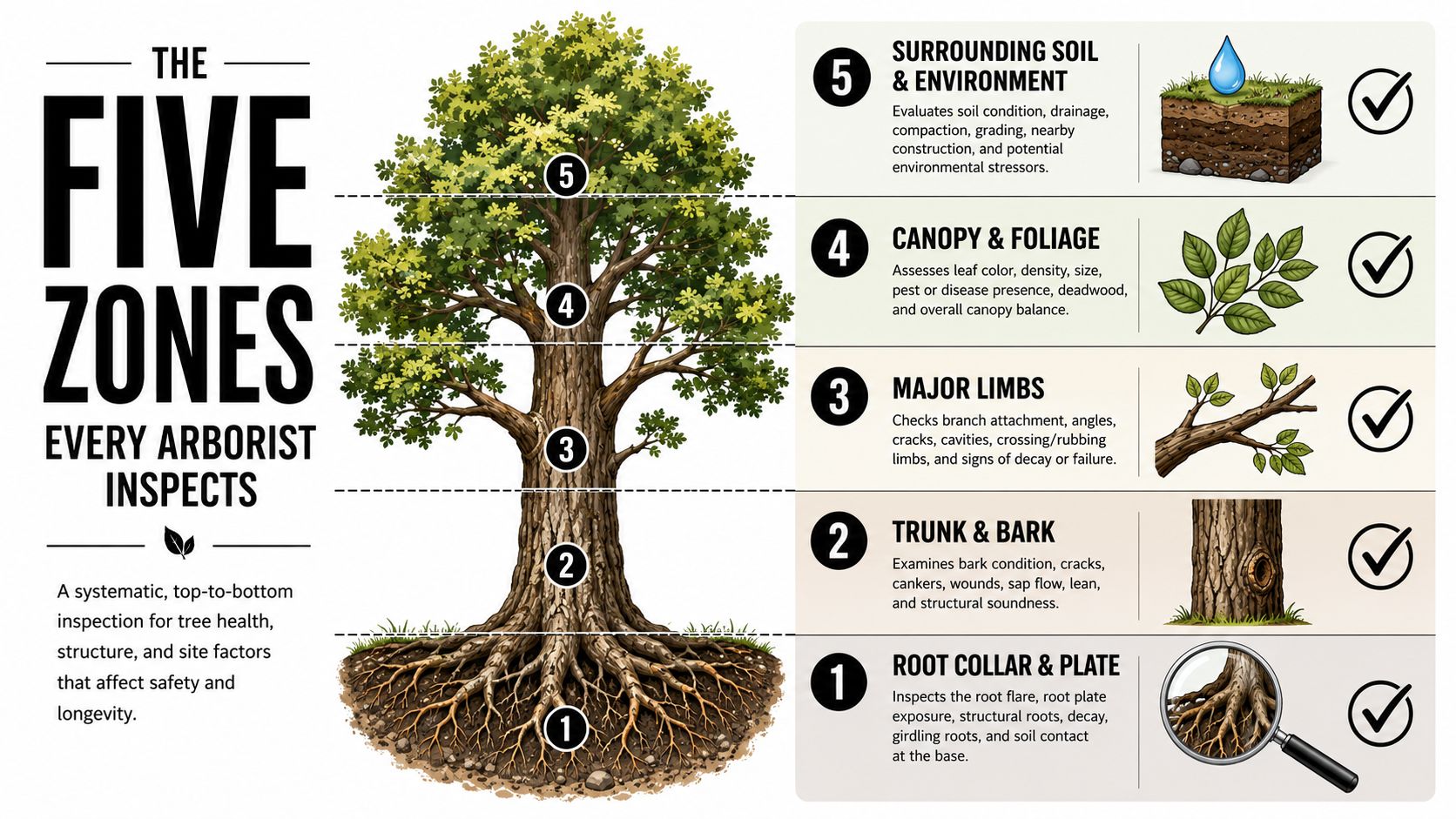
Zone one is the root collar and root plate
The root collar is where the trunk transitions into the major roots. Check whether the flare is visible, whether roots circle tightly around the trunk, and whether soil has heaved or cracked. Mushrooms near the base can indicate decay, although the fruiting bodies alone don't establish how far decay has progressed.
Recent grading, pavement work, retaining walls, lawn installation, or construction cuts can damage roots without leaving an obvious canopy symptom. The University of Kentucky tree health assessment checklist highlights exposed roots, soil heaving, mushrooms, and root-flare visibility as useful inspection points.
Zone two is the trunk and bark
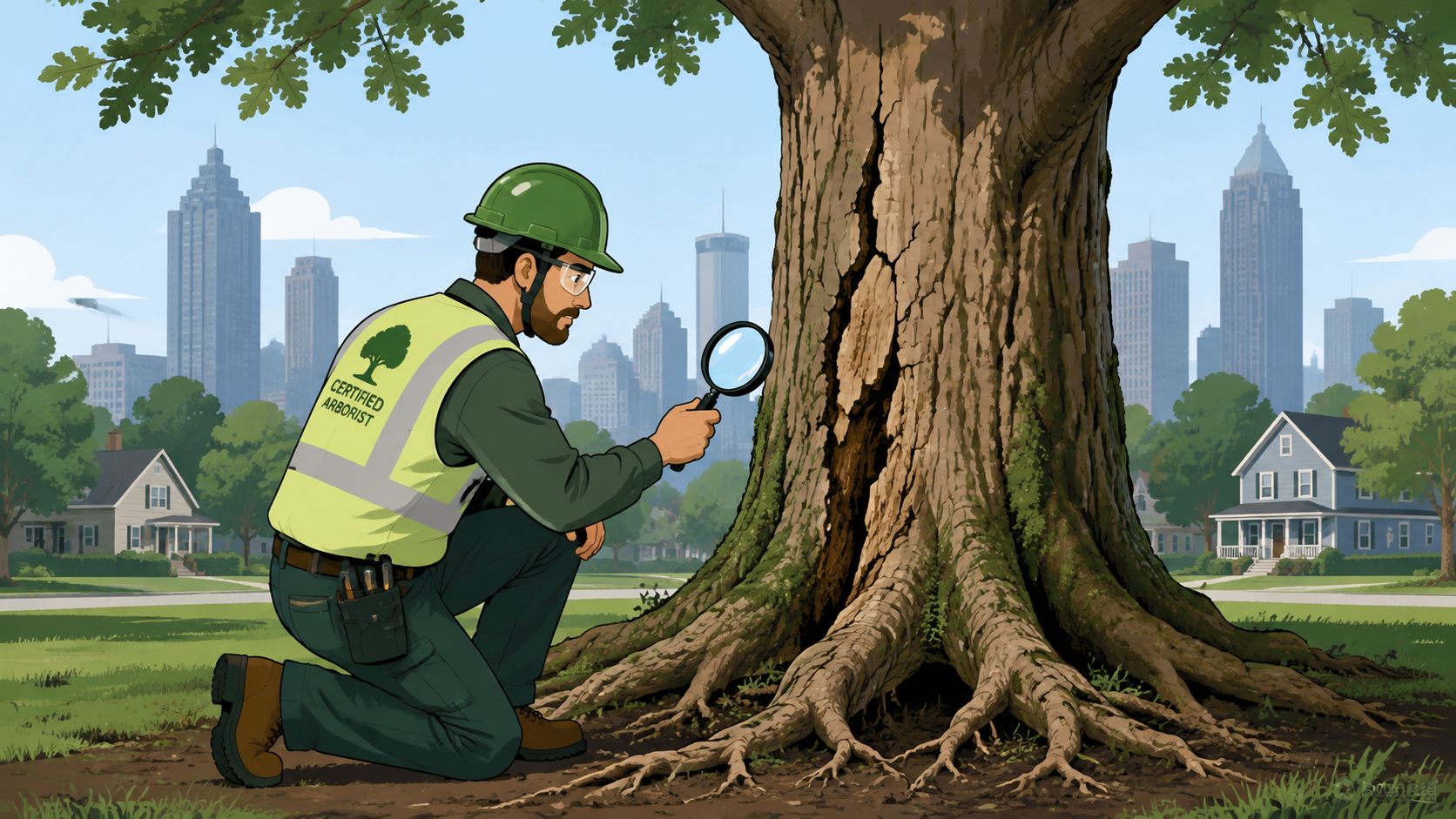
Walk around the entire trunk. Look for longitudinal cracks, cavities, loose bark, fungal conks, old wounds, and seams where two stems meet. Codominant stems with included bark deserve particular attention because the union may not shed loads as safely as a well-formed branch attachment.
Measure lean from a fixed reference rather than guessing from the sidewalk. A smartphone level app can help you document direction, but it can't determine whether the lean is old and stable or recent and dangerous. Fresh soil movement at the base changes the decision.
Zone three is the scaffold branches and canopy
Inspect major limbs, branch unions, recent break points, and deadwood. A hanging limb over a driveway is an immediate target concern, even if the rest of the tree appears vigorous. Look for asymmetric thinning, sudden crown loss, and branches with cracks or weak attachments.
Use binoculars from the ground. Don't climb, shake limbs, or stand beneath a suspect branch to get a closer look. Tree trimming and tree pruning should remove a documented defect, not shorten every branch that looks inconvenient.
Zone four covers pests and disease
Symptoms need interpretation. Emerald ash borer can threaten white ash, ambrosia beetles commonly affect stressed maples, and oak wilt concerns may arise in parts of North Georgia, including Forsyth County. Hole patterns, galleries, discolored leaves, fungal structures, and crown dieback can help an arborist narrow the diagnosis.
A symptom doesn't automatically justify removal. The correct response may involve pruning, sanitation, site correction, treatment, or monitoring, depending on the tree and risk.
Zone five is soil and the surrounding site
Finish by looking outward. Check compaction from construction, poor drainage, lawn-equipment wounds, altered grades, nearby foundations, pavement, sewer lines, and areas where people regularly gather. A tree's risk depends on both its defects and what lies within the failure zone.
A Homeowner Checklist You Can Run in 15 Minutes
You can complete a useful first-pass inspection without climbing or using specialized equipment. The purpose is triage, not certification.
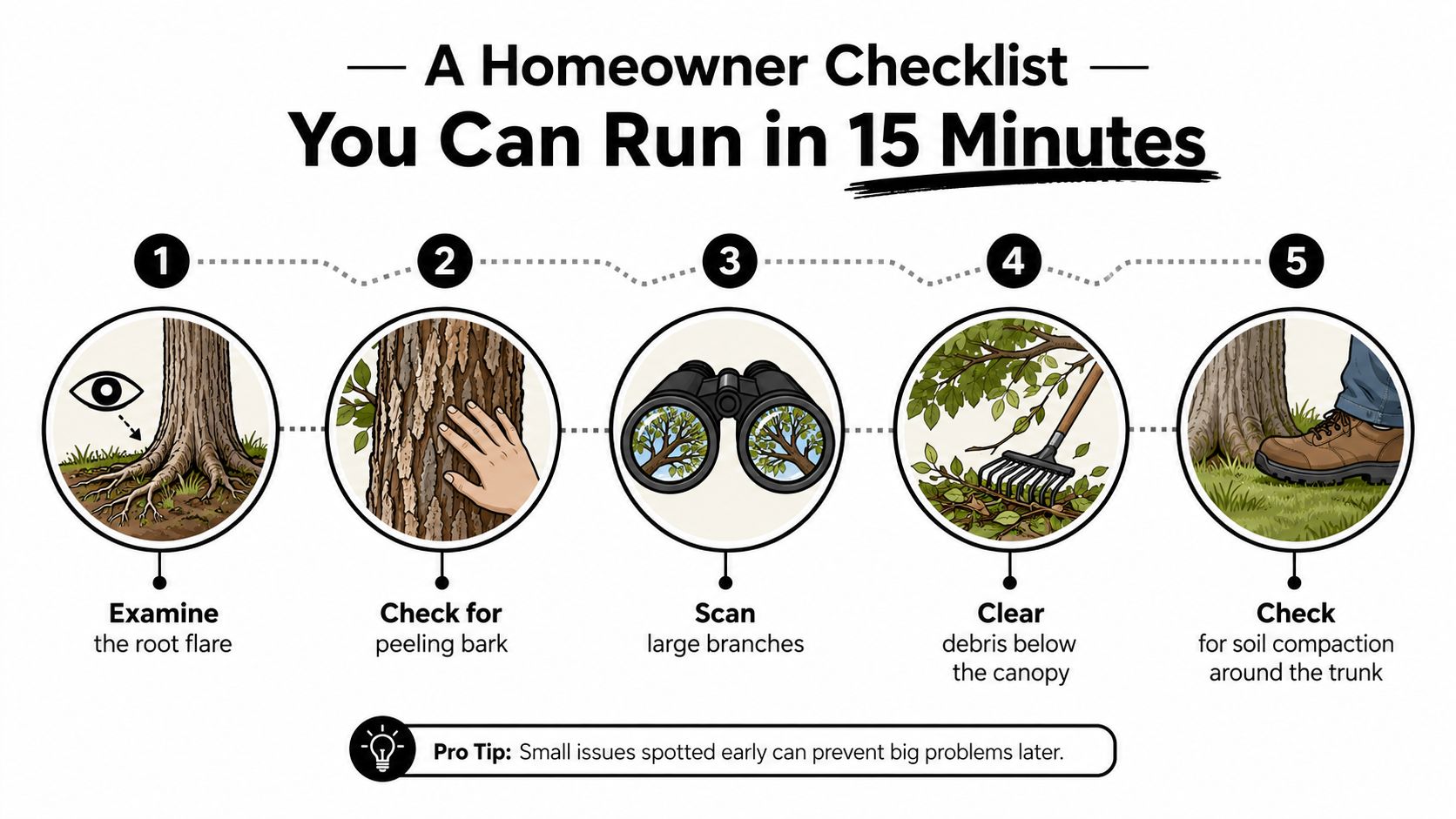
- Start at the root flare. Walk around the base and look for exposed roots, mushrooms, soil heaving, fresh cracks, or a root flare buried under mulch. Note whether the ground moved after the storm.
- Check trunk direction. Stand well away from the tree and identify the lean. Compare it with older photographs if available. A new lean toward a home, street, or driveway deserves prompt attention.
- Inspect trunk unions. Look for cracks, seams, included bark, cavities, and loose bark. Never insert tools into a cavity or attempt to test a branch by pulling on it.
- Scan the target zone. From the street or a safe part of the yard, identify deadwood and broken limbs over roofs, parked vehicles, play areas, sidewalks, and property lines. Use binoculars if you have them.
- View the crown from a distance. Look for sudden thinning, dead branch tips, uneven foliage, and recent limb loss. Compare the tree with nearby trees of the same general type, but don't treat a visual comparison as a diagnosis.
A storm can leave a tree looking upright while the root plate shifts under wet soil. It can also leave a single broken hanger that requires fallen tree removal or targeted storm damage tree cleanup before anyone uses the driveway.
For a visual explanation of storm-related failure and removal decisions, review this tree falling on house example.
Stop the inspection and keep people away if you see root plate movement, a fresh dangerous lean, fungal conks with nearby structural defects, or cracked unions overhanging a structure or property line. Don't park beneath the tree, don't cut the limb yourself, and don't assume the weather has made the tree safer. Call an arborist or emergency tree removal crew.
What a Professional Arborist Adds Beyond Your Eyes
After a storm, a tree can look upright and green while a root plate shifts or a hidden trunk defect weakens the next failure point. Your fifteen-minute walk-around can identify obvious danger, but it cannot establish a formal risk rating or safely inspect high branches. A professional translates visible clues into a decision: monitor, prune, test, or act now.
ISA assessment materials distinguish between limited-visual, basic, and advanced techniques. A limited inspection uses accessible visual evidence. A basic assessment may add binoculars, mallet sounding, and closer evaluation of visible defects. An advanced case can require aerial inspection or instruments such as a resistograph or sonic tomography.
A resistograph measures resistance as a fine drill passes through wood, helping identify changes associated with internal decay. Sonic tomography uses sound transmission to map differences in internal wood condition. Neither tool replaces arborist interpretation, and neither belongs on every service call.
Professional arborist tree risk assessment and inspection
| Inspection Target | Homeowner 15-Minute Walk-Around | ISA Professional Assessment |
|---|---|---|
| Root collar and soil | Observe exposed roots, heaving, mushrooms, and grade changes | Evaluate root-zone defects, site history, drainage, targets, and root-plate stability |
| Trunk | Look for cracks, cavities, bark seams, and lean | Characterize defects, assess loading, and determine whether advanced testing is justified |
| Branches | Spot deadwood, hangers, and obvious broken limbs | Inspect attachment structure, failure likelihood, canopy distribution, and mitigation priorities |
| Internal condition | Usually not visible | Use sounding, resistograph testing, sonic tomography, or aerial inspection when appropriate |
| Final decision | Decide whether to keep clear and call | Produce a documented risk assessment and recommendations |
Research in HortScience describes assessment as a progression of detection, location, characterization, and action, using diagnostics when internal decay or load-bearing compromise is suspected. Green foliage and intact bark do not clear a tree.
A useful report identifies the tree, defects, targets, recommended work, and urgency. It can support a choice between pruning, cabling, monitoring, tree removal, stump removal, or site correction. Ask whether the crew is licensed and insured, whether an ISA Certified Arborist is involved, and whether the estimate separates emergency work from routine tree service. Service providers should also understand self employed handyman insurance 2026 when professional liability is part of the job.
North Atlanta Permit Rules You Need to Know First
Don't schedule tree removal before checking the city where the tree stands. North Atlanta rules vary sharply, and a permit threshold may depend on diameter at breast height, species, stream buffers, condition, or the reason for removal.
Measure DBH at the standard breast-height point used by the municipality, then verify the local rule before work begins. A professional assessment can document whether the tree is hazardous, but it doesn't automatically replace a permit.
Local thresholds differ
| City or County | DBH Threshold for Permit | Notes for Homeowners |
|---|---|---|
| Atlanta | 6 inches or more | A permit is required to remove, destroy, or injure a private-property tree at or above this DBH. Separate routes apply for construction versus safety or landscaping removals, and permits must be posted on site. Atlanta's tree ordinance |
| Sandy Springs | 18 inches or larger | A permit is also required for dogwoods or redbuds at 10 inches or larger, trees within a 75-foot stream buffer, and certain combinations of healthy and dead, dying, diseased, or hazardous trees. Sandy Springs permit guidance |
| Brookhaven | 4 inches or greater | The threshold applies regardless of tree condition. Brookhaven permit information |
| Unincorporated Cobb, Cherokee, and Forsyth areas | Verify locally | County and municipal rules aren't interchangeable. Confirm the jurisdiction before pruning, removal, land clearing, or lot preparation. |
Atlanta recognizes an imminent-hazard process for situations such as storm damage or heaving roots. The Atlanta Tree Commission's removal permit guidance identifies safety and emergency permitting paths, including contacts for inspections and imminent-hazard permits.
After a storm, take photographs from a safe distance, record the address and tree location, and ask the arborist to document the defect and target. Don't cut first and ask questions later unless an immediate emergency requires action to protect people. Even then, preserve photographs and invoices, and contact the applicable city process.
For homeowners in Marietta, Roswell, Kennesaw, Woodstock, Acworth, and Canton, the key issue is jurisdiction. A tree-service company that works across Cobb County and Cherokee County should still verify the city ordinance before dispatching a removal crew.
How Often to Schedule an Assessment in North Atlanta
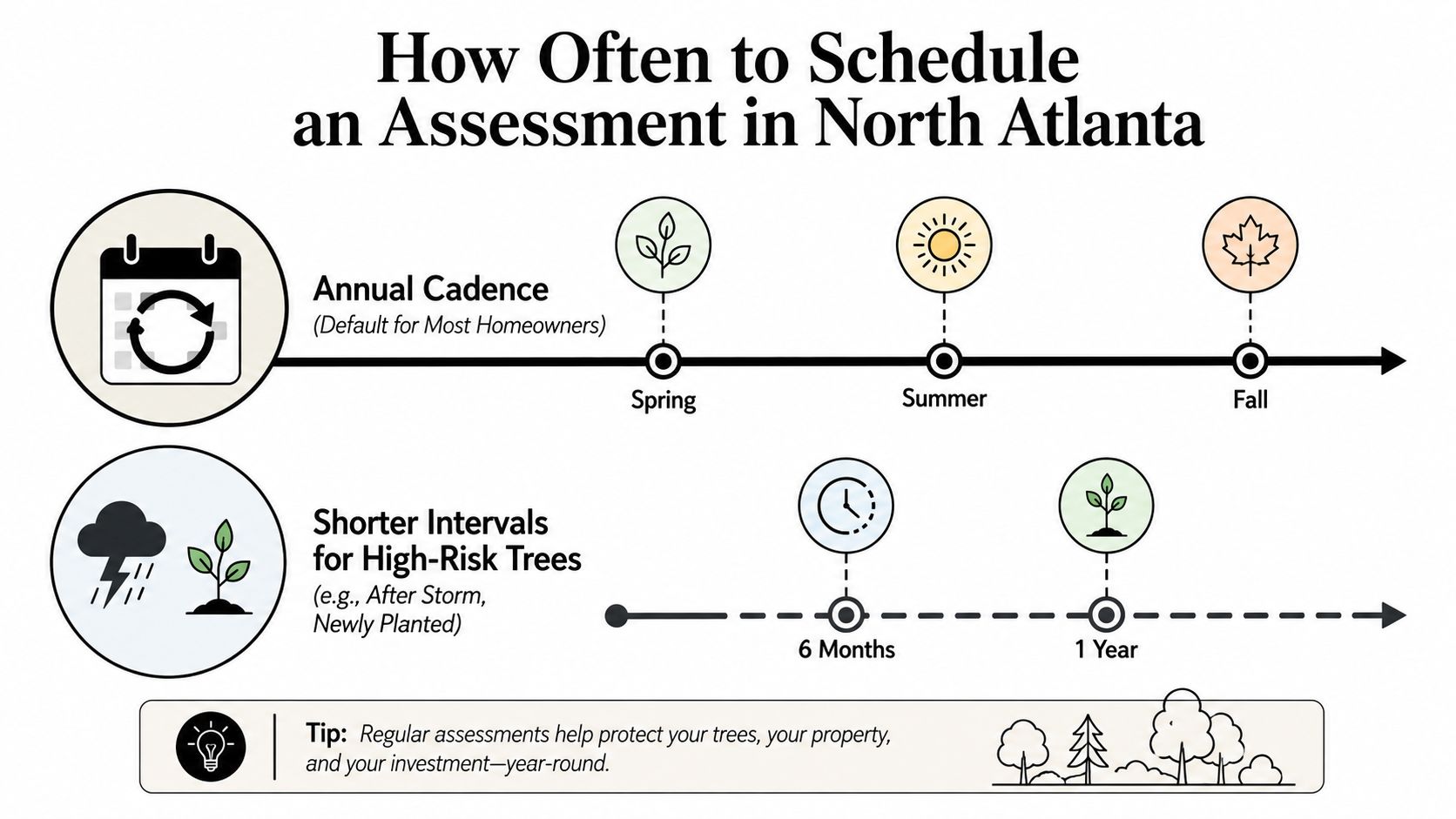
An annual assessment is the right default for most North Atlanta homeowners. Schedule it before storm season when possible, then arrange another inspection after a major wind event, tornado warning, or lightning-heavy storm that may have loaded branches or saturated the root zone.
Mature hardwoods near houses, driveways, streets, and play areas deserve closer attention than trees in low-use portions of a property. A mature oak on a storm-exposed lot shouldn't sit on a long inspection cycle because the canopy still looks full.
Use triggers, not just a calendar
Schedule a professional review when:
- Spring storms pass through: Ask for a post-storm sweep before removing hangers or cutting damaged limbs.
- Dry summer weather persists: Check drought-stressed trees after long July and August dry spells.
- You buy a property: Establish a written baseline for a newly purchased home older than 20 years.
- You prepare to sell: A documented assessment can clarify tree condition for buyers, agents, insurers, and HOAs.
- Construction changes the site: Reassess after grading, pavement, drainage changes, or root-zone disturbance.
A written report creates a record of changes. It can also help a property manager prioritize tree pruning, stump grinding, hazardous tree removal, and future monitoring instead of reacting to whichever branch fails first.
A tree doesn't need to look dead to deserve an inspection. Structural defects often become visible only after the tree has lost its margin of safety.
Mature hardwoods close to structures warrant a shorter cycle than an infrequent inspection routine. If a tree has a known defect, prior failure, storm exposure, or major site disturbance, follow the arborist's monitoring schedule rather than relying on a generic reminder.
Frequently Asked Questions About Tree Health Assessment
How much does a professional tree health assessment cost in the Atlanta metro?
There isn't a defensible universal price for every property, and the available verified information doesn't establish a reliable local dollar range. Cost depends qualitatively on the number of trees, access, report depth, travel, required equipment, and whether the assessment supports a permit, insurance matter, property transaction, or emergency decision. Request a written estimate that separates the assessment from tree removal, tree pruning, stump grinding, and storm cleanup.
How often should trees be inspected?
Use an annual cadence as the practical default, with a post-storm inspection after significant weather. Mature oaks and other large hardwoods near structures, trees with known defects, and storm-exposed lots need more frequent monitoring than low-risk trees in open areas.
Quantitative canopy metrics can add context. One urban-tree study describes trees as generally healthy when canopy density exceeds 50%, crown transparency remains below 30%, and crown dieback stays below 5%. Those benchmarks come from urban tree health research in Forests, but they aren't a substitute for evaluating targets, roots, trunk defects, or branch attachments.
What warning signs mean I should call an arborist today?
Act promptly for a leaning trunk with fresh soil movement, root plate heave, cracked codominant stems over a structure, fungal conks combined with other defects, sudden canopy thinning, or large broken limbs. Keep people and vehicles out of the failure zone until a qualified professional evaluates the tree.
When should I contact Richmond Tree Experts GA?
Contact Richmond Tree Experts GA when you need an ISA TRAQ-level tree risk assessment, storm damage response, tree removal near a structure, tree trimming or pruning based on a documented defect, stump grinding, stump removal, fallen tree removal, or land clearing and lot preparation. The company serves North Metro Atlanta communities including Marietta, Roswell, Alpharetta, Cumming, Johns Creek, Milton, Kennesaw, Woodstock, Acworth, Canton, Cobb County, Cherokee County, and nearby areas.
Richmond Tree Experts GA can evaluate tree health, document structural risk, and recommend the right next step, whether that's pruning, emergency tree removal, storm cleanup, stump grinding, or monitoring. If a tree is leaning, cracked, or damaged after a storm, visit Richmond Tree Experts GA to request an assessment and discuss a safe response.