

A storm has pushed a mature pine onto the edge of your roof in East Cobb. The driveway is blocked, the trunk is resting on a fence, and a power line runs through the canopy. You need emergency tree removal, but the obvious question is not just which saw to use. It's whether a crew can reach the tree, control every section, protect the house, and clear the debris without turning a dangerous situation into a larger one.
That's where tree removal heavy equipment earns its place. In North Atlanta, from Marietta and Roswell to Kennesaw, Woodstock, Acworth, and Canton, equipment selection depends on access, soil, structures, utility lines, traffic, and the intended use of the property. A large machine isn't automatically safer, and a chainsaw crew isn't automatically more efficient. The right method matches the site.
Understanding Urban Tree Removal Challenges
A typical Marietta removal rarely happens in an empty field. The tree may stand between a garage and a retaining wall, lean across a driveway, or have limbs woven through a roofline. In Roswell, a backyard gate may be too narrow for a full-size loader, while a nearby swimming pool, decorative paving, or septic system limits where a crew can place equipment. In East Cobb, steep grades and soft ground can matter just as much as the tree's height.
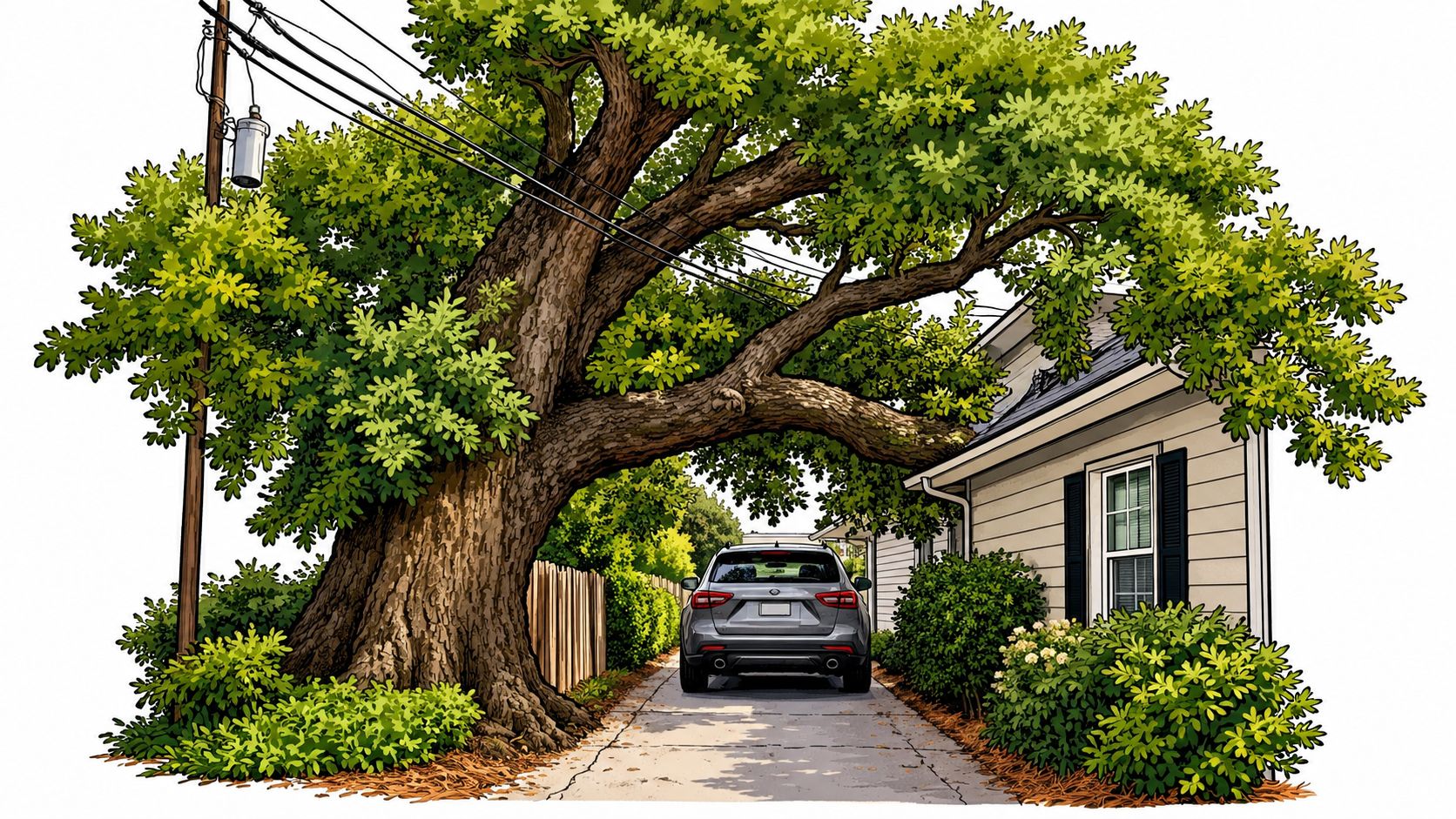
A homeowner may see one oak and assume the job requires a climber with a chainsaw. That can work when the tree has sound structure, the drop zone is open, and a crew can lower limbs safely. It doesn't work as well when the tree is unstable, the trunk is suspended over a home, or there isn't room to stage ropes and landing areas.
Access often decides the machine
A compact excavator with a grapple may reach a backyard through a wider side passage and move logs without repeated hand carrying. A skid steer can handle brush and sections on firm ground, but it may be the wrong choice on wet turf or beside fragile hardscape. A crane can lift sections over an obstacle, yet it needs a suitable setup area, overhead clearance, and a carefully planned load path.
Professional crews also consider what happens after cutting. A tree removal project includes bucking logs, feeding branches into a chipper, loading material, protecting surfaces, and leaving the property usable. Stump grinding, stump removal, and follow-up grading can require a separate plan. Grinding depth should match the next use of the ground, not just the size of the remaining stump.
The history of mechanized forestry illustrates why specialized equipment became important. The forestry equipment history and feller-buncher overview describes a Bobcat 1074 feller buncher that could cut, bunch, and transport trees. The machine was later discontinued in 1987, showing that this equipment class was commercially established by the 1980s. That same source describes an excavator fitted with a 5,000-pound cutting head, a 500-pound rotating blade, and the ability to cut trees up to 24 inches in diameter.
Those machines were developed for timber harvesting and land clearing, not for squeezing between suburban houses. Residential work requires a smaller, more controlled approach. A qualified estimator should inspect access points, identify obstacles, and explain why the crew is choosing a bucket truck, crane, excavator, grapple, ropes, or climbing methods. Homeowners can also review practical guidance on tree protection zones around work areas before equipment arrives.
Practical rule: Tree size starts the discussion. Site constraints finish it.
Essential Heavy Equipment for Tree Removal
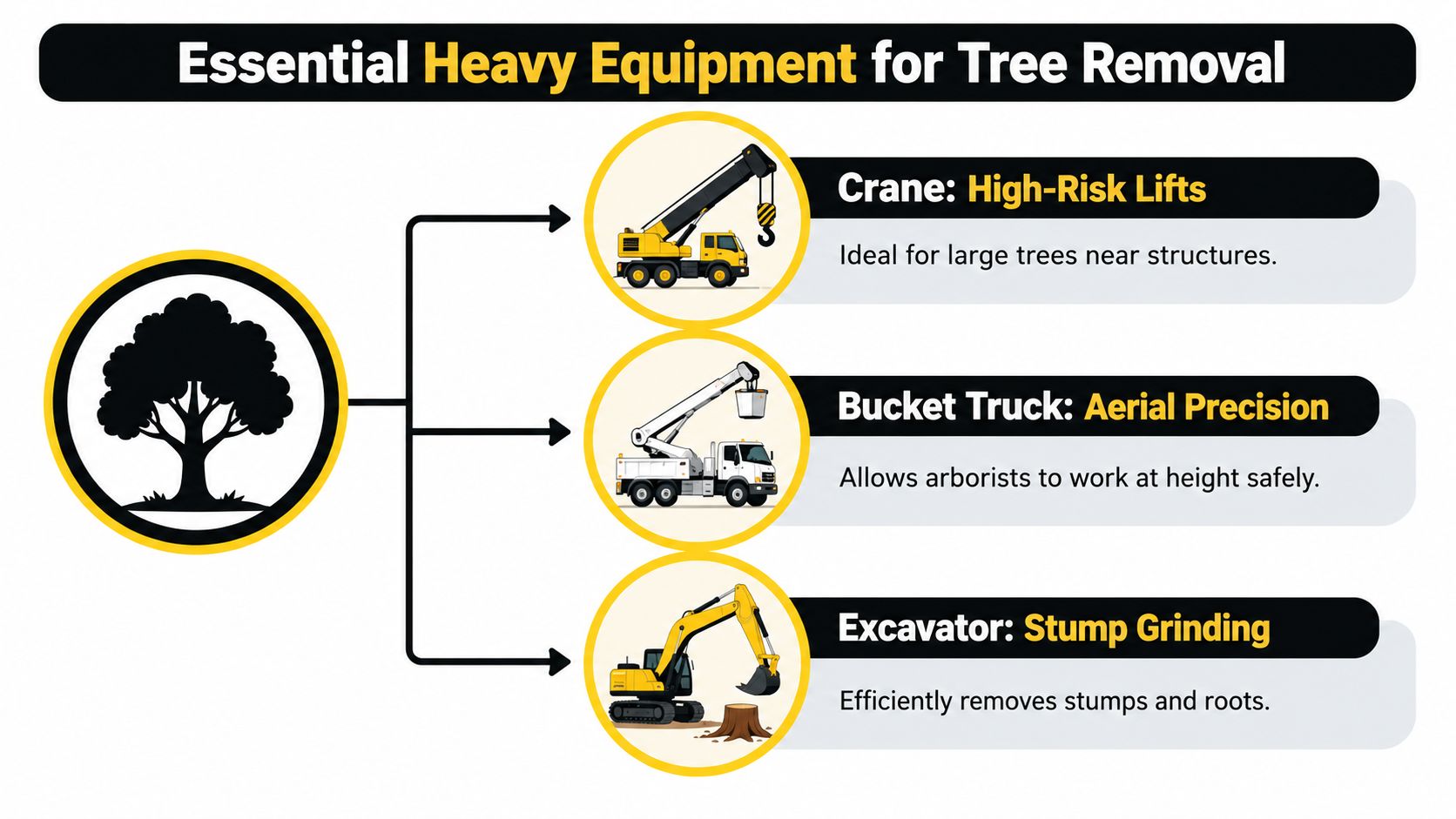
The machine list makes more sense when each tool is tied to a specific problem. Crews don't bring a crane just because a tree is tall. They bring one when lifting controlled sections is safer or more practical than dropping, dragging, or lowering those sections through a crowded yard.
Cranes control the largest pieces
A crane can lift trunk sections vertically and place them in a designated landing area. That changes the removal sequence near a house, pool, road, or other structure. The arborist cuts a manageable section, attaches approved rigging, and coordinates the lift with the crane operator. The team still needs a stable setup location and a clear route for the boom and suspended load.
A crane doesn't eliminate risk. It concentrates the risk into load planning, rigging, communication, ground stability, and exclusion zones. Poor placement or an oversized lift can damage pavement, compact soil, or create an uncontrolled swing.
Bucket trucks provide aerial access
A bucket truck lets an arborist reach portions of a tree without climbing every section. It works well beside a street or driveway where the truck can be positioned safely and the ground can support its outriggers. The operator can prune, remove deadwood, and dismantle limbs in controlled stages.
The truck isn't useful if the canopy is behind a house, the access road is too narrow, or overhead lines prevent safe positioning. In those situations, climbing and rigging may provide better control than forcing an aerial lift into an unsuitable setup.
Excavators and grapples handle the ground work
An excavator with a grapple can pull, hold, rotate, and place cut material. It differs from a feller buncher, which is a specialized forestry machine designed to cut and bunch trees efficiently in suitable harvesting environments. On a residential property, a compact excavator is usually selected for reach, control, and access rather than raw production.
An excavator can also expose or remove a stump, move logs, and prepare a landing zone. It isn't a substitute for a stump grinder in every situation. If the goal is to leave the area ready for turf, planting, or site development, the operator needs to choose between grinding and excavation based on the remaining roots, soil conditions, and intended finish.
For technical background on the components that power loaders, excavators, and other machinery, hydraulic solutions for heavy equipment provide useful context. Hydraulic performance affects attachment control, but the operator still has to match the attachment to the site.
Chippers and loaders finish the removal
A heavy-duty chipper processes branches into chips near the work area, reducing the amount of loose brush that must be carried or hauled. A grapple loader or skid steer can move larger logs and feed staging piles. On a small lot, a large chipper may be difficult to position and unnecessary. On a storm cleanup project with extensive branches, undersizing the chipper can slow the entire operation.
For homeowners comparing stump grinding equipment options, ask whether the crew plans to grind, excavate, or leave a below-grade remnant. The answer should reflect the next use of the space.
Safety and Regulatory Considerations
Heavy machinery makes tree work more controlled only when the crew controls the surrounding area first. Before cutting begins, the crew should identify power lines, structures, vehicles, unstable ground, traffic, public access, and the expected path of every limb and trunk section. The Texas Department of Insurance tree service safety guidance emphasizes these site hazards and states that the drop zone should extend at least twice the tree height or limb height.
That requirement can make a tight suburban lot difficult. A tree may fit physically in the backyard, yet its potential drop zone can extend across a driveway, neighboring property, or street. The crew may need to dismantle it in small pieces, use ropes, close access temporarily, or position a crane where the load can be lifted away from people and structures.
Ground pressure matters
A heavy machine can solve one problem and create another. Wet clay, recently saturated soil, drainage areas, septic fields, and decorative paving may not tolerate concentrated loads. Tracks can distribute weight better than narrow tires in some conditions, but tracks don't make a machine harmless to turf or underground infrastructure.
The operator and estimator should identify travel paths before unloading. Mats may protect a driveway edge or lawn, while a smaller machine may avoid the need for extensive ground protection. If no safe setup exists, the crew may choose climbing and rigging instead of bringing in a larger unit.
Atlanta and DeKalb rules are different
In the City of Atlanta, a permit is required to remove a hardwood tree 6 inches in diameter or larger, or a pine 12 inches or larger, measured 4.5 feet above ground. The arborist inspection and permit are free. If a healthy protected tree is removed, the city may assess a recompense fee of $140 per diameter inch as of January 1, 2026, according to this Atlanta tree removal permit and cost guidance.
DeKalb County uses a different framework for residential property. Its homeowner guide says a Notice of Tree Removal is required for more than five trees or any specimen-size tree. Removing more than five trees but fewer than ten may require a clearing-and-grubbing permit, while removing or clearing ten or more trees may require a Land Disturbance Permit. Homeowners planning land clearing should review the DeKalb County homeowner tree removal guide before scheduling machinery.
A permit question belongs at the start of the estimate, not after the crew has already cut.
A professional safety plan also covers utility clearance, communication signals, personal protective equipment, traffic control, and emergency access. More detail on tree removal safety procedures can help homeowners evaluate whether a proposed operation sounds organized or improvised.
Manual vs. Mechanized Tree Removal Methods
A tree behind a narrow Marietta gate may be safer to dismantle by hand than to force a machine across the yard. A climber using ropes can reach the trunk, cut manageable sections, and lower them into a planned landing area. This approach gives the crew close control around gardens, fencing, roofs, and other finished surfaces when the tree is stable enough to climb and there is room to rig safely.
Machines become more useful when the tree is structurally compromised, the canopy cannot be reached safely from the ground, or heavy sections must move away from a building. A bucket truck improves aerial access from a street or driveway. A crane can lift large sections over a roof instead of dragging them across the property. An excavator processes logs and root material quickly, but it requires operating room and can compact soil or damage turf.
| Method | Best For | Pros | Cons |
|---|---|---|---|
| Climbing and rigging | Narrow access, gardens and fencing, controlled dismantling | Precise placement, limited machine footprint, useful behind structures | Physically demanding, slower for heavy material, unsuitable for some hazardous trees |
| Bucket truck | Street-side trees and accessible aerial work | Efficient canopy access, reduces climbing exposure, supports pruning and sectional removal | Needs truck access, stable ground, and clearance from utilities |
| Crane-assisted removal | Large or hazardous trees near structures | Lifts sections away from roofs and obstacles, reduces dragging across the lot | Requires setup space, load planning, traffic coordination, and suitable ground |
| Excavator with grapple | Log handling, stump excavation, open or semi-open lots | Moves heavy material, supports clearing and cleanup, handles ground work | Can damage turf or soil, needs access width and operating room |
| Skid steer with attachments | Brush, small trees, debris, and lot preparation | Compact, maneuverable, adaptable with grapples or cutters | Not a universal solution for tall trees or finished lawns and plantings |
A machine choice should account for more than cutting speed. The USDA Forest Service explains that feller-buncher productivity, measured in tons per productive machine hour, is directly proportional to tree diameter. Larger stems take longer to cut, while each cycle removes more biomass. The USDA feller-buncher equipment information also identifies terrain, site layout, ground disturbance, and maneuverability as factors that should guide equipment selection.
That production relationship does not place a large machine in every residential yard. On a confined lot, a slower climbing operation may reduce risk to lawns, plantings, fences, and foundations. A mechanized crew may make more sense for land clearing, storm debris, or a hazardous tree with a clear route for the equipment. The right method is the one that moves wood efficiently without creating a larger access, soil, or property-damage problem.
Case Examples from North Atlanta Neighborhoods
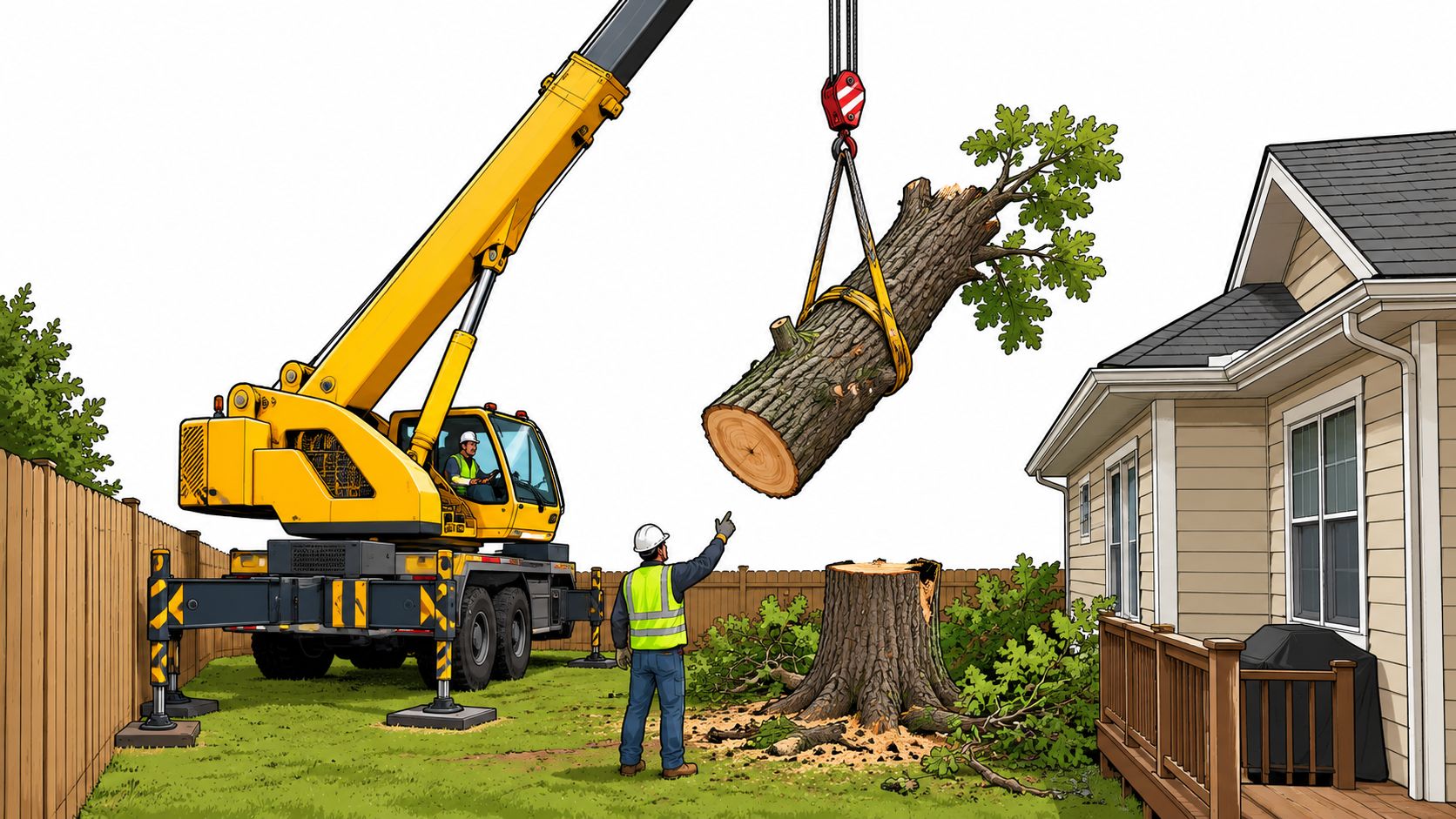
A large oak in East Cobb may have a clear trunk but no safe place to drop its upper sections. The house sits on one side, a neighbor's fence borders the other, and the driveway is the only practical access route. A crane-assisted removal can lift sections over the roofline and place them in a controlled landing area, provided the operator has a suitable setup position and the crew has planned the loads.
That approach differs from a backyard tree in Roswell growing behind a narrow gate. A compact climbing and rigging crew may be able to dismantle it piece by piece without bringing a heavy vehicle across finished lawn. If a stump remains near a patio, a smaller grinder can finish the work with less disruption than an excavator excavation.
Storm response changes the priorities
After a storm in Canton, a fallen tree may rest on a home, block a driveway, or pull branches into utility lines. The first priority is not cosmetic cleanup. The crew must isolate the hazard, keep people away, coordinate around utilities, and determine whether the trunk is under tension. An excavator, grapple, or crane may be useful after the crew has secured the work zone, but rushing machinery into an unstable scene can make the situation worse.
Storm-damage guidance from the University of Florida recommends not working alone, keeping the work zone more than twice the tree's height, staying clear of downed or nearby utility lines, and calling a professional when more than 50% of the canopy is damaged. These points are summarized in the hurricane tree cleanup guidance.
Local diagnosis prevents wrong equipment
In Kennesaw or Woodstock, a lot-clearing project may call for a grapple-equipped excavator, a skid steer, a chipper, and a stump grinder. A single hazardous tree near a house may call for none of those large attachments if a trained climber can lower every section precisely.
An ISA Certified Arborist should assess the tree, surrounding structures, access, and intended land use before equipment is selected. That diagnosis is especially valuable for real estate agents, site design professionals, and property managers who need the site cleared without creating new grading, drainage, or site problems.
Hiring Certified Arborists for Complex Removals
A heavy machine doesn't make an unqualified crew competent. The operator must understand the attachment, the ground conditions, the tree's structure, the load path, and the people working around the machine. Tree removal also requires judgment before the first cut, especially when a hazardous tree is leaning toward a house or has storm-damaged limbs.
An ISA Certified Arborist brings specialized knowledge to the diagnosis. Certification doesn't replace experience or insurance, but it gives a homeowner a useful qualification to verify. Ask who inspected the tree, who will direct the work, and whether the person making the recommendation will be present during the removal.
Verify the company, not just the equipment
A professional estimate should identify the proposed method and explain why it fits the property. It should also address protection for driveways, lawns, fences, irrigation, structures, and neighboring areas. Licensed and insured crews should be willing to explain their coverage and provide documentation appropriate to the work.
Be cautious when a contractor focuses only on having a crane or excavator. Equipment is a means, not a safety plan. The better questions concern access, overhead lines, drop zones, rigging, cleanup, disposal, stump grinding, and what happens if the ground becomes unsafe.
Atlanta's private-property rule provides an important distinction for emergency work. A tree that has already fallen doesn't require a permit for removal under the city's stated rule, as explained in the Atlanta 311 fallen-tree permit guidance. That doesn't remove the need for utility awareness, safe access, or professional assessment when the tree is on a home or tangled with infrastructure.
Fast response matters after a storm, but speed shouldn't replace planning. A qualified crew can provide an estimate, explain whether the work is emergency tree removal or routine tree cutting service, and separate immediate hazards from later services such as tree trimming, tree pruning, stump removal, and storm damage tree cleanup.
Checklist for Homeowners Hiring Tree Services
Before hiring a tree service in Marietta, Roswell, Kennesaw, Woodstock, Acworth, Canton, or nearby Cobb and Cherokee County communities, confirm the following:
- Verify credentials: Ask whether an ISA Certified Arborist inspected the tree and who will supervise the work.
- Confirm insurance: Request current liability and workers' compensation documentation.
- Ask about permits: Check City of Atlanta or county requirements before tree removal or land clearing begins.
- Match equipment to the site: Ask why the crew selected climbing, a bucket truck, crane, excavator, grapple, chipper, or stump grinder.
- Protect the property: Confirm the travel route, ground protection, utility precautions, and cleanup plan.
- Clarify the scope: Get tree removal, tree pruning, fallen tree removal, debris hauling, stump grinding, and emergency response items in writing.
- Plan for the next use: Tell the crew whether the area will receive turf, planting, paving, construction, or grounds work.
Richmond Tree Experts GA offers tree removal, emergency tree removal, stump grinding, storm damage cleanup, and equipment-based solutions for complicated residential and commercial sites. If a hazardous tree is leaning toward your home or you need reliable land clearing in North Metro Atlanta, visit Richmond Tree Experts GA to request service and discuss the safest approach.

