

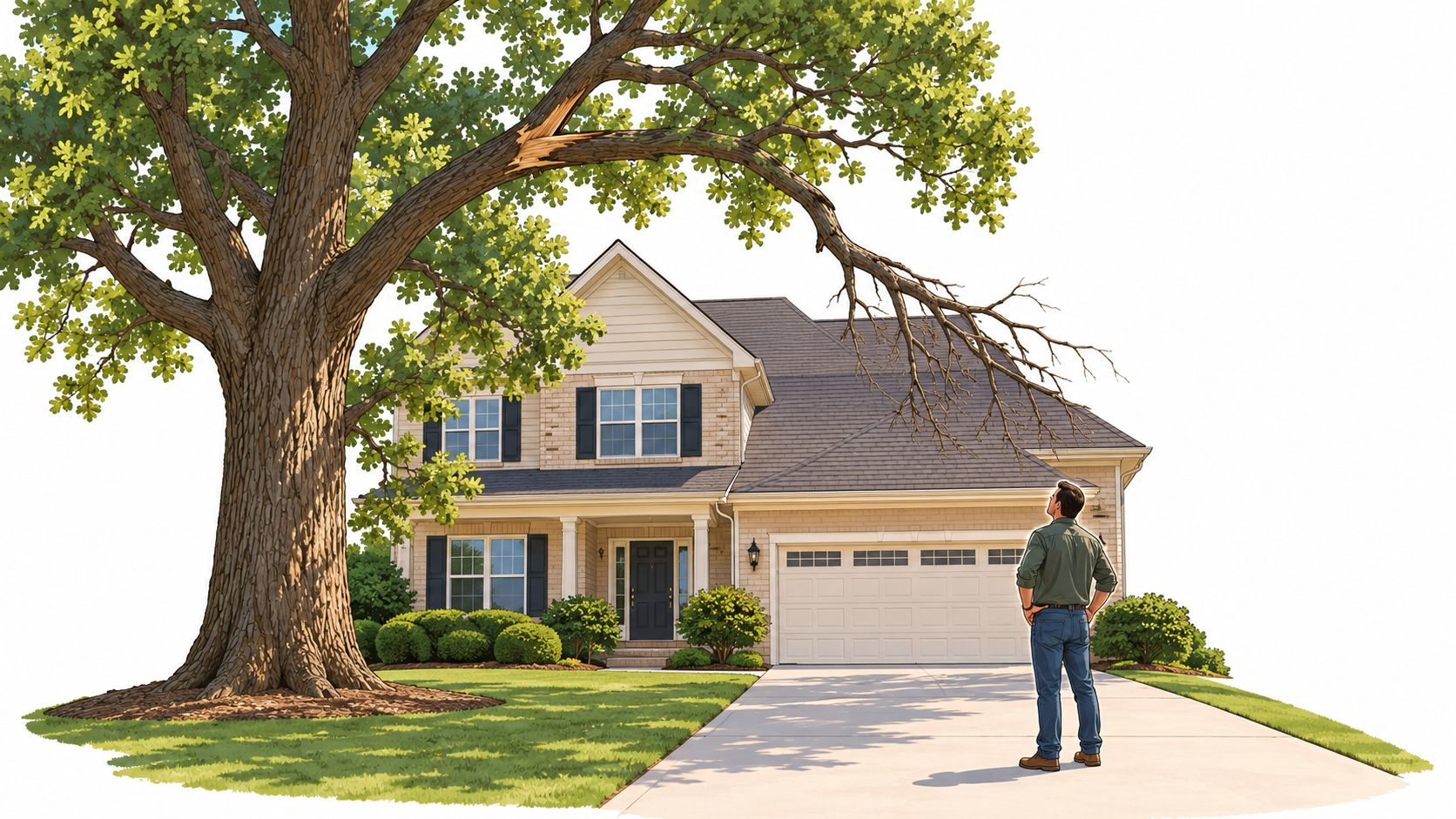
A branch is scraping the roof, deadwood hangs over the driveway, and a recent storm has left a limb split above the lawn. If you're searching for tree trimming in Alpharetta, the first decision isn't which crew can cut fastest. It's whether the tree needs targeted pruning, urgent hazard work, removal, or an assessment before anyone starts.
Start With the Tree and the Job
A tree's proximity to a house can look alarming, but a branch near a roof doesn't automatically mean the whole tree should come down. A sound tree might need a carefully planned clearance cut. A hanging, broken limb may call for prompt hazard work. A split trunk or serious structural defect could warrant a removal assessment, while uncertainty about the tree's condition is a reason to pause and have it evaluated on site.
The work order should identify the problem, not just say “trim it.” A homeowner may want branches cleared from a roofline, deadwood removed above a walkway, or a damaged limb taken down after a storm. Those are different objectives, and they call for different cuts, equipment, and safety precautions.
Keep people away from the hazard first. Don't walk beneath a hanging limb or approach a fallen tree, split leader, or leaning trunk to inspect it yourself. If a tree or branch is near a power line, stay clear and contact the utility. Have a qualified professional assess the situation before directing a crew to cut.
For property owners comparing tree service in Alpharetta, Roswell, Marietta, or nearby North Metro Atlanta communities, the useful first question is: what outcome does this tree need? A site visit can help distinguish routine tree pruning from emergency tree removal, and preservation from a situation where removal may be safer. If a job involves moving heavy equipment or hauling logs, a practical heavy duty work trailer guide can help explain the considerations behind transporting bulky loads.
Understand Pruning, Trimming, and Removal
“Tree trimming” is often used as an umbrella term, but a clear scope describes the work the tree needs. Think of pruning as maintenance for the tree's structure and condition, not as cutting it down to fit an arbitrary outline.
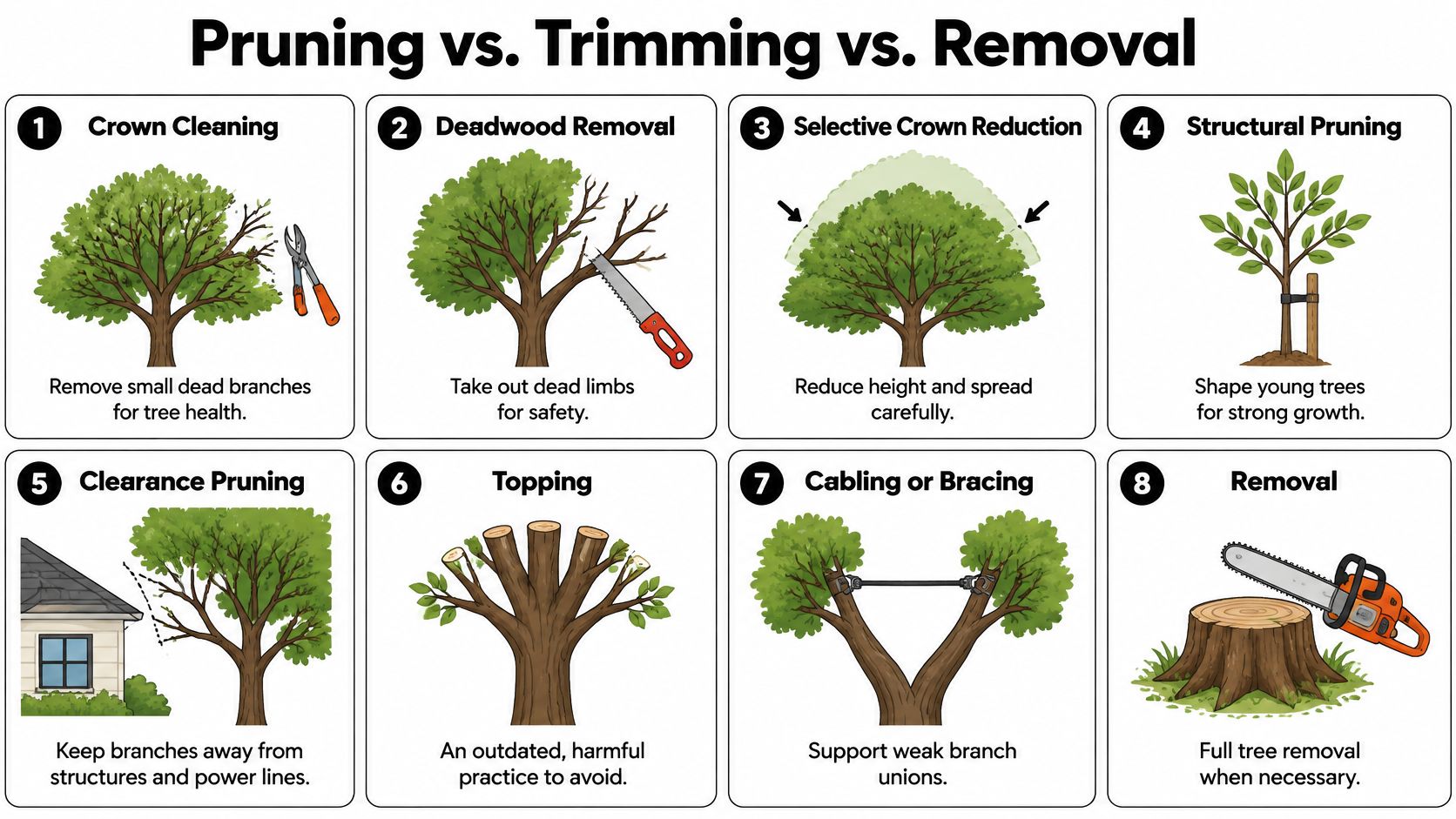
- Crown cleaning removes selected dead, broken, or diseased branches. It's not the same as thinning a healthy canopy just to make it look sparse.
- Deadwood removal focuses on limbs that have died or broken and could fall. An arborist should assess their location and the risk they pose.
- Selective crown reduction reduces the height or spread of a canopy by cutting back to suitable lateral branches. It shouldn't be confused with chopping off branch ends.
- Structural pruning addresses how branches are arranged and attached, especially when developing a stronger form matters.
- Clearance pruning gives roofs, driveways, and other features more room. Near utility lines, don't treat the work as ordinary homeowner trimming. Ask the utility or a qualified professional how it should be handled.
- Cabling or bracing may offer support for certain weak unions, but it requires professional judgment and doesn't make every compromised tree safe.
- Whole-tree removal takes down the tree rather than pruning selected branches. It may be appropriate when a tree is unsafe or unsuitable to retain, but it's a separate scope of work.
Topping, which cuts back large limbs to stubs or creates a flat-topped shape, isn't a proper substitute for targeted pruning. The cuts can prompt dense, weakly attached shoots and leave large wounds. A sound proposal should explain which branches will be cut and why, rather than promising to “cut it back” without a defined objective.
Cut placement matters, too. The branch collar is the slightly swollen area where a branch joins the trunk or a larger limb. A proper pruning cut usually ends just outside that collar and the branch-bark ridge, not flush against the trunk. That preserves the tree's natural protective tissue. These cut-placement principles and the guidance to limit live-foliage removal to no more than 25% in one annual growing season, adjusting for the tree's condition and context, are described in arboricultural pruning guidance.
Before accepting a quote, ask the arborist to name the objective, identify the proposed cuts, explain how they'll protect the tree, and state what cleanup is included. If you're curious how structural and maintenance cuts are used on a very different scale, bonsai structural and maintenance cuts provide a useful comparison in precision and purpose.
A visual demonstration can also help clarify the difference between selective pruning and indiscriminate cutting:
Choose the Right Time for Tree Trimming
There isn't one ideal calendar date for every tree in Alpharetta. The right timing depends on the tree's species, health, recent stress, the reason for pruning, and what's happening around it. A routine structural correction may be planned; a broken limb over a walkway or a tree threatening a structure needs a prompt assessment instead of a convenient appointment several months away.
Start by naming the work. Deadwood removal, clearance from a roof, structural pruning, and a reduction in live canopy each have different effects. If the tree is declining, diseased, or recovering from storm damage, an arborist may recommend a different approach than for a healthy tree that needs routine maintenance. Timing can't make an excessive cut safe, and trying to solve a large clearance problem in one visit may remove too much live foliage.
Practical rule: Routine pruning can be scheduled around the tree's condition and purpose. Broken, dead, or imminently hazardous limbs need prompt assessment, regardless of the season.
Weather and access also matter. A crew needs to assess whether the work area is safe, especially when storm damage has left a limb under tension or a tree is resting on a structure. If a utility line is involved, keep clear and arrange utility coordination rather than asking a crew to work around it casually.
When you request a tree trimming or tree removal estimate, describe the urgency plainly: routine maintenance, damage that needs prompt attention, or an immediate threat. Include where the tree is, what it's near, and whether access is blocked. This helps the service provider assess the job and advise on scheduling without confusing seasonal maintenance with emergency tree removal.
Plan for Cost Before Requesting a Quote
A single price for tree trimming Alpharetta GA wouldn't tell you much. The scope can change with tree size, species, condition, access, work height, the branches involved, and how crews will lower or move debris. An emergency tree removal after a storm isn't comparable to routine pruning, and neither is comparable to land clearing or stump grinding.
A quote should make clear whether it covers pruning or full removal, hauling debris, stump work, and any necessary coordination around utilities or site access. For commercial properties, the scope may also need to account for entrances, customer or tenant access, and work around multiple trees. If crews will need room for specialized equipment, ask how they plan to reach the work area and protect the surrounding property.
| Service Need | Primary Goal | Scope Questions to Ask | Common Adjacent Services |
|---|---|---|---|
| Tree trimming or pruning | Improve structure, remove selected branches, or create clearance | Which branches are included? What pruning objective will guide the cuts? | Deadwood removal, roofline clearance |
| Hazardous-tree removal | Address an unsafe tree or urgent threat | What assessment supports removal? How will the tree be dismantled safely? | Emergency response, debris hauling |
| Stump grinding or stump removal | Address the remaining stump after a tree is cut | Is grinding included? What happens to the resulting material? | Replanting preparation, cleanup |
| Storm damage tree cleanup | Remove damaged limbs or fallen trees and restore access | What areas are unsafe? Does the quote cover the full cleanup? | Fallen tree removal, emergency tree service |
| Land clearing and lot preparation | Prepare a defined area for future use | What vegetation and debris are included? Could the work disturb soil? | Stump services, site preparation |
Compare bids against the same written scope. Ask for the tree or trees to be identified, the proposed work described, cleanup and stump services listed, and scheduling assumptions stated. Verify the crew's insurance and relevant qualifications instead of relying on a low number alone. A bid that excludes hauling, assumes only limited cuts, or offers topping as a shortcut may not represent the same job as a detailed proposal.
For more context on the variables that can shape an estimate, compare your scope with this tree-trimming cost guide, then request a site-specific quote rather than treating a general guide as a price commitment.
Navigate Alpharetta Permits and Site Rules
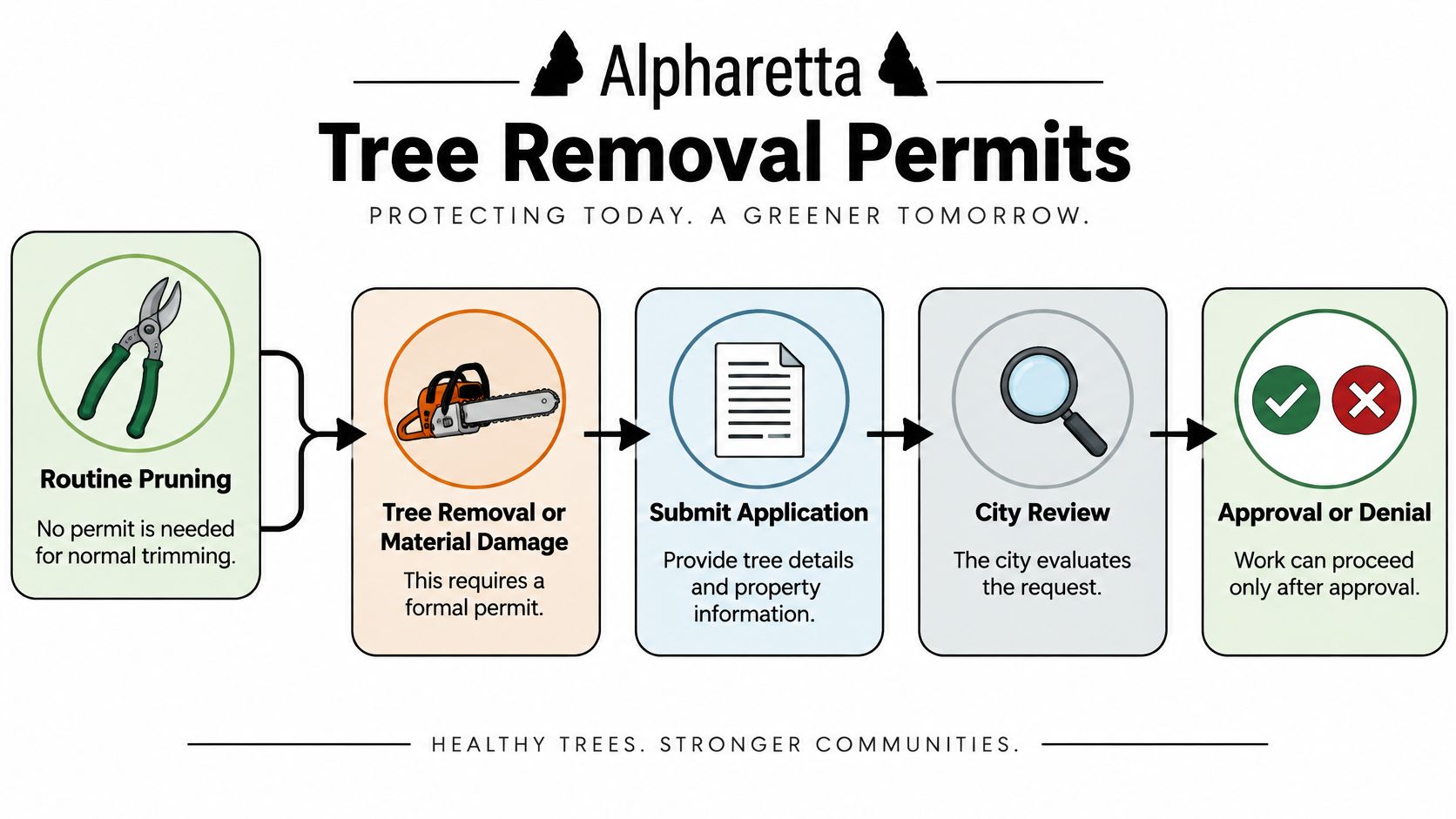
Alpharetta treats tree removal as a municipal permitting matter, not routine landscaping. The city's instructions say an approved tree-removal permit must be posted on-site before removal, and each application must identify the common name, size, location, and reason for removal for every proposed tree. Applicants also need to provide a property diagram and photographs. Check the city's official tree-removal permit instructions and confirm current requirements with the Arborist Division before work begins.
The distinction between routine pruning and removal matters, but don't assume that calling a job “trimming” settles its status. Work that injures, destroys, or removes a regulated tree may require documentation and municipal approval. When the proposed work could substantially change a tree or remove it, ask the city whether review is required rather than relying on a contractor's general summary.
Plan applications early. The city's online instructions state that one permit can cover a maximum of 25 trees, with larger projects requiring separate applications. Complete applications are generally processed within 10 working days. These are planning milestones, not a guarantee for a specific project, so factor in the application and review process before tying tree work to a renovation, property sale, or storm cleanup schedule.
Replacement planting and tree density can also affect a project. Alpharetta's authorized-contractor verification materials specify that replacement deciduous trees must be at least 2 inches in caliper, while evergreens must be approximately 9–10 feet tall. If a property doesn't meet required tree density, the materials call for a minimum-density calculation, identification of trees that will remain, and an owner-signed replanting plan.
For a permit discussion, gather tree names and measurements, photographs, a site diagram, and any proposed planting information. Homeowners, property managers, and real-estate professionals benefit from assembling these documents before scheduling work. Rules also differ by jurisdiction: don't apply another county's requirements to Alpharetta. For example, DeKalb County's homeowner tree-removal guide describes its own thresholds and exceptions, which aren't a universal standard for Cobb, Cherokee, or other North Metro Atlanta areas.
Compare Four Alpharetta Tree Situations
These examples are educational, not diagnoses. A photograph or a homeowner's description can identify a concern, but a site assessment is needed to judge a tree's structure, condition, and risk.
Mature shade tree with minor deadwood near a walkway. Look for dead or broken branches above people, rather than assuming the whole canopy is defective. Gather photographs and note the walkway, nearby structures, and access. Ask which limbs need removal and how the arborist will protect the branch collar. Targeted deadwood removal or crown cleaning may fit; tree removal shouldn't be the automatic starting point.
Storm-damaged tree over a home. A split limb or fallen tree near the house makes keeping people away the first priority. Don't approach the damaged area to collect measurements or direct cutting. Tell the service provider what's fallen, where it rests, and whether access is blocked, then ask how the crew will assess the load and coordinate any necessary utility response. This may require emergency tree service, storm damage cleanup, or fallen tree removal.
Repeated roofline clearance. If the same branches keep growing toward the roof, ask for a sustainable clearance plan rather than an offer to shorten every branch indiscriminately. A clear scope should identify the branches and intended cuts. Where utility lines are nearby, get qualified guidance and follow appropriate coordination; tree trimming near power lines requires a different level of caution from ordinary roofline pruning.
Declining or structurally compromised tree. Gather photos of visible defects, note the tree's location and what could be affected if it failed, and ask whether the tree can be retained safely. Removal and replacement may deserve evaluation if pruning can't address the risk. An ISA-certified arborist can help when you're unsure how condition, site constraints, and canopy value affect the choice.
Work With an ISA-Certified Arborist
An ISA Certified Arborist is a useful point of contact when a tree's condition is uncertain, its structure is complex, utility relationships affect the work, or you're weighing preservation against removal. Certification doesn't replace a site-specific assessment, so ask the professional to explain what they observed and how it informs the proposed scope. This guide to what an ISA Certified Arborist is can help you understand the role before scheduling an assessment.
A sound service process starts with a useful first conversation. Describe whether you need tree trimming, tree removal, stump grinding, storm damage cleanup, or land clearing. Include the tree's location, nearby buildings and driveways, visible damage, and access concerns. If a tree has fallen, a limb is hanging, or a trunk is leaning toward a structure, say so directly and ask about emergency response. Don't assume a specific arrival time unless the company confirms it.
The next steps should make the work clear before a crew arrives:
- Assess the site. Ask what the arborist or estimator will inspect, including tree condition, targets, access, and hazards.
- Review the written scope. Confirm which trees and branches are included, how debris will be handled, and whether stump work is separate.
- Verify credentials and coverage. Request relevant credential details and proof of insurance. Ask what equipment the job requires and how the crew will protect nearby property.
- Confirm the schedule and communication. Establish how the provider will handle changes in conditions or scope, particularly on storm-damaged trees.
- Check the finished work. Review whether the agreed cuts, cleanup, and any included stump work are complete before closing out the job.
For an estimate, you can compare local providers on the same written scope. Richmond Tree Experts GA states that it offers an ISA Certified Arborist team, professional equipment, free estimates, competitive pricing, and financing options. Those are useful details to verify as you compare services, alongside insurance, scheduling communication, and the work plan.
If a tree has fallen onto a home, a limb is hanging over an entrance, or a hazardous tree is blocking access, explain the immediate condition and keep people away while awaiting professional guidance. For routine work, share your preferred timing and any property or site requirements. A clear description helps the provider assess the call without implying a guaranteed response time.
Make the Next Decision With Confidence
Start with safety. Keep people away from a fallen tree, hanging limb, split structure, or other apparent hazard, and seek prompt professional assessment. Don't confuse urgent risk management with routine pruning, and don't treat every branch near a building as proof that the whole tree must be removed.
Next, state the job's purpose: maintenance, clearance, structural correction, preservation, or removal. Gather photographs, measurements, a property diagram, and relevant permit information before work begins. Compare proposals against the same written scope, including cleanup and any stump grinding or removal, so you can tell whether the bids cover equivalent work.
When the tree's condition, proposed cuts, removal decision, or regulatory status is unclear, involve an ISA-certified arborist. That's especially useful when a project affects several trees, a commercial site, or a property transaction where documentation and timing matter.
Richmond Tree Experts GA offers Alpharetta-area tree trimming, tree removal, stump grinding, storm cleanup, and arborist services. A well-defined assessment and work order help protect both the tree and the property, while arbitrary cutting can create problems that careful pruning could have avoided.
Contact Richmond Tree Experts GA for an estimate on tree trimming, tree removal, stump grinding, or storm cleanup in Alpharetta and nearby North Metro Atlanta communities. Visit Richmond Tree Experts GA to discuss the tree, the site, and the work you need assessed.

