

You've heard the crack, felt the house shudder, and now you're standing in a hallway looking at limbs where your ceiling should be. That's the moment most North Georgia homeowners reach for a chainsaw or a ladder, and it's exactly the wrong instinct. What to do if a tree falls on your house isn't a cleanup decision first. It's a sequence of safety, jurisdiction, and insurance decisions, and the order you make them in determines whether anyone gets hurt, whether your claim holds up, and whether the tree comes off without tearing the house further apart.
The First 30 Seconds After a Tree Lands on Your Home
It's usually around 2 a.m. in Marietta or Roswell when this happens. A thunderstorm rolls through Cobb or Cherokee County, rain is hammering the gutters, and then there's a sound that isn't thunder at all. Splitting wood, a deep thud through the floor joists, glass somewhere, and then water hitting drywall where water has never been.
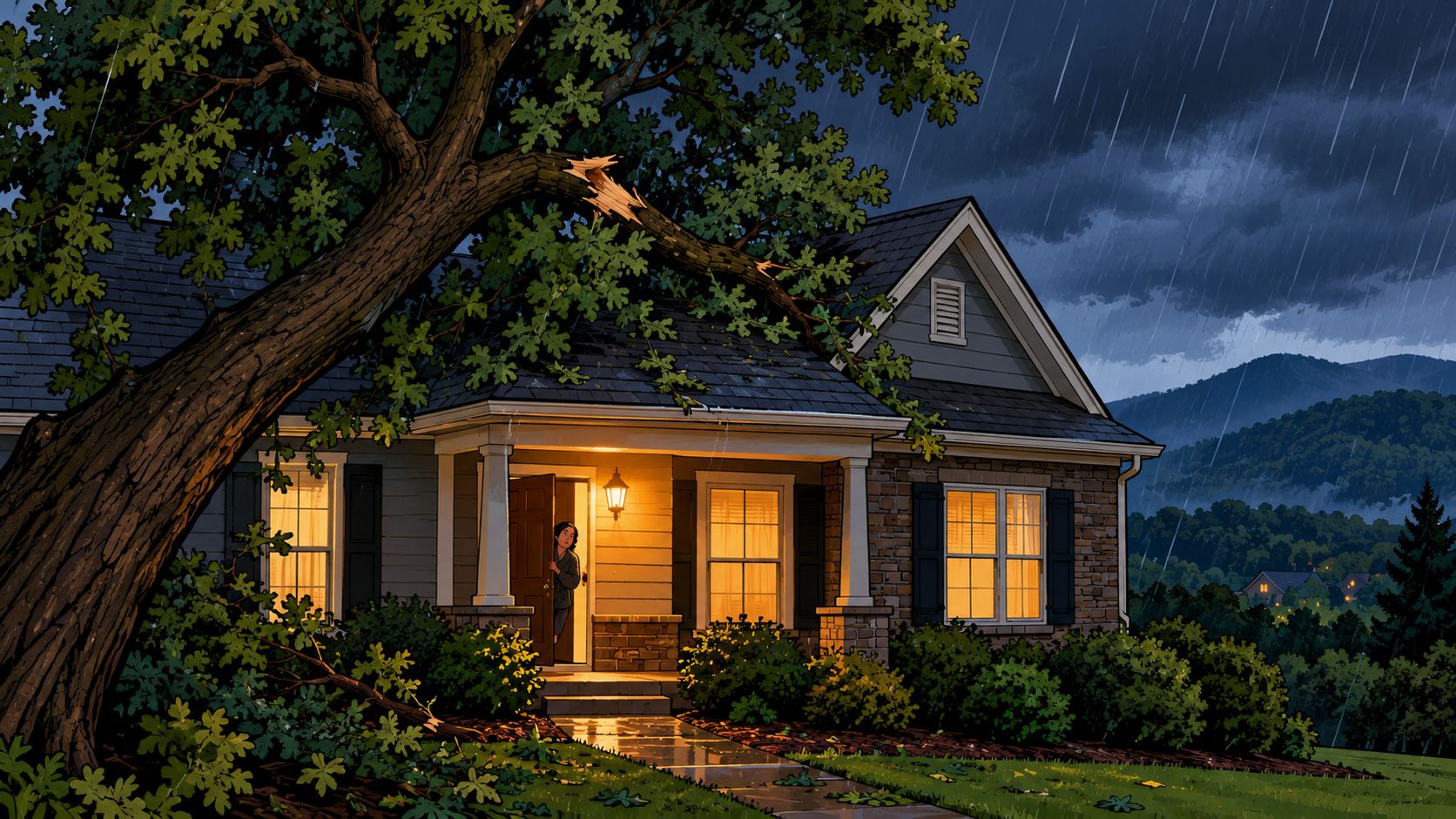
Your senses will sort it out faster than your brain will. Listen for continued cracking overhead. Look for sparks, flickering lights, or a sagging ceiling. Smell for gas or hot insulation, and watch for water spreading across a ceiling below the impact point. Any one of those changes this from a bad night to an evacuation.
Run the Triage Before You Touch Anything
Get people and pets out of the affected area first, and keep everyone clear of rooms beneath the impact zone. A tree resting on rafters can shift, punching limbs through a ceiling that looked intact a minute earlier. If anyone's injured, trapped, or the building looks unstable, that's an emergency call, not a tree service call.
NOAA defines a severe thunderstorm by wind gusts of at least 58 mph, hail at least 1 inch in diameter, or a tornado, and notes roughly 1,200 tornadoes occur in the United States each year in its NOAA severe storms explainer. Storms at that level leave trunks structurally unstable even when only part of the stem looks damaged. What looks settled on your roof may still be loaded and ready to roll.
A fallen tree on a house is a structural emergency until someone qualified tells you otherwise. Treat it that way for the first hour and you'll avoid most of the injuries crews see on storm calls.
What Your Hands Want to Do and Why You Shouldn't
Don't climb onto the roof to look. Don't pull on branches that may be supporting part of the roof load, and don't start a chainsaw anywhere near a stem that's resting on the structure. Cutting one section can transfer compression and tension through the trunk, causing sudden rolling, kickback, or collapse into rooms below.
Keep children, tenants, neighbors, and bystanders away from the tree and the debris field. If you can take a quick photo from the street or a safe doorway, do it, then get clear. The next hour belongs to phone calls and keeping distance. Cleanup, fallen tree removal, and storm damage tree cleanup come after the house, the wires, and the gas lines have been cleared by people trained to read them.
Who to Call First in the Atlanta Area
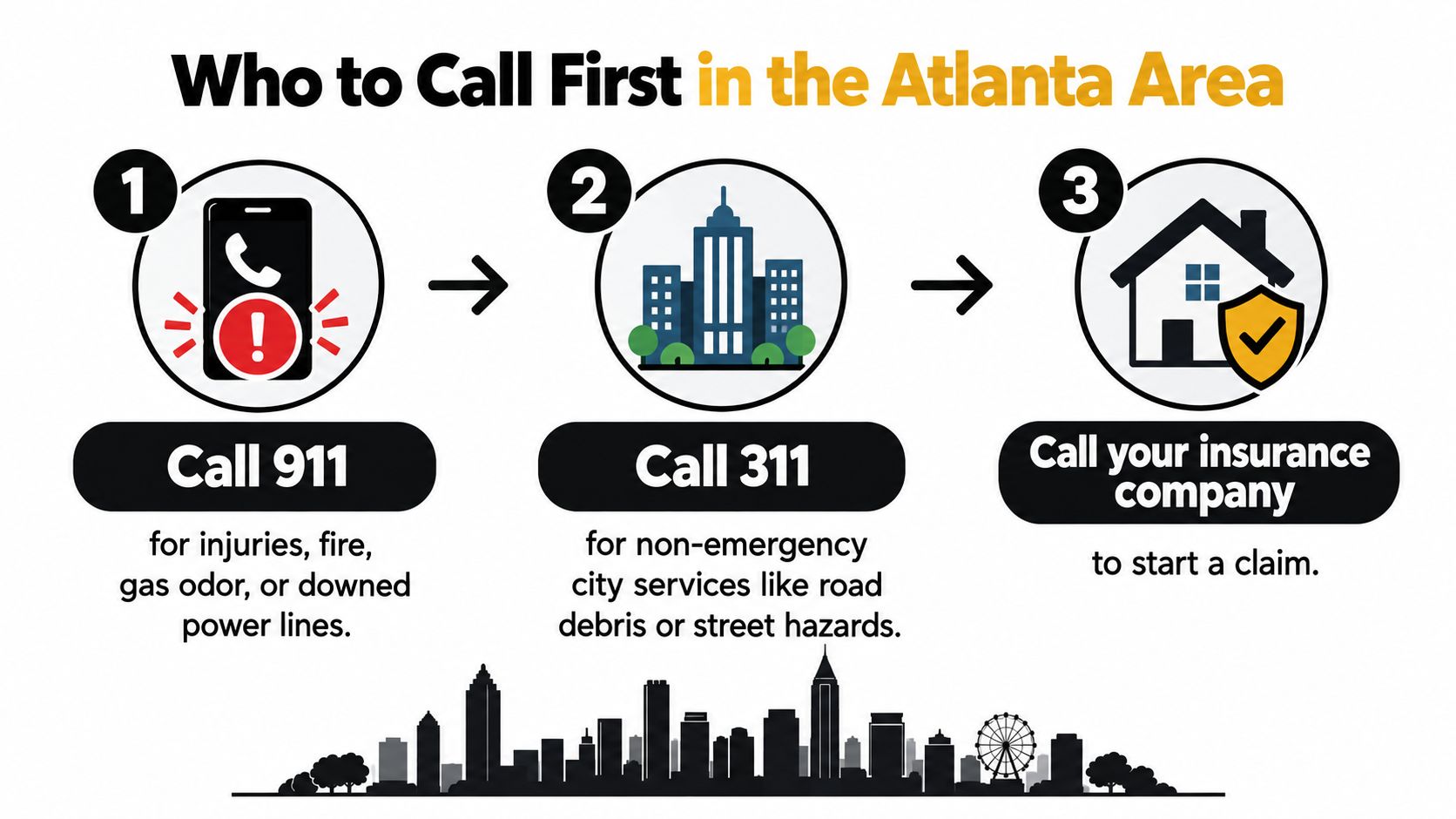
The order of your calls matters more than how fast you make all of them. Homeowners searching for emergency tree removal or tree removal near me at 3 a.m. often call a crew before they've called anyone who can tell them whether the house is safe to stand next to. Work this list in sequence.
The Call Sequence That Protects You
- Call 911 first for life safety: Do this for injuries, entrapment, fire, a gas odor or hissing, downed lines, or a structure that looks ready to fail. If you smell gas, leave immediately, move well away, and don't use switches, flames, or vehicles near the suspected leak.
- Call the utility provider for wires: Presume every storm-damaged line is energized. A tree touching a line can itself become electrified, and wet ground around it isn't safe either.
- Call your insurer next: Open the claim the same night and ask, in plain terms, what emergency stabilization is authorized before a crew signs a work order.
- Call a tree service last in this sequence: You want a licensed and insured crew for hazardous tree removal, but you want them arriving to a scene that's already been cleared.
For suspected energized wires, guidance in Amica guidance on a tree falling on a home supports staying at least 30 feet away and calling 911 or the utility provider. Alabama Cooperative Extension guidance cited in North Georgia safety practice also warns people to stay at least 10 feet from distribution lines and never cut trees from utility lines themselves. Both distances point to the same rule. You don't need to measure, you need to stay back.
The Jurisdiction Split Most People Get Wrong
Where the tree stood decides who owns the problem. In the City of Atlanta, homeowners generally handle removal from private property, while the city handles a public-property tree that falls on a home. Atlanta directs residents to call 911 for emergency or after-hours downed-tree reports, while non-emergency reports can go through 311.
That split matters across Cobb County, Cherokee County, and nearby North Metro Atlanta areas too. A tree blocking a public road in Kennesaw, Woodstock, Acworth, or Canton is a different call than a tree from your own backyard resting on your own roof. A neighbor's tree on your house still usually starts with your safety calls and your insurer, regardless of whose yard it came from. Vacant properties and commercial sites follow the same safety sequence, with the added step of notifying tenants and documenting who was told and when.
Practical rule: If you're deciding between 911 and a non-emergency line, decide based on hazard, not ownership. Injuries, fire, gas, and wires are always emergency calls.
Getting the insurer on the phone early isn't bureaucracy. It locks in authorization for emergency work, starts the clock on your claim, and gives you a claim number to hand to every contractor who follows.
Safe Mitigation Steps Before the Crew Arrives
There's a gap between the emergency calls and the moment a crew pulls into your driveway in Marietta or Canton. What you do in that gap either prevents secondary damage or creates a second accident. The line between helpful and dangerous is narrower than most homeowners expect.
What You Can Safely Do Yourself
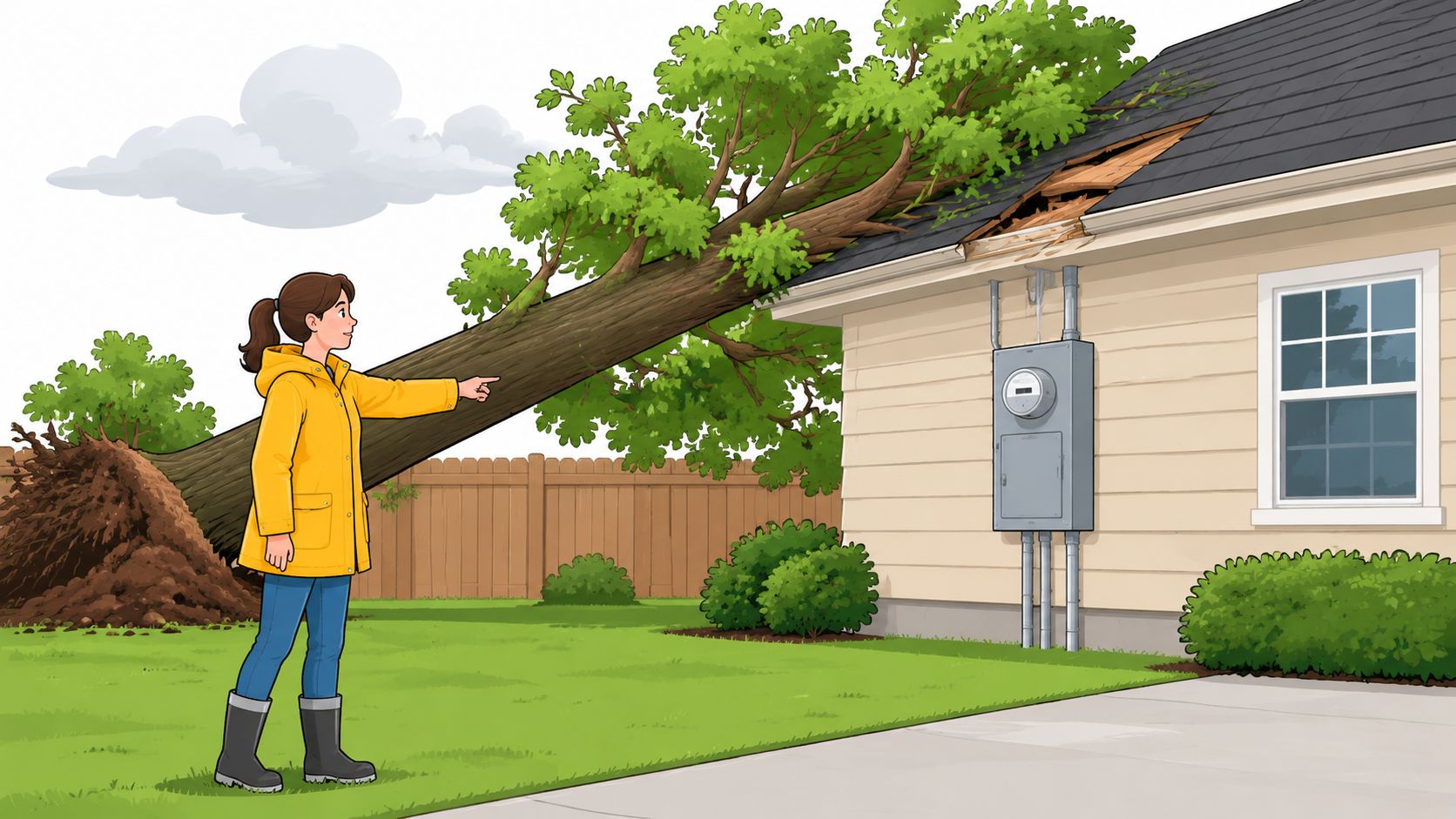
You can keep people out of the impact zone, photograph from a safe location, and, in specific circumstances, isolate utilities. The Red Cross utilities and major systems guidance advises shutting off electricity at the main panel when sparks, frayed wires, or a hot-insulation odor are present. If water lies between you and the panel, don't stand in it or attempt access, and use a qualified electrician instead.
For broken pipes, turning off the main water valve makes sense if you can reach it without entering a damaged area. Don't reset tripped breakers, don't reconnect utilities, and don't use damaged plumbing. If sewage lines may be damaged, avoid sinks, showers, and toilets until someone qualified has looked.
What Has to Wait for a Professional
Tarping sounds harmless until you're standing on compromised decking over a room with a displaced ceiling. Don't walk a damaged roof, don't walk beneath suspended limbs, and don't cut any wood that's touching the house. A stem resting on a structure remains mechanically loaded, and removing one section transfers forces through the rest of the trunk in ways you can't predict from the ground.
Watch how a professional crew reads a loaded stem and plans the dismantle before any saw starts.
A competent plan identifies suspended loads, sets an exclusion zone, protects utilities, and uses controlled sectional dismantling or lifting equipment rather than pulling the tree off with a vehicle and a strap. That's especially true where lines are involved, which is why our guidance on safe tree removal near power lines stresses utility isolation before any cutting. Pulling a tree off a house with a truck is how a repairable roof becomes a collapsed wall.
The most common second injury on these calls isn't from the tree that fell. It's from the homeowner's saw, ladder, or tarp attempt in the hours after.
If rain is coming in, move belongings away from the intrusion only if you can do it without entering the impact zone. Otherwise, let it get wet. Belongings are documented and replaced. People aren't.
Photographing the Damage for Your Insurance Claim
Once you're safe and the emergency calls are made, your phone becomes the most valuable tool you own. Adjusters pay claims based on evidence, and the evidence is best in the first hours, before any crew touches the tree. Shoot from safe locations only, and don't enter an unsafe area for a better angle.
Shoot in This Order
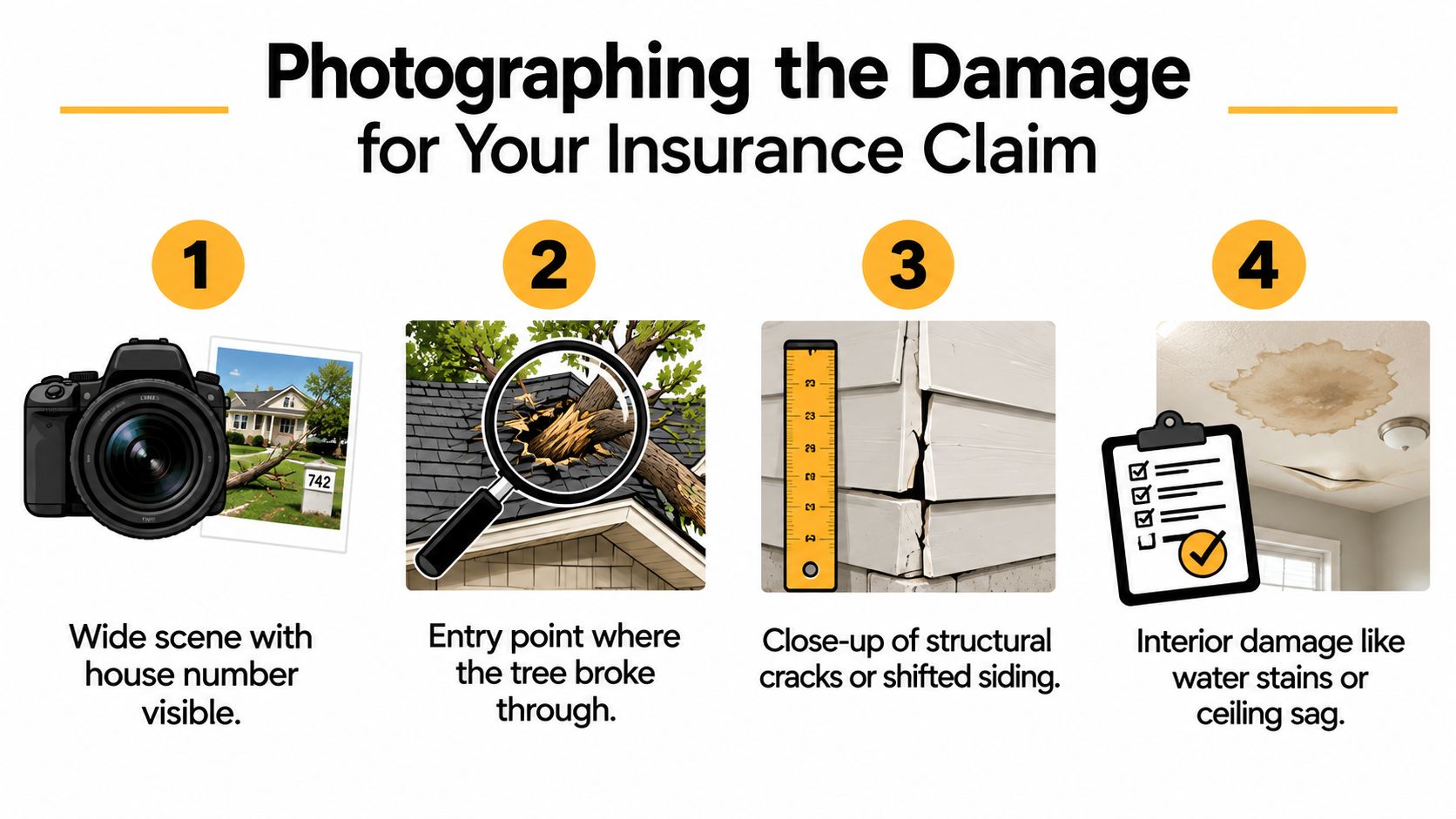
- Start wide: Capture the full scene from the street with the house number visible, showing the tree's position relative to the home, driveway, and road.
- Move to the entry point: Photograph where the trunk or limbs broke through the roof, siding, or windows, from multiple safe angles.
- Document the perimeter: Get the car in the driveway, the fence section the root ball took out, a dented HVAC unit, cracked windows rooms away from the impact, and any fallen wires.
- Go inside only if cleared: Shoot ceilings, walls, floors, furniture, and water stains below the impact point, plus any ceiling displacement or sagging.
That sequence mirrors neutral guidance in Texas Department of Insurance storm guidance, which supports photographing before cleanup, making only temporary repairs needed to prevent additional damage, and retaining receipts. If you want a broader reference while you work, the resources on documenting damage for claims from Restore Heroes collect similar documentation practices in one place. A short, calm video walk-around with narration adds context still photos miss, as long as you stay in cleared areas.
The Paper Trail That Matches the Photos
Write down the date, time, and storm conditions while you remember them. For rental and commercial properties in Roswell or Woodstock, log affected assets, tenant notifications, and utility calls in the same record. Keep every invoice, estimate, hotel receipt, and boarding-up bill from this point forward.
Don't discard damaged materials until your insurer advises you to. That includes soaked belongings, broken trim, and sections of damaged roofing a crew removes during stabilization. An adjuster who can't see what was damaged has a reason to dispute what it cost.
Fridge test: If a spouse or tenant had to document this without you, could they follow your checklist and produce the same file? If not, simplify it until they could.
Good documentation also protects you on permits. In Atlanta, a tree that has already fallen may not require a removal permit, but photographs showing it fell rather than was cut are exactly how you prove that distinction later.
What Homeowners Insurance Actually Covers
The question homeowners ask is whether insurance covers a fallen tree. The more useful question is which costs your policy covers, under what conditions, and what you need authorized before work starts. Those are three different answers, and confusing them is expensive.
Damage to the House Versus Removal of the Tree
A standard homeowners policy generally addresses damage to the dwelling and other insured structures when a tree strikes them. The tree on your roof, the broken rafters under it, and the water intrusion below are structural damage questions. Detached garages, sheds, and fences may fall under other-structures coverage, depending on your policy wording.
Tree removal costs follow separate logic. Whether removal is covered, and to what extent, can depend on where the tree landed, whether it caused covered damage, your deductible, and the specific language in your policy. A tree that fell harmlessly across a yard is treated differently from one resting on the dwelling, even if both need the same tree cutting service to clear.
The scale of storm risk behind these policies is not theoretical. NOAA's National Centers for Environmental Information recorded 203 U.S. billion-dollar severe-storm disasters between 1980 and 2024, within 403 total billion-dollar weather and climate disasters in that period, per the NOAA billion-dollar disasters state summary. The agency notes high winds can down thousands of trees, damaging homes, businesses, vehicles, and power lines. Insurers price and limit tree coverage with that recurring exposure in mind.
The Gray Zones and the Deductible Question
| Situation | Who usually handles it |
|---|---|
| Your tree on your house | Your insurer for structural damage, removal per policy terms |
| Neighbor's tree on your house | Your insurer first, possible liability questions after |
| Public tree on your house | The city, in Atlanta's stated arrangement |
| Tree blocking a public road | The responsible public authority |
| Tree in the yard, no structural hit | Often the homeowner |
Ask about your deductible on the first call, because storm-related deductibles can differ from what you expect and they apply before coverage does. Roof-specific claim questions come up fast once decking is exposed, and homeowners comparing repair paths often find 7 Summits Roofing insurance claim advice useful background for that conversation with an adjuster. Whatever you read, confirm the answer against your own policy, in writing.
Get authorized stabilization in writing before you sign. A verbal okay at midnight is hard to prove three weeks later.
Temporary repairs that prevent additional damage, like professional tarping of an exposed roof, are generally the kind of mitigation insurers expect. Permanent repairs and full removal pricing should wait for the adjuster's guidance and written estimates.
Choosing the Right Crew for Structural Tree Removal
A tree on a house is not a bigger version of a tree in a yard. The crew you hire for routine tree trimming or tree pruning in Kennesaw may be excellent at canopy work and still wrong for a stem that's load-bearing against your roof framing. This job calls for a different skill set, and the difference shows up in whether removal causes new damage.
What a Structural Removal Actually Requires
The tree has to come apart in sections, from the top down, with rigging or crane lifts controlling each piece so nothing drops, rolls, or tears free of the structure. The crew sets a ground exclusion zone, reads compression and tension in the stem before every cut, and protects the roof and walls the tree is resting on. That's ISA Certified Arborist level work with professional equipment, active general liability coverage, and workers' compensation for everyone on site.
A handyman with a pickup, a tow strap, and a chainsaw offers none of that. Worse, uninsured labor removing a tree before it's documented can destroy claim evidence and leave you holding liability for their injuries. Before anyone signs, work through the questions to ask a tree removal service and get written estimates that spell out scope, debris hauling, and stump grinding or stump removal if you want the site finished in the same mobilization.
Permits and the Questions to Ask in Atlanta
Permit rules surprise people, so ask about them up front. In the City of Atlanta, a permit is required before removing a hardwood measuring at least 6 inches in diameter or a pine at least 12 inches, measured 4.5 feet above ground, according to ATL311 tree removal guidance. No permit is required for a tree that has already fallen, and the process otherwise requires an arborist inspection before removal.
Ask whether the crew handles permit follow-up, whether they've done structural removals in Cobb County or Cherokee County recently, and whether they'll coordinate with your roofer so tarping follows removal immediately. On the roofing side, homeowners researching repair contractors sometimes trust Aastro Roofing for repairs as one reference point for how a repair scope should read. Whoever you choose, verify credentials yourself rather than taking a door-knock pitch after a storm.
Fast response matters. A fast crew with no rigging plan, no insurance certificate, and no exclusion zone is just a faster way to make the hole bigger.
Free estimates are standard from reputable tree service in Marietta, Roswell, Acworth, and Canton providers. Use them. Two written scopes for the same tree will teach you more about the job than any sales pitch.
Repairs, Prevention, and Finishing the Job
Getting the tree off is the visible milestone. What determines whether you're done in weeks or still arguing in months is everything underneath it. Once the stem is lifted, a structural professional should evaluate roof framing, bearing walls, rafters and trusses, and ceiling displacement before permanent repairs begin.
Temporary tarping keeps weather out, but it isn't a repair. Wet insulation often has to come out, drywall replacement should follow moisture readings rather than guesswork, and matching roofing materials takes longer than the emergency phase. The Red Cross home structural elements guidance supports visual exterior inspection only, with re-entry waiting on local-authority clearance and assessment by a building inspector or qualified contractor, because exterior damage can indicate serious interior damage.
Prevention While Crews Are Already on Site
Ask the arborist to look at what's still standing. Remaining trees on the lot may have root or trunk damage from the same storm, and a leaning hardwood often signals root plate failure rather than a cosmetic tilt. A formal tree risk assessment tells you which trees need removal, which need tree pruning to reduce sail and weight over the roof, and which can be kept with monitoring or support.
For imminently hazardous trees that haven't fallen, Atlanta's emergency procedure allows removal during non-working hours without first obtaining the permit, provided the homeowner leaves a message explaining the circumstances, takes two photographs documenting the condition, and follows up for the permit within five working days, per the Atlanta Tree Conservation Commission removal permits page. That documentation habit is worth copying in any jurisdiction.
Larger recovery projects can trigger land rules too. Cherokee County regulates clearing and grading of one acre or more under its land-disturbance permit program, with smaller clearing handled through an Erosion Control Permit, according to Cherokee County development and land disturbance permitting. Sandy Springs generally requires a Land Disturbance Permit when at least 1,000 square feet of ground is disturbed, with fees including a $25 administrative fee, a $50 certificate fee, and a $200-per-acre commercial land-disturbance fee, per Sandy Springs land disturbance permits. If your cleanup grows into land clearing or lot preparation, those thresholds decide your paperwork before the first machine rolls.
The storm ends in a night. The paperwork, the repairs, and the condition of your remaining trees go on, and handling all three deliberately is what keeps the next storm from becoming the same claim.
If a tree is on your house in Marietta, Roswell, Kennesaw, Woodstock, Acworth, or Canton, or one is leaning dangerously after a storm, Richmond Tree Experts GA provides emergency tree removal, hazardous tree removal, storm damage cleanup, and stump grinding with licensed and insured crews and free estimates. Visit Richmond Tree Experts GA to request a fast response and a written assessment your insurer and your city can both work from.

