

When you start looking into Atlanta tree removal costs, you'll find the numbers can be all over the map. On average, you can expect to pay somewhere between $735 to $2,000, with most homeowners landing around the $880 per tree mark.
Of course, that's just a ballpark. A small, simple job on a tree under 30 feet might only set you back $200. On the flip side, a massive, tricky removal could easily climb past $2,000.
Why Is There Such a Wide Range in Atlanta Tree Removal Costs?
Asking for the cost of tree removal is a lot like asking for the price of a home repair—there's no single answer. The final bill depends on the specifics of the job. Think of it less as a fixed price and more as a spectrum that slides up or down based on factors like the tree's height, its health, and where it’s standing on your property.
Knowing the city-wide average gives you a realistic starting point so you're not caught off guard when the quotes start rolling in. Unsurprisingly, the biggest thing that moves the needle on price is the sheer size of the tree. A bigger tree means more work, more specialized equipment, and a whole lot more risk for the crew.
How a Tree's Size Shapes the Final Bill
To give you a better idea of what to expect, we can group trees into three general size categories. This is how most arborists think when they're putting together an estimate, and it’s a great way for you to frame your budget.
- Small Trees (under 30 feet): Think of the smaller, decorative trees in many Atlanta yards, like Dogwoods or Japanese Maples. These are usually a straightforward job for a small crew with basic equipment.
- Medium Trees (30 to 60 feet): This is the sweet spot for many mature suburban trees—think Bradford Pears or mid-sized Maples. The job gets more complex here, demanding more skill and coordination.
- Large Trees (over 60 feet): We're talking about those majestic, old-growth trees like towering pines or sprawling oaks. Removing one of these is a major undertaking that often requires a crane, advanced rigging techniques, and a team with serious experience.
This infographic gives you a quick visual on how those costs ramp up as the tree gets bigger.

As you can see, the price jump between categories is significant. It’s a direct reflection of the increased danger and difficulty that comes with size.
A Closer Look at the Atlanta Market
Let's drill down into the local numbers. While the city-wide average for tree removal is about $880, most quotes will fall somewhere in the $735 to $2,000 range.
Here’s a more detailed look: small trees typically run from $200 to $400, medium trees from $400 to $800, and large trees start at $800 and can go way up from there. It's also important to remember that these base prices usually don't include extras like stump grinding or hauling away all the debris. For a deeper dive into local pricing, check out this great cost breakdown from Atlanta Arbor.
Key Takeaway: The city average is a helpful guide, but the final price tag will always come down to the unique details of your tree and your property.
Estimated Atlanta Tree Removal Cost by Size
To make it even simpler, here's a table you can use as a quick reference guide. Just find your tree's approximate height to get a solid idea of the potential cost.
| Tree Size | Height Range | Estimated Cost Range |
|---|---|---|
| Small | Under 30 ft | $200 – $400 |
| Medium | 30 ft – 60 ft | $400 – $800 |
| Large | Over 60 ft | $800 – $2,000+ |
This table should help you set a realistic budget before you start making calls for official quotes.
What Goes Into a Tree Removal Quote?
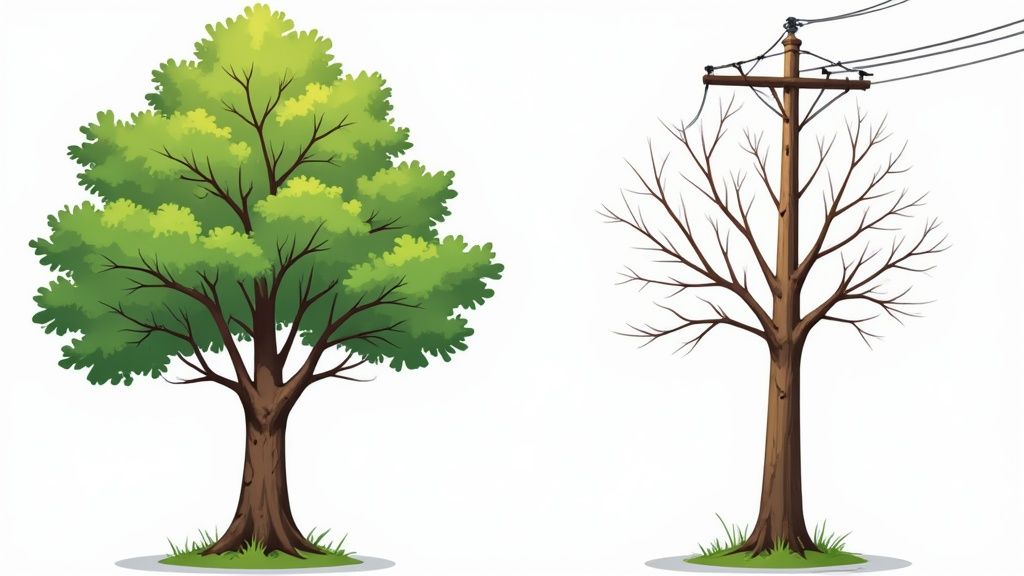
Ever wonder why your neighbor paid $500 to take down their pine tree, but the quote for your similar-sized oak came in at $1,500? It’s a common question. While tree size is a huge piece of the puzzle, the final Atlanta tree removal cost is shaped by a handful of critical factors that every arborist has to weigh.
Getting a handle on these variables will help you see your property from a professional’s perspective and understand exactly what you're paying for. Think of it less like simple demolition and more like surgery. A tree in an open field is a straightforward procedure, but one leaning over your roof requires a surgeon's precision, and that's reflected in the price.
The Tree's Location and Accessibility
After size, this is arguably the biggest factor driving the cost. A tree standing alone in a wide-open backyard is a completely different job than one crammed between your house and a fence. It all comes down to risk and equipment.
Easy access means the crew can roll in a bucket truck and make quick, efficient work of the job. But if they can't get the big machinery to the tree? They'll have to physically climb it, which is far more time-consuming, dangerous, and expensive.
- Close to Structures: Is the tree hanging over your house, deck, or garage? Every branch has to be carefully roped down to avoid damaging your property. That methodical, painstaking work adds a lot of hours to the job.
- Hazards Overhead and Underfoot: Power lines are the most obvious hazard, turning a standard removal into a high-stakes operation that requires extreme precision. But underground utilities, septic tanks, or even irrigation lines also complicate things.
- Getting In and Out: Can a heavy truck and wood chipper actually get into your yard? If the crew has to navigate narrow gates, steep slopes, or your prize-winning rose bushes, they might have to haul every log and branch out by hand. That's a massive increase in labor.
Simply put, a tree in a tight spot in Roswell or East Cobb, with homes and landscaping all around, is almost always going to cost more than its twin out in an open field.
The Health and Condition of the Tree
A tree’s health has a direct impact on the risk involved in removing it. A strong, healthy tree is predictable. A dead, diseased, or rotting one? That's a liability.
Dead or dying trees are notorious for brittle branches that can snap without warning, putting the crew and your home in danger. Arborists have to approach these trees with a completely different, more cautious game plan to bring them down safely.
A dead tree is often more dangerous—and therefore more expensive—to remove than a live one. The wood is unstable, and the risk of it breaking unpredictably is much higher, which demands specialized skills and higher insurance coverage from the tree service.
On top of that, a tree infested with termites or carpenter ants could be hollow on the inside, making it dangerously unstable. This forces the crew to work much slower and more methodically, which naturally adds to the final bill.
The Tree Species Matters More Than You Think
You might not think about it, but the type of tree you have can make a huge difference in the cost. From an arborist's perspective, not all trees are created equal.
A tall pine, for instance, is usually pretty straightforward. Its branches grow in a predictable pattern, and the wood is relatively soft. Now, compare that to a massive, sprawling oak. Its wood is incredibly dense and heavy, and its complex branch structure requires far more intricate rigging and cutting to dismantle piece by piece.
- Wood Density: Hardwoods like Oak, Hickory, and Maple are tough. They're much heavier and harder to cut than softwoods like Pine or Poplar, which means more wear on the chainsaws and more sweat from the crew.
- Branch Structure: Trees with multiple trunks or limbs that grow in every direction are more complex puzzles to solve. Each section has to be carefully planned and secured before a single cut is made.
- Debris Volume: Some trees just make a bigger mess. A Magnolia, for example, produces a huge amount of leaves and small branches, which adds a surprising amount of time to the cleanup and disposal process.
Beyond the Cut: Understanding the Full Cost of Tree Removal
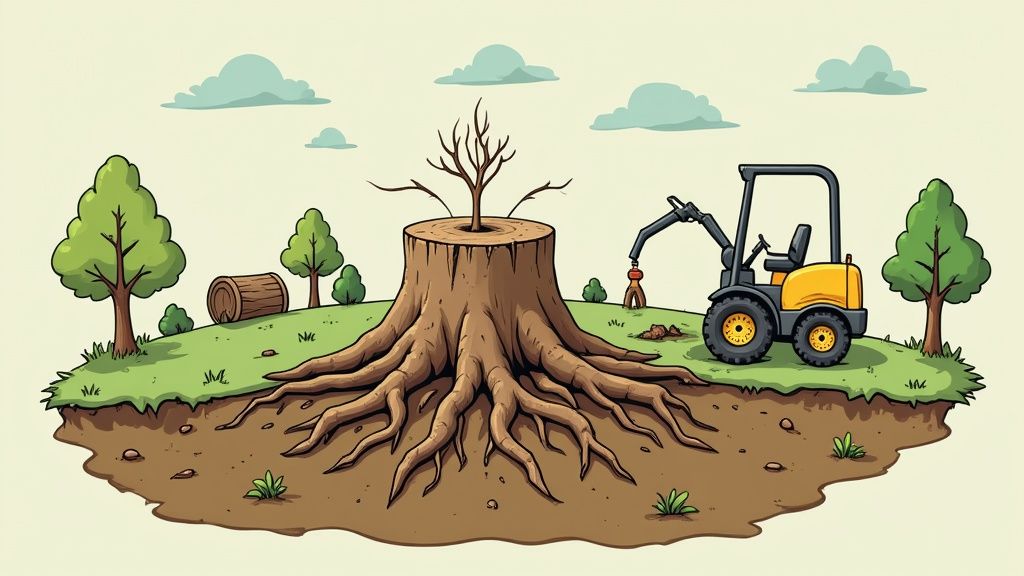
So, you've gotten a quote to take down that troublesome tree. It's easy to look at that number and think, "Great, that's the budget." But here’s something I’ve seen surprise countless Atlanta homeowners: the initial estimate often just covers the felling of the tree itself.
The final bill can include other essential services that weren't part of that first number. These aren't hidden fees meant to trick you; they're necessary add-ons to finish the job right. Think of it like getting a new paint job for your car—the paint itself is one cost, but the prep work, sanding, and clear coat are what make it look perfect. The same principle applies here.
That Stubborn Stump: More Than Just an Eyesore
Once the tree is gone, you're left with a stump. It's tempting to just leave it be, but that little leftover can cause big headaches down the road. A decaying stump is basically a welcome mat for pests like termites, ants, and other wood-boring insects. Before you know it, they could be eyeing your house.
It’s also a major tripping hazard, a nightmare for your lawnmower, and can even start sprouting new, weedy growth. If you want your yard back, stump removal isn't just a cosmetic touch-up—it's a must.
Stump grinding is the go-to solution. A powerful machine literally chews the stump down into wood chips, grinding it several inches below the soil. This gets rid of the stump and leaves you with a spot ready for new grass or a garden bed.
In Atlanta, stump grinding is almost always quoted separately. You can expect to pay anywhere from $150 to $450, with the final price depending on the stump's size, age, and the type of wood.
When Roots Run Deep
Stump grinding takes care of the visible problem, but what about the massive root system lurking underground? Most of the time, these roots will rot away on their own. But for big, aggressive trees, those roots are a hidden threat.
They have the power to crack sidewalks, buckle driveways, and even creep into your home’s foundation or sewer lines. If the tree was anywhere near your house or other structures, you can’t ignore the roots. Nationally, basic root removal might run from $300 to $800, but for a huge, sprawling system, costs can easily shoot past $2,000.
This isn't a simple job. It often involves careful excavation to avoid hitting utility lines, making it far more complex than grinding a stump. It’s also a good time to see if your homeowner’s policy can help. You can learn more about how to navigate tree removal insurance coverage in our detailed guide.
Comparing Additional Tree Removal Services
Getting a tree removed is rarely a one-step process. Several add-on services might be necessary to fully restore your property. The table below breaks down the most common ones you'll see in the Atlanta area, helping you understand what you might need and why it's worth the investment.
| Service | Average Cost Range (Atlanta) | Why It's Important |
|---|---|---|
| Stump Grinding | $150 – $450 | Prevents pest infestations, eliminates tripping hazards, and allows for new landscaping. |
| Root Removal | $300 – $2,000+ | Protects foundations, plumbing, and driveways from damage caused by large, invasive root systems. |
| Limb Chipping | $75 – $150 | Converts bulky branches into usable mulch, reducing waste and simplifying debris management. |
| Log Splitting | $100 – $250 | Processes large trunk sections into manageable firewood, turning a disposal problem into a resource. |
| Full Debris Hauling | $100 – $300 | Ensures your property is left completely clean, removing all logs, branches, and wood chips from the site. |
Knowing about these potential costs upfront helps you create a realistic budget and ensures there are no surprises when the final invoice arrives. It’s all part of making sure the job is done completely and professionally.
Navigating Atlanta's Tree Removal Permits and Rules
In Atlanta, you can't just decide to cut down a tree on a whim. The city is famous for its incredible urban canopy—often called a "city in a forest"—and there are serious rules in place to protect it. Thinking you can skip the official process isn't a minor slip-up; it can land you with massive fines that make the original Atlanta tree removal cost look like pocket change.
Think of the city’s tree ordinance like zoning laws for your green assets. Just like you need a permit to build a deck, you almost always need one to remove a significant tree. Getting a handle on these rules is the first step to making sure your project goes smoothly and legally.
This whole process exists for a reason. It encourages homeowners and developers to think carefully before taking down healthy trees, which helps preserve the city's unique character and environmental health for everyone.
When You Need a Permit (And When You Don't)
The big question that determines whether you need a permit usually boils down to this: is the tree dead, dying, or a hazard? The city understands that some trees pose a real threat to people and property, so the rules are a bit more relaxed in those cases.
You generally do not need a permit to remove a tree that a certified arborist has officially declared dead, dying, or hazardous. But you can't just take their word for it and start cutting. You'll need proof, like a formal letter or report from the arborist, to have on hand in case the city asks.
Taking down a perfectly healthy tree, however, is a completely different ballgame. For healthy trees, especially bigger ones (usually measured by their trunk diameter), a permit is almost always required. This means filling out an application and, more often than not, having a city arborist come out for a site visit. You can dive deeper into the specifics by reading our guide on how to secure a tree removal permit in Atlanta.
Understanding the City's Fee Structure
If the city gives you the green light to remove a healthy tree, expect a fee. This isn't just to cover paperwork; it’s a "recompense" payment for losing a public asset. The money collected goes into a fund to plant new trees elsewhere, helping to maintain Atlanta's overall tree canopy.
The city has historically calculated these fees based on the tree's size, typically a base fee plus an extra charge for every inch of the trunk's diameter. This makes sense—it ensures that removing a huge, mature oak has a bigger financial impact than taking out a small, young maple.
Right now, Atlanta is overhauling its fee structure to better reflect the true cost of replanting and to crack down on illegal removals. The proposed changes would spike the removal fee from the current $100 per tree plus $30 per trunk-inch to a much higher flat rate of $260 per tree-trunk-inch. This update would also apply these hefty fees to commercial properties, which hold about a quarter of the city's trees.
The High Cost of Cutting Corners
So, what happens if you just ignore the rules and fire up the chainsaw? The penalties are steep—intentionally so. They're designed to be a powerful deterrent.
Fines for illegal tree removal in Atlanta can be absolutely eye-watering. Under the proposed new ordinance, those fines could leap from $60,000 per acre to an incredible $260,000 per acre. This sends a strong message about how seriously the city takes protecting its green infrastructure.
The city is making one thing crystal clear: the cost of a permit and its fees are nothing compared to the massive financial hit you'll take for breaking the law. It's a gamble that's just not worth it.
Trying to figure all this out on your own can feel overwhelming, but a good, reputable tree service will handle the entire permit process for you. They know the local ordinances inside and out and will make sure your project is 100% compliant, saving you from headaches and potential legal trouble.
How to Hire a Reputable Tree Service in Atlanta
Choosing the right tree removal company is about so much more than just finding the lowest price. It’s about protecting your home, your family, and your wallet from a job gone wrong. A lowball quote might look good on paper, but it often screams "no insurance" or "no experience," and that’s a recipe for disaster. The true Atlanta tree removal cost always includes the peace of mind that comes from hiring a real professional.
Think about it. You wouldn't let an unlicensed plumber touch the pipes in your house. The same logic absolutely applies to the dangerous work of felling a tree that towers over your home. Taking a little extra time to properly vet a company is the smartest move you can make.
The Absolute Must-Haves: Don't Settle for Less
Before you even think about comparing prices, you need a checklist of non-negotiables. Any legitimate tree service in Atlanta will have these ready to go. If a company gets cagey or defensive when you ask for them, that's your cue to walk away.
The two big ones are their license and proof of insurance. And when it comes to insurance, you need to see proof of two specific types.
- General Liability Insurance: This is what protects your property. If a heavy limb comes crashing down on your roof or fence, this policy is what pays for the repairs. Without it, you could be stuck with the bill for their mistake.
- Worker’s Compensation Insurance: This is every bit as critical. It protects you if one of their crew members gets hurt on your property. If they don't have it, you could find yourself on the hook for medical bills and lost wages.
Pro Tip: Don't just take their word for it. Always ask for a copy of their insurance certificates and call the provider to confirm the policies are current. A professional company won't just be okay with this; they'll expect it.
Digging Deeper Than Just the Price Tag
Once you've confirmed a company is properly insured, it's time to look at their expertise and reputation. A detailed quote is a great starting point, but the story doesn't end with the final number.
A real quote is a written, itemized document—not a figure scribbled on the back of a business card. It should clearly spell out the entire scope of the job. Will they haul away every last branch? Is stump grinding part of the deal? How will they protect your lawn and landscaping? Getting it all in writing is the only way to avoid surprises.
Beyond the paperwork, look for signs of genuine professionalism. A team that has an ISA Certified Arborist on staff is a huge green flag. These are folks who have passed tough exams covering everything from tree biology to the safest work practices. You can learn more about what it means to be a certified arborist in Atlanta to see why their knowledge is so crucial for tricky jobs.
Finally, don't be shy about asking for local references. A good company will be happy to connect you with recent clients in your area, whether you're in Roswell, Milton, or Marietta. A quick chat with a past customer gives you the real story on their professionalism, punctuality, and cleanup. Honestly, that five-minute phone call can tell you more than any flashy ad ever will.
Your Top Questions About Tree Removal Costs, Answered
When you're facing a tree removal project, a lot of questions pop up. Getting straight answers is key to budgeting properly and avoiding any nasty surprises down the road. Let's tackle some of the most common questions we hear from homeowners around Atlanta.
Will My Homeowners Insurance Pay for Tree Removal?
This is a big one. Generally, your insurance will step in to cover the cost of removing a tree if it has already fallen on your house or another insured structure (like a garage or fence) due to a covered event, like a storm.
However, insurance almost never covers the cost of removing a standing tree, even if it's dead, diseased, or looks dangerous. They view that as preventative maintenance—your responsibility as the homeowner. The critical difference is whether the tree has already fallen and caused damage.
What If My Neighbor's Tree Falls in My Yard?
It might not seem fair, but in most situations, you're responsible for dealing with whatever part of the tree lands on your property. Your own homeowners insurance would be the one to cover the removal and any repairs to your home.
The only real exception is if you can prove your neighbor was negligent. For instance, if you had previously sent them a certified letter warning them that their dead tree was a hazard and they did nothing about it.
Key Insight: Always document any communication about a dangerous tree on a neighbor's property. A written record could be absolutely essential if you ever need to file a claim and prove negligence.
Is There a Cheaper Time of Year to Get a Tree Removed?
Absolutely. You can often get a better deal during the late fall and winter. Tree service companies in Atlanta are slammed during the spring and summer storm season and when everyone is focused on their landscaping.
Once things slow down in the dormant season, roughly from November to February, demand drops off. To keep their crews working, many companies are more willing to offer competitive pricing. Planning your project for this off-season can lead to some serious savings.
For a precise quote and expert advice on your specific tree situation, trust the certified arborists at Richmond Tree Experts GA. Contact us today for a free, no-obligation estimate for your property in Roswell, Marietta, or anywhere across the Atlanta metro area. Visit our website at https://richmondtree.com.
Need a tree taken down safely? Richmond Tree Experts has worked on Marietta and Metro Atlanta trees since 1985, and every job is looked at by an ISA Certified Arborist before it is priced. Start with tree removal, or see everything we do: tree removal, stump grinding and arborist services across Cobb, Fulton, Cherokee, Gwinnett and DeKalb counties (service areas).
Call (770) 974-3964, 7am to 11pm every day, or request an estimate online.

