

A branch is hanging over the driveway, or the canopy has a few dead limbs just beyond arm's reach. A pole saw can make routine pruning easier, but the wrong cut can put a person, roof, vehicle, or power line at risk. The first buying decision isn't which saw has the longest reach. It's whether the branch is a safe job for a homeowner at all.
For homeowners in Marietta, Roswell, Kennesaw, Woodstock, Acworth, Canton, and nearby North Metro Atlanta communities, that distinction matters after storms as much as during planned tree trimming. Use a pole saw for small, isolated branches you can reach from stable ground. For hazardous tree removal, storm damage tree cleanup, or a fallen tree that threatens a structure, call a qualified crew instead.
Quick Picks for Common Yard Jobs
Pole saw selection starts with a rejection test. If the limb is too big for a pole pruner, close to an energized line, or above a roof, the saw is the wrong tool no matter how good the specs look. For cuts that pass, the table narrows power type, bar length and weight by job.
The U.S. Forest Service puts the pole-pruner ceiling at about 4 inches, or 10 centimeters, and says larger limbs call for chainsaw work by qualified individuals, according to its pruning guidance. The same guidance warns against pole pruner use near utility lines unless the operator is qualified for line clearance. That makes the best tree trimming pole saw a task-specific choice. Bar length and motor size matter after the branch passes the safety screen.
| Job | Power type | Bar length | Weight to expect |
|---|---|---|---|
| Light shaping and deadwood on small branches | Battery, single pack | 8 inches | 11.8-15.4 lb |
| Routine yard pruning of branches up to about 4 inches | Battery with spare pack | 10 inches | 15.4-17.9 lb |
| Frequent heavy pruning, professional use | Professional-class pole saw, such as the Husqvarna 525PT5S | 12 inches maximum | 15.4 lb |
| Limbs over about 4 inches or near lines | Not a pole saw job | Not applicable | Qualified arborist or line-clearance crew |
The second row is not a bigger-limb row. It is the same 4-inch ceiling with a longer bar and a spare pack for repeated cuts. I would treat the 10-inch bar as a reach decision, not a capacity upgrade. A 10-inch bar is a tool specification. It does not turn an oversized overhead limb into a homeowner job. Branches over about 4 inches belong to a qualified chainsaw operator or a professional crew, and near lines they belong to a line-clearance arborist. When a job lands in the last row, the buying decision is over.
For light crown work, a battery saw with an 8-inch bar is the handiest pick. It is lighter, easier to control overhead, and less likely to pull you off balance from the ground. A spare pack helps on a row of small limbs. The Husqvarna 525PT5S is a different class: Husqvarna lists a 12-inch maximum recommended bar length and a weight of 15.4 pounds in its product listing. More reach and more power add weight, and weight is what wears out shoulders during overhead work.
In North Metro Atlanta yards, use a pole saw for accessible small branches in a clear area. Send storm-damaged, oversized, or electrically hazardous limbs to a professional crew. If the branch passes the 4-inch test but the drop zone is over a roof, vehicle, or fence, the next call is a scoping arborist, not a bigger pole saw.
Yard test: If the cut is under about 4 inches, reachable from stable ground, and clear of power lines and hazards, a pole saw may be a reasonable buy.
Clearance Rules That Rule Out a Pole Saw
If a pole saw or the branch could come within 10 feet of an energized line, stop. OSHA advises surveying the site, treating lines as energized, and maintaining at least 10 feet of clearance from lines up to 50 kV. The required clearance increases for higher voltages, and OSHA documents a fatal incident involving pole-saw contact with an energized overhead line in its electrical safety guidance. Even carrying a pole saw near a line can create danger, so don't walk beneath a line with the saw extended.
| Situation | Pole saw appropriate? | Next step |
|---|---|---|
| Small branch, no energized line within 10 feet, solid footing | Yes | Clear the drop zone and set a retreat path |
| Any energized line within 10 feet, including walking under one | No | Keep clear, contact the utility, and call a qualified line-clearance arborist |
| Limb larger than about 4 inches (10 cm) | No, for a pole saw | Use a qualified chainsaw operator or professional crew |
| Limb or tree over a roof, drive, fence, or structure | No | Book a scoping arborist visit |
| Leaning tree, split trunk, or storm-loaded limbs | No | Get a professional hazard assessment before any cut |
A safe decision also depends on where the limb will fall, whether the tree is leaning, and whether you can stand securely without reaching or climbing. A branch over a roof or vehicle can do damage even when the cut itself seems manageable. Don't rely on a pole saw to control a heavy limb once it starts to fall.
A scoping arborist can tell you whether a tree should come down, can be pruned back to health, or is fine to leave alone. Richmond Tree Experts GA offers scoping visits, and customers can call 770-974-3964 to schedule one. For tree trimming near a utility line, review tree trimming near power lines and use a qualified line-clearance professional.
The best purchase may be no purchase. If a limb is inside the minimum approach distance, over a roof, or positioned to hit people or vehicles, don't try to solve the hazard with a longer pole.
Power Types Side by Side
Manual, corded, battery, and gas saws solve different problems. The right choice depends on the number and size of the limbs, how far you need to move around the tree, and whether you're prepared to maintain the tool.

| Power type | Reach and weight | Runtime or fuel | Upkeep | Best fit |
|---|---|---|---|---|
| Manual pole pruner | Lightest, no motor | Human effort only | Sharpen the blade | Thin limbs, occasional use |
| Corded electric | Light, limited by cord length | Continuous power within cord reach | Care for the cord and oil the chain | Yard work near an outlet |
| Battery | Light to midweight, depending on bar | Battery pack limits the session | Spare packs and chain care | Routine residential pruning |
| Gas | Heaviest, with the most power | Fuel tank and mixed fuel | Air filter, spark plug, and chain sharpening | Frequent or heavy work by a crew |
A manual pole pruner is a sensible choice for thin limbs and occasional shaping. It has no motor or battery to maintain, but repeated cutting above shoulder height can tire your arms. Choose it when the cuts are small enough that hand-powered work won't turn into a long overhead session.
Corded electric avoids fuel and battery charging, but the cord limits where you can stand and can catch on branches. It suits lighter work near an outlet, not a tree that requires frequent repositioning around the yard.
Battery power is the practical middle ground for many suburban properties with scattered small limbs. It's portable and quieter than gas, but a single pack can become the bottleneck during a larger pruning session. A spare pack is useful if the work involves more than a few cuts.
A gas pole saw makes sense for people who use a saw regularly and need its heavier-duty performance. That capability comes with more weight and routine engine maintenance, including fuel mixing, air-filter cleaning, and spark-plug checks. It's rarely the simplest choice for occasional homeowners.
When height or reach makes a homeowner tool unsafe, professional precision pruning can be done from a bucket truck. Richmond Tree Experts GA performs precision pruning from bucket trucks, which can provide a controlled alternative to trying to extend a pole saw beyond stable handling.
Cordless Models Compared on Cut Speed and Weight
A faster cut can mean more weight to hold overhead. In independent testing on a standardized 4-inch oak branch, the STIHL HTA 135 averaged 4.0 seconds per cut at 20.2 pounds, while the Husqvarna 120iTK4 averaged 8.0 seconds at 11.8 pounds. The Outdoor Life pole-saw comparison also tested Milwaukee and ECHO models:
| Model | Average seconds per 4-inch oak cut | Measured weight | Best fit |
|---|---|---|---|
| STIHL HTA 135 | 4.0 | 20.2 lb | Fast cuts for crews with long duty cycles |
| Milwaukee M18 FUEL | 5.3 | 15.4 lb | Balance of speed and weight for frequent pruning |
| ECHO X Series | 6.0 | 17.9 lb | Midweight option for steady work |
| Husqvarna 120iTK4 | 8.0 | 11.8 lb | Lighter residential use and fatigue reduction |
The STIHL's cut time is half the Husqvarna's in that test, but the STIHL weighs 8.4 pounds more. That trade-off matters when you're holding the tool aloft through a series of cuts. A quick result on a stopwatch doesn't account for the added effort of controlling a heavier saw overhead.
For commercial property managers and grounds crews, a faster model may pay off when the saw runs often enough to justify the handling burden. For an occasional residential job, a lighter tool may be easier to control over the full session, even if each cut takes longer. Consider the total time spent lifting, positioning, and lowering the saw, not just the seconds spent cutting.
The same comparison measured maximum tool lengths ranging from 8.5 to 11.5 feet. That's a tool-length range, not a tree-height rating. Judge reach against your own height and whether you can keep steady control from the ground.
Pick rule: occasional yard work favors a lighter saw; frequent cutting may justify a faster one. Neither is appropriate when the line clearance, limb size, footing, or drop zone makes the job unsafe.
Battery Capacity, Bar Length and Runtime
Battery capacity and bar length only matter after the clearance screen says a pole saw belongs on the job. Voltage by itself does not tell you how much energy a pack stores. Compare watt-hours: a 40 V, 2 Ah pack and a 20 V, 4 Ah pack each contain approximately 80 Wh before losses, according to the cordless battery guidance at The Tested Hub. The higher voltage label does not automatically mean the pack will run longer.
Runtime moves with load, wood type, chain condition and technique. No fixed minute rating survives a switch from dry softwood to green hardwood. Hardwood draws more current and shortens the session, while light limbs and a sharp chain stretch it. Plan around the hardest wood you expect to cut, and carry a charged spare if the job runs past a few cuts.
Match the bar to the limb
Match the bar to the branch, not the tree. A longer bar adds reach and weight; a short bar keeps the saw light but limits diameter. The bar and chain must fully cover the cut with the chain seated and tensioned. I would size the bar to the largest branch you routinely cut, not the largest one you might attempt, because a long bar on a small powerhead bogs down in hardwood and makes overhead control harder.
A realistic homeowner cut is a 2-inch dead branch with a clear drop zone and no lines overhead. Make the cut, clear the piece, and move on. A green limb beyond the saw's rated capacity carries more weight, binds the bar more easily, and falls in a way you cannot control from the ground. That goes to a qualified professional with the right gear.
Brushless motors generally run cooler and hold torque better than brushed motors, which helps on repeated cuts. Treat that as a design advantage, not a promise of a specific runtime gain. The practical difference shows up in fewer stalls and less heat.
Use this order when comparing cordless saws: check watt-hours, match the bar to your largest routine branch within the safety limit, then estimate runtime from the number and type of cuts. Carry a spare charged pack for a long session, and look for tool-free chain tensioning and automatic oiling to reduce downtime.
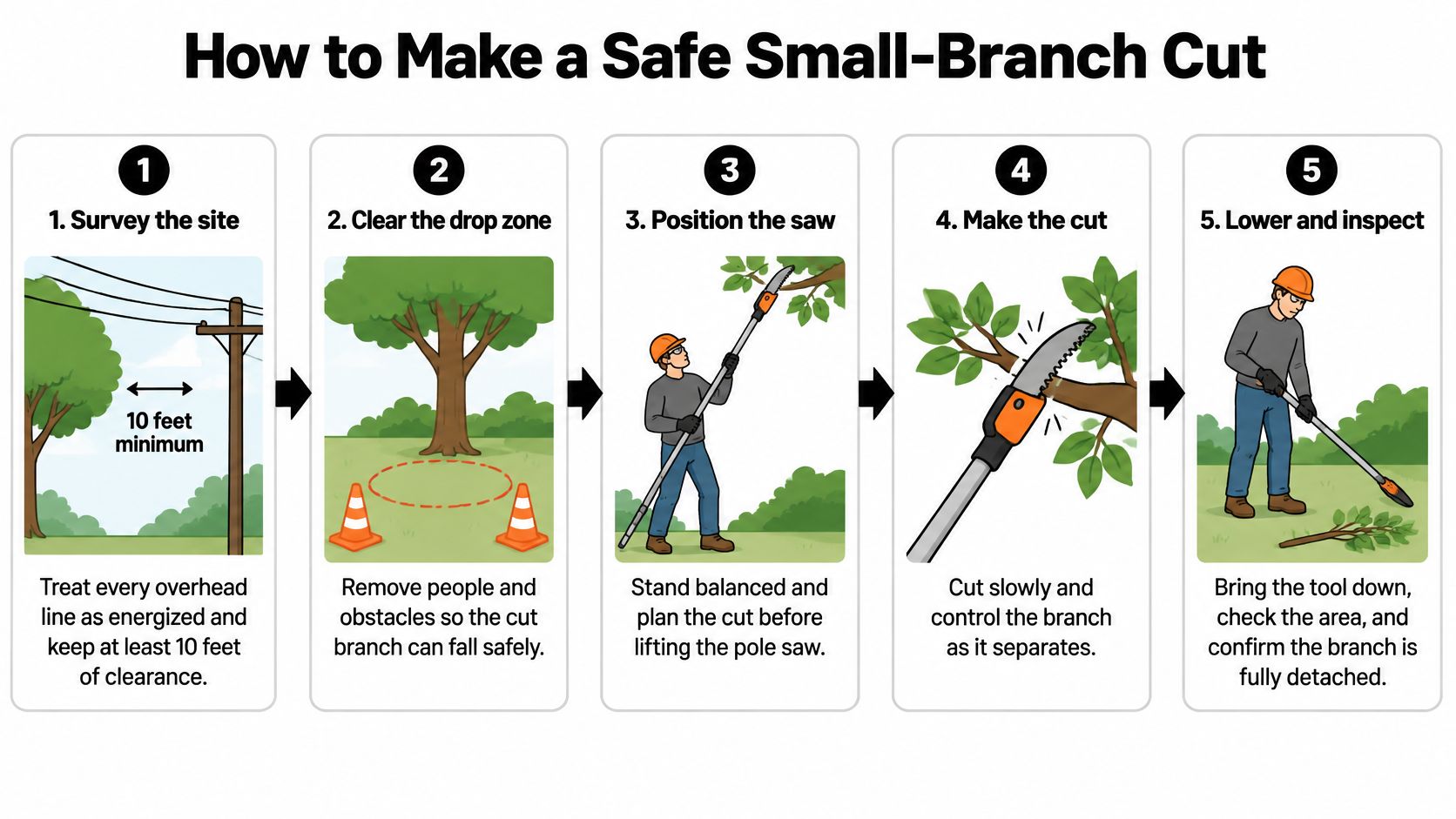
How to Make a Safe Small-Branch Cut
A pole saw is only for a small, isolated limb when you can stay on stable ground and predict where the branch will fall. OSHA's tree-trimming safety guidance highlights hazards such as struck-by incidents, falls, and electrical contact, and recommends clearing the drop zone, cutting only limbs whose ends are visible, and carrying the saw with the blade pointed away and downward. Follow these steps only when the work passes the safety screen:
Survey the site. Treat every overhead line as energized and maintain the required clearance. If you can't confidently establish a safe distance, don't bring the pole saw into the area.
Clear the drop zone. Move people, vehicles, and equipment away from where the limb could land or bounce. Choose a retreat path before cutting so you won't have to step toward the falling branch.
Cut only visible limbs. Position yourself so you can see the end of the branch and the area beneath it. If foliage blocks your view of where the wood may fall, change the plan or stop.
Use an underside relief cut for a larger limb within safe pole reach. Make a shallow cut from underneath before cutting from the top, which helps reduce bark tearing and the risk of the limb pinching the bar. Don't use this technique as a reason to tackle an oversized or hazardous branch.
Carry the saw with the blade pointed away and downward. Don't carry it over your shoulder. That position reduces the chance of bringing the cutting head into contact with yourself or someone nearby.
Keep your footing and balance. Work from stable ground with your weight controlled and arms below shoulder height. Stop if you have to lean, climb, or stretch to reach the cut.
Call an ISA Certified Arborist for a risky limb. Stop if the limb is over about 4 inches, cracked, under load, or leaning toward a structure. Richmond Tree Experts GA provides dead tree branch removal when a dead limb is not a safe homeowner cut.
A clean result has a flat cut surface with the surrounding bark intact, and the branch falls where you planned. Put the tool down and reassess if the limb shifts, the bar binds, or your footing changes.
For a visual demonstration of small-branch pruning, use this video as a supplement to the safety steps above.
Cost, Permits and Response Time Before You Call
How much does tree removal cost?
A tree-removal estimate reflects more than height. Trunk size, proximity to buildings, equipment access, nearby lines, and whether you add stump grinding can all change the work. Ask for a written estimate based on an arborist's assessment rather than guessing from one limb or a general price range. Richmond Tree Experts GA provides tree trimming cost information, and estimates are free, with an arborist visiting the tree and providing a written price.
Do I need a permit to remove a tree?
Check the tree ordinance for your city or county before arranging removal. Rules can differ by jurisdiction and address, especially for protected trees or trees near property boundaries. If you're in Cobb County, Cherokee County, or another North Metro Atlanta area, confirm the rules that apply locally before scheduling cutting.
What are signs a tree may be dangerous?
Watch for a fresh lean, cracks or splits in the trunk, a canopy that has become bare or brittle, mushrooms or soft decay at the base, and soil heaving near the roots. A limb that has already fallen onto a structure also calls for prompt assessment. Don't try to diagnose a loaded or leaning tree by cutting a branch to see what happens.
How quickly can a crew respond?
For a tree on a house or road after a storm, ask for the current response window when you call. Keep people and pets clear of the tree and any nearby line while you wait. Emergency tree removal, storm damage response, and fallen-tree removal require appropriate equipment and trained crews, not a borrowed pole saw.
When to Buy a Pole Saw and When to Call a Crew
Buy a pole saw when the branches are small, reachable from stable ground, clear of power lines, and well away from structures. Call a crew when a tree is on a house, driveway, or road after a storm; when a limb is leaning or split; or whenever a power line may be involved.
When a fallen tree touches power lines, keep everyone away and request qualified emergency help. OSHA says tree trimming or removal within 10 feet of an energized line must be performed by trained tree trimmers; crews should contact the utility to de-energize, ground, or shield the lines, and treat downed lines as energized until the utility confirms otherwise, according to OSHA storm-cleanup guidance.
Richmond Tree Experts GA offers emergency tree service, including storm damage response. An ISA Certified Arborist looks at every job before it's priced, and estimates are free, with a written price after the arborist visits the tree. For work beyond routine pruning, the company also handles tree removal, stump grinding, and professional tree assessment.
Choose the tool that matches your job in the quick-pick table this week. If any situation in the clearance table applies, book a scoping visit by calling 770-974-3964.
For tree trimming, hazardous tree removal, stump grinding, or storm damage tree cleanup in Marietta, Roswell, Kennesaw, Woodstock, Acworth, Canton, and nearby North Metro Atlanta communities, Richmond Tree Experts GA can assess the tree and provide a free written estimate. Contact Richmond Tree Experts GA to schedule an arborist visit and get a clear recommendation before work begins.

