

You're backing out of your driveway in Marietta or Roswell and notice it again, a grey, leafless limb hanging over the car, the roof edge, or the sidewalk where your kids walk. It hasn't fallen yet, but every storm makes you wonder if today's the day. That's exactly when dead tree branch removal stops being yard cleanup and becomes a safety decision. The saw matters less than two things, whether the limb is safe for you to touch at all, and whether local rules let you cut it without checking first.
Deciding Between DIY and an ISA Arborist
| Factor | DIY is reasonable | Call an ISA Arborist |
|---|---|---|
| Branch diameter | Under about 2 inches | 2 inches or more, or any limb that tears bark as it falls |
| Height and access | Reachable from the ground or a stable stepladder | Needs a ladder above head height, climbing, or a bucket truck |
| Targets below | Lawn, empty yard, no structures | Roof, driveway, road, fence, neighbour's property |
| Overhead utilities | None within reach | Any line within reach, call the utility, not a saw |
| Number of limbs | One or two small dead limbs | Several dead limbs or deadwood across the crown |
| Tree condition | Otherwise healthy tree | Cracks, fungus at the base, lean, split union, or recent storm damage |
| Equipment | Hand pruners, loppers, pruning saw, pole saw | Chainsaw aloft, rigging, crane or stump grinder |
Read the table row by row, not as a score. Height and access is the row homeowners bend most often. If you're stretching from a ladder, leaning to reach, or cutting above your head, you don't control where the piece goes and you can't step back quickly. Ground level work with hand tools is a different job from climbing, rigging, or running a chainsaw aloft.
Targets below changes the math even for a small limb. A dead piece over open lawn in Woodstock can drop and do nothing. The same piece over a driveway, fence, or gutter in Kennesaw needs to be lowered, not dropped. If there's any line within reach, stop. That's utility territory, not a pruning problem.
Why the risk numbers matter
Tree work looks routine from the ground, but the OSHA enforcement directive on tree trimming reported 727 inspections connected to a fatality or hospitalization involving tree-trimming or clearing operations during fiscal years 2018 through 2022. In the same summary, Bureau of Labor Statistics data for 2017 through 2021 recorded 1,159 fatalities in the landscaping-services industry, with falls to a lower level accounting for 21% and struck-by-object or equipment incidents accounting for 13%.
Those figures don't mean every dead twig is dangerous. They show why working at height, heavy limbs, and unpredictable breakage deserve respect. Dead wood snaps differently from live wood. It can shear early, roll off the saw, or break at a decayed spot you didn't see.
An arborist also answers a bigger question than whether one limb comes off. Our scoping arborist tells you whether a tree needs to come down, can be pruned back to health, or is fine to leave alone. That matters when you see cracks, fungus at the base, a lean, a split union, or storm damage. Those are signs a tree is dangerous, not just signs it needs tree trimming.
We have ISA Certified Arborists on staff, and you can review what that credential covers through our guide to finding certified arborists near you. Use it when a whole tree decision is on the table, including hazardous tree removal, tree removal, or whether cabling or pruning can save the tree.
Practical rule: One answer in the arborist column is enough. Don't average the rows and talk yourself into the job.
If any row lands on the right, I would stop and call. That's the line between routine tree pruning and a tree cutting service job.
Check the Branch Before You Cut
Start these checks in order, on site, before you open a tool bag. The visual below covers the first checks you'll make with your thumbnail and hands.
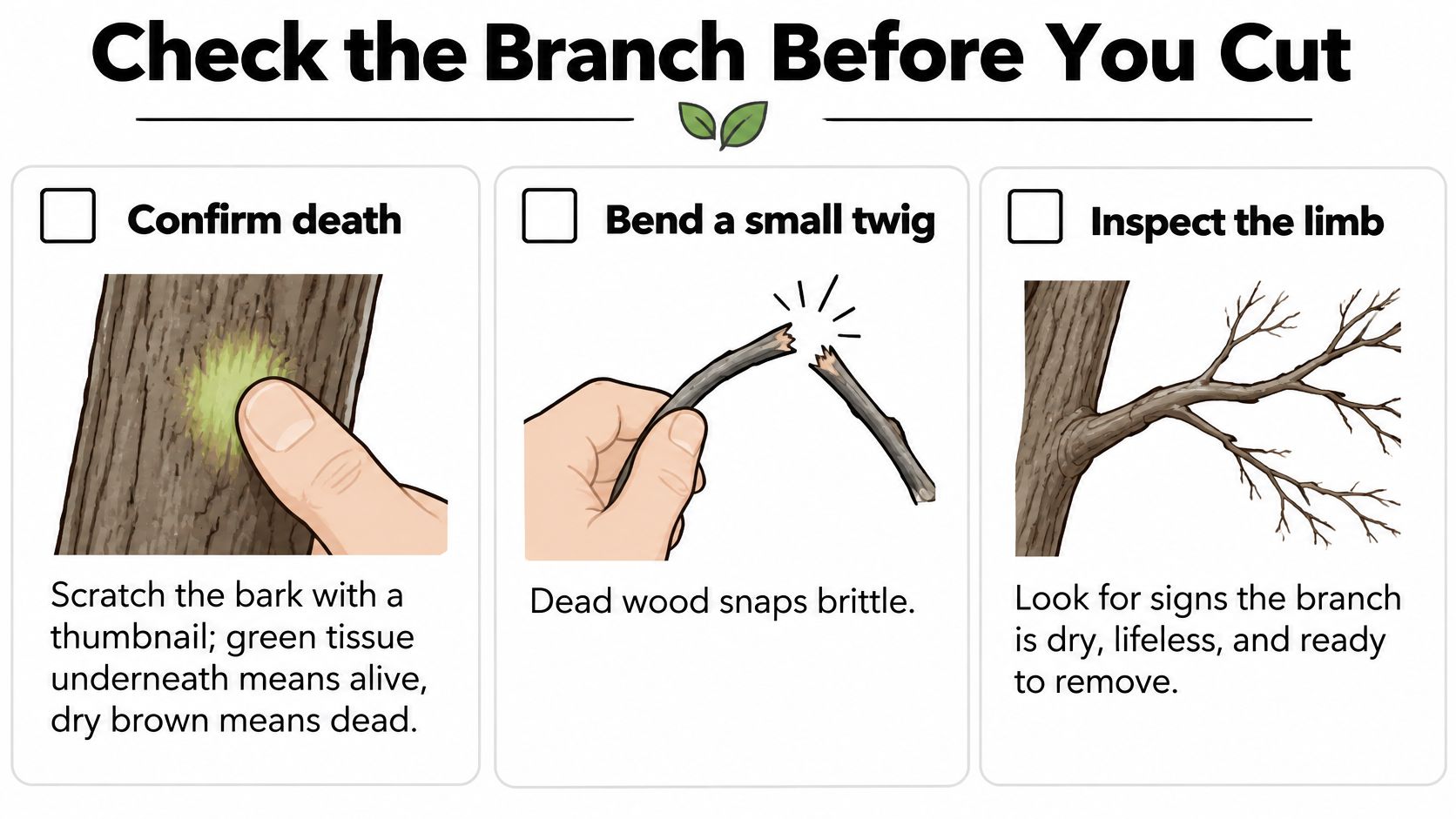
1. Confirm death. Scratch the bark with a thumbnail on a small twig. Green, moist tissue underneath means it's alive. Dry brown means dead. Bend a small twig next. Live wood flexes, dead wood snaps brittle. In winter, look for dry buds and grey, cracked bark, since bare branches alone only tell you the tree is dormant.
2. Measure diameter. Put a tape at the planned cut point, not at the tip. The U.S. Forest Service hazard-tree assessment classifies trees in the "safety prune" category when they require removal of deadwood or broken branches, and identifies dead, dying, diseased, or weakened branches greater than 2 inches in diameter as potential or immediate threats to bodily injury or property damage. That measurement tells you whether you're holding a hand saw job or a hazard.
The short video below shows what to look for when you're standing under the tree making that call.
3. Map the drop zone. Stand back and name everything the limb could strike if it fell straight down or swung on a hinge of bark. People, cars, pets, the roof, and gutters all count. Say a limb hangs over a driveway in Acworth. Even if it's small, the car moves or the job changes to lowering pieces by rope.
The stop checks
4. Look for hung branches. A broken limb caught in the crown is a widow maker. It can drop without warning when wind shifts or when you cut nearby wood. Don't work under it, and don't pull it down with a rope from below.
5. Inspect the attachment. Check where the limb meets the trunk for cracks, decay, included bark, or a split. A sound branch has a clear branch collar, the swollen junction you'll cut outside of later. A cracked attachment can fail while you're halfway through the cut.
6. Check overhead lines. Look up before you set a ladder, then look again. Keep your body, ladder, and pole saw well clear of any wire. Dead wood is dry, but a pole, a wet rope, or a falling limb can still bridge the gap to a line.
If the limb is over a structure, touching a line, or cracked at the attachment, your inspection is done. The answer is stop and call an arborist.
For homeowners in Marietta, Roswell, Alpharetta, and Johns Creek, inspection should cover diameter, decay, attachment strength, proximity to roofs and pedestrian areas, and collar condition, not only whether the limb looks dead. That habit protects the remaining tree and the property under it.
Atlanta Permits and What to Do After a Storm
| Case | Atlanta rule | What to do |
|---|---|---|
| Hardwood tree, 6 inches DBH or more | Permit required under Section 158-26 | Apply before removal |
| Pine tree, 12 inches DBH or more | Permit required under Section 158-26 | Apply before removal |
| Dead or dying tree at those sizes | Still permitted, dead status does not exempt it | Apply before removal |
| Dead branch only, pruning | May be treated differently from whole-tree removal | Confirm with the city first |
| Imminent storm hazard | Emergency action allowed | Contact the Arborist Division, document, apply within 5 working days |
| Neighbour's overhanging tree | Prune less than 20% of the live canopy | Use proper cuts, avoid imbalance |
| Marietta, Roswell, Alpharetta, Cobb or Cherokee County | Local ordinance may differ | Verify with the city or county before scheduling |
Most guides treat dead wood as automatically permit-free. In Atlanta, that assumption gets homeowners in trouble. The City of Atlanta Section 158-26 document requires a permit to remove hardwood trees measuring 6 inches or more in DBH and pine trees measuring 12 inches or more in DBH, where DBH means trunk diameter at breast height.
Dead does not mean exempt
The Atlanta Tree Commission removal permits page states that removing, destroying, or injuring a private-property tree at least 6 inches in diameter at breast height requires a permit, and the rule applies even when the tree is dead or dying. Atlanta also limits pruning of a neighbour's overhanging tree to less than 20% of the live canopy, with proper cuts and no resulting imbalance or instability.
That creates a distinction you need to get right. Taking one dead branch off a healthy oak is pruning. Cutting a large dead stem, or removing the whole tree because the crown died, can become tree removal under the ordinance. If you're asking do I need a permit to remove a tree, measure DBH first, photograph the trunk with the tape visible, and confirm before a crew is booked.
Our overview of the local tree preservation ordinance helps you sort permit questions before scheduling. Don't carry Atlanta's thresholds into Marietta, Roswell, Alpharetta, Johns Creek, Milton, or unincorporated Cobb County or Cherokee County. Cities and counties administer different ordinances, so verify locally for hazardous tree removal, land clearing, and lot preparation.
After a storm, work in this order
1. Keep people back. Treat a suspended limb over a roof, driveway, or road as loaded. Keep kids and pets inside and move cars if you can do it without walking under the limb.
2. Do not touch energised lines. If wood is on a wire, or a wire is down, call the utility and wait. Photograph from a safe spot, not from under the tree.
3. Document before anyone cuts. Take wide photos and close photos. Note whether the limb broke naturally or was cut, and what it is threatening. That record helps with the city, your insurer, and a property manager or landlord.
4. Handle the emergency filing. The Atlanta Tree Commission FAQs explain that Atlanta allows emergency action for an imminently hazardous tree, but homeowners are expected to contact the Arborist Division, document the condition with photographs, and submit the required application within five working days after removal. Trees in the public right-of-way fall under different departments and procedures, so don't assume a street tree is yours to remove.
5. Call your insurer early. FEMA guidance on tree removal from private property advises contacting the homeowner's insurance company because many policies may cover tree removal when a disaster-caused fallen tree damages the home or blocks access. FEMA also states it does not directly remove trees from private property. It may fund local governments for debris removal, which is not the same as a crew showing up for your fallen tree removal.
Photographs taken before emergency tree removal protect you twice, once with the permit office and once with insurance. Take them before the saw starts.
For storm damage tree cleanup in Canton, Woodstock, or East Cobb, that sequence, safety, photos, utility clearance, then cutting, keeps a bad night from becoming a permit or coverage problem later.
Tools and PPE for Dead Branch Work
| Tool or PPE | Use it for | Note |
|---|---|---|
| Bypass hand pruners | Stems under about 3/4 inch | Keep sharp, wipe blades between trees |
| Lopper | Limbs up to about 2 inches | Use the bypass type for live wood |
| Curved folding pruning saw | Limbs about 2 to 4 inches | Cuts without crushing, good for tight spots |
| Pole saw | Small overhead limbs reached from the ground | Never use near power lines |
| Chainsaw | Larger limbs, only with training | Requires chaps, gloves and eye protection, arborist work when aloft |
| Safety glasses or face shield | Chips and sawdust | Wear even for hand pruning |
| Cut-resistant chaps and gloves | Any chainsaw or pole saw use | Check for cuts after every job |
| Hearing protection | Chainsaw or chipper noise | Earplugs or earmuffs |
| Tarp and rope | Gathering and lowering cut wood | Keep the rope clear of the drop zone |
| Stepladder rated for the load | Reaching limbs within arm's length | Set on firm, level ground, never on a slope |
Match the tool to the diameter you measured, not to what happens to be in the garage. Bypass pruners and loppers crush less than anvil tools, and a curved folding saw pulls through dead wood without pinching as easily. A pole saw is only for small overhead limbs you can reach while both feet stay on the ground.
Non-negotiable protection
Wear an ANSI Z89.1 hard hat, safety glasses or a face shield, gloves, and boots with good tread. Add cut-resistant chaps and hearing protection for any chainsaw use. Dead limbs shed chips and small stubs fall straight down, often while you're looking at the saw.
Dull or dirty blades tear bark and can carry pathogens from a diseased tree to a healthy one. Sharpen before you start and wipe blades between trees. If a blade needs force, it's dull, pinched, or the wrong tool.
Don't attempt climbing, rigging, chainsaw work aloft, or anything above a stable ladder. A single slip with a saw or a falling stub can cause a serious injury that costs far more than hiring stump grinding, pruning, or removal help for the larger work.
How to Make the Cut Without Tearing Bark
For a small limb you've cleared to handle from the ground, the sequence below shows the order that keeps bark intact.
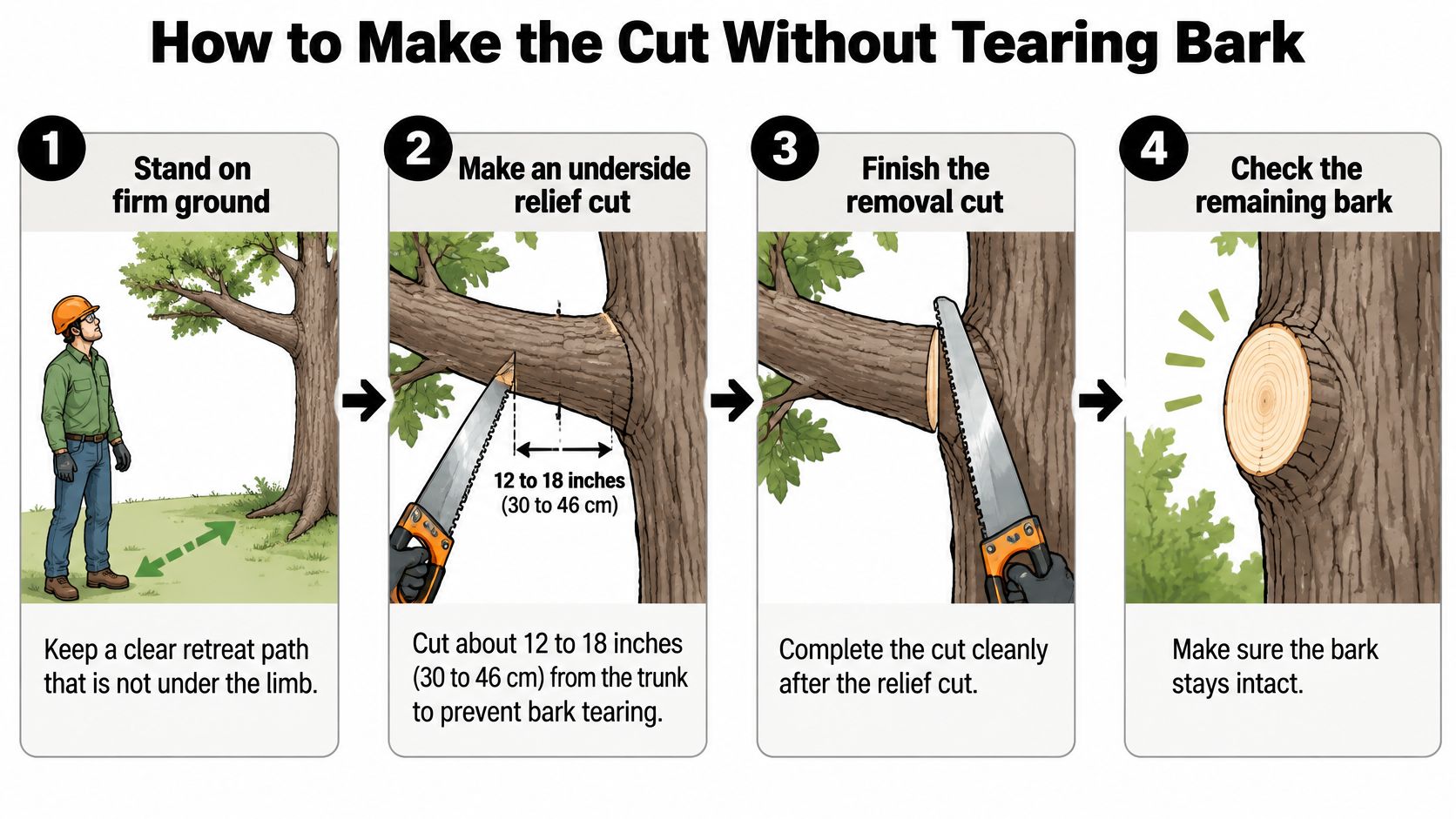
The University of Minnesota Extension pruning guide directs you to make the final cut just outside the branch collar, and for limbs large enough to tear bark, to use a three-cut sequence with an underside relief cut approximately 12 to 18 inches (30 to 46 cm) from the attachment, a top cut slightly farther out, and a final cut back to but not through the collar. Use sharp, clean equipment, and confirm hazards first, including utilities, buildings, roads, and targets below.
The three-cut sequence
1. Set your footing and retreat path. Stand on firm ground beside the limb, never under it. Pick a step-back route that's clear of the tarp, the ladder feet, and stacked wood. If the piece rolls, you move without tripping.
2. Make the underside relief cut. Saw upward from below, about 12 to 18 inches out from the attachment, roughly a quarter of the way through. This cut is your insurance. When the limb's weight shifts, the wood breaks at this kerf instead of peeling a strip of bark down the trunk.
3. Make the top cut farther out. Move an inch or two beyond the undercut and saw down from the top. The limb should drop cleanly once the cuts meet. Keep your free hand out of the fall path. Don't try to catch or guide a heavy piece by hand.
4. Remove the stub at the collar. Now the weight is gone, so you can cut accurately. Place the saw just outside the branch collar, angled slightly away from the trunk, and cut through the short stub. Support a heavy stub with your hand underneath or a rope if it could roll and tear the edge.
5. Clean the edge and leave it alone. Smooth a ragged edge with a clean knife if a small flap remains. Don't paint the wound or apply dressing. The tree seals the cut by growing callus tissue over it, and coatings can trap moisture against wood that needs to dry.
Storm-broken limbs use a shorter first cut
Broken wood behaves differently from an intact dead limb. The UGA Extension guidance on storm-damaged trees describes a three-cut method for larger branches beginning with an underside cut approximately 8 to 12 inches from the trunk and about one-quarter through the branch. For a storm-broken limb, start at that shorter distance. Keep the longer distance for intact dead limbs that still carry their full weight out to the tip.
That difference matters because a split limb may already be hinged on torn fibres. Cutting far out can let the outer section swing and widen the split. Working closer, with the weight removed in smaller pieces, gives you more control.
Pitfalls that damage the tree you are saving
- Flush cuts: Cutting flush with the trunk removes the collar, damages protective stem tissue, and can create dead areas that invite decay into the trunk.
- Long stubs: A stub can't seal. It decays, holds water, and can produce weak regrowth that breaks later.
- Cutting between branches or buds: On live wood nearby, cut back to a branch or bud that can take over growth, not into empty internode wood.
- Wet weather pruning: Ragged or contaminated tools and wet conditions can spread pathogens. Pick a dry day and clean tools.
- Unnecessary wound dressing: Paint doesn't substitute for a correct cut location. It hides the wound instead of helping it close.
A correct cut looks boring. The collar stays intact, the bark edge is clean, and there's no stub sticking out waiting to rot.
Next season, a healthy wound shows a ring of callus tissue rolling in from the edges. It won't close in a month on a larger limb, and it shouldn't be reopened. If you see blackened, sunken tissue spreading from the cut, or fungal growth at the wound, that's a reason to have the tree assessed rather than cutting deeper.
Work above ground or with power equipment belongs with an ISA Certified Arborist, particularly for mature trees or branches over structures. I would rather you make three clean small cuts from the ground than one heroic cut from a ladder.
Cleanup, Disposal and Protecting Your Property
Before the first cut, lay a tarp under the work area and clear beds, toys, grills, and vehicles from the drop zone. Small dead twigs shatter into pieces that hide in mulch and lawn. A tarp turns an hour of picking into one drag to the pile.
Lower heavy sections with rope rather than dragging them across the lawn. Dragging tears turf, ruts wet soil in Cherokee County clay, and crushes shrubs at the fence line. Cut wood into lengths you can carry without twisting, and stack it where a chipper or trailer can reach it.
Where the debris goes
The FEMA fact sheet on removing debris from private property says people handling debris should wear protective equipment such as gloves and masks, avoid touching visible electrical cables, and wait for professionals when wires are present. It also says suspected toxic debris should be sealed in plastic bags rather than burned, and debris should be placed away from trees, poles, structures, fire hydrants, and meters, and never block roadways.
Follow that placement even for routine deadwood in Cobb County. A pile against the house invites insects and blocks a meter reader. A pile in the street creates a problem for neighbours and collection crews. Check local collection instructions before you put wood at the curb, since size limits differ by city.
Chip small, clean branches into mulch if you have access to a chipper and know how to run it. Spread mulch 2 to 4 inches deep, keeping it several inches away from the trunk so bark stays dry. Don't burn treated or painted wood. Don't compost diseased wood that could carry fungal spores back into beds.
Protect the tree that's staying
Don't top the tree to make future deadwood easier. Don't paint wounds, and don't pile soil or mulch against the trunk. Keep equipment off the root zone where you can, especially on wet ground, because compaction harms roots long after the branch is gone.
Our crews haul away every branch before they leave the job, which is the main reason to hire help for larger deadwood, stump removal, or a full fallen tree. You can see how that hauling fits with cleanup through our yard waste removal service.
Finish with a property check. Look in gutters for chips, walk fence lines for a stub that bounced, and rake the lawn edge where sawdust piles can smother grass. Then step back and check the crown. If you see more deadwood you missed from below, note it now while the drop zone is still clear.
Cost, Response Time and Calling a Crew
Cost is usually the first question, and it's the hardest to answer without seeing access. A 2024 consumer cost analysis in The Spruce reported that removing a dead or hazardous tree cost an average of $670, with prices ranging from $140 to $1,200. Use that range to sanity-check quotes for how much tree removal costs, not as a price for your specific tree.
Price moves with size, access, number of limbs, proximity to structures, and whether haul-away and stump grinding are included. Compare estimates on the same scope. A low number that leaves wood, stump, and debris behind isn't the same job as a full tree removal with cleanup.
Before you book, run the permit check if the job has grown from one dead branch into a whole tree, a large dead stem, or storm damage. Confirm the rule before any cut, especially for emergency tree removal where documentation still matters after the work.
What to have ready when you call
Call Richmond Tree Experts GA at 770-974-3964 and say whether the job is storm damage, an immediate hazard, or routine deadwood so the crew can triage it. Have three things ready:
- Photos: One wide shot of the whole tree and one close shot of the branch and its attachment.
- Diameter: Your tape measurement at the cut point, plus trunk DBH if the whole tree may come down.
- Distance: How close the limb is to the roof, driveway, fence, road, or any line.
We offer emergency tree service, including storm damage response, plus tree removal, tree service in Marietta, Roswell, Kennesaw, Woodstock, Acworth, and Canton, and searches like tree removal near me across North Metro Atlanta. We offer free, no-pressure estimates, usually given the same day. Licensed and insured crews with professional equipment can then tell you how quickly they can respond based on hazard level, not a generic promise.
If a dead limb is hanging over your home in Marietta, Roswell, or anywhere in Cobb County or Cherokee County, Richmond Tree Experts GA can assess whether it needs pruning, emergency removal, or a full hazardous tree removal with cleanup handled for you. Visit us to request a free estimate, send your photos and measurements, and get a clear plan before the next storm tests that branch.

