

When you start searching for "certified arborists near me," you’re looking for more than just someone with a chainsaw. You're searching for a true tree health expert. Hiring an ISA-Certified Arborist is the single biggest difference between simply cutting branches and proactively managing the long-term health of your trees—a move that protects your property and prevents future headaches.
Why an ISA Certified Arborist Is Worth It
Frankly, anyone can call themselves a "tree guy." But only a professional who has passed a comprehensive exam covering all aspects of arboriculture can earn their certification from the International Society of Arboriculture (ISA). This isn't just a fancy title; it's your assurance of their knowledge, experience, and commitment to their craft.
Think of them as tree doctors for your Atlanta property. These professionals are trained to see what the average person misses. They know the unique challenges our local climate and soil present to beloved species like our dogwoods, oaks, and magnolias.
Beyond Simple Tree Trimming
The real value of a certified arborist shines through in high-stakes situations. Let's say a huge oak is leaning a little too close to your house after a big summer storm. An untrained trimmer might immediately recommend taking it down—a costly, messy, and potentially unnecessary solution.
An ISA-Certified Arborist, on the other hand, will conduct a detailed risk assessment. They might spot subtle signs of root decay or find structural weaknesses an untrained eye would miss. Their recommendation might be strategic pruning or cabling to save the tree while making it safe.
This is the kind of expertise that is crucial for:
- Preventing Costly Damage: They can identify hazardous limbs before they crash down on your roof or car in the next storm.
- Diagnosing Silent Diseases: They are trained to spot the early warning signs of root rot, insect infestations, and other issues while they're still treatable.
- Protecting Property Value: Proper tree care boosts your home's curb appeal and overall worth. Bad pruning does the opposite.
At its heart, the job of a certified arborist is all about risk management. They use science-based knowledge to protect your two most valuable assets—your trees and your home—making sure both can thrive together safely for years.
Ultimately, bringing in a certified professional is an investment in the safety, beauty, and long-term health of your property. To get a better sense of their extensive training, you can learn more about what an ISA-Certified Arborist is and why their expertise is so vital.
Starting Your Hunt for the Best Local Arborists
Let's be honest, a generic web search for "arborist near me" is going to dump a mountain of options on your screen. It’s overwhelming. Your real goal isn't just to find an arborist, but to build a small, solid list of qualified, local pros.
A big part of a smart search is knowing what you're looking at. When you type in your query, you'll get a mix of ads and natural results. It’s definitely worth taking a moment for understanding the difference between paid and organic search results so you can tell who's paying for the top spot versus who earned it.
When it comes to finding a truly qualified expert, your first stop should always be the International Society of Arboriculture (ISA). Their official "Find an Arborist" database is the gold standard. It cuts through all the marketing fluff and lets you filter specifically for certified experts right here in the Atlanta area.
The ISA tool is simple and effective. You just pop in your location, and it gives you a list of professionals who have proven their credentials.
Using this database from the get-go means every single person you consider has already met the ISA's strict standards for tree knowledge and professional ethics. You're verifying their qualifications before you even make a single phone call.
Check for Local Recommendations
After you've got a list of certified pros, it's time to see who your neighbors trust. This is where you get the real, unfiltered feedback.
Hyper-local resources like your neighborhood's Nextdoor page or Atlanta-area gardening groups on social media can be invaluable. Don't be shy—ask people who they've hired and what their experience was like. A good referral from someone down the street is often the best indicator of quality work.
The arboriculture field has become incredibly professional over the years. As of 2021, there were roughly 60,000 ISA-certified arborists worldwide. That number speaks volumes about the industry's dedication to high standards and ongoing education.
When you combine the official, verified list from the ISA with genuine recommendations from your community, you get the best of both worlds: proven credentials backed by real-world performance. Our own guide on how to find a reliable contractor online has even more tips for navigating this part of the process.
The idea here is to narrow your options down to a focused list of three to five promising companies. That’s your shortlist, and it gives you a fantastic starting point for the next phase of your research.
How to Vet Your Shortlisted Arborists
Alright, you’ve got a short list of promising names. Now comes the most important part: doing your homework. This is where you separate the true tree care professionals from someone who just bought a chainsaw and a truck. Vetting isn't hard, but it's absolutely essential to protect your property and your wallet.
First things first, you need to verify their ISA certification. Don't just take their word for it. The ISA makes this incredibly simple—just head over to their official "Find an Arborist" tool and pop in their name or certification number. If they don’t show up, they aren’t currently certified. That’s a major red flag.
Digging Into Insurance and Reputation
Next up is insurance, and this is non-negotiable. Any legitimate tree care company will have no problem showing you proof of both general liability insurance and workers' compensation.
Liability insurance is what covers any accidental damage to your house, car, or landscaping. Workers' comp is what protects you from being sued if a crew member gets hurt on your property. Without it, you could be on the hook for their medical bills.
A common trick from uninsured outfits is to offer a rock-bottom price. That's not a discount—it's the cost of risk being transferred directly to you. Always, always insist on seeing a current insurance certificate.
This quick visual can help you get started on finding reputable candidates from the get-go.
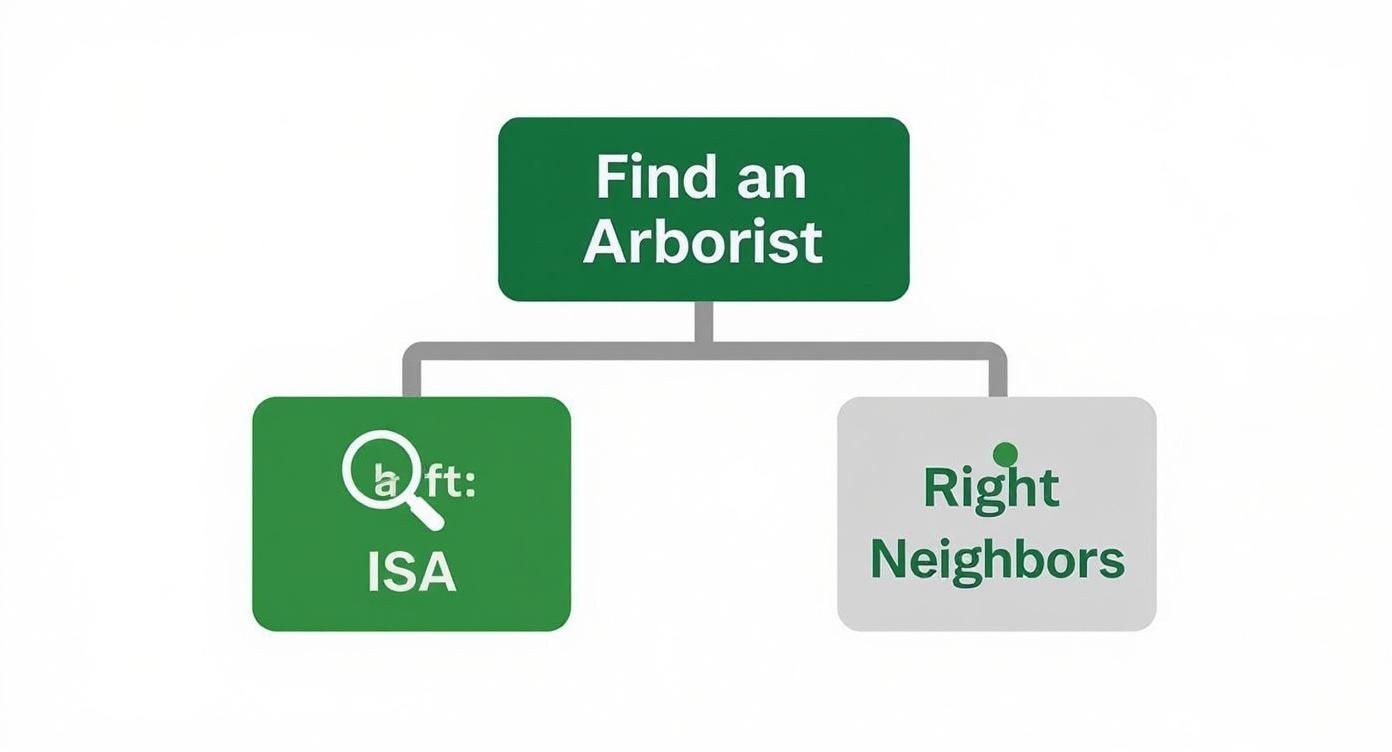
Starting with a verified database like the ISA's gives you a solid foundation of expertise, while local recommendations can offer fantastic firsthand insights.
Finally, it’s time to check their digital footprint. A company's online reputation can tell you a lot. Look beyond their slick website and see what real customers are saying.
- Google Reviews: Scan for recent feedback. Pay close attention to how the company responds to both glowing praise and sharp criticism.
- Better Business Bureau (BBB): Check their rating and see if any complaints have been filed. How were they resolved?
- Nextdoor or Local Facebook Groups: Search for the company's name in community forums. This is where you’ll often find the most candid, unfiltered feedback from your neighbors.
One or two grumpy reviews aren't a deal-breaker, but a consistent pattern of complaints about poor communication, sloppy work, or property damage is a clear sign to steer clear. To really get into the weeds on this, you can find guides that detail all the essential tree service insurance requirements you need to confirm.
To make this process a bit easier, here’s a quick checklist you can use when you're on the phone or getting an estimate from a potential company.
Arborist Vetting Checklist
Use this table as a quick reference to make sure you're covering all your bases with any company you're considering.
| Verification Item | How to Check | Why It's Important |
|---|---|---|
| ISA Certification | Use the ISA's "Find an Arborist" tool online. | Confirms they have passed a comprehensive exam on tree care and adhere to a code of ethics. |
| General Liability | Ask for a copy of their insurance certificate and call the provider to verify it's active. | Protects you financially if their work causes damage to your property (home, car, etc.). |
| Workers' Compensation | Request the certificate and verify it with the insurance carrier. | Protects you from liability if one of their employees is injured while working on your land. |
| Online Reviews | Check Google, BBB, and local community forums like Nextdoor. | Reveals patterns of customer service, reliability, and quality of work from past clients. |
| Written Estimate | Ensure they provide a detailed, written quote—not just a verbal price. | Creates a clear record of the agreed-upon scope of work and cost, preventing disputes. |
Taking a few extra minutes to run through these checks is the best way to ensure you’re hiring a trustworthy, skilled, and professional arborist for the job.
Getting On-Site Consultations and Quotes
Now comes the most important part of the process: the in-person meeting. This is where you separate the true professionals from the rest. The on-site consultation is your chance to interview the arborist, watch them in their element, and see how they assess your property firsthand.
A real expert won't just glance at a tree and throw out a number. They should walk the property with you, actively listening to what you need and pointing out things you might not have noticed. This is your moment to gauge their expertise and see if their approach feels right.
Key Questions for Your On-Site Meeting
When they show up, you’re not just shopping for a price. You're evaluating a potential partner who will be responsible for the health and safety of your property's biggest assets. Treat it like an interview.
To get the most out of this meeting, have a few key questions ready for every certified arborist near me you consider:
- Can you walk me through your specific plan? A pro will have no problem explaining exactly how they plan to prune a limb or fell a tree, step-by-step.
- What kind of equipment will you be using, and how do you plan to protect my property? This is huge. You need to know how they’ll avoid tearing up your lawn, cracking your driveway, or damaging nearby plants.
- What’s a realistic timeline for this job? Get a clear start and finish date, but also understand that things like a big Georgia thunderstorm can cause delays.
- Is stump grinding and full debris removal included in this quote? Don't get hit with surprise fees. Make sure the price covers the entire job, from start to cleanup.
Getting these details sorted out upfront is crucial. The global tree services market is now valued at a whopping $1.49 billion, a number driven by homeowners who demand professional standards. You can read more about tree service industry trends to see why holding contractors to a high standard has become the norm.
A detailed, itemized quote is the calling card of a legitimate business. If someone scribbles a single number on the back of a business card, be wary. The best quotes break everything down, from labor and equipment to cleanup costs.
Finally, let your gut be your guide. If a bid comes in dramatically lower than all the others, it's often a red flag for a reason—they might be cutting corners on insurance, using old equipment, or planning risky maneuvers.
And if you hear an arborist suggest “tree topping”? End the conversation right there. This harmful practice is a dead giveaway that they lack proper training. Your goal is to hire a knowledgeable expert, not just the cheapest option.
Getting it in Writing: Finalizing the Contract
You’ve done the hard work of vetting, checking credentials, and getting on-site estimates. Now, you’ve picked your pro. The final, and arguably most important, step is getting a solid, written contract in place before a single branch is cut.
This isn’t just a formality; it’s your safety net. A handshake deal or a verbal agreement simply won't cut it when you’re dealing with something as complex and potentially dangerous as tree work. A contract protects you and the arborist by making sure everyone is on the same page from the get-go.
Remember this key takeaway: A verbal promise is not a contract. A professional written agreement is your best tool for ensuring there are no surprise costs or disagreements once the work begins.
A legitimate, detailed contract is the mark of a true professional. It eliminates any gray areas about the scope of work, costs, and project timeline.
What a Rock-Solid Contract Looks Like
Before you put pen to paper, give the document a thorough read-through. If it feels vague or leaves things open to interpretation, that’s a major red flag.
Your contract absolutely must include these key details:
- A Detailed Scope of Work: The agreement needs to spell out exactly what's going to happen. It should specify which trees are being pruned or removed and whether services like stump grinding and hauling away the debris are part of the deal.
- The Full Cost and Payment Terms: There should be no mystery here. The contract must state the total price and have a clear payment schedule (e.g., deposit amount, when the final payment is due).
- Proof of Insurance: Don't just take their word for it. The contract should include attached copies of their current liability insurance and workers' compensation certificates.
The tree care sector is a surprisingly large industry, employing nearly 300,000 people to keep up with demand. Any arborist who takes their business seriously will provide a comprehensive contract without hesitation. You can discover more insights on the growing tree service industry to get a sense of why these professional standards are so critical.
Taking this final step seriously gives you the peace of mind that the job will be done safely, correctly, and on budget.
Your Top Questions About Hiring an Arborist Answered
When you start looking into professional tree care, a lot of questions pop up. It's completely normal. Making the right call for your property means getting clear, honest answers first. Let's break down some of the most common things homeowners in Atlanta wonder about when they start searching for a "certified arborist near me."
First up, the big question: what's this going to cost? In the Atlanta area, tree work pricing isn't one-size-fits-all; it really depends on the job. A straightforward tree health assessment might run you $100 to $200. If you need a medium-sized oak pruned, you're likely looking at a range of $300 to $1,500. The most involved and costly jobs are the large, tricky removals—especially when the tree is looming over a house or power lines. Those often start at over $1,000.
How Can I Tell If My Tree Is a Hazard?
This is another huge concern, and for good reason, especially after one of Georgia's infamous storms rolls through. You don't need to be an expert to spot some initial warning signs.
It's time to call in a professional for a proper risk assessment if you notice any of these red flags:
- Big, dead branches hanging out in the upper parts of the tree.
- Deep, unsettling cracks or splits running down the trunk.
- A new or worsening lean. If your tree is suddenly tilting, that's a problem.
- Mushrooms or other fungal growth popping up around the base of the tree.
These symptoms can signal serious internal decay or structural weakness that isn't always visible to the untrained eye. An arborist can give you the real story on the level of risk.
A quick but important note: there's a world of difference between a general landscaper and a certified arborist. While your lawn care crew is great for trimming hedges, they just don't have the deep knowledge needed for large, mature trees. An ISA-Certified Arborist understands tree biology, knows how to prune without causing long-term damage, and is trained in the complex safety protocols required for big jobs.
Handing over major tree work to someone who isn't qualified can do permanent harm to your trees and, worse, create a massive safety liability on your property. An arborist's expertise is your peace of mind that the job is done safely and correctly.
For professional tree care and expert advice in Atlanta and surrounding areas like Johns Creek, Alpharetta, and Marietta, trust the ISA Certified Arborists at Richmond Tree Experts GA. Contact us today for a free estimate and ensure your trees are in the best hands.
Not sure what your tree needs? Richmond Tree Experts has worked on Marietta and Metro Atlanta trees since 1985, and every job is looked at by an ISA Certified Arborist before it is priced. Start with an ISA Certified Arborist evaluation, or see everything we do: tree removal, stump grinding and arborist services across Cobb, Fulton, Cherokee, Gwinnett and DeKalb counties (service areas).
Call (770) 974-3964, 7am to 11pm every day, or request an estimate online.

