

Nothing beats the satisfaction of picking a fresh lemon or satsuma right from your own backyard. But if you’re growing citrus here in Georgia, you know that our climate can be both a blessing and a curse. Success means staying one step ahead of the common citrus tree diseases that absolutely love our warm, humid weather.
Your First Look at Protecting Georgia Citrus Trees
For any Georgia homeowner, a thriving citrus tree is a real source of pride. The same weather that gives us that lush, green growth, however, also rolls out the welcome mat for a whole host of fungal and bacterial problems. It's a classic double-edged sword.
The good news is, you don’t need a degree in plant pathology to keep your trees healthy. It really comes down to knowing what to look for and being consistent with preventative care. Think of this guide as your playbook for turning what seems like a complex problem into a series of simple, actionable steps.
Why Proactive Care Is Your Best Defense
Let's be honest: waiting until your tree is covered in spots or dropping leaves is usually too late for an easy fix. A proactive game plan not only saves you from future headaches and expense but keeps your trees looking great and producing fruit for years to come. The goal is to make your yard an environment where these diseases just can't get a foothold.
This really boils down to a few key habits:
- Pick the Right Spot: Give your tree plenty of sunlight and well-draining soil from the start. This single step helps you dodge root rot and a ton of other moisture-related headaches.
- Water Smarter, Not Harder: A deep watering every so often is much better than a little bit every day. It encourages strong roots without creating the soggy soil that fungi love.
- Prune for Airflow: Thinning out the canopy a bit lets air move through freely. This helps the leaves dry off faster after a rain, giving fungal spores less time to take hold.
- Take a Weekly Walk: Seriously, just strolling through your yard and giving your trees a quick once-over can help you spot trouble when it’s small and simple to manage.
Protecting your citrus isn't just a spring-cleaning task; it's a year-round commitment. Consistent care that's dialed in for Georgia's unique climate is the only way to effectively prevent devastating citrus tree diseases.
To give you a quick reference, here's a look at the most common issues we see on citrus trees around the Atlanta area.
Quick Guide to Common Citrus Threats in Georgia
This table summarizes some of the most prevalent issues Georgia homeowners face with their citrus trees. Use it to quickly identify potential problems and know what your first move should be.
| Threat Type | Key Symptoms | Recommended First Action |
|---|---|---|
| Fungal Diseases | Yellow/brown spots, powdery residue, greasy lesions | Prune affected areas, improve air circulation, apply fungicide. |
| Bacterial Diseases | Raised cankers, fruit drop, wilting, oozing sores | Remove infected limbs immediately; avoid overhead watering. |
| Nutrient Deficiency | Yellowing leaves (specific patterns), stunted growth | Perform a soil test and apply a balanced citrus fertilizer. |
| Pest Infestations | Curled leaves, sticky residue (honeydew), visible bugs | Identify the pest and apply horticultural oil or insecticidal soap. |
Remember, this is just a starting point. Accurate diagnosis is everything when it comes to effective treatment.
When you see symptoms you just can't figure out, or a problem is getting worse despite your best efforts, it's time to call in a professional. Since 1985, Richmond Tree Experts has been the trusted name for expert tree care all across the Atlanta area. Our ISA Certified Arborists have the tools and experience to diagnose exactly what’s wrong and create a treatment plan that gives your citrus trees the best possible chance to thrive.
Diagnosing Common Fungal and Bacterial Diseases
Figuring out what's wrong with your citrus tree can feel like a bit of detective work, but you don't need a magnifying glass to get started. Here in Georgia, many of the most common fungal and bacterial problems leave behind some pretty obvious clues. Learning what to look for is the first real step toward fixing the problem and stopping it from happening again.
Think of it this way: your tree is always trying to tell you how it's feeling through its leaves, fruit, and branches. That raised, corky spot isn't just a random blemish; it’s a clear signal for a specific issue like citrus canker. Once you can read these signs, you can stop worrying and start taking confident, decisive action.
To point you in the right direction, this decision guide can help walk you through some common symptoms and what to do next.
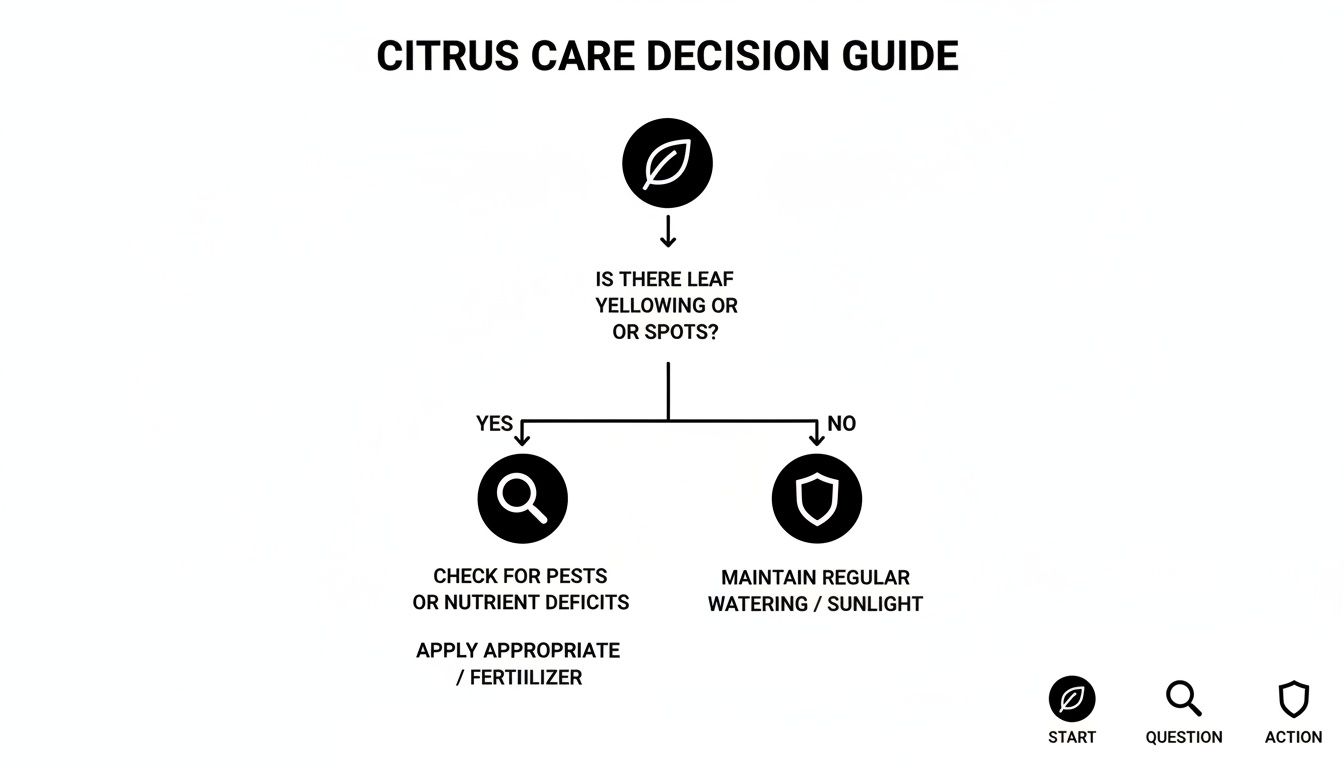
This chart really drives home the most important point: you have to identify the core problem—whether it's weird spots, yellowing leaves, or something else—before you jump to pruning or spraying.
Common Fungal Foes in Georgia
It's no secret that Georgia's humidity is a paradise for fungal growth. Spores can float in on the wind or splash around in the rain, just waiting for the right damp conditions to take hold of your trees. Two of the biggest offenders you're likely to run into are Citrus Scab and Greasy Spot.
Citrus Scab is infamous for making the fruit look terrible.
- On Fruit: Be on the lookout for raised, wart-like patches. They often start out pinkish or tan before turning a crusty grayish-brown. These scabscan merge together and completely distort the fruit's shape.
- On Leaves: You'll see similar scabby spots on young leaves, which often makes them curl up or look misshapen.
While the fruit itself is usually fine to eat, a bad scab infection makes it pretty unappealing. The fungus hits young, developing tissues the hardest, so you'll see it pop up most often during the cool, wet days of spring.
Greasy Spot shows up in a totally different way.
- On Leaves: The textbook sign is a yellowish-green blister on the underside of the leaf. Over time, this turns into a dark brown or black lesion that looks oily or greasy.
- Leaf Drop: Infected leaves tend to fall off way too early. This really weakens the tree over time because it can't photosynthesize properly.
This disease actually gets its start from spores living in the dead leaf litter on the ground. Rain comes along and splashes them up into the tree. That makes simple yard hygiene one of your best preventative tools.
Fungal diseases often thrive in silence, building up in fallen leaves or on lower branches. By the time symptoms are widespread, the infection is well-established. Regular cleanup and proactive pruning are your most powerful tools for prevention.
The Bacterial Threat of Citrus Canker
While fungal issues are common, bacterial diseases like Citrus Canker are a much more aggressive threat. This disease is incredibly contagious and spreads like wildfire in wind-driven rain, especially during our summer storms. Unlike the slow start of many fungal problems, canker lesions are distinct and pretty alarming.
Here's what to look for with Citrus Canker:
- Raised Lesions: You're looking for raised, corky spots on the leaves, stems, and fruit. These aren't flat—they have a very specific texture you can feel.
- Water-Soaked Halo: The dead giveaway is the bright yellow "halo" that forms around the brown, raised center of the spot.
- Fruit Damage: On the fruit, the lesions can become crater-like, making it completely inedible and causing it to drop from the tree way too soon.
Because it's so aggressive and subject to quarantine rules in some places, spotting Citrus Canker is serious business. If you even suspect your tree has it, you need a professional diagnosis right away to keep it from spreading. For a wider look at identifying different tree problems, our comprehensive tree disease identification guide provides great insights that apply across your whole landscape.
Knowing the difference between these common citrus diseases is absolutely critical. A wrong guess can lead to the wrong treatment, which wastes your time and money while the real problem just gets worse. If the symptoms you're seeing don't quite line up with these descriptions, an ISA Certified Arborist from Richmond Tree Experts can give you a definitive diagnosis and create a targeted plan to fix it.
Understanding the Threat of Citrus Greening
When it comes to citrus tree diseases, there's one that stands in a league of its own for sheer destructive power: Huanglongbing (HLB), better known as citrus greening. This isn't just another spot or blemish you can treat; it's a death sentence for citrus trees. In fact, it's considered the most devastating citrus disease in the entire world.
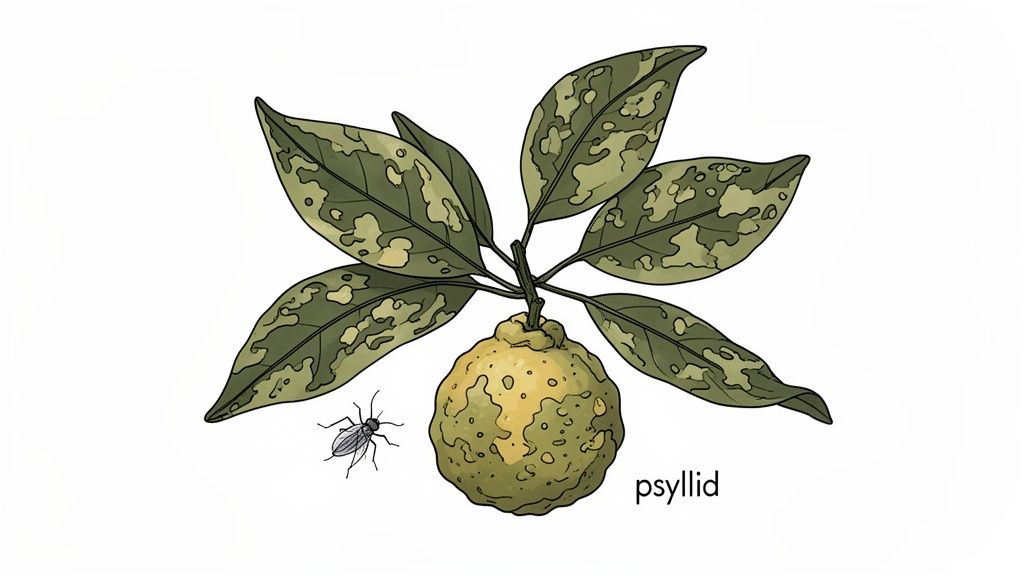
Unlike a fungal problem you can spray or a bad branch you can prune, citrus greening is caused by a bacterium with no cure. Once a tree is infected, its fate is sealed. It will go into a slow, heartbreaking decline and eventually die, all while acting as a contagious source for every healthy citrus tree in your yard and your neighbor's.
The Unstoppable Combination A Tiny Pest and a Deadly Bacteria
The real reason citrus greening spreads like wildfire is its tiny partner in crime: the Asian citrus psyllid. This sap-sucking pest is smaller than a grain of rice and acts as a vector, much like a mosquito carries malaria from person to person. When a psyllid feeds on an infected tree, it picks up the HLB bacteria and injects it into every healthy tree it feeds on afterward.
This is what makes the disease so insidious. The psyllid is small, it flies, and it can travel for miles on the wind or by hitching a ride on new plants. It spreads the infection far and wide before anyone even realizes there's a problem.
Worse yet, the symptoms can take years to show up, making early detection incredibly difficult but absolutely essential. A tree can be silently spreading the disease for a long, long time before it even starts to look sick.
How to Spot the Symptoms of Citrus Greening
You've got to be a bit of a detective to spot citrus greening, because the symptoms can easily be mistaken for a simple nutrient deficiency. But if you know what to look for, the patterns are unmistakable.
Key signs of HLB include:
- Blotchy, Mottled Leaves: This is the dead giveaway. A nutrient deficiency usually creates a symmetrical pattern, but HLB causes yellow blotching that's totally random and asymmetrical. You might see yellow on one side of the leaf's main vein while the other side stays green.
- Misshapen and Bitter Fruit: Infected trees produce fruit that’s lopsided, small, and often stays partially green even when it should be ripe. And the taste? Awful. The juice is notoriously bitter, salty, or even metallic, making it completely inedible.
- Premature Fruit Drop: An infected tree just doesn't have the energy to hold onto its fruit. You'll see it drop to the ground long before it has a chance to mature.
- Twig Dieback: As the disease takes over, the tree starts to die from the tips of its branches inward, giving it a thin, sparse, and sickly look.
The most crucial tell-tale sign is the asymmetry. Zinc or iron deficiencies create predictable, uniform yellowing patterns. Citrus greening creates chaos on the leaf—a clear signal that this is a systemic infection, not a simple nutrient issue.
A Cautionary Tale from Florida
If you want to understand just how bad this citrus tree disease can get, you only have to look at what happened in Florida. Since HLB was first found there in 2005, it has absolutely crippled a legendary industry. In 2004, Florida was pumping out nearly 300 million boxes of citrus. By 2024, that number had collapsed to just 20 million.
That’s a catastrophic 90% loss in two decades. This agricultural disaster has cost the state over $20 billion, wiped out 50 million trees, and vaporized 33,000 jobs. Today, it's estimated that over 80% of Florida's citrus trees are infected. You can discover more insights about these devastating impacts on the citrus industry and local economies.
While we haven't seen that level of devastation in Georgia yet, Florida’s story is a terrifying preview of what's at stake. Vigilance is our best and only defense. If you even suspect your tree might have citrus greening, you need to act immediately. Don't wait. Contact an ISA Certified Arborist at Richmond Tree Experts for a professional diagnosis. Finding and removing infected trees early is the only way we can protect the rest of the citrus in our yards and our communities from this unstoppable threat.
Decoding Nutrient Deficiencies and Stress Signals
When your citrus tree’s leaves start looking a little off, it's easy to jump to the worst conclusion—some kind of complex, hard-to-beat disease. But more often than not, the tree is just trying to tell you it's hungry, thirsty, or stressed out.
Think of your tree's leaves like its personal report card. They give you clear, visual clues about its overall health long before a minor issue spirals into a major problem. Learning to read these signals is one of the most powerful skills you can have as a Georgia citrus grower. Not every yellow leaf spells disaster; in fact, many common problems are simply physiological and are surprisingly easy to fix.
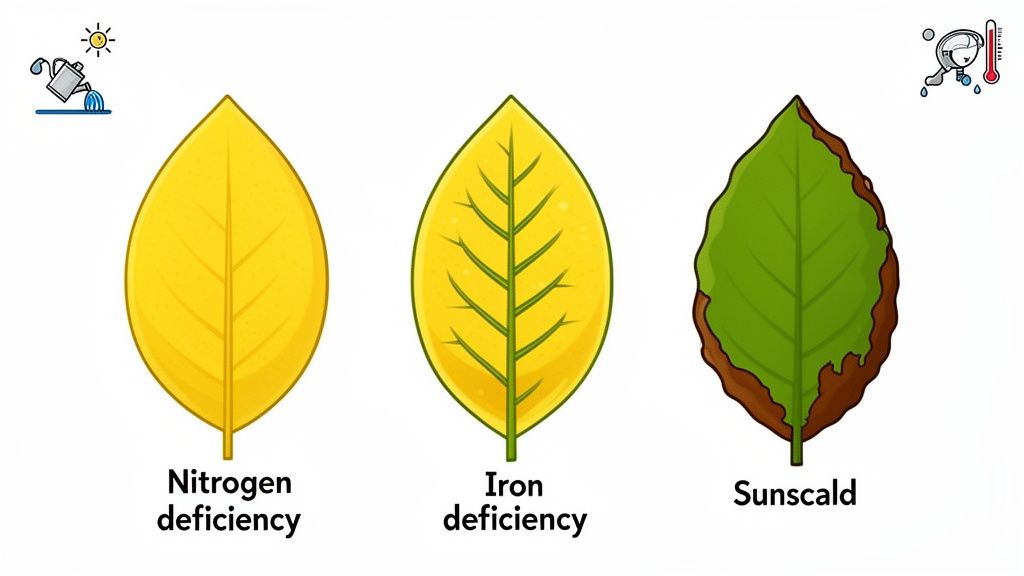
So, before you grab a fungicide, take a moment to play detective. Is the yellowing all over, or is it patchy? Is it happening on the old leaves or just the new growth? The specific pattern is your key to a correct diagnosis and a speedy recovery.
Reading the Leaves: A Guide to Nutrient Needs
Georgia’s heavy clay soil can be a real headache for citrus trees. It has a nasty habit of locking up essential micronutrients, making them unavailable to the plant’s roots even if they’re present in the soil. This leads to some very distinct visual symptoms that are frequently mistaken for diseases.
Here’s how to decipher what your tree is asking for:
- Nitrogen (N) Deficiency: This one shows up as a uniform, pale green or yellow color that takes over the entire leaf. It starts with the older, mature leaves first because the tree is pulling nitrogen from its old growth to fuel the new shoots.
- Iron (Fe) Deficiency: This creates a really striking pattern on new, young leaves. The leaf tissue turns yellow, but the veins stay a distinct dark green. It's a classic sign called "interveinal chlorosis" and points directly to an iron issue.
- Magnesium (Mg) Deficiency: Look for an inverted "V" shape of yellowing on the older leaves. The tip and outer edges of the leaf will turn yellow, but a triangle of green will remain at the leaf's base.
Thankfully, the fix is usually straightforward. A high-quality, balanced citrus fertilizer that's specifically formulated with these crucial micronutrients is your best friend here. Just apply it according to the package directions during the growing season (spring and summer), and you'll often see the problem correct itself.
Think of fertilizer as your tree’s multivitamin. While a disease requires targeted medicine, a nutrient deficiency simply means the tree is missing a key building block for healthy growth. Correcting the diet is the first and most important step.
Beyond Nutrition: Environmental Stressors in Georgia
It's not just about what's in the soil. Your tree’s health is deeply connected to its environment, and our local Georgia climate brings a unique set of stressors that can mimic the symptoms of citrus tree diseases.
Improper Watering
This is a big one. Both too much and too little water can cause yellowing leaves and even significant leaf drop. In our dense clay, overwatering is especially dangerous. It leads to root rot, where the roots literally suffocate and can no longer absorb nutrients. On the flip side, underwatering during a brutal summer scorcher will cause the tree to shed leaves to conserve moisture.
The key is to water deeply but infrequently. Let the top few inches of soil dry out completely between waterings to make sure the roots get a healthy balance of both water and oxygen.
Sunscald and Frost Damage
Our climate swings can be tough on citrus.
- Sunscald: The intense summer sun, especially on the southwest side of the tree, can literally scorch the bark on the trunk and limbs. This creates bleached, cracked, or sunken patches that become an open invitation for pests and disease. A simple coat of diluted white latex paint on the trunk works wonders to reflect that harsh sunlight.
- Frost Damage: A sudden cold snap can cause leaves to wilt, turn black, and die off. Young twigs are particularly vulnerable. The damage might look terrible, but resist the urge to prune right away. Wait until you're sure spring has arrived, then trim back the dead branches. If you prune too early, you'll just encourage tender new growth that will get zapped by the next frost.
By learning to tell the difference between a true pathogen and a simple cry for help—whether it's for food, water, or protection from the elements—you become a much more effective caretaker. It saves you time, money, and the hassle of applying unnecessary chemicals, letting you give your tree exactly what it needs to thrive.
A Seasonal Calendar for Proactive Citrus Care
Keeping your citrus trees healthy and thriving in Georgia isn't a one-and-done deal. It's really about sticking to a consistent, year-round game plan. When you sync up your care routine with the seasons, you can get ahead of problems before they morph into full-blown citrus tree diseases. Think of this calendar less like a chore list and more like a strategic playbook to keep your trees tough and resilient.
This approach simplifies everything, breaking down what seems like complex care into easy, manageable tasks. Every season brings its own set of challenges and opportunities, from knocking out overwintering pests to shielding new growth from a surprise frost. Following this natural rhythm makes tree care feel routine instead of overwhelming, and it keeps you one step ahead of trouble.
Spring Awakening and Defense
As the weather finally warms up, your citrus trees are bursting with new life—but so are pests and fungal spores. Spring is your best shot to set the stage for a healthy, productive year.
- Pest Prevention: Get a jump on pests by applying a dormant horticultural oil before the new leaves fully unfurl. It’s a safe and incredibly effective way to smother any overwintering troublemakers like scale, mites, and psyllid eggs before they even get a chance to hatch and multiply.
- Fertilization Kick-Start: As soon as you see that new growth popping, it's time to feed your tree. A balanced, citrus-specific fertilizer gives it the essential fuel needed to support strong shoots and beautiful blossoms.
- Monitor New Growth: Make a habit of gently checking the tender new leaves at least once a week. This is prime time for fungal issues like citrus scab or pests like aphids to make their first appearance, and catching them early is key.
Summer Vigilance and Support
Georgia's hot and sticky summers can be a recipe for stress and disease in citrus trees. Your focus now needs to pivot from awakening the tree to actively protecting and supporting it through the toughest part of the year.
Proper watering is absolutely non-negotiable. You’ll want to water deeply but not too often, letting the soil dry out a bit between sessions to avoid deadly root rot. A thick layer of mulch is your best friend for holding in moisture and keeping the soil cool, but always remember to keep it a few inches away from the trunk itself. This is also peak season for insect activity, so you have to be scouting for threats constantly.
An effective pest management strategy is about so much more than just grabbing a bottle and spraying. It's about monitoring your trees, encouraging beneficial insects to stick around, and really understanding the life cycles of common pests. This big-picture view is the heart and soul of Integrated Pest Management (IPM).
A smarter, more sustainable approach will always win in the long run. To build a stronger defense for your trees this summer, it's worth taking the time to learn about the principles of Integrated Pest Management and see how they can work in your own backyard.
Fall Preparation and Cleanup
Once the temperatures start to cool down, your tree begins getting ready for its winter nap. Your job now is to help it store up energy and, just as importantly, clean up anything that could cause disease problems next spring.
You can give it one last, light feeding, but make sure you get it done no later than early September. If you fertilize too late, you’ll encourage a flush of new growth that will be extremely vulnerable to the first frost. The single most important task this season, though, is sanitation. Get out there and rake up every last fallen leaf and fruit from around the base of your tree. This simple act gets rid of the main hiding spots where fungal spores and pests love to spend the winter.
Winter Protection and Rest
Winter in Georgia can be a real wild card, throwing mild, sunny days at you one week and a sudden, damaging freeze the next. Your number one goal is simply to protect your tree from the cold.
- Frost Protection: If you have young or particularly sensitive trees, have frost cloths or old blankets at the ready. When a freeze is in the forecast, cover the tree before the sun goes down to trap the day's warmth from the ground, and be sure to uncover it the next morning so it can breathe.
- Water Wisely: Even a dormant tree gets thirsty. Make sure the soil is moist—but never soggy—before a hard freeze hits. A well-hydrated tree is much better at handling the cold.
- Avoid Pruning: Whatever you do, resist the urge to prune. Pruning just tells the tree to push out new growth, which is the most susceptible part of the plant to frost damage. Hold off until you’re confident the last frost of spring has passed.
Now, let's pull all this advice into a simple, scannable checklist you can use to stay on track all year long.
Seasonal Citrus Health Checklist for Georgia
This table breaks down the essential tasks for each season, making it easy to stay proactive and keep your citrus trees in peak condition right here in the Atlanta area.
| Season | Key Task | Purpose |
|---|---|---|
| Early Spring | Apply dormant horticultural oil before new growth. | Smothers overwintering pests like scale, mites, and aphids before they become active. |
| Spring | Fertilize with a citrus-specific formula. | Provides essential nutrients for new leaves, shoots, and blossoms. |
| Late Spring | Begin regular monitoring for pests and diseases. | Catches early signs of citrus scab, aphids, or leafminers on tender new growth. |
| Summer | Water deeply and infrequently; maintain mulch. | Prevents drought stress and root rot, common issues in Georgia's heat and humidity. |
| Summer | Scout for insects like citrus psyllids and scale. | Allows for early intervention using IPM strategies to minimize chemical use. |
| Early Fall | Apply a final, light fertilizer (before September). | Helps the tree store energy for winter without encouraging vulnerable new growth. |
| Fall | Clean up all fallen leaves and fruit. | Removes overwintering sites for fungal spores and pests, reducing next year's problems. |
| Winter | Prepare frost protection (cloths, blankets). | Protects the tree from sudden temperature drops and damaging freezes. |
| Winter | Water before a predicted hard freeze. | Ensures the tree is well-hydrated, which increases its tolerance to cold. |
Sticking to a seasonal schedule like this is the best way to prevent major problems before they start. By giving your tree what it needs when it needs it, you’re setting it up for a long, healthy, and fruit-filled life.
When to Call a Professional Arborist
While there’s a lot you can do to keep your citrus trees healthy, some problems are just too big for a DIY approach. Knowing when it’s time to hang up the garden gloves and call in a pro is one of the smartest things you can do as a tree owner. This isn’t about giving up—it’s about making a strategic move to protect your investment.
Think of it this way: you can handle a simple cut with a bandage and some ointment, but you wouldn’t try to set a broken bone yourself. An ISA Certified Arborist is a tree doctor. They have the deep-down training and sophisticated tools to figure out exactly what’s wrong, whether it’s a tricky disease, a nutrient issue, or something else entirely.
Key Signs You Need an Expert Opinion
Some symptoms are more than just a minor headache; they’re alarm bells warning you that professional help is needed right away. Ignoring these red flags can cause a tree to go downhill fast or even let a disease jump to other healthy plants in your yard.
You should get an arborist on the phone if you see any of these:
- Symptoms of Citrus Greening (HLB): If you spot that classic blotchy, uneven yellowing on the leaves or find fruit that’s lopsided and bitter, you need a professional diagnosis immediately. This isn’t something to wait on.
- Widespread or Rapid Decline: When a tree suddenly starts looking terrible—dropping lots of leaves, branches dying back, or strange discoloration spreading quickly—it's a sign of a serious, deep-rooted problem.
- Confusing or Overlapping Symptoms: Can't tell if you're looking at a fungus, a bacterial canker, or pest damage? An expert can cut through the confusion, give you a definite answer, and stop you from wasting time and money on the wrong treatments.
- Need for Large-Scale Pruning: Trying to remove big, heavy branches is a dangerous job. It takes specialized equipment and a solid understanding of how to make proper cuts without hurting the tree or yourself.
Calling a professional isn't a last resort; it's a proactive step toward ensuring the long-term health and vitality of your citrus trees. An expert diagnosis saves you time, money, and the frustration of guesswork, delivering peace of mind and effective results.
Your Local Partner in Tree Health
For homeowners all over the Atlanta metro area—from Cumming and Johns Creek to Roswell and Marietta—having a trusted local expert makes all the difference. Richmond Tree Experts has been part of this community since 1985, so we’ve seen just about everything Georgia’s climate can throw at a tree.
Our team isn't just a group of guys with chainsaws; we are ISA Certified Arborists. That certification isn't just a piece of paper—it means we're committed to the science behind tree care. We use the most up-to-date, effective methods to diagnose and treat citrus tree diseases, and we know the unique challenges of Georgia's soil and weather.
You can learn more about what it means to work with a certified arborist in Atlanta, GA, and how our expertise can protect your landscape. We’re here to be your partner, helping you keep your trees healthy and beautiful for years to come.
Common Questions About Citrus Tree Health
To give you a bit more confidence in looking after your citrus, we’ve pulled together some of the most common questions we hear from homeowners all over the Atlanta area. Think of this as a quick-start guide to troubleshooting problems before they get out of hand.
Can I Grow Lemons and Oranges in North Georgia?
You bet! The trick is twofold: you need to pick cold-hardy varieties and give them a solid plan for winter protection. Trees like Meyer Lemons, Satsuma Oranges, and certain kumquats are fantastic choices for our climate.
If you’re in a place like Cumming or Alpharetta, planting your tree in a smart spot—like against a south-facing wall—can make a world of difference. When a hard freeze is on the forecast, using frost cloths or even old blankets is non-negotiable if you want to protect your investment from the cold.
What Causes Black Spots on My Citrus Leaves?
When you see black spots on citrus leaves here in Georgia, it almost always points to one of two things: Greasy Spot fungus or sooty mold. Knowing which one you're dealing with is crucial because the treatments are completely different.
- Greasy Spot: This fungal disease shows up as dark, oily-looking blisters on both sides of the leaf. Eventually, it causes the leaf to drop way too early.
- Sooty Mold: This is actually a fungus that grows on the sticky "honeydew" left by pests like aphids, scale, or whiteflies. It looks just like a layer of black soot that you can literally wipe off, and it's a dead giveaway that you have an insect problem.
Figuring out the cause is the first real step. One is a disease, the other is a pest problem in disguise.
While both Greasy Spot and sooty mold leave ugly black spots, only one is a direct sign of a pest infestation. Getting to the root cause—whether it's fungal spores in the air or sap-sucking insects—is everything when it comes to choosing the right treatment and stopping it from happening again.
Is Fruit from a Diseased Tree Safe to Eat?
That's a great question, and the answer really depends on what disease we're talking about. For most common fungal issues like citrus scab or greasy spot, the fruit might look a little rough on the outside, but the inside is usually perfectly fine and tasty. Just peel off the skin and you're good to go.
However, fruit hit by citrus greening (HLB) is another story entirely. That disease makes the fruit lopsided and gives it a nasty bitter or salty taste, making it completely inedible. When you're facing serious citrus tree diseases and have any doubt, getting a professional diagnosis is the only way to get a clear, safe answer.
How Often Should I Fertilize My Citrus Tree?
Here in Georgia, a good rule of thumb is to fertilize your citrus trees three to four times during the growing season, which is roughly from March through August. Make sure you use a balanced, citrus-specific fertilizer that includes key micronutrients like iron, zinc, and magnesium. Our heavy clay soils love to lock those up, making them unavailable to your tree.
Whatever you do, don't fertilize in the late fall or winter. It can push out a flush of new, tender growth that the first hard frost will absolutely demolish.
If you're staring at confusing symptoms or a problem that just won’t quit, don't spin your wheels. The ISA Certified Arborists at Richmond Tree Experts have the local know-how and diagnostic tools to get your citrus trees back on track. Get in touch with us today for a consultation and let's figure it out together.

