

A good tree disease diagnosis always starts with a simple, structured visual inspection. It’s a two-part process: first, assessing the tree’s overall health from a distance, and then getting up close to examine its leaves, bark, and branches. Honestly, mastering this initial check is the most crucial step you can take. It’s how you catch problems early and stop a minor issue from turning into a major disaster.
Your First Look at a Potentially Sick Tree
Spotting trouble early is your best defense. The goal here isn't to have all the answers right away; it’s about training your eye to see what’s normal for your tree and what isn't. You're essentially developing a baseline for its health, which makes any deviation jump right out at you. A methodical approach, moving from the big picture down to the fine details, makes sure you don't miss critical clues hiding in plain sight.
This initial health check breaks down nicely into two phases: the view from afar and the close-up inspection. Each gives you a different layer of information, and when you put them together, you get a solid picture of the tree's current condition.
The Big Picture View from Afar
Before you even get close enough to touch the tree, take a step back. I mean way back—across the yard or even across the street. This distant perspective is fantastic for seeing large-scale problems that are easy to miss when you're standing right underneath the canopy.
So, what are you looking for?
- Overall Shape and Symmetry: Does the tree have a full, balanced canopy? Or is one side looking noticeably thin, bare, or just plain weird? A lopsided crown can be a sign of root damage or a disease working its way up one side of the tree’s vascular system.
- Lean and Posture: A slight lean that’s been there for years is probably fine. But a new or worsening tilt is a huge red flag—it points to root failure or serious structural instability. Pay close attention after heavy storms or when the ground is saturated. In cases of a significant lean after a storm, you should get a professional assessment for storm damaged tree removal to keep everyone safe.
- Canopy Density: Take a look at other healthy trees of the same species nearby and compare. Is your tree’s canopy thin and sparse, letting a lot more daylight through than it should? This condition, which we call dieback, often starts at the very top and is a classic sign of stress.
Pro Tip: I always tell people to take a photo of their tree from the same spot each season. This creates a visual record that makes it incredibly easy to spot those subtle, year-over-year changes in density and shape that you might otherwise forget.
Getting Up Close and Personal
After you've sized up the tree from a distance, it’s time to move in for a closer look at its individual parts. This is where you’ll find the more specific symptoms that often point you toward a particular pest or pathogen.
I recommend starting with the trunk and working your way up to the branches and finally the leaves.
Inspecting the Trunk and Bark
Think of bark as a tree's armor. Any breach or weird spot can be an open door for disease. Gently run your hands over the bark (wearing gloves is always a good idea) and keep your eyes peeled for anything out of the ordinary.
- Cracks and Cankers: Deep vertical cracks can sometimes be caused by frost or rapid growth. What you really need to watch for are sunken, discolored areas of dead bark, which we call cankers. These are classic signs of a fungal or bacterial infection.
- Fungal Growth: Seeing mushrooms or fungal brackets growing right on the trunk or at the base is a serious warning. They are often the external sign of significant internal decay, even if the tree looks perfectly healthy otherwise.
- Unusual Holes: Notice any small, perfectly round holes, maybe in a line or a random pattern? That’s a tell-tale sign of boring insects, which don't just weaken the tree but also introduce nasty pathogens.
Beyond what our eyes can see, some pros are now using advanced techniques like multispectral imaging for early disease detection. This can reveal tree stress long before visible symptoms appear, showing just how far modern science has come in helping us with preemptive tree care. This initial hands-on inspection sets the stage for a more detailed diagnosis, which we’ll get into next.
Reading the Signs on Leaves and Needles
A tree's leaves are its voice. Long before a tree shows major signs of decline, the foliage will give you clues that something is wrong. Think of the leaves and needles as an early warning system. Learning to read them—from slight color changes to strange new spots—is the most important skill you can develop for keeping your trees healthy.
You don't need a biology degree to spot trouble. The trick is to look for patterns and ask the right questions. Is the damage showing up on new spring growth or on older, established leaves? Is it spread evenly across the whole tree, or is it isolated to just one side or a single branch? Answering these questions helps narrow down the list of potential culprits from dozens to just a few likely suspects.

This image shows a classic example of what to look for. Notice the distinct brown spots surrounded by yellow halos. That halo is a dead giveaway that a pathogen is actively spreading through the leaf tissue, a common sign of many fungal infections.
Discoloration Is More Than Just Yellowing
When you see yellow leaves, it's easy to jump to conclusions. But the way a leaf is yellow tells a much more specific story.
The technical term for this yellowing is chlorosis, and it means the leaf isn't making enough chlorophyll. But the pattern is everything.
- Uniform Yellowing: If entire leaves are turning a pale, washed-out yellow, especially the older ones toward the interior of the tree, it’s often a sign of a nitrogen deficiency. The tree is simply pulling mobile nutrients from old leaves to feed the new growth.
- Interveinal Chlorosis: This creates a really striking, web-like pattern where the leaf tissue turns yellow but the veins stay bright green. It’s a classic symptom of an iron or manganese deficiency, which I often see in landscapes with high-pH (alkaline) soils.
- Mottling and Mosaics: A splotchy, almost pixelated pattern of light green and yellow across the leaf is a major red flag for a viral infection, like the infamous mosaic virus.
And don't just look for yellow. If you see leaves taking on a reddish or purplish tint, especially early in the growing season, it could be a sign of a phosphorus deficiency. The tree just can't convert sunlight into energy efficiently.
Spots, Lesions, and Blemishes
Spots on leaves are probably the most common symptom homeowners notice. They almost always point to a fungal or bacterial infection. These pathogens kill small areas of leaf tissue, creating what we call necrosis—which shows up as spots, blotches, or lesions.
Put on your detective hat and look closely at the details.
- Anthracnose: A very common fungal disease that creates ugly, dark, sunken-looking blotches. I often see these spots forming along the leaf veins, and in a bad year, it can cause a tree to drop a shocking number of leaves.
- Leaf Spot Diseases: This is a huge category of fungal problems. The key is to examine the spots themselves. Do they have a sharp, defined border? Is there a halo of a different color? For example, Cercospora leaf spot often creates spots with a tan center and a dark purple border.
- Powdery Mildew: This one is unmistakable. It looks exactly like someone dusted the leaves with white powder. It’s a fungus that loves high humidity and can really stunt new shoots and flowers.
Here's a pro tip: Always check where the infection starts. Fungal spores are often splashed up from the soil by rain or irrigation. Because of this, many leaf spot diseases will appear on the lower leaves first and slowly work their way up the tree.
A quick-reference table can be incredibly helpful for sorting through these symptoms at a glance.
Common Leaf Symptoms and Potential Causes
| Symptom | Appearance | Potential Fungal/Bacterial Cause | Potential Environmental/Nutrient Cause |
|---|---|---|---|
| Uniform Yellowing | Entire leaf turns pale yellow or light green, often starting with older leaves. | N/A | Nitrogen deficiency, poor drainage. |
| Interveinal Chlorosis | Leaf tissue turns yellow, but the veins remain distinctly green. | N/A | Iron or manganese deficiency, high soil pH. |
| Distinct Spots | Round or irregular spots with clear borders, sometimes with halos. | Anthracnose, Septoria leaf spot, Cercospora. | Chemical spray injury (phytotoxicity). |
| White Powdery Film | A white to grayish powdery coating on the surface of leaves and stems. | Powdery Mildew. | N/A |
| Red/Purple Tint | Leaves, especially new ones, develop a purplish or reddish discoloration. | N/A | Phosphorus deficiency, cold soil temperatures. |
| Scorched Edges | Brown, dry, and crispy margins on the leaves. | Bacterial Leaf Scorch. | Drought stress, salt damage, windburn. |
This table isn't exhaustive, but it covers the most common issues you're likely to encounter and helps point you in the right direction.
Distortions in Shape and Texture
Finally, don't forget to look at the actual shape of the leaves. Healthy foliage should look normal for that specific tree species. Anything that's curled, puckered, swollen, or twisted is a clear sign that something is disrupting its growth.
These distortions are often caused by insects feeding on tender new growth or by certain fungi that mess with the leaf's development.
- Leaf Curl: Diseases like peach leaf curl are dramatic. They cause new leaves to become incredibly thick, puckered, and twisted, often turning reddish.
- Galls: These are bizarre-looking growths or swellings on a leaf or stem. While they can look alarming, they are usually just an aesthetic issue caused by the feeding of tiny insects or mites. In most cases, they don't harm the tree's overall health.
- Wilting: This is a tricky one. We all associate wilting with a lack of water. But if you see a single branch or a whole section of a tree suddenly wilt and die—especially when the soil is moist—you could be looking at a serious vascular disease like Dutch elm disease or verticillium wilt. These diseases clog the tree's internal plumbing, starving branches of water from the inside out.
Clues Hidden on Tree Trunks and Branches
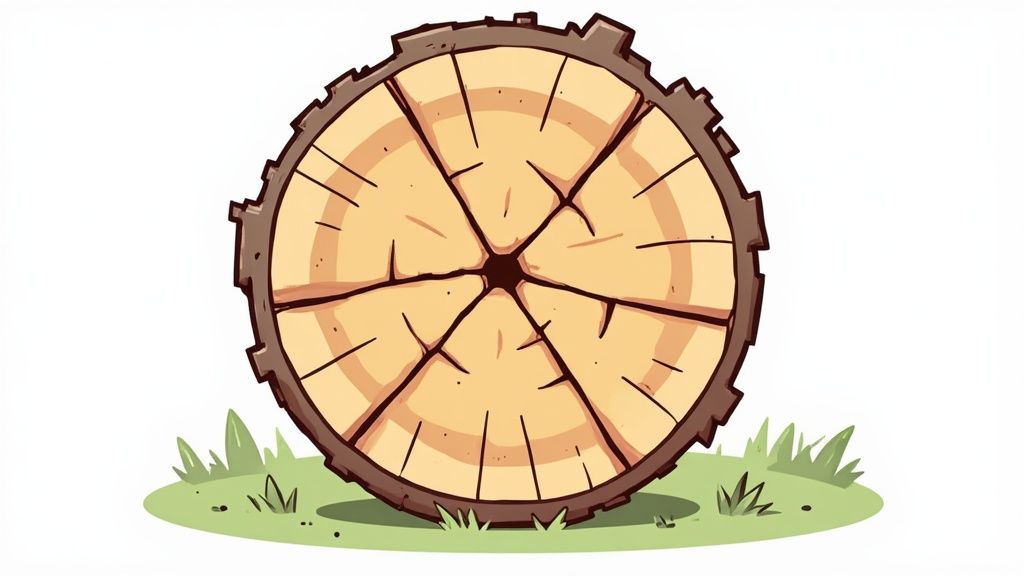
While leaves give you a real-time snapshot of a tree’s health, the trunk and branches tell a much deeper story. Think of this woody framework as the tree’s historical record, its circulatory system, and its skeleton all in one.
When you see trouble here, it often points to significant, long-term problems that can threaten the tree’s stability and its very ability to move water and nutrients. Unlike leaf issues that can come and go with the seasons, problems on the trunk and branches are often permanent and far more dangerous.
Cankers and Wounds: The Telltale Signs
One of the first things I look for on a trunk or branch is a canker. These are essentially dead zones, often looking sunken or discolored, maybe with cracked, calloused edges. They're usually caused by a fungus or bacteria that got in through a wound—maybe a bad pruning cut or damage from a storm.
A canker is a serious problem because it slowly strangles the branch or trunk, cutting off the flow of life-giving sap. Here’s what to keep an eye out for:
- A Sunken Look: The spot looks like it's been pressed in compared to the healthy bark around it.
- Odd Colors: The canker might be darker, lighter, or even have a strange orange or reddish tint.
- Target-Like Rings: Some fungal cankers, like Nectria, form concentric rings as the infection spreads year after year.
Imagine a canker as a festering wound that the tree is desperately trying to seal off. That raised ridge of tissue you might see around the edge is the tree's attempt to build a wall against the infection.
Reading the Cracks and Peeling Bark
Not every crack spells disaster. Sometimes shallow vertical lines are just stretch marks from rapid growth. The ones that get my attention are the deep, serious cracks that expose the raw wood underneath. These are open invitations for wood-boring insects and decay fungi to move right in.
If you see bark peeling away in large sheets, that's a major red flag. It usually means the cambium—the thin, living layer just under the bark that creates new growth—is dead. This can be caused by anything from a lightning strike or sunscald to a very advanced disease.
A Note on Structural Integrity
Deep cracks, especially near the base of the trunk or where major limbs join, are a huge structural concern. If you spot these, it's time to call in a professional. Expert solutions like tree cabling and bracing services can sometimes provide the support needed to save a tree that's become structurally weak.
Fungal Growths and Oozing Sap
Fungi are another big clue. While the moss and lichens you see on bark are usually harmless, some fungi are a dead giveaway for internal decay.
- Mushrooms (Conks): Seeing a mushroom or a hard, shelf-like "conk" growing out of the trunk or a major root is an undeniable sign of advanced internal rot. The fungus has been quietly feasting on the wood for years; the mushroom is just its final reproductive stage.
- Fungal Mats: If you peel back a piece of bark and find a soft, fan-shaped mat of white growth, you're likely looking at a serious root rot disease like Armillaria.
Oozing sap, sometimes called gummosis, is the tree’s cry for help. It’s a response to stress, whether from insect borers, canker diseases, or a physical wound. A little clear sap might be nothing to worry about, but if it’s constantly oozing or turns into a dark, foul-smelling liquid (we call that slime flux), you’re dealing with an active bacterial infection.
When Your Environment Is the Real Culprit
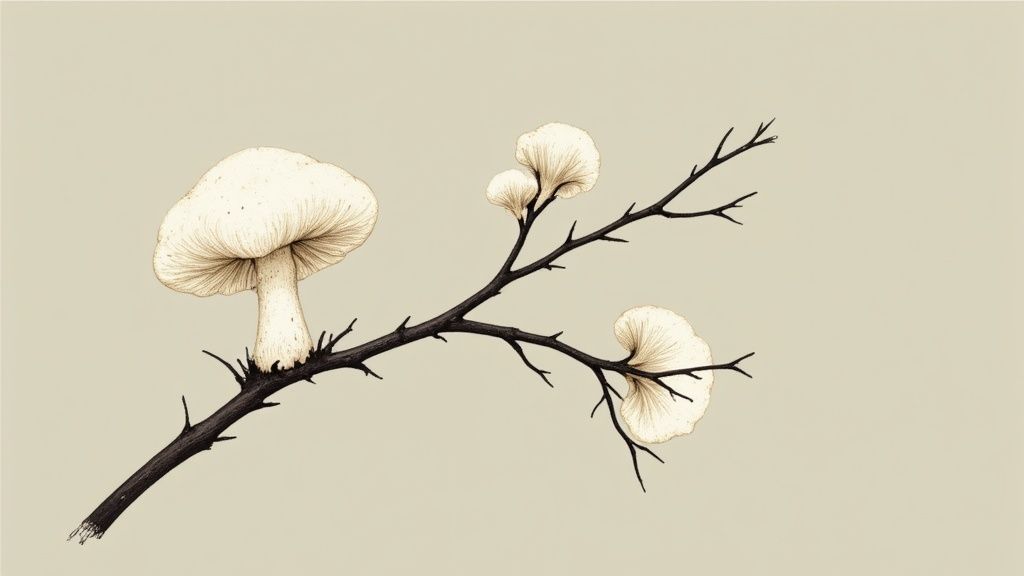
It’s completely natural to see yellowing leaves or thinning branches and immediately assume some nasty disease is at play. I've seen it countless times. But before you start mixing up a fungicide, take a deep breath and look at the bigger picture.
More often than not, what looks like a disease is actually the tree's cry for help against its surroundings. In the tree world, we call this abiotic stress, and it’s one of the most common—and misdiagnosed—issues out there. These environmental problems can perfectly mimic the symptoms of a pathogen, sending you down a rabbit hole of ineffective treatments.
Water Woes: Overwatering and Drought
Water is everything to a tree, but getting the balance wrong is a recipe for disaster. What’s tricky is that both extremes—too much and too little—can look surprisingly similar.
If your tree’s leaves are yellow but still feel limp and pliable, you might be overwatering. Waterlogged soil essentially suffocates the roots, cutting off their oxygen supply. The tree is literally drowning from the ground up. I see this a lot in landscapes with heavy clay soil or in low spots where water just sits.
On the other hand, if the yellow leaves are wilting and feel brittle or crispy at the edges, you’re likely looking at drought stress. The soil will be bone-dry. This kind of stress is a major problem because it hammers a tree's immune system, making it an easy target for opportunistic pests and secondary diseases that move in for the kill.
Soil and Root Zone Problems
A tree's health is built from the ground up. What’s happening below the surface in the root zone has a massive impact on everything you see above ground.
Soil Compaction is a silent killer, especially in urban and suburban yards. Foot traffic, heavy mowers, or parking a car under the canopy can squeeze the air out of the soil. Without those tiny air pockets, roots can't breathe. The signs are often subtle at first:
- Stunted growth with very little new wood each year.
- A thin canopy that you can easily see daylight through.
- New leaves that are noticeably smaller than they should be.
Another huge one is improper planting depth. If a tree is buried too deep, the root flare—that natural taper where the trunk meets the ground—is covered. This often leads to girdling roots that wrap around the trunk and slowly choke the life out of the tree by cutting off water and nutrients.
Pro Tip: Go out and look at the base of your tree. You should see the trunk widen slightly as it enters the soil. If it looks more like a telephone pole going straight into the ground, there's a good chance it was planted too deep.
Recognizing Chemical and Physical Damage
Sometimes the problem isn't a disease or a soil issue but something we did. Learning to spot these clues can save you a lot of guesswork.
Herbicide drift is a classic. Someone sprays weed killer on a windy day, and the mist settles on your tree's leaves, causing them to curl up, twist, and look deformed. The tell-tale sign is that the damage often appears suddenly and is usually concentrated on just one side of the tree—the downwind side.
In colder climates, winter brings salt damage. The salt sprayed on roads to melt ice can splash onto branches or build up in the soil. The result is often scorched, brown needles on evergreens and dead branch tips on other trees. You’ll almost always see the worst damage on the side of the tree facing the street. This stress carries over, and as research shows, stressors like drought significantly reduce a tree's ability to grow, leaving it vulnerable. You can learn more from the global study on tree rings and drought impact.
Deciding When to Call a Certified Arborist
Even with a good field guide in hand, there are times when you have to know your limits. Being a responsible property owner means recognizing when a problem is out of your league. Some tree symptoms aren't just cosmetic—they point to serious structural problems that need a professional eye.
Think of it this way: making the call to an expert isn’t giving up. It’s a smart, proactive move to keep people safe and give your tree the best possible shot at survival.
Red Flags That Demand an Expert Opinion
So, how do you tell the difference between a minor leaf spot and a genuine hazard? It comes down to recognizing the signs of structural failure. A few discolored leaves might be treatable, but the following symptoms are immediate red flags. If you see any of these, it's time to stop guessing and get a professional on the phone.
You should seek an expert opinion right away if you spot:
- Large Dead Limbs: Any dead branch bigger than a few inches around is a major concern, especially if it's high up in the canopy. We call these "widow-makers" for a reason.
- Deep Trunk Cavities or Cracks: Big openings in the trunk are a gateway for extensive internal decay. This rots the tree from the inside out, severely weakening its core.
- Significant Leaning: A tree that suddenly starts leaning, or leans progressively more over time, is a huge warning sign. Check the ground around the base—if it looks like it’s heaving or cracking, you could be looking at root failure.
- Fungal Growth at the Base: Seeing mushrooms or hard, shelf-like fungi (conks) growing on the trunk or near the roots is a classic sign of advanced internal rot. The fungus you see is just the tip of the iceberg.
These are not DIY situations. Assessing them requires specialized equipment and a deep understanding of tree biology and physics. Trying to handle it yourself isn't just ineffective; it can be incredibly dangerous.
An experienced arborist does more than just name the disease. They’re trained to assess risk, understand how different tree species fail, and create a plan that protects both the tree and your property.
What to Expect from a Professional Assessment
When you bring in a certified arborist, they take the guesswork out of the equation. They have tools and techniques that go far beyond what you can see with the naked eye. For instance, an arborist might use a resistograph to drill a tiny, harmless hole to measure the extent of internal decay or take soil samples to find a hidden nutrient deficiency.
This kind of professional insight is more important than ever. The challenges facing our trees are immense. Global data shows that about 34% of forest loss between 2001 and 2024 is likely permanent due to land use changes. You can read more about the drivers of global forest loss from WRI. Protecting the mature trees in our own backyards is a small but critical piece of that puzzle.
When you're ready to get that professional opinion, make sure you're hiring the right person. An ISA Certified Arborist has proven expertise. For homeowners in the Atlanta area, you can learn more about what to look for and what the process entails by reading up on hiring a certified arborist in Atlanta, GA. A true pro will give you a definitive diagnosis and a clear action plan, giving you peace of mind.
Got Questions About Tree Diseases? We've Got Answers.
When you're trying to figure out what’s wrong with a tree, it's easy to go down a rabbit hole of questions. Even after a close look at the leaves and bark, you might still be unsure what to do next. Let's tackle some of the most common questions we hear from homeowners trying to get to the bottom of their tree problems.
We want to help you cut through the noise and feel confident about how to care for your trees. We’ll cover everything from a tree's amazing ability to heal itself to the real-world usefulness of those new-fangled apps.
Can a Sick Tree Just Get Better on Its Own?
This is a great question, and one we hear all the time. The honest answer is a solid "it depends." Trees are remarkably tough. They have a built-in defense mechanism called compartmentalization, which allows them to form barriers to wall off disease or decay and stop it from spreading.
You’ve probably seen this yourself with the "wound wood" or callus that forms around an old pruning cut. But this natural armor isn't invincible. A young, healthy tree might shake off a minor fungal leaf spot without any help.
The trouble starts when a tree is already stressed out from things like drought, compacted soil, or simply old age. Its defenses are down. Aggressive diseases, like Dutch elm disease or sudden oak death, can easily overpower a weakened tree's ability to compartmentalize. In those situations, the tree absolutely cannot heal on its own, and you need to step in to have any chance of saving it.
The Bottom Line: A tree's ability to heal is directly linked to its overall health and how severe the disease is. Don't just assume a serious symptom will disappear. A "wait-and-see" approach can be a death sentence for a struggling tree.
How Can I Find Out What Diseases Are Common Around Here?
Knowing what you’re up against locally is a massive advantage. Some diseases are only found in specific regions because of the climate, soil, or types of trees that grow there. The issues facing oaks in California are completely different from what you’d find with maples in Georgia.
Your absolute best resource for this is your local university cooperative extension office. These offices are treasure troves of information, staffed by horticulture experts who are there to help the public. They publish fantastic, science-based guides on disease outbreaks happening right in your county.
Just search online for "[Your State] university extension tree diseases," and you'll find a ton of localized information. It’s a game-changer because it gives you a much shorter list of potential culprits, making your detective work a lot more accurate.
Are Those Tree ID Apps Actually Any Good for Diagnosing Diseases?
Lately, smartphone apps that claim to identify plants and diseases from a photo have popped up everywhere. They can be a fun place to start and, to be fair, they're often pretty good at telling you what kind of tree you have.
When it comes to diagnosing a disease, however, their reliability takes a nosedive. An app might correctly see "brown spots" on a leaf, but it just doesn't have the nuance to tell the difference between the dozens of things that could be causing them.
Here’s a quick look at the good and the bad:
- The Good: They’re fast, convenient, and great for a quick species ID.
- The Bad: They often get the disease wrong, can't consider environmental factors (like poor drainage or herbicide damage), and completely miss structural problems like root rot or cankers on the trunk.
Think of an app as a digital field guide, not a certified arborist. It can give you a clue, but you should never make a final treatment decision based on what an app tells you, especially if it’s a tree you really care about. A real diagnosis means looking at the whole picture—the tree and its surroundings—and that still takes an experienced human eye.
When you need answers from a pro, Richmond Tree Experts GA is ready to help. Our ISA Certified Arborists have the field experience and diagnostic tools to give you a definitive assessment and a clear plan for your trees. Protect your property's valuable green assets with a professional consultation. Visit us at https://richmondtree.com to schedule your appointment today.
Not sure what your tree needs? Richmond Tree Experts has worked on Marietta and Metro Atlanta trees since 1985, and every job is looked at by an ISA Certified Arborist before it is priced. Start with an ISA Certified Arborist evaluation, or see everything we do: tree removal, stump grinding and arborist services across Cobb, Fulton, Cherokee, Gwinnett and DeKalb counties (service areas).
Call (770) 974-3964, 7am to 11pm every day, or request an estimate online.

