

Trim every tree every year. That's the advice you'll hear most often, and it's wrong for most trees in North Atlanta. Annual cutting on a healthy shade tree removes live canopy it didn't need to lose, opens wounds it has to seal, and trains fast, weak regrowth you'll pay to cut again next year.
A better rule is simpler. Inspect every year, trim only when you have a defined reason. How often should trees be trimmed depends on age, species, structure, and risk, not on an automatic subscription. The schedule below gives you a starting interval you can use today in Marietta, Roswell, Kennesaw, Woodstock, Acworth, and Canton, then shows you when condition should override it.
Trimming Intervals by Tree Type and Age
Start with the tree's situation, not the month on the calendar.
| Tree situation | Recommended interval | What the cut is for |
|---|---|---|
| Newly planted, first five years | Inspect and prune every other year | Build strong structure and remove competing leaders |
| Established shade or ornamental | Inspect yearly; trim on a 5-8 year cycle when condition calls | Remove dead, broken, diseased or weak wood |
| Fast-growing or structurally defective | Assess more often than the general cycle | Catch defects early |
| Fruit trees (apple, pear, stone fruit) | Every year, late winter or early spring | Scaffolds, light, airflow and fruit balance |
| Neglected mature tree | Restore over two or three seasons | Limit stress from heavy cuts |
| Dead, broken or hazardous limbs | When found, outside the cycle | Safety, not the schedule |
Young Trees Need Structure First
The USDA Forest Service fact sheet on pruning young trees reports that young trees should ideally be inspected and pruned every other year during the first five years after planting. That early work establishes strong branch architecture, removes competing leaders and poorly attached limbs, and lowers the corrective work required later.
Small cuts now are cheap. A competing leader removed with hand pruners or a pole saw at year two is a different job from a codominant stem that needs a bucket truck and rigging at year fifteen.
Established Trees Run on a Longer Cycle
For mature trees, that same USDA guidance indicates a return interval of approximately five to eight years is usually sufficient for many older trees. It also notes that a tree left unpruned for 10 years generally takes longer and costs more to prune than one maintained a few years earlier. That's the trade-off. Waiting too long doesn't save money, it defers it into a bigger, riskier visit.
Oaks, maples, pines, and dogwoods across Cobb County, Cherokee County, and North Fulton generally follow this cycle. Move a tree to closer assessment if it's fast growing, carries heavy limbs over a roof or driveway, sits near a building or utility corridor, or already has a structural defect.
Test for today: If a tree hasn't been inspected in the last twelve months, book the inspection before you decide whether it needs a cut.
Fruit Trees Are the Exception
Fruit trees don't follow the shade tree cycle. Apples, pears, and stone fruits need annual pruning in late winter or early spring, after the coldest weather but before bud break, as described in the University of Minnesota Extension guide to growing stone fruits. The goal isn't size for its own sake. It's well spaced scaffold branches, light penetration, airflow, and balance between leafy growth and fruit.
Don't overdo it on young fruit trees. Excessive pruning can delay fruiting and push leafy shoots instead. For a neglected mature fruit tree, I'd phase restoration over several seasons rather than trying to fix it in one severe visit.
Purpose also sets priority. Safety work follows the inspection immediately. Structural work belongs in the early years or the dormant season. Aesthetic shaping can wait until the tree's cycle naturally calls for it. When seeking tree trimming or tree pruning in Marietta or Roswell, ask which of those three purposes the visit serves.
How Much Canopy to Remove in One Visit
Interval is only half the decision. Dose matters just as much. A light, well timed cut every few years does less harm than one aggressive reduction meant to buy you a decade.
Municipal specifications based on ANSI A300 commonly limit routine pruning to no more than 20% of a tree's live tissue in one calendar year, according to the San Francisco tree pruning standards. That document notes one specification allows up to 30% only for restoration pruning, and even then recommends several pruning cycles over multiple years. It also states that shoots should be removed at intervals of three years or less in the applicable maintenance context.
Treat those numbers as ceilings, not targets. If a crew can't explain why a healthy mature tree needs anywhere near the maximum, don't approve it.
Why Heavy Cuts Backfire
Remove too much canopy at once and the tree responds with stress and a flush of weakly attached shoots. You also create larger wounds that take longer to seal. The canopy looks smaller for a season, then fills back with worse structure than you started with.
Our tree pruning basics guide explains the cut placement behind this, but the planning point is plain. Frequent heavy trimming is a sign the wrong tree is in the wrong place, and relocation, growth regulation, or replacement can be better options than repeating the same hard cut.
One and done trimming usually creates the next problem. It rarely solves the current one for long.
A Phased Example
Say you have a mature oak in Woodstock that nobody has touched in ten years. It has deadwood over the driveway, two limbs rubbing, and branches touching the roof.
Year one should handle deadwood, the broken or rubbing limbs, and only the clearance needed to get branches off the house. Year two or three, after you've seen how the tree responds, a crew can do limited structural reduction if it's still justified. That keeps each visit inside the live tissue limit and avoids shocking the tree.
Before you approve any crown reduction, ask three questions.
- What's the objective: Is it deadwood, clearance, structure, or hazard reduction, stated in plain words?
- What percentage is coming off: Will the crew name a number and keep it at or under the ceiling?
- What's left for next time: If the answer is nothing, you're probably being sold too much work at once.
For property managers across North Metro Atlanta, those three answers belong in the written scope. They turn a vague tree cutting service visit into measurable work.
When to Trim Trees in the Atlanta Area
In Atlanta, seasons shape the work more than a specific calendar date. The chart below shows how I'd sequence the year.
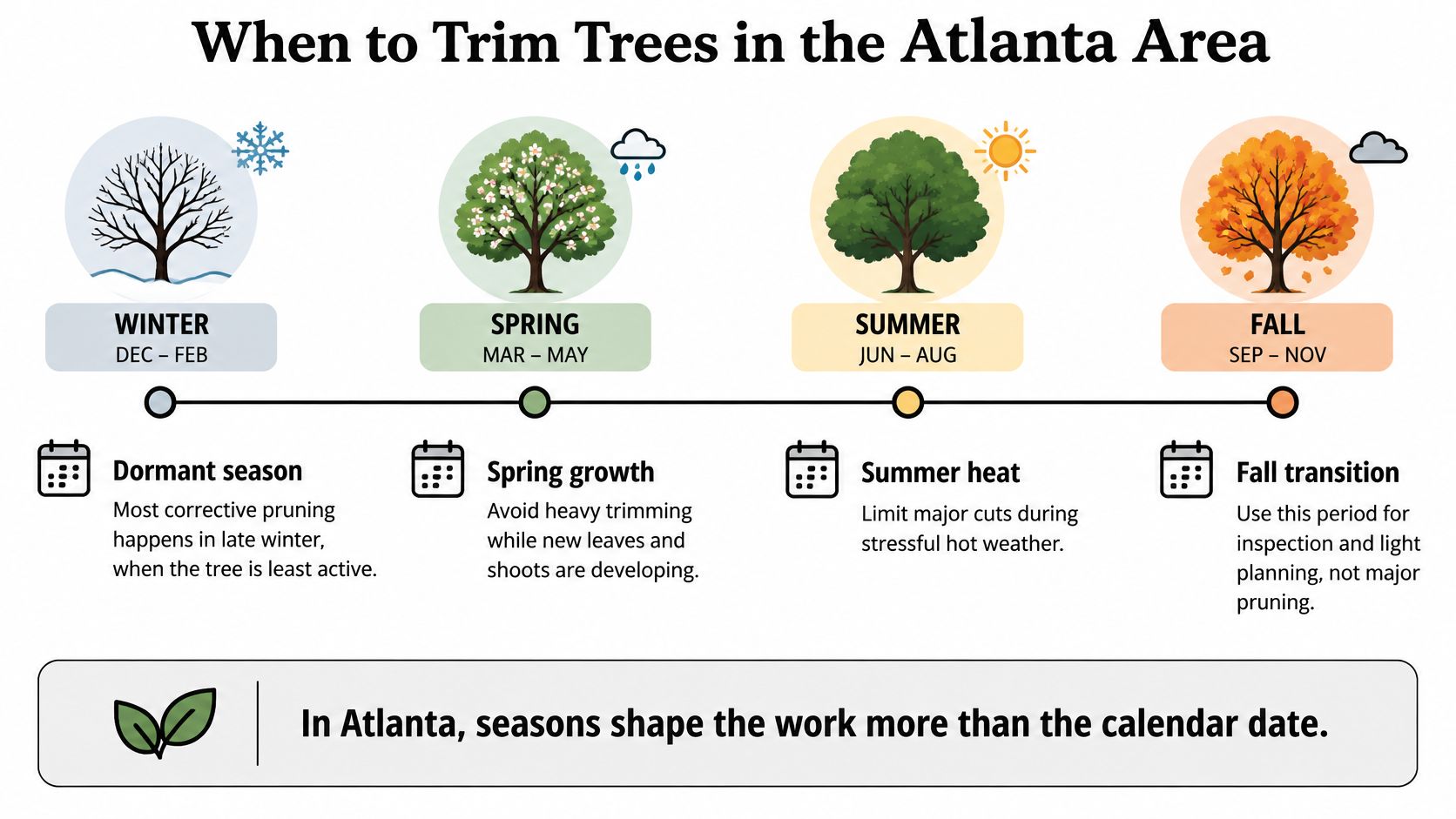
Late winter to early spring is generally the preferred window because branch structure is visible without foliage, sap flow and insect activity are lower, and wounds have a longer period to begin sealing before vigorous growth, according to the University of Minnesota Extension guide to pruning trees and shrubs. That guide also sets the primary inspection interval as annual, with pruning when dead, broken, diseased, crossing, or structurally weak branches are identified.
The Year in Order
- Dormant season: Inspect structure while leaves are off, then make most corrective, structural, and deadwood cuts.
- Spring growth: Hold off on heavy cuts while the tree is pushing new leaves and shoots.
- Summer heat: Limit major work during stressful hot weather to light clearance and hazard removal.
- Fall transition: Inspect, photograph, and plan dormant season work instead of starting major pruning.
Newly planted trees start structural training during the first dormant season. Remove competing leaders, crossing limbs, and branches growing toward the center, and don't reduce the central leader without a reason. Young trees deserve more frequent checks because a weak union corrected early stays a small cut.
The short video below shows what a dormant season structural assessment looks like in practice.
Hazardous dead or storm damaged limbs are the exception. They come off whenever they appear, in any month. After a major storm in Kennesaw, Acworth, or Canton, inspect before you assume a cracked limb can wait until winter.
Inspect in winter, cut in the dormant window, and act on hazards immediately.
Signs a Tree Needs Trimming Between Cycles
Dead branches are the sign homeowners notice first, and they should. Deadwood over a walkway, driveway, or roof isn't a scheduling question. It's a removal job in any season, because dead limbs don't get stronger while you wait.
Use the signs below to decide whether a tree stays on its cycle or moves up.
| Sign | What it usually means | Action and timing |
|---|---|---|
| Dead or dying branches | Deadwood, disease or stress | Remove in any season |
| Crossing or rubbing limbs | Wounds where decay can enter | Thin in the dormant season |
| Two similar stems forming a narrow V | Weak codominant union | Early training; arborist check on mature trees |
| Limbs over roof, drive or sidewalk | Clearance conflict | Clearance pruning within the 20% limit |
| Broken or cracked limbs | Storm or hazard damage | Remove promptly; call an arborist if large |
| Conks, cankers or oozing wounds | Possible decay or disease | Arborist diagnosis before cutting |
How to Read Each Sign
Crossing or rubbing limbs wound each other every time the wind moves them. Bark wears through, moisture gets in, and decay follows. Thin one limb in the dormant season while the damage is still superficial.
A narrow V with two stems of similar size is a codominant union. Bark gets trapped inside the fork instead of forming a strong connection. On a young tree, subordinate one stem early. On a mature tree, don't guess. Get an assessment before anyone cuts, because removing the wrong stem can destabilize the canopy.
Limbs over a roof, driveway, or sidewalk call for clearance pruning, not topping. A good crew raises or reduces specific branches, hauls away the material, and leaves the tree's natural form intact. If you're comparing a tree service in Roswell or Marietta for this work, the scope should name the limbs, not just promise to shape the tree.
When Two Signs Appear Together
One sign may justify moving a trim forward by a season. Two or more signs together should move the tree up the schedule now. A codominant union plus a crack, or conks at the base plus deadwood in the crown, points to a tree that needs diagnosis rather than routine trimming.
Conks, cankers, or oozing wounds deserve that caution. Cutting first can spread infected material and remove the evidence an arborist needs. Photograph the sign, note where it sits on the trunk or limb, and book the assessment.
Don't trim on instinct. Match the sign to the action, and if you can't name the objective, you're not ready to cut.
When Trimming Turns Into Hazard Work
Four conditions turn a trim into a hazard call: a leaning trunk with fresh soil heave at the base, a crack through the trunk, a large limb hanging over a home, and a tree that has partly fallen in a storm. If any one is present, the trimming schedule stops. These are emergency tree removal and hazardous tree removal situations, not weekend projects.
A leaning trunk is under load. Cutting limbs off the wrong side can shift that load and bring the tree down on the cutter. Stay clear, keep people and pets inside, and call a licensed and insured crew equipped for fallen tree removal and storm damage tree cleanup. The tree risk assessment service fits this decision point: whether a tree can be pruned back to safety or needs to come down.
The Marietta Permit Checkpoint
An urgent-looking tree is not automatically exempt from local rules. In Marietta, dead, dying, diseased, infested, or otherwise hazardous trees on regulated development sites may be removed only after the property owner submits a Notification of Tree Removal and city staff verifies the tree's condition before removal, under the City of Marietta tree protection ordinance.
Prepare before you call the city.
- Photograph the damage: Take clear photos before anything is moved, for the permit record and any insurance claim.
- State the reason: The application requires the owner's information, the reason for removal, and supporting documentation.
- Document condition: Note lean, cracks, conks, or dead sections so staff can verify what you reported.
Richmond Tree Experts GA checks the tree rule for each parcel before quoting and files whatever paperwork the job needs. That step matters in Cobb County and Cherokee County too, because rules change by city and by whether the tree sits in a buffer or right of way.
If the tree isn't clearly yours, confirm responsibility before you hire a crew.
Safety rule: Never approach a tree tangled with a downed power line, and never cut into a trunk that is still under load.
After a storm, call early. Tree removal near me searches spike after severe weather, and good crews book fast. Confirm licensing and insurance and ask for a realistic response time in writing before work starts.
Building a Maintenance Plan for Homes and Properties
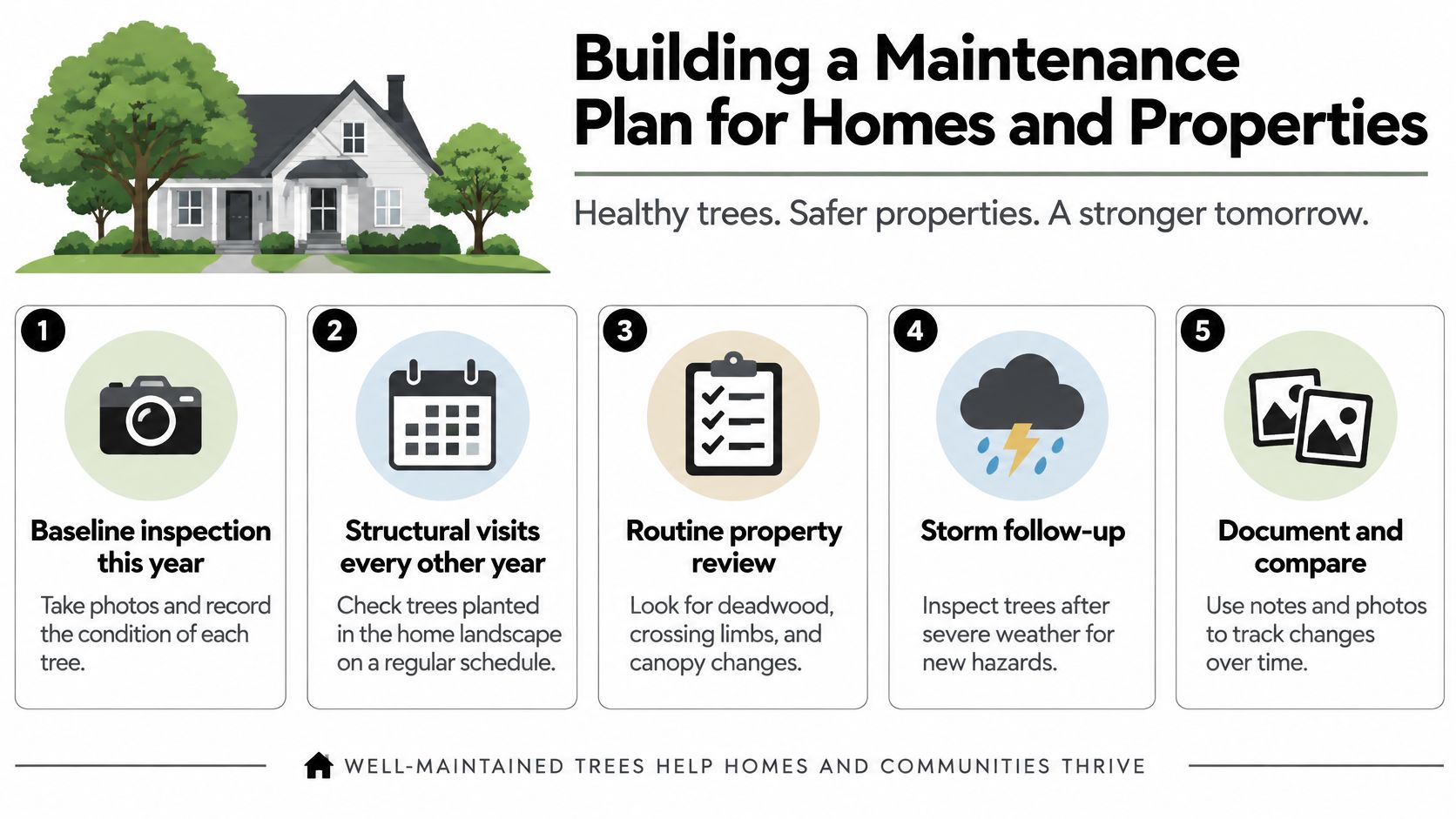
A plan you can run fits on one page. No software required. Dates, photos, and a named objective for every tree.
The Homeowner Version
Start with a baseline inspection this year. Walk the property, photograph each tree from the same angle you will use next year, and note deadwood, cracks, lean, and clearance conflicts. For trees planted in the last five years, schedule structural visits every other year. For established trees, walk the property annually after the dormant season and trim on the longer cycle only when the inspection gives you a reason.
Add one more trigger. Inspect after any major storm, even if nothing fell. Cracked limbs can hang for weeks before they drop. The residential tree care page explains how those inspections connect to pruning, stump grinding, and removal when a tree cannot be saved.
The Property Manager Version
Properties with many trees need an inventory, not memory. Record species, approximate age, location, and a simple risk rating for each tree. Then set a next inspection date per tree and a budget line per cycle, so tree removal, stump grinding, and routine pruning do not compete for the same unplanned dollars.
Deadline discipline matters here. A missed inspection date turns a small clearance issue into an emergency call. For other deadline-driven property work, the same rule applies, as with 1031 exchange timelines and deadlines. Keep the tree dates visible and the cost stays predictable.
Be honest about what current evidence proves. A 2024 pilot study in Arboriculture and Urban Forestry analyzed 24 study trees and found no statistically significant difference among the tested tree trimming frequencies. That is a small pilot, so it does not prove frequency never matters. It does support building your plan on condition and clear objectives rather than paying for the most frequent visit by default.
Your One Page Checklist
- Tree list: Species, location, and approximate age for every tree you own.
- Inspection date: The last date each tree was checked, with photos attached.
- Objective: Structure, clearance, deadwood, health, or hazard, one per tree.
- Percentage to remove: The amount planned for the next visit, kept under the ceiling.
- Next review date: Written down now, not decided when something falls.
Book a Trim Assessment With a Certified Arborist
Four outcomes are possible for each tree: trim it, give it a clearance cut, assess its health, or remove it. That call shouldn't be made from a photo alone.
Gather what an arborist will ask for before you call. Note the species if you know it, photograph the whole tree and any damage, list the warning signs you've spotted, and name your objective: safety, clearance, structure, or appearance. That preparation makes the site visit faster and the estimate more accurate.
Every job we price is looked at by an ISA Certified Arborist first. The scoping arborist tells you whether the tree needs to come down, can be pruned back to health, or is fine to leave alone. Estimates are free anywhere we work across Atlanta's north metro, and you get a written price after the visit. Price depends on the tree's height, trunk diameter, what sits underneath it, and how much room the crew has to work, so those numbers get set on site.
Take these four steps this week.
- Inventory your trees with species, approximate age, and location.
- Check each tree against the interval table to see where it sits in its cycle.
- Book an assessment for any tree showing two or more warning signs.
- Put the next review date on the calendar for everything else.
The first two steps take an afternoon. They'll tell you which trees can safely wait years and which can't wait another storm season. A tree with two warning signs and a target nearby gets no benefit of the doubt.
If a tree on your property in Marietta, Roswell, or anywhere in North Atlanta is leaning, cracked, dropping deadwood, or overdue for inspection, Richmond Tree Experts GA will send an ISA Certified Arborist to assess it and give you a free written estimate. You'll get a straight answer on whether it needs trimming, treatment, or removal, and a schedule built on the tree's condition rather than a sales cycle.

