

You're standing in a Marietta or Roswell yard after a storm, saw in hand, looking at a water oak limb over the roof and a crape myrtle that hasn't been touched in years. Cutting the wrong limb, or the right limb in the wrong month, can cost you shade, flowers, and structural strength. Tree pruning basics come down to three decisions you make before you cut: timing, objective, and amount.
Best Pruning Times for Common Atlanta Trees
| Tree | Best window | Avoid | Why it matters |
|---|---|---|---|
| Water oak and willow oak | Late winter, before buds swell | Spring through midsummer | Beetles and oak wilt risk peak in warm months |
| Bradford pear | Late winter | Late spring and summer | Early cuts fix weak branch unions before they split |
| Dogwood, redbud and flowering cherry | Right after flowering | Late winter | Next year's flower buds form on old wood |
| Crape myrtle | Late winter | Topping in any season | Topping creates weak, fast regrowth |
| Japanese maple | Late summer or late fall | Early spring | Avoids heavy sap flow and cutting into active growth |
| Southern magnolia | Late winter to early spring | Hot summer | Lower limbs can be removed; heavy cuts stress the tree |
| Loblolly and Virginia pine | Winter | Spring and early summer | Fresh wounds attract bark beetles |
| Dead, broken or diseased limbs | Any time | None | Safety removal should not wait for the season |
One universal pruning month doesn't work in North Atlanta. The Purdue Extension pruning guidance notes that most ornamental pruning is commonly scheduled in late winter or early spring, yet living-wood cuts can recover fastest in late spring or early summer, when growth and wound-response cells are active. Dormant pruning can also stimulate vigorous regrowth from redistributed reserves, so winter isn't automatically gentler.
Oaks and Flowering Trees Need Opposite Logic
Water and willow oaks are the hard case in Kennesaw, Woodstock, and Canton yards because they're common, large, and often overhang homes. I would schedule live cuts for late winter and avoid spring through midsummer, when beetles are active and fresh wounds carry more disease risk. If a limb is dead or hanging after a storm, remove it anyway. Safety outranks season.
Flowering trees reverse the rule. Dogwood, redbud, and flowering cherry set next year's buds on old wood, so late winter tree trimming removes the bloom you wanted. Prune them right after flowering instead. Bradford pear belongs in late winter while you can see and correct narrow, weak unions, and pines belong in winter because fresh wounds in spring attract bark beetles.
Practical rule: Check the bloom or leaf-out date for that species before you schedule any live cut.
Avoid unnecessary live pruning during heat or drought stress in Cobb County and Cherokee County summers. A stressed tree has less energy to close wounds, and a light job can wait for cooler, moister weather.
Set Your Pruning Goal Before You Cut
Name the objective in one sentence before you pick up a saw. If you can't state it, pause. Tree pruning with a vague goal like "make it look thinner" usually removes healthy interior growth and leaves the actual defect in place.
- Remove deadwood: Take out dead, diseased, broken, or hazardous branches, such as a snapped pine limb hanging over an Acworth driveway.
- Improve clearance: Raise or reduce limbs over roofs, sidewalks, driveways, and service drops. A water oak limb scraping a Marietta roofline needs clearance, not general thinning.
- Reduce risk: Correct weak unions and co-dominant stems before they split. This is hazardous tree removal prevention, not cosmetic tree cutting service work.
- Build structure: On a young willow oak in Roswell, choose three to five well-spaced scaffold limbs with wide angles in the first few years.
Each goal points to different branches. Clearance work targets low limbs and roof conflict. Structural work targets crossing branches, water sprouts, and competing leaders. Risk work targets the union or limb that could fail over a target.
The One-Sentence Test
Before each cut, run a short checklist. What's the target branch? What's the defect or conflict? Where will the final cut sit, and how much live canopy does the whole job remove?
If the answers blur together, you're not pruning to an objective. You're guessing, and the tree pays for it.
How Much Live Canopy You Can Safely Remove
Start with branch size, then check the whole crown. Small branches are easier for a tree to close over. Large limbs leave large wounds, and one oversized wound can cost more than several small, well-placed cuts.
- Under about 2 inches: Generally acceptable candidates if they meet your objective.
- About 2 to 4 inches: Reconsider. Confirm the objective and test whether reduction, rather than full removal, solves the problem.
- Over 4 inches: Needs strong justification and an arborist review before any cut.
The Crown Limits
The USDA tree and shrub pruning fact sheet says not to remove more than 25% of a tree's live canopy in a single year, while maintaining approximately one-half to two-thirds of the tree's total height in living branches. It also warns against pruning more than two-thirds of total height.
Leaves power growth and stored-energy production. Take too much live canopy and you create stress, sun exposure on bark that was shaded, weak sprouts, and lower resilience before the next storm. Young trees tolerate more removal than mature trees, so a mature oak in a Woodstock backyard deserves a lighter hand than a newly planted maple.
Use a 40-foot water oak as a worked example. Living foliage should cover roughly the upper 20 to 27 feet. If your plan would strip the lower crown up to a bare trunk with a tuft on top, it's too much.
If a plan takes more than a quarter of the live crown this year, split it across two or three years.
Staging feels slow. It keeps the tree photosynthesizing while you work toward clearance or structure, and it's cheaper than paying later for decline, tree removal, and stump grinding because you overcut a tree that could have been kept.
How to Make a Proper Pruning Cut
The sequence matters as much as the saw. This diagram shows the collar identification step that controls where every final cut lands.
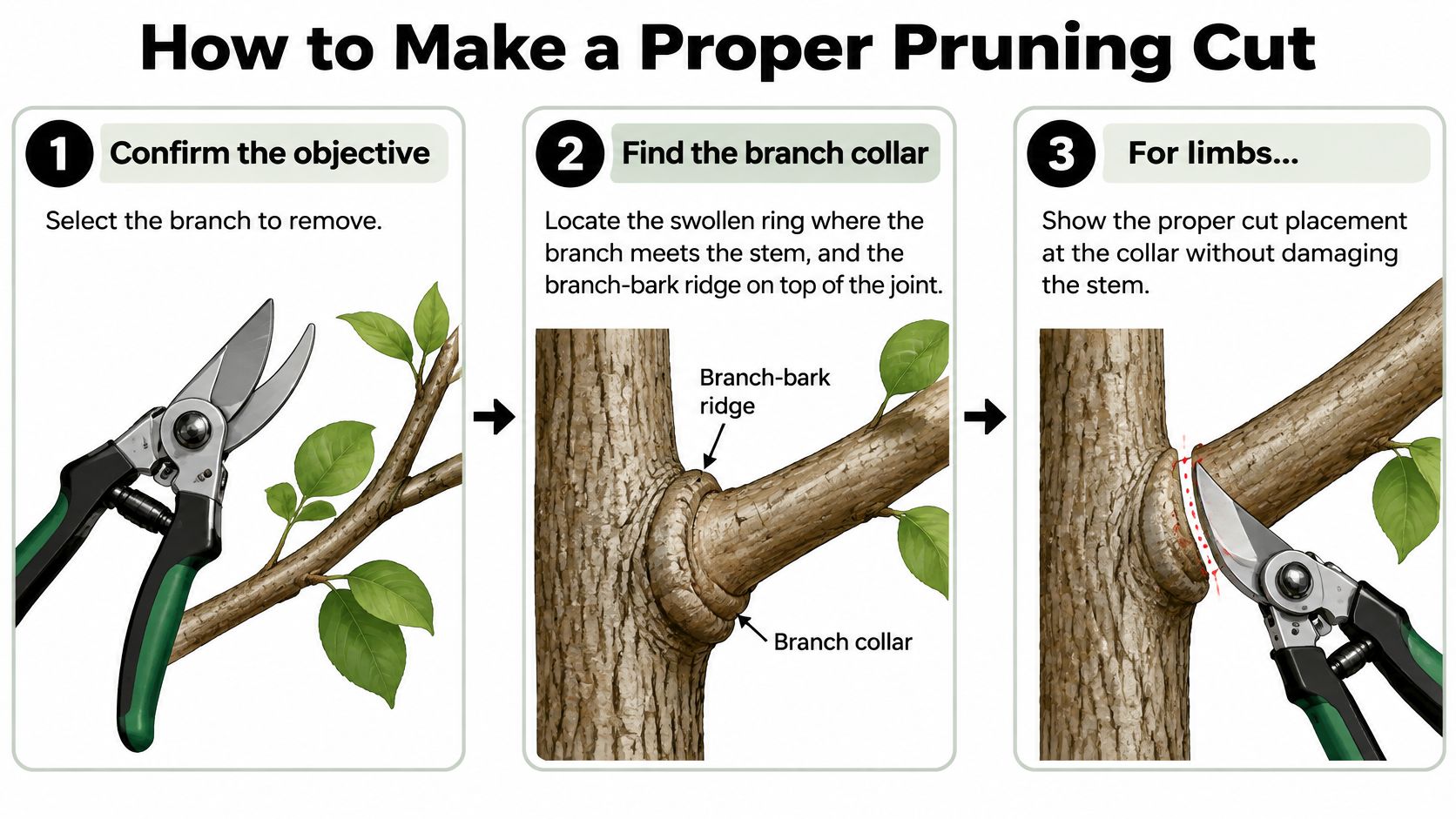
- Confirm the objective. Select the branch that is dead, diseased, broken, interfering, or hazardous. Don't move to tools until that branch earns its removal.
- Find the branch collar and branch-bark ridge. The collar is the swollen ring where branch meets stem, and the ridge sits on top of the joint. The Iowa State Extension pruning guidance directs the final cut just outside the collar, avoiding flush cuts and retained stubs.
- Make an undercut on larger limbs. For limbs larger than about 2 inches, undercut 12 to 18 inches out from the trunk. This stops bark stripping as the limb starts to fall.
- Make the top cut outside the undercut. The limb drops cleanly without tearing bark down the trunk. Control the drop zone before you start.
- Make the final cut just outside the collar. Leave no stub and don't cut flush into the trunk. The collar contains tissue involved in wound compartmentalization, and cutting through it increases the exposed wound area.
- Check the finished cut. It should be clean and slightly angled, with bark intact and no ragged tear. A ragged finish means your blade or sequence failed.
- Reduce to a strong lateral when you're not removing the limb. End the cut on a lateral branch at least one-third the diameter of the parent limb, as the Iowa State guidance specifies that benchmark.
Watch the three-cut sequence in motion before you try it on a limb you care about.
Tool Choice
Use bypass pruners for stems under 1 inch. Use loppers up to about 2 inches, and switch to a sharp pruning saw beyond that. Anvil pruners crush live tissue, so keep them off live branches.
Clean, sharp tools make clean wounds. Dull tools tear bark and force you to saw longer in awkward positions, which is where homeowner injuries start.
When to Stop
Stop if the limb is heavy, above a roof, or near a power line. A loaded limb can roll, split, or spring when the cut releases. That work needs rigging and a trained tree service in Marietta or your local North Metro Atlanta city, not a ladder and optimism.
Pruning Mistakes That Weaken Trees
- Topping: Cut back to selective laterals instead of stubbing the crown, because topping triggers weak sprouts below large wounds that may never close.
- Long stubs: Cut just outside the collar instead of leaving a stub that dies back and rots into the stem.
- Heavy pruning during heat or drought: Postpone nonurgent live cuts until cooler, moister weather instead of adding wound stress to an already strained tree.
Topping deserves the strongest warning for Atlanta crape myrtles and older oaks. If you're deciding whether a proposed cut crosses that line, review what tree topping does to structure and regrowth before you approve the work.
The shade trade-off is measurable. A study of plane trees found severe table-topping increased leaf-level photosynthesis by 20% and transpiration by 56%, yet reduced whole-canopy photosynthesis by 47% and canopy latent heat flux by 82%.
In plain terms, remaining leaves work harder while the whole tree delivers far less shade and cooling. For a west-facing home in Kennesaw or Canton, that loss shows up as hotter rooms and higher summer energy use. More cutting doesn't mean more benefit.
Site conditions set the ceiling. Soil sealing, restricted root volume, drought, and pavement stress can amplify pruning impacts. A declining oak squeezed between a driveway and compacted soil may need soil care before heavier crown work, not another aggressive thinning.
Ask whether the site needs improvement first. Pruning a stressed tree harder rarely fixes why it's stressed.
A Yearly Pruning Schedule by Tree Age
Pruning frequency depends on a tree's age, condition, species, and site. Use this schedule as a starting point, then adjust for Atlanta's heat, drought, storms, and the tree's growth.
| Tree stage | Age or condition | Main task | How often |
|---|---|---|---|
| Young tree | 1 to 5 years | Select and space three to five scaffold limbs | Yearly in late winter |
| Establishing tree | 5 to 15 years | Clearance and removal of crossing limbs | Every 2 to 3 years |
| Mature tree | Over 15 years | Deadwood removal, safety check, light thinning | Every 3 to 5 years |
| Storm-stressed or declining tree | Any age | Remove broken limbs and assess the damage | After storms and as needed |
Young trees benefit from early structural pruning while branches are small. A Roswell maple shaped at age three, for example, may need only light clearance by age twelve because crowded limbs were addressed early. Late winter is a useful window, but avoid live cuts during heat or drought.
For mature trees, keep pruning restrained. Remove deadwood or address a specific clearance or safety concern; avoid thinning just because the calendar says it is time. If replacing a declining tree, choose a low-water species suited to Georgia soil, available space, and site conditions. You can find drought-tolerant trees for Austin for examples of low-water species habits, but confirm that any selection fits your Georgia property.
Keep a Simple Log
Record the year, pruning objective, branches removed, and approximate amount of live crown taken. Add a phone photo from the same spot each year. This makes it easier to track staged work and see whether clearance over the roof is improving.
Use the table as a prompt to inspect, not as an automatic cutting schedule. A young tree without structural pruning may need attention, while a mature tree without a specific issue may not need cutting that year.
Storm Damage Cleanup Without Risk
Keep people and pets away from a tree that struck a house, blocks a driveway, or lies across a line. Treat every downed wire as live, report it to the utility or emergency services, and don't test it. During a thunderstorm, stay indoors or in a vehicle with a roof.
After weather clears, handle only what you can reach from the ground. Small broken limbs under about 2 inches, cut at the collar with sharp hand tools, are homeowner work if nothing is under tension. If you're looking at a broken tree branch hanging over a roof or a leaning trunk, that's emergency tree removal and storm damage tree cleanup for a crew, not a homeowner climb.
Photograph damage before cleanup for insurance records. Then sort debris correctly. Yard trimmings such as leaves, brush, and shrub and tree prunings stay separate from household trash and can be chipped, composted, or mulched. Whole trees, stumps, and large limbs from land clearing fall under a different category, and fallen tree removal tied to site preparation can trigger extra rules.
Decide When to Call a Certified Arborist
A small, reachable dead branch may be safe to prune from the ground with sharp hand tools. Larger limbs, high cuts, and trees near structures call for an arborist's assessment. The risk changes quickly when wood is heavy, overhead, or under tension.
Get an assessment if a tree leans, loses bark, thins from the top down, or has a hanging limb. These signs can point to structural problems or decline. An arborist can assess whether pruning, treatment, or removal is appropriate before you commit to work.
What Professional Assessment Adds
Heavy, high cuts often require rigging to lower wood in controlled pieces. A mistake on a loaded limb can injure you, damage a fence, or leave a large wound. For tight access or difficult removals, crane-assisted equipment may be needed.
When comparing certified arborists near me, ask whether an arborist assesses the tree before pricing. At Richmond Tree Experts GA, every job is assessed by an arborist before it is priced. The scoping arborist tells you whether the tree needs to come down, can be pruned back to health, or is fine to leave alone.
That assessment can help you avoid paying for tree removal in Roswell or stump removal when corrective pruning may address the problem. It can also identify when pruning would leave a hazardous tree standing.
Before contacting an arborist, photograph the tree from two sides and write down your goal. If the work involves a large cut, get an assessment before proceeding. An arborist can consider the tree, access, and nearby targets rather than relying on a generic price.
For homeowners in Marietta, Roswell, Alpharetta, and nearby communities, an on-site assessment can clarify scope, access, and whether pruning or removal is the right approach.
If a limb hangs over your roof, an oak leans, or the tree shows signs of decline, arrange an arborist assessment before committing to pruning or removal. Visit Richmond Tree Experts GA to request an arborist evaluation, and we'll tell you whether the tree should be pruned, treated, or removed safely.

