

The storm has passed, but the oak beside your driveway is leaning toward the house. You're searching for tree removal near me, hoping someone can arrive quickly without turning an already stressful situation into roof damage, a permit dispute, or an unfinished cleanup.
Knowing how to hire an arborist means checking more than a certification badge or the bottom line on an estimate. Whether you need tree service in Marietta, Roswell, Kennesaw, Woodstock, Acworth, or Canton, the strongest hiring test is simple: Who assessed the tree, what exactly will the crew do, and who owns the permit responsibility?
Verify the Credential and Insurance Before You Compare Quotes
Start with the individual's credential and the company's insurance. A leaning oak needs a qualified assessment, not just someone willing to cut it down. Until that assessment happens, keep people, vehicles, and pets away from the area where the tree could fall.
Ask for the assessing arborist's full name and credential number, then check their current status in ISA's official certification directory. Don't substitute a company logo, a photograph of a certificate, or a salesperson's assurance for that check.
The International Society of Arboriculture's credential history explains that its Certified Arborist credential began in 1992; examination eligibility requires three years of full-time arboriculture experience, or a combination of relevant education and practical experience, followed by passing the professional examination.
Identify the person making the recommendation
Certification belongs to a person, not an entire company. A business can employ certified staff without sending that person to examine your tree. Ask who will inspect the root area, trunk, crown, nearby structures, and equipment access before recommending removal or pruning.
At Richmond Tree Experts GA, we have ISA Certified Arborists on staff, including ISA Master Certified Arborists. Our explanation of what an ISA Certified Arborist does can help you distinguish a tree-care assessment from an estimate based only on cutting and hauling.
Master-level expertise can be useful for complicated decisions, but it doesn't replace a site-specific safety plan. Match the assessor's qualifications to the actual problem, especially when a tree has structural defects, restricted access, or nearby utilities.
Verify coverage independently
Request general liability and workers' compensation certificates directly from the insurer. Look up the insurer's telephone number yourself and confirm that the named business, coverage dates, and operations match the contractor proposing the work.
Ask specifically about property damage involving structures and vehicles, and whether subcontractors are covered. A certificate isn't a promise that every possible loss will be paid, so clarify exclusions with the insurer rather than accepting the estimator's interpretation.
For rental owners, VerticalRent's guide to vetting maintenance professionals for rental properties provides useful context for organizing contractor checks and keeping records across properties. Tree work deserves the same documented scrutiny as other consequential maintenance.
Pre-hire verification checklist
| Check | What to request | Where to confirm |
|---|---|---|
| Individual ISA credential | Arborist's name and credential number | ISA's official certification directory |
| ISA Master Certified Arborist | Confirmation of master level for complex risk or removal work | ISA's official certification directory |
| General liability insurance | Certificate issued directly by the insurer | Insurer, using a phone number you look up yourself |
| Workers' compensation | Certificate naming the company and its crew | Insurer or state records |
| Property damage coverage | Certificate covering damage to structures and vehicles | Insurer, using a phone number you look up yourself |
| Municipal license or permit | License or contractor registration applicable where the tree stands | City or county permit office |
Run every row before booking a site visit. Drop companies that can't substantiate applicable requirements or advertised qualifications; a master credential isn't mandatory for every routine job, but a claim to hold it must be verifiable.
Questions That Expose a Weak Crew
A polished estimate doesn't tell you who will be standing in your yard. The City of Atlanta's arborist-hiring guidance pairs credential and insurance checks with a written proposal addressing scheduling, debris disposal, stump grinding, equipment access, and road or sidewalk closures.
Use these questions to test whether the company has planned your job or merely priced it. Write down the answers, especially any promises that affect safety, access, or cleanup.
Ask for names and procedures
Who will physically examine my tree, and is that person an ISA Certified Arborist or only an estimator?
A strong answer identifies the assessor and explains what they'll evaluate. We scope every job through an ISA Certified Arborist, not a salesperson. An estimate based only on photographs may help with initial triage, but it shouldn't conceal who makes the final recommendation.
Who supervises climbing, crane work, and utility avoidance on the day of the job?
Look for a named foreman and a clear division of responsibility. An answer that leaves supervision to whoever arrives suggests the company hasn't assigned ownership.
If a limb falls on the roof or into a power line, who files the claim and who pays the deductible?
The contractor should explain its incident-reporting process and contractual responsibility. Don't accept a blanket promise that insurance will handle everything, because the policy and circumstances determine coverage.
Will the crew make standards-based pruning cuts, or do they top trees?
For tree trimming and tree pruning, ask for the objective: removing deadwood, improving clearance, or reducing a specific limb. Indiscriminate topping isn't a substitute for a pruning prescription.
Does cleanup include haul-off, chipping, raking, and stump debris?
A strong answer separates each task. A clean-looking driveway doesn't mean the crew will remove grinding chips or restore the lawn.
Who pulls the permits, and will they be approved before the first cut?
The answer should identify the responsible party and the approval checkpoint, not assume a hazardous-looking tree needs no authorization.
How soon can a crew arrive if the tree falls before the scheduled job?
Ask for a dated response window and escalation contact. A promise of fast service is weak unless someone explains what happens when conditions change.
Practical rule: A strong answer names a person and a process. Put any answer you're relying on into the written agreement.
Certification alone doesn't settle crew supervision, emergency planning, or financial responsibility. Those are operating commitments, and they need to survive beyond the sales conversation.
Compare Written Proposals Line by Line
The cheapest tree cutting service can become the most expensive choice when its proposal leaves cleanup, access repairs, or stump work unresolved. Compare the same job before comparing totals.
The ISA tree-care safety guidance recommends obtaining at least two or three written proposals and warns against choosing solely on the lowest price. Use this screening sequence:
- Define the work. Separate diagnosis, pruning, removal, stump grinding, and emergency response.
- Verify the individual's credential. Match the assessor to the recommendation.
- Confirm current insurance. Include liability, property damage, and workers' compensation.
- Check authorization. Resolve permits, applicable licensing, and utility-clearance procedures.
- Collect comparable proposals and references. Require enough detail to understand each contractor's exclusions.
Keep the comparison process visible while reviewing bids.
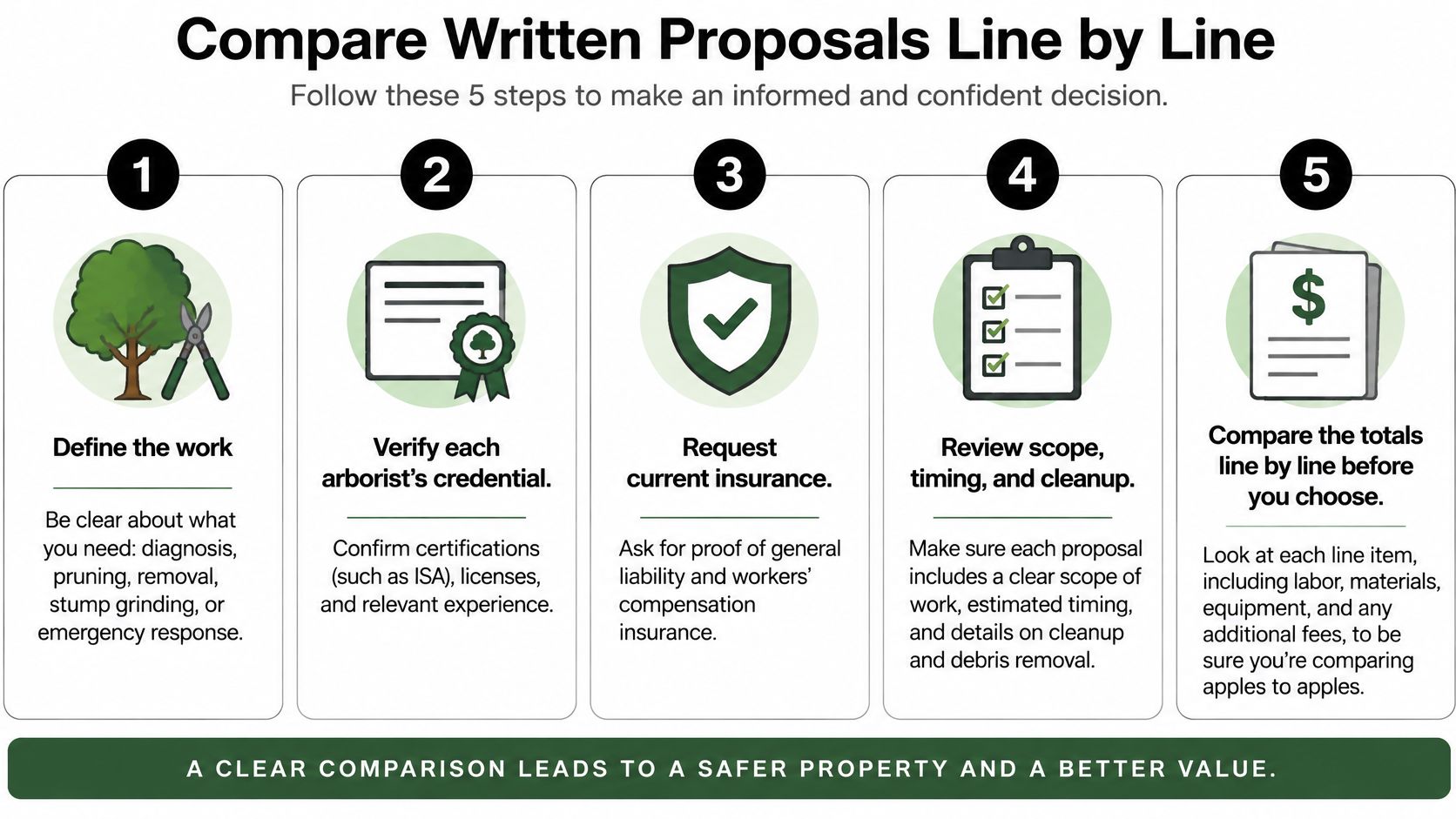
Copy this proposal checklist
What a complete written proposal states
| Proposal element | What it must specify | Why it matters |
|---|---|---|
| Trees and locations | Species, approximate size, and exact location of each tree | Prevents disputes over which trees are included |
| Work method | Pruning cut type or removal method, including crane use if needed | Shows how the crew will handle overhead and falling-object risk |
| Equipment | Bucket truck, crane, chipper, or stump grinder | Determines access needs and possible site damage |
| Cleanup and debris | Haul-off, chipping, and raking included or excluded | Changes the real cost of the job |
| Stump work | Grind depth and restoration of the grade | Prevents uneven ground and surprise charges |
| Exclusions | Items not covered, such as hauling wood or plant replacement | Stops hidden add-ons after the signature |
| Permits and damage | Who pulls permits and who pays for property damage | Puts permit and cancellation liability in writing |
| Payment and change orders | Payment schedule and how added work is approved | Controls scope creep |
If you haven't compared contractor documents before, you can browse sample contractor proposals from AurenWell to see how scope, exclusions, and payment terms fit together. For tree work, the tree identification and removal method still need to be specific to your property.
Understand what changes the price
There isn't a useful universal answer to how much tree removal costs without seeing the tree and access route. Height, trunk size, overhead obstacles, crane positioning, debris handling, permit fees, and replacement planting can change the work substantially.
Stump grinding and stump removal also need separate descriptions. Grinding reduces the stump below grade; excavation removes the stump and associated material more extensively, creating different access and restoration needs. Specify your intended finish, whether that's grass, a planting bed, or a construction area.
We provide free, no-pressure estimates anywhere we work, usually given the same day, after an arborist visits the tree and gives a written price. Our tree service estimate information explains how to start that process.
A lower total isn't a saving if you still have to hire someone else to finish the agreed result.
For urgent work, include the arrival window in the comparison. Distinguish the assessment visit, hazard stabilization, tree removal, and final cleanup rather than treating them as a single arrival promise.
Permits That Can Change the Job
A crew may be ready to remove a tree, but the property's jurisdiction may require approval first. Confirm which city or county governs the address. A mailing address alone may not settle that question.
Atlanta, Roswell and Marietta have different tree-protection rules. For example, the City of Atlanta's tree-removal guidance sets different diameter thresholds for hardwoods and pines and requires inspection and approval before removal. Check the rules that apply to your property rather than treating one city's requirements as a regional standard.
Check the jurisdiction before scheduling
Roswell's code-enforcement guidance describes permit requirements for tree removal and directs residents near the Chattahoochee River to contact Planning & Zoning. In Marietta, the tree-protection ordinance sets authorization and notification requirements, including procedures for dead or hazardous trees. Confirm the current process with the relevant city office before work is scheduled.
For clearing or other land disturbance, ask the applicable Cobb, Cherokee, Forsyth or Gwinnett county permit office whether erosion-control requirements or permits apply. Rules can depend on the location and scope of the work.
Tree removal permit requirements by jurisdiction
| Jurisdiction | What may trigger review | What to confirm first |
|---|---|---|
| City of Atlanta | Tree species, diameter and proposed work | Whether inspection and approval are required |
| Roswell | Tree size, location and proposed work | Whether a removal permit or Planning & Zoning review is needed |
| Marietta | Proposed removal and the tree's condition | Whether authorization, notification or replacement requirements apply |
| Kennesaw, Woodstock, Acworth, Canton | Address and proposed work | The city's tree-protection and removal requirements |
| Cobb, Cherokee, Forsyth and Gwinnett counties | Location and scope of clearing or development | Whether county approvals or erosion-control measures are required |
| Land disturbance | Clearing and site conditions | Whether the applicable county requires an erosion-control plan or permit |
Assign permit ownership
Put permit responsibility in the written scope. The contract should identify who applies, who confirms approval before work starts, and who covers costs if authorization is delayed or denied.
Before signing, confirm these details:
- Governing authority: Verify whether the property is within city limits or in an unincorporated county.
- Tree information: Record the species and diameter, and ask how the authority requires the tree to be measured.
- Ownership: Check whether the tree is on private property or within a public right-of-way.
- Replacement requirements: Clarify whether planting, fees, surveys or protection plans are required.
- Permit responsibility: Name the party responsible for applications, approval checks and cancellation costs.
The tree-preservation ordinance overview can help you identify questions to ask. The governing office makes the determination. A contractor's written scope should make clear whether permit approval is included before equipment is scheduled.
Storm Damage, Dangerous Trees and Emergency Calls
Keep clear of downed lines and call the utility. Treat any line touching a tree, fence, vehicle, or house as energized until the utility confirms otherwise. Don't let a tree crew cut a tree resting on a live wire.
A tree on a roof can involve both electrical hazards and unstable structural loads.
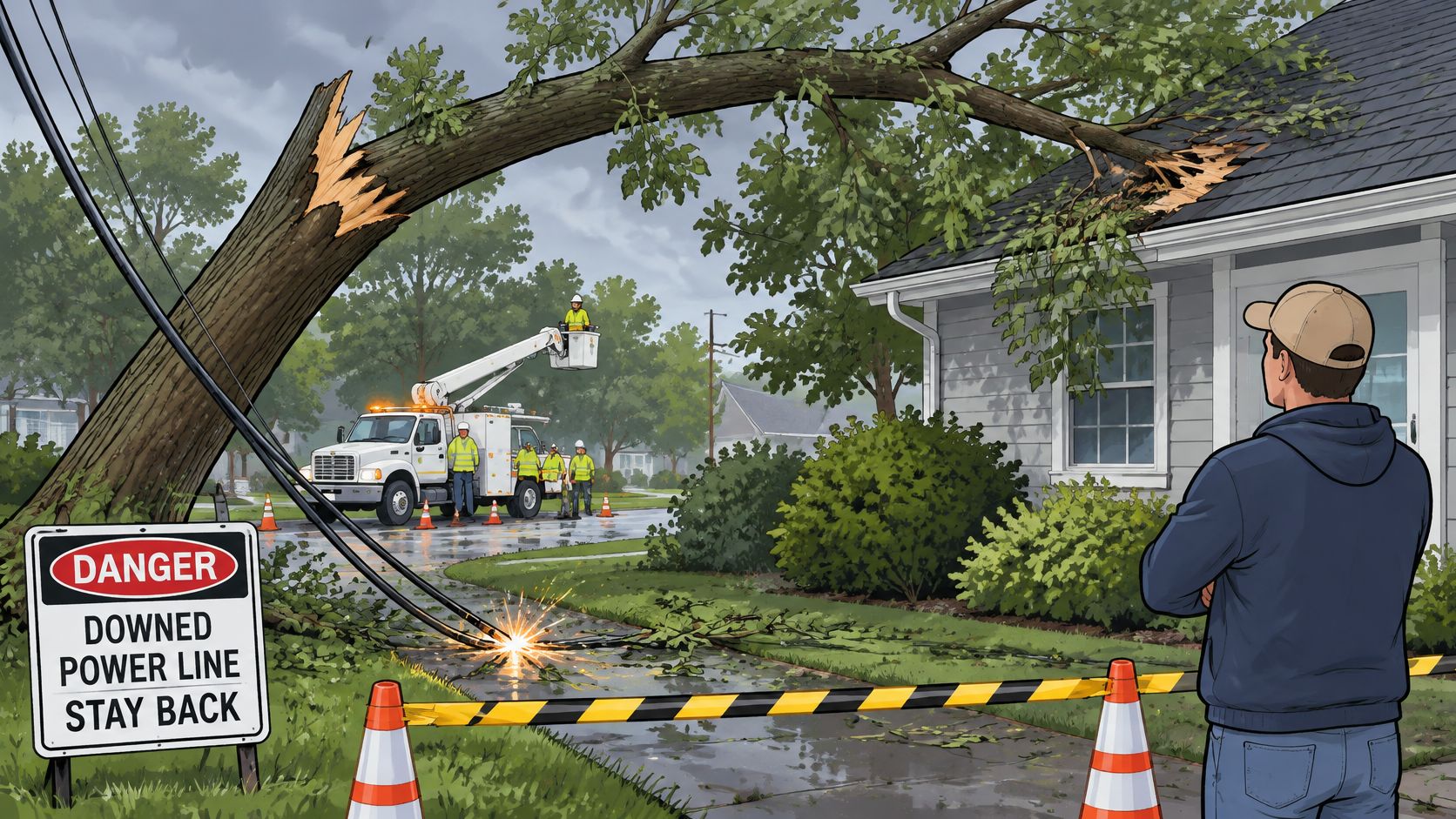
A fresh lean, lifted soil, a split trunk, or hanging canopy warrants prompt professional assessment. Don't walk beneath damaged limbs to take better photographs, and don't assume a tree is safe because it hasn't moved since the storm.
Document without approaching the hazard
The FEMA disaster-damaged tree guidance uses the following thresholds for public-assistance eligibility, including diameter of at least 6 inches measured 4.5 feet above ground, a lean greater than 30 degrees, and root-ball exposure of 50% or more. These aren't homeowner insurance guarantees or minimum thresholds for calling an arborist.
Storm damage thresholds for documenting a tree
| Condition | Threshold | Use in documentation |
|---|---|---|
| Diameter | FEMA diameter threshold stated above | Smaller trees don't meet that eligibility threshold |
| Trunk or canopy damage | Split trunk or broken canopy | Photograph damage and record when it occurred |
| Lean | FEMA lean threshold stated above | Use an existing reference object in a photograph taken from safety |
| Root ball exposed | FEMA exposure threshold stated above | Removal and filling the root-ball hole may qualify |
| Stump | Exposure below FEMA's root-ball threshold | Flush cutting and debris disposal generally eligible; remaining stump grinding generally isn't |
Photograph the overall scene, damaged areas, and contact points with the house or driveway from a safe position. Record when the damage occurred and retain the assessment, authorization, invoices, and disposal records for your insurer.
Use the same safety-first approach when considering the work shown below.
Separate emergency dispatch from a callback
Ask when a qualified crew can assess the site, when it can stabilize the hazard, and when storm damage tree cleanup will finish. An after-hours answering service such as SkipCalls can help a contractor receive calls, but an answered phone doesn't establish crew availability.
A Tree Care Industry Magazine review of news reports and OSHA records identified 243 tree-care-related fatal occupational injuries in the United States from 2020 through 2023. Emergency tree removal requires a safety plan, not merely the fastest chainsaw.
Reject pressure to sign before inspection, cash-only demands, unverifiable insurance, and cutting before a written scope exists. For fallen tree removal, require the responder to explain how it will protect the building while releasing loaded branches and lifting material.
Shortlist, Contract and Next Steps
Choose finalists who can turn their assessment into an executable contract. A friendly estimator and professional equipment are useful, but neither settles what happens when the crew discovers restricted access, hidden damage, or an authorization problem.
Book a site visit with the assessing arborist and walk the access route together. Identify gates, septic areas, irrigation, fragile pavement, overhead service lines, and landscaping you want protected. Make sure the written price reflects those constraints rather than an assumed route through the property.
Choose the right outcome, not just removal
Not every concerning tree needs to come down. Our arborists explain whether a tree needs removal, can be pruned back to health, or is fine to leave alone. Where appropriate, our arborist services include diagnostics, treatment plans, cabling, and bracing.
We also provide tree risk evaluations, pre-construction tree prescriptions, insurance claim tree appraisals, and tree care consultations. Those services address different decisions: whether to retain a tree, how to protect it during construction, or how to document its value.
For land clearing and lot preparation, bring the grading, drainage, and site plans to the assessment. A removal plan that ignores retained-tree roots or the eventual construction access can create avoidable conflicts. For stump work, explain whether you intend to install sod, build, or replant so the scope addresses the finished use.
Buy the result you need, with the responsibilities written down, rather than the largest amount of cutting for the lowest total.
Sign only when the contract is usable
Before authorizing work, complete these contract checks:
- Attach the assessment and scope. Identify the trees, intended outcome, methods, and accepted exclusions in the signed document.
- Assign permit accountability. State who obtains approval and who bears responsibility if work begins without it.
- Identify the insured contractor. Keep current insurer-issued certificates and the assessing arborist's credential number with your contract.
- Set payment terms. Tie payments to the agreed work and clarify how delays or partial completion are handled.
- Require approval for changes. Added work needs a description and agreed price before it proceeds.
- Define completion. Specify the debris removal, stump finish, restoration, and final walkthrough you're buying.
We offer financing for our services. If you use financing, compare its terms separately from the work proposal so a manageable payment doesn't distract from an incomplete scope.
The same hiring standard applies to us as to any other company. For homeowners comparing tree service in Roswell or Marietta, or scheduling work elsewhere in Cobb County, Cherokee County, and nearby North Metro Atlanta, the objective is a documented decision you can confidently authorize.
This week, write down the questions that matter most for your property: whether the tree can stay, how the crew will protect the house, and who handles approval. Don't sign until the answers are in writing.
We offer free, no-pressure estimates with an ISA Certified Arborist assessment and a written price for your tree work. Visit Richmond Tree Experts GA or call 770-974-3964 to arrange a site visit and discuss removal, pruning, stump work, or storm-related concerns before you commit.

