

Protecting trees on a construction site is about so much more than just telling the crew to “watch out for the trunk.” The real work—and the real success—lies in safeguarding the entire root system before a single shovel hits the ground. This means getting proactive about soil compaction, excavation damage, and all the other physical risks that come with a busy job site.
Your best tool for the job? A clearly marked and enforced Tree Protection Zone (TPZ). It’s a simple concept: create a physical barrier that keeps heavy machinery, materials, and constant foot traffic a safe distance away from the tree’s most vulnerable areas.
Why Tree Protection Is a Smart Investment
Let’s be real. On a chaotic construction site, protecting trees can feel like an afterthought—just one more box to check on a never-ending list. It’s easy to look at a huge, sturdy oak and think it can handle a little disruption. But that’s a classic mistake, and it’s one that can lead to expensive, irreversible damage down the road.
Ignoring tree health isn’t just bad for the environment; it’s a serious financial risk.
The most devastating damage isn’t the kind you see right away. Sure, a backhoe scraping the bark is obvious. But the silent killer is soil compaction. Heavy equipment, piles of materials, and even constant foot traffic squeeze the air and life out of the soil. This crushes the tiny pores that roots absolutely depend on to breathe and soak up water, leading to a slow, sad decline that might not show up for years.
The Hidden Costs of Neglect
Think about it this way: a healthy, mature tree can boost a property’s value by anywhere from 5% to 15%. When that same tree starts dying a few years after the project wraps up, you’re not just losing a beautiful asset—you’ve inherited a major liability. The bill for removing a large, dying tree can easily climb into the thousands of dollars, wiping out any money you thought you saved by cutting corners.
This isn’t just a local problem; it’s a huge issue. Urban expansion is one of the biggest reasons we’re losing trees for good. Between 2001 and 2024, the United States lost over 1.6 million hectares of tree cover just from construction related to urban growth. That’s a staggering number, and it puts us far ahead of many other developed countries. You can dig into more of the data on this global trend from the World Resources Institute.
The only truly effective strategy is to plan ahead. You have to start seeing trees not as obstacles in your way, but as valuable, living parts of the final landscape that need to be defended from day one.
Introducing the Tree Protection Zone
This brings us to the core of any good tree preservation plan: the Tree Protection Zone (TPZ). A TPZ is simply a designated no-go area around a tree, marked off with a sturdy, highly visible fence. It’s a non-negotiable boundary that protects the critical root zone from all construction activity.
When you put up a proper TPZ, you’re turning a vague suggestion into a clear, enforceable rule on the job site. It’s your single best defense against the big three threats:
- Soil Compaction: It stops vehicles and heavy equipment from ever rolling over the most sensitive root areas.
- Root Damage: It keeps all digging, trenching, and grading at a safe distance.
- Physical Injury: It acts as a shield, protecting the trunk and branches from being smashed by machinery or materials.
By putting in a little effort upfront to fence off these zones, you’re protecting a living asset that will add value and beauty for decades to come.
Your Pre-Construction Tree Protection Playbook
If you want to save your trees, you have to plan for it. Success is almost entirely decided before the first shovel ever hits the dirt.
The pre-construction phase is your golden opportunity to set the stage for success. This is where you shift from just hoping trees survive to actively planning for them to flourish.
It all kicks off with a thorough, practical tree inventory. This isn’t just about counting trees; it’s about understanding their value, health, and what they’ll need to get through the chaos of construction. Bringing in a certified arborist at this stage is non-negotiable—they have the trained eye to assess each tree’s condition, species-specific stress tolerance, and overall viability.
Building Your Tree Inventory
A good inventory is way more than a simple headcount. Your arborist will help you document the critical details for every significant tree on the property, which will shape your entire site plan.
- Species Identification: Knowing you have a resilient oak versus a more sensitive maple completely changes how you plan around it.
- Health Assessment: We’re looking for signs of disease, pests, or structural weakness. A tree already in decline might not be the best candidate for preservation.
- Diameter at Breast Height (DBH): This simple measurement, taken at 4.5 feet from the ground, is the foundation for calculating the all-important Tree Protection Zone.
This data lets you prioritize. You can focus your efforts on the trees that offer the most value and have the best shot at survival. Armed with this information, you can work with your architect and construction manager to design a site plan that works with the landscape, not against it.
Mapping Out Defensible Zones
Once you know which trees you’re protecting, it’s time to map out their defense perimeters. We call these Tree Protection Zones, or TPZs.
This is where the real strategy comes in. Research shows that trees with over 70% of their critical root zone (CRZ) preserved have an excellent chance of survival. A common guideline is to establish a protection radius of 1-1.5 feet for every inch of trunk diameter. This calculation can vary based on the tree’s health and tolerance, which is why an arborist’s input is so valuable.
Tree Protection Zone (TPZ) Calculation Guide
To give you a better idea, here’s a quick reference for calculating the minimum radius for a Tree Protection Zone (TPZ). This is based on the tree’s trunk diameter (DBH) and its general vigor or tolerance to construction stress.
| Tree Vigor/Tolerance | DBH Multiplier | Example (10-inch DBH Tree) |
|---|---|---|
| Good (Tolerant Species) | 1.0 ft/inch | 10 inches x 1.0 = 10 ft radius |
| Fair (Moderate Species) | 1.25 ft/inch | 10 inches x 1.25 = 12.5 ft radius |
| Poor (Sensitive Species) | 1.5 ft/inch | 10 inches x 1.5 = 15 ft radius |
As you can see, a more sensitive or struggling tree needs a much wider berth to have a fighting chance.
Mapping also means thoughtfully placing all the temporary construction chaos. Staging areas for materials, portable offices, and the main routes for heavy machinery absolutely must be located well outside of any TPZ. Soil compaction from this activity is a leading cause of post-construction tree death. It’s also vital to prevent soil erosion on construction sites, as this directly impacts the delicate root systems you’re trying to protect.
This infographic shows exactly what’s at stake when these steps are ignored.
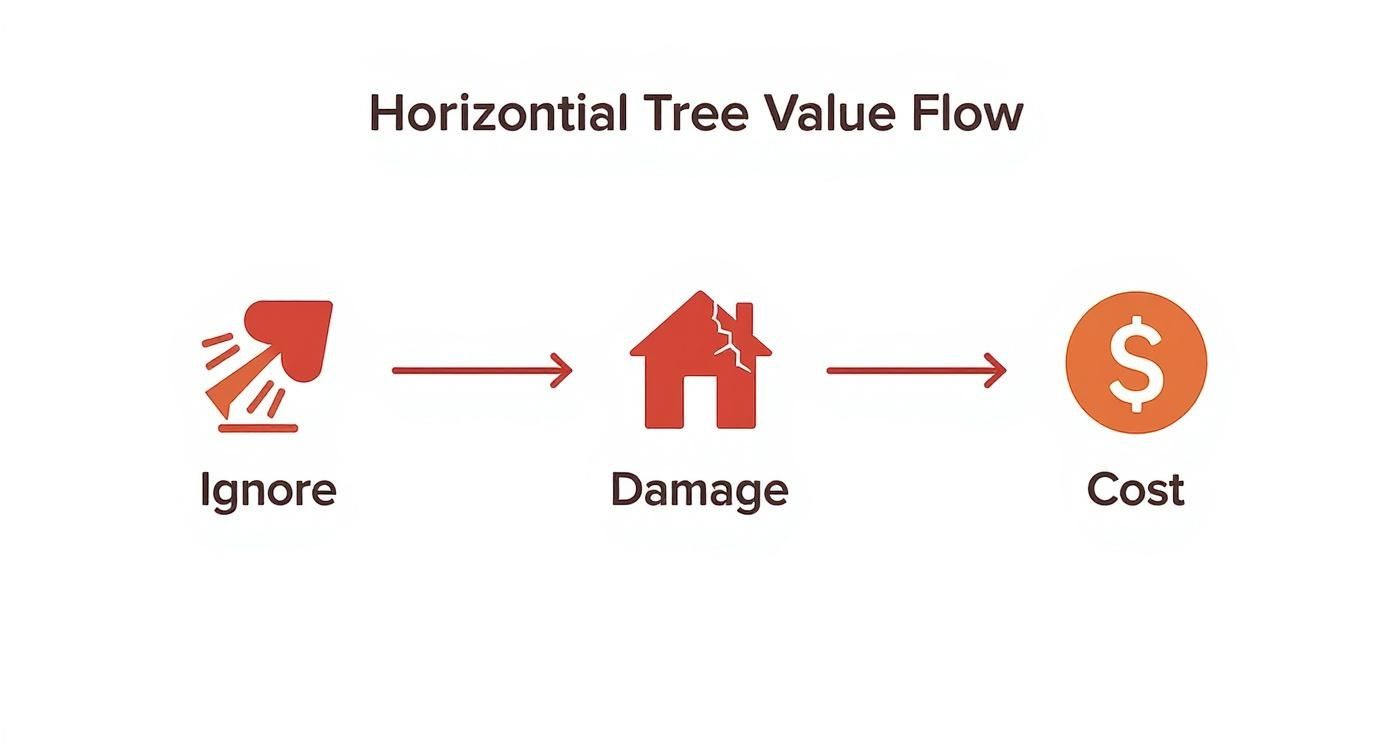
As you can see, a little neglect upfront quickly spirals into property damage and huge costs down the road, turning a beautiful asset into a dangerous liability.
A detailed site plan that clearly marks every single TPZ is your most important document. It’s the visual guide for every person on that job site, from the excavator operator to the delivery driver.
For tricky situations where a tree’s health is a bit shaky, an arborist can create a specific care plan. These strategies, often called tree prescriptions, outline proactive treatments to boost a tree’s resilience before, during, and after the project. By investing in this level of detail, you prevent costly mistakes and make sure your trees don’t just survive—they thrive for decades.
Setting Up Physical Defenses on the Job Site
Once your pre-construction plans are locked in, it’s time to bring those lines on paper to life. Let’s be real: when a multi-ton excavator is moving earth a few feet away, a roll of caution tape isn’t going to do a thing. Real, effective tree protection requires robust, physical barriers that create an undeniable “no-go” zone.
The goal here is to build a fortress around each Tree Protection Zone (TPZ). This isn’t just about marking a boundary. It’s about putting up a physical wall that stops accidental damage before it happens. I’ve seen it a hundred times—flimsy tape gets torn down, driven over, or just plain ignored within hours on an active site.
Installing a True No-Go Zone
Your first and best line of defense is a sturdy, highly visible fence. To do this right, you need to understand the best practices for setting up physical barriers, like using specialized temporary fencing for construction sites. This kind of rigid, chain-link, or welded wire fencing sends a crystal-clear message: this area is off-limits to everyone and every piece of equipment.
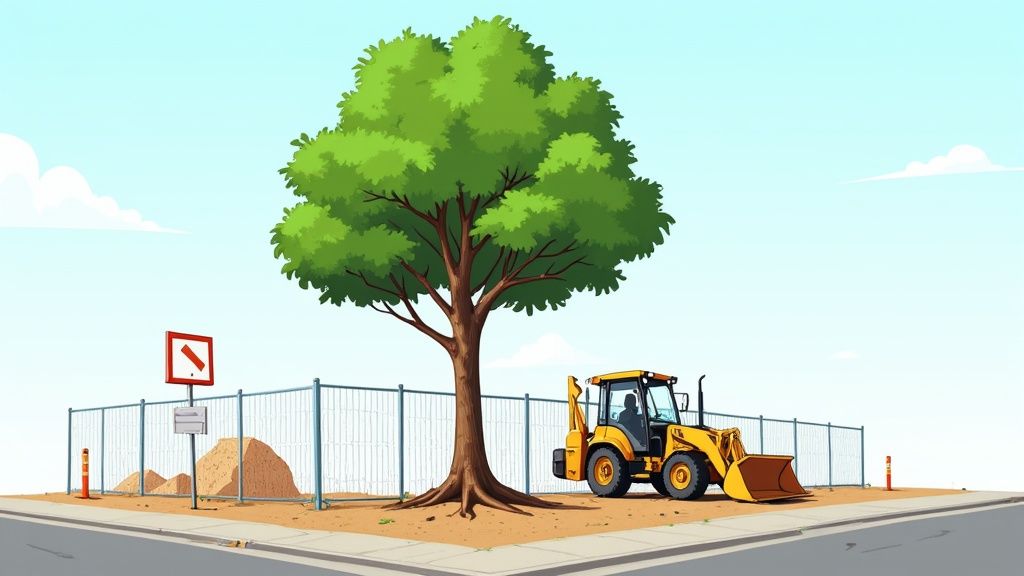
When you’re putting up the fencing, keep these points front and center:
- Placement is Everything: The fence goes at the perimeter of the TPZ you mapped out, not right up against the trunk. You’re shielding the entire critical root zone, not just the tree itself.
- Visibility is Key: Go with bright orange or another high-contrast color. Slap some clear, multilingual signs on it that say “Tree Protection Zone – Keep Out.” You can’t over-communicate this.
- Secure the Perimeter: Make sure the fence is well-supported so it can’t be easily shoved aside or knocked over. This barrier needs to stay put for the entire duration of the project.
For mature or structurally weaker trees, you might need to go a step further. In certain situations, professional tree cabling and bracing services can give extra stability to vulnerable limbs, stopping them from failing under the stress of nearby construction vibrations.
Preventing the Silent Killer: Soil Compaction
One of the sneakiest and most damaging threats to a tree’s health is soil compaction. It doesn’t look as dramatic as a snapped branch, but it can be just as deadly. Even a single pass from a heavy truck can crush the tiny pore spaces in the soil, effectively suffocating the roots below. Protecting a tree means defending the ground it lives in.
A simple yet incredibly effective tactic is to lay down a deep layer of organic mulch before the fence even goes up. We recommend spreading a 10-15 cm (4-6 inch) deep layer of coarse wood chips across the entire TPZ. This creates a natural cushion that distributes weight and absorbs impact, drastically reducing compaction.
Remember, if more than 40% of a tree’s root system or stem gets damaged, its chances of survival plummet. Proactive steps like mulching aren’t just nice-to-haves; they are absolutely essential for a tree’s long-term health.
Navigating Unavoidable Root Zone Conflicts
Sometimes, there’s just no way around it. A utility line or foundation footer has to pass near a protected tree. When this happens, traditional trenching is a death sentence for any roots in its path. Thankfully, modern, less invasive techniques are your best friend here.
Instead of digging a destructive open trench, you should insist on methods like these:
- Air-Spading: This tool uses a focused, high-pressure stream of air to safely move soil away from roots without cutting or tearing them. It’s like delicate surgery instead of amputation.
- Horizontal Directional Boring: This is a trenchless method that allows crews to drill a path for utilities underneath the root zone, leaving that critical area completely undisturbed.
By investing in these physical defenses and championing smarter techniques, you create a job site where trees aren’t an obstacle, but a protected, prioritized asset.
Managing Daily Construction Near Protected Zones
Getting those sturdy fences up is a great first step, but now the real work begins. Protecting trees during a build isn’t a “set it and forget it” task. The challenge shifts from initial setup to daily enforcement, because a well-placed barrier is only as good as the crew’s respect for it.
It’s in the day-to-day grind where even the most carefully crafted plans can start to unravel without clear rules and someone keeping a watchful eye.
Establishing Non-Negotiable Ground Rules
The Tree Protection Zone (TPZ) has to be treated as a strict no-go area. Full stop. This isn’t a friendly suggestion; it’s a hard-and-fast rule for the survival of the tree. The most common violations—the ones that do the most damage—often seem pretty harmless on the surface.
Your first job is to lay down a simple set of ground rules that leaves zero room for misinterpretation. These rules need to be communicated to every single person who steps onto the site, from your lead foreman to subcontractors and even the guy delivering a load of lumber.
Make it crystal clear that the TPZ is completely off-limits for:
- Material Storage: Stacks of bricks, lumber, or bags of concrete do more than just sit there. Their weight compacts the delicate soil around the roots, and rain can cause chemicals to leach into the ground.
- Vehicle Parking: Absolutely no trucks, excavators, or even personal cars inside the fence. The soil compaction from a single parked truck can be devastating.
- Waste and Washout: Never, ever allow washout from concrete trucks, paint sprayers, or other tools inside the TPZ. Those chemicals are toxic to tree roots.
- Foot Traffic: It’s not a shortcut, a break area, or a place to toss lunch trash.
The success of your entire tree protection plan boils down to one thing: communication. A rule that isn’t understood by everyone is a rule that will eventually be broken. Assume no one knows the plan until you’ve personally explained it.
Consistent Communication and Site Inspections
A quick “toolbox talk” at the very beginning of the project is the best way to get everyone on the same page. Don’t just point to the fence and say, “stay out.” Walk everyone over to it and explain why it’s there.
A worker who understands that soil compaction can literally suffocate a tree’s roots is far more likely to respect that boundary than one who was just given an order.
After that initial meeting, consistent monitoring is key. You don’t have to spend hours on it. A quick walk-around at the start or end of each week can help you spot trouble before it causes irreversible harm.
Keep your inspections focused with a simple mental checklist:
- Barrier Integrity: Is the fence still standing strong? Have any sections been moved, bent, or taken down?
- Zone Violations: Is there anything inside the TPZ that shouldn’t be? Look for materials, trash, or equipment.
- Visible Tree Damage: Do you see any fresh scrapes on the bark or newly broken branches?
- Soil Disturbance: Are there signs of digging, soil being piled up, or any liquid spills near the fence line?
If you spot something wrong, deal with it right away. Fix the fence, get the materials moved, and have another quick chat with the crew. It’s this consistent, daily management that ensures the defenses you worked so hard to put up can actually do their job from the first day to the last.
Post-Construction Care for Long-Term Survival
Just because the last truck has pulled away and the site is clean doesn’t mean the job is over. For the trees, the real work is just beginning. They’ve endured months of ground vibrations, soil compaction, and shifts in their environment. The stress won’t show up overnight; it can take years for the full impact to become visible.
This post-construction phase is your last, best chance to ensure the trees you worked so hard to save will actually thrive. It’s all about shifting their focus from just surviving back to healthy, active growth. What you do now determines whether they become long-term assets or a slow, costly problem.
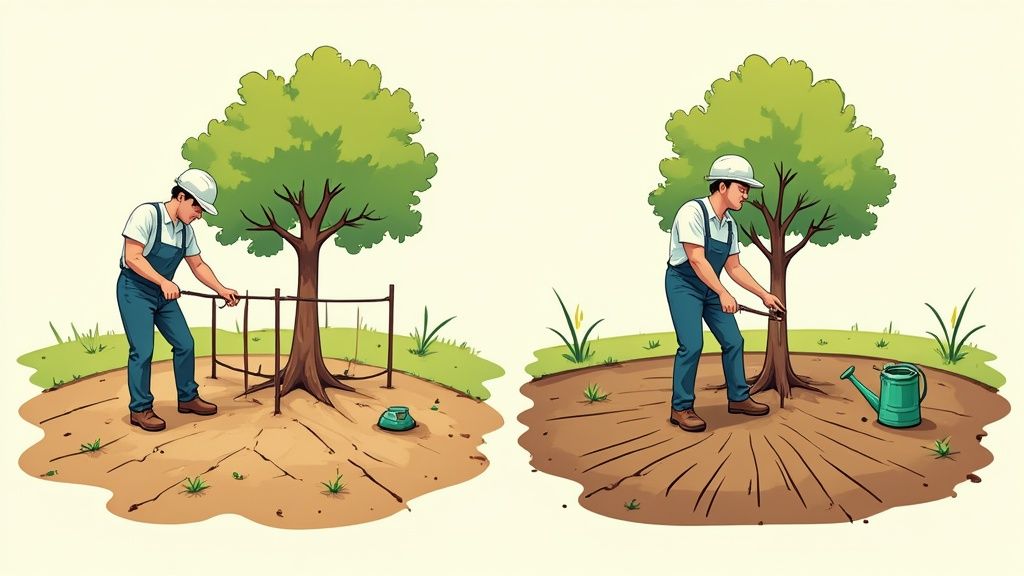
Your first move is to carefully dismantle all the protective barriers. As you take down the fences and remove any trunk guards, give the tree a thorough look-over. Check for any fresh scrapes, broken branches, or signs of new soil disturbance that might have happened in the final days of the project.
Assessing and Remediating Soil Damage
Now, turn your attention to the ground. Even with the best planning, some soil compaction around the edges of the Tree Protection Zone (TPZ) is almost guaranteed. Compacted soil is a quiet threat—it suffocates delicate roots by cutting off their access to vital oxygen and water.
Here’s a simple field test: try pushing a long screwdriver or a soil probe into the ground. If you hit a wall of resistance in the first few inches, you’ve got compaction. This needs to be addressed. Techniques like radial trenching can be a lifesaver. This involves carefully digging narrow trenches out from the tree (like spokes on a wheel) and backfilling them with high-quality compost. It’s a fantastic way to get air and organic matter back into the soil where the roots need it most.
Post-construction care isn’t a one-and-done task; it’s an ongoing commitment. A tree’s reaction to construction stress can be delayed by 3-5 years, making consistent monitoring absolutely critical for its long-term health.
Creating a Long-Term Recovery Plan
With the immediate soil problems handled, it’s time to think long-term. This is not the time for aggressive pruning or heavy fertilization. The tree is still fragile. The goal here is gentle, consistent support to help it recover on its own terms.
Your plan should focus on two key areas:
- Consistent Watering: For the first 2-3 years after construction, you need to be the tree’s best friend during dry spells. Provide deep, slow watering to encourage roots to grow deep and re-establish themselves.
- Strategic Mulching: Apply a fresh 2-4 inch layer of organic mulch over the root zone. Be sure to keep it a few inches away from the trunk itself to prevent rot. Mulch is a powerhouse—it holds in moisture, keeps soil temperatures stable, and stops weeds from stealing nutrients.
If you’re seeing signs of trouble—like wilting leaves, a thinning canopy, or off-color foliage—it’s a signal to bring in a professional. A tree care consultation can give you a customized plan to tackle any lingering issues from the construction process. This ensures your trees not only survive but go on to add beauty and value to the property for decades.
To keep things simple, here’s a quick checklist of the essential tasks to stay on top of after the build is complete.
Post-Construction Tree Care Checklist
| Task | Frequency/Timing | Key Considerations |
|---|---|---|
| Initial Inspection | Immediately after barriers are removed | Look for new bark damage, broken limbs, or soil disturbance. Document with photos. |
| Soil Decompaction | As needed, based on inspection | Use methods like radial trenching or air spading. Avoid damaging major structural roots. |
| Deep Watering | Every 1-2 weeks during dry periods for 2-3 years | Water slowly to ensure deep soil penetration, not runoff. |
| Mulching | Annually (or as needed) | Apply a 2-4 inch layer of organic mulch, keeping it away from the trunk flare. |
| Monitoring | Seasonally | Watch for signs of stress: leaf discoloration, canopy thinning, or pest infestations. |
| Pruning | Only if necessary (dead or broken branches) | Avoid major pruning for at least 2-3 years to allow the tree to recover its energy. |
Following these steps will give your preserved trees the best possible chance to recover fully and grace your new landscape for many years to come.
On-the-ground questions always come up, even when you have a solid tree protection plan. Every construction site has its own quirks, and it’s natural to second-guess if you’re making the right calls to keep your trees safe. We’ve pulled together some of the most common questions we hear from homeowners and project managers, with clear answers to give you confidence in your strategy.
What’s the Real Cost of Skipping Tree Protection?
It’s easy to look at tree protection as just another line item on a budget, but ignoring it costs far more in the long run. A healthy, mature tree can seriously boost your property value. When that same tree dies a few years after the project wraps up—all because of damage that was preventable—you don’t just lose an asset. You gain a huge liability.
The price tag for removing a large, dead tree can easily climb into the thousands of dollars, wiping out any money you thought you saved. Beyond that, you lose decades of shade, natural beauty, and all the other environmental perks that are pretty much impossible to replace overnight.
How Far Away Does the Fence Really Need to Be?
This is one of the most critical questions we get, and the answer is crucial. A solid rule of thumb is to set up a protected zone of one foot for every inch of the tree’s trunk diameter. So, for a tree with a 15-inch trunk, your fence needs to be at least 15 feet away from the trunk on all sides.
This isn’t just about protecting the part of the tree you can see. It’s about shielding the huge, delicate web of feeder roots that stretch way beyond the tree’s branches. Most of these vital roots are in the top 12 inches of soil, making them incredibly easy to damage.
Can We Just Cut a Few Roots If We Have To?
Cutting tree roots should always be your absolute last resort. It’s a move that can have serious consequences, since it directly cripples the tree’s ability to pull in water and nutrients. It also makes the tree structurally weaker and much more likely to fall over in a storm.
If you absolutely must cut a few roots—say, for a critical utility line—only remove the bare minimum necessary. You have to bring in a certified arborist before you do anything. They can figure out the potential impact and recommend the least harmful approach, which often involves specialized tools like an air spade to work around the roots instead of through them.
What Are the Signs of Construction Stress in a Tree?
Unfortunately, the real signs of stress usually don’t show up until long after the construction crew is gone, sometimes 2-5 years later. This delayed reaction is exactly why post-construction care is so important.
Keep an eye out for these common red flags:
- Wilting or yellowing leaves when they should be green and healthy.
- A thinning canopy, where you start seeing more sky through the branches than you used to.
- Leaves that are smaller than normal or just stunted new growth.
- Dead branches starting to appear at the very top of the tree.
If you spot any of these signs, it’s a clear signal the tree is in trouble and needs professional help right away. Catching it early can often be the difference between saving the tree and having to remove it.
At Richmond Tree Experts GA, we specialize in creating and implementing effective tree protection plans for construction projects throughout the Atlanta area, including Cumming, Johns Creek, and Forsyth County. Our ISA Certified Arborists can help you navigate every stage, from pre-construction assessment to post-build recovery. Protect your valuable green assets by partnering with the experts. Learn more and schedule your consultation at https://richmondtree.com.
Need a tree taken down safely? Richmond Tree Experts has worked on Marietta and Metro Atlanta trees since 1985, and every job is looked at by an ISA Certified Arborist before it is priced. Start with tree removal, or see everything we do: tree removal, stump grinding and arborist services across Cobb, Fulton, Cherokee, Gwinnett and DeKalb counties (service areas).
Call (770) 974-3964, 7am to 11pm every day, or request an estimate online.

