

When a big storm rolls through, the mess it leaves behind can feel pretty daunting. But before you even think about cleanup, the absolute number one priority is safety. The first thing you need to do, once the storm has passed, is take a look around from a safe distance. You're looking for the big, immediate dangers—things like downed power lines or a tree that's now leaning uncomfortably close to your house.
Your First Steps After the Storm Passes
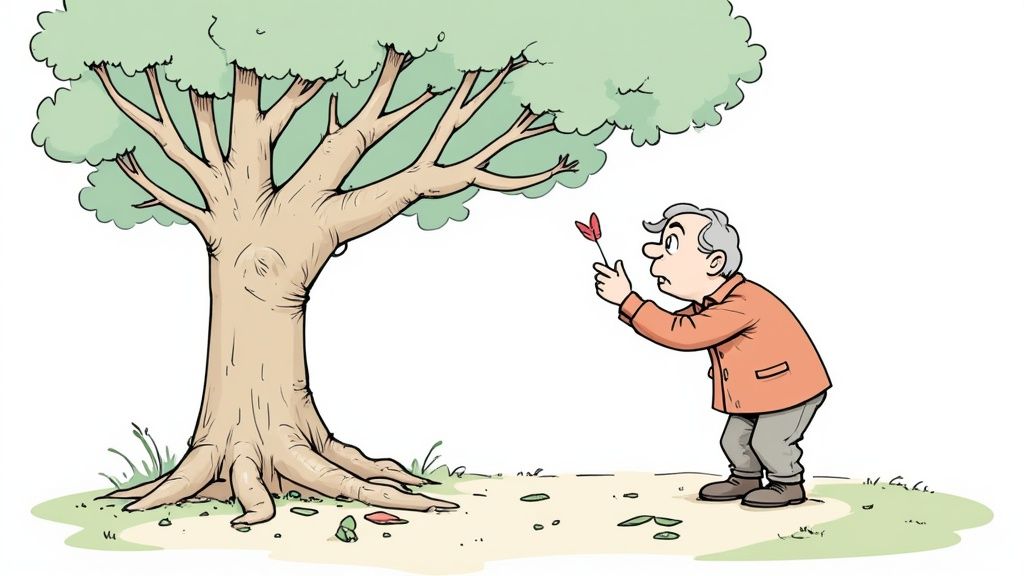
Those first few moments after the wind and rain die down are critical. The storm might be over, but the hazards are often just getting started. Your game plan should be all about making smart, safe choices to secure your property without putting yourself or anyone else in harm's way. This isn't the time to be a hero with a chainsaw; it's a time for careful observation.
To help you stay focused, here's a quick checklist of what to do right away.
Immediate Post-Storm Safety Checklist
This table is a quick reference for the first actions to take after a storm to ensure safety and start the recovery process effectively.
| Priority | Action Item | Key Considerations |
|---|---|---|
| Highest | Check for Downed Power Lines | Assume all wires are live. Stay at least 30 feet away. Call your utility company immediately. |
| High | Assess Unstable Trees & Limbs | Look for trees leaning towards structures or large, hanging branches ("widow-makers"). |
| Medium | Document All Damage | Take photos and videos of everything before moving debris. This is crucial for insurance claims. |
| Next | Contact Professionals | Call 911 for immediate threats, then your utility company, then your insurance agent. |
Following these steps in order will keep you safe while getting the recovery process started on the right foot.
Prioritize Safety Above All Else
Before you even step outside, do a visual sweep of your property from a doorway or window. You're trying to spot the most obvious, high-risk threats first.
- Downed Power Lines: If you see any fallen wires, treat them as if they are live. No exceptions. Keep a distance of at least 30 feet and call your utility company and 911 right away. Don't touch anything that's in contact with a downed line—not a fence, not a puddle, nothing.
- Leaning Trees or Hanging Limbs: Keep a sharp eye out for trees leaning toward your house or garage. Also, scan the canopy for large, broken branches that are just hanging up there. We call them "widow-makers" for a reason; they can come down without any warning.
I can't stress this enough: The biggest mistake I see homeowners make is underestimating how unstable a storm-damaged tree really is. A tree that looks fine can shift in an instant, and branches that are bent under tension can snap back with terrifying force. When in doubt, stay back.
Remember, swift action is key for all types of property damage after a storm. Getting a handle on how to respond in those first few hours can make a massive difference, as detailed in this helpful homeowner's guide to storm damage roof repair.
Make the Right Calls
Once you've identified the immediate dangers, it's time to get on the phone. Who you call first matters.
- Emergency Services (911): Your first call should be to 911 if there's an immediate threat to life or property. Think: a tree has crashed into your home causing structural damage, or it's completely blocking a public road.
- Utility Company: Next, report any downed power, cable, or phone lines. Their crews need to make the area safe before anyone can start cleanup work.
- Your Insurance Agent: Get the claims process started as soon as you can. Your agent will walk you through what they need from you regarding documentation and professional estimates.
This isn't just a minor inconvenience; it's a huge issue nationwide. In the U.S., severe storms lead to an estimated $400 million in tree cleanup costs every single year.
Document Everything Meticulously
Before a single branch is moved, grab your phone and document everything. This is your proof for the insurance company, and it’s absolutely vital.
Take wide shots of your whole property to show the overall scene, then get close-ups and videos of the specific damage points. Make sure you capture the fallen tree from several angles, clearly showing where it came from and what it landed on.
If you're not sure about the extent of the damage or just want an expert opinion for your records, a professional tree care consultation can give you an official assessment. This initial documentation will be your best friend when it comes to getting a smooth and fair insurance claim.
How to Assess Your Damaged Trees
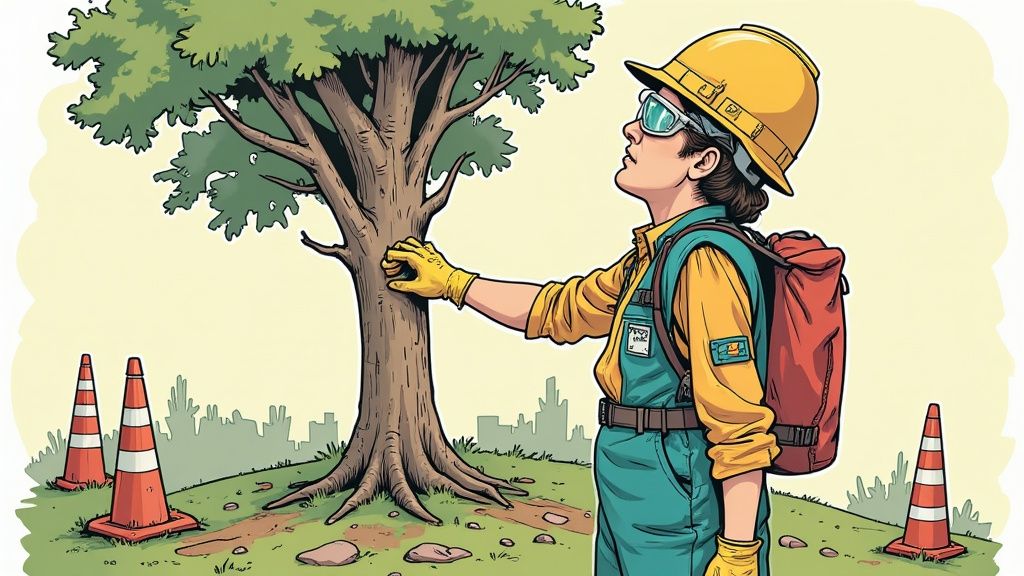
Once the storm has passed and it's safe to go outside, your attention will naturally turn to your trees. The first step is always to check for immediate dangers like downed power lines. If the area is clear, you can start a preliminary damage assessment from a safe distance.
It's important to remember that not every branch on the ground means a tree is a total loss. Learning what to look for can help you gauge the severity of the damage and give you a solid foundation for when you call in a professional arborist.
Start with the big picture. Look at the entire tree. Is it leaning in a way it wasn't before the storm? Any lean greater than 15 degrees from its normal vertical position is a serious red flag. It often points to root failure, which makes the tree dangerously unstable.
This kind of damage isn't just a local problem. Storms are a massive driver of tree loss worldwide. Between 2001 and 2024, a staggering 206 million hectares of tree cover in temperate and boreal zones were lost to disturbances like storms and wildfires. You can find more data on global forest trends from the World Resources Institute.
Spotting Critical Damage from Afar
Some types of damage are so severe they’re almost a guaranteed sign that the tree needs to come down. These are the issues that signal a tree is too compromised to save and now poses a major risk. Keep an eye out for these tell-tale signs, which almost always require professional storm damaged tree removal.
- A Split Trunk: If the main trunk of the tree is cracked or split open, its core structure is compromised. This is an extremely hazardous situation, especially if the split runs deep.
- Major Root System Upheaval: Check the ground around the base of the tree. If you see soil and roots pushed up on one side, it’s a clear sign the root system has been torn from the ground. That tree is no longer anchored.
- Hollow or Decayed Sections: Storms have a way of exposing a tree's hidden weaknesses. If a large limb has broken off and revealed a hollow or rotted interior, it's a good bet the rest of the tree is just as weak.
Think of it this way: a mature oak that lost a single big limb but otherwise looks solid might be saved with some expert pruning. But a tall pine tree that's now looming over your driveway at a scary angle? That’s a completely different level of threat and needs immediate attention.
The most crucial thing to remember is that a storm-damaged tree is under immense and unpredictable stress. Branches can be held under extreme tension, and what looks stable one minute can fail the next. Your safety is paramount, so always perform your assessment from a distance.
Applying the 50 Percent Rule
Here’s a practical guideline I often share with homeowners for a quick first look: the "50 percent rule." It’s not a hard-and-fast scientific law, but it’s a great starting point for making a judgment call.
Look up at the tree's crown—the leafy, upper part. If more than 50 percent of it has been destroyed, the tree might not have enough leaves left to produce the food it needs to recover. Its chances for survival are slim.
Likewise, check the trunk for large wounds. If a single gouge or tear covers more than 25 percent of the trunk's circumference, the tree's internal circulatory system—which moves water and nutrients—is likely too damaged to function properly.
This initial check-up isn't about you making the final call. It's about gathering information so you can have a more productive conversation when you call for professional help. Knowing these details helps an arborist understand the urgency and get the right team out to you faster.
Deciding Between DIY and Professional Removal
It's tempting to try and save some money by handling storm cleanup on your own. I get it. But when we're talking about storm damaged tree removal, the stakes are incredibly high. What might look like a straightforward job can quickly spiral into a dangerous and expensive disaster, potentially causing property damage or, even worse, serious injury.
Making the right call starts with being brutally honest about the situation and your own limits. This isn't usually a complicated decision, but it does require a healthy respect for the sheer force and unpredictability of a damaged tree.
This visual guide breaks down how things like tree size and your own experience level should steer you toward either a DIY project or calling in a pro.
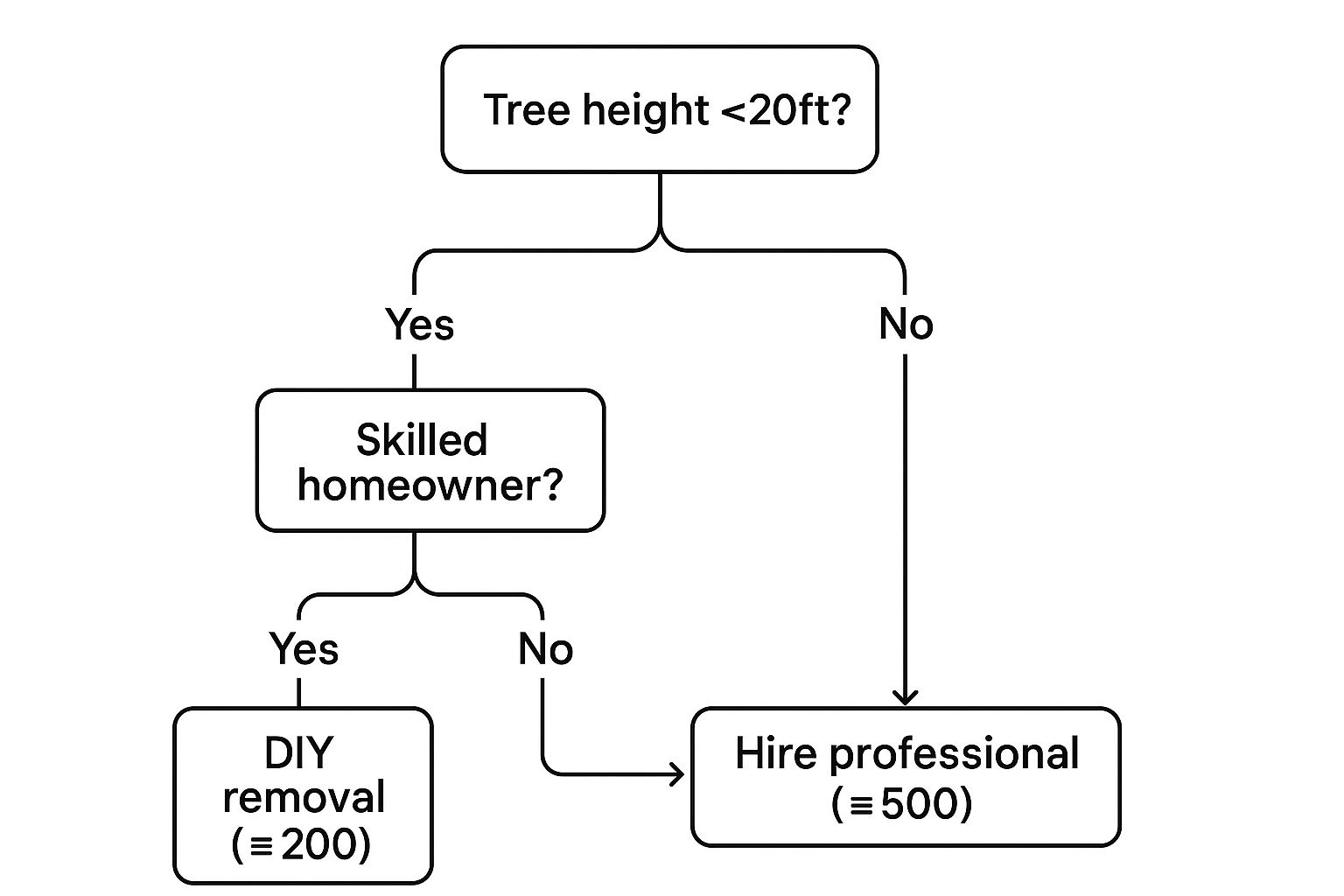
As you can see, even with smaller trees under 20 feet, your skill level is the deciding factor. For anything bigger, the only truly safe move is to get a professional on the phone.
When DIY Might Be an Option
Let's be clear: there are very few scenarios where tackling this yourself is a genuinely safe bet. If you're even considering it, the situation has to tick all of these boxes to keep the risk as low as possible.
- Small, Grounded Debris: You're perfectly fine clearing small branches and twigs that are already on the ground and nowhere near structures or power lines.
- No Chainsaw Required: If the job only needs tools like loppers or a handsaw for branches that are just a few inches thick, you're likely in the clear.
- Clear, Open Space: The work area has to be flat, stable, and a good distance from your house, fences, or other trees.
Basically, if the job feels like it goes beyond routine yard work, that’s your cue to stop and think twice.
One of the most critical mistakes homeowners make is underestimating the tension in a bent or pinned-down branch. A "spring pole"—a branch under extreme pressure—can snap back with enough force to be fatal. Professionals are trained to spot these hazards and safely release that stored energy.
DIY vs Professional Tree Removal: When to Call for Help
To make it even clearer, here's a quick matrix to help you decide which storm cleanup tasks you can handle and when it's non-negotiable to bring in a professional arborist.
| Situation | DIY Feasibility | Professional Recommendation |
|---|---|---|
| Small branches & twigs on the lawn | High | You can likely handle this yourself with basic yard tools. Just watch your footing. |
| A small, completely fallen tree (under 15-20 ft) in an open area | Low to Moderate | Possible if you have chainsaw experience and the right safety gear. Still risky. |
| Large, broken branches hanging high in a tree | None | Absolutely not. This is a job for climbers and bucket trucks. It's a "widow-maker" situation. |
| A tree of any size leaning on your house, garage, or fence | None | Do not touch it. The tree is unstable and could shift, causing massive damage. |
| Any tree or branch tangled in power lines | None | Extremely dangerous. Call your utility company and a professional tree service immediately. |
| A tree with a split or cracked trunk | None | The structural integrity is gone. It could fail at any moment. This requires expert assessment. |
| Large-scale cleanup requiring heavy lifting or a chainsaw | None | Without the right rigging equipment and experience, this is a recipe for disaster. |
Ultimately, your safety and your property's integrity are what matter most. When in doubt, always err on the side of caution and call for help.
Non-Negotiable Signs to Hire a Professional
Some situations are just black and white—they absolutely demand professional expertise. Trying to handle these jobs yourself isn't just risky; it's a gamble you can't afford to lose. For these complex tasks, it pays to understand the role of a certified arborist in Atlanta, GA and why their specialized knowledge is so crucial.
You have to call in a professional if you see any of these red flags:
- Any Tree Leaning on a Structure: A tree resting on your house, garage, or fence is a ticking time bomb. One wrong cut can cause it to roll, shift, or come crashing down, creating far more damage than you started with.
- Entanglement with Utility Lines: Never, ever go near a tree that is touching or even close to a power line. The risk of electrocution is real and severe. Only specially qualified line-clearance arborists, often working with the utility company, can safely manage this.
- Any Work Requiring a Ladder: Using a chainsaw on a ladder is one of the most dangerous things a homeowner can do. Professionals have aerial lifts and sophisticated climbing gear to work safely at height.
- Large-Diameter Wood: If the trunk or major limbs are too heavy for one person to lift, you simply don't have the right equipment to manage the job safely and control where those heavy pieces land.
A professional crew brings more than just a bigger chainsaw. They show up with cranes, rigging equipment, and years of training to systematically dismantle a hazardous tree, ensuring no one gets hurt and nothing gets broken in the process.
Understanding Tree Removal Costs and Insurance
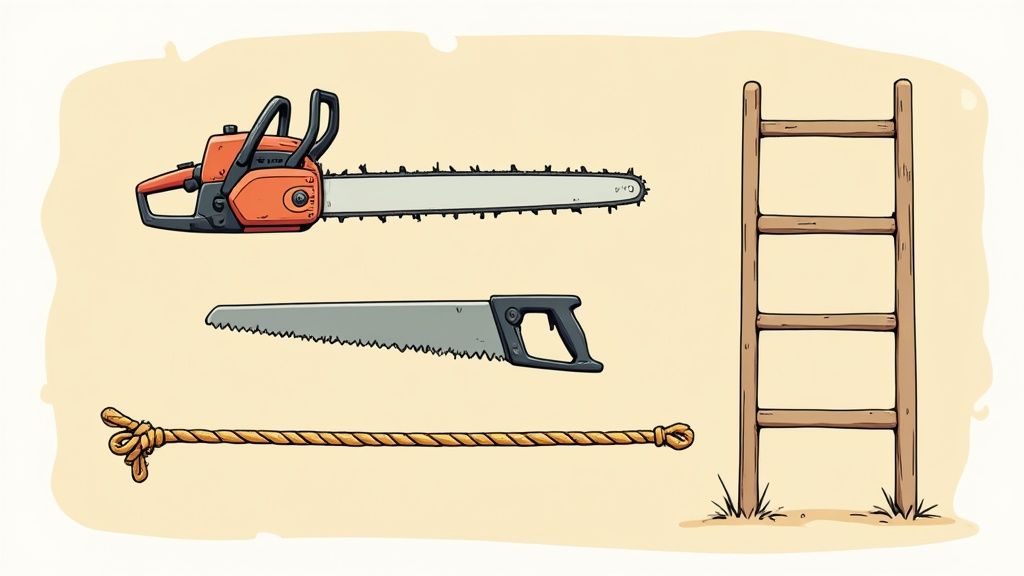
When a storm hits, the financial fallout from the cleanup can be just as overwhelming as the visible damage. The cost of professional storm damaged tree removal isn’t some flat-rate fee you can look up; it's a complicated puzzle based on the unique mess in your yard. Getting a handle on what drives that cost will help you know what to expect when the quotes start coming in.
The final price tag hinges on a few key things. Of course, the tree's size and where it landed are big ones. A massive oak sprawled across your yard is going to cost more than a small maple, but it’s the complexity that really dictates the bill. Is the tree tangled up in power lines? Is it balanced precariously on your roof? These are high-risk situations that demand specialized equipment and a very careful, experienced crew, which naturally increases the cost.
Key Factors That Determine Your Bill
Another huge factor is simple access. If a crew can easily drive a crane and other heavy equipment right up to the tree, the job is quicker and cheaper. But if that same tree is in a fenced-in backyard with no easy way in, things get complicated. The crew will have to dismantle it piece by piece and haul it out manually, which means more labor, more time, and a higher price.
Here's a quick look at what professionals are evaluating when they give you a quote:
- Tree Size and Diameter: Bigger, denser trees take more time and beefier equipment to handle.
- Proximity to Structures: A tree that has crashed into a house, garage, or shed requires a delicate, surgical removal to avoid making things worse.
- Site Accessibility: Can the truck and wood chipper get close, or will every branch and log have to be carried out by hand?
- Level of Risk: Trees wrapped in utility lines or those with unstable, splintered trunks are extremely hazardous and call for a top-tier, highly skilled team.
It's a common mistake to think all fallen trees are the same job. A tree that falls cleanly in an open field is pretty routine. A tree that has punched through a bedroom ceiling? That’s an emergency operation requiring immense precision.
Navigating Your Insurance Policy
Homeowner's insurance can feel like a labyrinth, but there’s a simple rule of thumb when it comes to storm-damaged trees. Most policies will cover removal costs if the tree fell on and damaged a covered structure, like your house, fence, or garage. Some policies even provide a small amount of coverage (usually $500 to $1,000) for debris removal even if no structure was damaged.
Now, if that same tree just falls in your yard without hitting anything, the cleanup cost is almost always on you. This is exactly why good documentation is critical. Before any work starts, take tons of clear photos showing where the tree landed and all the damage it caused. This proof is your best friend when filing a claim. The storm cleanup industry is huge—in North America, forestry support services have a payroll of over $55 billion, with much of that tied to storm recovery.
Facing a sudden, large expense is never easy. If your insurance doesn't cover the full cost, looking into options like tree service financing can make the financial burden manageable and help you get your property back to being safe and clear.
What to Expect During and After the Cleanup
Once the immediate danger of a storm-damaged tree has been managed, your focus can shift to getting your property back to normal. The actual tree removal is often just the first step—the real work comes with the cleanup. A professional job is a multi-stage operation designed to leave your yard safe, clean, and ready to recover.
This final phase goes way beyond just cutting up a fallen trunk. A truly thorough job means dealing with every last bit of debris, from tiny twigs to massive logs. Knowing what this process involves will help you know exactly what to ask for when you're getting a quote.
The Cleanup and Hauling Process
So, what does a professional cleanup actually look like? Typically, the crew will start by chipping all the smaller branches and limbs right there on your property. This is a game-changer, turning a giant, tangled pile of brush into neat wood chips. These chips can either be hauled away or, if you like, left behind for you to use as mulch in your garden beds.
The bigger pieces—the trunk and major limbs—are cut into more manageable logs, loaded onto trucks, and taken away for disposal.
When you're dealing with a ton of debris, looking into professional tree cleanup services is a smart move that can save you a world of headache. Just make sure you get crystal clear on what's included in your initial quote to sidestep any surprise charges later.
Ask these specific questions:
- Wood Chipping: Is the chipping of all brush included in the price?
- Log Hauling: Are they going to remove all the large trunk sections, or just cut them up and leave them for you to handle?
- Stump Grinding: Is grinding the stump below ground level part of the deal, or is that an extra fee? A leftover stump is a tripping hazard and an open invitation for pests like termites.
Make sure your contract explicitly states that "complete debris removal and haul-away" is included. I’ve seen situations where homeowners were left with a massive pile of logs on their curb, assuming it was part of the job when it wasn't.
Restoring Your Landscape
With the tree gone, you've got an open space and, most likely, some ruts and compacted soil on your lawn from the heavy equipment. But look at it this way—it's a clean slate and a chance to build a more resilient landscape.
Think about replanting with storm-resistant tree species known for their strong wood and deep roots. Trees like Bald Cypress, Live Oak, and Ironwood are much better equipped to handle high winds than brittle species like the notorious Bradford Pear.
Your lawn is going to need some TLC, too. The weight of the fallen tree and all that machinery can compact the soil, making it nearly impossible for grass to grow back.
- Aerate the Soil: Get a core aerator to loosen up those compacted spots and give the soil some room to breathe.
- Topdress and Reseed: Spread a thin layer of compost over the bare patches and reseed them.
- Water Deeply: To encourage strong, deep roots, water the new grass thoroughly but not too often.
Taking these last steps ensures the storm damaged tree removal process ends not just with a clear yard, but with a healthy foundation for the future of your landscape.
Answering Your Questions About Storm Damaged Trees
After a big storm rolls through, the phone starts ringing, and it's almost always the same few questions from stressed-out homeowners. When you're looking at a mess of downed limbs and maybe even a whole tree on your property, it's easy to feel overwhelmed. Let's clear up some of the most common concerns about safety, who pays for what, and what happens next.
Will My Insurance Cover Tree Removal?
This is the big one, and the answer almost always comes down to a single detail: where the tree landed.
Most standard homeowner's insurance policies will cover the cost of storm damaged tree removal, but only if that tree hit a covered structure. We're talking about your house, your garage, or even a fence. The policy is really about covering the cost to get the tree off the structure so you can start repairs.
But what if a tree just falls in your yard and doesn't hit anything? In that case, the cleanup bill is usually on you. Some policies might throw in a small amount for general debris cleanup, often just $500 to $1,000, but don't count on it. The best advice is to pull out your policy and call your agent right away to get a clear picture of your coverage.
Here's something that surprises a lot of people: If your neighbor's tree falls on your house, it's typically your insurance that foots the bill. It's usually considered an "act of God." The only time their insurance might get involved is if you can prove they were negligent—like if they ignored a dead or obviously dangerous tree for months.
What Should I Look For In A Tree Removal Company?
Choosing the right crew is critical, especially after a storm when demand is high. Unfortunately, this is also when you see unqualified folks with a chainsaw trying to make a quick buck, which can be a dangerous gamble for you.
Here’s what you absolutely need to verify before letting anyone start work:
- Proof of Insurance: Don't just take their word for it. Ask to see certificates for both general liability and worker's compensation insurance. This is your shield against being held liable if someone gets hurt on your property.
- Certified Arborists on Staff: Look for a company that employs ISA (International Society of Arboriculture) Certified Arborists. This isn't just a fancy title; it means they have proven, professional knowledge of tree biology, safety, and proper techniques.
- A Written Estimate: Never, ever move forward on a verbal quote. A professional company will give you a detailed, written contract that spells out exactly what they're going to do—including cleanup, hauling, and stump grinding.
Can I Keep The Firewood?
Absolutely, in most situations. If you've got a fireplace and want to keep the wood, just make sure you tell the tree service company upfront. Most crews are more than happy to cut the trunk and larger limbs into firewood-length pieces for you.
Keep in mind, though, this might not change the price of the job much. The labor is pretty similar, and the crew still has to spend time chipping and hauling away all the smaller branches and debris. Just be sure to ask for a "cut and leave" quote so everyone is on the same page from the start.
When you're facing the chaos of storm cleanup, you need a team you can count on to bring safety and order back to your property fast. For a professional assessment and dependable cleanup services in the Atlanta area, give Richmond Tree Experts GA a call. Our certified arborists are equipped and experienced to handle any storm damage situation safely.
Get a free estimate and some expert advice by visiting us at https://richmondtree.com.
Need a tree taken down safely? Richmond Tree Experts has worked on Marietta and Metro Atlanta trees since 1985, and every job is looked at by an ISA Certified Arborist before it is priced. Start with tree removal, or see everything we do: tree removal, stump grinding and arborist services across Cobb, Fulton, Cherokee, Gwinnett and DeKalb counties (service areas).
Call (770) 974-3964, 7am to 11pm every day, or request an estimate online.

