

Most tree branch removal jobs fall between $75 and $850 per branch, with a national average near $150. The price depends on the branch's size, height, access, and risk, not just the few seconds it takes to make the cut.
That distinction matters across North Atlanta. A limb hanging over a roof in Roswell, a storm-split oak branch above a driveway in Marietta, or a heavy hickory section trapped behind a fence in Cherokee County can turn a simple tree cutting service into a carefully managed arborist job. Crews are pricing mobilization, climbing or bucket access, rigging, cleanup, hauling, insurance, and the possibility that one mistake damages your home or a neighbor's property.
If you're searching for tree branch removal cost, tree removal near me, or emergency tree removal after a storm, start with the risk assessment rather than the saw. A safe, ground-level limb may be manageable. Anything over a structure, near a utility line, recently broken, or attached to a visibly unstable tree deserves a professional inspection.
What Tree Branch Removal Costs in 2026
A small or medium branch typically costs $75 to $250, while a large limb can run $150 to $850. The reported average is about $150 per branch, according to this current tree branch removal cost guide. Treat those figures as planning ranges, not a guaranteed per-branch rate. A smaller limb over a roof can require more labor than a larger one falling safely into an open yard.
Branch removal is usually cheaper than full tree removal, but crews price the entire service, not the few seconds spent cutting. The quote covers inspection, equipment positioning, surface protection, controlled lowering, debris loading, hauling, and cleanup. In dense North Atlanta neighborhoods, narrow driveways, fences, screened porches, and overhanging limbs often determine the price before branch size does.
Professional tree trimming averages $300 to $1,000, with many homeowners paying about $500 per tree. Very large trees can reach $1,000 to $2,500, according to this tree trimming price reference. Full tree removal averages about $750, commonly ranges from $200 to $2,000, and extreme work near power lines can exceed $10,000, based on that reference.
2026 Tree Branch Removal Cost Ranges
| Job Type | Low | Typical | High |
|---|---|---|---|
| Small or medium branch | $75 | $75 to $250 | $250 |
| Large limb | $150 | $150 to $850 | $850 |
| Branch-only hauling | $75 | $75 to $250 | $250 |
For a straightforward North Atlanta job, a homeowner may see a quote around $120 for a small, accessible limb. A large storm-damaged branch over a roof or driveway can reach $750 or more. Those examples reflect labor and risk, not a fixed local tariff. Ask the crew to identify the landing zone, access plan, disposal method, and any added pruning before approving the work. A professional branch removal service should address each item, especially when the limb is cracked, suspended, or close to a structure.
How Branch Size and Type Change the Price
A four-inch oak limb over a Roswell driveway can cost more than a six-inch branch falling into an open lawn. The quote reflects labor and risk, not branch diameter alone. Before requesting a tree service Marietta estimate, note the branch's base, attachment point, species, condition, and everything beneath it.
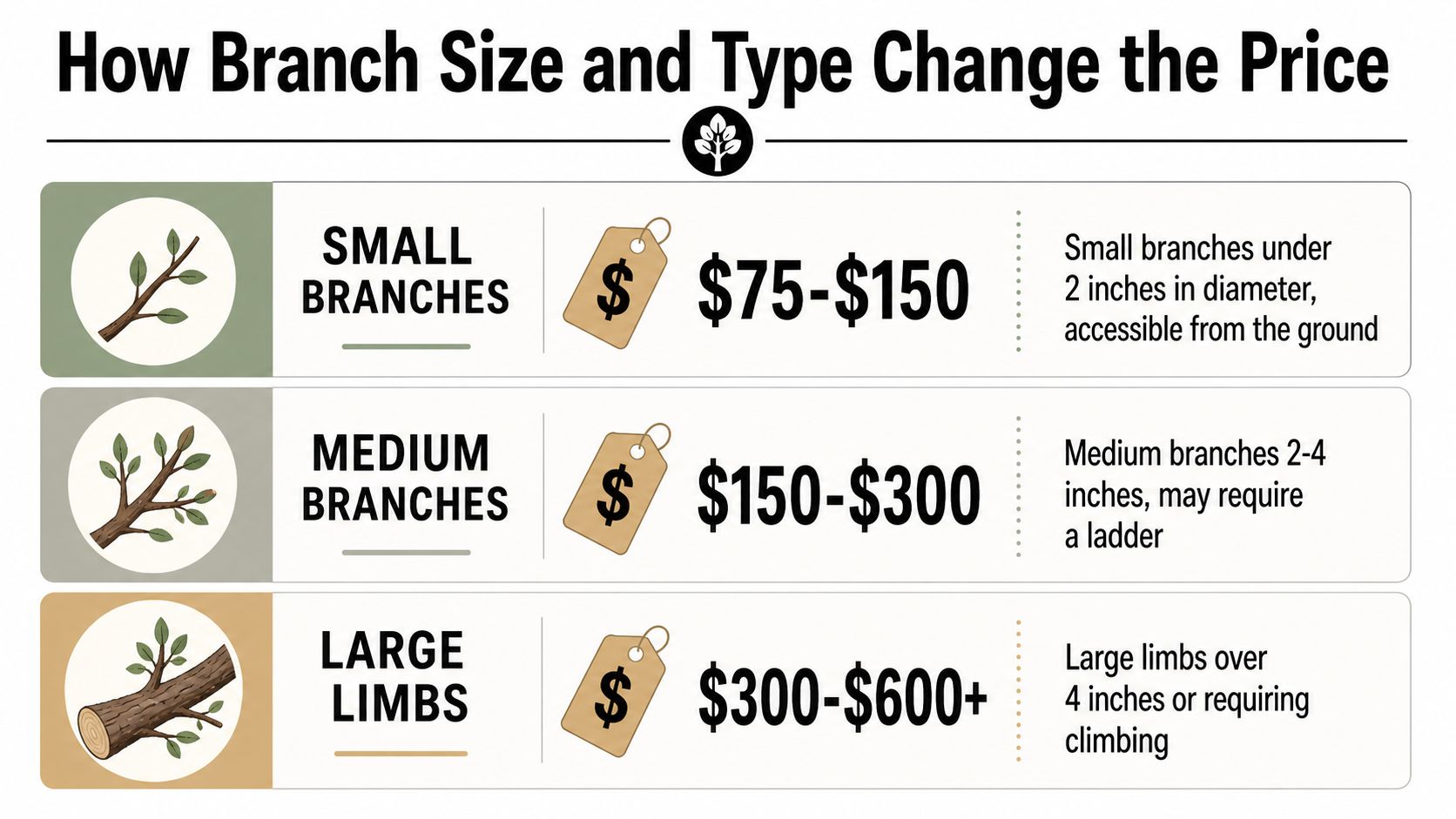
Small branches
Small branches, roughly under 2 inches in diameter, usually cost less when reachable from the ground and separated from buildings, vehicles, fences, and walkways. A routine deadwood cut in a Marietta or East Cobb yard may fall around $75 to $150, within the lower end of the branch-removal range cited by HomeGuide.
A low maple branch extending into a walkway is a simple example. If it has no tension and a clear landing area, a worker may cut it with a hand saw or pole saw while another person manages the debris. The same branch becomes a higher-risk job when it is woven through a fence or positioned above a vehicle.
Medium branches
Medium branches, approximately 2 to 6 inches, need more control because their weight and reach make an uncontrolled fall dangerous. A pole saw, ladder setup, climber, or bucket access may be necessary, while a second worker manages the landing area. A reasonable local planning range is $150 to $400, with access and disposal still shaping the final quote.
A four-inch oak limb over a Roswell driveway illustrates the difference. The cut may be routine, but the crew must keep it off cars, control its movement, and move the resulting wood through the property. Tight suburban lots turn an ordinary cut into a labor-and-risk service.
Large limbs
Large limbs, over 6 inches, warrant a professional assessment, particularly when they come from dense hardwoods such as oak or hickory common in Forsyth County and Cherokee County. These jobs can run from $400 to $850 or more, within the large-limb range reported in HomeGuide's branch removal guide.
A storm-split hickory limb still attached above a roof cannot be dropped safely. The crew may need to rope it down in sections, controlling each piece until it reaches the ground. That work is controlled dismantling, not ordinary pruning, and a mistake can damage the roof or injure someone below.
Measure at the branch base, identify the species if possible, and report whether the limb is hanging, cracked, resting on something, or under tension. Ground-level photos help with an initial estimate. They do not replace an on-site assessment when the branch threatens a structure.
The Cost Drivers Most Homeowners Overlook
A branch can be small and still require a high-risk removal. In North Atlanta, access and risk usually affect tree branch removal cost more than the number of cuts. Crews price the labor involved in reaching the limb, controlling its fall, protecting nearby property, and removing the debris. A narrow side yard or pool below the canopy can turn a short job into careful dismantling.
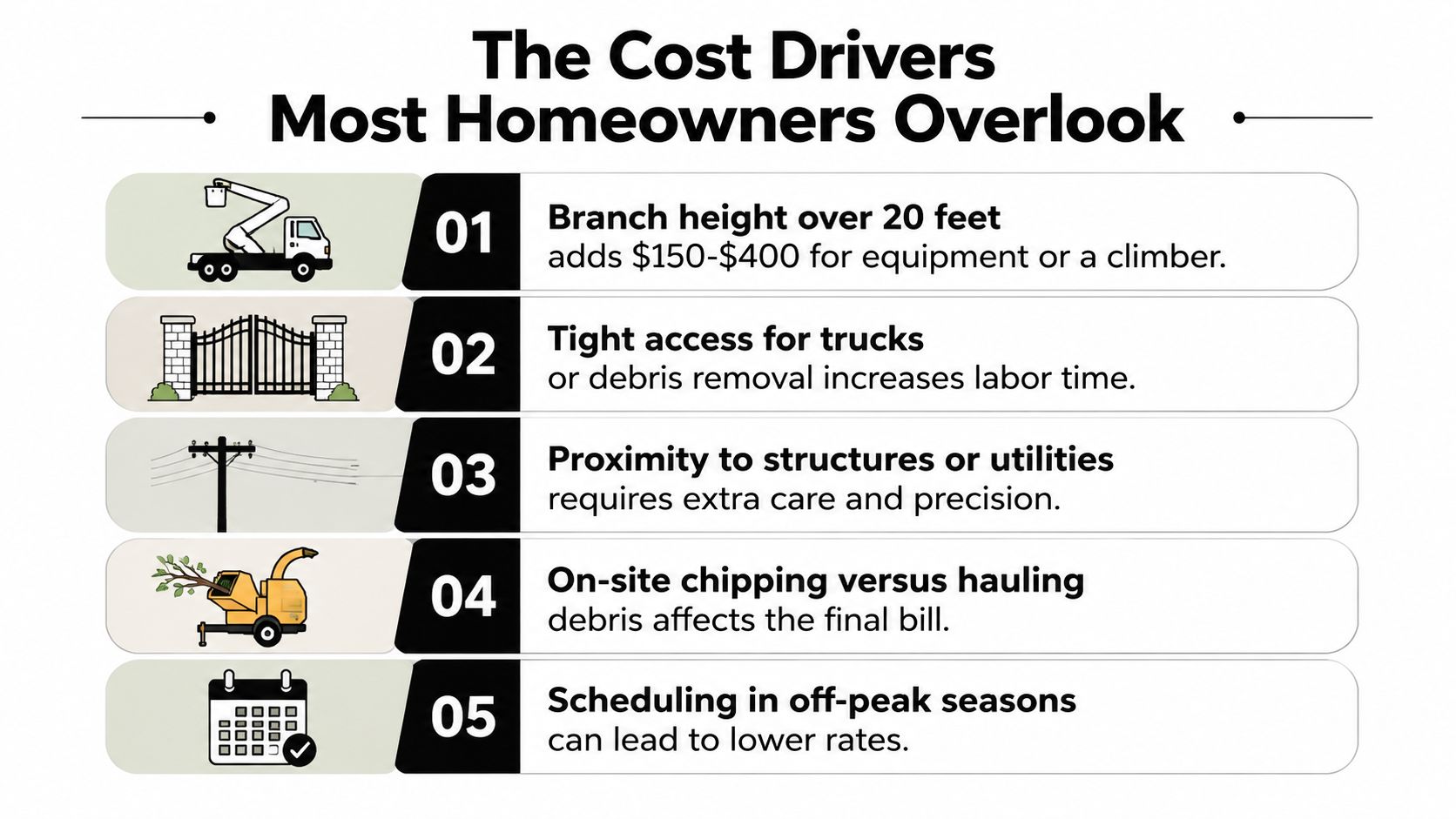
Height and equipment
A branch more than 20 feet above ground may require a bucket truck or a climber. That adds roughly $150 to $400 for equipment or specialized labor, according to the North Atlanta branch-removal pricing discussion. The truck also needs firm, usable ground. A gate, steep driveway, retaining wall, or tight lot may prevent equipment from reaching the tree.
Tight access
Fences, narrow gates, pools, retaining walls, and steep driveways slow the entire job. Workers may need to carry brush farther, protect hardscape, or use smaller equipment. Older Roswell and Alpharetta neighborhoods often restrict access. Newer subdivisions may provide front-yard access but place more roofs, cars, fences, and landscaping beneath the canopy.
Ask the crew how it will reach the tree and move the wood out. Access affects labor before the first cut.
Rigging and structures
A limb above a roof, deck, fence, vehicle, or power line cannot be dropped. Crews use ropes, pulleys, and controlled sectional cuts to lower each piece. Rigging over structures can add $200 to $500, as reported in the same local pricing discussion. Storm-damaged limbs require even more control because cracks and tension can change how the wood moves.
Practical rule: If you cannot identify a clear landing zone beneath the branch, price the job as a controlled removal, not a basic trim.
Cleanup and hauling
Cutting is one line item. Branch-only hauling can cost $75 to $250, and HomeGuide's cost data identifies disposal as a meaningful part of the invoice. Confirm whether the crew will chip brush, leave mulch, remove logs, rake the work area, and haul away material that cannot go through the chipper.
Storm calls in Cobb or Gwinnett bring blocked driveways, unstable limbs, damaged trees, and heavy demand at once. Ask for a written emergency scope that separates immediate stabilization from later trimming or crown correction.
DIY Versus Hiring a Professional Crew
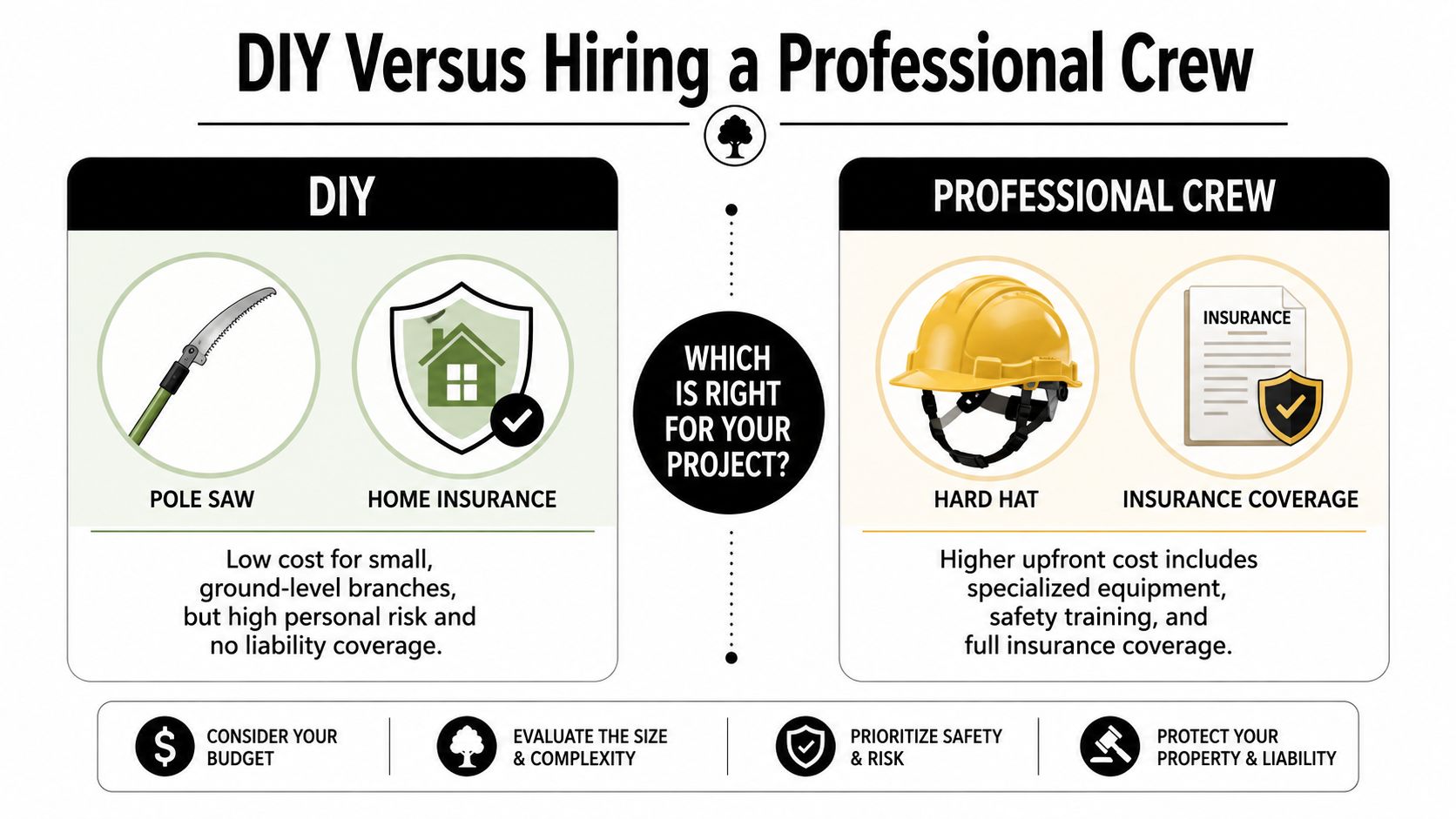
DIY branch cutting fits only a narrow situation: a small, ground-level limb with no cracks, utility contact, structure beneath it, or obstacle in the fall zone. You also need suitable protective equipment and safe cutting skills. In dense North Atlanta neighborhoods, that combination is uncommon.
A ladder, chainsaw, roof, climbing, or nearby electrical line changes the job from routine maintenance to controlled risk. A falling limb can damage shingles, gutters, fences, vehicles, landscaping, or a neighbor's property. Unlicensed work may also create a coverage dispute if it causes damage, depending on the policy and circumstances.
Where DIY stops
Use this test before picking up a saw:
- Can you reach the branch from the ground without a ladder?
- Is the limb completely away from power lines, roofs, fences, vehicles, and people?
- Can you control where the cut section will land?
- Does the tree show no lean, decay, cavities, hanging deadwood, or storm damage?
If any answer is no, hire a professional crew. Do not improvise with a ladder and chainsaw. A licensed, insured tree service has climbing systems, rigging, chippers, bucket trucks, traffic protection, and trained workers who can lower wood safely through tight access points.
That equipment matters when a branch overhangs a roof, deck, driveway, or fence. The quote reflects labor and risk, not just the number of cuts. Storm-damaged limbs deserve the same treatment because hidden cracks and shifting tension can make them move unpredictably.
A qualified arborist also examines the tree beyond the visible limb. Repeated branch loss can point to structural weakness, disease, root disturbance, or a hazardous tree requiring broader action. Tree pruning should improve the tree's structure, not remove only the easiest branch to reach.
Property managers and real estate agents should request proof of insurance, a written scope, cleanup details, and the name of the person assessing the tree. Keep that record before work begins.
The video below provides additional visual context for safe tree maintenance decisions.
Permits, Hazardous Trees, and Atlanta Rules
Permit requirements differ by municipality. A branch removal job in Marietta may follow a different process from one in Atlanta, Roswell, Milton, or Johns Creek. In the City of Atlanta, removing a private-property tree requires a permit when the tree is hardwood at least 6 inches in diameter or pine at least 12 inches in diameter, measured 4.5 feet above ground. The Arborist Division handles inspection and approval, according to this Atlanta permit resource.
That threshold applies to tree removal, not every pruning cut. Still, storm-damaged limb work can reveal a larger removal problem. Confirm the governing jurisdiction, measure the trunk correctly, and ask the contractor whether the crew will handle the permit. You can also review the Atlanta tree removal permit requirements before approving the scope.
Atlanta-area permit thresholds at a glance
| Jurisdiction | Permit Trigger | Hazard Exemption |
|---|---|---|
| City of Atlanta | Hardwood at least 6 inches, or pine at least 12 inches, measured 4.5 feet above ground | Hazardous-tree removal may use a dedicated application or building-permit path |
| Cobb County communities | Check the governing city or county office before removal | Ask the relevant arborist or permitting office about emergency procedures |
| Fulton County communities | Local ordinance and property jurisdiction control the trigger | Document immediate danger and confirm the local process |
| Gwinnett County communities | City rules may differ from county requirements | Verify the hazardous-tree route before cutting |
Atlanta routes dead, dying, diseased, or hazardous trees through its Arborist Division. Removal may proceed through a building permit or a dedicated hazardous-tree removal application, as explained in this Atlanta tree-removal permit overview.
A newly developed lean demands prompt attention, especially after a storm. Soil lifting, ground cracks, exposed roots, or a sudden change in posture can signal instability. Deep trunk cracks, hanging dead branches, fungal growth at the base, bark loss, cavities, and construction-related soil disturbance also warrant an assessment.
Keep photographs, stay outside the danger zone, and call for hazardous tree removal when the tree threatens a structure or access route. In dense North Atlanta neighborhoods, tight driveways, fences, roofs, and nearby homes increase the labor and risk involved. A permit question can become a safety question quickly, so have the crew assess the entire tree before cutting a damaged limb.
A Real North Atlanta Pricing Scenario
Consider a representative Alpharetta emergency job. A large oak limb split during a summer thunderstorm and came to rest on the roof above a garage. The homeowner searched for emergency tree removal, but the immediate need was controlled branch removal, not taking down the entire oak.
The first quote discussion separated urgent access from later care. The emergency limb removal landed around $450 to $750, a range consistent with the difficult large-limb pricing documented in the North Atlanta branch cost guide. The estimate covered crew dispatch, an on-site assessment, rigging, sectional cutting, debris processing, and removal of logs that couldn't be chipped.
How the crew built the scope
The crew first established whether the roof, gutters, and utility lines were safe to approach. They then positioned equipment where access allowed and attached rigging so the limb could be lifted and lowered rather than dragged across shingles.
Workers made sectional cuts from the roof side upward, controlling each piece. Brush went into the chipper, while larger unchippable sections were loaded for haul-off. The quote wasn't based on the number of saw cuts. It reflected the labor required to keep weight off the roof and prevent secondary damage.
A steep pitched roof would push the job toward the upper end. So would a fenced backyard with no truck access, or a limb resting near a power line that required additional coordination and precision. If the oak needed a follow-up crown reduction to rebalance the damaged canopy, the additional work could run around $150 to $300, based on the scenario parameters.
The homeowner should receive two separate answers: what must be removed now to make the property safe, and what pruning or inspection can wait until conditions are stable.
The final invoice should identify emergency response, rigging, cutting, chipping, log haul-off, and any follow-up pruning separately. The homeowner also verified the contractor's insurance before work began and photographed the damage for the insurer. That simple documentation protects everyone when a roof, vehicle, fence, or neighboring property sits inside the work zone.
Smart Ways to Save and Get an Accurate Quote
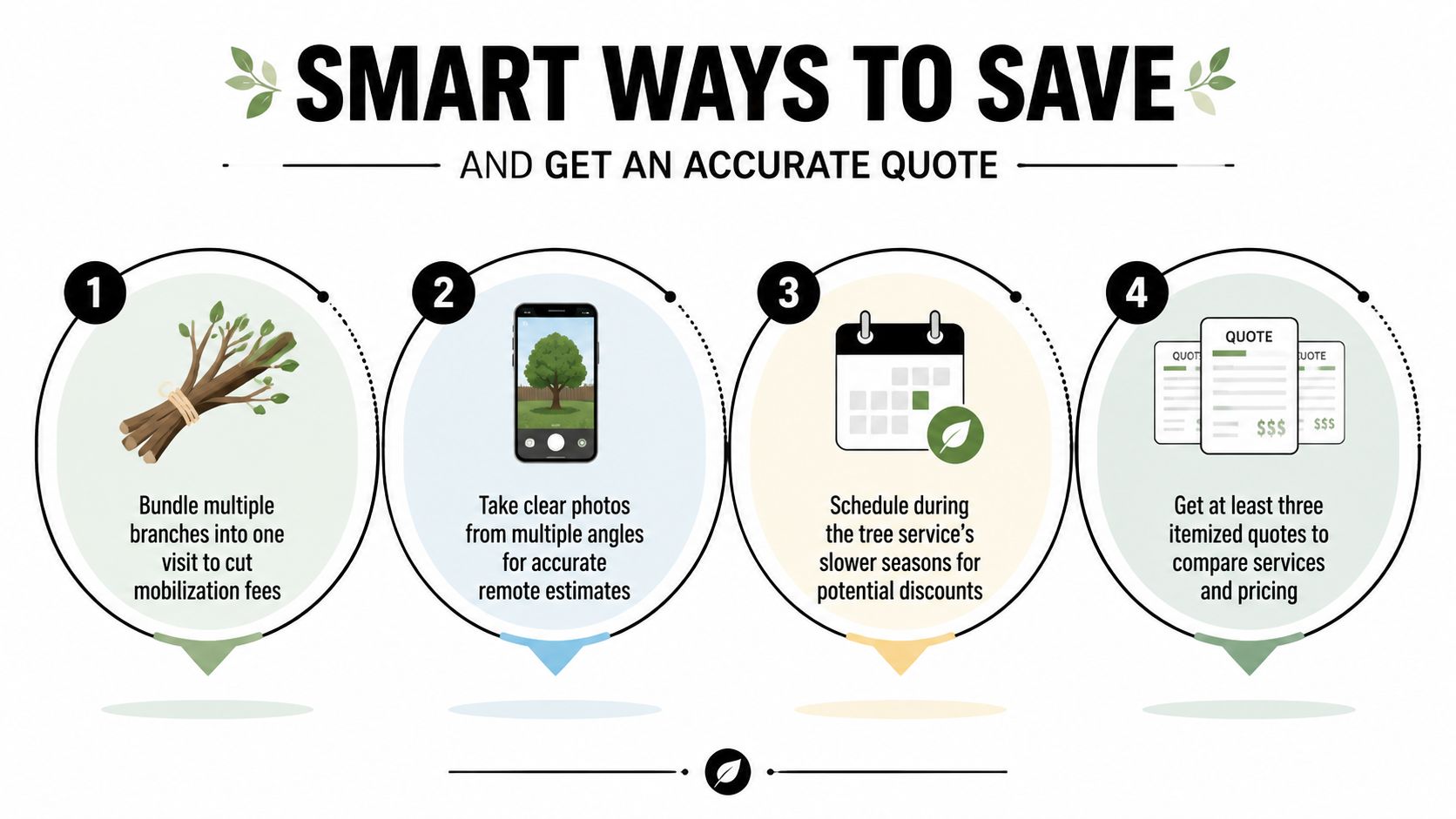
The safest savings come from reducing wasted setup, not from pushing a crew to rush. Group several non-urgent limbs into one scheduled visit when access is already clear. One mobilization can cover multiple pruning points. A storm-damaged limb over a roof, driveway, fence, or power-line area is different. Treat it as a safety job and schedule it promptly.
Make the estimate useful
Send photos from several angles. Include the branch union, the full tree, the likely landing area, and nearby roofs, fences, driveways, and utility lines. Photos help identify access problems, but a limb over a roof or a hazardous tree still requires an on-site assessment.
Ask for a written, itemized scope before approving work:
- Cutting and rigging: State whether climbing, bucket access, sectional cutting, and controlled lowering are included.
- Chipping and hauling: Confirm whether brush, logs, disposal, and final cleanup are included or billed separately.
- Property protection: Ask how the crew will protect roofs, turf, fences, driveways, vehicles, and irrigation.
- Credentials and coverage: Request proof of insurance and identify who will assess structural risk.
For contractors and commercial property managers comparing bids, Exayard landscaping estimating software can organize estimates and line items. A homeowner does not need software for one limb, but a written breakdown matters when several trees, stump grinding, or land clearing are included.
Schedule with judgment
Schedule routine trimming when crews have availability instead of during the immediate rush after a storm. Clear gates, move patio furniture, relocate vehicles, and mark irrigation heads before arrival. These steps will not make a dangerous limb safe, but they can prevent avoidable labor and access delays.
Ask about payment terms before scheduling. Smaller branch jobs are often settled at completion, while larger rigging projects may require a deposit. A combined project involving tree removal, stump grinding, stump removal, or lot preparation can use different terms.
Use a written tree service estimate that names the property, scope, disposal method, access assumptions, insurance status, and exclusions. Richmond Tree Experts GA provides free on-site estimates across Cumming, Johns Creek, Milton, Alpharetta, Roswell, Marietta, Forsyth, East Cobb, Cobb, Gwinnett, and Cherokee.
For a branch over a roof, driveway, pool, fence, or power-line area, contact Richmond Tree Experts GA for a free on-site estimate and a clear plan for tree trimming, emergency tree removal, storm damage cleanup, stump grinding, or hazardous tree removal. Send photos if the situation is stable. Stay away from fallen or tension-loaded limbs until a licensed and insured crew assesses them.

