

A limb is hanging over your roof after last night's storm. Or perhaps a mature oak has been rubbing against the shingles for months, and now you're finally ready to call a tree service in Marietta, Roswell, Kennesaw, Woodstock, Acworth, or Canton. You search for a tree pruning estimate, request a few quotes, and discover that the numbers don't look remotely alike.
That spread doesn't automatically mean someone is overcharging you. In tree work, the significant difference usually sits inside the scope: which branches are removed, how the crew reaches them, whether limbs are lowered or dropped, what happens to the debris, and whether the work addresses a safety risk or only improves appearance. The same principle applies to tree removal, emergency tree removal, stump grinding, fallen tree removal, and storm damage tree cleanup across Cobb County, Cherokee County, and nearby North Metro Atlanta communities.
What a Tree Pruning Estimate Actually Covers
A Marietta homeowner recently calls three contractors about the same backyard tree. One offers a short verbal number over the phone. Another sends a one-line proposal for “tree trimming.” The third walks the property, photographs the canopy, identifies roof and fence exposure, and separates deadwood removal from clearance pruning. The three prices can differ by hundreds of dollars because they may describe three different jobs.
A credible estimate isn't just a price tag. It's a written arboricultural assessment that identifies which tree will receive which work, by what method, and for what purpose. “Trim the oak” leaves too much open to interpretation. “Remove deadwood, reduce selected limbs for roof clearance, preserve the branch collar, chip brush, haul away logs, and rake the work area” gives both sides something they can verify.
Practical rule: If you can't tell what happens to the branches, wood, stump, and work area from the estimate, you don't yet have a comparable bid.
Historical municipal data illustrates why broad flat pricing can mislead. In 1986, U.S. municipalities spent an average of $10.62 per public tree annually, with pruning representing 30% of tree-care budgets, compared with 28% for removal and disposal and 14% for planting. Those figures are historical public-tree benchmarks, not residential Atlanta quotes, but they show why a serious estimate identifies work categories instead of treating every tree as interchangeable. The University of Florida urban-tree maintenance guidance also explains why maintenance estimates vary with size, species, access, weather, policy, and maintenance objectives.
For homeowners comparing tree trimming and pruning companies, the first useful question is not “What's your price?” It's “What exactly is included?” A practical overview of pruning terminology and maintenance considerations appears in this tree trimming and pruning guide from Pool & Landscaping of Vistancia. You can also compare terminology with this tree trimming and pruning service resource.
A proper bid should identify:
- The specific tree or work zone.
- The pruning objective.
- The method and equipment.
- The hazards and access constraints.
- Debris, haul-off, and cleanup.
- Any permit or municipal review issue.
- Optional work, such as stump grinding or removal of additional trees.
That structure protects the homeowner from surprise change orders and protects the contractor from being expected to perform work that wasn't priced.
Inside a Credible Written Scope
A written scope should let you stand in the yard with the estimate and match the paper to the trees. Before assigning labor hours, the estimator should record the tree's species, diameter at breast height, height, crown density, pruning objective, quantity, access conditions, equipment needs, and disposal requirements.
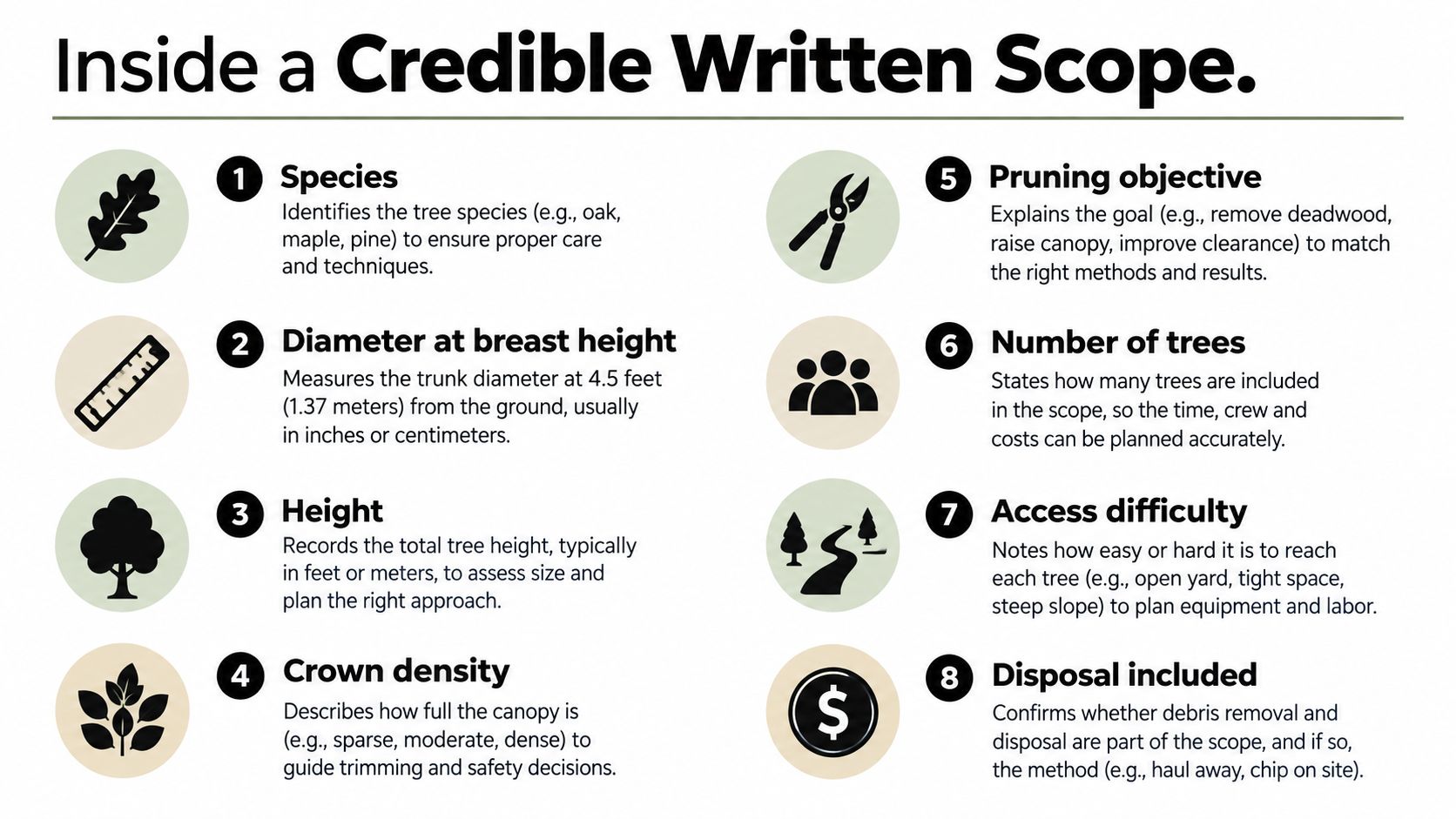
The information that belongs on the page
Species affects branch structure, wood characteristics, growth habit, and the way a crew approaches cuts. An oak, pine, sweetgum, and ornamental tree aren't interchangeable even when they appear similar from the driveway.
Diameter at breast height, or DBH, is the trunk diameter measured at a standard height above ground. It gives the estimator a more useful size reference than a casual description such as “large tree.” The USDA Natural Resources Conservation Service pruning guidance identifies tree size, species, and quantity as primary cost variables, while equipment, manual labor, and debris cleanup create separate cost components. U.S. Forest Service research also notes that cities commonly track street-tree costs by DBH classes.
Height and crown density help predict climbing, bucket-truck, rigging, and lowering time. A tall, open-canopy tree may be easier to work than a shorter tree with heavy, tightly packed limbs.
Pruning objective should use a defined category, such as deadwood removal, crown cleaning, crown reduction, structural pruning, raising, or clearance pruning. “Shape the tree” isn't enough for a professional scope.
Quantity matters because several trees on one property can share mobilization, equipment setup, and cleanup. The estimate should still identify each tree separately rather than hiding all work inside one vague package.
Production details make the price understandable
Access notes should state whether a bucket truck can reach the canopy, whether a climber must work from the tree, and whether gates, slopes, fences, pools, roofs, or soft ground restrict equipment. Disposal notes should specify whether brush is chipped, chips remain on site, logs are cut and stacked, or all debris is hauled away.
The contractor then converts the scope into production units, such as trees per crew-hour, climbing time, bucket-truck time, rigging time, and brush volume. You don't need to see every internal calculation, but the estimate should reveal the conditions that produced the final number.
What Drives the Price on a North Atlanta Property
A water oak over a Whitlock Avenue roof isn't priced like the same species in an open lawn. The tree may require controlled lowering, roof protection, additional ground labor, and careful separation of brush from larger wood. A sweetgum with clear bucket-truck access can follow a much more efficient production plan, even if both trees appear similar from the street.
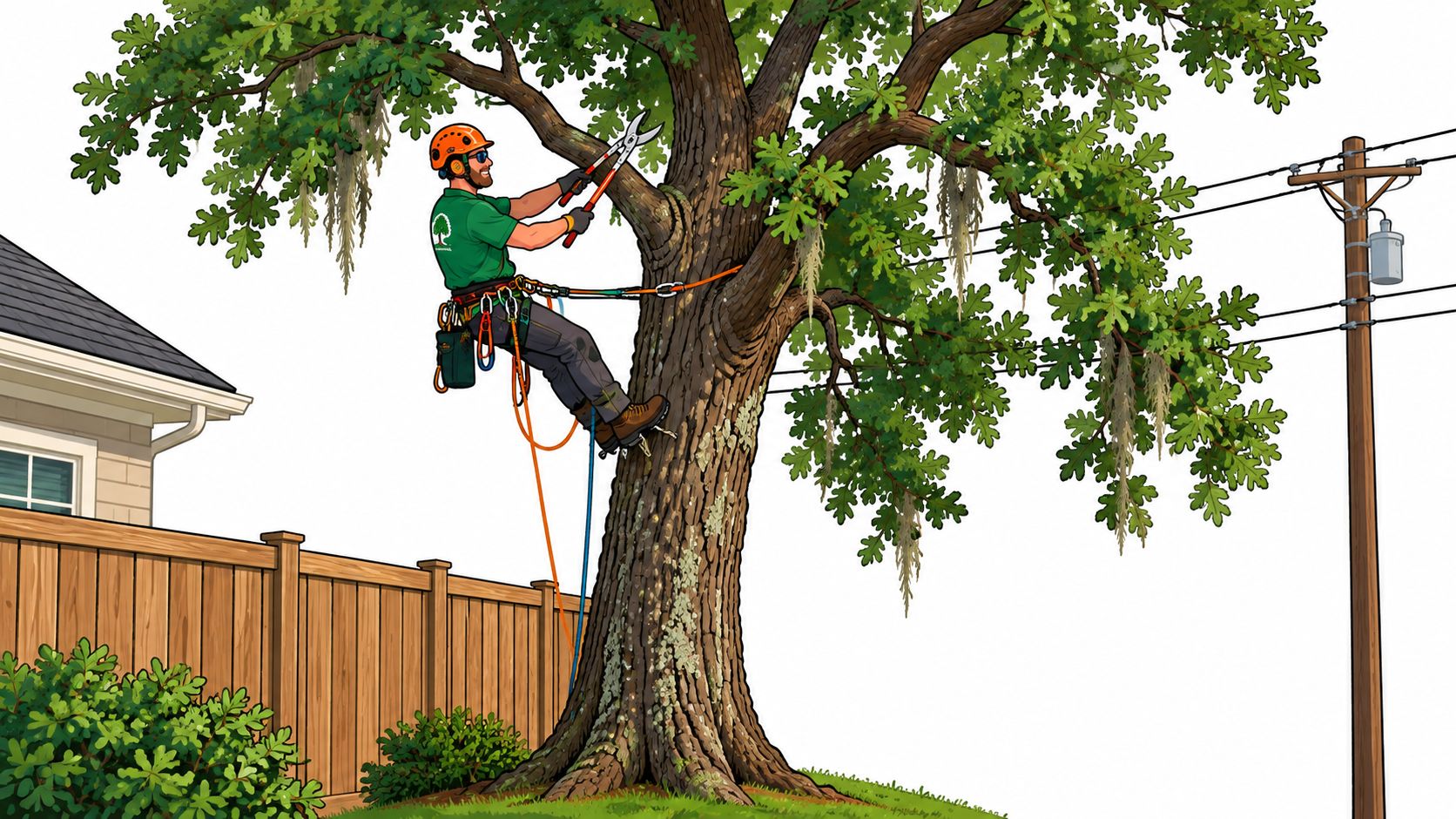
Five variables that change the work
Size affects the amount of canopy, branch weight, climbing distance, and debris. DBH, height, and crown spread should be considered together.
Species changes the structure and handling of the work. A tree with heavy lateral limbs may require more rigging and lowering than an ornamental tree receiving selective deadwood removal.
Location determines what the crew must protect. A branch over a roof, driveway, sidewalk, play area, pool, retaining wall, or fence can't just be dropped. Power-line conflicts may require additional coordination and specialized procedures.
Access controls equipment selection. A bucket truck may reduce climbing time when it can reach the canopy, while a fenced backyard may require hand carrying, rope work, or a smaller machine. The estimator should note gate width, driveway surface, slope, lawn condition, and distance from the truck to the tree.
Health and structural condition affect both safety and method. Dead, cracked, storm-damaged, or decayed limbs may not support ordinary climbing methods. A tree leaning toward a target can turn routine tree pruning into risk-reduction work, emergency tree removal, or a diagnostic visit before any cutting begins.
The estimate should also account for timing. USDA Forest Service guidance recommends retaining a live crown of at least one-third of tree height in relevant production systems and advises pruning during winter or very early spring before active growth begins. Those recommendations make season, tree condition, and the proposed amount of live-tissue removal material to the scope, as described in this USDA Forest Service guidance.
A contractor who skips the site visit can't reliably assess these variables. That's why a firm phone price often becomes a change order once the crew discovers a roof below the canopy, limited chipper access, or wood too weak for safe climbing.
For emergency tree removal, fallen tree removal, and storm damage tree cleanup in Cobb County or Cherokee County, the estimator should separate immediate stabilization from later pruning, stump grinding, stump removal, or full removal. Those are different services with different equipment and risk profiles.
Sample Atlanta-Area Price Ranges
Homeowners often want a planning figure before scheduling an inspection. The table below provides illustrative planning ranges, not verified market quotes or promises. Because no reliable residential price schedule applies uniformly across metro Atlanta, the final number still depends on the written scope, access, equipment, hazards, disposal, and municipal requirements.
| Size class (DBH) | Crown cleaning / deadwood | Clearance pruning | Structural / risk-reduction |
|---|---|---|---|
| Small ornamental or young tree | Lower planning range for selective deadwood | Higher when work is near roofs, fences, or utilities | Depends on branch structure and diagnostic complexity |
| Medium residential tree | Moderate range for canopy cleaning | Moderate to higher range when lowering or rigging is needed | Higher when cuts require structural inspection and precise selection |
| Large mature tree | Higher range because canopy volume and branch weight increase production time | Higher when the canopy extends over structures or access is restricted | Highest planning category when risk targets, rigging, or aerial equipment are involved |
These categories are more useful than a single “per-tree” number because they connect price to work type. Crown cleaning removes specified dead, diseased, damaged, or poorly attached branches. Clearance pruning addresses a defined conflict, such as roof, driveway, sidewalk, or utility clearance. Structural or risk-reduction pruning requires more judgment and shouldn't be sold as cosmetic shaping.
What the planning range may exclude
Ask whether the proposal includes:
- Brush chipping and chip haul-off.
- Logs cut, stacked, or removed.
- Stump grinding or stump removal.
- Crane or specialized aerial equipment.
- Traffic control.
- Permit or inspection costs.
- Lawn, fence, roof, or driveway protection.
- Emergency mobilization after a storm.
A routine maintenance visit shouldn't be compared directly with hazardous tree removal or emergency tree service. Storm-damaged work may involve hanging limbs, unstable stems, blocked driveways, utility hazards, and immediate exclusion zones. The estimate should say whether the contractor is stabilizing the site, completing a partial removal, or returning for scheduled cleanup.
A planning range helps you budget. Only a site-specific scope tells you what you're buying.
Permits and City Rules That Change the Bid
Regulatory scope can change the estimate before a saw starts. “Atlanta” isn't one universal rule set for every property in Marietta, Roswell, Cumming, Alpharetta, Johns Creek, Milton, East Cobb, or an unincorporated county. The governing municipality and the proposed work determine whether the contractor needs a permit, notification, arborist meeting, photographs, or other documentation.
Within the City of Atlanta, pruning a neighbor's overhanging tree without a permit is allowed only when proper cuts remove less than 20% of the live canopy and the work doesn't make the tree unstable. The city also changed its process effective June 25, 2025, requiring an arborist meeting before permit submission for projects that may affect trees. Those rules make canopy percentage, property-line responsibility, and the proposed pruning method relevant to the estimate. Check the city's tree-pruning and overhanging-tree guidance before authorizing work.
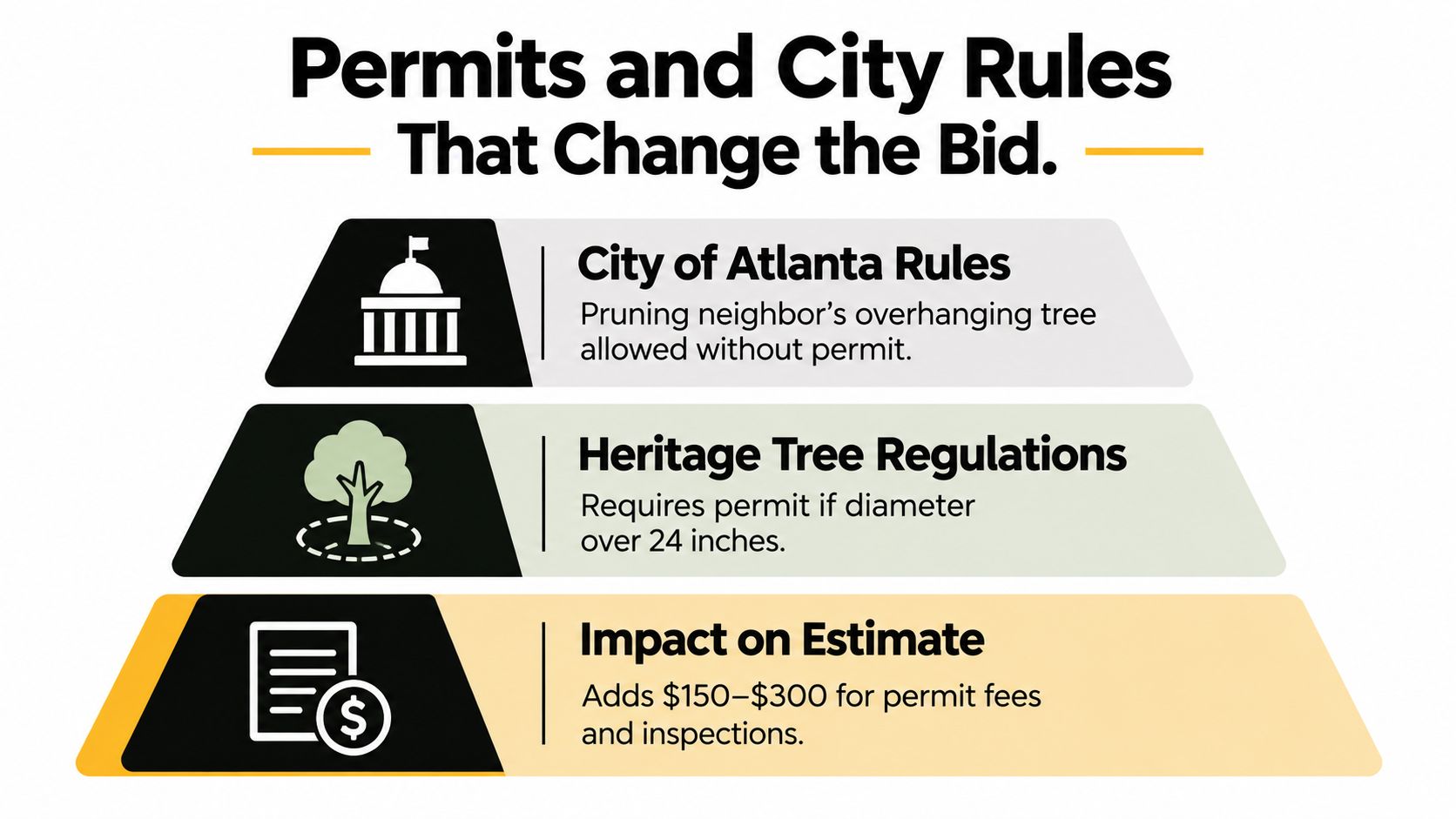
Match the paperwork to the municipality
Marietta uses its own documentation process for tree-removal notification. The city form asks for a site plan identifying proposed removal trees and required replacement trees, an arborist or architect report on tree health, DBH measured 4.5 feet above ground, species, and photographs. Review the Marietta tree-removal application when a pruning recommendation may become a removal project.
The estimate should identify:
- The municipality governing the property.
- Whether the work is pruning, removal, or storm cleanup.
- Species, DBH, location, and condition.
- Photos and a site plan when relevant.
- Who handles permits, meetings, notifications, and replacement requirements.
- Whether those administrative tasks are included or excluded from the price.
For homeowners and property managers, this tree preservation ordinance resource can help frame the questions, but local officials remain the authority for a specific property. Land clearing and lot preparation require even more care. Georgia's Environmental Protection Division administers state environmental permits and operates erosion-and-sedimentation programs, while broader clearing, regrading, drainage changes, exposed soil, or wetland conditions can trigger additional review. A tree service estimate isn't proof that every development approval has been satisfied.
Questions to Ask Before You Sign
The fastest way to compare contractors is to ask each one the same questions and record the answers beside the price. A legitimate tree service should be comfortable explaining the work, equipment, insurance, and cleanup plan.
Put these questions in your notes app
- Who will supervise the work? Ask whether an ISA Certified Arborist reviews the recommendation and whether that person will be involved in the job.
- Can you provide insurance documentation? Request general liability and workers' compensation confirmation before work begins.
- Which trees and branches are included? The proposal should identify locations, species when known, and the exact pruning objective.
- Which pruning standard guides the scope? Ask whether the work is specified using ANSI A300 terminology rather than a vague promise to “trim” the tree.
- What is the live-tissue limit? The estimate should state the intended extent of live-crown removal when structural or reduction work is proposed.
- What happens to brush and logs? Confirm chipping, haul-off, stacking, firewood handling, and cleanup.
- Is the stump included? Stump grinding and stump removal should appear as separate line items if offered.
- How will the crew protect targets? Ask about rigging, roof protection, traffic control, utility coordination, and exclusion zones.
- What could create a change order? Access restrictions, hidden decay, emergency conditions, or additional trees should be identified before cutting.
ANSI A300 Part 1 covering pruning was first published in 1995, and by 2023 the separate ANSI A300 arboricultural standards had been consolidated into one volume with 10 clauses addressing practices including pruning, soil management, support systems, risk assessment, and integrated pest management. This history is summarized in TCIA's ANSI A300 overview.
Two bids that look different may be priced for different work. Compare the scope before comparing the total.
Don't accept “cleanup included” without a definition. One contractor may rake and blow the site while leaving large logs stacked in the backyard. Another may chip brush, haul every piece away, grind the stump, and restore the work area. Those proposals aren't equivalent, even if both use the word cleanup.
How Richmond Tree Experts GA Builds Your Estimate
The process starts with the property, not a guess over the phone. A homeowner can describe the tree, share photographs, and explain the concern, but an estimator still needs to inspect the canopy, targets, access route, and ground conditions before pricing routine tree pruning or a larger tree removal project.
Richmond Tree Experts GA's stated process uses a free on-site estimate and a written proposal reviewed by an ISA Certified Arborist. For properties in Marietta, Roswell, Cumming, Alpharetta, Johns Creek, Milton, or East Cobb, the visit should identify each tree, its approximate size and condition, the pruning objective, access constraints, equipment plan, debris handling, and any municipal question.
What to prepare before the visit
Mark the trees you want inspected and note whether the concern is deadwood, roof clearance, a dangerous lean, storm damage, or a possible removal. Clear access to gates and driveways where possible, identify utility conflicts, and gather any notice from a neighbor or municipality.
The written estimate should then separate routine tree trimming, structural pruning, hazardous tree removal, stump grinding, stump removal, and storm damage tree cleanup rather than combining unrelated work in one total. A separate emergency response path is appropriate when a fallen tree blocks a home, a limb is suspended over a target, or a tree is leaning dangerously.
The company states that call coverage runs from 7 a.m. to 11 p.m., offers free written estimates, and routes emergency storm-damage cases through a separate response path. Those service details should still be confirmed when you call, especially after a major storm when conditions and crew availability can change.
Storm triage comes before cosmetic decisions. Oklahoma State University Extension states that when more than one-third of a tree's branching system has been damaged by wind or ice, removal should be considered instead of attempting to salvage it. The storm-damaged tree guidance from Oklahoma State University Extension also supports removing broken or dangerous limbs first and having an arborist assess extensive damage.
If a large branch needs removal, don't treat the estimate as permission for a homeowner to perform hazardous chainsaw work. University of Nebraska Extension describes a three-cut method for certain large storm-damaged branches and warns against topping, flush cuts, and wound dressings. Near homes, driveways, sidewalks, fences, or power lines, professional rigging and exclusion zones matter more than a quick cleanup.
Getting a Bid You Can Actually Compare
Start with a simple property packet. List the trees by location, record species if you know them, estimate height and trunk size without pretending those estimates are exact, and mark the trees on a yard sketch or photograph. Note roofs, fences, driveways, septic areas, power lines, gates, slopes, and any storm damage.
Ask for three written, scope-based bids when the situation allows. Each proposal should identify:
- The exact trees and work category.
- The pruning method or removal plan.
- Equipment, access, and safety controls.
- Brush, log, stump, and cleanup handling.
- Permit or notification responsibilities.
- Exclusions and possible change-order conditions.
- Insurance and responsible supervision.
Use this tree service estimates resource when organizing the questions and documents you want to discuss with contractors. Reject any proposal that arrives as a single number on a business card, especially when the job involves a mature tree over a structure, emergency tree removal, land clearing, or power-line exposure.
A defensible bid doesn't need to be the lowest. It needs to explain the work well enough that you can compare it with another contractor's proposal without guessing what was omitted. The cheapest line on the page can become the most expensive choice when haul-off, stump grinding, rigging, permits, or cleanup appear only after the crew arrives.
Richmond Tree Experts GA provides free on-site estimates and written scopes for tree pruning, tree removal, stump grinding, and storm-related work across North Atlanta communities. Visit Richmond Tree Experts GA to request an estimate that identifies the work, access plan, debris handling, and safety considerations before you sign.

