

The storm has passed, but a tree is leaning toward your roof, a broken limb is hanging over the driveway, or roots have lifted the patio again. You need to know whether it's dangerous, how quickly a crew can respond, and whether removing it will leave you with another expensive problem.
Tree removal and replacement should be one coordinated job, not a cutting appointment followed by a rushed nursery purchase. For homeowners in Marietta, Roswell, Kennesaw, Woodstock, Acworth, and Canton, the right sequence is to assess the hazard, confirm the parcel's permit requirements, remove the tree safely, and give its replacement a realistic chance to establish.
Decide Whether the Tree Has to Come Down
| Tree condition | Likely outcome | Action |
|---|---|---|
| Over half of branches and leaves gone or damaged | Unlikely to survive the next growing season | Plan removal and replacement |
| Split trunk | Poor survival prospects | Plan removal and replacement |
| Pre-existing disease plus storm damage | Poor survival prospects | Plan removal and replacement |
| Deadwood or clearance conflicts on a sound tree | Can be restored by pruning to ISA standards | Prune, don't top |
| Split union or heavy horizontal limb on a valuable tree | Can be supported when suitable for retention | Arborist-designed cabling and bracing |
| Declining but structurally sound | Cause needs a diagnosis | Arborist diagnosis and written treatment plan |
| Leaning dangerously toward a structure or line | Hazard to life and property | Emergency removal; utility handles any downed line first |
For storm-damaged trees, UGA Extension's damaged-tree guidance says that losing or damaging more than 50% of branches and leaves makes survival through the next growing season unlikely; it also identifies split trunks and pre-existing disease as poor survival indicators.
That's a triage threshold, not permission to start cutting. A tree with foliage remaining can still have failed roots, a separating trunk, or a suspended limb that makes approaching it unsafe. Conversely, a tree that looks ragged may need corrective tree pruning rather than removal.
Separate poor appearance from structural danger
A scoping arborist examines the trunk, branch attachments, root zone, canopy, and potential targets. At Richmond Tree Experts GA, our scoping arborist tells customers whether a tree needs to come down, can be pruned back to health, or is fine to leave alone. A documented tree risk assessment gives that decision a defensible basis.
Many common Metro Atlanta problems, including oak decline and root compaction, can respond to pruning, soil care, cabling, or targeted treatment when caught early. None of those treatments makes a badly compromised trunk sound again, and cabling isn't a universal substitute for hazardous tree removal.
Practical rule: Waiting is reasonable only when someone has assessed the defect and given you a monitoring or treatment plan.
Tree trimming should remove deadwood and resolve clearance problems without topping. Topping leaves large wounds and encourages weakly attached regrowth, while indiscriminate thinning can remove foliage a stressed tree needs.
Before anyone cuts, answer three questions:
- Is the structure sound? Look beyond leaf color to roots, trunk defects, and branch unions.
- Is the tree worth saving? Consider expected health, canopy benefits, treatment needs, and location.
- What sits inside the drop zone? Include homes, roads, neighboring property, and utility infrastructure.
Permits and Protected-Tree Rules in Atlanta
You may need a permit to remove a tree, and the correct answer comes from the jurisdiction governing your parcel, not your mailing address. The City of Atlanta's tree-work permit guidance identifies pathways through a building permit or an application for a dead, dying, diseased, or hazardous tree.
Atlanta's Arborist Division verifies trees proposed for removal. For building-permit removals, properties are posted before work so the public can appeal; tree work through the Parks and Recreation process must be done or directed by a certified arborist.
Those are City of Atlanta procedures, not blanket rules for Cobb County, Cherokee County, or every North Metro municipality.
Complete the pre-removal checks
- Confirm the parcel jurisdiction. Establish whether the city or unincorporated county administers tree protection.
- Measure every tree in scope. Record trunk diameter using the jurisdiction's required measurement method, and identify each tree on a site sketch.
- Identify protected and street trees. Don't assume that a tree beside your driveway is entirely under your control.
- Document the hazard. Obtain an arborist's written findings and photographs showing cracks, decay, root movement, or storm damage.
- Check utilities and construction constraints. Include overhead lines, underground services, equipment access, and retained-tree protection.
- Get written approval before work begins. Confirm whether posting, appeal periods, or additional conditions apply.
- Budget beyond cutting. Include required replacement, stump work, irrigation, inspections, and establishment maintenance.
Understand the financial exposure
The Atlanta City Council's ordinance announcement states that changes beginning January 1, 2026 include recompense of $140 per diameter inch of trunk, planting credit at 1.25 times caliper inches planted, and an increase in acreage-based illegal-removal fines from $100,000 to $200,000 per acre.
Recompense and penalties aren't interchangeable. Confirm which obligations apply to the proposed removal rather than treating a published figure as a complete project quote.
For land clearing and lot preparation, put the approved tree list, retained-tree protection, and replacement obligations into the construction documents. A sale or construction schedule can stall when the owner discovers those obligations after equipment has arrived.
How to Remove the Tree and Handle the Stump
A tree cutting service should explain how the crew will control the tree, protect the property, and leave the site. Emergency tree removal is not ordinary removal done faster. Storm-loaded branches, trapped tension, unstable roots, and damaged structures change the work plan.
The safety sequence starts before equipment enters the yard.
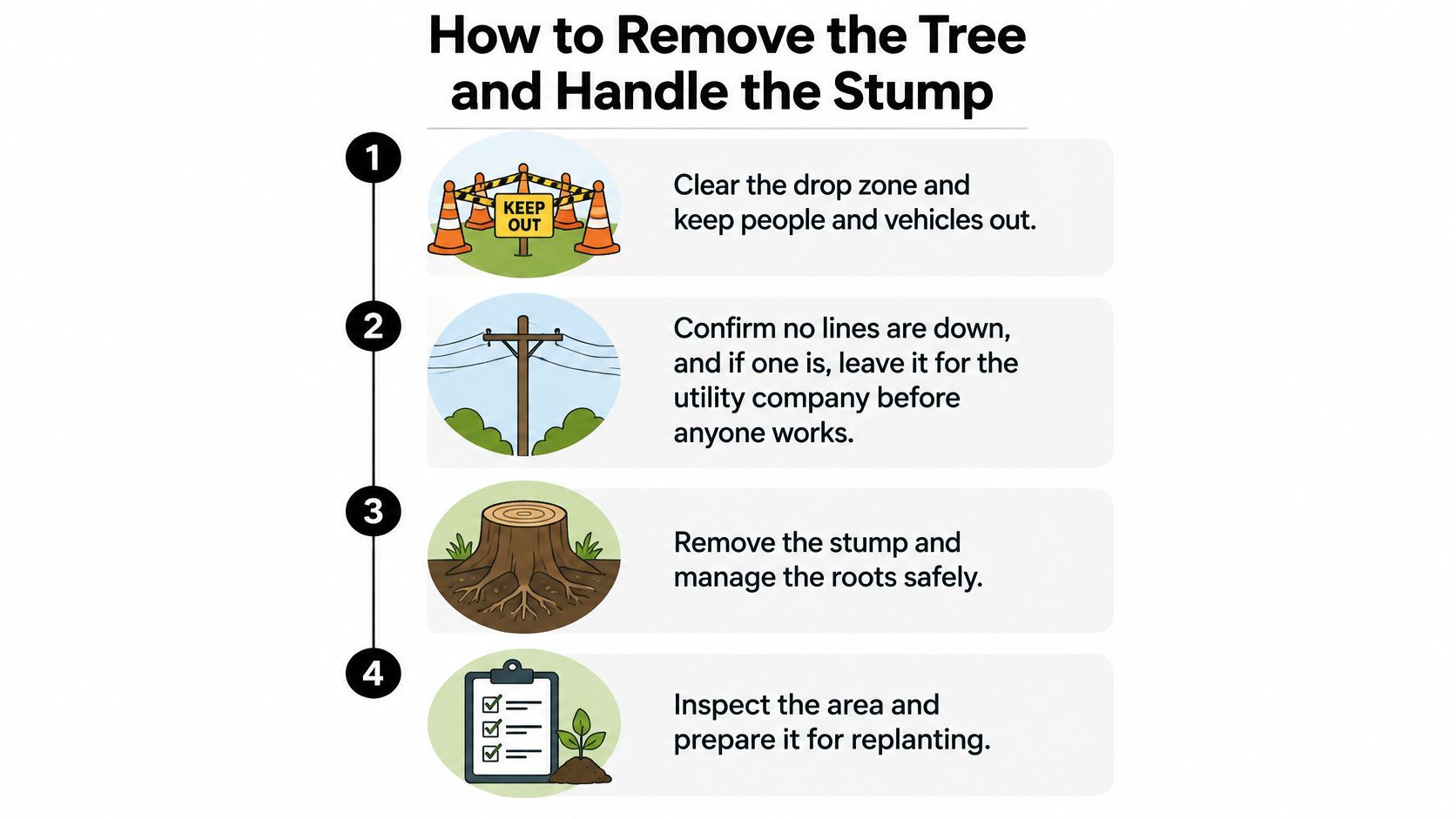
Control the work area first
- Clear the drop zone. Keep people, pets, and vehicles outside the work area, including adjoining space where branches could swing.
- Check for downed lines. Treat any fallen wire as energized and leave it to the utility company before tree work begins.
- Address hanging broken limbs before climbing beneath them. The crew should choose an access method that avoids placing a climber below suspended material.
- Use controlled cuts on large broken limbs. UGA Extension's storm-damage guidance describes an undercut 8–12 inches from the trunk, approximately one-quarter through the branch, followed by a top cut a few inches beyond it and a final cut just outside the branch collar.
- Protect access routes. Our crews protect the lawn and hardscape they work over, rather than treating repairable damage as unavoidable.
- Rig and lower sections over targets. A trunk over a roof or fence needs controlled dismantling, with crane assistance where the work plan calls for it.
- Finish the debris removal. Our crews haul away every branch before they leave the job.
Hanging broken branches, often called widow makers, can fall without warning. Saturated soil and high winds can also destabilize the root plate, so the crew must evaluate neighboring trees and wait for safe operating conditions.
For fallen tree removal from a house, don't pull branches away to inspect the roof yourself. The tree may be supporting other sections or holding damaged building materials in place.
Grinding isn't complete site preparation
Stump grinding reduces the stump below grade; stump removal generally means extracting more of the stump and root mass. The latter creates more disturbance and isn't automatically necessary for a successful replacement.
Excess grindings shouldn't become the replacement tree's entire rooting medium. Remove or relocate excessive woody debris, repair equipment-compacted soil, verify drainage, and establish a planting position where roots can extend beyond the old stump zone.
A smooth layer of topsoil can hide an unsuitable planting site. Check what's underneath before approving the finish.
A ready-to-plant site should meet this checklist:
- Debris managed: No large buried wood pockets beneath the proposed root ball.
- Soil usable: Compacted areas loosened without damaging retained roots or utilities.
- Drainage confirmed: No persistent water-filled depression at the planting position.
- Grade restored: Finished soil supports the root ball without settling into a void.
- Access preserved: Future watering and inspection won't require crossing an inaccessible bed.
Choose a Replacement Tree That Fits the Site
A sapling planted where a mature tree stood is a 10–20 year performance plan. The new tree can fill the bed within a season or two, but the shade, habitat, and stormwater interception you lost only return through years of survival and growth. If the removal permit carried replacement conditions, confirm them before you buy, because the species you choose may need to satisfy the approval.
The difference shows up in canopy, not in tree count.
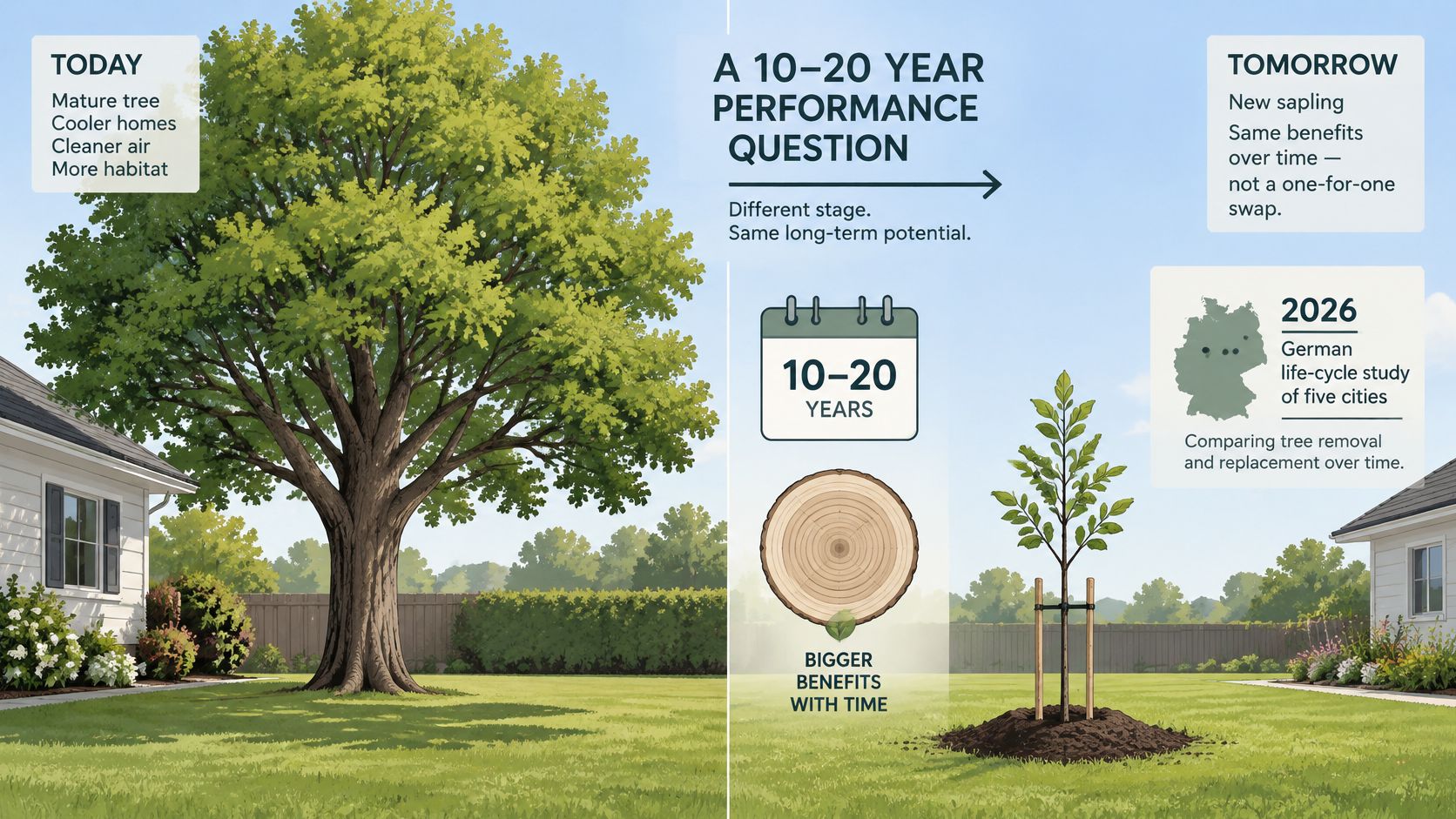
A 2026 life-cycle-cost study covering five German cities found preservation, including protection measures, more cost-effective over 50 years than removal and replanting, with planting in partially sealed areas costing up to five times more than preservation.
The practical takeaway: before committing to replacement, check whether selective pruning, root-zone protection, or support can retain a valuable tree. When the tree has to come down, the next question is what can live in the space it leaves behind.
Match the mature tree to the available space
| Site scenario | Practical choice | What to verify |
|---|---|---|
| Narrow planting strip beneath power lines | A small understory tree such as eastern redbud or dogwood | Mature height, utility clearance, sunlight, drainage, and usable soil |
| Open yard with deep, well-drained soil | A large shade tree such as red maple | Arborist confirmation of soil suitability, mature canopy spread, and distance from structures |
Species selection also weighs drought and heat tolerance, storm resilience, invasiveness, and establishment cost. A tree that needs constant correction to fit the site was the wrong choice at purchase, and correction costs compound across that 10–20 year horizon.
For a preliminary layout, OutdoorBrite's guide to design your backyard online free can help you compare planting locations against patios, paths, and usable lawn. Field checks still decide utility clearance and soil suitability.
The video below walks through weighing mature size against site limits.
Our native tree planting guidance supports choosing for local conditions rather than appearance alone. We help homeowners plan the right scope for the property and then complete the installation work.
Choose for the canopy the lot can carry in 15 years; the nursery tag describes a sapling. Keep the pick consistent with the original keep, prune, or remove decision.
How to Plant the Replacement Tree Step by Step
For deciduous transplants, plant before spring leaf emergence or after fall leaf drop, while the soil is moist. Avoid treating the delivery date as the planting deadline when the soil is saturated or the site still needs repair.
Purdue Extension's transplant guidance provides the timing and sizing benchmarks below, including watering dry ground 3–4 days before digging, a root-ball radius of 8–12 inches per inch of trunk diameter, a hole about twice the root-ball width, and hole depth 2–3 inches less than soil-ball height.
Follow the planting sequence
- Choose the seasonal window. Schedule deciduous transplanting before leaves emerge or after they drop, with moist, workable soil.
- Prepare dry ground ahead of digging. Pre-watering helps hold soil around roots during transplanting; don't turn the site into mud.
- Size the root ball. Measure trunk diameter at breast height for the Purdue benchmark, then confirm what the actual tree and handling equipment require.
- Dig wide in prepared soil. Place the receiving hole outside the old stump void, with space for roots to grow into surrounding soil.
- Set the elevation before backfilling. Keep the root flare visible and follow the shallow-hole benchmark rather than burying the trunk.
- Protect the ball during handling. Lift with suitable straps and equipment, secure the root ball, and limit root exposure to sun and wind.
- Backfill and water thoroughly. Settle soil around the ball without driving heavy equipment over the new root zone.
- Keep aftercare simple. Skip fertilizer during the first year and stake only where wind or exposure warrants it, following Purdue's guidance.
The sequence below highlights the planting controls that are easiest to overlook.
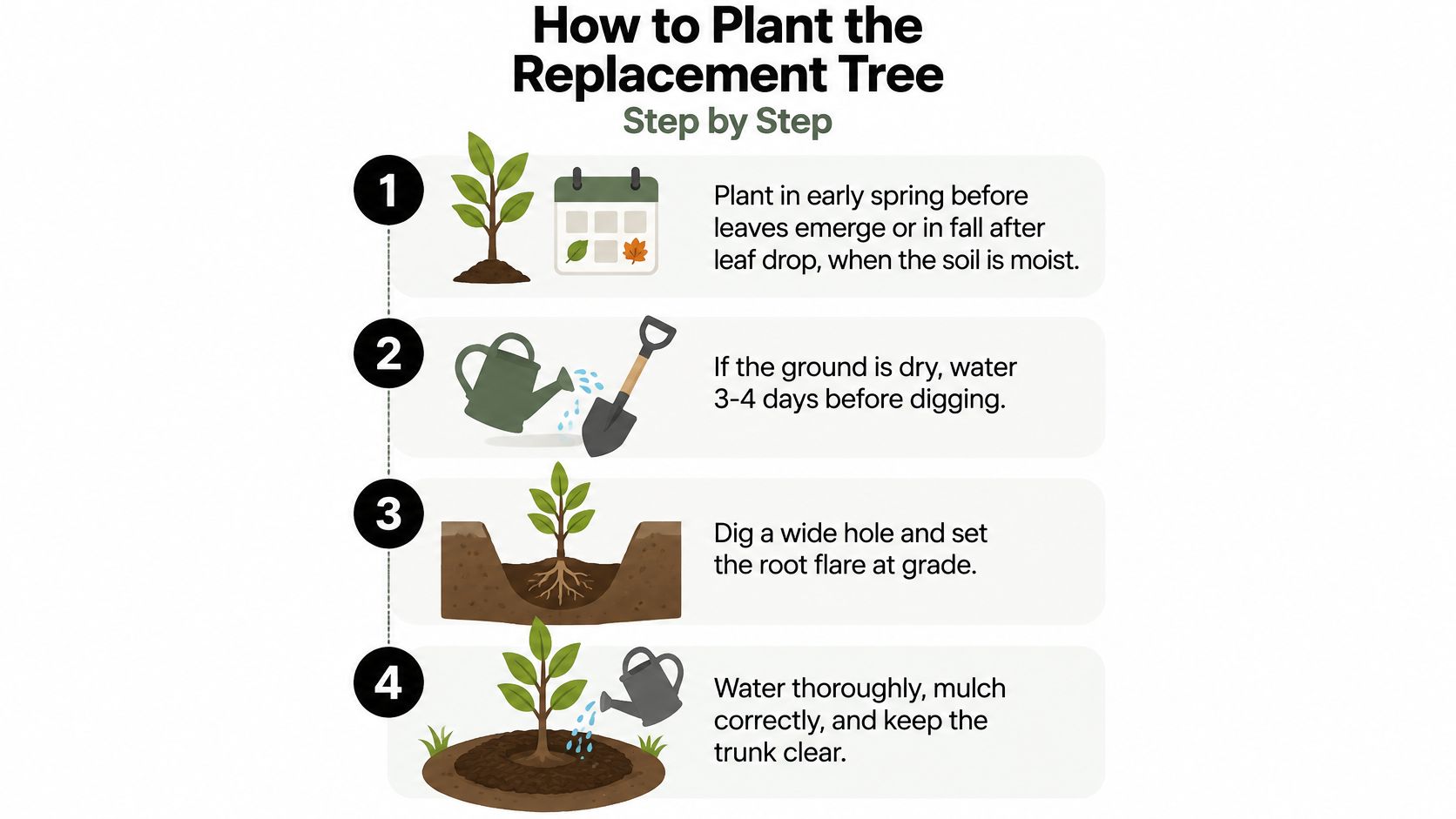
Root-ball radius by trunk diameter
These values scale the Purdue benchmark above; they're starting dimensions, not a substitute for inspecting nursery stock.
| Trunk diameter | Root-ball radius |
|---|---|
| 1 inch | 8–12 inches |
| 2 inches | 16–24 inches |
| 3 inches | 24–36 inches |
Radius isn't diameter. Confusing them produces a much smaller root ball than intended, and these dimensions shouldn't be used to plan a homeowner lifting operation.
Planting too deep is the most common planting error to guard against. Nursery soil can conceal the flare, so locate the first substantial roots before deciding the final elevation.
Check the root flare before backfilling is finished, not after mulch hides the trunk base.
Spread mulch over the surrounding soil while keeping it away from the trunk. Record actual root-ball dimensions and final flare elevation, since nursery stock won't always match a sizing table.
Confirm the Replacement Survives Its First Three Years
A replacement tree is a 10-to-20-year survival plan, and the first three years decide most of the outcome. A clean bed when the crew leaves means nothing on its own. The tree counts as established only after documented survival and acceptable vigor, so start with a planting record rather than a photograph of the finished bed.
Keep these details together:
- Tree identity: Species, nursery size, and trunk diameter.
- Installation details: Root-flare elevation, actual root-ball dimensions, and planting date.
- Watering ownership: The named person responsible for irrigation, including during absences.
- Acceptance terms: Inspection dates, mortality replacement provisions, and the condition required for final acceptance.
Measure establishment rather than appearance
A documented workflow aligned with ANSI A300 planting and transplanting standards accounts for soil, root, and construction-impact conditions, then schedules survival checks. A typical establishment schedule inventories new plantings roughly 4–5 months after planting and again after the third year, using representative circular or linear plots on larger projects.
For a single residential replacement, inspect and record that individual tree. Plot sampling makes sense for multi-tree installations; it is not a reason to skip the only replacement in your yard. If the removal permit carried a replacement condition, a dead tree leaves that obligation open, so records matter beyond the warranty conversation.
The checkpoints should stay visible throughout maintenance.
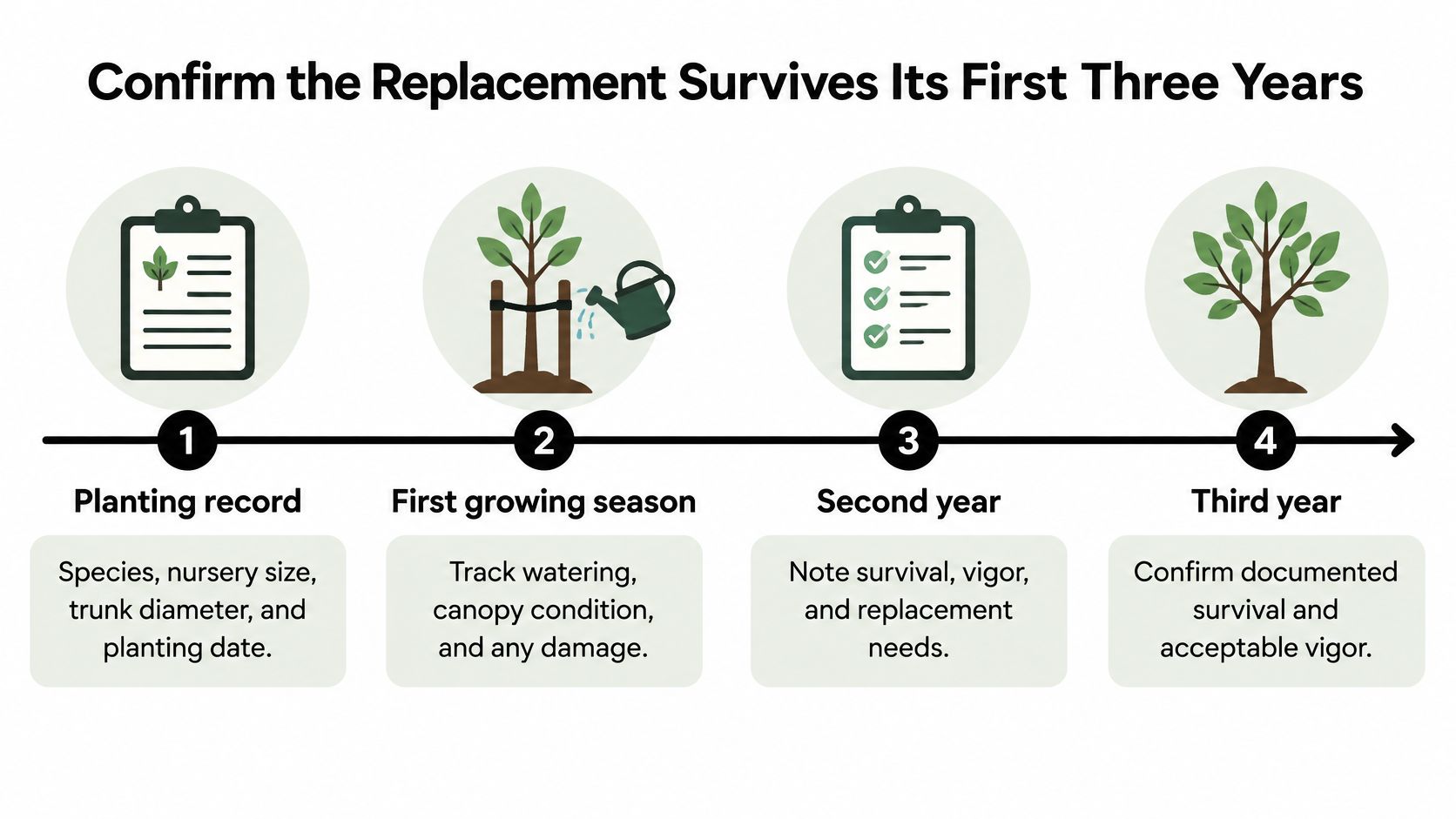
| Checkpoint | When | What to record |
|---|---|---|
| Planting record | Day of planting | Species, nursery size, trunk diameter, root-flare elevation, planting date, irrigation owner |
| First survival inventory | 4–5 months after planting | Survival in representative circular or linear plots |
| Second survival inventory | After the third year | Survival and vigor, with mortality replacement under the contract |
| Long-term benchmark | Five years | Survival, vigor, and canopy development judged against the contract's acceptance terms |
Survival across urban plantings varies widely with species, site preparation, and follow-up care. No project-level average sets the bar for one yard tree. Judge the replacement against the acceptance terms you wrote into the contract, and treat anything short of a vigorous, self-supporting tree at year three as a warranty conversation.
Prevent the failures you can control
The recurring failure points are planting too deep, choosing a species that outgrows available soil volume, leaving construction-compacted soil untreated, and assigning nobody to water. Check moisture at the root ball rather than assuming rainfall or lawn sprinklers reached it. A sprinkler pattern that wets turf can leave a dense nursery root ball dry underneath.
Follow a written newly planted tree watering plan and adjust it to soil moisture and weather. Put watering frequency, inspections, mortality replacement terms, and multi-year acceptance criteria into the contract, with a maintenance budget that covers establishment rather than planting day alone.
Call a Certified Crew Before the Tree Comes Down
You're deciding more than whether to hire someone with a saw. Get a scoping evaluation, confirm the parcel's permit pathway, and request one written scope covering removal, stump work, replacement species, planting, and watering.
If a tree is on a structure, a line is down, or a tree is leaning dangerously, move people and pets away. Leave downed lines to the utility company, then call a professional from a safe location.
Compare the whole job
Richmond Tree Experts GA handles hazardous, dead, storm-damaged, and in-the-way trees, including crane-assisted and tight-access removal. We also offer emergency tree service, including storm damage response; homeowners can call 770-974-3964.
When comparing tree service in Marietta or Roswell, or searching for tree removal near me in Kennesaw, Woodstock, Acworth, or Canton, check these items:
- Cost drivers: Trunk diameter and height, tight-yard access, work over a roof, hazard conditions, and emergency timing.
- Complete scope: Separate stump grinding, replacement planting, and establishment watering from the cutting price.
- Crew qualifications: Confirm appropriate licensing, insurance, arborist involvement, and professional equipment.
- Response window: Ask when assessment and work can occur, and get the booking window in writing.
Atlanta's $140-per-diameter-inch recompense also makes permit review a budget issue; unauthorized removal can add penalties rather than save money. Don't assume every removal has the same regulatory charge.
We offer free estimates for landscaping projects. Confirm whether your removal estimate is free before authorizing chargeable assessment or work, and request a scoping evaluation before the tree is cut or a permit window closes.
Richmond Tree Experts GA offers hazardous tree removal, storm damage response, stump grinding, and arborist-led planning for the replacement site. Visit Richmond Tree Experts GA or call 770-974-3964 to request a scoping evaluation and a coordinated plan for safe removal and lasting replacement.

