

Water your newly planted tree daily for the first 2 weeks, then every 2 to 3 days from weeks 3 through 12, then weekly from months 4 through 12. In Georgia, that schedule keeps a new tree alive far more reliably than watering only when you happen to remember, especially once heat, red clay, and uneven rainfall start working against you.
A lot of homeowners in Marietta, Roswell, Kennesaw, Woodstock, Acworth, and Canton plant a tree with good intentions, give it a few heavy soakings, then assume the weather will take over. That’s usually where things go sideways. New trees don’t fail because the species was wrong in every case. Many fail because the first year of watering was inconsistent, too shallow, or too heavy in clay soil that stayed wet longer than expected.
Your New Tree's First Year Is Its Most Important
A newly planted tree is living through a transition that established trees never have to deal with. It has lost part of its root system during digging or container production, and now it has to rebuild that root network in unfamiliar soil. That’s why the first 12 months matter so much.
The first year isn’t just about keeping leaves green. It determines how well the tree anchors, how evenly it grows, and how it handles the first hard summer. That’s consistent with guidance on the critical first 12 months after planting, which treats that establishment window as the period that directly affects long-term survival and structural integrity.
In practical terms, the biggest mistake is treating a new tree like a mature oak in the backyard. Mature trees can tolerate wider swings in moisture. A new tree can’t. Right after planting, the root ball dries faster than the surrounding soil, and if that root ball goes dry repeatedly, the tree stalls.
What homeowners usually get wrong
Most bad outcomes come from one of these habits:
- Watering by memory: If you water only when you happen to think about it, the tree gets drought stress between soakings.
- Spraying the surface: A quick pass with the hose wets the top layer and leaves the root zone dry.
- Assuming rain handled it: Light showers often don’t replace a scheduled watering.
- Using the same routine for every yard: A front yard in full sun near a driveway dries differently than a shaded side yard.
Practical rule: A new tree needs a plan, not good intentions.
For North Atlanta homeowners, watering is the most important part of aftercare because our conditions are deceptive. The air can feel humid, but the root zone can still be dry. Then the opposite happens in heavy clay. The surface looks cracked, but the soil below can still be holding water.
That’s why the schedule matters early, and why observation matters after that.
A Phased Watering Blueprint for Georgia Trees
A new tree planted in metro Atlanta in May can go from "looks fine" to stressed in less than a week if the watering schedule is loose. I see that pattern every summer, especially in new subdivisions where red clay was scraped, compacted, and covered with a thin layer of topsoil. The tree is alive, but the root ball is drying faster than the surrounding ground, and the homeowner is judging moisture by the surface.

The schedule below works well for Georgia because it follows how a transplanted tree becomes established. It also leaves room for the two things that throw off generic advice here: hard red clay that drains slowly once it is wet, and hot stretches that dry the root ball fast even when the air feels humid.
Weeks 1 through 2
Water every day.
The goal is simple. Keep the root ball consistently moist while the disturbed soil settles and fine roots start to recover from planting. Clemson Cooperative Extension's tree planting guidance supports frequent watering right after planting because the original root mass still does most of the work during this stage.
In North Atlanta, this daily check matters even more on sites with reflected heat from driveways, curb strips, and front yards with full western sun. A light shower usually does not count. If rainfall does not soak the root zone, water anyway.
Mulch helps this stage go better. A proper mulching method around newly planted trees slows evaporation and keeps the top of the root ball from baking.
Weeks 3 through 12
Water every 2 to 3 days.
Now the job changes. The tree still needs regular moisture, but the soil should cycle between moist and slightly drier conditions so roots start extending beyond the nursery root ball. The Morton Arboretum's watering guidance for new trees recommends tapering frequency after the first couple of weeks while still watering sufficiently to reach the root zone.
This is the phase where Atlanta homeowners often get in trouble. They either keep the soil soggy because they are worried, or they back off too much because the canopy has not wilted yet. In clay soil, either mistake can set the tree back. Too much water holds oxygen out of the root zone. Too little dries the planted root ball before the tree has enough new roots to compensate.
If you need a simple way to gain plant watering confidence, this guide can help: gain plant watering confidence.
Months 4 through 12
Water once a week in normal conditions, then adjust for heat and rainfall.
University of Minnesota Extension notes that weekly watering is a solid baseline after the first three months and through the rest of the establishment year. That baseline fits Georgia well, but only as a starting point. During stretches of summer heat in Atlanta, some trees in full sun or on berms need water sooner. Trees planted in heavier clay or low spots may need longer gaps between soakings.
Here is the working schedule:
| Phase | Watering frequency | Primary goal |
|---|---|---|
| First 2 weeks | Daily | Keep the root ball evenly moist |
| Weeks 3 to 12 | Every 2 to 3 days | Support new root growth into surrounding soil |
| Months 4 to 12 | Weekly | Build a wider, more stable root system |
Use the schedule, then verify it at the soil. Push a screwdriver or soil probe into the root zone, or check by hand under the mulch near the edge of the root ball. In Georgia, that quick check prevents two expensive outcomes: a tree that declines slowly from chronic watering mistakes, and a tree that weakens enough to become a removal problem after the first serious storm.
The Art of Watering Deeply Not Shallowly
A lot of newly planted trees in Metro Atlanta die with a hose nearby. The schedule looked fine on paper, but the water never made it through the mulch, into the root ball, and out into the surrounding soil where new roots need to grow.
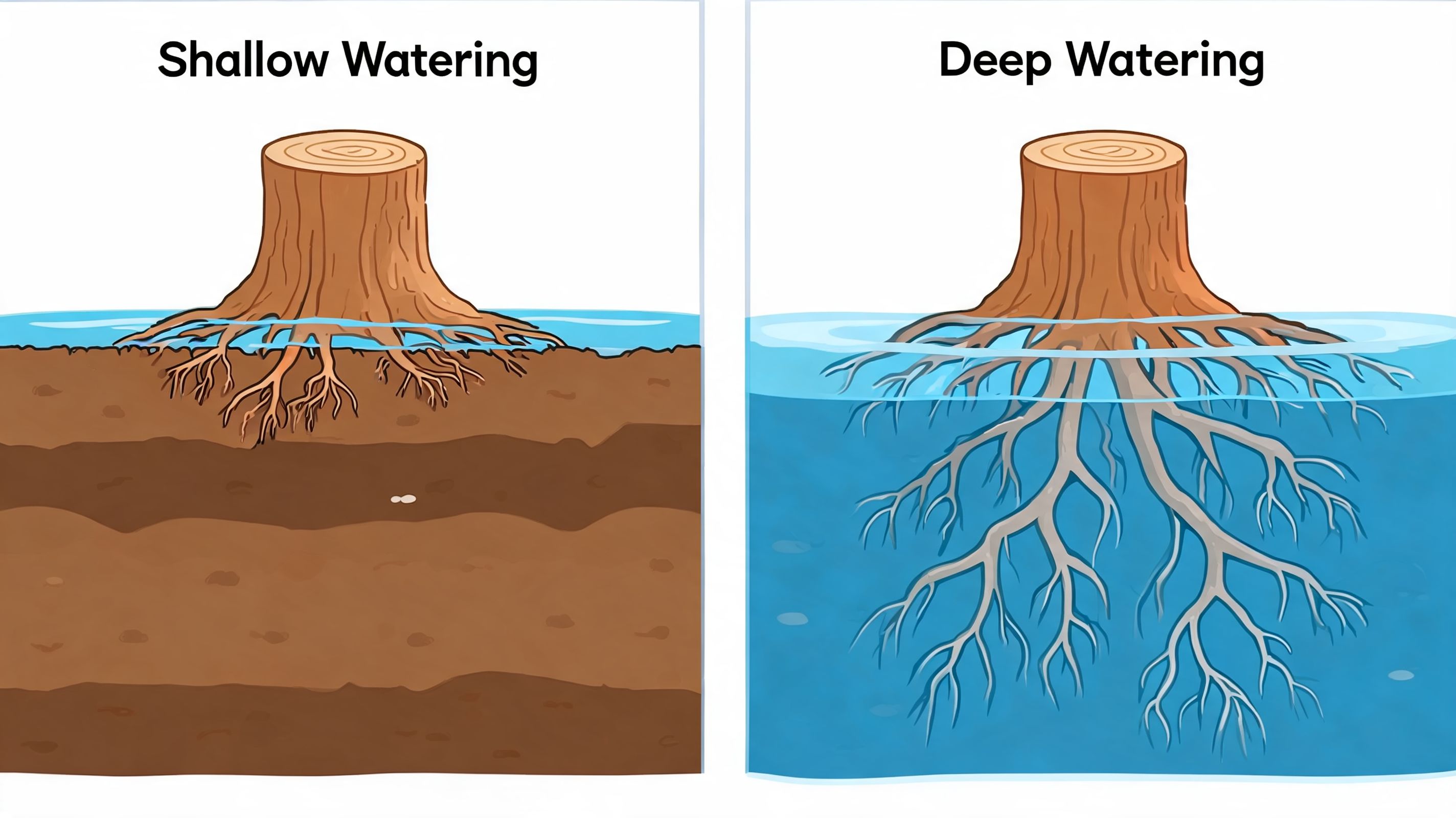
In Georgia clay, surface watering fools people fast. The top inch looks dark and damp, but a few inches down the root ball can still be dry, especially on compacted new construction lots or any site with slope. I see that pattern all the time around Marietta and the north side suburbs.
Deep watering means applying water slowly enough that it soaks through the root ball and reaches the soil just beyond it. That is how you get roots to leave the nursery soil and establish in the native ground instead of circling in place.
How much water to apply
The amount depends on tree size, soil conditions, and how quickly the site drains. Clemson Cooperative Extension recommends watering newly planted trees with roughly 1 gallon per inch of trunk diameter per day, applied in a way that moistens the entire root area rather than just the trunk. For a typical container or balled-and-burlapped shade tree, that usually means a long, slow soak instead of a quick spray.
Use that number as a starting point, then check the soil before repeating it. In red clay, the right volume applied too fast runs sideways. In loose backfill, the same volume may drain where the roots can use it.
What works in the yard
The best method is the one that puts water into the root zone slowly and predictably.
- A soaker hose: Loop it around the root ball and slightly beyond the edge of the planting hole.
- A watering bag: Good for steady release, as long as you still check moisture under the bag.
- A 5 gallon bucket with small holes: Simple, cheap, and effective for one or two trees.
- A hose set to a trickle: Reliable if you stay nearby and move it as needed.
If you want to gain plant watering confidence, stop judging by how wet the mulch looks. Check the soil under the mulch and near the edge of the root ball. That tells you whether the water went where the tree needs it.
Mulch helps hold that moisture in place, but only if it is installed correctly. A wide ring works better than a mulch volcano against the trunk. If you need a refresher, this guide on how to mulch trees covers the setup that keeps moisture in the soil without trapping decay against the bark.
This visual gives a solid overview of watering depth and delivery pace:
What doesn’t work
A few common habits cause more trouble than homeowners realize:
- Blasting water at the trunk flare: It concentrates moisture in the wrong spot and often sheds water off hard soil.
- Short daily sprinkles after the first establishment period: They keep the surface damp and the deeper root zone dry.
- Relying on lawn sprinklers: Turf irrigation rarely runs long enough to soak a new tree properly.
- Filling a watering bag and assuming the job is done: Bags are tools, not guarantees.
Water the whole root area slowly. Then verify with your hand, a trowel, or a soil probe.
That extra minute matters in Atlanta yards, where clay can stay wet near the surface while the root ball dries out underneath, or hold too much water around a tree planted too deep. Deep watering done correctly builds a stronger root system. Done poorly, it sets up decline that shows up later as dieback, instability, and a tree that needs professional help sooner than it should.
Adjusting for Atlanta's Unique Climate and Clay Soil
A watering plan that works in loose, sandy soil will fail fast in metro Atlanta. I see it every summer. A homeowner follows a generic schedule, the mulch looks damp, and the root ball underneath is either bone dry or staying wet too long.

Summer changes the schedule
North Georgia heat changes everything, especially in July and August. Trees planted in full sun, near driveways, beside sidewalks, or on south-facing slopes lose moisture faster than the same species planted in afternoon shade. Holden Forests & Gardens advises in its summer tree care guidance that trees exposed to hot conditions and heat-reflective surfaces may need watering more often during summer, and that watering before 8 AM helps limit evaporation.
That timing matters in Atlanta yards. Morning watering gives the root zone time to absorb moisture before the heat builds. Late-day watering can work if needed, but soil that stays wet overnight is a poor fit for a freshly planted tree sitting in slow-draining clay.
Red clay changes the margin for error
Georgia red clay holds water well. That helps during dry spells. It also means a new tree can decline from overwatering faster than homeowners expect.
The problem is what the surface tells you. Clay often forms a dry crust on top while the soil a few inches down is still wet and tight. If you keep watering by calendar instead of checking the root zone, roots end up in soil with too little oxygen. In the first year, that is how a healthy planting starts slipping backward.
Check the site before adding water:
- Probe below the surface: Use your finger, a screwdriver, or a hand trowel to check moisture in the root zone, not just the mulch.
- Pay attention to heat exposure: Pavement, stone borders, and reflected sun dry one side of the planting area faster.
- Watch how water moves: If it ponds, runs off, or sits against the root ball, slow the application rate.
- Notice the turf around it: Grass pulls moisture away from a new tree and often hides how dry the soil really is.
Some sites need more than a better watering routine. Compacted soil, heavy foot traffic, and old construction fill can keep air and water from moving the way roots need. In those cases, a homeowner may need professional tree aeration services near Atlanta instead of just pouring on more water.
Rain is not always enough
A rainy week in Atlanta does not always water a new tree. Short summer storms can wet the mulch, darken the top layer, and leave the root ball mostly untouched. The University of Minnesota Extension explains that newly planted trees generally need water when rainfall is lacking, with a common baseline of about an inch per week. That baseline is useful, but the best gauge is still the soil around your tree.
In red clay, your hand is often more reliable than the forecast. Check before you water. Check again after a storm. That habit keeps a manageable watering issue from turning into root loss, canopy dieback, or a young tree that starts leaning and needs professional help much sooner than it should.
Watering Stress vs A Hazardous Tree Warning
Not every struggling tree is dangerous. Some are showing stress from a watering problem that can still be corrected. The important part is knowing when you’re looking at a care issue and when you’re looking at a safety issue.
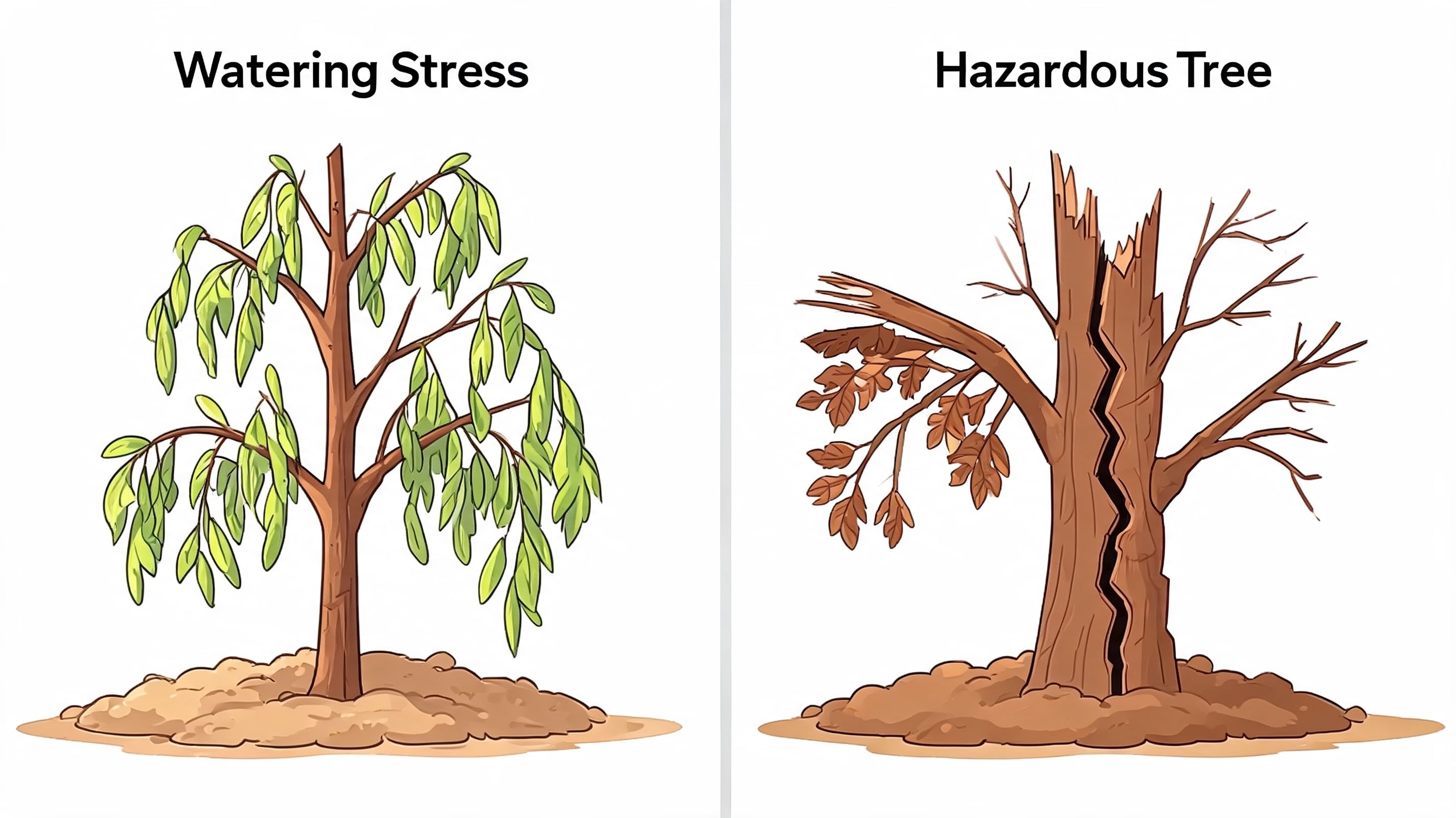
Signs of a watering problem
A newly planted tree with water stress often shows symptoms in the canopy first. Leaves may wilt, curl, yellow, or develop scorched edges. Growth can slow, and the tree may look thin compared with healthier nearby plantings.
Those symptoms deserve attention, but they don’t automatically mean the tree is hazardous. If the trunk is sound, the root flare is stable, and the tree hasn’t started shifting in the soil, the problem may still be corrected by fixing the watering routine and improving root-zone conditions.
Signs the issue is now structural
The line changes when root failure, decay, or instability enters the picture. Guidance focused on overwatering newly planted trees in clay soil points out that Atlanta's heavy red clay soil retains moisture longer, increasing the risk of root rot from overwatering, and that this can compromise structural stability and turn the tree into a hazard.
That’s the part homeowners sometimes miss. A tree can go from “looks stressed” to “should not be standing over a driveway” when root rot weakens the base.
Use this comparison:
| Watering stress you may be able to correct | Warning signs that need an arborist |
|---|---|
| Wilted or curled leaves | Tree starts leaning or shifting |
| Leaf scorch or yellowing | Soil heaving near the base |
| Slow growth after planting | Cracks, decay, or dead scaffold limbs |
| Dry root ball or soggy planting hole | Movement after wind or storms |
If the tree is changing position, not just changing color, stop troubleshooting and get it inspected.
Young trees can also become dangerous after storms if poor establishment left them weakly rooted. That’s especially true in clay that alternates between hard dry periods and saturated periods. A tree that never rooted well may not get a second chance once wind loads hit it.
When to Call for Tree Service in North Atlanta
There’s a point where watering advice stops being useful because the primary concern is safety. If a newly planted tree is leaning toward a house in Marietta, if storm winds snapped a leader in Woodstock, or if the root plate is moving in saturated soil in Roswell, you’re no longer dealing with ordinary aftercare.
Situations that need prompt help
Call a professional tree service when you see any of the following:
- A tree leaning toward a structure: That can move from concern to emergency tree removal quickly.
- A fallen or partially fallen tree: Fallen tree removal near homes, fences, driveways, or power-adjacent areas needs equipment and training.
- Cracked limbs after storms: Storm damage tree cleanup often involves hung-up branches that can drop without warning.
- A new tree that won’t stabilize: If staking, soil correction, and watering adjustments haven’t helped, root failure may be developing.
- A dead or declining tree near targets: Hazardous tree removal is a safety job, not a weekend project.
What homeowners usually ask
The questions are usually practical. Do I need tree trimming or full tree removal. Is this an emergency tree removal situation or can it wait. Should I grind the stump now or handle stump grinding later. If I’m clearing a lot for a project, is land clearing the better route than piecemeal tree cutting service.
Those are fair questions, but the first step is a competent diagnosis. A qualified certified arborist in Atlanta GA can tell you whether the tree can be saved, pruned, monitored, or should come down before it damages property.
What not to do
Homeowners get hurt when they confuse urgency with DIY urgency.
- Don't climb a compromised tree: Stress cracks and weak attachments fail suddenly.
- Don't cut a leaning tree from the base: Compression and tension wood can react violently.
- Don't park under it and wait: If the tree is already moving, time is not on your side.
- Don't assume a green canopy means safe structure: A tree can leaf out and still be unstable.
If you’re searching for tree service in Marietta, tree removal near me, emergency tree removal in Roswell, tree trimming in Kennesaw, stump removal in Acworth, or storm damage cleanup in Woodstock, the right company should offer licensed and insured crews, proper equipment, and clear guidance on whether the problem is urgent or routine. For non-emergency work, a free estimate helps you compare pruning, stump grinding, hazardous tree removal, and cleanup options without guessing.
If you’re in Marietta, Roswell, Kennesaw, Woodstock, Acworth, Canton, or nearby Cobb County and Cherokee County, Richmond Tree Experts GA can help with everything from arborist evaluations to tree removal, emergency tree removal, tree trimming, stump grinding, storm damage cleanup, and hazardous tree work. If your new tree looks stressed, unstable, or unsafe, reach out for a professional assessment before a watering issue turns into a property damage problem.
Not sure what your tree needs? Richmond Tree Experts has worked on Marietta and Metro Atlanta trees since 1985, and every job is looked at by an ISA Certified Arborist before it is priced. Start with an ISA Certified Arborist evaluation, or see everything we do: tree removal, stump grinding and arborist services across Cobb, Fulton, Cherokee, Gwinnett and DeKalb counties (service areas).
Call (770) 974-3964, 7am to 11pm every day, or request an estimate online.

