

A limb is through the shingles, or the pine that looked fine last week is now leaning over the driveway. You're in the yard deciding whether this is a full removal, a trim, or a job that needs a permit before anyone starts a saw.
That decision is the job. The same tree can be a routine takedown on one lot and a regulated removal on the next. A fast cut can also leave a drainage or permit problem for the sod, wall, or drive that comes later.
If you need tree service in Gwinnett County, GA, match the work to the problem first. Safety comes before speed, and the parcel location comes before the estimate.
Tree Services in Gwinnett by Problem
Richmond Tree Experts GA is a family-owned company based in Marietta. We've worked Metro Atlanta trees since 1985 across Cobb, Fulton, Cherokee, Gwinnett, and DeKalb, and most of that work is residential: removals, pruning, stump grinding, and storm work.
Gwinnett County population figures show the county rising from 957,062 in 2020 to an estimated 1,018,099 in July 2025. A lot of mature trees now sit tight against newer homes and take the full force of a storm.
Start with the row that matches what you're looking at.
| Service | Typical reason to call | What the crew handles |
|---|---|---|
| Tree removal | Dead, hazardous or in-the-way tree | Felling, sectional removal, crane-assisted or tight-access work |
| Emergency tree removal | Tree on a house, car or blocked driveway | Immediate dispatch, hazard cut-back and debris clearing |
| Tree trimming and pruning | Limbs crowding a roof, drive or line | Crown thinning, deadwood removal and clearance cuts |
| Stump grinding and removal | Stump left after a removal | Grinding below grade, root clean-up and grade restored |
| Storm damage cleanup | Fallen limbs or split trees after wind or ice | Hanging-limb removal, trunk assessment and debris haul-away |
| Land clearing | Lot prep for building, drainage or overgrown ground | Selective or full clearing and mulching |
| Arborist assessment | Declining tree, insurance claim or property dispute | ISA Certified Arborist diagnosis, risk evaluation and appraisal |
Property managers lining up turf, a wall, or grading after a cut should read grounds advice from Facility Management Insights before anyone changes grade around a stump. Roots, slopes, and the next planting interact.
Match the service to today's problem. A leaning tree calls for an arborist assessment or emergency removal. A branch on the roof calls for trimming or storm cleanup. A stump left behind calls for grinding. If a tree is already on a structure, use the storm steps below. Cost and permit questions are answered in the sections that follow.
Storm Damage and Fallen Trees During the First Hour
A limb is through the roof. The family is still inside. Branches block the driveway. Work this sequence, and don't start cutting.
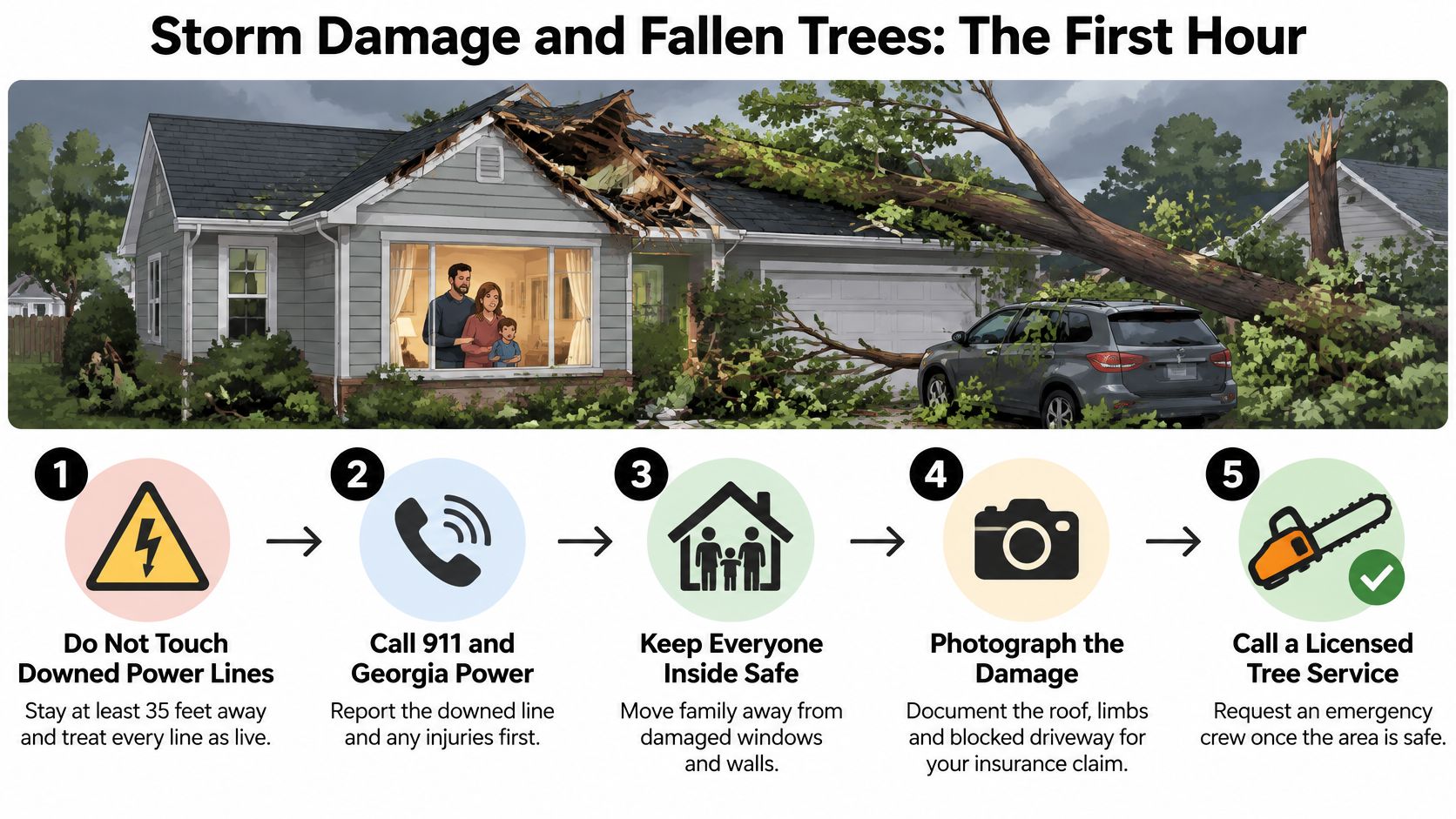
- Don't touch a tree on a power line. Call the utility first and stay well back.
- Clear the strike zone. Keep people and pets out, and treat any hanging limb as able to drop without warning.
- Move vehicles and people away from the tree and any cracked wall or window.
- Photograph the tree, the damage, and the root area before anything is cut. Those photos are the claim file. Understanding contractor estimates for storm claims helps you see what an adjuster is pricing.
- Call an emergency crew. Ask for the dispatch window, whether they'll make the area safe first, and whether they'll haul debris. Reach us at 770-974-3964, or open our emergency fallen tree removal page if the tree is already down.
- Ask for an arborist check before a full removal. UGA Extension guidance on storm debris says that when more than 50% of a tree's branches and leaves are gone or damaged, the tree is unlikely to survive the next growing season, while a mature tree that loses only one major limb may often stay if broken branches are removed properly and the tree is monitored. The same guidance says homeowners shouldn't work on trees touching power lines until the utility has addressed the line.
- Leave larger storm-cleanup jobs to a crew. A homeowner saw is the wrong tool once the tree is loaded, split, or hung up.
High winds on saturated soil, and roots that have lifted, keep the risk up after the rain stops. A tree appraisal is a documented valuation if the claim or a dispute needs a number.
Call for emergency help now, document the damage, and hold off on cutting until the crew has assessed the tree.
Warning Signs a Tree Is Dangerous Before It Falls
A rough-looking tree and a failing tree are not the same thing. One dead twig in the crown is ordinary. A new lean plus heaved soil over a bedroom is not.
One sign rarely decides it
I would not schedule a removal on a single cosmetic flaw. An arborist's risk evaluation weighs three things together: the target (house, driveway, play area), the tree's health, and the site. Our ISA-certified arborists do those evaluations, plus pre-construction prescriptions, insurance appraisals, and care consultations. Cabling and bracing sit in that same toolbox when the wood is still sound.
| Sign | What it suggests | Next step |
|---|---|---|
| Cracks or split at the base or trunk | Structural weakness | Arborist risk evaluation |
| Mushrooms or conks at the base or on roots | Internal decay | Decay assessment before pruning |
| New or increasing lean with soil heaving | Root failure may be underway | Urgent evaluation |
| Dead limbs hanging over a home, drive or play area | Falling limbs | Remove or cut back and clear the area |
| Lifted or exposed roots | Unstable anchorage | Evaluate after wet weather |
| Sparse canopy with about half the branches gone | Little recovery potential | Removal likely |
| Trunk in contact with power lines | Electrocution and fire risk | Call the utility, not a crew |
Say a 40-foot oak over a driveway has a split union. That combination, a structural crack plus a hard target, calls for an evaluation and likely removal. A single dead limb over open lawn is a pruning job. Cut the deadwood, clear the ground, and leave the tree.
Practical rule: If a sign threatens a structure, get an ISA Certified Arborist risk evaluation before you book the saw. If the trunk or a limb is on a power line, call the utility instead of a crew.
Diagnostics and a written treatment plan come before anyone climbs a tree you intend to keep. A hazard over a roof does not wait on a seasonal pruning calendar.
Permits for Removing a Tree in Gwinnett County
A single-family owner removing a tree outside regulated areas usually doesn't need a permit. The location of the tree decides that, not the size of the job.
Gwinnett County's tree removal information states that residential tree removal is generally permit-free only for an individual homeowner's occupied property when the tree is outside regulated areas, including required zoning or stream buffers, conservation and open-space areas, the Chattahoochee River Corridor, designated Tree Save Areas, and public street-tree locations. Even then, the homeowner must retain at least two live trees on the lot.
| Situation | Permit or review | What to check first |
|---|---|---|
| Occupied single-family home, tree outside regulated areas | No permit for removal | Keep at least two live trees on the lot |
| Tree in a stream buffer or Chattahoochee River Corridor | Additional review | Map the parcel against the buffer |
| Designated Tree Save Area or conservation/open-space | Additional review | Confirm the designation on the site plan |
| Public street-tree location | Additional review | Confirm ownership with the county |
| Hazard removal in a regulated area | Documentation of the hazard condition | Written arborist assessment |
| Commercial, office, industrial or multifamily property | Land Disturbance Permit | Permit in hand before any removal |
Map the parcel before you book
An arborist or contractor should map the tree on the parcel and screen it against buffers and protected designations before scheduling. Trees in regulated areas can trigger extra review, limits on how the tree is taken down, or written documentation of a hazard. Disease or insect removals may need written findings from the county extension service, the Georgia Forestry Commission, or a certified arborist.
Cities inside the county can apply their own rules on top of the county sheet. Confirm with the city where the property sits before you treat a county handout as the last word. Our notes on the tree preservation ordinance are a useful starting point for that screen, not a substitute for the parcel check.
A fast removal that ignores a buffer can turn into a stop-work problem the week you want a wall, turf, or a regrade.
Commercial, office, industrial, and multifamily sites are a different path. Those properties need a Land Disturbance Permit before any removal. Don't let a crew start because the tree "looks dead."
What Tree Work Costs in Gwinnett and What Moves the Price
A pine over a Duluth driveway and the same pine in an open Lawrenceville yard are two different jobs. Tree work in Gwinnett does not price off a flat menu, so use the factors below to read an estimate and get an itemized figure for the specific lot before work is scheduled.
| Service | Main cost driver |
|---|---|
| Small tree removal (under 30 ft, open yard) | Height and clear fall zone |
| Medium tree removal (30 to 60 ft) | Proximity to home, fence or driveway |
| Large tree removal (over 60 ft or near a home) | Rigging and sectional cuts |
| Crane-assisted or tight-access removal | Crane hire and blocked access |
| Stump grinding, per stump | Stump diameter, root spread and number of stumps |
| Trimming or pruning, per tree | Tree size, height and lift needed |
| Land clearing, per acre | Tree density, slope and debris volume |
| Storm emergency work | After-hours timing and urgency; confirm on the estimate |
| Permit fees | Property type and regulated-area status |
Four things usually set the number.
Height and diameter decide whether the tree can fall in one piece. Distance to a house or fence decides whether it must come down in sections. A 45-foot tree 10 feet from a garage costs more than the same tree in an open yard because the crew rigs every piece. Access adds a crane, extra rigging, or hand-carried debris when a gate or slope blocks the truck. Debris disposal is its own line.
Georgia EPD yard-trimmings rules define yard trimmings as leaves, brush, grass clippings, shrub and tree prunings, discarded Christmas trees, and vegetative matter from landscaping. Land-clearing debris, such as trees, stumps, and limbs, is not legally classified as yard trimmings and is not under the same landfill ban. Each city, county, or solid-waste authority sets local handling rules for yard trimmings, so separate routine pruning debris from stumps and cleared wood.
Regulated-area status can change the job before price is even firm. A tree that needs documentation, a protected-buffer screen, or a different takedown method is no longer only a saw-and-haul removal, and the estimate should show that handling.
Ask for an itemized estimate covering removal, cleanup, stump work, and any permit fees. Richmond Tree Experts GA lists a free estimate for landscaping projects, so confirm whether the tree-work visit is free before you book. Start that request on our tree service estimates page.
ISA Certified Arborists, Crews and Safety Equipment
A healthy maple in a Duluth yard has a split union and a full crown. Nobody should climb it on the assumption it has to come down.
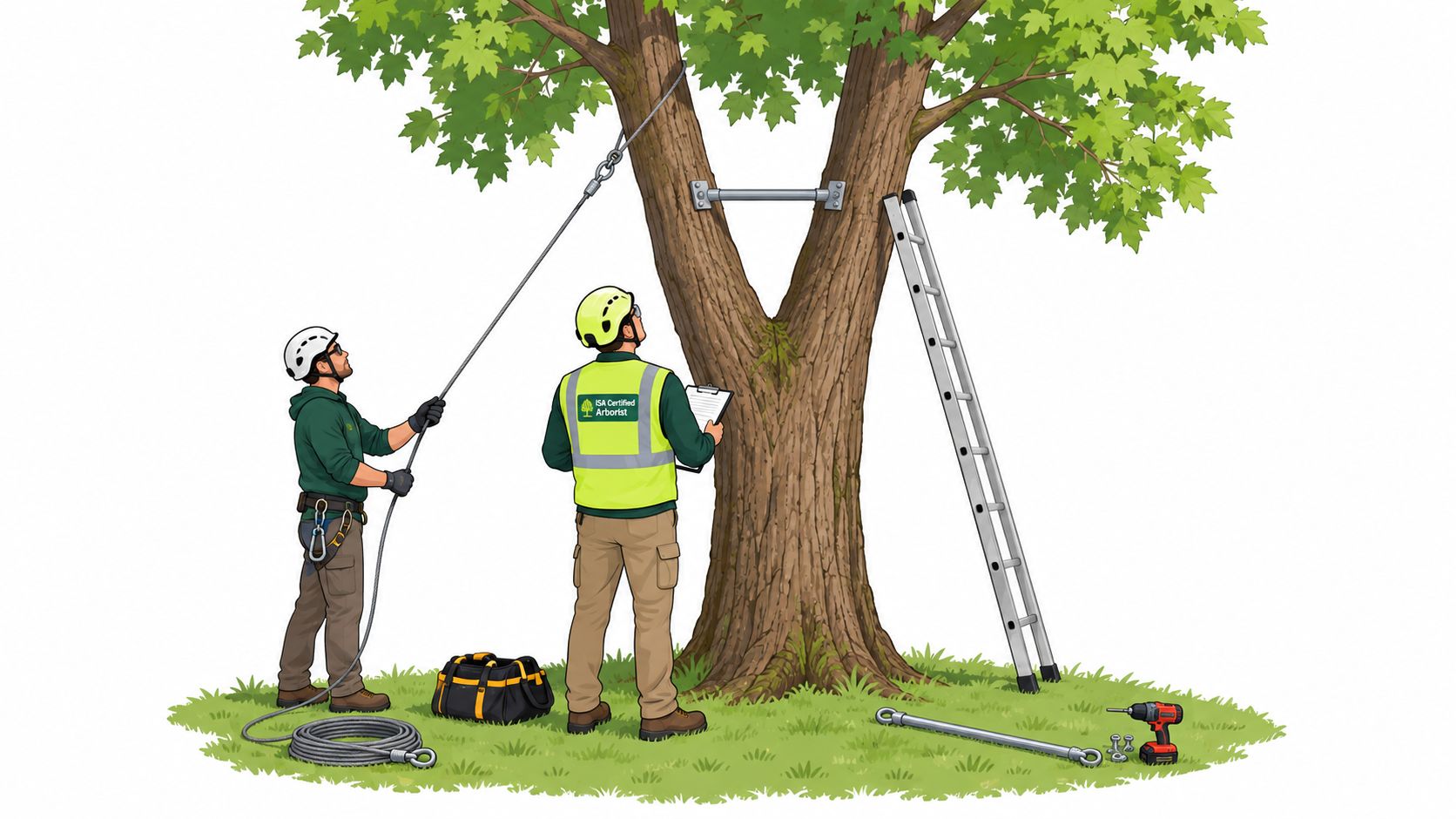
An ISA Certified Arborist diagnoses the union, decides whether cabling and bracing can hold it, and writes a treatment plan before anyone leaves the ground. If the wood is hollow or the target is a bedroom, the plan changes to removal. Saving the tree is the right call only when the hardware and the wood agree.
What the crew brings
We're fully licensed and insured. Ask for a certificate of insurance before work starts, and read the additional-insured line if a property manager needs it.
We use a top-of-the-line stump grinder so the stump is finished the first visit, not left as a second trip. We also offer spike-less tree care. Climbing spikes punch wounds into trunks you plan to keep. Spike-less work avoids those wounds on trees that stay standing. A removal doesn't need that courtesy. A prune or a cable job does.
This short clip shows how a crew talks through a cut before the saw comes out.
Checks you can make on site
- A cleared drop zone. People, pets, and cars are outside the fall path before the first cut.
- Controlled rigging over roofs and fences, so pieces don't free-fall onto shingles.
- A crane where the tree can't be rigged by hand because of lean, decay, or a blocked yard.
- No work near energized lines until the utility has isolated them.
Ask who will be on site, whether the arborist will see the job, and what protection the crew carries. A climber without a named arborist is fine for a simple open-yard fell. It is the wrong setup for a split maple you hope to keep.
Confirm Your Gwinnett Address and Request an Estimate
Confirm the address before you describe the tree. In Gwinnett County we serve Lawrenceville, Duluth, Norcross, Peachtree Corners, Lilburn, Suwanee, Sugar Hill, and Berkeley Lake. We're based at 1715 Nekoma St, Marietta, GA 30068.
We also work Cobb and Cherokee lots, including Marietta, Roswell, Kennesaw, Woodstock, Acworth, and Canton. Marietta has been home base the whole time. A published response-time promise isn't something you should invent from a website. For an active hazard, get the dispatch window in writing.
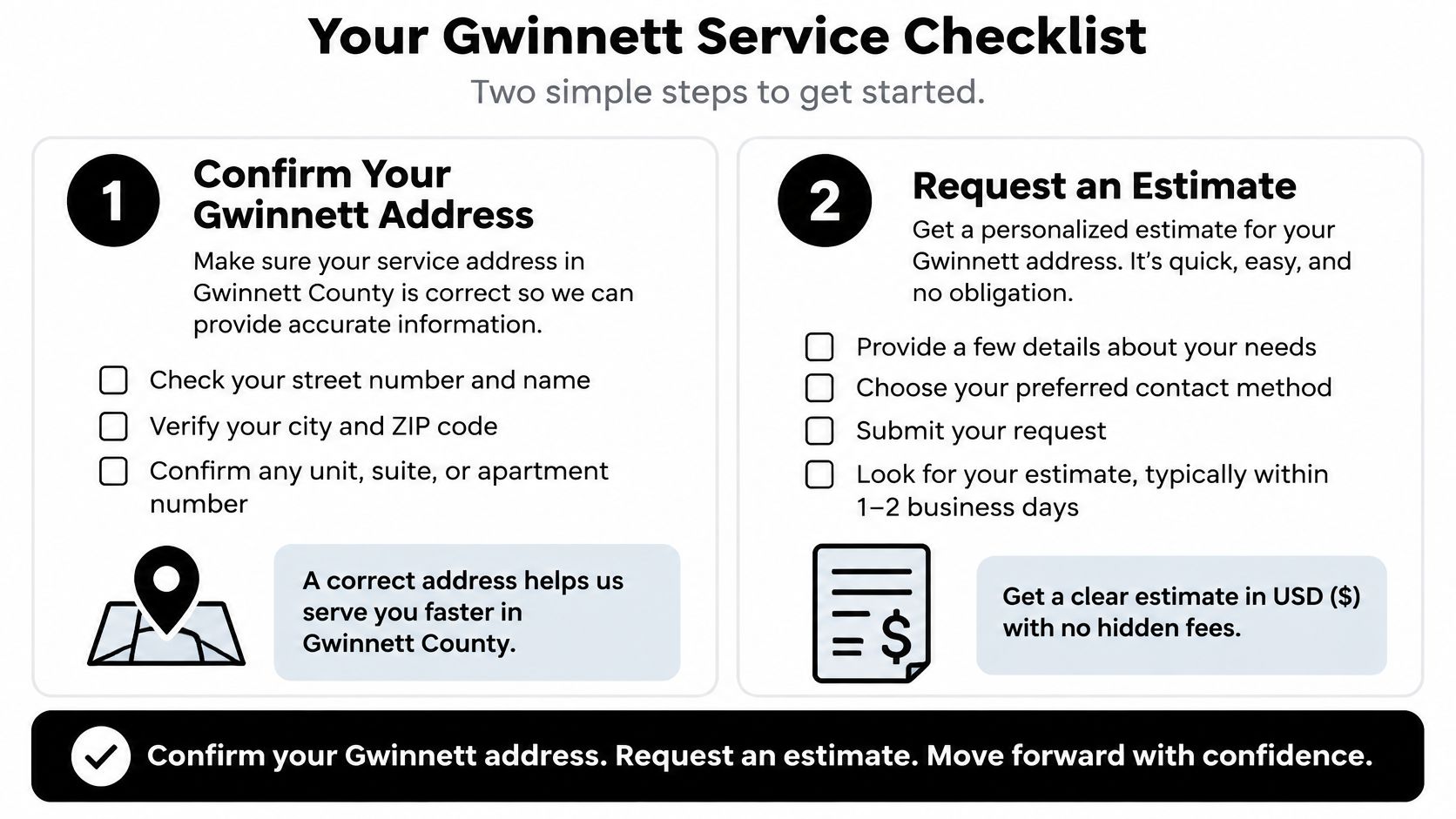
Have this ready before you call. Each item changes either the permit path or the price.
- Property address and parcel number, so the crew can screen buffers and protected areas before anyone schedules a saw.
- Photos of the tree, the damage, and the root area. A lean you can see in a photo is easier to triage than a verbal description.
- Species, if you know it, and where the tree sits relative to the house, the drive, and utility lines.
- Home or commercial site. A house and a multifamily or industrial lot do not share the same permit path.
- Whether an insurance claim is open. That may call for a tree appraisal rather than a simple removal note.
- Emergency or scheduled. A tree on a roof is not the same ticket as a stump you want gone before sod.
For an active hazard, call 770-974-3964 now and ask for the emergency dispatch window. For everything else, request an itemized estimate, confirm the permit path, ask about financing, and send the site plan if a property manager or landscape architect is already involved.
We handle tree removal, trimming, stump grinding, storm cleanup, and arborist risk checks for homeowners and property managers across Gwinnett County and nearby North Metro lots. If a tree is on the house, call for a crew. If it is still standing, get the permit screen and an itemized estimate before you cut. Visit Richmond Tree Experts GA to start that request.

