

74% of homeowners would consider financing at least part of a home-improvement project, according to a 2025 Modernize survey of more than 14,000 homeowners. For tree work, though, willingness to borrow isn't the most useful test. The better question is whether the payment covers the complete project, or leaves permits, debris, stump work and yard repairs outside the advertised installment.
For a tree service payment plan near me in Marietta, Roswell, Kennesaw, Woodstock, Acworth, or Canton, compare the work and the borrowing separately. A manageable monthly payment won't protect you from an incomplete cleanup, an excluded stump, or a contractor paid before the job is finished.
Payment Plan Options for Tree Service Compared
An unexpected tree invoice can force a difficult timing decision when a household does not have enough cash or available credit to pay it immediately. The options below differ in who provides the funds, how payments are scheduled, and which costs deserve a close look.
Tree service payment options compared
| Option | How it works | Cost signal to check | Best fit |
|---|---|---|---|
| Contractor or in-house payment plan | Company splits the invoice into installments, often after a deposit | Deposit size, late fee, any interest charged | Planned removals and stump grinding with a fixed scope |
| Third-party installment lender | Lender pays the invoice and you repay in fixed monthly payments | APR, origination fee, term, prepayment penalty | Larger invoices where the full amount is needed now |
| Personal or home improvement loan | You borrow the money yourself and pay the contractor in full | APR, term, total of payments | Buyers who want to negotiate price as a cash customer |
| Credit card paid over time | You charge the invoice and carry a balance | APR, minimum payment, deferred-interest terms | Small jobs you can clear within a promotional window |
| Deposit then milestone payments | Smaller upfront deposit, later payments tied to completed work | Deposit cap, retention amount held back | Multi-phase jobs such as removal plus restoration |
Match the arrangement to the job
An in-house plan, if offered, keeps payment administration with the contractor. Before deciding, get the deposit, installment dates, and charges written into the agreement.
A third-party installment loan separates the lender from the crew. Confirm when the lender pays the contractor and whether your approval of completed work is required for payment.
With a personal loan, you arrange funding independently and pay the contractor in full. You can discuss the service price as a cash customer, though that does not guarantee a discount. A credit card is better suited to a balance you can realistically clear within its promotional terms.
A milestone agreement ties payments to distinct deliverables, such as removal, stump grinding, and restoration. It is a payment schedule, not necessarily a monthly loan.
Practical rule: Choose the payment structure after defining the work, not before.
For tracking accepted schedules, apps for managing loan payments can help organize due dates. An app does not change the contract or reduce borrowing costs.
Richmond Tree Experts GA offers financing for its services. Ask which options apply to your invoice, and get eligibility and terms confirmed in writing.
Handle an Emergency Tree Before Financing Is Approved
Don't wait for a credit decision to protect people from a hazardous tree. A recently changed lean, cracks or splits in the trunk or base, heaving soil, exposed roots beside the lean, or a tree resting on a structure or line warrants prompt professional assessment. Don't approach the tree to investigate.
OSHA's storm tree-work guidance places nonessential workers at least 20 feet beyond the expected drop zone during trimming and adjacent occupied work areas at least two tree lengths from a tree being felled, with more distance where rolling or sliding is possible. These are work-site controls, not an invitation for homeowners to measure a safe viewing position beside an unstable tree.
Under OSHA's tree-care safety guidance, trimming or removal within 10 feet of a power line requires trained tree trimmers, with utility coordination to de-energize and ground or shield lines before work begins. Treat a line lying across a driveway or yard as energized until the utility confirms otherwise.
Protect people and preserve the record
- Keep clear. Move people, pets and vehicles away from the expected drop zone only when you can do so without entering danger.
- Call the utility. Report any tree touching a line. Don't touch the tree, wire or nearby objects.
- Contact the correct authority. For an imminent hazard in Atlanta, contact the Arborist Division. Outside Atlanta, identify the authority responsible for the parcel.
- Photograph from safety. Record the tree, its position and visible damage before cutting starts. Don't enter the hazard area for a better image.
- Document authorization and scope. Obtain the emergency crew's written quote and applicable authorization.
- Separate later work. Once the immediate hazard is stabilized, arrange financing for eligible cleanup, removal, stump work or restoration.
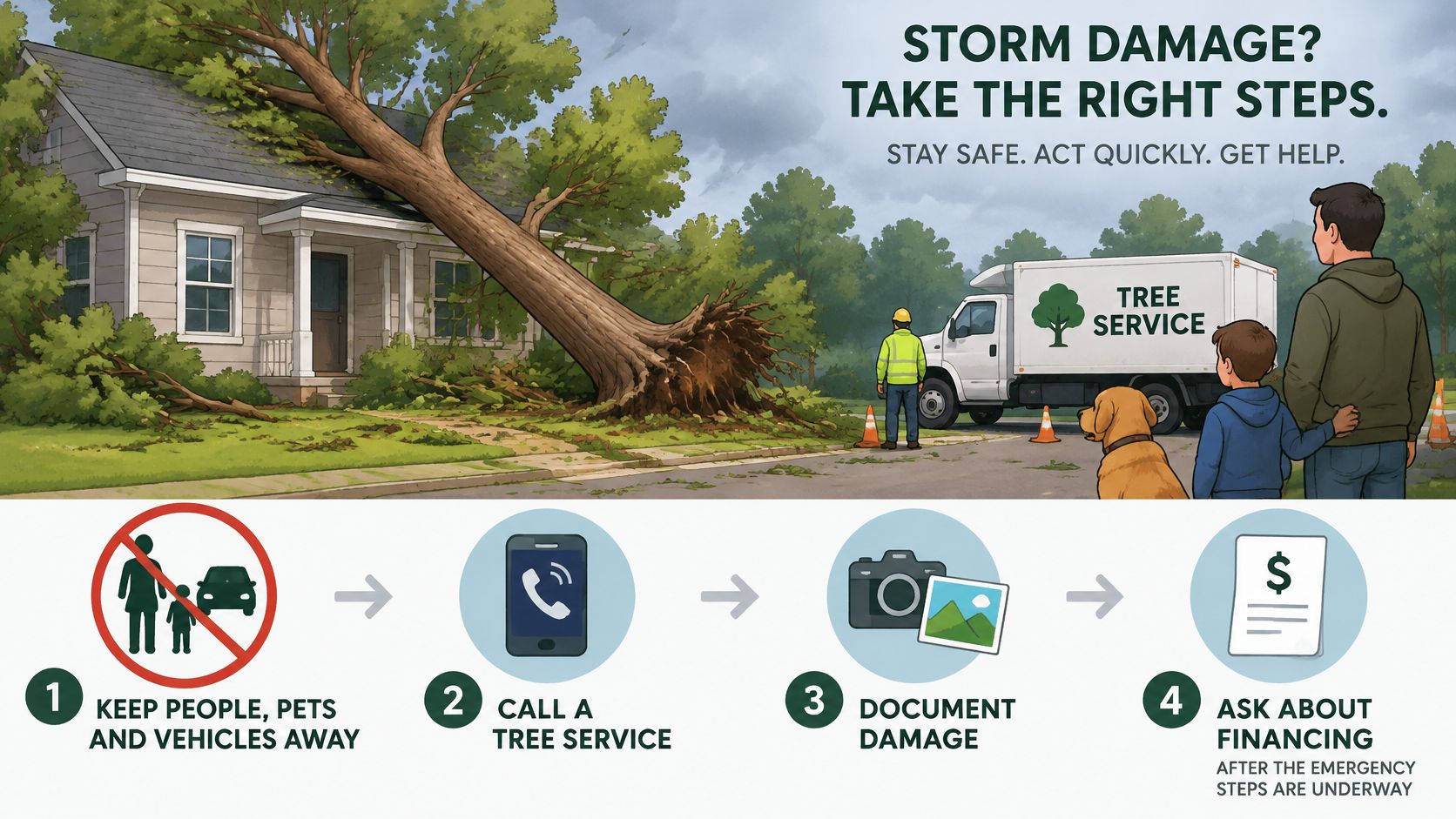
The Atlanta Tree Conservation Commission's removal guidance calls for photographs and contact with the Arborist Division for imminently hazardous trees, with follow-up within five working days when emergency removal occurs outside normal hours. Financing doesn't replace emergency authorization, insurance coordination or evidence preservation.
An undocumented removal, or incorrectly describing a standing tree as already fallen, can complicate the permit record and a damage claim. Record what happened rather than choosing a description that seems easier.
We offer emergency fallen tree removal, including storm damage response, and customers can call our office directly for urgent work. Storm call volume and site access affect dispatch, so arrival time remains unconfirmed until the office provides a current estimate. Confirm the emergency scope and payment obligation before work begins, without delaying evacuation or utility notification.
How to Qualify for a Tree Service Payment Plan
Qualification comes from the lender's or contractor's written criteria, not from the advertised monthly payment. Lenders typically assess credit history, income, existing monthly debts and the amount requested. Applicants financing the same tree invoice may receive different rates, limits or repayment periods.
Read the actual offer for minimum borrowing amounts and eligibility conditions. Don't assume that prequalification guarantees final approval, or that a financing advertisement means every service line is eligible.
Prepare before applying
- Set an affordable payment ceiling. Start with what remains after housing, utilities, food, existing debt payments and a practical reserve. Don't use the lender's maximum approval as your household budget.
- Gather the supporting documents. Keep proof of income and the written tree estimate ready. The estimate should identify the property, work and amount being financed.
- Ask about the credit inquiry. Confirm whether reviewing terms triggers a hard credit check, and at what stage that happens.
- Test the repayment period. Compare the offered term with the shortest repayment period your budget can support without relying on another loan.
For an application-preparation checklist, Fintrack's guide to applying for credit provides a useful companion to the lender's own requirements. Submit sensitive financial documents only through the lender's verified application process.
Contractor plans and outside credit aren't interchangeable
A contractor's in-house arrangement may require a signed scope, a deposit at signing and a defined balance. Ask whether it also requires a credit check or limits how much of the invoice can remain unpaid.
A credit card requires enough available credit for the charge. A personal loan requires an approved amount and acceptable rate, and funding must be available when the contract requires payment.
An approval limit tells you what a lender will advance. It doesn't tell you what your household can comfortably repay.
If you're declined or approved for less than the invoice, don't treat that decision as evidence that a dangerous tree can wait. Ask whether immediate hazard work can be separated from optional cleanup or restoration. You can pay an eligible portion, reduce nonurgent scope, or request a deposit-and-milestone arrangement if the contractor offers one, without asking the crew to omit necessary safety work.
How to Compare APR, Term and Total Repayment
A lower monthly payment can cost more overall. For example, a standard amortization calculation for a $20,000 loan at 4.75% APR gives these approximate figures:
| Term at 4.75% APR | Monthly payment | Interest paid |
|---|---|---|
| 36 months | about $597 | about $1,503 |
| 48 months | about $458 | about $1,989 |
This is a borrowing illustration, not a tree removal price or an offer from Richmond Tree Experts GA. Extending repayment lowers the monthly bill but increases total interest.
APR includes the interest rate and mandatory fees. The finance charge covers interest and certain fees over the loan's life; the total of payments combines the principal and those charges. Use the written disclosure to compare the full cost, rather than multiplying rounded monthly-payment figures.
Compare offers on an equal basis
- Record the amount financed. Separate the contractor's invoice from costs you'll pay directly.
- Get the disclosures in writing. Compare APR, finance charge and total of payments.
- Hold the principal constant. Use the same financed amount and scope for each offer.
- Check fees and flexibility. Review late-payment charges and prepayment terms.
- Clarify promotional deadlines. Find out whether a deferred-interest offer adds interest if the balance remains after the deadline.
- Identify the lender and servicer. Confirm who receives payments and handles billing questions.
An introductory interest offer and a deferred-interest promotion can have different costs. Ask what happens if you miss the payoff deadline and whether early repayment changes any fees.
BadCreditMD's guide to choosing loans without repeat borrowing can help you assess whether a repayment schedule depends on taking out another loan. Choose a payment that fits your budget without relying on repeat borrowing.
Before comparing financing, get a written scope through the tree service estimate process. The financed amount should match the work you expect, including cleanup or stump removal if those are part of the job.
Choose the shortest term your budget can support while leaving room for regular bills and project costs that financing may not cover. Monthly affordability matters, but the total repayment shows what the loan will cost.
What the Monthly Payment Leaves Out and Which Permits Apply
Permit and approval requirements by case
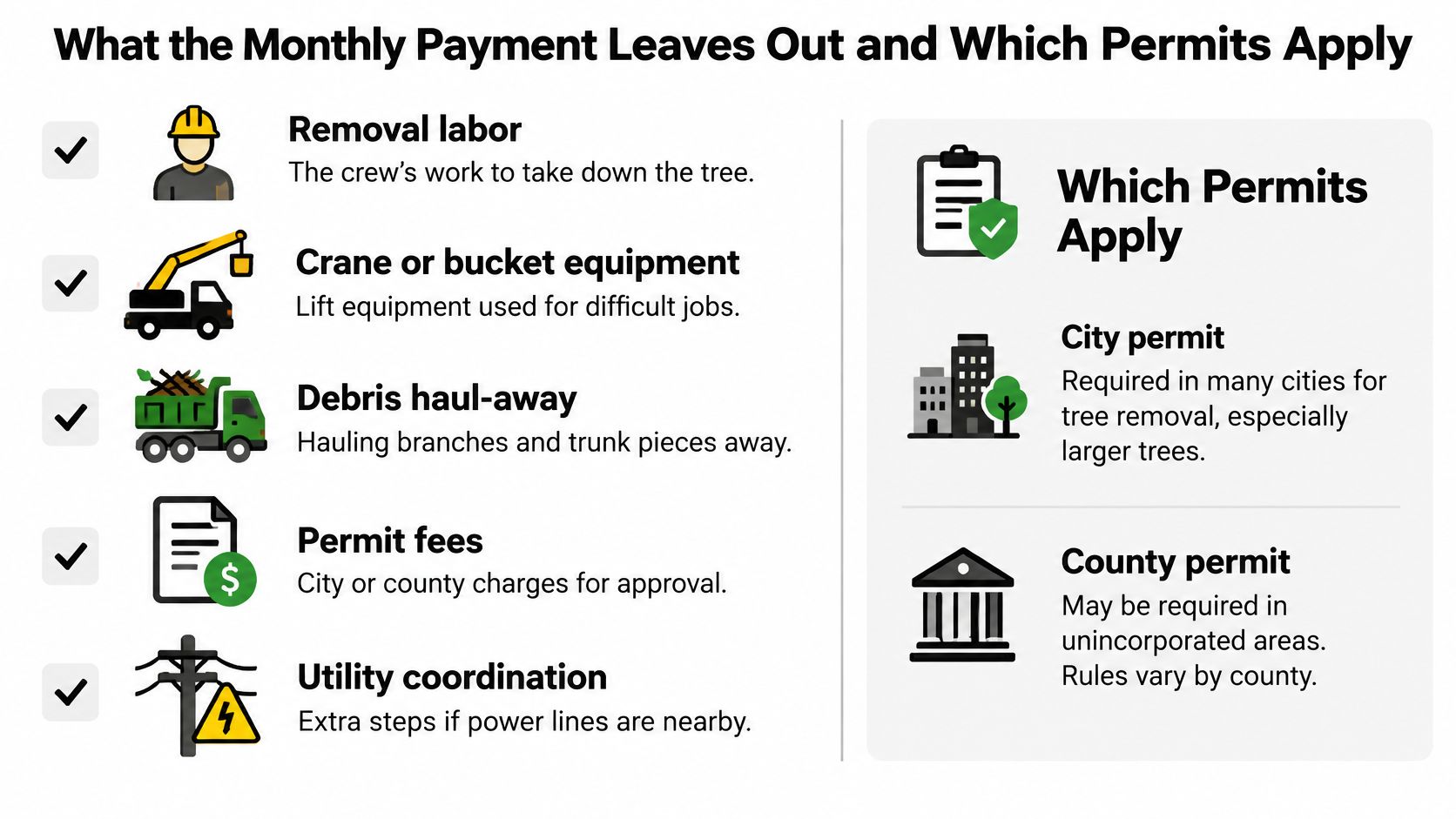
| Situation | Requirement | Where it applies |
|---|---|---|
| Fallen tree already down | No removal permit generally required | Atlanta |
| Imminently hazardous tree | Contact the Arborist Division, photograph the condition, and complete the required after-hours follow-up | Atlanta |
| Private hardwood at least 6 inches or pine at least 12 inches in diameter | Approval required; replacement planting or recompense may apply to a healthy tree | Atlanta |
| Project that may affect trees | Arborist meeting required before application, effective June 25, 2025 | Atlanta |
| Single dead or diseased tree | No arborist approval needed for homeowner removal | Cherokee County |
| Broader removal tied to disease or infestation | Written advice from Extension Service, Georgia Forestry Commission, or ISA Certified Arborist may support authorization | Cherokee County |
| Grading, clearing vegetation, or altering land | Erosion and sedimentation requirements may apply; check the 25-foot vegetative buffer near regulated waters | Georgia |
Trees Atlanta's preservation guidance identifies Atlanta's approval thresholds of 6 inches for private hardwoods and 12 inches for pines, potential replacement or recompense obligations, and the pre-application arborist meeting requirement effective June 25, 2025. These Atlanta rules shouldn't be applied automatically to properties elsewhere in North Metro Atlanta.
Cherokee County's tree preservation regulations distinguish homeowner removal of dead or diseased trees from broader disease- or infestation-related removals supported by professional advice. Georgia EPD's erosion and sedimentation resources address land-disturbing work and encroachment on a 25-foot vegetative buffer for certain waters.
Identify the parcel before the permit
Use these questions to select the relevant process: Is the tree down or standing? Is the parcel in Atlanta, Cherokee County or another jurisdiction? Is this individual tree removal or land clearing? A mailing address alone isn't enough to settle municipal jurisdiction.
For tree service in Marietta, Roswell, Kennesaw, Woodstock, Acworth or Canton, don't substitute a neighboring city's rules. Our tree preservation ordinance information supports that parcel-specific approach. We check the tree rule for each parcel before quoting and file the paperwork the job needs.
Build a complete cost worksheet
A financed invoice isn't automatically a complete project budget. Ask whether removal labor, crane or bucket equipment, debris haul-away, stump grinding, surface cleanup, arborist evaluation, emergency surcharges and utility coordination are included or separately payable.
Our prices are set on site according to tree height, trunk diameter, what sits beneath the tree and available working room. Every job is assessed by an ISA Certified Arborist before pricing.
Keep these worksheet categories separate:
- Service invoice. Itemize tree cutting service, equipment, hauling and stump work.
- Government and permit costs. Identify fees, required replacement planting, recompense and who pays each charge.
- Optional restoration. Specify soil, grading, sod, irrigation repair or other agreed reinstatement.
- Amount due at signing. Show every immediate payment, including costs excluded from financing.
For tree trimming and tree pruning, identify which trees and branches are included. For stump removal, clarify whether the quote means grinding or excavation, and who removes grindings and fills the opening.
For land clearing and lot preparation, define boundaries, protected trees and erosion controls. The useful comparison isn't merely what a crew charges to cut vegetation, but what it costs to leave the parcel in the agreed condition.
Verify the Contract and Checklist Before You Sign
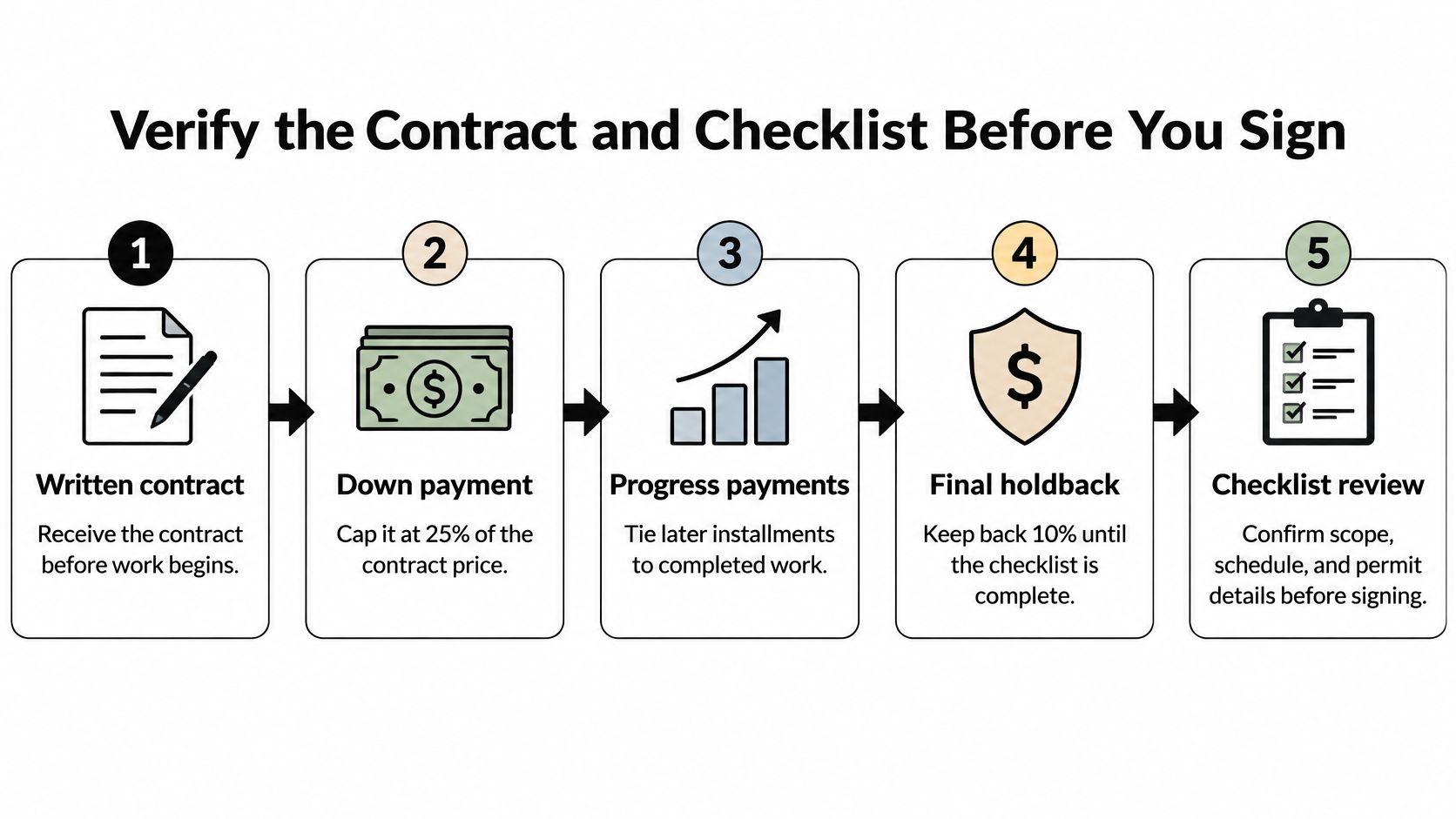
Receive the written contract before work begins. It should identify the trees, service lines, payment triggers and finished condition, not just state tree work with a monthly amount.
Georgia's contractor consumer guidance recommends a down payment of no more than 25%, progress payments tied to completed work, and withholding 10% until you're satisfied and have evidence that subcontractors and employees have been paid. Treat these as consumer-protection recommendations when negotiating the agreement, not as a substitute for reading the lender's separate disbursement terms.
Make completion measurable
For tree removal, define whether completion includes lowering the trunk, cutting remaining wood and hauling it away. For storm damage tree cleanup, identify which debris belongs to the contracted work and whether damaged fencing or lawn repairs are excluded.
A milestone such as removal complete can otherwise leave both parties interpreting the same words differently. Attach a clear deliverable to each payment, and arrange a completion inspection before releasing the final balance.
The agreement should also include written start and completion dates and a financing-contingency clause if borrowed funds are necessary. Assign responsibility for access delays, utility conflicts, weather postponements, permit changes and damage to irrigation, turf, retaining walls or hardscape.
Use the same checklist for competing quotes
- Borrowed amount and total repayment. Match the financed principal to the approved scope.
- APR and charges. List every lender and contractor fee.
- Term and installment. Confirm due dates, payment amount and repayment period.
- Promotional conditions. Record any deferred-interest deadline and the consequences of missing it.
- Deposit and milestones. Identify what must be completed before each payment.
- Separate project expenses. List permits, disposal and restoration rather than assuming they're included.
- Named parties and scope. Identify the lender, loan servicer and contractor, with the work attached to the agreement.
Request current insurance documentation and applicable business licensing before hiring. For hazardous tree removal, ask how the crew will use professional equipment, rigging and site protection for your particular access constraints.
Pay for a defined result, not simply for a crew having visited the property.
Compare competing quotes with the same checklist. A lower installment isn't a better offer if one contractor includes haul-away and restoration while another leaves them to you.
We provide free, no-pressure estimates anywhere we work, usually given the same day, with an arborist visiting the tree and a written price supplied before work starts. Confirm estimate timing with the office; an estimate turnaround isn't a promise of same-day removal.
Call 770-974-3964 with the tree's location, approximate height and trunk size, safely taken photos and the property's county ready. Ask us to show financing options beside permit and restoration items so you can review the full obligation before signing.
Richmond Tree Experts GA offers financing, arborist-assessed written estimates and emergency storm damage response. Visit Richmond Tree Experts GA to request a free estimate and compare the complete tree-work scope with the payment options available for your invoice.

