

You hear a branch scrape the roof after dark, or notice a split where a heavy limb joins the trunk. The tree still looks green, but now you're wondering whether it needs a trim, a smaller crown, or complete removal. Before you book tree trimming in Cumming, GA, separate the part that's failing from the tree you'd like to keep.
A mature tree doesn't automatically need to come down because it's close to the house. The right decision depends on its structure, what's beneath it, and whether selective pruning can meet the objective without leaving a damaged canopy. Start with safety, then compare the work, the rules, and the written estimate.
Dangerous Tree Signs and Storm Response
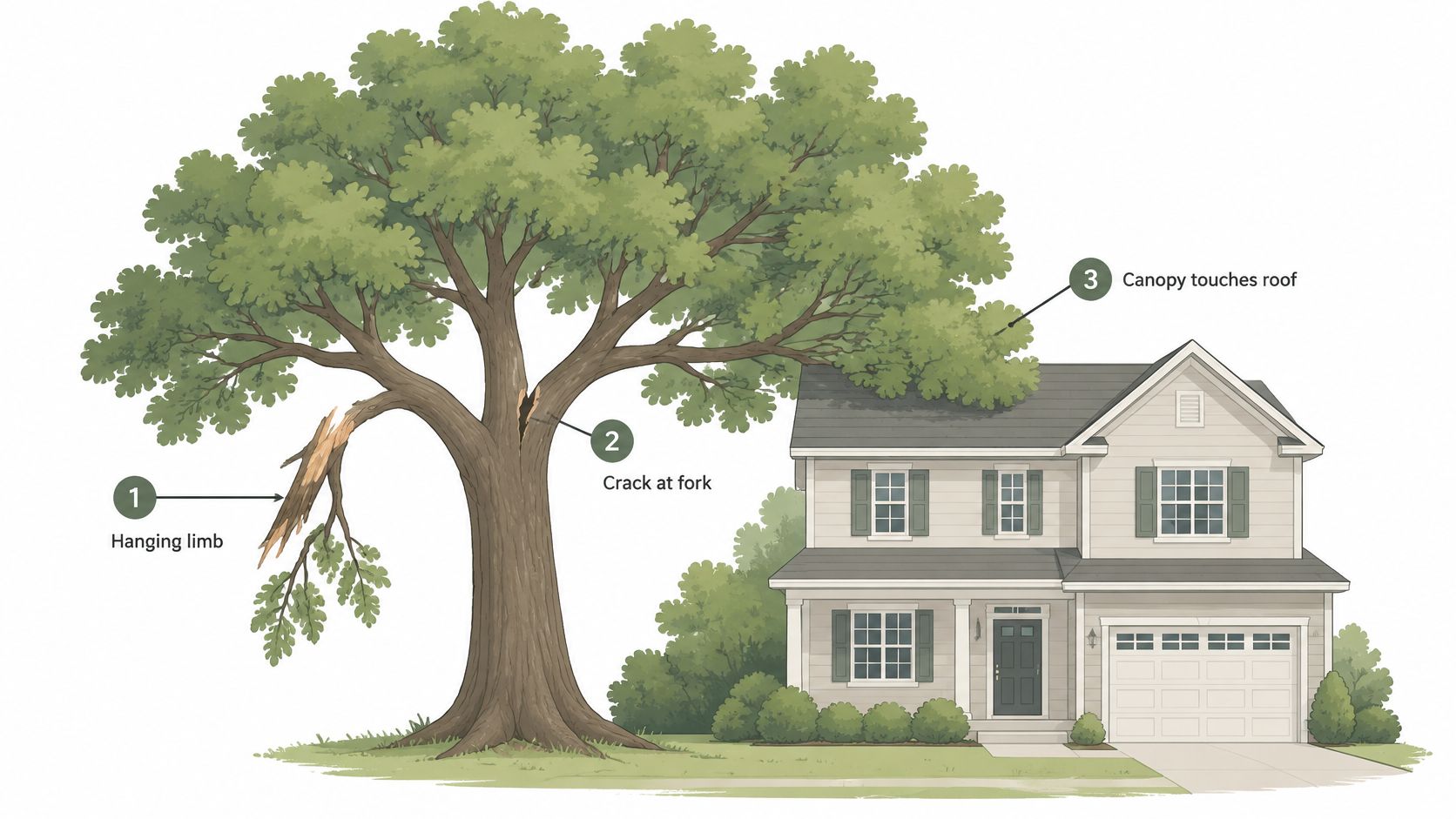
A hanging limb, a crack at a fork, or branches contacting the roof deserve attention before anything else on the lot. Each one signals a different job. A broken limb suspended over an entrance calls for a faster response than healthy foliage brushing a gutter.
Inspect from the ground, and keep everyone out from under suspect branches while you look.
- Dead growth: Look for brittle twigs and branches that stay bare while the surrounding canopy leafs out. Don't climb to test them.
- Weak forks: Check for narrow, V-shaped unions with bark pressed between the stems, especially where a crack is visible.
- Conflicting branches: Note limbs rubbing against one another or contacting the roof.
- Changed position: Report a lean that appears different from last year, rather than assuming every leaning tree is unstable.
- Blocked clearance: Identify low branches over a driveway, sidewalk, or street. Required clearance depends on the location and use, not a universal homeowner measurement.
A cracked branch union works like a split shelf bracket: the load it carries matters as much as the crack itself. A professional tree risk assessment separates a branch-level problem from a whole-tree concern, and that distinction drives whether the answer is targeted pruning, a crown reduction, or removal.
What to do after a storm
- Keep people and pets clear. Never climb or cut a limb caught in a power line. Call the utility first.
- Photograph the failure point and property damage from a safe location before cleanup.
- Get a professional assessment of any standing tree that appears to be actively failing before authorizing cutting.
- Call a qualified crew for torn bark, cracked trunks, hanging limbs, or a tree resting on a structure.
When I walk a Cumming property after a storm, the standing tree is the question that matters. A mature tree with sound roots and a damaged crown often has a middle path: a proper crown reduction that lowers wind load while keeping the canopy. Forsyth County prohibits topping, so a "cut it back hard" approach is off the table for those trees.
Storm exposure across Georgia is documented, not hypothetical. The Georgia Forestry Commission's forest-health report tracks damaging weather and forest-health events statewide, and Cumming properties share that exposure.
Atlanta posted Hurricane Helene tree guidance during that storm response, treating fallen trees differently from hazardous standing ones and asking for documentation before cutting. That page was tied to a specific emergency, so confirm current requirements with the City of Atlanta before relying on it. Atlanta's permit rules govern Atlanta addresses. A Cumming property falls under Forsyth County's framework instead.
Trees need trimming for specific failing parts, not for size alone.
Best Months to Trim Each Tree in Cumming
Cumming sits in north Georgia's humid subtropical band. Trees here reliably go dormant by December, push their spring growth flush in March and April, and then face July and August heat that punishes any tree carrying fresh wounds. That calendar shapes every window below.
Use the table as a planning guide, not a disease forecast or permission to postpone hazardous work. A calendar alone can't establish whether a particular oak, maple, or pine should be cut.
Best trimming window by tree species in Cumming
| Tree | Best months | Months to avoid |
|---|---|---|
| Oaks, including red, white, water, and willow | December through February, fully dormant | April through June, during the spring flush, plus heavy cutting in July and August heat |
| Maples, including red, sugar, and Japanese | December through mid-February | Late February through March, when rising sap runs heavy from fresh cuts |
| Pines, including loblolly, Virginia, and longleaf | November through February | July through September, when heat and dry spells leave less margin for recovery |
| Dogwoods | Late April through June, after the bloom finishes | February through early April, when pruning removes that year's flower buds |
| Flowering pears, including Bradford and similar | April and May, after bloom, for elective shaping | Any month if a union is already cracked or failing |
| Crape myrtles | January through early March, before new growth starts | June through August for anything beyond light touch-ups |
| Dead, broken, or hanging limbs of any species | Any month | Waiting for a preferred season |
A rigid month-by-month prescription can still mislead homeowners. Claims that particular months automatically create oak wilt or pine wilt risk need local, disease-specific support, and sap bleeding, cold injury, and branch failure aren't interchangeable reasons to avoid pruning.
Timing also connects to the bigger decision on a mature tree. An oak crowding the roofline is often a candidate for crown reduction, which keeps the tree standing, and that reshaping work schedules best inside the dormant window when the crew can read the branch structure clearly. For a flowering dogwood, say whether your priority is keeping blooms, clearing a walkway, or removing damaged wood. For a pine, ask whether the concern is one limb or the stability of the whole tree.
The exception is a failing limb
Safety work doesn't wait for a dormant window. A hanging branch above the driveway needs an assessment now, even if elective canopy work would be better scheduled for January.
That exception covers the immediate hazard only. The crew can remove the failing limb and recommend a separate date for nonurgent pruning.
Scheduling rule: Plan elective work around the species and flowering cycle. Let the arborist choose suitable weather, and don't assume pruning wounds "seal" simply because several dry days follow the cut.
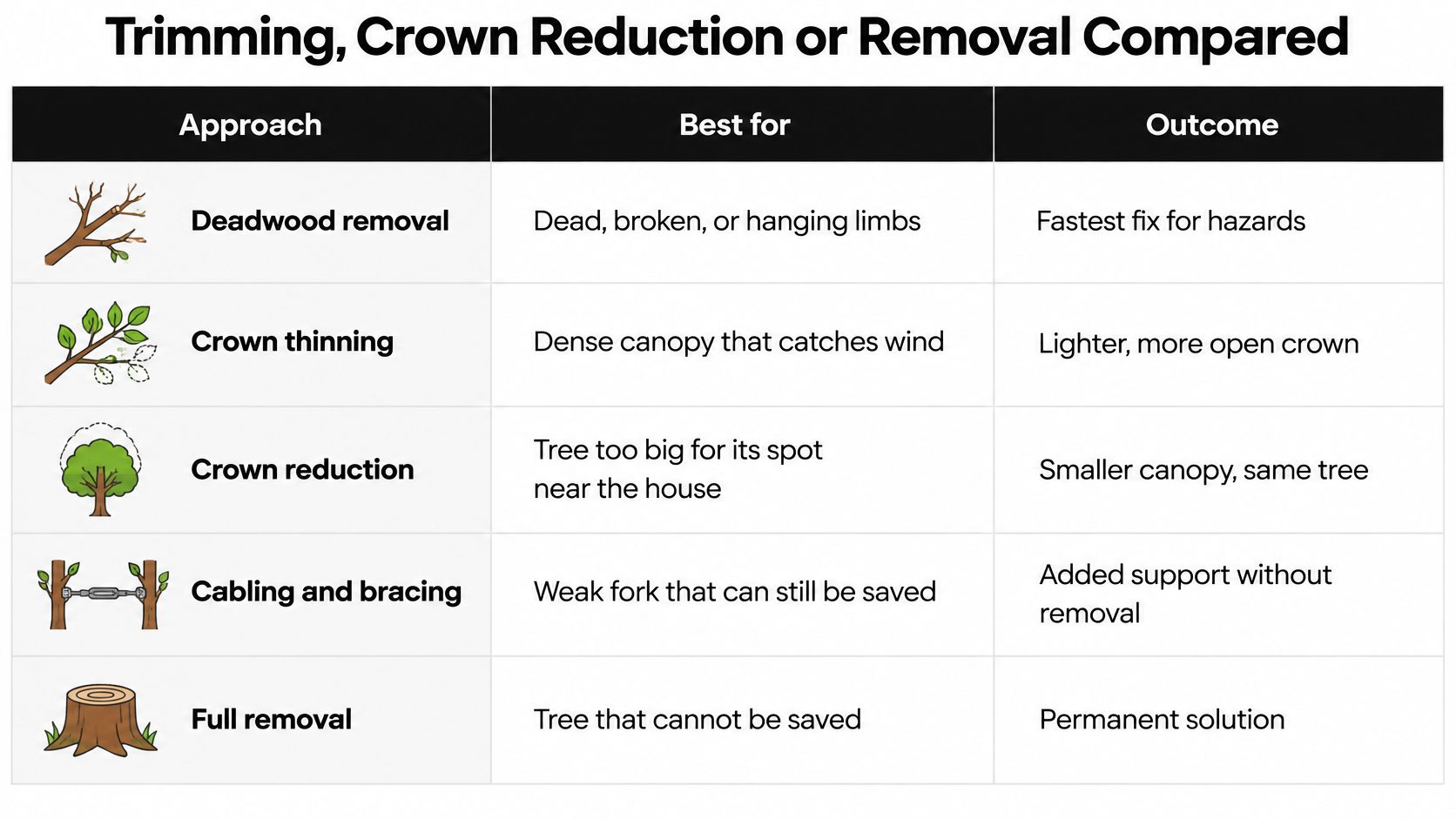
Trimming, Crown Reduction or Removal Compared
| Method | Best for | What it changes | Main limit |
|---|---|---|---|
| Deadwood removal | Dead, broken, or hanging limbs | Removes failing wood without intentionally resizing the tree | Doesn't correct every structural weakness |
| Clearance pruning | Roofs, driveways, and service areas | Creates space around a specific target | Doesn't support weak unions |
| Crown reduction | A canopy extending beyond suitable space | Shortens selected branches while retaining tree form | Requires appropriate lateral branches and proper cuts |
| Cabling and bracing | Selected weak unions worth retaining | Adds supplemental support | Doesn't eliminate decay or future inspection |
| Removal with replacement | Unacceptable structural failure, severe decay, or root damage | Removes the tree and starts a replacement plan | Loses the existing mature canopy |
Deadwood removal is the focused choice when the problem is failing wood, not the tree's overall dimensions. Clearance pruning addresses a conflict with the house or access route without automatically thinning the entire crown.
A properly specified tree crown reduction cuts selected branches back to suitable laterals. Think of shaping back to an existing branch, not hacking off the tree's head. The arborist must decide whether the remaining structure can support that approach.
Why topping isn't the middle path
Forsyth County's posted tree-ordinance draft expressly prohibits topping and directs crown-reduction pruning consistent with ANSI A300 practices. Because that document is labeled as a draft, confirm the adopted requirements with the county before relying on it as current law. Either way, topping shouldn't be accepted as a substitute for a defined pruning objective.
Cabling and bracing may be considered for a retainable tree, but a split fork isn't automatically repairable. Removal with replacement becomes the appropriate comparison when the remaining tree can't reasonably meet the safety objective.
Reduction doesn't cure trunk decay, restore damaged roots, or erase major storm damage. Preserving shade matters, but retaining a tree requires more than making it look smaller.
What Tree Trimming Costs in Cumming
A mature water oak leaning over a roofline and a young maple standing in open lawn are two different jobs, and no honest price list covers both. Richmond Tree Experts GA doesn't publish fixed prices for that reason. Every quote follows an on-site assessment of the actual tree, the work area, and the access.
| Service | When it fits the tree | What moves the price |
|---|---|---|
| Routine pruning of a small tree | Healthy tree, reachable from the ground | Ground access, tool requirements, debris volume |
| Crown reduction on a mature tree | The middle path between a light trim and removal, when the remaining structure can carry it | Number of cuts back to suitable laterals, crown size, rigging over targets |
| Clearance over a roof, drive, or service drop | Limbs threatening a structure or line | Restricted access and utility coordination |
| Storm limb removal | Limbs hanging or resting on a structure | Urgency, loading, rigging, possible crane |
| Hazardous tree removal | The tree can't be retained safely | Tree dimensions, structures, lines, access |
| Stump grinding | Follow-up after a removal | Stump size, access, root spread, cleanup |
| Hazard assessment by an ISA Certified Arborist | Diagnosis before choosing a scope | Assessment scope and whether the fee is credited toward approved work |
What you're paying the crew to manage
Height and crown density set how much material the crew must reach, cut, control, and process. A spreading oak over a house is a different scope from a small ornamental accessible from the lawn.
Access can change the entire work plan. A narrow gate may keep equipment out of the backyard, while a clear driveway allows a different setup. Ask how the contractor intends to move wood without damaging fences, retaining walls, sod, or artificial turf.
Work near structures and conductors takes another level of planning. The price should reflect controlled lowering and any necessary utility coordination, not just time spent running a saw.
- Debris handling: Confirm whether chipping, log removal, and hauling are included.
- Urgency: Ask whether storm mobilization or after-hours work carries a separate charge.
- Assessment: Find out whether the consultation is free, separately priced, or credited toward approved work.
- Equipment: Ask why a lift, crane, or additional rigging is needed rather than comparing equipment charges in isolation.
Compare the same finished job
Request three written estimates with matching scope: tree identification, approximate size, pruning objective, cut type, access plan, cleanup, and timing. The tree service estimate request should identify whether you need routine pruning, crown reduction, emergency removal, or a diagnosis before choosing among them.
A low bid that leaves logs behind or substitutes topping for defined reduction cuts isn't the same job at a lower price. Don't assume removal includes the stump, either.
Stump grinding and stump removal need separate clarification. Ask what material will remain, whether chips leave the property, and what preparation is included for replacement planting or lawn work. For land clearing and lot preparation, request a separate scope identifying retained trees and protection measures before equipment enters.
Estimate check: Compare what the property will look like when the crew leaves, not just the total at the bottom.
Forsyth County Rules Before You Cut
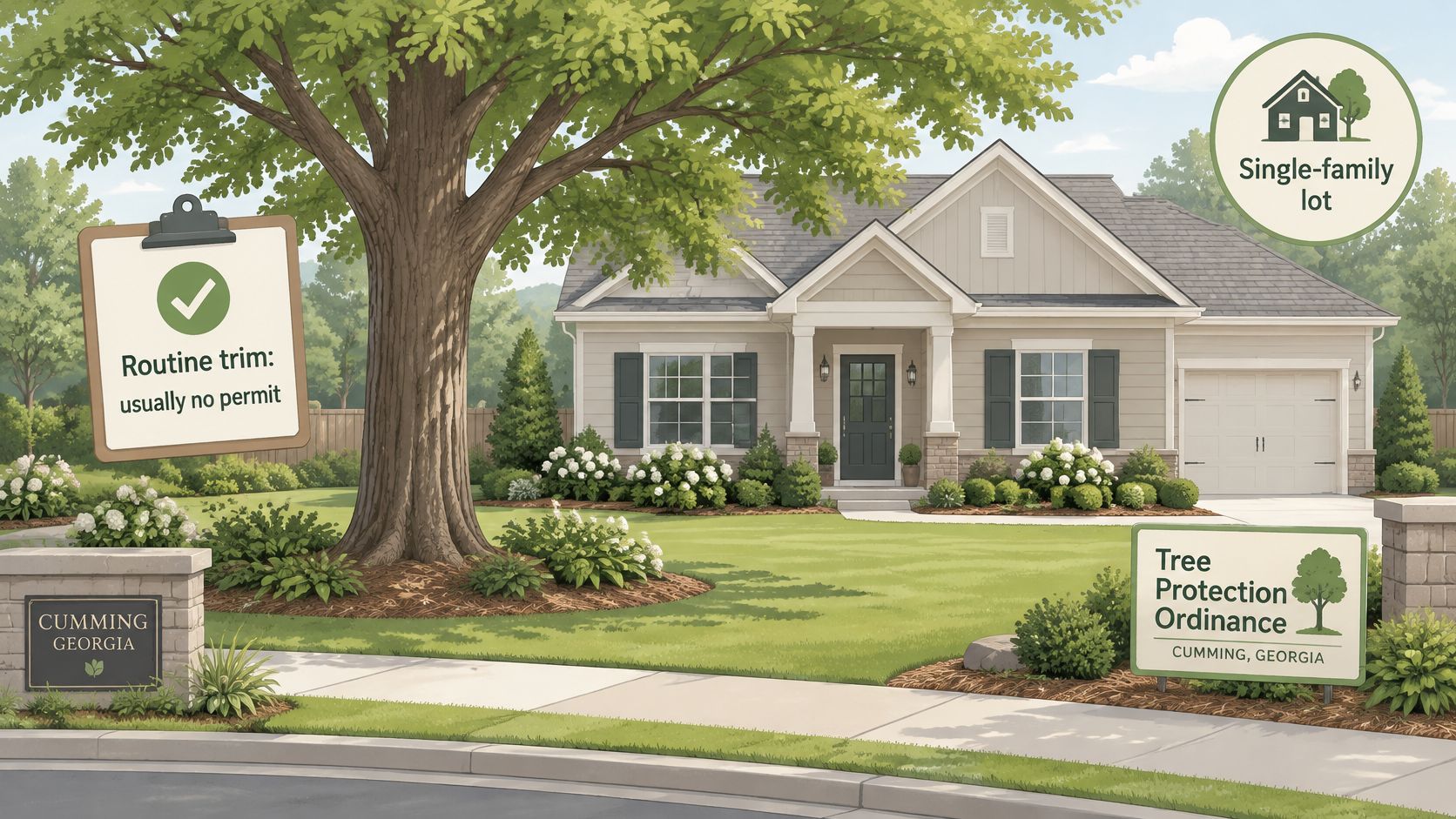
Don't assume you need Atlanta's removal permit for a Cumming property. Equally, don't assume a single-family address makes every tree exempt from local requirements. Confirm the parcel's jurisdiction and whether development approvals or tree-protection conditions apply.
Forsyth County posts a Tree Protection & Replacement Ordinance showing a revision date of April 13, 2017. Treat that posting as a reference document rather than settled law. The posted version reads as a draft, so confirm its figures and revision date against the county's currently adopted ordinance before relying on them. As written, it requires qualifying development sites to inventory trees and prepare protection or replacement plans, prepared by a registered design professional, urban forester, or arborist. The same document carries the county's topping restriction, which is what makes crown reduction the middle path for mature Cumming trees rather than removal.
Development rules aren't ordinary pruning instructions
The posted ordinance specifies minimum densities of 20 tree units per acre for residential zoning, 15 for commercial and industrial zoning, and 18 for planned commercial or qualifying mixed-use development meeting the Development of Regional Impact threshold. Tree units aren't just a count of individual trees. Verify those numbers with Forsyth County Community Development before designing a site plan around them.
Those standards matter to builders, commercial property managers, and owners undertaking qualifying redevelopment. They aren't a reason to prescribe the same pruning treatment for every residential lot.
Atlanta's official tree-permit guidance generally requires approval for private-property trees measuring at least 6 inches DBH, measured 4.5 feet above ground. Atlanta's code carries exemptions for trees that are dead, dying, or hazardous, so the threshold does not apply to every tree on every lot. That is an Atlanta rule, not a Cumming permit threshold.
Check your property before authorizing removal
- Confirm jurisdiction from the parcel address, including whether the property is within city limits or unincorporated county territory.
- Read HOA covenants and any architectural-review requirements.
- Check easements and identify overhead and underground utility constraints.
- Photograph the tree and its surroundings before removal.
- Contact Forsyth County Community Development when construction, rezoning, redevelopment, or a property transaction raises questions about approved plans.
An HOA approval doesn't replace government approval, and a contractor's verbal assurance isn't documentation. For land clearing, settle preservation and replacement requirements before treating every tree as removable.
DIY Trimming or Hiring an ISA Certified Arborist
| Factor | DIY | ISA Certified Arborist |
|---|---|---|
| Upfront cost | Tools, protective equipment, and your time | Written price for the assessed scope |
| Safe working height | Keep homeowner work at ground level | Ask about climbing, lift access, and rigging |
| Near power lines | Avoid entirely | Requires separately qualified line-clearance personnel |
| Cut quality | Depends on knowledge and tool control | Specify ANSI A300 and preserved branch collars |
| Diagnosis of decay or disease | Easy to misidentify | Professional assessment before choosing treatment |
| Liability and insurance | Homeowner exposure | Request current insurance documentation |
| Storm damage | Don't cut loaded or suspended limbs | Qualified emergency crew and suitable equipment |
Reasonable DIY work is small, low, and clear of hazards. That might mean removing accessible suckers or clipping young growth with hand pruners. A pole pruner is only appropriate when you can control the tool and remain outside the branch's landing area.
Don't convert ground-level work into a ladder-and-chainsaw job. A branch can shift as it separates, and a homeowner balancing on a ladder has little room to respond. Storm-loaded limbs require particular restraint.
Power lines require different qualifications
Under OSHA's tree-care electrical-safety guidance, all power lines must be treated as energized, and tree work within 10 feet requires trained, experienced line-clearance trimmers, with another worker within normal voice communication range.
Electrical danger isn't limited to touching a conductor with a saw. Branches, ropes, ladders, poles, and equipment can create hazardous paths. An ISA credential alone doesn't establish line-clearance qualifications.
What to verify before hiring
- Diagnosis: Ask what the arborist found at the branch union, trunk, and root area, and how it changes the recommendation.
- Credentials: Check the arborist's name in ISA's online credential directory rather than relying only on a logo.
- Insurance: Request liability insurance and workers' compensation documentation, and verify applicable business licensing.
- Work method: Ask how the crew will control branches above the roof, protect the ground, and keep other people outside the work zone.
Proper pruning should preserve the branch collar and bark ridge rather than leaving flush cuts or long stubs. The written objective matters as much as the person's ability to operate a saw.
Hire a professional when the work requires climbing, involves a roof, or approaches utility lines. For small ground-level pruning, sharp tools and careful cuts can be reasonable. If you can't explain where the branch will land, don't start cutting.
How Richmond Tree Experts Handles a Cumming Trim
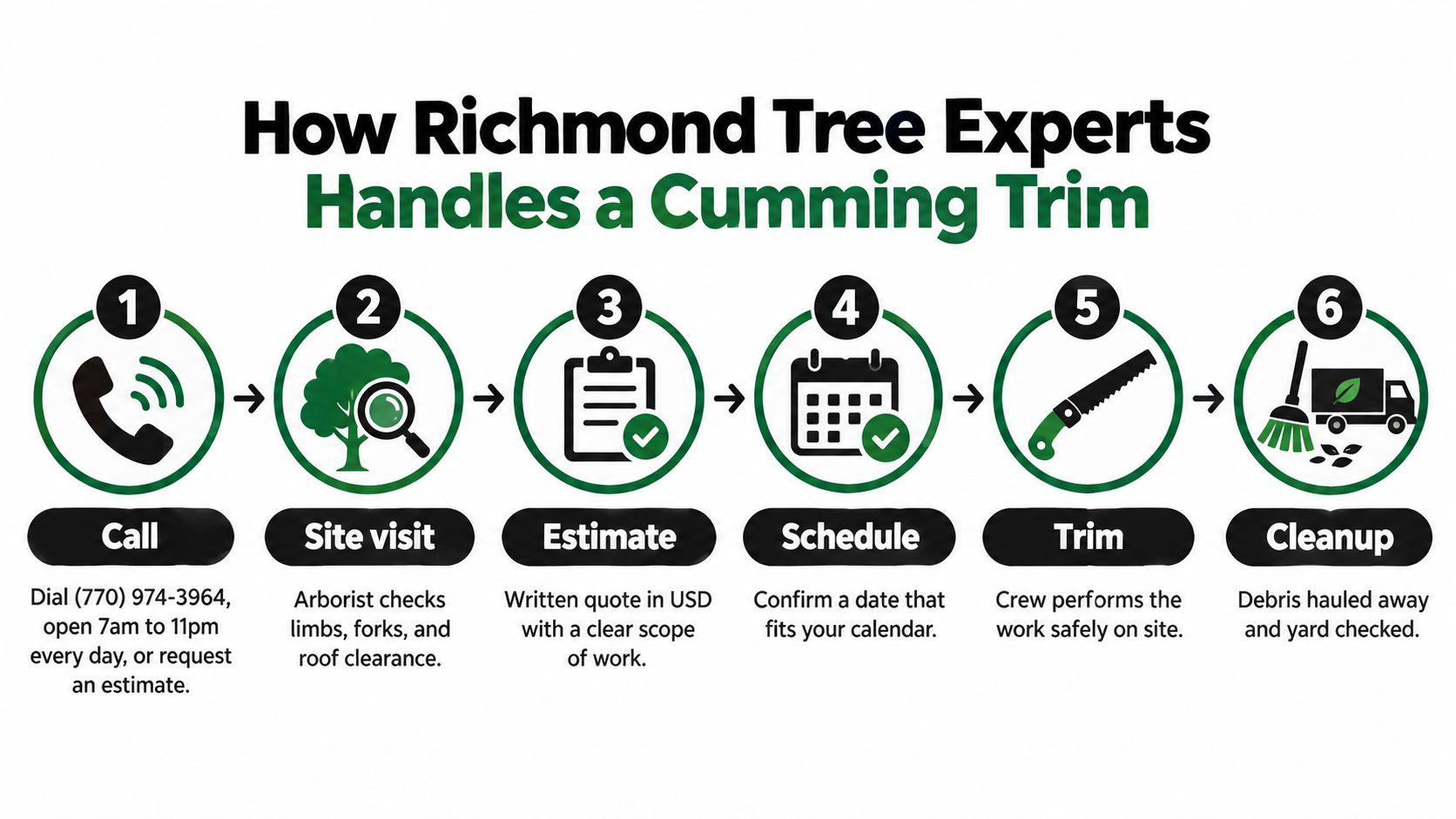
A trim on a mature Cumming oak goes wrong when the crew pulls up ready to cut before anyone has agreed on what the tree needs. The job should produce a defined objective, a work plan matched to the site, and a yard left in the condition the quote describes.
From first contact to the written scope
- Call and describe the hazard. Call (770) 974-3964, with published contact hours of 7am to 11pm every day, or request an estimate online. Say immediately whether the tree contacts a structure, blocks access, or sits near a line.
- Site visit and free estimate. Ask whether the arborist who assesses the tree holds an ISA Certified Arborist credential, and treat the answer as something to verify rather than assume. The visit should identify clearance conflicts, visible defects, and site limits that shape the recommendation.
- Written quote. Confirm whether the objective is clearance, deadwood removal, crown reduction, or removal. On a mature tree that has outgrown its space, crown reduction is the middle path between a light trim and removal, and it keeps the work inside Forsyth County's restrictions on topping. Any permit or protection question belongs under county rules; Atlanta's tree ordinance does not govern Cumming addresses. The quote should also name cleanup responsibilities, scheduling, and the pruning standard.
On-site work and handover
- Preparation. Review the work zone, driveway access, utility constraints, and protection for lawns and beds. Confirm the crew's licensing and insurance documentation before mobilization.
- Execution. The crew should use the smallest cuts that meet the objective and precut larger limbs to limit bark tearing, following the ANSI A300 pruning principles. Rigging, lift access, or crane work should follow the assessed site requirements, not a standard equipment package.
- Cleanup and follow-up. Check that chipping, hauling, and log handling match the quote. Grade restoration, lawn repair, stump grinding, and replacement planting stay outside the scope unless they are written down. Ask what changes to watch for and whether the retained tree needs another inspection, since supports and unresolved defects should carry a monitoring recommendation.
For a storm call, begin with the safety and photograph steps above, then establish the emergency scope and cleanup plan. An emergency arrival window must be confirmed when you call; office contact hours are not a guaranteed crew arrival time.
Ask whether the immediate visit covers stabilization, complete fallen tree removal, or only assessment. A fast response helps only when you know what the responding crew can safely complete.
Confirm Your Trim and Book a Free Estimate
Before calling, decide what you need the tree to do differently. “Clear the roof without topping” gives the arborist a more useful starting point than “make it smaller.” If you don't know whether pruning can solve the problem, request an assessment rather than committing to removal.
Gather the details that help the estimate
- Property address: Include access restrictions, gates, and the best place to park.
- Tree photographs: Take two views from different angles, staying outside the hazard area.
- Damage photographs: Include the failure point and affected structure when safely visible.
- Your objective: Identify clearance, deadwood removal, reduction, hazardous tree removal, or replacement.
- Property conditions: Mention HOA rules, development plans, easements, and nearby utilities.
Service inquiries can cover Cumming and Forsyth County, plus Marietta, Roswell, Kennesaw, Woodstock, Acworth, and Canton. Also identify your location when requesting work in Cobb County, Cherokee County, Johns Creek, Milton, Alpharetta, East Cobb, Gwinnett County, or nearby North Metro Atlanta communities so coverage and scheduling can be confirmed.
Whether you're searching for tree service in Marietta, tree service in Roswell, or “tree removal near me,” compare the same essentials: qualified personnel, documented insurance, a defined scope, and an actual arrival window. Mention whether you also need stump removal, storm damage tree cleanup, or lot preparation rather than assuming those services are bundled.
Act on hazards before scheduling appearance work
If a tree is on a home, power line, or road, follow the earlier storm precautions. Contact the utility or emergency services first when appropriate, keep people away, then arrange emergency tree removal.
Call (770) 974-3964 or request a free estimate online. Schedule elective trimming for a suitable species-specific window, but book a hazard assessment now if a limb is failing.
Richmond Tree Experts GA offers tree trimming, tree removal, stump grinding, and arborist assessment for homeowners deciding whether to retain or remove a mature tree. Visit Richmond Tree Experts GA to request a free estimate, share your tree photos, and confirm the right scope and response window for your Cumming property.

