

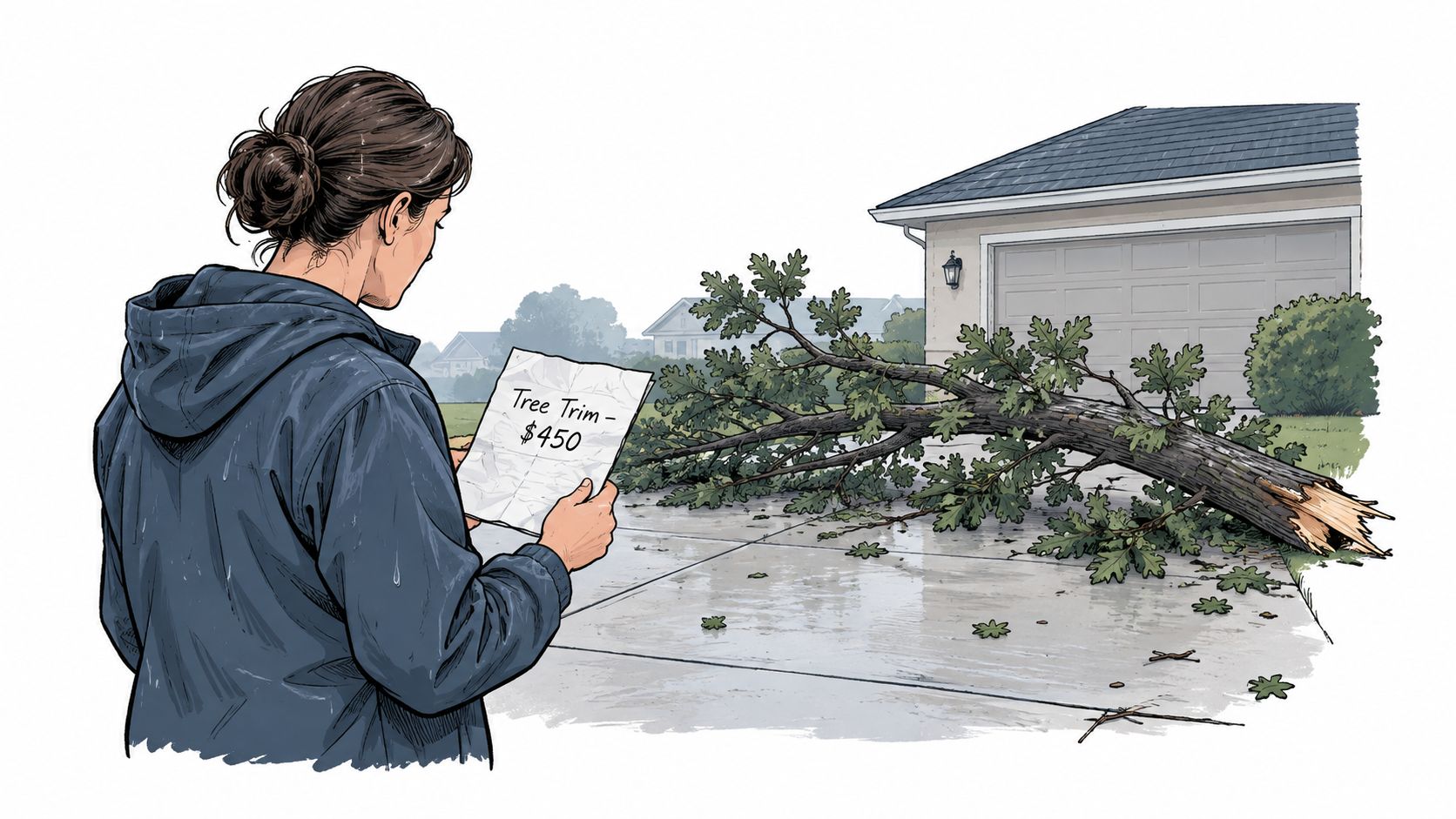
A storm has just moved through Roswell, and a heavy limb is blocking the driveway. You need an emergency tree removal crew, but the first estimate you receive says only, “Remove branch, $450.” It doesn't say whether the crew will lower the limb, haul away the wood, protect the lawn, grind the damaged stump, or return if hidden decay changes the job.
That kind of quote creates trouble for everyone. A professional tree trimming estimate template should work as a written work specification, not a guess printed beside a single price. It should tell a homeowner in Marietta, a property manager in Cobb County, or a landscape architect in Alpharetta exactly which tree is involved, what work will be performed, what hazards were identified, and what remains outside the scope.
Why the Standard Tree Service Quote Fails Homeowners
Six weeks after the Roswell storm, the homeowner discovers that the original crew removed the branch but left a rough section of trunk near the fence. The estimate never explained debris disposal, stump grinding, root disruption, access limitations, or whether the crew had priced rigging around the roof. The follow-up invoice feels unexpected, even though the crew may have encountered genuine additional work.
This dispute starts with a weak document, not necessarily bad intentions. “Trim tree” can mean deadwood removal, roof clearance, crown cleaning, reduction, or corrective pruning. “Remove tree” can mean fell it in an open yard, dismantle it over a house, haul all wood away, or leave sections on site. Those are different services with different equipment, labor, hazards, and completion standards.
The asset deserves a better record
The scale of urban tree ownership makes vague estimates especially poor stewardship. USDA Forest Service research estimates that U.S. urban forests contain approximately 3.8 billion trees with a structural asset value of about $2.4 trillion, and nearly 80% of the U.S. population depends on urban trees for environmental, economic, and social benefits.
That value doesn't mean every trimming job needs a lengthy report. It does mean the estimate should connect the proposed work to a clear objective. A tree beside a driveway may need clearance pruning. A declining tree over a play area may need a hazard assessment. A mature oak near a commercial entrance may need selective deadwood removal rather than aggressive reduction.
Practical rule: If the client can't tell which tree is included, what “complete” looks like, and what happens to the debris, the estimate isn't finished.
A useful tree service estimate reference should help clients compare tree service providers in Roswell, Marietta, Canton, and nearby North Metro Atlanta markets without reducing every proposal to an hourly total. The document protects the homeowner, the property manager, and the crew because everyone approves the same scope.
The Core Fields Every Estimate Template Must Include
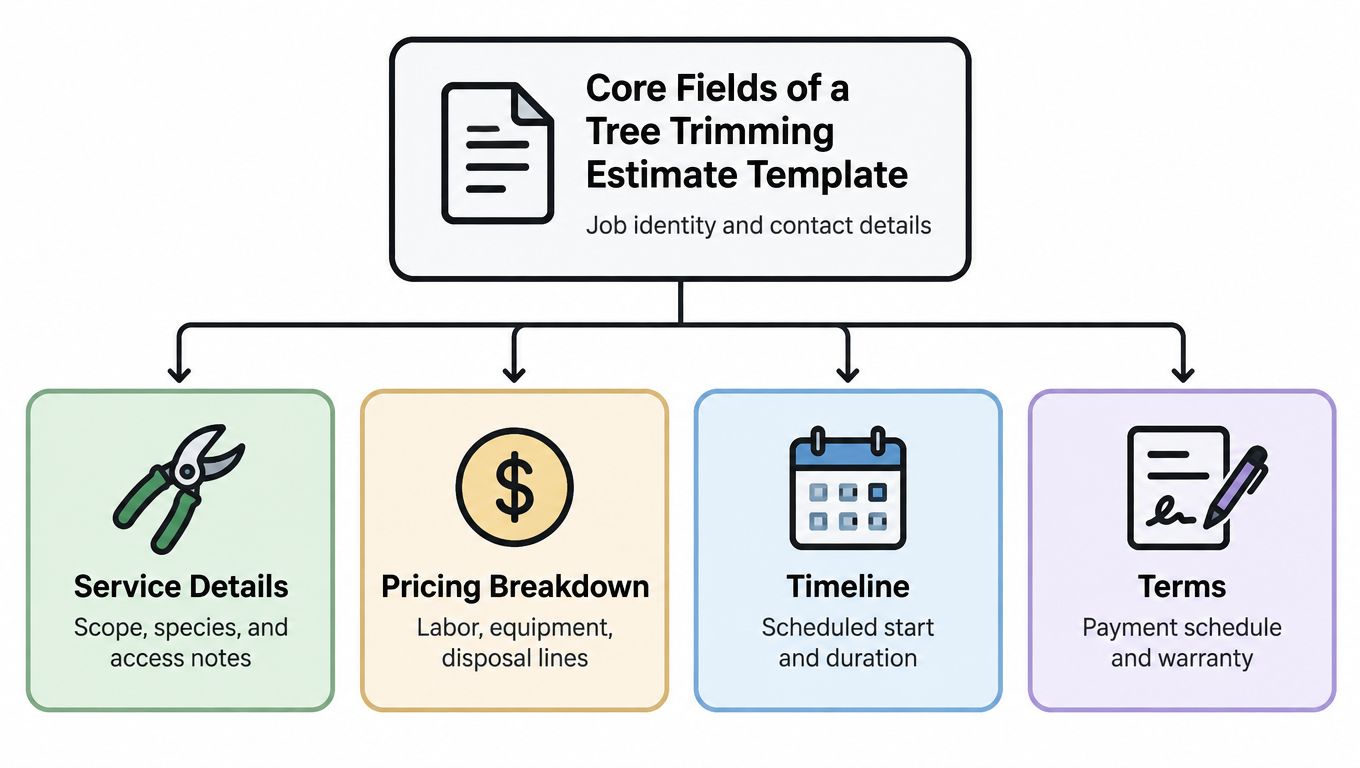
A reliable template starts with one record per tree. Give each tree an identifier, mark its physical location on a photo or site sketch, and record the species or type, diameter, height, condition, targets, access route, and overhead utility exposure. “Backyard tree” isn't enough when a property has several oaks, pines, or ornamental trees.
The pruning objective must be equally specific. Use terms such as deadwood removal, crown cleaning, roof clearance, utility clearance, thinning, or reduction, then describe the intended method and cut types. The client should know whether the crew is removing selected branches, shortening limbs to a measurable point, or reducing a crown throughout the tree.
Record measurable scope
Avoid “light trim” and “shape as needed.” A defensible specification records the foliage percentage, branch diameter range, crown position, maximum cut size, and required clearance height. It should also state whether the work addresses a roof, structure, road, sidewalk, utility corridor, or another target.
ANSI A300 guidance specifically calls for written specifications identifying the trees, objectives, methods, extent, pruning location, part-size range, foliage percentage, and clearance requirements. It also recommends a visual inspection before work, sharp tools, correct branch-collar cuts, and no more than 25% foliage removal in one growing season.
Separate production from risk
The price section should distinguish production quantities from risk modifiers. Production might include:
- Tree quantities: Identify each tree and each included service.
- Crew time: Record expected crew hours, climbing hours, and lift hours.
- Disposal volume: State whether brush is chipped, hauled away, left for the client, or handled through a separate disposal line.
- Special equipment: List a bucket truck, crane, chipper, rigging gear, or stump grinder when required.
Risk modifiers belong beside, not inside, those quantities. Note confined access, a narrow gate, traffic control, structures, retaining walls, pedestrians, overhead conductors, and lawn-protection needs. A Marietta tree accessible from the driveway is not equivalent to an Alpharetta tree behind a house with no equipment route.
Finish with the work window, weather limitations, exclusions, change-order triggers, payment terms, and an inspection sign-off. Before-and-after photos give the homeowner and crew a shared record of the intended cuts and completed work.
How to Price Safety Risk and Site Controls Properly
A generic labor rate hides the most important cost drivers in tree work. The estimator should screen the site before assigning a price, because a tree over a roof, beside a sidewalk, or under power lines requires controls that an open-yard tree doesn't.
OSHA data for tree-trimming operations identified falls, struck-by incidents, and electrocutions as dominant fatal-event categories. Approximately 32% of deaths involved falls and 26% involved falling objects, with the cited categories representing 75.6% of fatalities in the national review.
Turn hazards into visible allowances
The estimate should contain a hazard screen for energized conductors, suspended limbs, defects, decay, lean, unstable soil, restricted drop zones, vehicle exposure, pedestrian traffic, and equipment access. Each checked hazard should lead to a control, an allowance, or an explicit exclusion.
For example, a tree leaning toward a garage may require sectional removal and rigging rather than a straight fell. A roadside tree in Kennesaw may require traffic protection and spotters. A backyard tree in Cumming may require additional ground labor if a chipper or lift can't reach the work area. Those aren't arbitrary surcharges. They're the resources needed to control the site.
Power-line exposure deserves its own yes-or-no field and a measured distance. NIOSH recommends treating lines as energized until verified otherwise and notes that required working distances vary with voltage from 2 to 15 feet. The estimate should identify utility coordination, shutdown delays, bucket access, and whether the utility company must handle the conductors.
Write the change-order boundary
Concealed cavities, inaccessible areas, emergency stabilization, and utility delays can change the work. State the trigger before the crew arrives, then explain what happens if it appears. The client might approve a documented additional allowance, pause the job for a revised scope, or exclude the condition entirely.
Commercial clients in Alpharetta, Johns Creek, and Cumming need this clarity for vendor comparisons and internal approval. Contractors and property managers who want broader risk-management context can also consult this guide for builders and subcontractors when reviewing insurance and responsibility boundaries.
Building Transparent Labor, Equipment, and Markup Line Items
A transparent estimate doesn't expose every internal business expense, but it should show the major components that create the total. Start with the service scope, then list labor, equipment, site controls, disposal, restoration, and optional work separately.
The economic case for tree management can support that explanation without pretending to establish a universal trimming price. One USDA Forest Service study found an average annual benefit of $47.83 per tree against an average annual management cost of $19, equivalent to $2.52 in benefits for every dollar spent in one assessment. Other Forest Service research found benefit-to-investment ratios ranging from $1.37 to $3.09 per dollar across five cities.
Those figures don't tell a crew what to charge for a difficult oak in East Cobb. They do support a better conversation about preservation, clearance, expected service life, and planned maintenance.
Use a line-item sequence
A practical estimate can follow this order:
- Labor: Show the crew composition or production allowance, including climber, ground crew, lift operator, setup, and cleanup.
- Equipment: Separate bucket truck, crane, chipper, rigging, stump grinder, fuel, and transport when applicable.
- Site controls: Add traffic protection, pedestrian control, lawn protection, utility coordination, or emergency access.
- Debris handling: State whether brush is chipped on site, hauled away, stacked, cut into logs, or left for the property owner.
- Optional services: List stump grinding, stump removal, surface-root work, additional haul-off, restoration, or follow-up inspection separately.
Markup should be identifiable as a business component rather than disguised inside an unexplained service charge. The same applies to contingency allowances. If concealed decay isn't included, say so. If weather, access, or utility conditions can change the schedule, connect the validity period to those conditions.
A calculator can help standardize arithmetic, but it shouldn't replace field judgment. For teams comparing estimating workflows, this quote calculator for CASA courses illustrates the value of structured inputs and visible calculations, even though tree work requires additional hazard and scope fields.
The client-facing total can remain simple. The supporting detail should not. A per-tree allocation is useful when a homeowner wants to remove one item from the proposal, but the crew should build the price from total production time, equipment utilization, controls, and disposal requirements.
For additional guidance on separating scope from cost, see this resource on tree trimming costs. The useful test is straightforward: could another estimator understand why the proposal changes if the tree moves closer to a roof, loses equipment access, or requires emergency response?
Permit Exposure and Regulatory Boundaries in Atlanta Markets
A low trimming price can become an expensive delay when the estimate ignores jurisdiction. Atlanta, Marietta, Roswell, Milton, Johns Creek, Cobb County, Cherokee County, and nearby North Metro communities may not apply the same tree rules, so “permit not included” is too vague to protect a client or a contractor.
In Atlanta, routine pruning generally doesn't require a permit when it removes less than 20% of the live canopy and doesn't make the tree unstable. Removing, destroying, or injuring a private tree at least 6 inches in diameter at breast height generally requires approval, including work involving dead or hazardous trees, according to Atlanta's tree permitting guidance.
Put compliance in the estimate
The template should include:
- Jurisdiction: Identify the city, county, right-of-way, or private parcel.
- Tree measurement: Record DBH and the proposed pruning percentage.
- Work boundary: State whether the work affects a public right-of-way, construction area, utility corridor, or private yard.
- Responsibility: Identify who handles permits, arborist meetings, applications, inspections, and replacement requirements.
- Conditional allowance: Add permit, arborist meeting, replacement planting, or plan revisions if required.
Atlanta moved affected permit applications to an electronic process and, effective June 25, 2025, requires an arborist meeting before applications for projects that may affect trees. That date-specific requirement makes an old template especially risky if the form doesn't prompt the estimator to verify current procedures.
Don't confuse pruning with removal
A tree trimming estimate should clearly distinguish routine pruning from hazardous tree removal, fallen tree removal, and construction clearing. Atlanta's public-property rules also matter. Removing a tree in a public right-of-way requires an application, and non-hazardous removals may require a replacement plan.
A property owner in Roswell may ask for emergency tree removal after a storm, while a landscape architect in Cherokee County may need a proposal for land clearing and lot preparation. Those jobs require different compliance checks. A practical tree preservation ordinance resource can help teams frame the conversation, but the estimate should still identify the governing jurisdiction and confirm requirements before work begins.
Common Mistakes That Turn Estimates Into Disputes
The most common mistake is allowing customers to compare hourly totals instead of completed work. A tree beside a retaining wall, a tree over a public sidewalk, and a tree in an open lawn may share the same pruning objective, but they don't share the same drop zone, access, equipment, or control plan.
A professional estimate records DBH, height, species, decay indicators, lean, target proximity, utility exposure, access constraints, equipment, traffic or pedestrian control, cleanup, wood disposal, stump treatment, and exclusions. It also says what happens to roots, logs, chips, and the work area after the final cut.
Three fields prevent most arguments
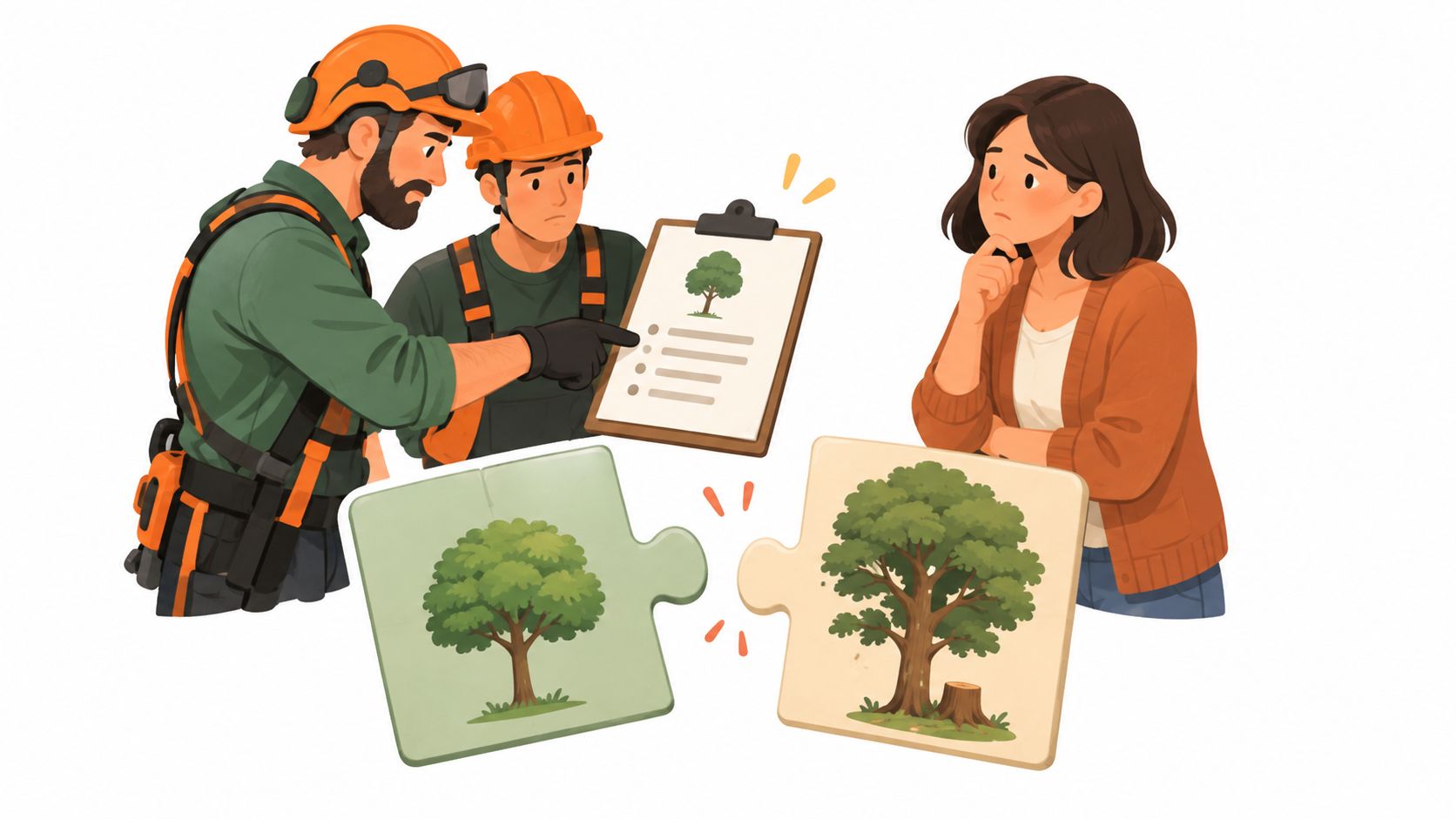
For every tree, add three plainly labeled fields:
- Included scope: Name the exact pruning, removal, stump grinding, or cleanup work.
- Completion standard: Describe the measurable result, such as clearance from a target, specified branch-size range, or debris-removal method.
- Excluded contingencies: State concealed cavities, utility shutdowns, inaccessible areas, restoration, permit work, or extra stump treatment that aren't included.
A fourth mistake is treating public-property work like private-yard work. A tree in a right-of-way may require an application, and a non-hazardous removal may require replacement planning. The estimate must identify that boundary before the client compares it with a lower proposal that omits the administrative work.
The cheapest estimate may be the least comparable. If one bid includes rigging, restoration, permit administration, haul-off, and post-work inspection while another leaves them unstated, the totals don't measure the same service.
Before-and-after photos or a marked site diagram help real-estate agents, commercial managers, and homeowners understand the record during handoffs. Add a validity period tied to weather, access, site conditions, and material changes, then require written approval for scope changes.
Putting the Template to Work on Residential and Commercial Jobs
On a residential job in Canton, the estimator should walk the property with the homeowner, identify each tree, photograph the target areas, and mark the access route. The finished proposal should distinguish tree trimming, tree pruning, tree removal, stump grinding, and stump removal rather than placing every service under “tree work.”
After a storm, safety comes first. FEMA guidance says homeowners generally must arrange and manage debris removal from private property, while local or state governments may provide curbside disposal under local rules. FEMA recommends assessing danger, documenting damage with photos or video, contacting the insurer, and avoiding any attempt to cut, move, or touch debris near downed power lines.
UGA Extension also identifies suspended broken branches, lifted roots, exposed roots, disturbed soil, and leaning trees as reasons for careful professional assessment after wind or ice damage. That matters for emergency tree removal, storm damage tree cleanup, and fallen tree removal in Roswell, Marietta, Alpharetta, Woodstock, Acworth, and surrounding communities.
Adapt the same record for larger properties
A commercial property manager needs more than a residential scope. The estimate should support budget comparison, contractor handoffs, recurring tree maintenance, access scheduling, traffic protection, and post-work verification. A landscape architect may need tree identifiers, removal boundaries, replacement responsibilities, and land-clearing exclusions that remain clear after the project changes hands.
For land clearing and lot preparation, Georgia environmental-planning rules are broader than routine pruning. They can cover grading, scraping, excavation, filling, vegetation clearing, and construction or alteration of a structure. Commercial landscaping plans must identify each tree proposed for removal exceeding 8 inches in diameter, measured 4.5 feet above ground, and provide a replacement-tree plan. The rules also restrict removal beyond 50% of existing trees above that threshold unless a reforestation plan prepared by a registered forester is filed with the application. Verify the applicable approvals before pricing clearing work.
Every completed estimate should answer five questions:
- Which trees: Can the crew and client identify every included tree?
- What work: Does the scope distinguish pruning, removal, stump work, cleanup, and restoration?
- What hazards: Are structures, utilities, traffic, access, decay, and storm conditions documented?
- What compliance: Does the proposal identify permits, right-of-way issues, and conditional requirements?
- What completion means: Can someone verify the finished work without relying on memory?
Teams building repeatable proposals can also review this professional cleaning quote guide for ideas on organizing commercial service scopes, line items, schedules, and terms. The tree-specific document still needs arboricultural measurements and hazard controls, but the administrative discipline transfers well.
Richmond Tree Experts GA provides written, itemized estimates for tree trimming, tree removal, stump grinding, arborist services, debris handling, project timing, risk assessment, and terms. Visit Richmond Tree Experts GA to request a professional estimate for residential or commercial work in Atlanta, Cobb County, Cherokee County, Fulton County, and nearby North Metro communities.

