

A storm has pushed a heavy limb onto your roof, or a tree is leaning toward the driveway and you need to know whether a crew can reach it safely. In Marietta, Roswell, Kennesaw, Woodstock, Acworth, Canton, and nearby North Metro Atlanta communities, the right truck isn't necessarily the biggest one. Ground conditions, access, overhead lines, and permit rules can matter more than maximum boom height.
For urgent tree removal, emergency tree service, or routine tree trimming, start by matching the equipment to the property. A truck that can't get close enough, stabilize on the ground, or work clear of power lines may not be the right tool for the job.
What a Tree Trimming Truck Is and Its Three Main Types
A tree trimming truck is a road-going truck that carries an aerial lift, so a worker can reach the canopy without climbing the trunk. The bucket is a vehicle-mounted elevating work platform, not a crane by default. OSHA lists extensible-boom, articulating-boom, aerial-ladder, vertical-tower, and combination devices as aerial lift types, and some lifts reach approximately 46 meters (151 feet). See OSHA's tree-care inspection guidance.
That height rating answers the wrong question for most properties. Reach on paper means little when the driveway is narrow, the soil is soft after rain, or the tree stands close to service lines. I recommend judging the truck by whether it can park, set its outriggers, and work at a safe angle.
| Truck type | What it does | Best for | Main limit |
|---|---|---|---|
| Bucket truck | Elevates a crew in a platform on an extensible or articulating boom | Pruning, deadwooding, and clearance from roofs and lines | Needs room to set outriggers and clear access |
| Crane truck | Lifts heavy limbs or whole tree sections with a crane | Crane-assisted removals and tight-access work | Needs open space and a planned path for the load |
| Chipper truck | Chips and hauls branch material; does not lift people | Cleanup after pruning or removal | Cannot reach the canopy on its own |
A bucket truck puts a worker and hand tools near the canopy for controlled cuts to ISA standards, including crown thinning, deadwooding, and clearance. A crane truck handles the heavy pick when a section cannot be cut and dropped safely. A chipper truck follows behind to grind limbs and clear the pile, and crews haul away every branch before they leave the job.
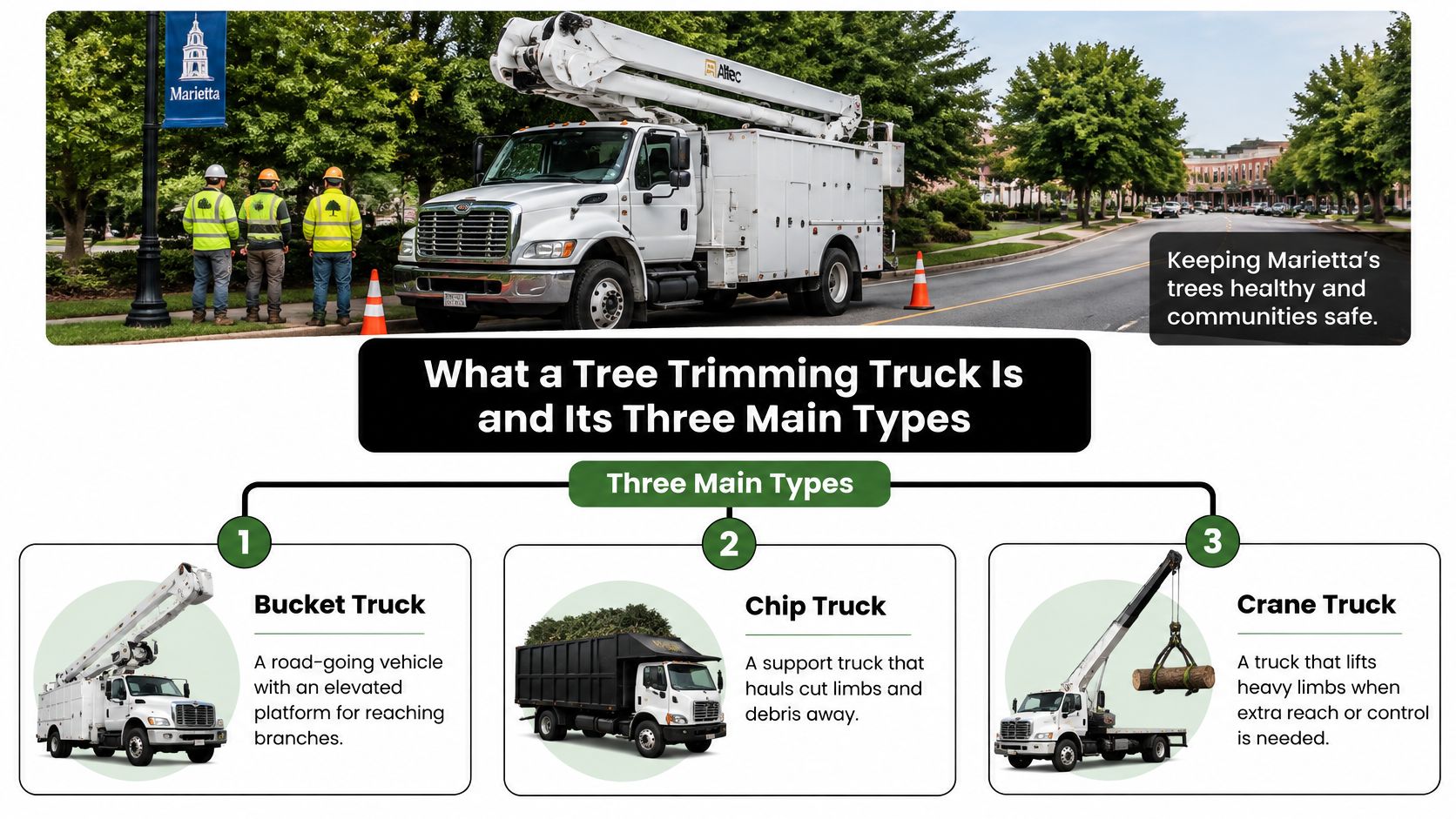
Most removals use more than one vehicle because reach, lifting, and cleanup are separate tasks. For detail on how those machines work together, review this overview of heavy equipment used in tree removal. If you want background on lift sizing from another trade, you can browse boom lift rental articles at https://www.getmywindowsclean.com/tag/boom-lift-rental/ for general context on platform height and setup space.
Before comparing quotes, ask which truck type the work calls for and whether your ground and access will accept it.
Site Access, Ground and Power Line Limits
A truck has to fit the site and stabilize safely before its boom can do useful work. Start with the ground. OSHA calls for the truck's brakes to be set and outriggers placed on pads or solid ground; the pads spread the load and help reduce settling and tip-over risk. A lawn that looks firm in dry weather may be soft after rain, and saturated soil or a drainage area can give way under an outrigger. On a slope, the crew also needs to control vehicle movement with appropriate measures such as wheel chocks.
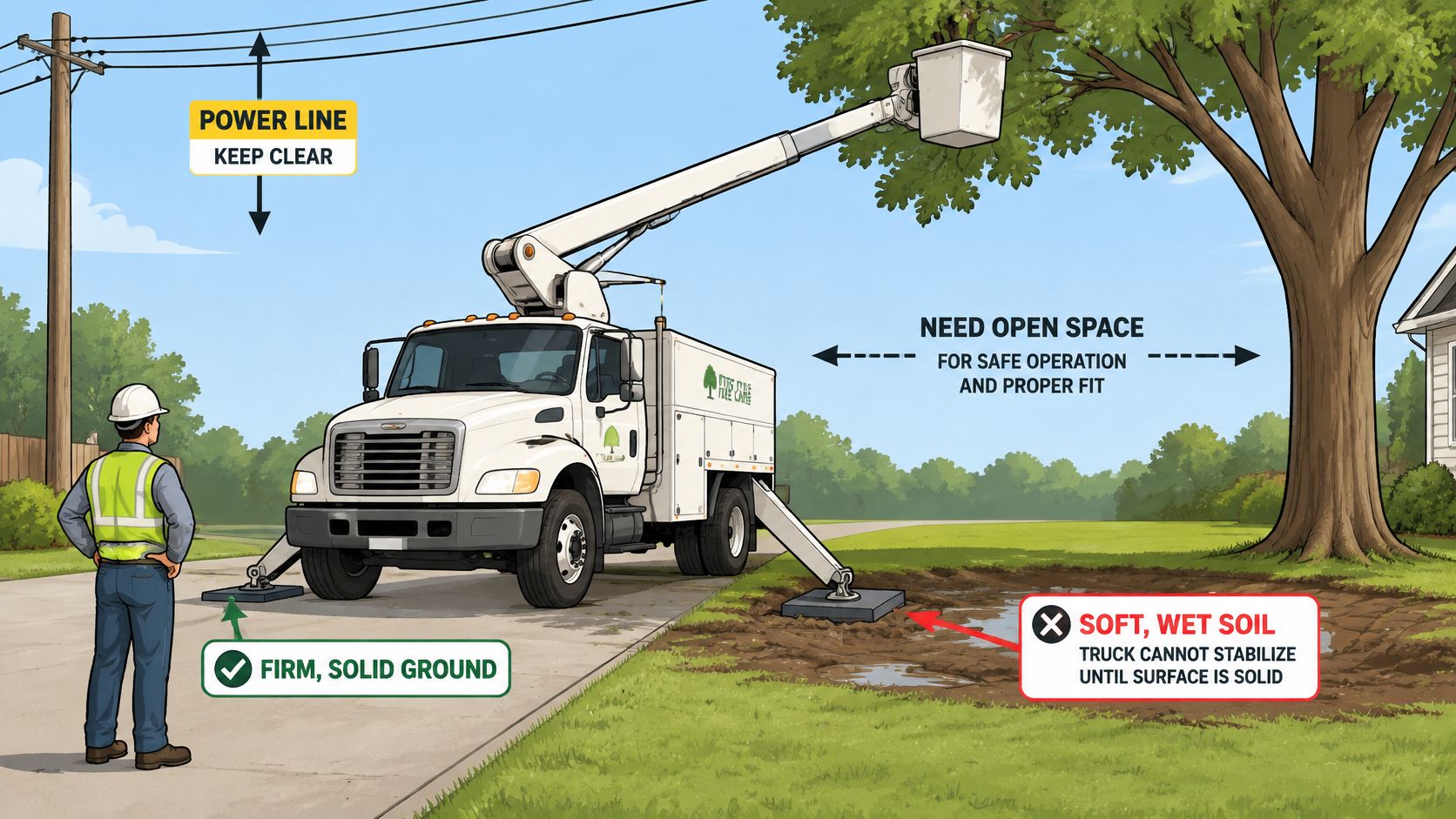
Access can rule out a truck
Measure the approach, not just the gate. A large truck may be unable to turn into a narrow driveway, pass between structures, or reach a backyard behind a fence. Even when it can park at the curb, the boom may not reach the tree at a safe working angle. In that situation, a compact lift or a climbing crew may be more appropriate than forcing a large truck into a poor setup.
The same trade-off applies to lawns and hardscape. A truck might reach the tree but still be a poor choice if the ground won't support the outriggers or the vehicle risks damaging the property. For equipment that operates on soft or uneven ground, rubber tracks for compact loaders offer a useful example of how tracked equipment differs from road-going trucks. For tree work near electrical hazards, see tree trimming near power lines.
Treat overhead lines as a hard limit
OSHA's general aerial-lift guidance identifies 10 feet as the baseline separation from energized lines, with greater clearance needed for higher voltages. Only qualified line-clearance tree trimmers may work closer, under the training, qualification, equipment, and operating conditions allowed by OSHA. A boom's insulation isn't something a homeowner should assume: OSHA says testing must follow ANSI A92.2 requirements, and an untested or failed boom is treated as non-insulating. Read OSHA's aerial-lift safety guidance.
Before positioning the truck, the crew should identify conductors and voltage where available, assess boom swing, and map the likely path of falling branches. Older neighborhoods in Marietta, Roswell, and East Cobb can have narrow setbacks that put equipment close to utilities. Kennesaw, Woodstock, Acworth, and Canton also have properties where tight lots complicate truck placement; nearby examples such as Cumming and Alpharetta face similar access considerations.
The homeowner's rule: Never ask a crew to cut a branch touching a power line. Keep clear and contact the utility.
How a Crew Works the Job Safely, Step by Step
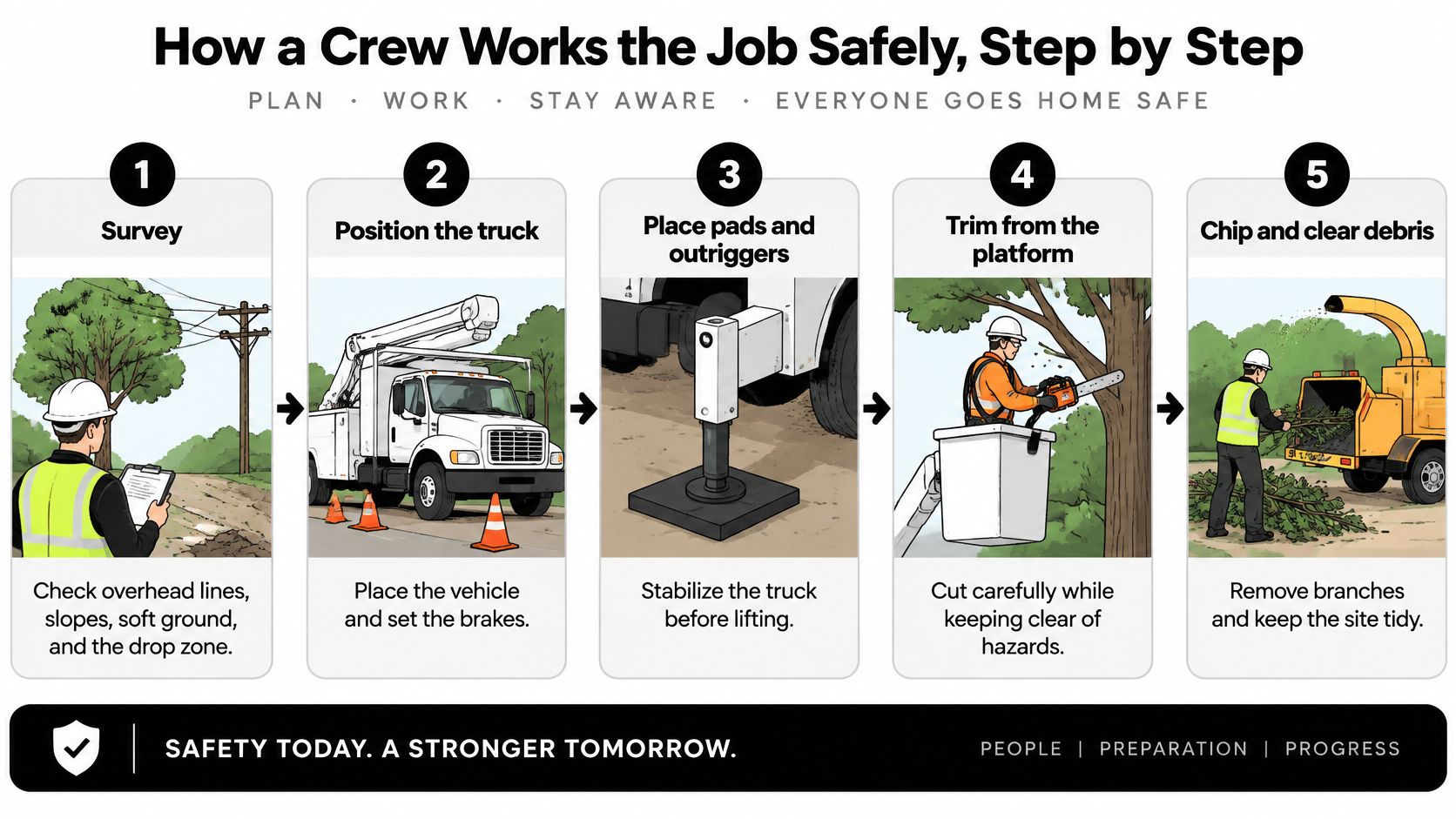
Safe work starts before the bucket leaves its cradle. A crew should follow a deliberate sequence so the truck, workers, and people nearby stay out of one another's way.
- Survey the site. Identify overhead lines, slopes, soft ground, structures, and the drop zone. This gives the crew a plan for where the truck can stand and where branches can safely come down.
- Position the truck and set the brakes. The truck needs a stable work position with enough room for the boom to move without entering hazards.
- Set outriggers on pads or solid ground. Proper support helps prevent the truck from settling or tipping as the boom moves.
- Run the daily control test. The operator checks the controls before relying on them aloft. OSHA also requires the boom to be secured in its travel position before highway movement.
- Raise the platform and prune from above. Workers use required fall protection, and the ground crew remains outside the marked drop zone.
- Lower limbs under control. Cutting a limb is only part of the job; the crew also has to manage where it goes. Heavy sections need equipment designed to lift them.
- Feed branches into the chipper truck. The chipper processes branch material for removal, but it doesn't lift workers or tree sections.
- Secure the boom before moving. The operator returns and secures the boom for travel before driving away.
A job may use a bucket truck, a chipper truck, and a crane together, but each vehicle has a different task. A bucket truck gets the arborist to the cut; the chipper clears branches; and a crane handles heavy sections when the work calls for lifting. OSHA specifically cautions that aerial lifts must not hoist tree sections unless designed for that use.
For additional context on safe operation of this equipment category, see TP Training's trailer-mounted EWP safety guidance.
Federal occupational-safety figures show why these controls matter. In an OSHA review, the Bureau of Labor Statistics recorded 637 fatalities in the tree-services and ornamental-shrubs industry sector between 1992 and 2002. For 1994–2007, falls from trees or bucket trucks accounted for 28% of fatal injuries, while workers struck by falling objects accounted for 29%. Together, those two categories represented 57% of reported fatal injuries in that period, according to OSHA's Federal Register review.
A truck's rated working height doesn't tell you whether a setup is safe. Stabilizing the vehicle, keeping it clear of hazards, managing electrical exposure, and preventing people from entering the drop zone matter just as much. A useful curbside check includes cones or barricades, a flagger when traffic or pedestrians need direction, clear signals between the operator and ground crew, and a pre-use inspection.
The homeowner's part is simple: keep children and pets well back, and stay clear when limbs come down. A video can also help explain what aerial-lift work looks like in practice:
Atlanta Permit Thresholds and Storm Removal Rules
In the City of Atlanta, private-property tree removal generally requires authorization, and specific size thresholds determine when a permit is required. The city offers a dead, dying, or hazardous tree permit application without a fee and requires tree work to be performed or directed by a certified arborist. These rules come from the City of Atlanta's tree-protection guidance.
| Tree situation | Permit or approval | What to do |
|---|---|---|
| Hardwood, 6 inches or more in diameter, private property | Permit required | Apply for a dead, dying, or hazardous tree permit, which carries no fee |
| Pine, 12 inches or more in diameter, private property | Permit required | Use the same application and have a certified arborist direct the work |
| Any tree on public property | Covered by city rules | Contact the city before any cutting |
| Fallen tree after a storm | No permit needed | Photograph the failure before removal |
| Standing tree judged imminently dangerous | Authorization from the Arborist Division | Call 404-330-6874, document with photos, and submit the application within 5 business days |
A fallen tree and a standing hazardous tree are not the same permitting situation. Atlanta's storm guidance says a fallen tree needs no permit, but the owner should photograph the failure before removal. If a standing tree is judged imminently dangerous, contact the Arborist Division, document the danger with photos, and submit the completed Dead, Dying, and Hazardous application with photos within 5 business days. The city lists 404-330-6874 as the Arborist Division number. Follow the City of Atlanta's storm tree-removal guidance.
For a broader overview of local requirements, read about the tree preservation ordinance. Marietta, Roswell, and other North Metro Atlanta suburbs set their own rules, so confirm requirements with the local office before cutting.
For a standing tree, look for a leaning trunk with lifting or cracked soil at its base, large trunk cracks or cavities, fungal growth at the base, or a thinning or dead canopy. These are warning signs, not a permit decision by themselves. Have a certified arborist assess the tree and confirm whether the hazardous-tree process applies.
When it's safe to do so, take photos before removal. Documentation helps distinguish storm cleanup from a standing-tree hazard and supports the correct next step.
What Homeowners Should Expect When a Crew Arrives
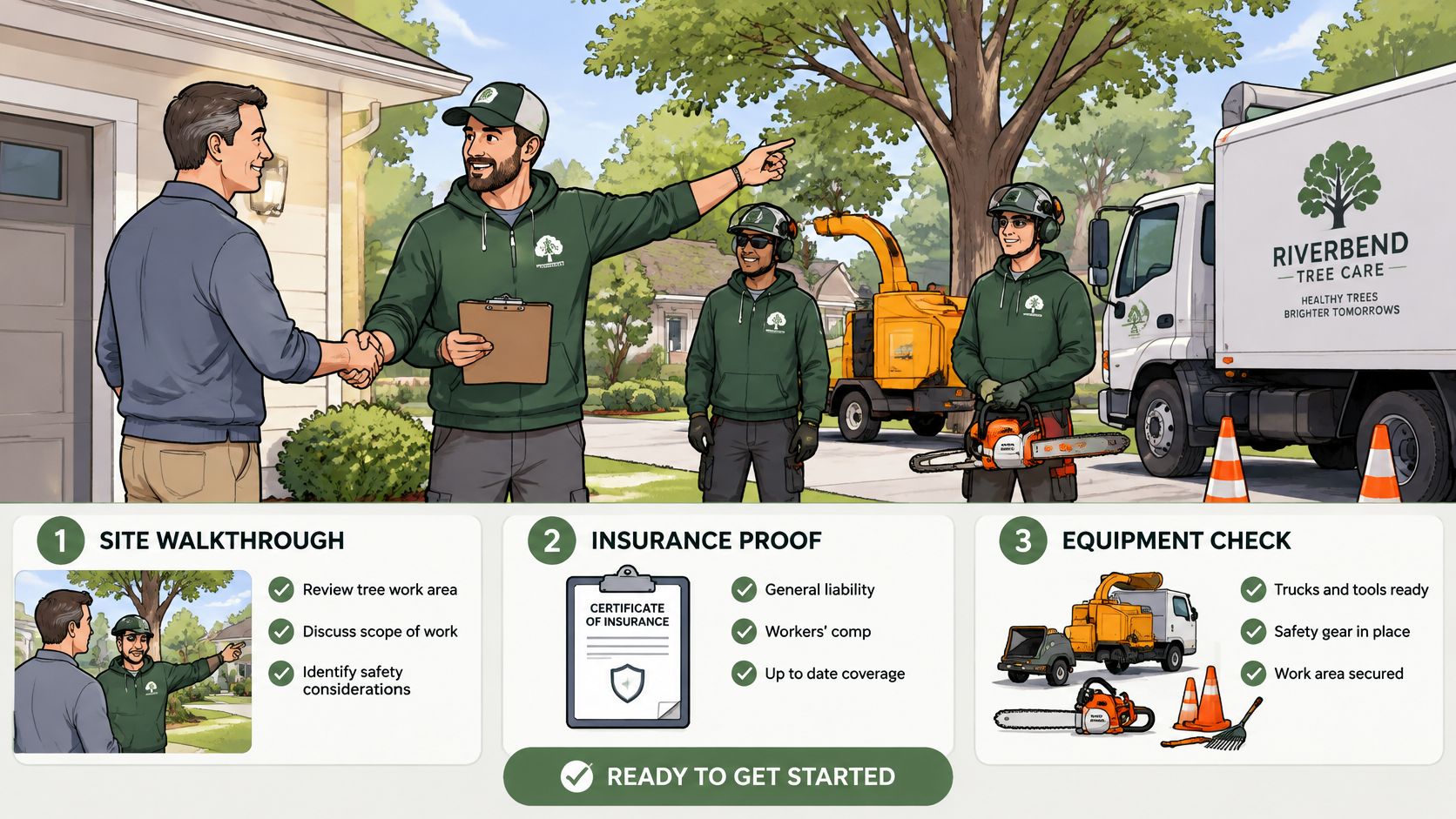
Before work starts, the crew lead should walk the site with you. Confirm the scope, credentials, and how the crew plans to protect the property.
- Site walk: The crew lead reviews the tree, access, nearby structures, and the work area with you.
- Insurance and licensing: Ask to see proof before work begins.
- Arborist assessment: Confirm that an ISA Certified Arborist has looked at the tree.
- Written scope: Make sure it explains what will be cut and what will remain.
Good tree pruning is more than making a clean-looking cut. Cuts should be made just outside the branch collar, the swollen area where a branch joins the trunk. Cutting into the collar can allow decay to expand into the main stem; flush cuts remove protective trunk tissue, while long stubs shouldn't be left behind. Municipal guidance also warns against topping, excessive lifting, and lion-tailing. Topping can promote weak shoots that are more likely to become projectiles in storms. See the municipal guide to proper pruning techniques.
Consider a mature maple leaning over a Roswell roof. If the tree can remain, a bucket truck may let the crew prune the crown back from the roof with controlled cuts. If the tree needs removal, a crane-assisted approach may let the crew take the top in sections rather than drop heavy pieces toward the house. The right choice depends on the tree's condition, the space around it, and the safest way to handle each section.
At the end, the cut faces should be clean, the bark shouldn't be torn, and the lawn shouldn't be left littered with branches. Richmond Tree Experts GA crews protect the lawn and hardscape they work over and haul away every branch before leaving the job.
What Drives the Cost and How Fast Crews Respond
A backyard maple with clear driveway access and no line contact prices like routine pruning. A storm-damaged oak on a Kennesaw roof prices like a rigging job, with crane-assisted sections, traffic control, and a full cleanup. The truck required is only one variable.
Setup time moves the number fast. A bucket truck that can park curbside and reach over the lawn is quick. A tight lot in East Cobb or a soft yard after rain forces mats, a smaller setup, or a climb assist, and that adds labor hours. Overhead lines, permit paperwork, and whether stump grinding follows add more time. One municipal stump-grinding specification requires grinding to a minimum depth of 12 inches and securing utility locates before work, which is extra mobilization beyond cutting a stump flush.
Equipment cost sits behind those quotes too. A 2023 Palfinger ETC37IH bucket truck was listed at $169,500 in a 2026 Construction Equipment Guide listing (Construction Equipment Guide's bucket-truck listings). Fuel, insurance, maintenance, and a trained crew ride on top of that payment.
Response speed follows the same site logic. Emergency tree service covers storm damage, fallen trees on homes, or trees leaning dangerously. I recommend calling with the address, photos, curb and gate width, any downed or sagging lines, and whether a limb is touching the house. That detail lets dispatch send the right truck first.
Exact pricing and arrival times depend on an on-site assessment, because Richmond Tree Experts GA sets prices on site based on the tree's height, trunk diameter, what is underneath it, and how much room the crew has to work.
Confirm the Truck Fits Your Property Before You Book
A bucket truck that cannot set its outriggers is just traffic in your driveway. Reach matters less than setup. I recommend measuring first, then booking.
Start with ground and width. Note curb to driveway width, gate openings, tight turns, soft lawn areas, slopes, and septic or irrigation lines the crew must protect. Then look up. Mark overhead lines and flag any limb touching or close to a wire, plus whether the utility has been notified. A tight side yard in Roswell or a wet slope in Alpharetta will rule out a heavy truck faster than boom height will.
Match that detail to the tree work. Identify species and trunk size, routine pruning or storm damage, and whether stump grinding follows. Richmond Tree Experts GA checks the tree rule for each parcel before quoting and files whatever paperwork the job needs. The company offers emergency tree service, including storm damage response for fallen trees on homes and leaning trees that look dangerous.
Call 770-974-3964 to request an on-site assessment. The crew can evaluate access, ground, utilities, and tree condition to confirm which truck type and work plan fit the job.
Richmond Tree Experts GA provides tree removal, tree trimming and pruning, stump grinding, and emergency storm damage service across North Metro Atlanta. Call 770-974-3964 to request an on-site assessment, or visit Richmond Tree Experts GA to arrange service.

