

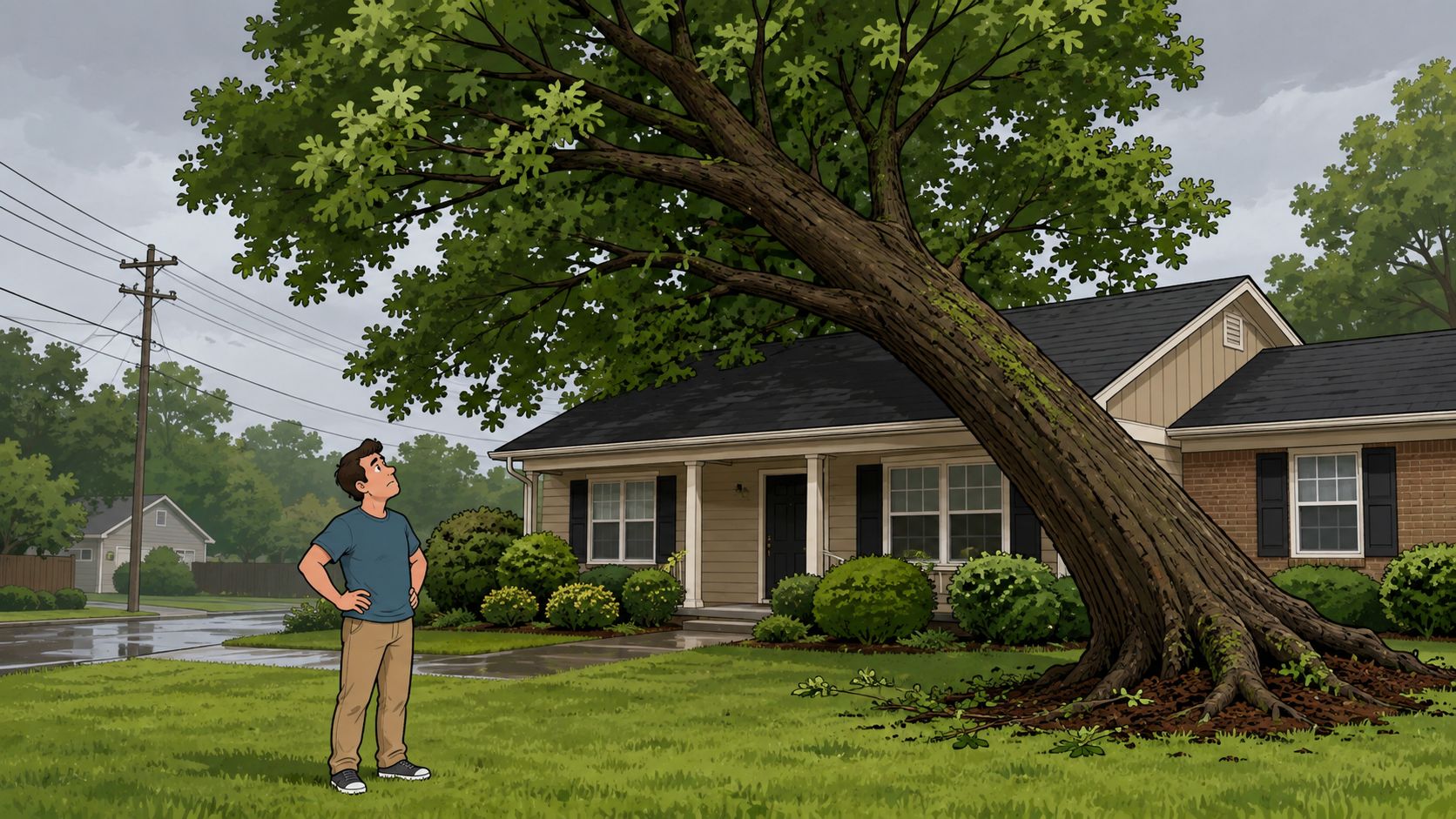
A homeowner in Marietta notices that a mature oak has developed a slight lean after a week of heavy rain. The tree still has a full canopy, and there's no obvious split in the trunk, but its upper branches reach over the roof and driveway. The question is immediate and practical: Is the tree dangerous, or is it just settling?
That question is harder to answer responsibly than a simple safe-or-dangerous verdict suggests. An arborist tree risk assessment considers the tree's structure, the likelihood that a part will fail, what lies beneath it, how often people use that area, and the likely consequences if failure occurs. Those details determine whether the right response is tree pruning, cabling, monitoring, emergency tree removal, or complete removal.
For homeowners and property managers across Marietta, Roswell, Kennesaw, Woodstock, Acworth, Canton, Cobb County, Cherokee County, and nearby North Metro Atlanta communities, that distinction matters. A mature canopy may be a major yard asset, but a weakened limb over a house, walkway, parking area, or play space creates a different responsibility than the same defect in an unused wooded corner. For broader property planning and design ideas, Atlanta landscape inspiration can also help homeowners think about how trees fit into the surrounding yard.
Why Tree Risk Assessment Matters for Atlanta Properties
A visual glance can identify obvious trouble, but it can't reliably tell you whether a defect is structurally significant or how much exposure exists below the tree. Tree risk is a combination of condition and consequence, not a label attached to the trunk by appearance alone.
The same defect can create different levels of risk
A dead limb over a rarely used woodland area may deserve pruning, but it doesn't carry the same consequence as a dead limb over a front entrance. An arborist considers target occupancy, failure likelihood, and the potential impact of the falling part. That approach helps separate a tree that needs scheduled care from one that requires an exclusion zone or urgent response.
North Atlanta properties face practical complications. Heavy rain can saturate soil around roots, storms can break hanging limbs, and trees near homes or utility infrastructure can create immediate access and safety problems. A fallen tree on a roof may also involve insurance documentation, blocked driveways, damaged fences, and difficult decisions about whether to preserve part of the tree or proceed with fallen tree removal.
Practical rule: Don't decide on removal from a single symptom. Have the assessor connect the defect to the target and site conditions.
The emotional cost matters, too. Removing a mature oak, pine, or tulip poplar changes shade, privacy, wildlife habitat, and the character of a property. A professional assessment can show when targeted tree pruning or tree trimming may reduce exposure, when monitoring is reasonable, and when hazardous tree removal is the safer option.
That same discipline applies after construction, grading, flooding, or storm damage. Root-zone disturbance may not produce an immediate canopy symptom, yet it can change anchorage and stability. A credible report gives homeowners, commercial property managers, architects, and real estate professionals a documented basis for action instead of relying on a rushed tree cutting service opinion.
Understanding ISA Standards and Assessment Levels
The International Society of Arboriculture's Tree Risk Assessment Best Management Practices is designed to help arborists assess risk consistently, evaluate the result, and recommend actions that bring risk to an acceptable level. ISA identifies the publication as a companion to the ANSI A300 Tree Care Standards, which gives professionals a recognized framework for documenting tree conditions and recommendations.
Three variables shape the rating
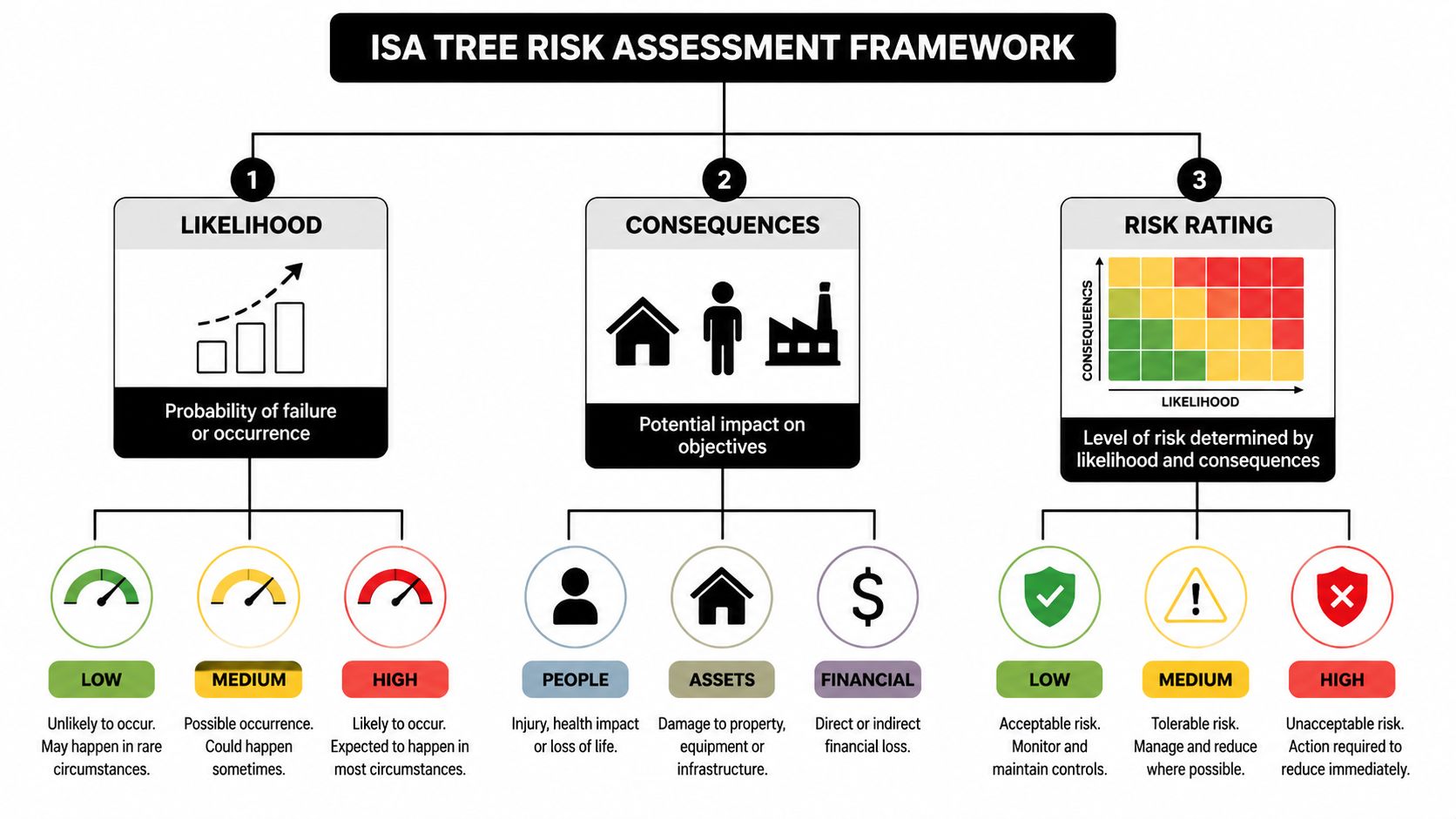
ISA-based tree risk work evaluates three connected questions:
- What is the likelihood of failure? The arborist examines defects such as decay, cracks, weak attachments, root problems, dead parts, or unusual architecture.
- What is the likelihood of impact? A falling part can only affect a target if it reaches an occupied or valuable area. The assessor considers houses, vehicles, roads, sidewalks, patios, play areas, and other targets.
- What are the consequences? The size and energy of the failing part, the value of the target, and the potential for injury or damage influence the final risk.
ISA's Basic Tree Risk Assessment form instructions describe the assessment as evaluating the likelihood of impact and consequences of failure. In practice, the assessor documents these elements separately instead of treating a visible defect as an automatic high-risk finding.
Assessment levels match the decision
A Level 1 assessment is a limited visual review, often useful for identifying obvious concerns across many trees or during a broad property survey. It isn't a substitute for a close inspection when a specific tree has a known defect.
A Level 2 assessment is a detailed ground-based inspection of the tree and its surroundings. This is the usual starting point for a residential concern involving a lean, cavity, dead limb, storm damage, or construction disturbance.
A Level 3 assessment uses advanced diagnostic methods for complex or borderline cases. It can help when the cost of removal is high, the tree has substantial ecological or aesthetic value, or visual inspection can't resolve the question.
Quantified Tree Risk Assessment, or QTRA, added a probability-based decision model to arboricultural risk work. The framework uses three independent components, target occupancy, likelihood of tree failure, and impact potential, and multiplies them to estimate the overall probability of death or serious harm. QTRA defines 1 in 10,000 as a benchmark threshold for acceptable public risk, with remedial action generally considered when risk exceeds that level, while risk at or below 1 in 1,000,000 may be classed as broadly acceptable, as discussed in ISA-published arboricultural literature.
For Atlanta property owners comparing providers, an Atlanta certified arborist should be able to explain the assessment level, evidence collected, limitations, and recommended next step in plain language.
The Step-by-Step Assessment Process
A professional assessment starts before anyone touches a chainsaw. An ISA Certified Arborist from Richmond Tree Experts GA begins with the property, not just the tree, because the surroundings determine whether a defect creates meaningful exposure.
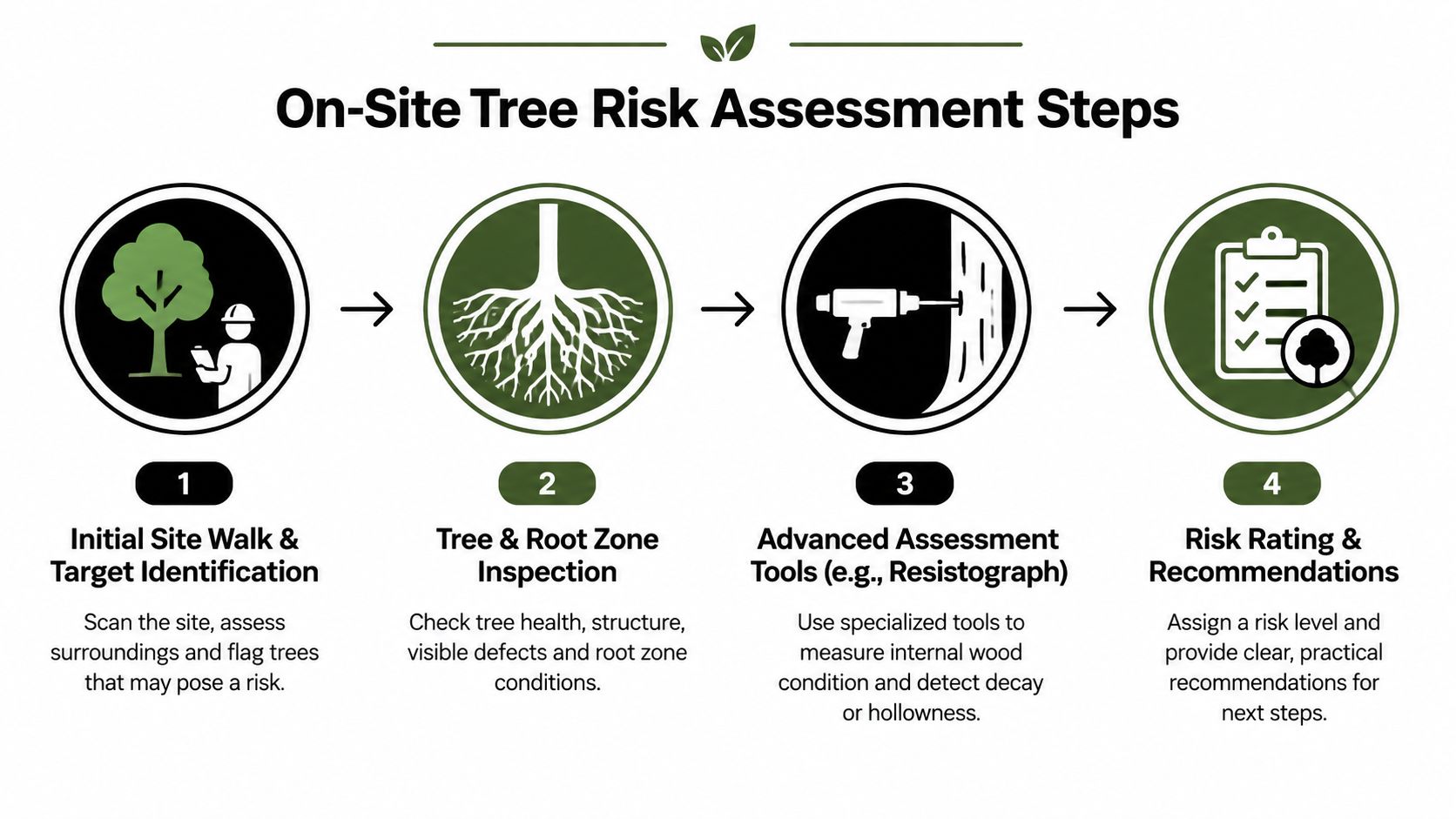
1. Establish the target and site conditions
The first walk identifies what could be struck if a branch, stem, or whole tree failed. The assessor notes homes, garages, fences, sidewalks, driveways, parking areas, roads, utility conflicts, gathering spaces, and high-traffic zones. They also look for recent grading, trenching, construction, flooding, soil changes, and storm impacts.
A tree leaning toward an empty rear boundary may require a different recommendation from one leaning toward a bedroom or frequently used driveway. This is why target identification comes before a final risk rating.
2. Inspect the root collar, trunk, and canopy
The arborist examines the root collar and surrounding soil for decay indicators, heaving, exposed roots, grade changes, poor drainage, and evidence of root-zone disturbance. The trunk inspection looks for cracks, cavities, seams, decay, missing bark, weak unions, and changes in taper.
The canopy review includes dead, broken, or hanging branches, poor attachment angles, included bark, uneven limb distribution, abnormal architecture, and signs of stress. Modern ISA guidance includes defect categories such as root-collar support loss, decay in roots, trunks, or structural limbs, cracks, weakly attached branches, dead parts, and unusual lean or taper. The assessor records the location and significance of each finding rather than writing “bad tree.”
3. Escalate when visual evidence isn't enough
Visual inspection is often appropriate, but it has limits. Hidden decay, internal hollows, and uncertain load-bearing capacity may require a resistograph, sonic tomography, or static load analysis. These tools aren't automatic upgrades for every tree. They make sense when a borderline finding could lead either to unnecessary removal or to retaining a tree without enough evidence.
Research has traced the field's movement from ground-based visual checks toward minimally invasive and quantitative tools, while also finding measurable relationships between failure and variables such as height, stem weight, age, and DBH. The same review found no clear relating factors for branch failure, which reinforces the need for judgment rather than a one-tool answer. A useful technical overview of construction-related safety practices is available in these CDM compliance tips for trades.
4. Report the finding and action
The final step connects evidence to a recommendation. That may include tree pruning, cabling, bracing, an exclusion area, follow-up monitoring, emergency tree removal, or complete removal. A strong report identifies what was observed, what remains uncertain, which targets are exposed, and what the owner should do next.
Risk Ratings Explained and What They Mean for Your Trees
Risk ratings are decision tools, not predictions of exactly what will happen. A report may use low, moderate, high, or extreme categories, but the meaning depends on the method, the assessor's training, the target, and the time period being considered.
A large dead branch over a wooded slope might receive a different rating from an identical branch over a busy driveway. The defect hasn't changed. The occupancy and consequence have. Site conditions also matter. Saturated soil, recent excavation, storm damage, or a target that stays occupied can increase urgency without changing the visible defect itself.
Use the rating to choose the response
| Risk Rating | What It Means | Typical Recommendation |
|---|---|---|
| Low | The documented condition and exposure indicate limited risk under the assessment conditions. | Monitor condition, maintain routine tree care, and reassess if site use or tree condition changes. |
| Moderate | A defect or exposure deserves planned action, but immediate removal may not be justified. | Consider targeted tree pruning, cabling, bracing, target relocation, or a defined monitoring interval. |
| High | The likelihood and consequence combination warrants prompt reduction of exposure. | Restrict access, reduce the affected crown where appropriate, complete corrective work, or remove the affected tree or part. |
| Extreme | The situation presents an urgent or unacceptable level of risk, especially where people or structures are exposed. | Establish an exclusion zone and arrange hazardous tree removal or emergency stabilization as soon as safely possible. |
A tree with defects can often be retained. Proper pruning may remove a hazardous branch, cabling may support a weak union, and monitoring may be sensible when the target is distant or occupancy is low. Those options only work when the arborist can explain why the intervention addresses the specific failure pathway.
Methodology matters because assessors trained under different frameworks have rated the same trees differently. A review of tree risk methods found that approaches generally consider failure potential, target occupancy, and consequences, while also identifying a need for more research into how methods compare as defects and targets change. A 2023 reproducibility study found that arborists trained under different frameworks rated the same trees differently, with one group less likely to classify trees as “high” or “extreme” risk, as reported in Arboriculture & Urban Forestry.
Ask the assessor which framework was used, what uncertainty remains, and why the recommendation follows from the findings. If cabling is proposed, review the scope of tree cabling and bracing services alongside inspection and follow-up requirements.
Atlanta-Specific Factors That Influence Tree Risk
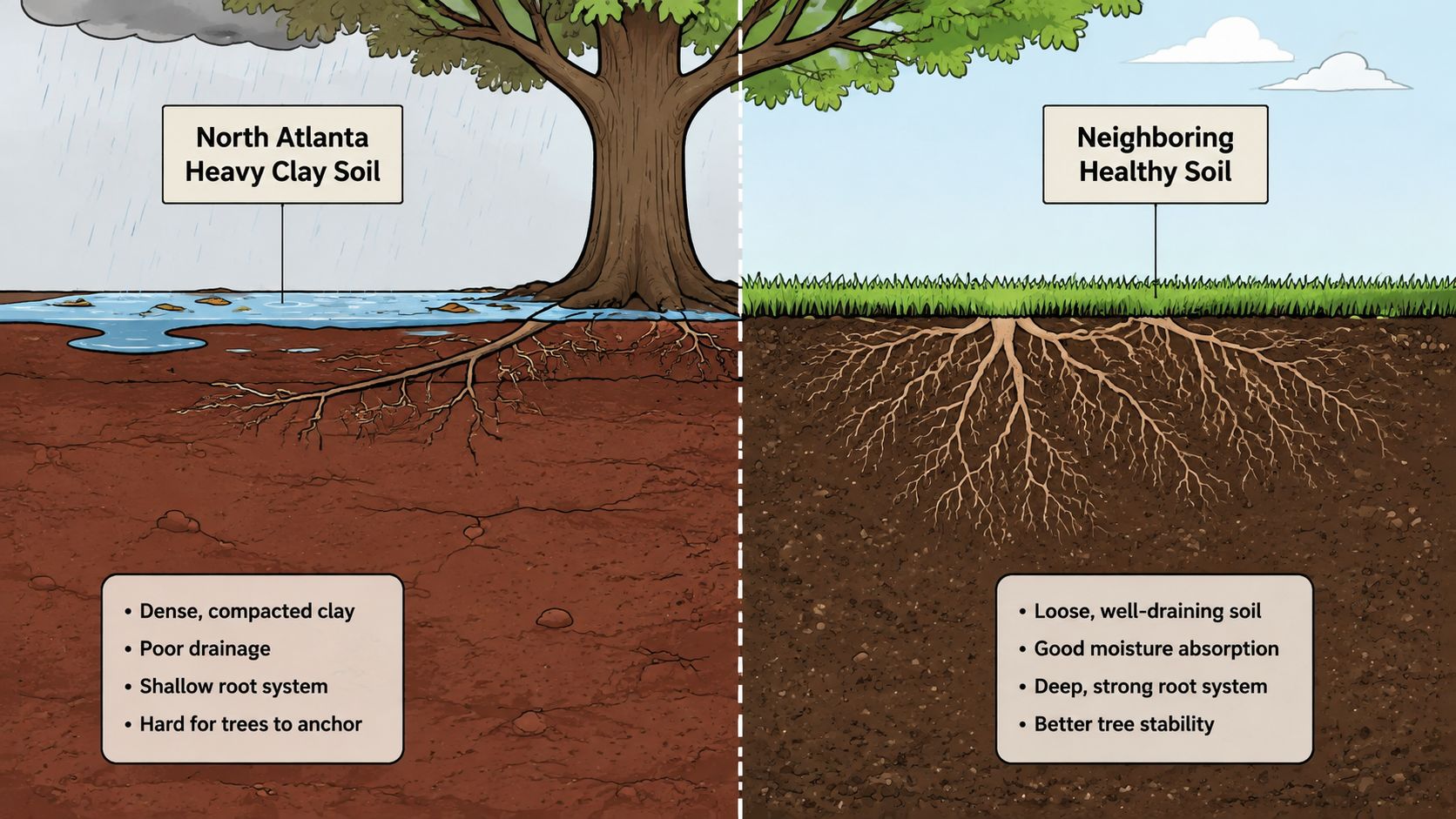
North Metro Atlanta trees grow in conditions that can change quickly. Heavy clay soils may hold water around the root zone during wet periods, while intense summer thunderstorms can load crowns with wind and rain. The same tree may appear stable during a dry inspection but deserve closer attention after saturation, grading, flooding, or a major storm.
Soil and species change the assessment
Clay can restrict root development and drainage, especially where construction has compacted the soil. Root anchorage depends on more than what is visible above ground, so an arborist checks the root collar, soil grade, drainage, and nearby disturbance rather than judging stability from the canopy alone.
Species also influence the questions an assessor asks. Water oaks may have brittle wood, pines can be vulnerable to root rot, and tulip poplars may develop limb-drop concerns. Those are not automatic removal decisions. Species characteristics are part of the context, while the actual rating still depends on observed condition, failure likelihood, target exposure, and consequences.
Local biological pressures add another layer. Ambrosia beetles, pine beetles, and root-rot pathogens can weaken trees internally or reduce vigor, making a close inspection more important when there are boring dust signs, crown decline, fungal growth, dead bark, or sudden canopy changes.
Ordinances affect removal decisions
Atlanta's tree ordinance generally requires an approved replacement plan before a permit can be issued to remove, destroy, or injure a living, non-hazardous tree, subject to the ordinance's requirements. Hazard exceptions can apply to trees that are imminently dangerous, close enough to endanger buildings, or determined hazardous by a city arborist, as described in the Atlanta tree ordinance and related Georgia guidance.
Permit rules can differ by municipality, so homeowners in Marietta, Roswell, Alpharetta, Cumming, Johns Creek, Milton, Kennesaw, Woodstock, Acworth, Canton, Forsyth County, East Cobb, Cobb County, Gwinnett County, and Cherokee County should confirm local requirements before scheduling non-emergency tree removal. Yard planning also includes protecting young trees from browsing pressure, and this calm guide to deer repellent offers general context.
What an Arborist Tree Risk Assessment Costs
Pricing should reflect the scope of the decision, not just the time spent looking at one trunk. A standard residential Level 2 assessment is usually priced as a site visit and report, while a property with multiple trees, difficult access, or complex targets requires more inspection and documentation. Ask for a written estimate before work begins.
What changes the price
- Number of trees: Reviewing a single tree differs from assessing an entire residential canopy or a commercial property.
- Property size: Large lots and campuses require more walking, target mapping, and reporting.
- Access and safety: Fences, steep slopes, dense understory, traffic, structures, and utility conflicts can make inspection more involved.
- Diagnostic testing: Resistograph drilling, sonic tomography, or static load analysis can add cost when visual evidence doesn't resolve the decision.
- Report requirements: Real estate transactions, insurance files, development planning, and commercial risk programs may need more detailed photographs, maps, and recommendations.
A typical assessment fee may include the on-site inspection, photographs, a written report, risk ratings, and prioritized recommendations. Follow-up inspections, monitoring visits, advanced diagnostics, permit assistance, tree trimming, tree pruning, tree removal, stump grinding, stump removal, and storm damage tree cleanup are commonly scoped separately.
Commercial property managers should expect a different proposal for a multi-building complex, retail site, office campus, or managed community. The arborist may organize the work by zones, occupancy patterns, tree populations, and maintenance priorities rather than treating every tree as an isolated residential request.
Richmond Tree Experts GA offers free estimates, competitive pricing, and financing options, but homeowners should still compare the scope of each estimate. A low quote that excludes the written report or overlooks target occupancy may not answer the decision you need to make. A thorough assessment can prevent an avoidable emergency tree removal call, but it can't guarantee that a tree will never fail.
Homeowner and Property Manager Warning Sign Checklist
Use this checklist as a screening tool, not a substitute for an on-site assessment. Mark yes when you observe a condition, then keep people and vehicles away from the potential failure zone until an arborist evaluates it.
At the base and root zone
- Heaving soil: Is soil lifting or cracking near the trunk?
- Exposed roots: Are major roots exposed, cut, decayed, or damaged?
- Fungal growth: Are mushrooms or conks appearing at the base or near major roots?
- Grade changes: Has construction, fill, trenching, or grading altered the soil around the tree?
- Saturated ground: Has heavy rain left the root zone waterlogged or unstable?
On the trunk
- Cracks or seams: Can you see deep vertical cracks, open seams, or separated wood?
- Cavities and decay: Are there hollow areas, soft wood, or decay indicators?
- Missing bark: Has bark fallen away from a major section of the trunk?
- Lean: Is the tree leaning newly, worsening, or toward a home, road, or occupied area?
- Weak unions: Do major stems meet with included bark or an unusually narrow attachment?
In the canopy
- Dead branches: Are large dead limbs positioned above a target?
- Broken or hanging parts: Is any branch suspended, split, or caught in the canopy?
- Thinning foliage: Has the crown become noticeably sparse?
- Premature leaf drop: Did the tree lose leaves earlier than surrounding trees?
- Uneven architecture: Are major limbs heavily weighted to one side?
Schedule a professional evaluation after a major storm, nearby tree failure, construction near the root zone, or a significant change in the tree's appearance. If a tree hasn't been inspected in over two years, an updated review can establish a useful baseline, especially where the property has high occupancy.
Frequently Asked Questions and Next Steps
How often should trees be assessed?
There isn't one interval that fits every property. Reassess after major storms, construction, flooding, visible changes, or a nearby tree failure. Higher-occupancy sites and trees with known defects may need a defined monitoring schedule.
Can a defective tree be saved?
Often, yes. Targeted tree pruning, cabling, bracing, exclusion, or monitoring may reduce risk. Removal becomes more appropriate when the remaining risk can't be reduced to an acceptable level, the tree is imminently dangerous, or the failure zone includes an important occupied target.
How is an assessment different from a health inspection?
A health inspection focuses on vigor, pests, disease, and treatment needs. A tree risk assessment focuses on failure, impact, consequences, and recommended risk reduction, even when the tree appears healthy.
How quickly can a crew respond?
Response depends on access, storm conditions, hazards, and crew availability. For a tree on a structure, blocking access, or threatening an occupied area, tell the scheduler that it's an emergency and keep clear of the site.
Do I need a permit for dangerous tree removal in Atlanta?
Atlanta's ordinance includes hazard exceptions, but the specific facts matter. Confirm the applicable local rule before removing a non-emergency tree, and document an imminent hazard with a qualified assessment when possible.
For scheduling, contact Richmond Tree Experts GA through its tree risk assessment service. Have the property address, the number and location of concerning trees, photos if safe to take them, and details about recent storms, construction, leaning, or fallen limbs. Richmond Tree Experts GA states that its ISA Certified Arborists and licensed, insured crews serve North Atlanta, with a company history dating to 1985, including Marietta, Roswell, Alpharetta, Cumming, Johns Creek, Kennesaw, Woodstock, and surrounding areas. The visit should clarify whether you need monitoring, tree trimming, pruning, a tree cutting service, stump work, land clearing, storm cleanup, or hazardous tree removal.
Richmond Tree Experts GA provides ISA Certified Arborist tree risk evaluations, written recommendations, emergency tree removal, storm damage tree cleanup, stump grinding, and related tree services for North Atlanta properties. Visit Richmond Tree Experts GA to request an assessment or free estimate, and share any recent storm damage, construction activity, or tree movement so the team can help prioritize the safest next step.

