

Thinking about burning that old tree stump? On the surface, it seems like a straightforward, rustic way to clear your yard. But from my experience, the reality is a whole lot more complicated. It’s a long, unpredictable, and potentially dangerous process that rarely gives you the clean slate you're hoping for.
Honestly, for most homeowners, the time, risk, and often disappointing results just don't stack up against modern alternatives.
Is Burning a Stump Actually a Good Idea?
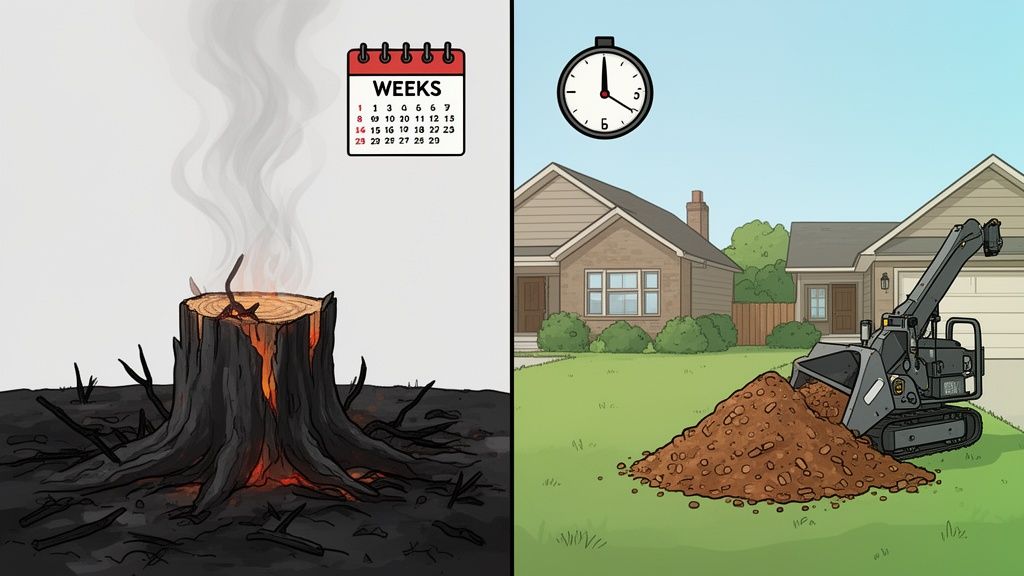
Before you start piling up firewood, let's look past the initial appeal of a DIY fire pit. Burning a stump isn't a quick weekend project; it's a slow-burn commitment that can easily drag on for days or even weeks. A stump doesn't just go up in flames and vanish. It smolders. And smolders. Requiring constant babysitting to make sure the fire doesn’t get out of hand.
Picture this: you're tending to a low-grade fire for a week straight, hoping it finally chews its way through the core of the stump. This slow, tedious burn is incredibly inefficient. More often than not, the fire fizzles out long before it reaches the deep, sprawling root system. You’re then left with a charred, ugly mess that’s even more of a pain to deal with than the original stump.
The Timeline and Effort Involved
The sheer time investment is one of the biggest turn-offs. A medium-sized oak or pine stump can take anywhere from 7 to 14 days to burn through—and that's if everything goes perfectly. During that entire time, you have to stay vigilant, managing the embers and keeping the fire contained.
When you put that up against professional methods, the choice becomes pretty obvious.
A professional with a stump grinder can turn an entire stump and its main root ball into mulch in less than an hour. Suddenly, weeks of your own effort and risk don't seem like such a great trade-off for a quick, guaranteed solution.
This drawn-out process also introduces some serious risks that homeowners in places like Roswell and Alpharetta might not think about at first.
Hidden Dangers and Unseen Consequences
An out-of-control surface fire is the obvious risk, but the hidden dangers are just as real. A smoldering stump can burn its way down into the root system, continuing to smolder underground long after you think the fire is out. These "zombie fires" can pop back up days later, potentially igniting your fence, your shed, or other landscaping.
Beyond the fire risk, there are other consequences to consider:
- Air Quality: The smoke from that smoldering stump is pumping carbon and fine particulates into the air, affecting you and your neighbors. In metro areas like Cobb and Gwinnett County, this can be a real nuisance and contribute to local air pollution.
- Incomplete Removal: Most of the time, a DIY burn won't destroy the whole root network. The roots left behind can attract pests like termites and ants or just lead to frustrating new sprouts popping up later on.
- Legal Headaches: Many towns and cities have strict burn bans. If you light up without checking the local ordinances in places like Cumming or Johns Creek, you could be looking at some hefty fines.
When you weigh the pros and cons, the decision gets a lot clearer. To help you compare the details, we've put together a table below. You can also explore our detailed guide on stump grinding vs removal, which breaks down the costs, timelines, and results for each method. It’s all about making an informed choice for your property's safety and your own peace of mind.
Burning a Stump vs Professional Grinding Quick Comparison
Deciding between a DIY burn and professional help? This table lays out the key differences to help you see why one is a weekend chore and the other is a multi-week gamble.
| Factor | DIY Stump Burning | Professional Stump Grinding |
|---|---|---|
| Time Commitment | Days to weeks of slow burning and constant supervision. | Typically under 1-2 hours from start to finish. |
| Effectiveness | Often incomplete; leaves behind charred wood and deep roots. | Complete removal of the stump down to below ground level. |
| Safety Risks | High risk of uncontrolled fire, underground smoldering, and smoke. | Minimal risk; handled by insured professionals with safety gear. |
| Cost | Low initial cost for materials, but potential for high costs from fines or damages. | Upfront cost, but predictable and includes cleanup. |
| Final Result | A burnt, messy hole; may require further work to clean up. | A clean area filled with mulch, ready for new landscaping. |
| Environmental Impact | Releases smoke and particulates into the air for days. | Minimal impact; engine emissions for a short duration. |
As you can see, while the idea of a "free" removal is tempting, the reality is that professional stump grinding delivers a faster, safer, and more complete result every single time.
Navigating Burn Laws in the Atlanta Metro Area
Thinking you can just light up a fire in your backyard is one of the costliest assumptions a homeowner can make, especially when it comes to a project as big as burning a stump. Here in Georgia, open burning regulations are no joke, and the rules can shift dramatically from one county line to the next. What might be perfectly fine in a rural patch of Cherokee County could be flat-out illegal in a denser suburb like Johns Creek or Marietta.
Before you even think about buying charcoal lighter fluid, your very first job is to get a handle on the specific laws for your property. These aren't just friendly suggestions; they're enforceable rules with some hefty penalties attached.
Your First Call Is to the Local Fire Marshal
Your path to doing this the right way starts and ends with your local fire department or county fire marshal's office. This step is completely non-negotiable. These are the folks who issue permits, call burn bans, and enforce the rules on the ground.
For instance, if you live in Forsyth County, you have to check their specific fire safety ordinances, which can be quite different from what your friend deals with over in Gwinnett or Cobb. These offices have the most up-to-date information, which is critical because the rules can change with the weather.
- Forsyth County Fire Department: They’re known for having clear guidelines on residential burning. You'll need to hit their website or call to find out the current burn status.
- Cobb County Fire and Emergency Services: They often have very detailed requirements about setbacks—that’s how far the fire has to be from your house or fence—and what you're even allowed to burn.
- Gwinnett County Fire and Emergency Services: As a heavily populated county, their rules are particularly strict to protect air quality and safety. You’ll almost certainly need a permit for anything bigger than a small campfire.
- Cherokee County Fire & Emergency Services: Even in the more rural parts of Cherokee, they still enforce state laws and can put their own bans in place when conditions get dry.
Never assume the rules are the same as they were last year or even last month. A five-minute phone call or a quick check of a website can save you from a world of trouble.
Understanding Seasonal Burn Bans
Georgia gets dry, especially from spring into late fall, and that sends the risk of wildfires through the roof. To combat this, the Georgia Environmental Protection Division (EPD) puts a statewide summer burn ban into effect every year.
This ban typically runs from May 1 through September 30. It covers 54 metro Atlanta counties, including all the areas we work in like Forsyth, Cobb, Gwinnett, and Cherokee. While the main goal is to keep ozone levels down during the hottest months, it's also a crucial fire prevention measure.
Let's be clear: trying to burn a stump during a mandated burn ban is a guaranteed violation. Fines for ignoring these bans can climb from hundreds into thousands of dollars, depending on how serious it is and which county you're in.
And that statewide ban is just the baseline. The local fire marshal in a city like Milton, Alpharetta, or Roswell has the authority to issue their own, even stricter bans if local conditions get too dry, even if it's outside that May-to-September window. You absolutely have to check both state and local restrictions.
Permits, Fines, and Other Headaches
Even when there isn’t an active burn ban, you’re almost certainly going to need a permit. How you get one varies. In some places, it’s as easy as filling out an online form or calling to get a burn permit number for the day. In others, especially for something as involved as a stump fire, they might require an on-site inspection. Permitting issues can get complicated, but you can learn more about the local red tape in our guide covering the tree removal permit process in Atlanta.
The financial and legal risk of getting this wrong is huge. If your fire gets out of control and damages your neighbor’s property, you are on the hook for every penny of the damage. We’re talking about paying for new fences, landscaping, or even house repairs—costs that can skyrocket into the tens of thousands and are rarely covered by your homeowner's insurance if you were breaking the law. The fine from the county is just the start; it's the civil liability where the real financial nightmare begins.
A Practical Guide to Burning a Stump Cautiously
So, you've jumped through the hoops with the local laws in places like Milton or Roswell, you've got your permit, and you're still set on burning that stump. Now, your focus needs to shift entirely to safety. This isn't a weekend bonfire. Burning a stump is a slow, methodical process that demands your full attention, often for days at a time.
Success all comes down to careful prep work and constant watchfulness. Before you even think about striking a match, it's wise to understand how to conduct a thorough risk assessment to spot any potential hazards. Keeping that safety-first mindset will guide you from clearing the site to putting out the very last ember.
Assembling Your Tools and Materials
Having the right gear ready isn't just about making the job easier—it's your first and best defense against something going wrong. Don't even start this project until you have everything you need laid out and within easy reach.
Here's what you absolutely must have:
- A Reliable Water Source: This is non-negotiable. A garden hose that can easily reach the stump, already connected and pressurized, is your primary tool. A few five-gallon buckets of water are a decent backup, but they shouldn't be all you have.
- Shovels and a Rake: You'll use these to clear the area around the stump, dig a containment trench, and manage the hot coals throughout the burn. A flat-head shovel is especially good for smothering any small flare-ups.
- A Power Drill with a Long Bit: You'll need a 1-inch spade or auger bit that's at least 10-12 inches long. This is for drilling the ventilation holes that help the stump burn from the inside out.
- Potassium Nitrate or Stump Remover: This chemical works by breaking down the wood fibers, making the stump much more porous so it can smolder effectively. Steer clear of dangerous accelerants.
Crucial Safety Warning: Never, ever use gasoline, diesel fuel, or any other volatile accelerant. They can cause explosive flare-ups that lead to serious injuries and out-of-control fires. Only use products specifically made for stump removal.
This flowchart lays out the essential legal and safety steps you must take before you start.

As you can see, checking the rules and securing a permit are mandatory first steps. Only then can you move on to the actual process of burning the stump safely.
Preparing the Stump and Surrounding Area
Proper site prep is where you stop most disasters before they can start. The goal here is to create a sterile, non-flammable bubble around that stump. Don't rush this part; cutting corners here is just asking for trouble.
Start by clearing everything away from the stump. You need to create a minimum 15-foot radius of nothing but bare dirt. Rake away every leaf, twig, pine straw, patch of dry grass, and anything else that could catch a spark. A single ember landing on dry pine straw is how many of these fires get out of hand.
Next, grab a shovel and dig a shallow trench—a "containment pit"—around the base of the stump. It only needs to be a few inches deep. The whole point is to catch coals and embers as the stump burns down, keeping them from rolling out into your cleared zone.
Drilling for an Effective Burn
A stump won’t just burn on its own from the outside in. The trick to a complete burn is getting heat and oxygen into the very core of the wood. That's where your power drill comes in.
Using that long auger or spade bit, drill a series of holes straight down into the top of the stump. Space them a few inches apart and go as deep as you can—at least 8-10 inches. Then, drill more holes horizontally into the sides, trying to connect them with the bottom of the vertical holes. This creates a network of tunnels that will act like a chimney, pulling air through the stump to feed the smoldering fire inside.
With the holes drilled, it's time for the potassium nitrate or stump remover granules. Pour the chemical into each of the vertical holes, filling them up. Next, carefully add hot water to dissolve the granules. This helps the solution soak deep into the wood fibers. This isn't an instant process; you need to let the stump sit and absorb the chemical for at least a week, sometimes even longer, for it to really work.
Managing the Slow Burn
Once the stump is fully saturated with the chemical, you're ready to start the burn. Place charcoal briquettes in the holes you drilled and across the top of the stump. Light the charcoal—don't pour lighter fluid directly on the wood itself. The charcoal will provide a steady, low heat that will slowly ignite the chemically treated stump.
This is where your patience is truly tested. The stump isn't going to erupt in flames. It will begin to smolder very slowly, a process that can take several days to over a week to complete. During this entire time, the fire needs constant supervision.
- Check on it frequently: Never leave your property while the stump is smoldering.
- Manage the embers: Use your shovel to gently nudge any falling embers back toward the base of the stump and into your containment pit.
- Be ready for flare-ups: Keep your hose handy. If any flames get too big, gently douse them. You're aiming for a smolder, not an open fire.
Extinguishing and Final Cleanup
After the stump has burned down as far as it's going to, you've reached the final, critical step: making sure it is 100% extinguished. This takes more than a quick spray with the hose.
Soak the entire area generously, using your shovel to turn over the ash and coals to expose any hidden hot spots underneath. A fire can smolder underground in the root system for days after you think it's out. Keep soaking and checking the area for at least 24 hours, looking for any wisps of smoke or feeling for heat. Once you are absolutely certain it's cold to the touch, you can scoop the ash and charcoal into a metal bucket for safe disposal.
The Hidden Risks of Stump Fires
When you picture burning a stump, the first thing that probably comes to mind is an escaped flame catching the lawn or fence on fire. And while that's a very real concern, the risks run much deeper.
The real trouble lies in the less obvious consequences—the kind of problems that impact your health, property, and local environment in ways most people don't consider until it's far too late.
More Than Just a Campfire
One of the most immediate yet overlooked hazards is the smoke itself. This isn't the pleasant, crackling aroma of a campfire. It's a thick, acrid plume of chemicals and particulates from wood that smolders slowly for days. That smoke doesn't just dissipate; it hangs in the air, drifting over to your neighbors' yards in communities like East Cobb or Roswell.
Inhaling that kind of wood smoke can trigger serious respiratory issues, especially for children, the elderly, or anyone with asthma. The fine particulate matter gets deep into the lungs, creating health problems that simply aren't worth the "savings" of a DIY burn.
The Problem with a Partial Burn
Here’s a frustratingly common outcome: the fire goes out too soon. More often than not, the flames will burn through the visible part of the stump but never manage to penetrate the massive, water-logged root system below. The fire dies, and you're left with a charred, ugly mess that’s even harder to deal with than what you started with.
Worse, that partially burned, softened wood creates the perfect new home for pests. You’ve basically put out a welcome mat for:
- Termites: They are drawn to decaying wood that’s in direct contact with the soil.
- Carpenter Ants: These destructive pests love excavating moist, softened wood to build their nests.
- Other Wood-Boring Insects: A whole host of beetles and other pests will gladly take up residence.
Suddenly, you've swapped a dormant stump for an active pest colony right in your yard, creating a direct threat to your home’s foundation.
But the frustration doesn't stop there. An incomplete burn means the root system is still very much alive. It’s incredibly common to see new sprouts and suckers popping up around the burn site months later, forcing you to start all over again.
This cycle highlights just how inefficient the whole process is. You can spend days supervising a fire only to be left with the same problem you tried to solve.
Environmental and Financial Blowback
The damage extends beyond your property line. A smoldering stump fire releases carbon into the atmosphere for days, contributing to local air pollution. Any fertilizers or chemicals you've used on your lawn over the years can also be released into the smoke or leach into the soil, contaminating the very ground where you might want to plant a garden or lay new sod.
The financial risks are just as sobering. While burning was a popular method in rural areas back in the 1970s, it now accounts for less than 10% of stump removals because of the inherent dangers.
Stump burn-related fires cause an estimated $50 million in property damages every year across the country. In 2023 alone, Georgia saw 180 such cases, a number made worse by our increasingly dry seasons.
Think about it: a DIY burn can take 7-14 days of constant watching and still has a 30% failure rate. It’s no surprise that the global market for stump grinders is projected to hit USD 812.5 million by 2035, as homeowners and businesses from Marietta to Forsyth County demand safer, more effective solutions. You can discover more insights about this growing market and what it means for modern landscaping.
Ultimately, the hidden risks—from health issues and pest infestations to environmental harm and staggering potential liability—paint a very clear picture. Burning a stump is a high-stakes gamble with a poor payoff, making professional, mechanical methods a much smarter and more responsible choice.
Why Professionals Offer a Better Solution
Sure, the appeal of a weekend DIY project is hard to ignore, but some jobs are just better left to the pros. Burning a stump is a perfect example of this. It’s a gamble against time, safety, and effectiveness—a weeks-long ordeal where you’re never quite guaranteed a good result.
That’s where the benefits of calling in a professional really shine. Instead of babysitting a smoldering fire for weeks on end, you get a clean, immediate solution. For homeowners in communities from Cumming to Marietta, this isn't about avoiding a task; it's about choosing safety, efficiency, and complete peace of mind.
The Grinding Advantage: Speed and Finality
Let's get real about the comparison. Burning a stump is a slow, smoldering process that can drag on for what feels like an eternity. You’re constantly checking on it, managing embers, and just hoping the fire gets the job done before it fizzles out or a sudden downpour ruins your efforts.
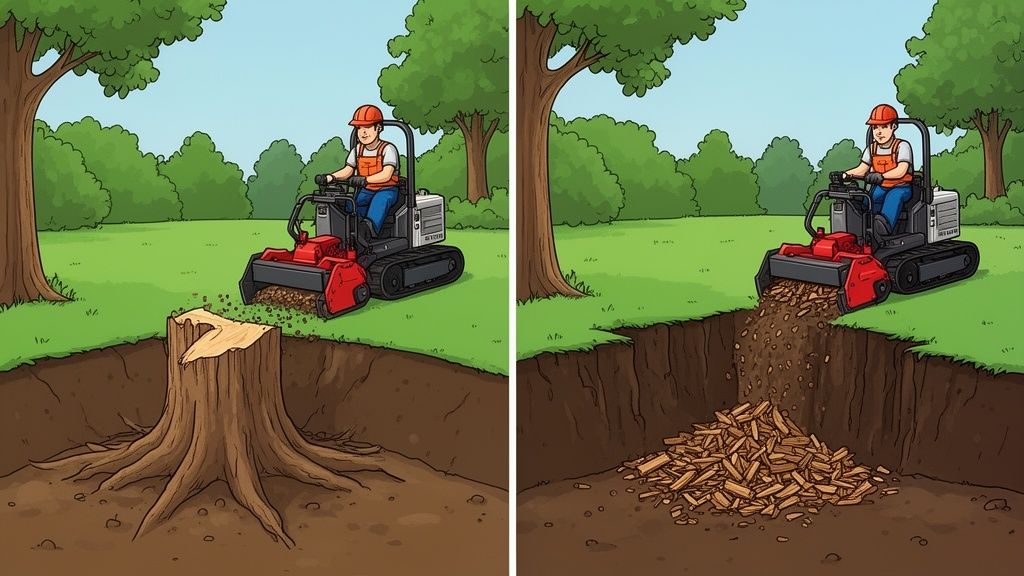
Professional stump grinding, on the other hand, is an active, powerful fix. At Richmond Tree Experts GA, our ISA Certified Arborists show up with high-powered stump grinders that make quick work of even the most stubborn tree remnants.
What takes a fire a week to partially burn, our equipment can completely obliterate in under an hour. We don’t just level the stump; we grind it 6 to 12 inches below the ground, turning it and the main root ball into a pile of useful wood chips.
This method gives you absolute finality. No charred mess to clean up, no risk of roots smoldering underground for days, and zero chance of the stump sprouting new growth down the line. Your yard is immediately ready for whatever you have planned next, whether that's new topsoil, grass seed, or a garden bed.
Expertise That Prevents Costly Mistakes
Handling tree work requires more than just brute force; it demands a deep understanding of tree biology and safety protocols. A huge benefit of hiring professionals is getting access to that expertise. Our team can spot issues a homeowner might easily miss, like the true spread of the root system or the location of underground utility lines.
Many DIY stump-burning attempts end in failure, frustration, and a lot of wasted time. In fact, the failure rate is surprisingly high—about 40% of attempts are plagued by annoying re-sprouts because the core root system was never fully eliminated.
This is a big reason the professional stump removal industry has grown so much. The global stump grinder market was valued at USD 95.72 million in 2022, and that number is a direct reflection of people wanting reliable solutions. As urban areas expand, land-clearing needs increase, and outdated methods like burning just don't cut it anymore. You can learn more about stump grinding market trends and see for yourself why safer, modern techniques are taking over.
Peace of Mind with Certified Arborists
Ultimately, choosing a professional service is about entrusting the job to someone who does this safely and correctly every single day. The team at Richmond Tree Experts GA is made up of ISA Certified Arborists who are trained to the highest standards in the industry. That certification means they have a comprehensive grasp of tree care, safety procedures, and local environmental rules.
That’s a level of expertise you just can't replicate on your own. When our crew is on your property in Johns Creek, Milton, or Alpharetta, you can rest easy knowing the job will be done right, with full insurance coverage and a commitment to leaving your yard clean and safe. To truly get the difference this makes, you can read more about what it takes to become one of our certified arborists in the Atlanta area. It's this dedication that offers the ultimate solution—a fast, complete, and worry-free end to your stump problem.
Your Top Stump Removal Questions Answered
When you’re staring at an ugly stump in your yard, a lot of questions pop into your head. It’s only natural. You’re probably wondering about the cost, how long it’ll take, and what your yard will look like afterward. We hear these questions all the time, so let's clear the air and give you the straightforward answers you need to make a smart decision.
How Long Does It Actually Take to Burn a Stump Completely?
Let’s be honest: burning a stump isn't an afternoon project. It's a long, slow, and often frustrating process. Think marathon, not sprint. Depending on the stump's size and the type of wood—a dense oak will fight you a lot harder than a soft pine—you could be looking at a smoldering fire for several days, sometimes even a few weeks.
This isn't a "set it and forget it" deal, either. You have to constantly keep an eye on it to make sure the fire doesn't get out of hand or just fizzle out. You’ll likely have to restart it over and over. And after all that time and effort? There's no guarantee it will even work. More often than not, you’re left with a charred, half-burned stump and a bigger mess than when you started.
Is Stump Grinding More Expensive Than Burning?
On the surface, burning a stump seems cheap. A few dollars for some chemicals and charcoal, right? But that’s a dangerously simplistic way to look at it. The hidden costs and risks can stack up fast, making it a far more expensive gamble than you think.
Let's break down the real costs:
- Your Time: How much is a week or more of constant babysitting worth to you?
- Property Damage Risk: An ember can travel, and an out-of-control fire can easily damage your fence, shed, or even your house. That’s a repair bill in the thousands.
- Hefty Fines: Get caught breaking a local burn ban in places like Forsyth or Gwinnett County, and you could be facing some serious penalties.
- The Cost of Failure: When the burn fails—and it often does—you still have to pay for a real solution. So you end up paying twice.
When you weigh all the factors, professional stump grinding is almost always the more cost-effective and sensible choice. It's a one-and-done deal that’s safe, guaranteed, and frees you from the headaches and hidden risks of a DIY burn.
What Can I Do with the Space After Stump Grinding?
This is where grinding really shines. A burned-out stump leaves behind a hazardous, ashy pit that’s useless for months, if not longer. But once we grind a stump, the space is yours to reclaim immediately.
The wood chips left over make fantastic natural mulch for your garden beds or around other trees. Or, if you prefer, we can haul them away for you. The ground is then ready for a layer of topsoil, and you can plant grass, lay down sod, start a flower garden, or even plant a new tree. You get your yard back right away, without the ugly scar tissue a fire leaves behind.
Are There Other Alternatives to Burning or Grinding?
Sure, other methods exist, but frankly, they’re not great. You could try chemical stump removers, but that involves drilling holes into the stump and waiting… and waiting. It can take months or even years for the chemicals to rot the wood enough to be removed.
Then there’s the old-fashioned way: digging it out by hand. If you’ve ever tried to dig out anything more than a small shrub, you know how back-breaking that is. For a mature tree’s root system, it’s next to impossible without heavy machinery.
For a fast, safe, and truly final solution, professional stump grinding is simply the best way to go for homeowners here in the Atlanta area.
If you're done looking at that old stump and want a professional solution you can count on, Richmond Tree Experts GA is ready to help. We offer expert stump grinding services across Cumming, Johns Creek, Milton, Alpharetta, Roswell, and the greater Atlanta area. Contact us today for a fast, free estimate!
Have a stump you want gone? Richmond Tree Experts has worked on Marietta and Metro Atlanta trees since 1985, and every job is looked at by an ISA Certified Arborist before it is priced. Start with stump grinding, or see everything we do: tree removal, stump grinding and arborist services across Cobb, Fulton, Cherokee, Gwinnett and DeKalb counties (service areas).
Call (770) 974-3964, 7am to 11pm every day, or request an estimate online.

