

Stumbling upon a thorny bush in your yard always brings a few questions to mind. The first, and most important, is figuring out exactly what you're looking at. Is it a helpful native plant, a simple ornamental, or an invasive species that’s about to become a real problem for your landscape?
Why Bother Identifying Thorny Bushes?
Finding some random, prickly plant on your property can be a little unnerving. Are you looking at a harmless native species that provides food and shelter for local birds, or is it an aggressive invader that’s gearing up to cause a major headache? Knowing what you're dealing with isn't just about satisfying curiosity—it's a crucial first step in taking care of your property the right way.
Getting a positive ID has a direct impact on safety, the health of your landscape, and even your property's value. A simple mistake could lead to nasty scratches, a run-in with something poisonous like poison oak, or letting an invasive plant completely take over and choke out the plants you actually want.
How an Arborist Sees It
When one of our arborists at Richmond Tree Experts shows up and sees a thorny plant, they don't just see a nuisance. They see a puzzle, and they start solving it by asking a few key questions—the same ones you can ask yourself:
- Is it a threat? Is this plant putting kids, pets, or anyone in a high-traffic area at risk? Is it creeping too close to your house or getting tangled in utility lines?
- Is it invasive? Some thorny characters, like Multiflora Rose or Japanese Barberry, are notorious for spreading like wildfire. They can easily push out native Georgia plants and mess with the local ecosystem.
- What’s its job in the environment? On the other hand, plenty of native thorny plants, like Hawthorn, are superstars in our local environment. They provide nectar for pollinators and tasty berries for birds.
An unidentified thorny bush is just an unknown on your property. Once you know its name and its habits, it stops being a potential problem and becomes either a manageable part of your landscape or a clear target for removal.
At the end of the day, a quick and accurate ID gives you the power to act with confidence. It lets you protect your family, keep your landscape healthy, and make a smart call on whether to keep, control, or get rid of the plant for good. This guide will give you the tools to get that process started.
A Practical Framework for Plant Identification
Trying to identify a thorny bush can feel a bit like detective work. If you just guess, you might mistake a beneficial native plant for a problematic weed. To really solve the mystery, you need to gather clues methodically. A structured approach is the only way to make sure your bushes with thorns identification is on the money.
This framework breaks the process down into four key investigative steps. By looking at each feature one by one, you'll build a complete profile of the plant in your yard, making a positive ID much, much easier. Think of it as collecting fingerprints, witness statements, and physical evidence before you name your suspect.
Step 1: Start with the Thorns Themselves
The first and most obvious clue is how the plant defends itself. But here's something most people don't realize: not all sharp points are created equal. Knowing the difference is a huge step forward in your investigation. Botanically speaking, you'll run into three distinct types.
- Thorns: These are the real deal—modified branches that grow right out of the plant's woody stem. Because they're structurally part of the branch, they are incredibly sturdy and tough to break off. Hawthorn trees are a classic example of a plant with true thorns.
- Spines: Spines are actually modified leaves or parts of leaves. A cactus is the most famous example, but locally, you might see them on a Japanese Barberry bush. Like thorns, they are deeply connected to the plant’s internal structure.
- Prickles: These are the most superficial of the bunch, growing from the plant's outer layer, or epidermis. Since they aren't tied into the deep woody tissue, you can often just snap them off cleanly. The perfect example? The prickles on a rose stem.
Step 2: Analyze the Leaves and Stems
After checking out the "weapons," your next move is to look at the leaves. Leaf arrangement and shape give you some of the most reliable clues for identifying any plant. Take a close look at how the leaves are positioned on the stem. Are they opposite, growing in pairs directly across from each other? Or are they alternate, staggered up and down the stem?
Then, inspect the leaf itself. Is it a simple leaf (a single, solid blade) or a compound leaf (divided into several smaller leaflets)? A blackberry bramble, for instance, has compound leaves with three to five toothed leaflets. The color and texture of the stems can also offer great clues. Sometimes, unusual features on the stems or leaves can even point to a health issue. If you suspect something is wrong, our detailed tree disease identification guide can help you spot signs of trouble on any of your landscape's woody plants.
Step 3: Examine Flowers and Fruit
If the season is right, the flowers and fruit are basically a signed confession from the plant. These features are often the most distinctive and can narrow down the possibilities in a hurry.
Jot down a few notes on the flower's color, size, and shape. Are they growing in clusters, or are they single blossoms? Do the same for the fruit. Are you seeing berries, nuts, or something else entirely? Note their color, shape, and what time of year they show up. The bright orange-red berries of a Pyracantha (or Firethorn) in the fall are a dead giveaway, for example.
By combining your observations of thorns, leaves, and reproductive parts (flowers and fruit), you create a multi-point verification system. This dramatically lowers the chance of a misidentification, ensuring you make the right call for your landscape.
This simple decision tree helps you visualize how these different clues lead you to classify a plant as harmless, a potential problem, or an invasive threat that needs attention.
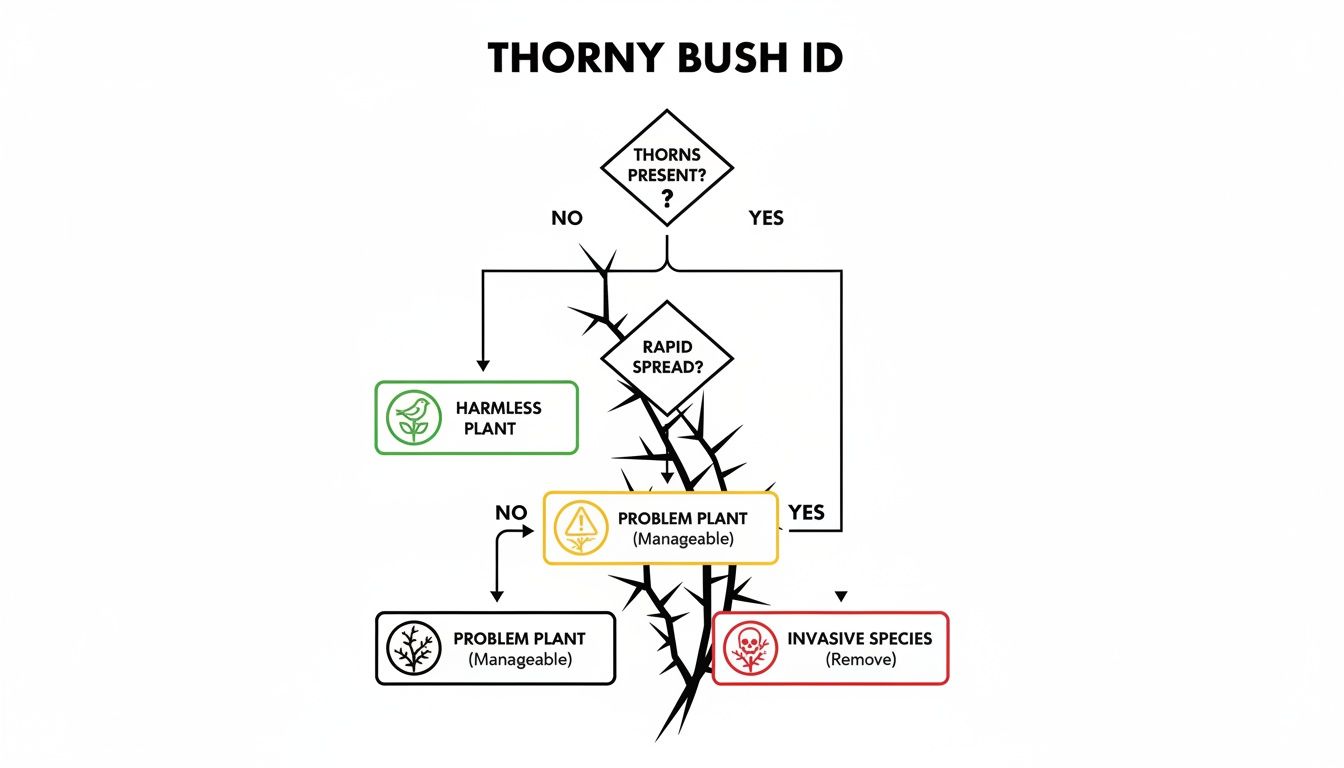
As the flowchart shows, just by answering a few key questions about a plant's characteristics and behavior, you can figure out its role in your landscape and decide what to do next.
Common Thorny Plants Found in Georgia
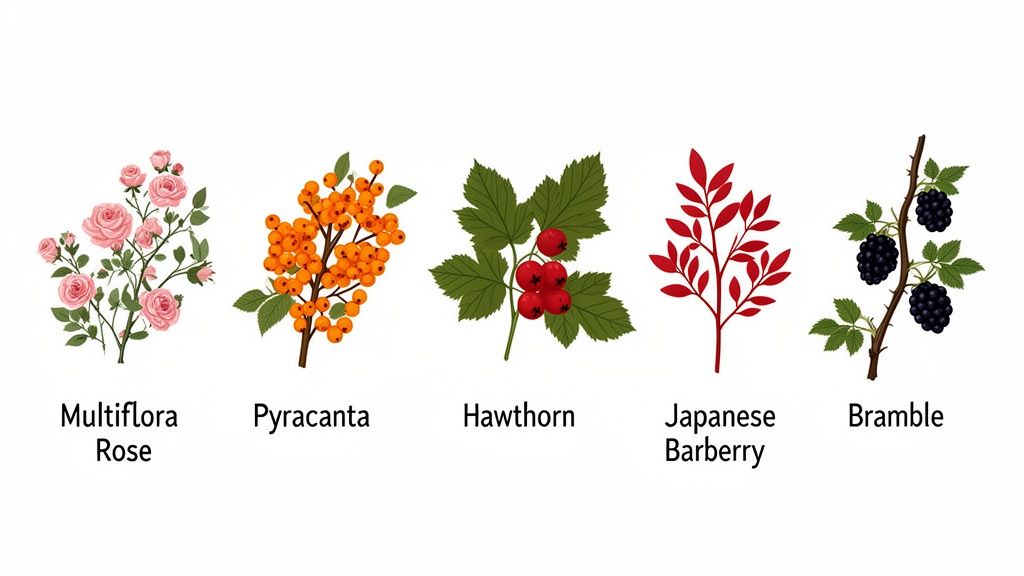
Now that you've got a solid framework for bushes with thorns identification, it's time to put those skills to the test. Think of this as a field guide to the usual suspects you're likely to find lurking in your North Georgia landscape, from Cumming to East Cobb.
Each plant has its own personality—its own unique combination of features. Learning them will help you quickly tell a native treasure from an invasive nightmare. We'll walk through the most common characters, detailing everything from their thorns and leaves to their flowers and fruit. Once you know their profiles, you'll have the confidence to know exactly what you're dealing with.
The Aggressive Invader: Multiflora Rose
Don't let its delicate looks fool you. Multiflora Rose (Rosa multiflora) is an incredibly aggressive invasive species. It was originally brought over for erosion control, but now it forms dense, impenetrable thickets that choke out our native plants with alarming speed.
- Thorns: It’s armed with countless sharp, curved prickles that grab onto your clothes and skin and just won't let go. Unlike a true thorn, these are just on the surface and can be snapped off the stem.
- Leaves: The leaves are compound, meaning they have multiple leaflets—usually five to eleven small, toothed ones per leaf. The dead giveaway is the feathery, comb-like growth (called a stipule) right at the base of the leaf stalk.
- Flowers & Fruit: You'll see clusters of small, fragrant white flowers in late spring. These turn into small, hard, red fruits known as rose hips, which stick around all winter.
Its growth habit is a sprawling, arching mess that climbs over anything in its path. If you spot this one on your property, you need a removal plan.
The Colorful Defender: Pyracantha
You probably know this one as Firethorn. Pyracantha is a wildly popular ornamental shrub, and for good reason—its display of autumn berries is absolutely spectacular. But while it's beautiful, it packs a serious defensive punch and is a real pain to prune if you're not careful.
Pyracantha is a perfect example of how a plant’s purpose—ornamental vs. wild—influences its management. It's a great security barrier but requires careful handling due to its formidable thorns.
You can spot it pretty easily once you know what to look for.
- Thorns: These aren't just prickles. Pyracantha has stout, sharp thorns that are actually modified branches growing straight from the woody stems.
- Leaves: The leaves are small, simple, and oval-shaped. They're also evergreen, staying a glossy dark green all year.
- Flowers & Fruit: In the spring, it's covered in little white flower clusters. The real show, though, is in the fall and winter when it's absolutely loaded with dense clusters of bright orange or red berries.
Native Hawthorns and Troublesome Brambles
Georgia is home to a bunch of native Hawthorn species (Crataegus spp.), which are small trees or large shrubs that are vital to our local wildlife. They're hard to miss, thanks to their long, wicked-looking, woody thorns that can be more than 3 inches long. They produce clusters of white flowers in spring, followed by small, apple-like red fruits (called haws) in the fall.
On the flip side, you have Brambles (Rubus spp.)—think wild blackberry and raspberry. These are also natives, but they can quickly become a nuisance. You'll know them by their arching canes covered in sharp prickles, their compound leaves (with three to five leaflets), and, of course, their delicious berries in the summer. While they feed wildlife, their aggressive growth often needs to be managed to keep them from completely taking over your garden beds.
How to Spot Invasive Thorny Plants
Let's be clear: not every plant with thorns is a villain. Some are harmless native species or even well-behaved ornamentals you bought on purpose. But others? They're aggressive invaders, ready to completely overwhelm your landscape if you let them. Nailing your bushes with thorns identification is the first step, because catching these bullies early can save you a world of trouble later on.
Think of invasive species as the outlaws of the plant world. They grow fast, spread like wildfire, and shove out the native plants that our local birds and pollinators count on. What starts as a single overlooked invader can explode into a dense, thorny thicket, turning a simple weekend chore into a costly, painful removal project.
A Perfect Example: Thorny Olive
If you want a poster child for troublesome invaders in Georgia, look no further than Thorny Olive (Elaeagnus pungens). This thing is a beast. It forms dense, sprawling mounds that cast such deep shade that nothing can grow underneath them—no native flowers, no new tree seedlings, nothing. Birds eat the fruit and then drop the seeds all over your property (and your neighbor's), helping it spread with alarming speed.
What's really tricky about Thorny Olive is that it didn't just show up. It was brought to North America from Asia way back in 1830 as an ornamental plant. People are still buying and selling it, sometimes without realizing they're planting a major threat in their own backyard. Because it loves Georgia's climate, finding and removing it early is critical to protecting our local ecosystem. You can learn more about the impact of Thorny Olive in the Southeast from the experts.
Spotting an invasive species early is like finding a small leak in a dam. You can patch it easily now, or you can wait until the whole structure gives way. Proactive identification prevents a small plant problem from becoming a landscape-wide disaster.
So, how do you tell an invasive troublemaker from a harmless native? Invasive species often give themselves away with a few key behaviors that should set off alarm bells for any homeowner.
Red Flags of an Invasive Plant
Keep an eye out for these aggressive growth patterns when you're sizing up an unknown thorny bush:
- Rapid, Unchecked Spreading: Does it feel like the plant is popping up everywhere at once? Invasive species spread much, much faster than most native plants.
- Forming Dense Thickets: They have a knack for growing into impenetrable walls of thorns and leaves, creating a "monoculture" where absolutely nothing else can survive.
- Outcompeting Other Plants: If you see a thorny bush completely smothering your other flowers, shrubs, or small trees, that's a huge red flag. You're likely looking at an invasive.
- Producing Tons of Fruit: Many invaders crank out an insane amount of fruit or seeds. This is their strategy for spreading far and wide, using birds and other wildlife as their personal delivery service.
By learning to recognize these habits, you can spot a potential threat long before it digs in and takes over your yard. Trust me, catching these plants early makes them infinitely easier and cheaper to get under control.
Safely Managing and Removing Thorny Bushes

Okay, so you’ve successfully figured out what kind of thorny bush you’re dealing with. Now what? The next step is deciding on a plan of action.
Whether you're just looking to trim back an ornamental Pyracantha or you’re ready to declare all-out war on an invasive Multiflora Rose, safety has to be your number one priority. This isn’t negotiable.
Trying to tackle thorny plants requires way more than a standard pair of garden gloves. You need to think of it like you're gearing up for a small-scale battle. Your personal protective equipment (PPE) is your armor, and if you skimp on it, you’re just asking for painful scratches, deep puncture wounds, and even a nasty infection.
Essential Safety Gear and DIY Techniques
Before you even think about making that first cut, you need to be properly geared up. This is the absolute baseline of protection for any thorny plant project, big or small.
- Heavy-Duty Gloves: Don't even try this with flimsy gloves. You need thick, puncture-resistant ones made from leather or a heavily reinforced synthetic material. Make sure they cover your wrists.
- Eye Protection: Safety glasses or goggles are a must. A rogue branch can whip back in a split second and cause a serious, permanent eye injury.
- Durable Clothing: Wear long sleeves and pants made from a tough fabric like denim to shield your skin from getting shredded.
For smaller, more manageable patches, a good strategy is to start by cutting the bush all the way back to the ground with loppers or a handsaw. This clears the area and gives you much better access to the root system. From there, you can use a shovel or a grubbing hoe to dig out the main root crown. If you leave that behind, you can bet the plant will be back.
Proper disposal is just as crucial as the removal itself. Never burn thorny plants, especially if they’re invasive or you’re not 100% sure what they are. Burning can release harmful toxins into the air. The best bet is to bag the material up securely for your municipal pickup.
Knowing When to Call for Professional Help
A single thorny bush is one thing. A massive, dense thicket that’s taken over a corner of your yard is a whole different beast. Some situations quickly escalate a DIY weekend project into a job that’s best left to the professionals.
Knowing your limits is key to staying safe and making sure the problem is actually solved for good. For those really aggressive thorny species, knowing and using effective invasive species control methods is critical, both for your own safety and for the local ecology.
If you’re staring down a huge infestation, have a plant tangled up in power lines, or are dealing with a root system so established you can’t make a dent, it’s time to call in an expert. Professional crews have the specialized equipment and know-how to handle these tough jobs safely and efficiently. If you're wondering about the cost, getting a sense of the factors that determine Atlanta brush removal cost can help you plan for a real solution.
When You Should Call a Certified Arborist
Taking on a single thorny bush in your yard can be a rewarding weekend project. But let's be realistic—some situations are just too big, too complex, or frankly, too dangerous for a DIY approach.
Knowing when to put down the loppers and pick up the phone isn't a sign of defeat. It's the smartest move you can make for your own safety, your property, and the long-term health of your landscape. When the stakes are high, a professional's touch is non-negotiable.
Think of an arborist as a tree specialist. You wouldn't perform surgery on yourself; you'd see a doctor. In the same way, a certified arborist has the specialized training, insurance, and heavy-duty equipment to solve major horticultural problems the right way.
Scenarios Demanding Expert Help
There are a few key situations where trying to go it alone is a recipe for frustration and potential disaster. Calling in a pro ensures the job gets done completely and safely the first time around.
You should absolutely call for backup if you're facing:
- Large-Scale Infestations: We're talking about a dense, impenetrable thicket of an invasive like Multiflora Rose or Thorny Olive that has completely taken over a significant area of your property.
- Proximity to Hazards: This is a big one. Are the thorny bushes tangled up in power lines? Are they grinding against your home's foundation or strangling a beautiful, mature tree you want to save? Don't risk it.
- Difficult Terrain: Is the thorny mess on a steep hill, a creek bank, or another hard-to-reach spot? Trying to use saws and other equipment on unstable ground is incredibly dangerous.
An ISA Certified Arborist does a lot more than just cut down a plant. They conduct a full risk assessment, give you a definitive bushes with thorns identification, and use specialized gear to ensure every last bit is removed without collateral damage to your property.
Bringing in an expert is about getting a safe, effective, and permanent solution. You can learn more about what a certified arborist in Atlanta, GA can do for you and how our team at Richmond Tree Experts is equipped to solve even the thorniest of problems.
We Hear These Questions All the Time
Even with a good guide, you're bound to have a few lingering questions. That's totally normal. Here are the answers to some of the most common things we get asked by homeowners around Atlanta. Hopefully, this clears up any final confusion.
What’s the Real Difference Between a Thorn, a Spine, and a Prickle?
You hear these words thrown around a lot, but for a plant detective, they mean very different things. Getting this right is a huge clue for bushes with thorns identification.
- Thorns are the real deal—they’re modified branches. Because they grow right out of the stem's deep, woody tissue, they are incredibly strong and hard to break off. A classic example is a Hawthorn tree.
- Spines are actually modified leaves. Think about a cactus; its spines are its leaves, adapted for defense. A Japanese Barberry bush is another great example.
- Prickles are just skin-deep. They grow from the plant's outer layer, or epidermis. You can usually snap them right off with your thumb. This is what roses actually have—prickles, not thorns!
Are All Thorny Bushes With Red Berries Poisonous?
Not at all, but you absolutely have to assume they are until you are 100% positive of the plant's identity. For instance, the berries on a Pyracantha (Firethorn) aren't deadly, but they'll give you a nasty stomach ache if you eat a bunch of them raw. On the flip side, some native Hawthorn species have delicious, edible red fruit.
When it comes to any wild plant, the golden rule is simple: if you don't know what it is, don't touch it and never taste it. Proper identification is the only way to keep your family and pets safe.
How Do I Finally Get Rid of These Invasive Blackberry Brambles?
Winning the war against blackberry brambles takes persistence. For a smaller patch, you can eventually exhaust the plant by repeatedly cutting the canes all the way to the ground and digging out the root crowns. It’s a workout, but it starves the plant of energy and will kill it over time.
Larger infestations usually call for a more serious strategy. This often means bringing in the heavy equipment for intensive mowing, then following up with a targeted herbicide application on the new growth that pops up. The best time to attack them is before they produce fruit, so you can stop the seeds from spreading and making your problem even bigger next year.
When an unknown thorny bush has gotten out of hand, you need a solution that’s both safe and effective. The ISA Certified Arborists at Richmond Tree Experts GA have the experience and professional equipment to identify, manage, and remove any problematic plant on your property. Contact us today for a professional consultation and let us take care of it for you.
Not sure what your tree needs? Richmond Tree Experts has worked on Marietta and Metro Atlanta trees since 1985, and every job is looked at by an ISA Certified Arborist before it is priced. Start with an ISA Certified Arborist evaluation, or see everything we do: tree removal, stump grinding and arborist services across Cobb, Fulton, Cherokee, Gwinnett and DeKalb counties (service areas).
Call (770) 974-3964, 7am to 11pm every day, or request an estimate online.

