

So, you're looking at a piece of land in the Atlanta area, dreaming of what it could become. Before you can lay a foundation or even plant a garden, you’ve got to clear the way. But what’s that going to cost?
The short answer is, it depends. For most properties around here, you're looking at a range of $500 to $5,600 per acre. If you've got a typical half-acre lot in a place like Cumming or Alpharetta, that number narrows down to somewhere between $250 and $2,800.
Your Financial Starting Point for Atlanta Land Clearing
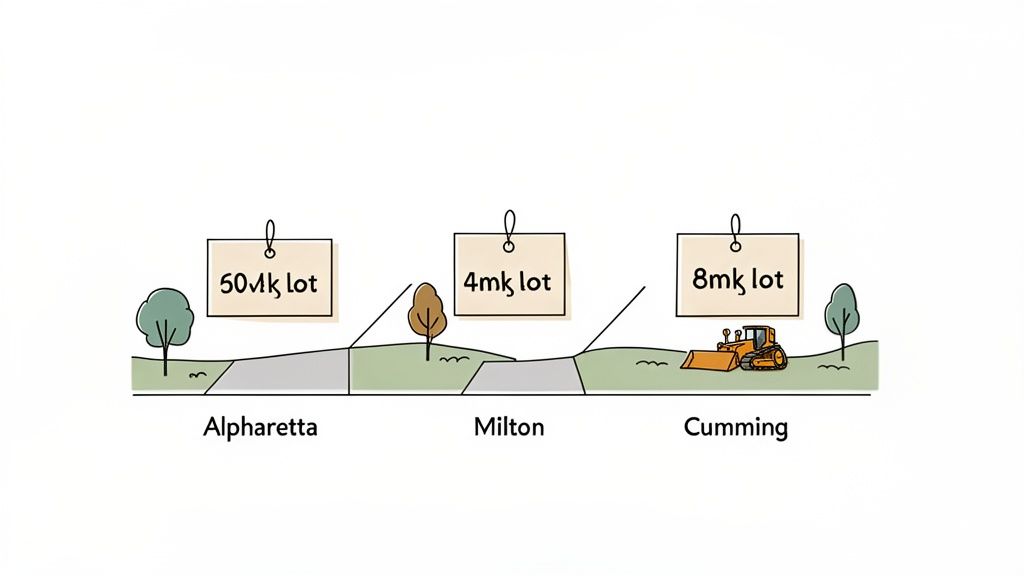
Whether you're planning a custom home, a commercial site, or just want more usable backyard space, land clearing is the first real step in turning that vision into reality. It’s about creating a blank canvas. But figuring out the budget for that first step can feel like trying to nail down a moving target. The cost to clear land isn't a simple, flat fee; it's a number that’s carefully calculated based on the unique character of your property.
Here at Richmond Tree Experts, we've been helping Atlanta-area folks tackle these projects since 1985. We get it—whether you've got a small lot in Roswell or a few acres out in Forsyth County, you need a clear, honest idea of the costs right from the start.
Understanding the Initial Numbers
Think of a land clearing estimate like a recipe. The size of your property is the main ingredient, but the final price gets seasoned by things like how many trees are on it, if it's hilly, and how easy it is for us to get our equipment in. A flat, lightly wooded acre is always going to be less expensive to clear than a steep, densely forested one.
On a national level, a good rule of thumb is a cost of around $1.30 to $2.00 per square foot. That’s a pretty wide range, but it reflects the huge difference between clearing some light brush and taking down dozens of mature hardwoods.
The real goal here is to get past the generic price tags and understand what's actually driving the cost for your project. When you know the variables, you can set a realistic budget and avoid any nasty surprises later on.
And before you get too far down the road, it's a smart move to understand what to know before buying land, because the condition of the property you start with has a massive impact on your total costs.
Estimated Land Clearing Costs in Atlanta at a Glance
To give you a more concrete idea of what to expect, we've put together a quick cheat sheet. This table breaks down the typical costs for common lot sizes you'll find around the Atlanta metro area, covering everything from lightly to heavily wooded properties.
| Lot Size | Lightly Wooded Cost Range | Heavily Wooded Cost Range |
|---|---|---|
| 1/2 Acre | $290 – $1,050 | $1,650 – $2,800 |
| 1 Acre | $580 – $2,100 | $3,300 – $5,600 |
| 2 Acres | $1,160 – $4,200 | $6,600 – $11,200 |
Keep in mind, these are solid starting points. The real price will come down to the specifics of your land, which we'll dive into next.
Key Factors That Influence Your Final Price
Thinking about the cost to clear land is a lot like budgeting for a kitchen remodel. You can find an average price per square foot, but the final bill really depends on what’s hiding behind the drywall. In the same way, a simple per-acre price for clearing land is just a starting point; the real cost gets hammered out by the unique character of your property.
Ever wonder why clearing one acre in Roswell might cost thousands more than a seemingly identical plot in Milton? The answer is always in the details—a handful of critical variables that every professional estimator has to size up. Each one adds a layer of complexity, demanding more time, different machinery, and specific skills, all of which shape your final quote.
Vegetation Density and Type
Hands down, the single biggest factor driving your cost is what’s actually growing on your land. A property scattered with light brush and a few small pines is a walk in the park compared to a parcel choked with mature oaks and a jungle of undergrowth.
Clearing a lightly wooded acre might run you somewhere in the $580 to $2,100 range. But if you're dealing with a heavily forested lot, that cost can easily swell to between $3,300 and $5,600 per acre.
Here’s a quick look at how the green stuff on your property moves the needle:
- Light Brush and Small Trees: This is the easy stuff. A crew can often make quick work of it with smaller machines like a skid steer fitted with a mulching head. It's faster and less labor-intensive.
- Mature Hardwoods: Big, dense trees like oaks and hickories are a different beast entirely. They demand heavy-duty equipment for removal, and their sprawling root systems make stump grinding a much bigger, and more expensive, chore.
- Dense Undergrowth: Thick vines, thorny briars, and tangled shrubs can bring a project to a crawl. This often requires a lot of manual labor or special attachments just to clear a path before the big machines can even get to the trees.
The specific machinery needed for the job is a huge part of the final price, which is why quotes can vary so wildly. One job might be perfect for a forestry mulcher, while another needs a bulldozer and an excavator. Getting a handle on the best equipment for clearing land can really help you understand why estimates aren't one-size-fits-all.
Terrain and Slope Challenges
Picture this: you're trying to move a heavy sofa. Is it easier to slide it across a flat, open living room or haul it up a narrow, winding staircase? The answer is obvious, and the same logic applies to land clearing. A flat, level lot is always the simplest and most affordable scenario.
When you start dealing with steep slopes, which are common in parts of East Cobb and North Georgia, you introduce a whole new set of challenges that hike up the cost.
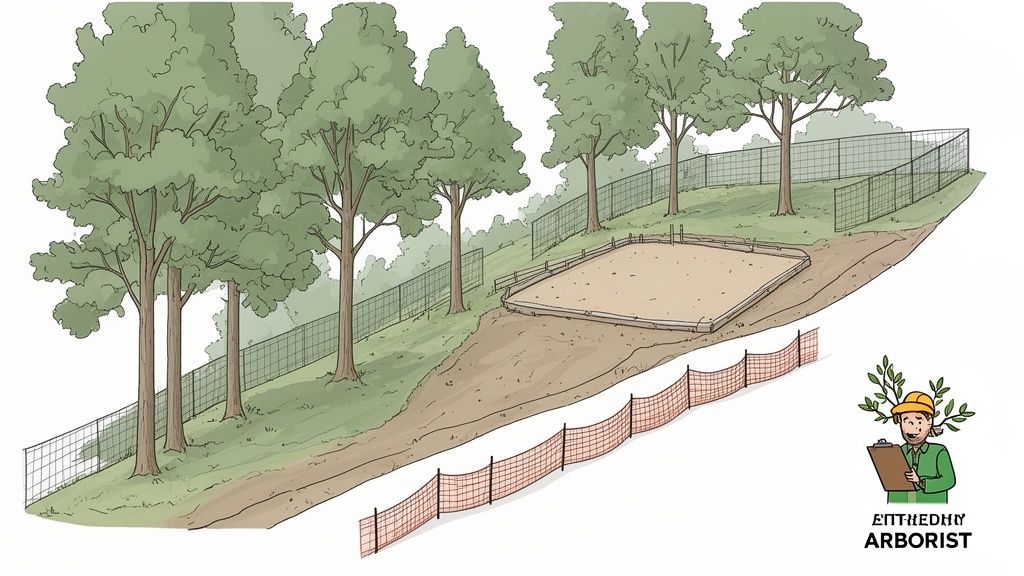
A sloped terrain not only makes it more difficult and dangerous to operate heavy machinery but also necessitates careful planning for erosion control. Once vegetation is removed, the risk of soil runoff increases dramatically, requiring extra steps to stabilize the land.
These preventative measures, like installing silt fences or grading the land into terraces, add both material and labor costs to your project. It's a non-negotiable step to protect your property and stay in line with local regulations.
Property Accessibility
How easy is it for a crew to get their big toys onto your property? In packed suburban neighborhoods like those in Johns Creek or Marietta, things like narrow driveways, low-hanging power lines, or nearby houses can create a real logistical headache.
If a contractor can't easily drive a large bulldozer or excavator onto the site, they might have to resort to smaller, less efficient equipment, which just stretches out the timeline. In some tricky situations, they might even have to build a temporary access road, adding another line item to your estimate. Bottom line: limited access means more hours on the clock and a higher final bill.
Separate Services That Add Up
Most standard land clearing quotes will cover the basics: cutting down trees and getting rid of the brush. But there are several other critical services that are often priced out separately. It is absolutely vital to know what is and isn’t included in that initial number you're given.
Be ready to talk about these potential add-ons:
- Stump Grinding or Removal: If you plan to build, leaving stumps behind is a non-starter. Stump grinding costs, on average, $130 to $350 per stump, and the price goes up with size and wood density.
- Debris Hauling and Disposal: So, what happens to the mountain of cleared trees and brush? Some contractors roll hauling into their base price, but many others charge for it. Landfill tipping fees can be surprisingly high, so get this clarified from the get-go.
- Final Grading and Leveling: After everything is cleared, the land is usually a lumpy, uneven mess. Grading is the process of creating a smooth surface with proper drainage—a crucial step before any concrete is poured. This service can easily add $800 to $4,000 or more to your total.
- Permits: Depending on where you are in Forsyth or Gwinnett County, you’ll likely need permits for tree removal or land disturbance. These typically run a few hundred dollars.
Comparing Real-World Project Costs in North Atlanta
Talking about the cost to clear land in abstract terms like "per acre" only gets you so far. To really wrap your head around what your project might cost, it’s much more helpful to walk through some real-world examples.
Let's break down a few scenarios common to the North Atlanta suburbs. This will show you exactly how different factors come together to shape the final price tag. Think of these estimates as a practical benchmark, showing how a property's unique DNA—from its Roswell address to its tree density in Forsyth County—directly impacts the scope and cost of the job.
Here’s a quick look at how different jobs can stack up, showing just how much the details matter.
Cost Scenario Breakdown for Atlanta Area Projects
| Project Scenario (Location & Size) | Key Challenges | Estimated Clearing Cost | Estimated Additional Services (Stump/Grading) | Total Estimated Project Cost |
|---|---|---|---|---|
| Roswell Suburban Lot (0.5 Acre) | Tight access, proximity to neighbors, avoiding existing landscape damage. | $1,800 – $2,500 | $900 – $1,350 | $2,700 – $3,850 |
| Forsyth County Wooded Tract (1 Acre) | Dense, mature hardwoods, significant slope requiring erosion control. | $4,500 – $6,000 | $2,700 – $4,300 | $8,200 – $12,300 |
As you can see, doubling the acreage doesn't just double the cost—it can triple it or more once you factor in the tougher conditions. Now let's dive into the specifics of why that is.
Scenario 1: The Half-Acre Suburban Lot in Roswell
Picture a classic half-acre residential lot in a Roswell neighborhood. The yard is moderately wooded with a mix of pines and smaller hardwoods, and the ground is mostly flat. The goal here is simple: clear the back part of the lot for a new patio and a bigger lawn.
- Key Challenges: Honestly, the biggest challenge here isn't the trees themselves—it's the access. Working inside an established subdivision means our crews have to be surgical. We need to avoid damaging manicured lawns, concrete driveways, and the neighbor's prize-winning roses. This often means using smaller, more precise equipment, which can take more time.
- Estimated Cost Breakdown:
- Selective Clearing & Brush Removal: You’re likely looking at $1,800 – $2,500. This covers taking down about 15-20 medium-sized trees and clearing out all the dense undergrowth. The straightforward nature of the vegetation helps keep this cost in check. For a deeper look at this specific line item, our guide on the average brush removal cost is a great resource.
- Stump Grinding: For 20 stumps, the cost would probably land between $400 and $600.
- Debris Hauling: Budget $500 – $750, depending on the final volume of wood chips and logs we need to haul away.
- Total Estimated Project Cost: $2,700 – $3,850
This scenario really shows how even smaller residential jobs demand careful planning, especially when it comes to logistics and getting all that debris off-site.
Scenario 2: The Heavily Wooded Acre in Forsyth County
Now, let's shift gears to a one-acre undeveloped piece of land in a more rural part of Forsyth County. This property is a whole different beast—it's choked with mature hardwoods, thick underbrush, and has a noticeable slope. The client wants the entire acre cleared to prep for new home construction.
This is where the big three cost drivers really come into play: vegetation density, terrain, and property access.

As the infographic makes plain, a project with dense trees and a steep grade is in a completely different league from a flat, lightly wooded lot.
Expert Insight: On a challenging site like this one, the combination of dense, mature trees and difficult terrain accounts for nearly 70% of the project's complexity and cost. It's not just about bringing in bigger equipment; it's about strategic planning for safety and erosion control from day one.
- Key Challenges: The sheer volume of large, mature trees is the biggest cost driver, period. Then you add the sloped terrain, which introduces another layer of complexity. It takes seriously skilled equipment operators to work safely and efficiently on a grade, and we have to be proactive with erosion control to prevent soil runoff once the ground is bare.
- Estimated Cost Breakdown:
- Heavy Clearing: Given the density, this could easily run from $4,500 to $6,000. We're talking about felling large trees and using heavy machinery like bulldozers to get it done.
- Stump Removal: Pulling dozens of massive hardwood stumps is a major undertaking. This alone could add $1,500 – $2,500 to the bill.
- Debris Hauling: The amount of debris from a full, dense acre is huge. You should expect hauling and disposal costs in the $1,200 – $2,000 range.
- Basic Grading & Erosion Control: Plan on $1,000 – $1,800 to stabilize the sloped site after clearing. This isn't optional—it's essential.
- Total Estimated Project Cost: $8,200 – $12,300
The Real Story: DIY vs. Professional Land Clearing
When you first see a quote for clearing land, it's easy to think, "I could do that myself for half the price." The idea of renting some heavy equipment for a weekend and saving a bundle is tempting, but that line of thinking often leads straight to a costly and dangerous mess.
The truth is, what seems like a simple job of knocking down trees is anything but. Professional land clearing is a science. It involves knowing the land, using specialized machinery safely, and understanding the maze of local rules. When you decide to go it alone, all that responsibility—and all the risk—lands squarely on your shoulders.
The Hidden Price Tag of a DIY Project
Trying to clear your own lot is a bit like attempting to do your own dental work. You might have a few of the right tools, but you’re missing the training and precision to avoid causing serious, expensive damage.
The costs start adding up the moment you look at equipment rentals. That daily rate for a bulldozer or an excavator? That's just the beginning. You’ll also be on the hook for delivery fees, fuel, insurance, and all the different attachments needed to get the job done. Before you know it, you’re spending thousands just on rentals, often getting close to what a professional would have charged in the first place.
And that's just the equipment. Here are the real budget-killers that trip up most DIY projects:
- Property Damage: It's shockingly easy for an inexperienced operator to hit an underground utility line, crack a septic tank, or even damage a nearby foundation. Those are repairs that can run into the thousands.
- Personal Injury: Let's be blunt: operating heavy machinery without training is incredibly dangerous. One wrong move can lead to a life-altering injury, and the medical bills will make any potential savings look insignificant.
- Bad Grading and Drainage: This is the mistake that keeps on costing you. If the land isn't graded correctly for proper drainage, you're setting yourself up for erosion, flooding, and a backyard that turns into a swamp with every rainstorm. Fixing drainage problems after the fact is a nightmare and far more expensive than having a pro handle it from the start.
The Power and Precision of Professional Equipment
When you hire a professional team, you're not just paying to avoid risks—you're investing in incredible efficiency. The equipment a company like Richmond Tree Experts brings to a job site is in a completely different league from what you can rent. We’re talking about industrial-grade forestry mulchers that can turn a dense thicket into mulch in a matter of hours, a task that could take a DIYer an entire weekend.
This isn't a niche market, either. The global demand for powerful land-clearing attachments was valued at US$2.42 billion in 2024 and is on track to nearly double by 2034. For property owners in places like Marietta or Cherokee County, that means professionals have access to better, faster tools that cut down on labor hours and, ultimately, your total project cost. You can get a sense of this rapidly advancing technology by reading the full report on land clearing attachments.
The Professional Advantage: A pro crew can often clear an acre of lightly wooded land in just a few hours. That same job, attempted with rented equipment, could drag on for days, piling up rental fees and increasing the odds of a costly mistake with every passing hour.
You Can't Rent an ISA Certified Arborist's Expertise
In the end, the biggest difference between a DIY job and a professional one isn't the machinery. It's the knowledge. An ISA Certified Arborist brings a trained eye to your property that no machine can replace. They can instantly tell the difference between a valuable, healthy tree that should be saved and one that’s a hidden hazard.
This selective approach does more than just clear a patch of land; it actively protects and enhances your property value. An arborist makes sure that the beautiful, mature oaks that provide shade and character are carefully protected, while the invasive species or dangerously leaning pines are removed safely. They ensure the job is done right, from the very beginning, saving you from the regret and expense of a project gone wrong.
Balancing Development With Environmental Responsibility
When your city’s nickname is "The City in a Forest," clearing land comes with some unique responsibilities. Atlanta's incredible tree canopy isn't just nice to look at; it's the lungs of our local ecosystem. This means a smart land-clearing plan isn’t just about what you tear down, but also what you decide to save.
Development and preservation don't have to be at odds. In fact, a thoughtful approach to clearing can seriously boost your property’s value while respecting our local environment. It all starts by ditching the old "clear-cut everything" mindset and getting strategic.
The Value of Selective Clearing
Think of your property as a living, breathing asset. A single mature, healthy oak tree can add thousands of dollars to your home's value, offer shade that slashes cooling costs, and provide a home for local wildlife. Selective clearing is all about pinpointing these high-value trees and preserving them, removing only what's absolutely necessary to make way for your project.
This is where working with an ISA Certified Arborist is a non-negotiable. They have the expertise to assess the health, age, and structural integrity of every significant tree, giving you the data to make smart choices. Their guidance ensures the trees you keep are not only beautiful but safe and set up to thrive for decades to come. Our guide on protecting trees during construction dives deeper into these strategies.
This isn’t just a local issue. Globally, tree cover loss hit a staggering 28.3 million hectares in 2023. Unchecked clearing right here in Gwinnett or Cobb County feeds into that global trend. But when an arborist guides targeted removals, we can help protect Atlanta’s vital urban canopy. You can discover the latest tree cover loss data to see the bigger picture.
Managing Erosion on Georgia Terrain
Another huge environmental factor, especially with the rolling hills so common in North Georgia, is erosion. The moment you strip away trees and undergrowth, you leave the soil exposed and vulnerable. Our region’s heavy rains can wash it all away, which doesn’t just rob your property of precious topsoil—it pollutes our local streams and rivers.
Professional land clearing services bake erosion control into the plan from day one. It’s not an add-on; it’s a core part of a responsible project that protects your investment and the local environment.
A good plan will always include effective erosion control measures like these:
- Silt Fencing: These barriers are strategically placed to catch sediment and stop it from running off your property.
- Mulching: Spreading a layer of wood chips across cleared soil is a simple but powerful way to hold it in place and retain moisture.
- Contour Grading: This involves carefully shaping the land to slow down rainwater and guide it where you want it to go, preventing washouts.
By making these sustainable practices a priority, your project becomes more than just another development. It becomes a smart investment that honors Atlanta's natural heritage and gives your property a stable, healthy foundation for the future.
How to Get an Accurate Land Clearing Quote in Atlanta
So, you've got a handle on the factors that shape the cost to clear land. Now it's time to take the next step. Getting a solid, reliable quote is more than just dialing a few numbers; it's about walking into the conversation prepared. A little bit of homework now can save you from some serious headaches and surprise bills later on.
Think of it like building a case file for your property. The more detailed information you can hand a contractor right out of the gate, the sharper their initial estimate will be. This makes the whole process smoother and ensures the on-site visit is productive for everyone involved.
Your Pre-Call Checklist for Success
Before you even think about picking up the phone, get these key pieces of information together. Showing up with these details tells a contractor you’re serious and helps them give you a far more accurate starting point.
- Property Address and Size: This is the baseline. Provide the full street address and the specific acreage or square footage you need cleared.
- Photos and Videos: A picture really is worth a thousand words here. Snap some clear photos or, even better, take a short video walking through the area. Make sure to capture the density of the trees and underbrush, and highlight any obvious challenges like steep slopes or big rocks.
- Project Goals: Get specific about what you're trying to achieve. Are you laying a foundation for a new home? Expanding your backyard for the kids? Prepping a lot for a commercial building? Your end game completely changes the scope of work.
- Property Survey or Plat: If you have one, your property survey is gold. It clearly marks your property lines, which is crucial for preventing any accidental—and expensive—clearing of your neighbor's land.
Asking the Right Questions
Once a contractor is on the phone or walking your property, it's your turn to do the interviewing. Any true professional will be happy to answer your questions. For a deeper dive into the entire process, our guide on how to clear land breaks it all down step-by-step.
A detailed, itemized quote is your best defense against unexpected expenses. Vague, one-line estimates are a major red flag and often hide costs for essential services like debris hauling or final grading.
Always insist on a written estimate that breaks down every single task. It should clearly list separate costs for stump grinding, hauling away debris, final grading, and any permits that might be required. This level of detail is the only way to make sure there are no unpleasant surprises when the final invoice arrives.
Ready to transform your property? Contact Richmond Tree Experts GA today for a free, no-obligation consultation. We offer transparent pricing and flexible financing options to make your project a reality.
Common Questions About Land Clearing Costs
When you're staring down a big project, questions about the cost to clear your land are always going to be top of mind. To help you get a better handle on your budget, we've pulled together the most common questions we hear from clients all across the Atlanta area. Here are some clear, straightforward answers to get you started.
How Long Does It Take to Clear One Acre of Land in Georgia?
This is a big one, and the honest answer is: it really depends on what we're looking at. For a lightly wooded, fairly flat acre, a professional crew can often knock out the job in just one to two days.
But if we're talking about a heavily forested acre choked with dense undergrowth, mature hardwoods, and a steep slope—which is common in parts of North Georgia—that project could easily stretch to three to five days or even longer. Things like how easily we can get our equipment to the site and what the weather is doing also play a huge role in the final timeline.
Do I Need a Permit to Clear Land?
Yes, almost always. Counties like Forsyth, Cobb, and Gwinnett have very specific rules about land disturbance and tree removal. They're not just trying to make things difficult; these regulations are in place to manage development, control erosion, and protect the local environment.
Getting the right permits ensures your project follows local laws for things like erosion control and preserving a certain amount of the tree canopy. Trying to skip this step is a bad idea—it can lead to some hefty fines and a stop-work order that brings your entire project to a halt. A professional clearing company will know exactly how to handle this for you.
Key Takeaway: You should always work under the assumption that you need a permit. The very first thing you should do is check with your local county or city planning department. It’s a simple step that can save you a world of legal and financial headaches down the road.
What’s the Smartest Way to Clear Heavily Wooded Land?
When you're dealing with a dense, heavily wooded lot, forestry mulching is usually the most efficient and eco-friendly way to go. Instead of the old method of cutting everything down, piling it up, and hauling it away, a single powerful machine grinds trees and brush right where they stand. It turns all that overgrowth into a natural, protective layer of mulch.
This method has some serious advantages:
- No Hauling Costs: You completely eliminate the expense of debris removal and landfill fees, which can add up quickly.
- Natural Erosion Control: That layer of mulch does a fantastic job of holding the soil in place and preventing erosion.
- It's Much Faster: Using one machine to do the whole job speeds up the project timeline significantly.
Bulldozing might seem cheaper at first glance, but once you factor in the costs of hauling away all the debris and the grading work you'll need afterward, mulching often proves to be the better value for heavily treed properties.
Can Land Clearing Actually Increase My Property Value?
Absolutely. Thoughtful, strategic land clearing in suburbs like Alpharetta or Milton can deliver a fantastic return on your investment. When you clear out those overgrown and unusable parts of your property, you're creating functional, valuable space for things like lawns, gardens, or outdoor living areas. That's a huge selling point for potential buyers.
Plus, selective clearing isn't just about removing trees. It's about taking out the unhealthy ones while preserving the mature, beautiful hardwoods that boost your curb appeal. A well-kept, usable lot is always going to be worth more than one that's an inaccessible jungle. You're not just clearing land; you're turning it into a real, tangible asset.
Ready to get a clear, accurate quote for your project? The team at Richmond Tree Experts GA has been serving the Atlanta community since 1985. Contact us today for a free, no-obligation consultation and let our certified arborists help you transform your property safely and efficiently.
Need a tree taken down safely? Richmond Tree Experts has worked on Marietta and Metro Atlanta trees since 1985, and every job is looked at by an ISA Certified Arborist before it is priced. Start with tree removal, or see everything we do: tree removal, stump grinding and arborist services across Cobb, Fulton, Cherokee, Gwinnett and DeKalb counties (service areas).
Call (770) 974-3964, 7am to 11pm every day, or request an estimate online.

