

It all boils down to a simple idea: pruning is for health, and trimming is for looks. Think of it like this: pruning is a targeted, surgical procedure for your trees, while trimming is more like a haircut for your hedges and shrubs. Getting this distinction right is the first step toward a landscape that doesn't just look great but is set up to thrive for years.
Defining Your Goal: Health or Shape?
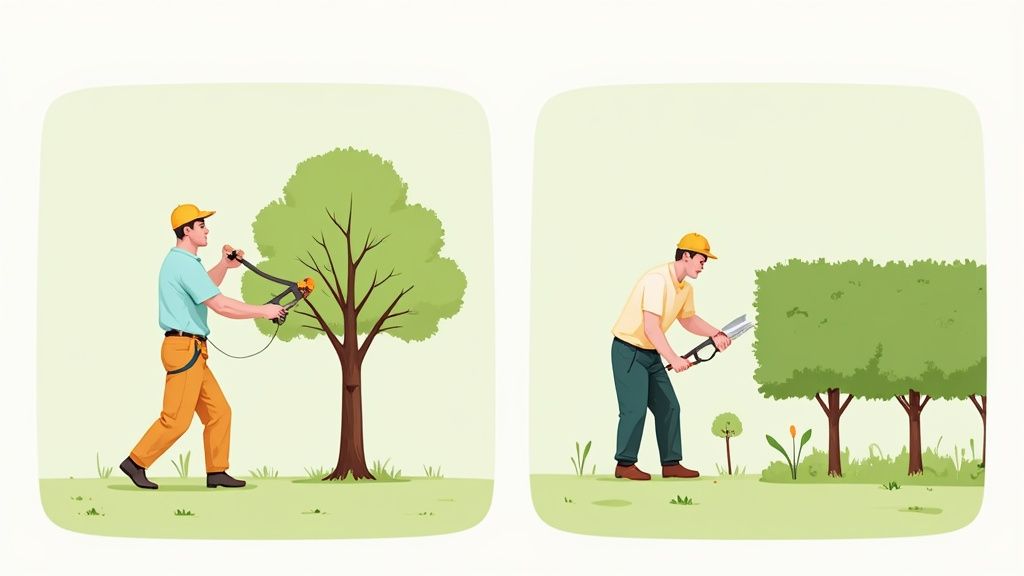
While many people use the terms interchangeably, their real-world goals couldn't be more different. The right cut at the right time has a huge impact on your plant’s resilience, growth, and lifespan, which is especially true in Georgia's dynamic climate. A simple misunderstanding of what your tree needs can lead to stressed plants, weak flowering, or even cause permanent harm.
Making the wrong cut isn't just a cosmetic oops—it's an open invitation for diseases and pests to move in. For instance, an aggressive trim when a tree actually needs careful pruning can be just as destructive as harmful shortcuts like tree topping, which can completely compromise a tree's structure. You can learn more about why tree topping is so dangerous in our detailed guide on the topic.
To make things crystal clear, let's look at a quick breakdown of how these two essential tasks differ.
Quick Comparison: Pruning vs. Trimming at a Glance
For a high-level view, this table lays out the fundamental differences between the two practices.
| Aspect | Pruning (For Health) | Trimming (For Shape) |
|---|---|---|
| Primary Goal | To improve the long-term health, structural integrity, and productivity of the plant. | To maintain a neat appearance, uniform shape, and desired size. |
| Typical Target | Dead, diseased, damaged, or crossing branches; structural defects. | Overgrown branches, exterior foliage, shaping hedges and shrubs. |
| Key Outcome | Promotes strong growth, prevents disease spread, and enhances safety. | Improves curb appeal, maintains clean lines, and controls plant size. |
At the end of the day, both are crucial for a well-maintained landscape, but they serve entirely different masters.
The simplest way to remember the difference: You prune a tree to help it live a long, healthy life. You trim a hedge to keep it from looking messy. Both are essential, but they solve completely different problems for your landscape.
Why Pruning Is Your Tree's Best Health Investment
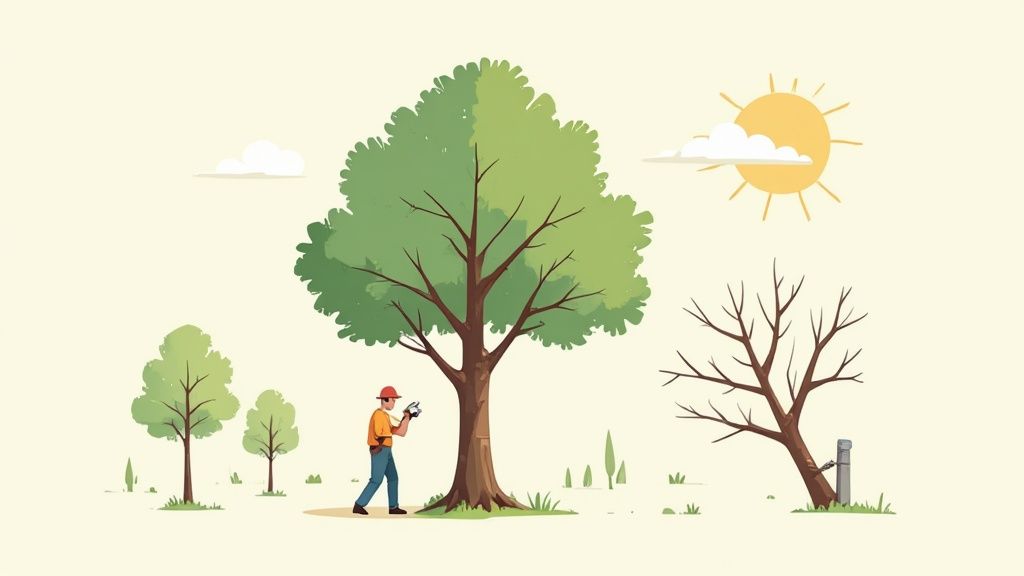
If trimming is like giving your tree a haircut, then pruning is its annual health check-up and physical therapy session rolled into one. This isn't about making a tree look neat; it's a strategic, science-backed approach focused squarely on long-term health and structural stability. Think of it less as a cosmetic touch-up and more like essential surgery. Each cut an arborist makes has a specific purpose—to protect the tree, encourage strong growth, and stop future problems before they even start.
The number one goal of pruning is to remove any part of the tree that has become a liability. This means targeting branches that are dead, diseased, or damaged, what we in the industry call the three D's. Letting these compromised limbs linger is like leaving an open wound; they become entry points for pests and decay that can quickly spread to the rest of the tree. A single diseased branch, if ignored, can put the entire organism at risk.
Building a Stronger Healthier Tree
Beyond getting rid of immediate threats, proper pruning is about shaping a tree’s future. For younger trees, structural pruning is critical. An arborist can spot and correct poor growth habits early on, removing weak, V-shaped branch unions that are notorious for splitting during intense Georgia storms. They also take out branches that cross and rub against each other, preventing wounds that invite infection.
This careful, selective removal achieves several key things at once:
- Improves Air Circulation: By thinning out a dense canopy, we allow air to move more freely. This helps dry out the leaves and branches, reducing the damp conditions where fungal diseases love to grow.
- Enhances Sunlight Penetration: More sunlight can now reach the inner parts of the tree, boosting photosynthesis and promoting a fuller, more balanced canopy instead of one that's all growth on the outside and bare on the inside.
- Directs Growth Energy: When a tree isn't wasting resources on weak or dying limbs, it can redirect that energy into what really matters: developing a stronger trunk, a more resilient root system, and better fruit or flower production.
Pruning is proactive healthcare. It's about anticipating a tree's future needs and making precise cuts today to prevent catastrophic failures, disease outbreaks, and stunted growth tomorrow. This approach adds years, and sometimes decades, to a tree's lifespan.
The Real-World Impact of Strategic Pruning
Picture a huge, mature oak in an Alpharetta backyard. Left on its own, it might develop heavy, over-extended limbs that hang precariously over the house. A professional arborist would identify these hazardous branches and strategically reduce their weight, making the tree significantly safer without sacrificing its natural form.
Now, think about a young dogwood just getting started. Early structural pruning can establish a strong central leader and well-spaced branches. This one intervention ensures it grows into a beautiful, resilient specimen instead of a weak, tangled mess. This is the clear difference between pruning and trimming: pruning is a long-term investment in the very life of your tree.
This intense focus on health is why professional tree and shrub pruning services make up 44% of the market in the landscaping industry. It underscores just how vital this service is over more superficial upkeep. You can read the full research about tree service market share to see why so many homeowners prioritize it. By investing in proper pruning, you aren't just tidying up your tree; you are actively safeguarding its future.
The Art and Science of Trimming for Aesthetics
Where pruning is all about a tree’s long-term health, trimming is purely about aesthetics—it's the art of shaping your landscape to look its absolute best. Think of it as the regular upkeep that keeps your property looking sharp, tidy, and intentionally designed. Trimming is all about managing the shape, size, and overall neatness of your plants, especially hedges and shrubs.
The main goal here is to control and direct a plant’s outward growth. This means making a lot of small, shallow cuts to the exterior foliage, which is a world away from the deep, structural cuts of pruning. The result? A clean, uniform look that gives your property’s curb appeal a serious boost. It's a much more frequent and far less invasive task than pruning, designed simply to keep plants looking great and staying within their designated space.
Shaping Your Landscape
Trimming has a few key applications that completely change how your landscape looks and feels. Each one serves a distinct visual purpose, turning what could be overgrown messes into beautifully manicured features.
- Creating Clean Lines: Trimming is what sculpts hedges into those crisp, formal shapes. This could be a neat boxwood border lining a walkway in Roswell or a tall, dense privacy screen in Johns Creek.
- Managing Plant Size: It’s easy for foundation shrubs around Marietta homes to get out of hand and start covering windows and pathways. Regular trimming keeps them in check, making sure they complement your home's architecture instead of hiding it.
- Promoting Fuller Growth: For many shrubs, a light trim of the outer growth actually encourages the plant to fill out and become denser. This technique is perfect for creating that full, vibrant, and bushy appearance.
This focus on appearance is the core difference between pruning and trimming. While both involve cutting, their reasons for doing so couldn't be more different. If you’re trying to elevate the look of your property, professional services like our tree trimming in Atlanta, GA can deliver that polished, well-maintained curb appeal you're after.
While trimming gives you that instant visual reward of a neat and orderly yard, it's critical to remember it won't fix underlying structural problems or deep-seated health issues. Think of it as a surface-level treatment, not a cure.
Ultimately, trimming is the finishing touch that brings a whole landscape design together. It ensures every plant looks its best and plays its part in your overall vision. But for the foundational health that supports all that beauty, you need the precise, surgical cuts that only pruning can provide.
Mastering the Calendar for Pruning and Trimming
Figuring out the difference between pruning and trimming is a great start, but the real secret to a healthy, beautiful landscape is knowing when to do each task. Timing isn't just a friendly suggestion in tree care—it's a core principle. If you make cuts at the wrong time of year, you can seriously stress your plants, open the door for diseases, and even stop them from flowering altogether.
When it comes to pruning for health, the best time is almost always when the plant is dormant. Here in Georgia, that usually means late fall or winter, right after the leaves have fallen. Pruning during this "off-season" keeps stress on the tree to a minimum since it's not actively trying to push out new growth. It also gives you a crystal-clear view of the branch structure, making it much easier to spot and remove problem limbs without a canopy of leaves in the way.
The Ideal Pruning Window
Most of your trees and shrubs will thank you for a good winter prune. That said, there are some major exceptions that every homeowner in places like Cumming or Milton needs to be aware of.
- Spring-Flowering Trees and Shrubs: For beauties like dogwoods, azaleas, and magnolias, you have to hold off until after they've finished their spring show. If you prune them in the winter, you'll be cutting off all the buds that were getting ready to become next season's flowers.
- Summer-Flowering Shrubs: On the flip side, plants like crape myrtles bloom on new growth. You'll want to prune them in late winter or early spring just before they wake up. This encourages a burst of vigorous new growth that will be loaded with summer blossoms.
If you want to get into the nitty-gritty for specific trees, check out our guide on the best time to prune trees for detailed, season-by-season advice.
When to Schedule Trimming
Trimming, which is all about aesthetics and shape, follows a completely different schedule. Since you’re just making light cuts to the outer growth, it’s best to do this during the active growing season. This allows the plants to heal and fill in quickly, keeping that full, lush look you're after. For most hedges and shrubs, a light trim once or twice during spring and summer is perfect.
Timing is the silent partner in successful tree care. Pruning during dormancy is a strategic health decision that sets a tree up for a vigorous spring. Trimming during the growing season is a cosmetic choice that maintains a polished look without causing undue harm.
This timeline gives you a great visual of the transformation that proper trimming can achieve, taking a plant from overgrown to perfectly manicured.
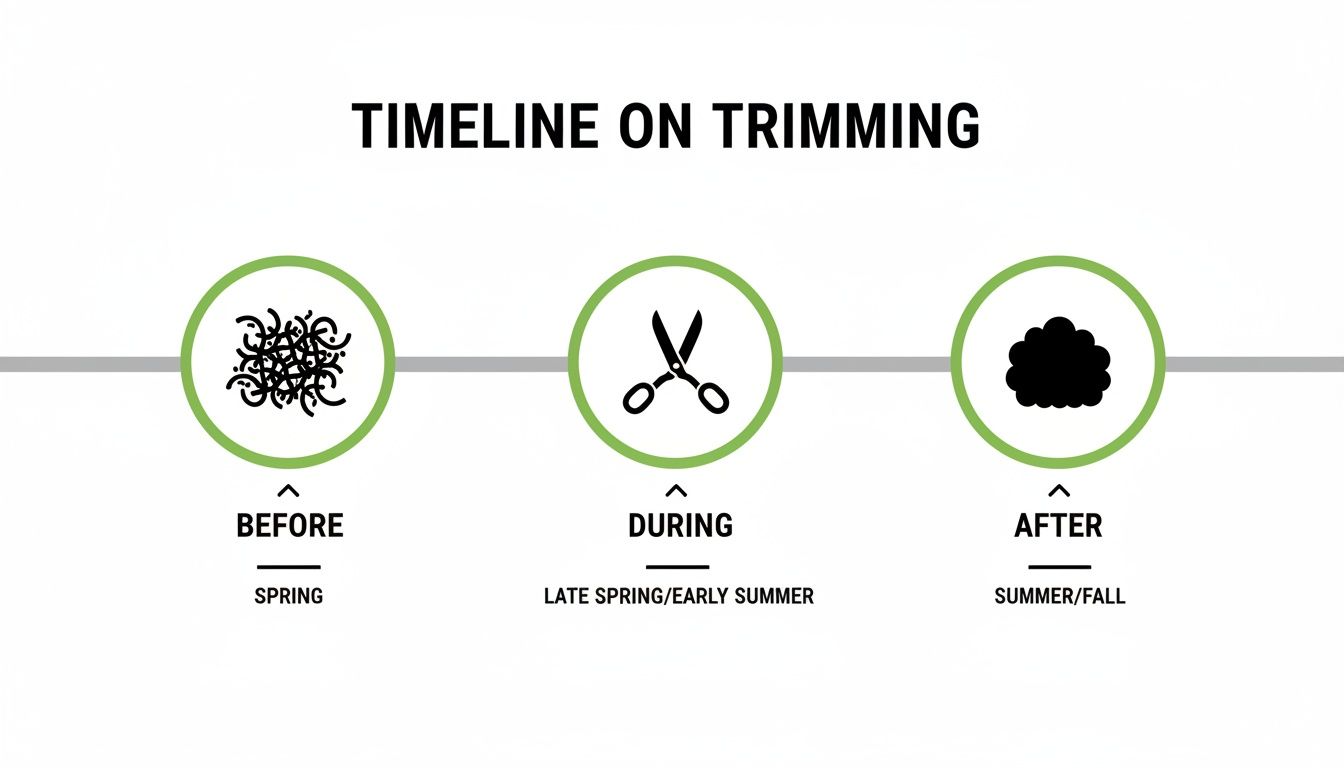
The takeaway here is pretty simple: trimming is ongoing maintenance you do when things are growing to keep the shape in check. By lining up your pruning with dormancy and your trimming with the growing season, you’re giving your plants their best shot at not just surviving, but thriving.
Choosing the Right Tools for Precision and Safety
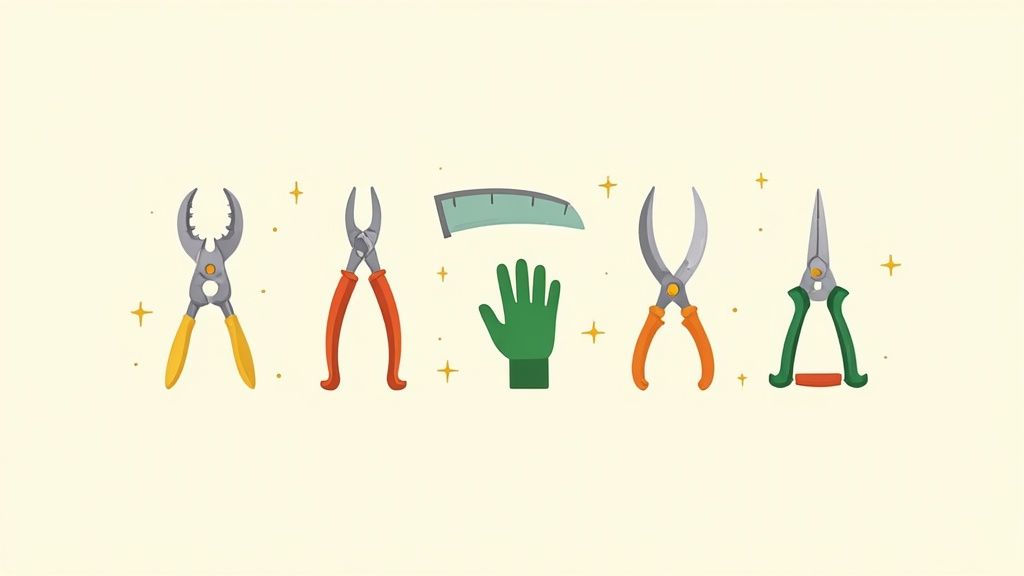
Knowing the difference between pruning and trimming is a great start, but it's using the right tools that truly turns that knowledge into healthy, beautiful trees. When you equip yourself properly, the work isn't just easier—it results in clean, precise cuts that help your plants heal quickly and stay strong. Grab the wrong tool, and you could end up with ragged wounds that are an open invitation for pests and disease.
A dull or dirty blade is another classic mistake. Instead of a clean slice, it crushes plant tissue and causes far more damage than necessary. The goal is always a cut so clean the plant can begin the healing process immediately. This is exactly why your tool selection and maintenance are non-negotiable for proper tree care.
Essential Tools for Health-Focused Pruning
Pruning is all about surgical precision. You're removing specific branches to benefit the entire tree, and each tool is designed for a particular branch size to ensure you get that perfect, clean cut every single time.
- Hand Pruners (Bypass Shears): These are your workhorses for small branches and twigs up to three-quarters of an inch in diameter. Their scissor-like action delivers a clean slice, perfect for delicate stems.
- Loppers: When you need a bit more muscle, loppers are the answer. Their long handles give you the leverage to cut through branches up to 1.5 inches thick, making them ideal for getting deeper into shrubs or tackling branches too beefy for hand pruners.
- Pruning Saws: For any branch thicker than 2 inches, a pruning saw is absolutely essential. Its sharp, curved blade is designed to cut smoothly on the pull stroke, which prevents the saw from getting stuck or "binding" in the wood.
Equipment for Aesthetic Trimming
Trimming is more about shaping and maintaining size, which often means cutting lots of small stems all at once. The tools for this job are built for efficiency and creating those nice, uniform surfaces.
A clean cut from a sharp tool is a plant's best defense against pests and pathogens. In contrast, a ragged cut is an open invitation for trouble, turning a simple maintenance task into a potential health crisis for your tree or shrub.
For shaping hedges and shrubs, nothing beats a good pair of hedge shears. They come in manual and powered versions, and their long, flat blades are perfect for creating straight lines and smooth curves. Manual shears give you more control for detailed work, while electric or gas-powered models can make short work of large hedges on properties in Forsyth County.
And a final pro tip: Before you start any job, always sanitize your blades. A quick wipe with rubbing alcohol or a diluted bleach solution is all it takes to prevent the spread of diseases from one plant to another.
Knowing When to Call a Certified Arborist
While a bit of light trimming on a small shrub is a perfectly fine weekend project, understanding the difference between pruning and trimming also means knowing your own limits. Some jobs just aren't meant for a ladder and a handsaw. They carry serious risks to your property and, more importantly, to you. This is where a certified arborist becomes an essential partner in caring for your landscape.
Any work that requires you to leave the ground, work anywhere near a power line, or tackle branches bigger than two inches in diameter is squarely in professional territory. It’s not just about having the right gear; it’s about expertise. Arborists are trained to read a tree’s structure, use specialized safety equipment, and make precise cuts that a homeowner simply can’t replicate safely. They bring a deep understanding of tree biology, letting them spot complex diseases or structural weaknesses that might otherwise go unnoticed.
Scenarios Demanding Professional Expertise
Bringing in an expert isn't an expense; it's an investment in the long-term health of your trees and the safety of your home. You should always pick up the phone and call a professional for:
- Large Limb Removal: Taking down heavy, overhead branches is a science. It requires specific rigging techniques to guide them safely to the ground, preventing them from crashing through your roof or fence.
- Proximity to Power Lines: This is a non-negotiable, life-or-death situation. Professionals are specially trained to work around high-voltage lines, a task that can be fatal for anyone else. Don't even think about it.
- Diagnosing Health Issues: If your tree is showing signs of decay, has strange spots on its leaves, or looks like it's fighting off pests, an arborist can give you an accurate diagnosis and create a real treatment plan.
- Post-Storm Damage Assessment: After a big storm rolls through, it can be hard to tell what’s really damaged. An arborist can safely assess your trees, identifying which ones can be saved and which have become immediate hazards that need to come down.
For complex tree health issues, professional services are not a cost, but an investment. An arborist's expertise protects your property's value, ensures the job is done correctly, and safeguards your family from potential hazards.
The numbers back this up. When you look at the tree care industry, the split between pruning and trimming is clear. Health-focused pruning leads the U.S. tree services market, making up a 44% share, while aesthetic trimming is just one part of the general maintenance offered by 82% of landscaping firms. You can discover more insights about the tree service industry to see the value professionals deliver. This tells a powerful story: when the health of a major landscape asset is on the line, homeowners overwhelmingly trust the experts.
Even after you get the hang of what separates pruning from trimming, a few practical questions always seem to pop up. Let's dig into some of the most common ones we hear from homeowners, so you can feel confident you're making the right calls for your trees.
Can You Trim and Prune at the Same Time?
It's tempting to knock both jobs out at once, but it’s usually best to keep them separate. The timing and goals for each task are often at odds. Think of it this way: pruning is a health-focused operation best done when a tree is dormant, while trimming is a cosmetic touch-up performed during the active growing season.
Trying to do both can seriously stress out a tree. If a tree needs both, always prioritize its health. Do the structural pruning during the winter, then circle back for a light, aesthetic trim later in the growing season after the tree has had plenty of time to recover.
The guiding principle here is to avoid overwhelming your tree. A dormant-season prune followed by a growing-season trim lets the plant recover from each activity on its own terms, which is always better for its long-term health.
How Much Can You Safely Cut at Once?
Here’s a critical rule of thumb that every certified arborist lives by: never remove more than 25% of a tree’s canopy in a single year. Taking off more than that can send the tree into a state of shock, draining its energy reserves and leaving it wide open to opportunistic pests and diseases. It's just not worth the risk.
What Is the Biggest Mistake Homeowners Make?
Easily one of the most damaging—and common—mistakes we see is when people cut a branch completely flush against the trunk. This mistake removes the branch collar, which is a slightly swollen area of tissue absolutely essential for healing the wound. Without that collar, the tree can't properly seal off the cut, leaving an open invitation for decay to set in.
Other frequent missteps include:
- Using Dull or Dirty Tools: This rips the wood instead of cutting it cleanly, leading to slow healing and easily spreading diseases from one plant to another.
- Wrong-Season Pruning: If you prune a spring-flowering tree like a dogwood or a redbud in the winter, you’re cutting off all the buds that would have become next season’s beautiful blooms.
Getting these details right is what separates a thriving landscape from a struggling one. If you’re dealing with a complex job or just feel out of your depth, the expert team at Richmond Tree Experts GA is always here to help homeowners in Cumming, Alpharetta, Roswell, and the surrounding areas. Contact us today for a professional consultation.
Need a tree taken down safely? Richmond Tree Experts has worked on Marietta and Metro Atlanta trees since 1985, and every job is looked at by an ISA Certified Arborist before it is priced. Start with tree removal, or see everything we do: tree removal, stump grinding and arborist services across Cobb, Fulton, Cherokee, Gwinnett and DeKalb counties (service areas).
Call (770) 974-3964, 7am to 11pm every day, or request an estimate online.

