

Tree topping is one of the most destructive things you can do to a tree. It's the practice of indiscriminately chopping off the top of a tree, along with its main branches, leaving behind ugly, weak stubs. This isn't professional pruning; it’s an act of severe injury. While it's often sold as a quick fix to reduce a tree's size, it actually creates far more problems and hazards than it solves.
Understanding Tree Topping: A Drastic and Damaging Cut

Think of it this way: what if a surgeon's solution to you being "too tall" was to simply cut your legs off at the knees? It sounds extreme, but that’s a pretty good analogy for what tree topping really is. It’s a drastic, uninformed attack that completely ignores the tree’s biology and structural integrity. There's a reason seasoned arborists consider this practice malpractice.
Sometimes called hat-racking or heading, tree topping is condemned by tree care professionals worldwide. The process strips anywhere from 50-100% of the tree's leaf-bearing crown—the very engine that allows it to produce food through photosynthesis. This devastating loss sends the tree into a state of shock, forcing it into a desperate survival mode. You can find more technical details about the process on Wikipedia.
Tree Topping Misconceptions vs Reality
So why do people still do it? Often, it's because homeowners have fallen for a few persistent myths. They might believe topping will make a tree safer or that it’s an easy solution for an overgrown canopy. The truth is, topping kicks off a domino effect of problems that wreck the tree's health, safety, and natural beauty.
Topping a tree is like performing major surgery without a medical license. The wounds are too large to heal properly, inviting decay and disease that can slowly kill the tree from the inside out.
Let's clear the air and debunk some of the most common misconceptions about tree topping. Here’s a quick look at the myths versus the arboricultural reality.
Tree Topping Misconceptions vs Reality
| Common Misconception | Arboricultural Reality |
|---|---|
| "Topping makes a tree safer." | It creates weak, poorly attached new growth that is far more likely to break off in a storm. |
| "It's the best way to reduce tree height." | Proper crown reduction achieves size control while preserving the tree's natural form and health. |
| "The tree will grow back healthier." | The tree grows back weaker, stressed, and highly susceptible to pests and diseases. |
| "It's a cheap and easy solution." | It leads to recurring costs for managing hazardous regrowth and eventual tree removal. |
As you can see, the short-term "fix" of topping a tree is never worth the long-term damage. It’s an expensive mistake that ultimately leads to a weaker, more dangerous, and unsightly tree.
How Topping Wrecks Your Tree's Health and Defenses
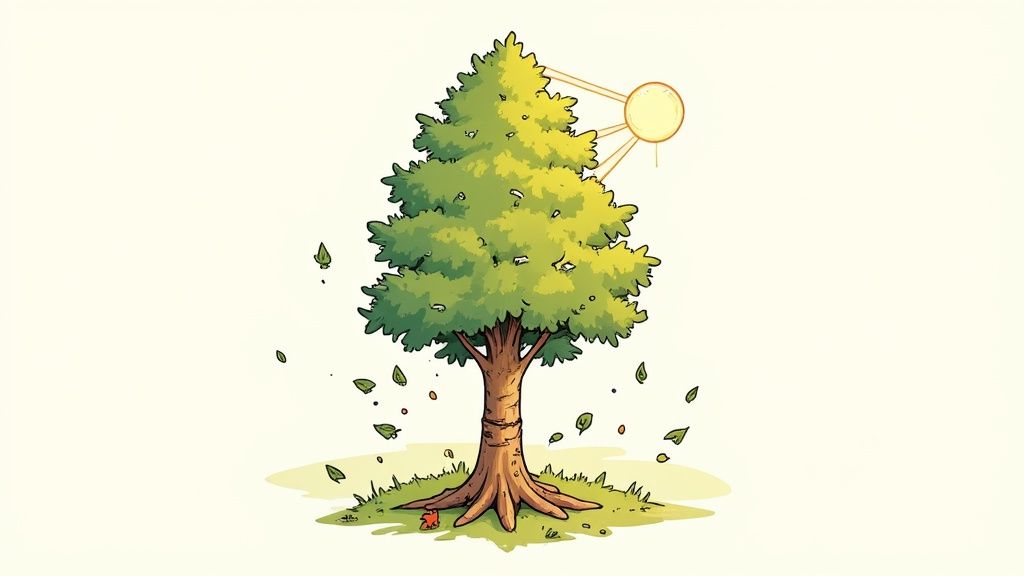
Topping a tree isn't just a bad haircut; it's a brutal, life-threatening injury that kicks off a chain reaction of problems. The ugly stubs you see are just the beginning. Below the surface, the tree is in a desperate fight for its life against a triple threat: shock, starvation, and decay.
Think about what happens to your skin after a bad sunburn—it’s painful, damaged, and wide open to infection. That's exactly what happens to a tree's bark when topping suddenly exposes it to intense, direct sunlight it's not used to. The bark, once protected by a lush canopy, simply can't handle the shock.
This abrupt exposure causes a condition called sunscald, where the tissue literally cracks, dies, and peels away. These deep cracks become open doors for boring insects and bacteria to march right into the tree's inner layers, bypassing all its natural defenses.
The Slow Process of Starvation
A tree's leaves are its power plants. They use photosynthesis to turn sunlight into the energy it needs for every single function, from growing roots to fighting off pests. When you top a tree, you can remove anywhere from 50% to 100% of its leaf-bearing crown, essentially pulling the plug on its entire food production system.
This massive loss of foliage immediately throws the tree into starvation mode. It’s forced to burn through its stored energy reserves just to survive, leaving it too weak to heal its wounds or defend itself from diseases that are just waiting for an opportunity.
The big, gaping wounds left behind by topping cuts are almost impossible for a tree to seal off properly. Unlike a small, clean pruning cut that can heal over, these large stubs become the perfect entry point for wood-decaying fungi that can hollow a tree out from the inside over many years.
An Open Invitation for Disease and Decay
A healthy tree is amazing at walling off injuries, creating special barriers to stop decay from spreading. But the huge, ragged cuts from topping are just too much for this natural defense system to cope with.
These open wounds turn into a breeding ground for fungi, bacteria, and pests. Topping leaves a tree vulnerable to all sorts of issues, including serious diseases. For any plant owner, understanding the signs of trouble is key. If you're looking for a general overview, there are good resources on how to identify plant diseases and save your garden that can help you spot problems early.
This combination of factors creates a dangerous downward spiral:
- Weakened Defenses: The tree is too starved for energy to effectively fight off infections.
- Open Wounds: Pests and fungi get an easy-access pass to the tree’s vulnerable heartwood.
- Structural Failure: As decay sets in from the inside, the tree becomes hollow and weak, making it a serious hazard that’s prone to breaking apart.
In the end, what starts as a misguided attempt to control a tree's size actually destroys its health, its defenses, and its structural integrity. You’re left with a liability instead of an asset.
Why Topped Trees Become More Dangerous, Not Safer
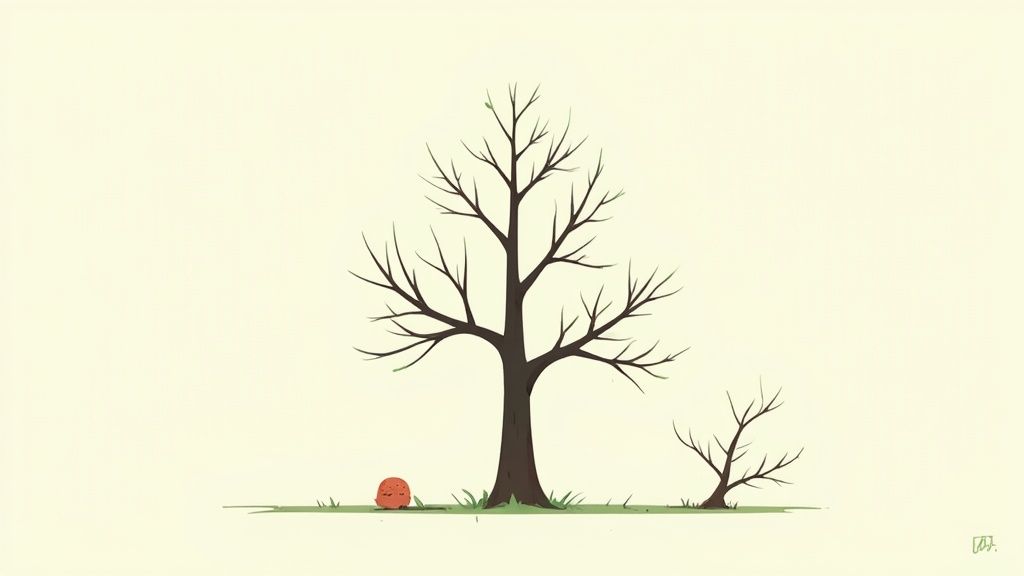
Many homeowners look at a tall tree and think that chopping off the top is a quick fix for safety. The logic feels sound—a shorter tree can’t fall as far, right? But this common assumption couldn't be more wrong. In reality, topping a tree triggers a desperate survival response that creates a far more dangerous situation than the one you were trying to prevent.
When a tree is topped, it essentially goes into shock. With a massive portion of its leaves gone, its food-making ability is crippled. To avoid starving, the tree kicks into crisis mode, forcing out a thick flush of new shoots from dormant buds just below the cuts. These shoots, known as watersprouts, are the tree's last-ditch effort to regrow its canopy and start photosynthesizing again.
These new branches aren’t like the old ones, though. They shoot up at an incredible rate—sometimes growing up to 20 feet in a single year—quickly creating a full, bushy canopy. From the ground, it might even look like the tree is recovering beautifully. The real danger, however, is hidden in how they’re attached.
The Illusion of Strength
Think of it like this: an original, natural tree limb is like a heavy-duty steel bolt anchored deep into a structural beam. It’s integrated into the tree's very structure, built to handle decades of wind, snow, and ice.
Watersprouts? They’re more like limbs attached with a dab of weak glue. They sprout from the outermost layer of wood right below the topping cut, with no deep, interlocking connection to the tree’s core. The attachment is superficial, flimsy, and notoriously prone to snapping off.
The dense cluster of fast-growing watersprouts creates a thick, bushy canopy. While it might look healthy from a distance, this regrowth is structurally unsound, with dozens of weakly attached branches ready to snap under stress.
As these poorly anchored sprouts get longer and heavier, they put immense pressure on their weak attachment points. The dense foliage also acts like a sail, catching wind gusts that a properly structured canopy would let pass through. This combination turns what was once a sturdy tree into a ticking time bomb.
A Hazard Waiting to Happen
The result is a tree that is far more likely to break apart during a storm, under the weight of ice, or even under its own rapidly increasing weight. Instead of a few large, sturdy limbs, you now have a mess of weak sprouts that can fail at any moment, posing a serious risk to your home, vehicles, and anyone underneath.
This weak new growth inevitably needs to be managed, which often leads to a costly and dangerous cycle of re-topping or corrective pruning. In cases where the tree’s structure is severely compromised, you absolutely need a professional arborist's help. Sometimes, installing support systems is the only way to manage the risk. Learning about tree cabling and bracing services can give you an idea of how experts handle these high-risk situations.
Ultimately, topping a tree trades a predictable, stable structure for an unstable and unpredictable one, turning a beautiful natural asset into a long-term liability.
The Hidden Financial Burden of Tree Topping
At first glance, tree topping often looks like a bargain. The initial quote is usually much lower than one for professional, structural pruning, making it seem like a smart, budget-friendly way to manage a big tree. But this upfront "saving" is a classic illusion. It masks a vicious cycle of escalating costs that turns a one-time decision into a long-term financial headache.
The problem kicks off with the tree’s natural survival response. Those fast, weak watersprouts that erupt after a topping cut need constant attention. Unlike a properly pruned tree that might only need a touch-up every five to seven years, a topped tree becomes a high-maintenance problem. It demands re-cutting every two or three years just to keep its hazardous new growth from getting out of control.
This cycle locks homeowners into an expensive and recurring maintenance trap. Those initial savings get erased pretty quickly as you start paying for repeated service calls year after year.
The True Cost of Topping Your Tree
That endless trimming cycle is just one piece of the financial puzzle. The real costs start to multiply when you factor in all the hidden liabilities and long-term consequences that topping creates. A single bad decision can set off a domino effect of expensive problems down the road.
Topping a tree is a poor investment that only depreciates over time. Instead of adding value to your property, it creates a disfigured, unhealthy, and hazardous liability that costs more to manage and, eventually, to remove.
For property owners, the perceived savings of topping are quickly swallowed by this cycle of maintenance. Research confirms that because topped trees produce weak, fast-growing shoots, they need repeated trimming far more often than correctly pruned trees. In fact, over a 20-year period, a single topped tree can cost a homeowner 200–300% more in maintenance and liability expenses than a tree managed with proper pruning techniques. It's a hard financial lesson many learn too late. You can dive deeper into this topic through Spokane's Urban Forestry program on tree care economics.
Devaluing Your Biggest Asset
Beyond the direct costs of trimming, a topped tree can seriously tank your property's value. Healthy, mature trees are a huge asset, boosting curb appeal and even property prices. A disfigured, topped tree, on the other hand, is an eyesore. To prospective buyers, it screams neglect and signals potential danger.
The financial fallout includes several hidden expenses you might not think about at first:
- Increased Property Damage Risk: Those weakly attached sprouts are notorious for snapping off in a storm. They can easily damage your roof, car, or fence, leading to costly repairs and messy insurance claims.
- Eventual Removal Costs: Topping is often a slow death sentence for a tree. When the tree inevitably dies from stress and decay, you’re left with the substantial expense of having it professionally and safely removed.
- Reduced Property Value: A beautiful, well-maintained tree can add thousands to your home's value. A topped tree does the exact opposite, becoming a major negative that can lower its market price.
When you add it all up, the initial "deal" from a tree topper is anything but. The real price is paid over years in repeated maintenance, increased risk, and a hit to your property value, making proper, professional pruning the far wiser financial choice from day one.
Safe and Effective Pruning Alternatives
So, you've seen the damage tree topping can do, and now you're asking the right question: what's the correct way to prune a tree? It’s a great question, and fortunately, we have answers that don't involve butchering your beautiful trees.
Certified arborists have a whole playbook of techniques that work with a tree's natural biology, not against it. These methods keep your trees healthy, beautiful, and structurally sound without resorting to the kind of destruction topping causes.
Professional pruning isn't about just hacking away at branches. It's a blend of science and art, involving careful, strategic cuts designed to help the tree heal quickly while meeting goals like improving safety or managing its size. It’s all about precision. To really appreciate the level of detail involved, consider the meticulous skill behind proper pruning techniques like those used in bonsai. While your oak tree isn’t a bonsai, the principle of thoughtful, health-focused cuts is exactly the same.
Professional Pruning Methods
Unlike topping, which is a one-size-fits-all disaster, a real arborist tailors the approach to what your tree actually needs. Each technique serves a specific purpose, and we choose the right tool for the job.
Here are the three most common and effective methods you'll see professionals use:
- Crown Reduction: This is how you correctly reduce a tree's height or spread. We carefully trim branches back to a sturdy lateral branch—one that’s at least one-third the diameter of the branch being removed. This preserves the tree's natural form and encourages strong, stable regrowth.
- Crown Thinning: With this method, we selectively remove branches throughout the canopy. The goal is to let more sunlight and air flow through, which reduces the weight on heavy limbs and lessens the "sail effect" during high winds. A thinned tree is much more likely to withstand a storm.
- Crown Cleaning: This is the most fundamental type of pruning every tree needs. It’s all about removing the "three D's"—dead, diseased, and damaged branches. This simple practice dramatically improves a tree's health and safety by getting rid of weak points and closing off potential entryways for pests.
The real difference between professional pruning and topping comes down to the cut itself. An arborist makes precise cuts at branch collars or strong lateral branches to encourage proper healing. Topping leaves behind large, ugly stubs that are an open invitation for decay and disease.
The infographic below really drives home how the initial "savings" from topping quickly spiral into much higher costs down the road.
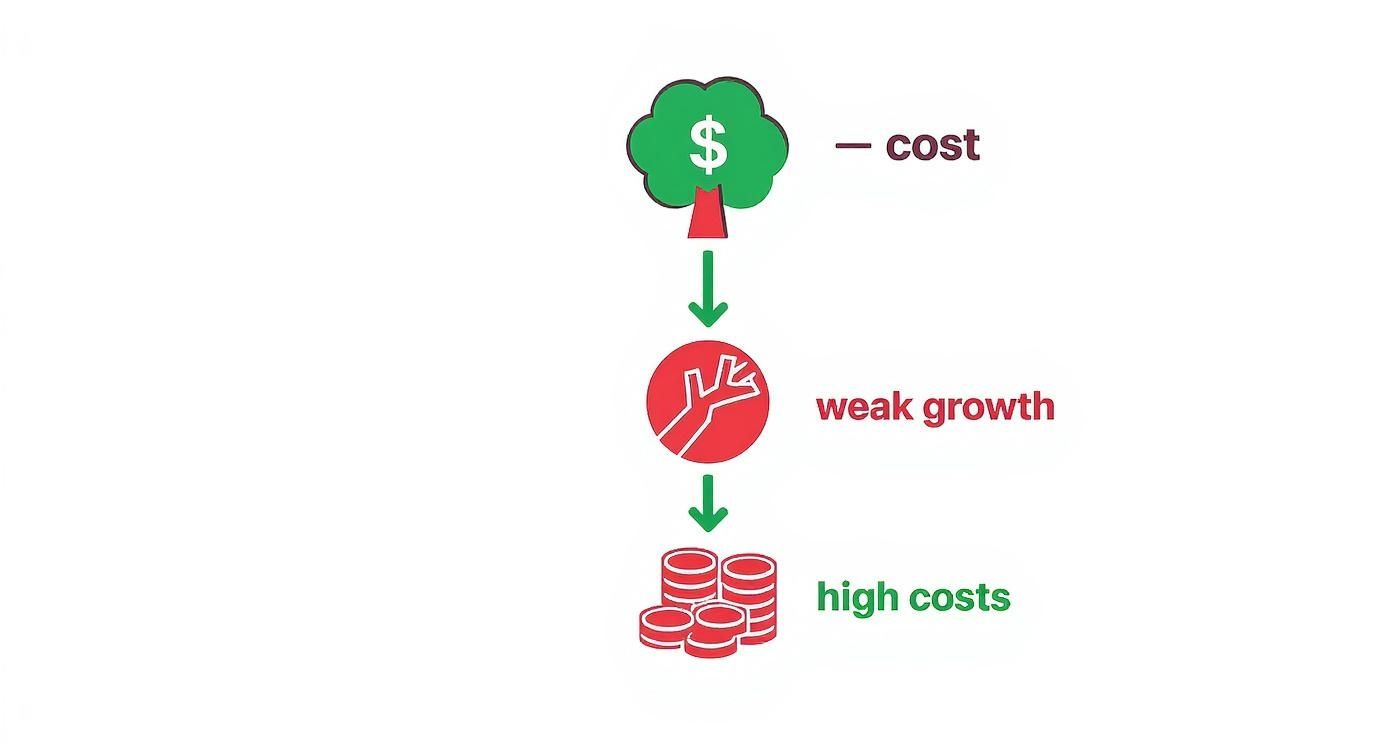
As you can see, topping is a financial trap. It turns a valuable asset into a long-term liability that demands constant, expensive fixes.
Tree Topping vs Professional Pruning Techniques
To make the contrast crystal clear, let's put these approaches side-by-side. The differences in purpose, impact, and long-term results are stark.
| Technique | Purpose | Impact on Tree Health | Long-Term Outcome |
|---|---|---|---|
| Tree Topping | Drastically and quickly reduce tree size with no regard for its structure. | Devastating. Creates large wounds, promotes decay, triggers weak and unstable new growth. | A weakened, ugly tree that is a safety hazard and requires expensive future maintenance or removal. |
| Crown Reduction | Methodically reduce a tree's height and spread while maintaining its natural form. | Positive. Encourages strong new growth from established lateral branches, improving structure. | A healthier, more stable, and attractively shaped tree that maintains its structural integrity. |
| Crown Thinning | Selectively remove interior branches to improve light and air circulation. | Beneficial. Reduces weight on limbs, lowers wind resistance, and discourages disease. | A more storm-resistant tree with a healthier canopy and a lower risk of branch failure. |
| Crown Cleaning | Remove dead, diseased, and damaged branches. | Essential. Improves safety, prevents the spread of decay and disease, and enhances appearance. | A safer, healthier, and more aesthetically pleasing tree with a longer lifespan. |
Ultimately, professional pruning is an investment in your tree's future, while topping is a shortcut that leads to a dead end.
When To Prune For Best Results
The "how" of pruning is critical, but the "when" is almost as important. While you can (and should) remove dead branches anytime you spot them, most major structural pruning is best done when the tree is dormant in the late fall or winter.
Pruning during dormancy puts far less stress on the tree and significantly lowers the risk of spreading diseases, like the dreaded oak wilt. Of course, every species is a little different. Understanding the best time to prune trees is key to ensuring a quick recovery and encouraging a burst of healthy, vibrant growth in the spring.
How to Hire a True Tree Care Professional
Avoiding the disaster that is tree topping really boils down to one thing: hiring the right people for the job.
It’s a hard truth, but not everyone with a chainsaw knows the first thing about tree health. Picking the wrong person can lead to damage that you just can't undo. A true professional is always thinking about your tree's long-term health, not just a quick and destructive fix.
The single most important credential you can look for is certification from the International Society of Arboriculture (ISA). This isn't just a piece of paper; it's the gold standard in our industry. It proves an individual has a deep understanding of arboriculture and has passed a seriously tough exam. To get the full picture, you can learn more about what it means to be an ISA Certified Arborist and why that certification should matter to you.
Questions to Ask Before You Hire
You need to arm yourself with the right questions to weed out the pretenders. A reputable arborist will be happy to answer your questions and give you clear, confident responses.
Here’s a simple checklist to guide that conversation:
- Are you and your crew fully insured? Don't be shy about this one. Ask to see proof of both liability and worker's compensation insurance. This is what protects you from any financial fallout if an accident happens on your property.
- What’s your approach to reducing a tree’s height? A pro will talk about crown reduction, not topping. If you hear the word "topping," consider it a major red flag and show them the door.
- Can you provide some local references? Any company that’s proud of its work will be more than willing to share references from happy clients right in your area.
A professional arborist will never use climbing spikes or spurs on a tree unless it's being completely removed. Those spikes punch deep, damaging wounds into the trunk, basically rolling out the welcome mat for pests and disease.
Red Flags to Watch Out For
Finally, keep your eyes peeled for some common warning signs. These are the tell-tale clues that you’re dealing with an unqualified "tree topper" and not a real-deal arborist.
- Door-to-door sales: Be skeptical of anyone who just shows up on your doorstep offering a "special deal" because they're "in the neighborhood."
- Pressure for a quick decision: Reputable arborists provide detailed estimates and give you the space and time to think them over. High-pressure tactics are a bad sign.
- Vague or suspiciously low prices: If a price seems way too good to be true, it almost certainly is. Topping is often cheaper upfront because it takes zero skill, but it will end up costing you far more down the road.
Common Questions About Tree Topping
Plenty of homeowners find themselves asking the same questions when a tree starts to feel a little too big for their yard. Let's walk through some of those common concerns and get you clear, straightforward answers that prioritize the health of your trees.
Is Topping the Only Solution for a Big Tree?
Absolutely not. In fact, topping is never the right solution. A certified arborist will recommend a proper crown reduction instead. This is a careful, skilled process where specific branches are pruned back to a healthy, supporting lateral branch.
The goal is to reduce the tree's overall size without sacrificing its natural shape or structural integrity. It's the polar opposite of topping, which involves indiscriminate, damaging cuts that butcher a tree's form.
A tree might technically survive being topped, but it will never truly recover. It's left permanently weakened, wide open to decay, and will need constant, costly maintenance to manage the hazardous, chaotic regrowth that always follows.
Can a Tree Ever Recover From Topping?
"Recover" is a pretty strong word here. While a tough tree might hang on for a while after being topped, it will never get back its natural form or the strength it once had.
The tree is left permanently scarred and vulnerable. This often kicks off a slow, steady decline that, years down the road, ends with its death and final removal. What was once a beautiful asset becomes a dangerous liability.
Is Tree Topping Illegal?
While most places don't have laws making it illegal for a homeowner to top a tree on their own property, many cities and municipalities do have ordinances against it for public trees.
More importantly, the entire professional tree care community, led by organizations like the International Society of Arboriculture (ISA), universally condemns it as a harmful and unacceptable practice. If a company offers "topping" as a service, it's a massive red flag that they aren't qualified or reputable tree care professionals.
If you're in Cumming, Alpharetta, Roswell, or anywhere in the surrounding Atlanta area and need real advice on managing your trees' size safely, put your trust in the ISA Certified Arborists at Richmond Tree Experts GA. We only use industry-approved methods that protect your tree’s health and your property's value. Get in touch with us today for a professional consultation by visiting us at https://richmondtree.com.
Need a tree taken down safely? Richmond Tree Experts has worked on Marietta and Metro Atlanta trees since 1985, and every job is looked at by an ISA Certified Arborist before it is priced. Start with tree removal, or see everything we do: tree removal, stump grinding and arborist services across Cobb, Fulton, Cherokee, Gwinnett and DeKalb counties (service areas).
Call (770) 974-3964, 7am to 11pm every day, or request an estimate online.

