

When homeowners ask me how deep tree roots really go, the answer almost always catches them by surprise. It's a lot shallower than you'd think. The overwhelming majority—we're talking nearly 90%—of a tree's entire root system is packed into the top 18 to 24 inches of soil. Instead of mirroring the branches above, these roots spread out wide, creating a massive, hidden network just beneath our feet.
Getting to the Root of It All
Most of us have this mental image of a tree with a giant, carrot-like taproot plunging deep into the earth. The reality, however, is much more like a wine glass. The wide, shallow bowl of the glass is the perfect analogy for the sprawling network of feeder roots soaking up water and nutrients. The stem? That represents the smaller, stabilizing anchor roots. It's a brilliant piece of natural engineering, all designed for maximum efficiency.
This expansive but shallow system is no accident. It allows trees to quickly capture the two things they need most: oxygen and rainwater, both of which are most plentiful right near the surface. A tree's one job is to survive and grow, and this root structure gets that job done perfectly.
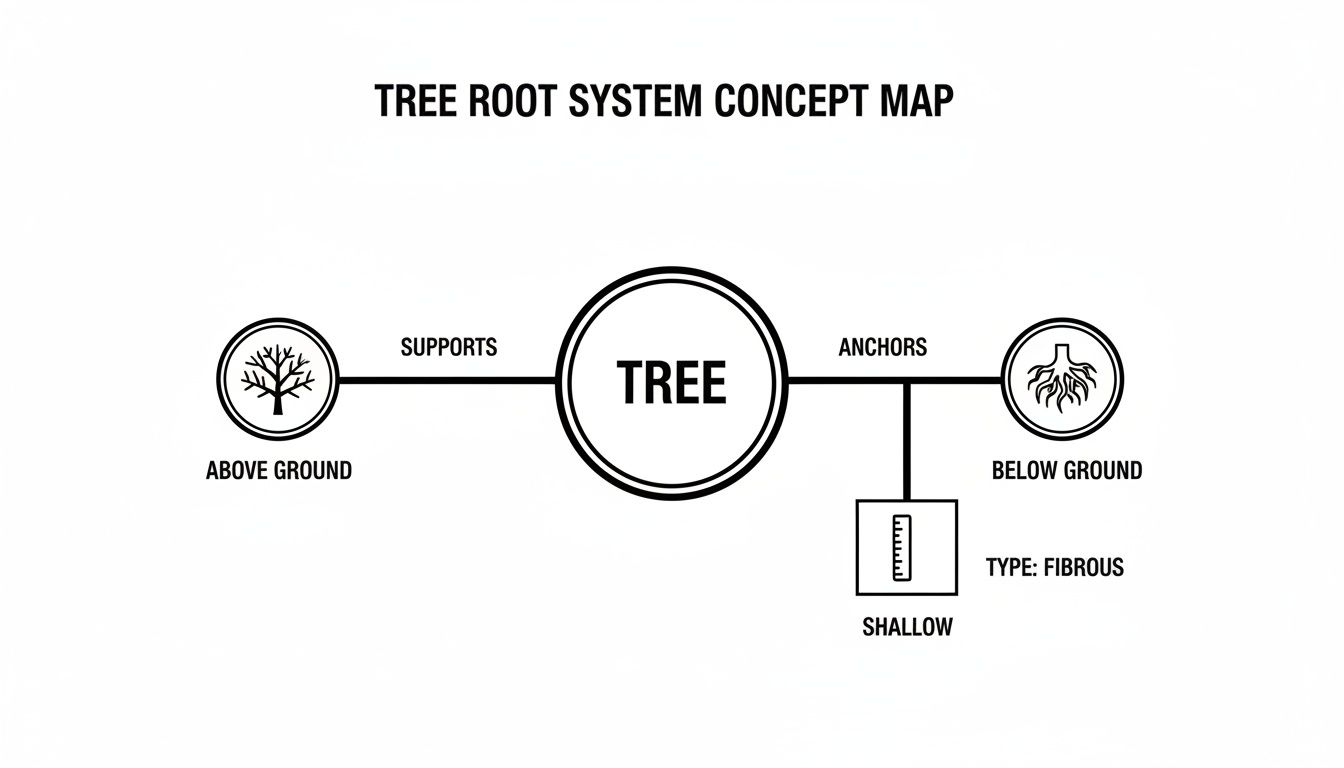
As you can see, while the tree stands tall and proud, its foundation is incredibly broad and surface-focused, prioritizing stability and resource gathering over sheer depth.
Why Spreading Roots Matter Most
Most of the real work is handled by the lateral roots that stretch far beyond the tree's drip line—often two to three times the width of the canopy. Think of these as the workhorses of the root system, responsible for collecting the vast majority of the tree's food and water. While they're absolutely essential for a tree's health, these are also the same roots that can cause trouble for nearby sidewalks, driveways, and foundations.
The myth of a deep, symmetrical root system causes many people to underestimate just how far a tree's roots can travel sideways. A tree's true footprint is often much, much wider than what you see above ground. That's a critical fact to remember when you're planting or planning any construction.
A quick look at the numbers can help put this into perspective.
Typical Tree Root Depth at a Glance
This table gives you a general idea of how deep you can expect the main root mass of different types of trees to be, versus the absolute deepest they could potentially reach under ideal conditions.
| Tree Category | Typical Depth of Main Root Mass | Potential Maximum Depth |
|---|---|---|
| Large Shade Trees | 18 – 30 inches | 10 – 25+ feet |
| Small/Medium Trees | 12 – 24 inches | 8 – 15 feet |
| Shrubs & Ornamentals | 8 – 18 inches | 4 – 10 feet |
As you can see, the bulk of the action always happens near the surface, even for the largest trees.
What About Maximum Root Depth?
Now, while that main root mass stays shallow, some trees do send down specialized roots for extra stability or to chase water deeper in the soil, especially during a drought. Arborists sometimes call these "sinker roots" or "striker roots."
Global studies back up this two-part strategy. One huge review on tree rooting depths found that while 95% of all roots are found within the top 3.6 feet of soil, some trees can push down to an average maximum depth of about 23 feet to tap into those deep water reserves. It’s a fascinating adaptation, for sure. But for the average tree in your yard here in Georgia, that kind of incredible depth is the exception, not the rule.
What Dictates How Deep a Root System Grows
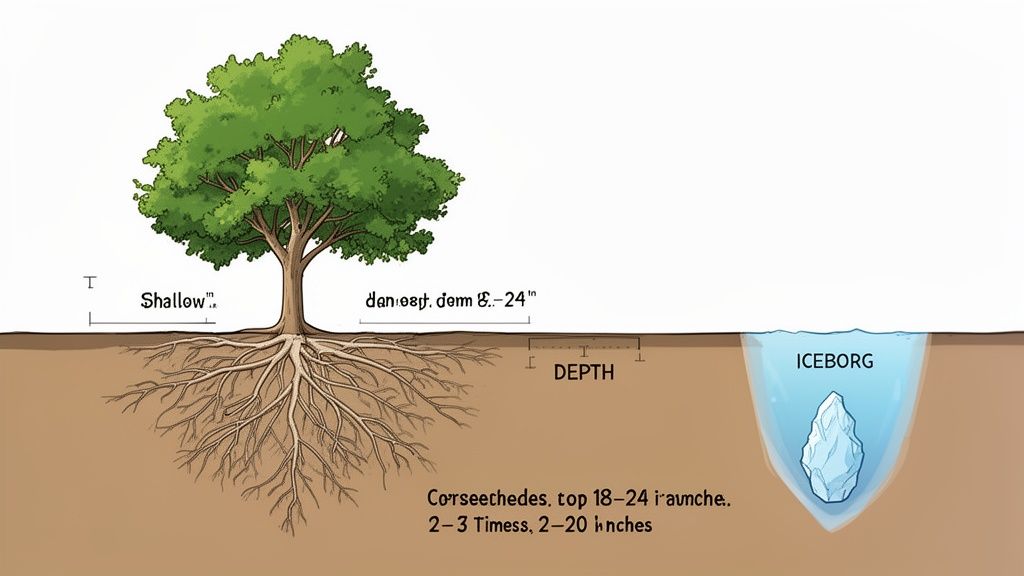
So, if most tree roots hang out near the surface, what actually tells them to spread wide or dig deep? It’s a fascinating dance between a tree's genetic programming and the neighborhood it grows up in. Think of genetics as the initial game plan, but the soil and local conditions are the playing field that really calls the shots.
Some trees, like many oaks and pines, are born to send down a powerful taproot. This is one main, beefy root that drills straight down, acting as a deep anchor and a probe for water reserves far below the surface. On the flip side, species like maples and elms tend to favor a fibrous root system, which looks more like a dense mat of thousands of smaller roots spreading out right under the grass.
But that genetic tendency is only half the story. The soil itself is the real architect here, sculpting the root system into its final form. A tree's roots are always on a mission, hunting for the easiest path to the resources they need to survive.
The Role of Soil Composition
The texture and density of your soil have a huge say in how deep any root can possibly go. It all boils down to the path of least resistance. Roots will always grow where it’s easiest to push forward and where they can find the good stuff—air, water, and nutrients.
Here in the Atlanta area, we're famous for our dense, compacted Georgia red clay. For a tiny tree root, trying to muscle through that heavy soil is like trying to drill through soft rock. It's a ton of work for very little reward.
Because of this, roots in our clay soil often give up on going down and instead spread out horizontally through the looser, richer topsoil. This creates an incredibly wide but frustratingly shallow root plate.
Now, if that same tree were growing in loose, sandy, or loamy soil, it’s a completely different ballgame. Those soils let roots dive deep with hardly any effort, which encourages a much stronger, more stable anchor system. The difference can be night and day, even for the exact same species of tree.
A tree’s root system is opportunistic. It won't waste energy trying to grow deep into compacted, oxygen-poor soil when everything it needs—water, air, and nutrients—is readily available in the top few feet. The soil conditions dictate the strategy.
Water and Oxygen Availability
Beyond just the soil's texture, the two most critical ingredients for root growth are water and oxygen. They are the true drivers of root depth, and their availability is tied directly to the ground beneath your feet.
Roots actually have to breathe. They need oxygen for respiration, the process that turns sugars into the energy they need to grow. This is why you almost never find healthy roots in waterlogged, swampy soil. Ground that is constantly saturated, which is common in low spots or yards with poor drainage, forces roots to stay right at the surface just to get a gulp of air.
This leads to a few common scenarios:
- Ideal Conditions: Well-drained, porous soil offers that perfect sweet spot of moisture and oxygen, giving roots the green light to explore deeper.
- Drought Conditions: During a dry spell, the moisture in the topsoil is the first to go. This can trigger some roots to push deeper in a desperate search for water, but only if the soil is loose enough to let them.
- Waterlogged Conditions: In soil that’s too wet, water fills all the air pockets, pushing the oxygen out. Tree roots in this situation will stay dangerously shallow because growing any deeper would literally cause them to drown.
This delicate balance is why the question of how deep are tree roots never has a simple answer. It’s a dynamic, living system that’s constantly responding to the ever-changing world underground. The roots you can't see are always adapting to the unique conditions on your property, from the type of clay under your lawn to the way you water your garden.
How Tree Size and Climate Shape the Root Zone
A tree's visible size is one of the biggest clues to its hidden needs. That towering White Oak you see in a Cumming, Georgia park requires a colossal underground anchor to stay upright during our summer thunderstorms. Its roots absolutely have to spread wider and push deeper than those of a small, decorative Dogwood. It’s a simple rule: the bigger the tree, the bigger its support system must be.
Think of it this way: a tree's trunk and branches are like the sail of a ship, and the root system is its keel. A massive sail catches a lot of wind and needs a heavy, substantial keel to keep the ship from tipping over. A tree with a huge canopy is no different—it needs an extensive root network for stability and to slurp up the immense amount of water and nutrients required to keep all those leaves and branches healthy.
But while a tree’s size sets the general blueprint, it's the local climate that acts as the ultimate director, telling the roots how and where to grow to meet those needs. A tree's root system is really a dynamic survival strategy, constantly being molded by its environment.
Climate as the Master Architect
Imagine planting two genetically identical trees in completely different parts of the country. One goes into the arid, drought-prone Southwest, and the other is planted right here in the humid, rain-rich environment of Johns Creek. Even though they’re the same species, their root systems would develop into completely different shapes. This is adaptation in real-time.
The world's most comprehensive database on plant root systems backs this up, showing a powerful connection between a tree's size and its root structure. The research is clear: climate is a huge factor. Arid regions consistently encourage deeper roots as trees desperately chase scarce water. You can even explore the data and learn more about these global root system findings yourself.
This environmental pressure creates two very distinct root growth strategies:
- Arid Climates: In places where rain is a rare event, trees can't count on surface moisture. Survival means sending down deep, narrow "tap-like" roots to reach groundwater reserves far below the surface. They conserve energy by not building a wide, shallow network.
- Humid Climates: Here in the Southeast, where rainfall is plentiful, the strategy is flipped. Trees can afford to build broad, shallow root systems that act like a giant sponge, quickly soaking up our frequent rains before the water has a chance to run off.
A tree’s root system is a direct response to its local water budget. It will invest its energy building the most efficient structure possible to find and absorb the water available in its specific climate, whether that means going deep or spreading wide.
Now, let's bring this down to the local level and see how climate and soil work together.
Climate and Soil Impact on Root Architecture
The general climate sets the stage, but the specific soil conditions on your property are what really fine-tune the performance. A tree's roots are constantly sensing the texture, moisture, and nutrient content of the soil and adjusting their growth accordingly.
| Condition | Typical Root System Response | Primary Driver |
|---|---|---|
| Humid Climate + Clay Soil | Very shallow, wide-spreading roots. | Clay holds water near the surface, and its density makes deep penetration difficult. Roots stay in the top layer where water and oxygen are abundant. |
| Humid Climate + Sandy Soil | Deeper, though still fairly wide roots. | Sandy soil drains quickly, so roots must go a bit deeper to follow the water as it percolates down. |
| Arid Climate + Clay Soil | Deeper roots that follow cracks and fissures. | Water is scarce, and dense clay is hard to penetrate. Roots will exploit any existing weaknesses in the soil to reach moisture trapped deep below. |
| Arid Climate + Sandy Soil | Very deep, narrow "tap-like" root systems. | Water drains straight down, very quickly. The tree's only survival strategy is to send a primary root straight down to find the water table. |
This table shows just how much the root "plan" can change based on what the tree encounters underground. A tree doesn't just grow—it actively responds to its immediate surroundings.
Local Conditions Fine-Tune the Plan
Even within a single climate zone like the Atlanta metro area, microclimates and specific site conditions can dramatically alter a tree's root growth. A pine tree growing on a dry, sunny ridge in Forsyth County will likely develop deeper roots than the exact same species planted in a low-lying, consistently moist area down in Milton.
This constant adaptation just highlights the incredible intelligence of natural systems. A tree doesn't grow roots based on a rigid genetic blueprint; it actively senses its environment and responds. This is why understanding the specific conditions of your property—from soil compaction in Alpharetta to drainage patterns in Roswell—is so crucial for predicting how deep your tree roots might actually go. It’s a customized story for every single tree.
When Tree Roots Become a Homeowner's Problem
The hidden, sprawling world of tree roots is a marvel of natural engineering. But the trouble starts where this unseen network meets your property. For homeowners, the slow, relentless growth of roots can lead to some of the most frustrating and costly damage imaginable, from cracked foundations to buckled driveways.
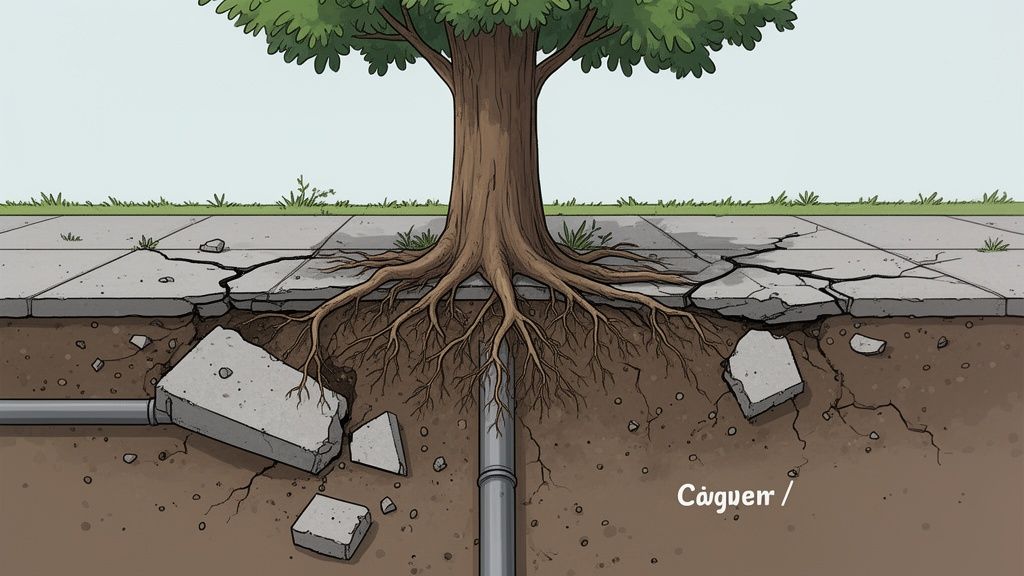
It’s a common myth that tree roots aggressively "attack" concrete. The truth is a little more subtle but just as destructive. Roots are opportunists. Tiny, hair-like feeder roots are constantly exploring the soil for water and air, and a hairline crack in a foundation slab or sidewalk is an irresistible invitation.
Once a root finds its way into a tiny fissure, it just keeps growing. Over the years, its gradual increase in girth exerts an immense, almost unstoppable pressure. That's how a nearly invisible crack gets forced open, eventually leading to serious structural failure.
The Two Ways Roots Wreak Havoc
Roots don't just damage property by exploiting existing weaknesses; they also cause problems through sheer displacement. As a tree’s main structural roots thicken year after year, they physically push the surrounding soil up and out of the way.
This leads to two primary types of damage that homeowners often see:
- Heaving and Cracking: This is what you see when a sidewalk slab is lifted and cracked, or a driveway develops a dangerous hump. The growing roots underneath are literally pushing the heavy concrete upward, causing it to buckle under the strain.
- Settling and Subsidence: In certain soil types, especially Georgia's famous clay, large roots can draw a tremendous amount of moisture from the ground. During dry spells, this causes the soil to shrink and compact, creating voids under a foundation. The foundation may then settle or sink into these unstable areas, causing cracks in your home's walls and floors.
For a deeper dive into this issue, you can learn more about how to identify and address tree roots damaging your foundation in our detailed guide. Understanding the signs early can save you from a world of hurt and major repairs down the road.
Not All Trees Are Created Equal
While any large tree planted too close to a structure can cause issues, some species are notorious for their aggressive, surface-level root systems. These trees are particularly problematic in urban and suburban landscapes where space is at a premium. Their roots are simply programmed to spread wide and shallow, making them high-risk neighbors for concrete and plumbing.
Knowing which trees have aggressive root systems is the first step toward preventing future damage. A beautiful shade tree can quickly become a liability if its roots are constantly threatening your home's structural integrity.
Here are a few of the most common culprits you might find in yards across the Cumming and Johns Creek areas:
- Silver Maple (Acer saccharinum): Known for its lightning-fast growth, this tree has a notoriously shallow and aggressive root system that frequently tears up sidewalks and invades sewer lines.
- Weeping Willow (Salix babylonica): Willows are absolute water-lovers. Their roots will aggressively seek out any source of moisture, including sewer pipes and drainage fields, often causing serious blockages and breaks.
- American Elm (Ulmus americana): Though less common now due to disease, elms have powerful, shallow roots that can easily lift pavement and find their way into foundations.
- Bradford Pear (Pyrus calleryana): While popular for their flowers, these trees have dense, fibrous root systems that can cause significant surface damage as they mature.
Spotting these trees near critical structures on your property should be a red flag. A proactive assessment by a certified arborist can help you understand the specific risks and figure out the best course of action before a small problem becomes a major headache.
How Our Modern Landscape Forces Roots to the Surface
Ever stop to think about whether a tree in the middle of a dense forest has the same root problems as the ones in our suburban yards? The answer is a hard no, and the reason boils down to us. The way we build our cities and neighborhoods has created a completely unnatural environment for trees, fundamentally changing how deep their roots can—or can't—grow.
When a new subdivision or home is built, the first thing that happens is the heavy machinery rolls in. Bulldozers, graders, and dump trucks crawl all over the land, and their immense weight compacts the naturally light, airy soil into a layer almost as hard as concrete. For a tiny, questing tree root, this compacted layer becomes an impenetrable wall, an artificial bedrock sitting just a foot or two below the grass.
Instead of exploring deep into the earth for water and stability, the roots hit this man-made hardpan and are forced to make a sharp turn, spreading out horizontally just below the surface. This single act of construction is often the most significant reason tree roots are so shallow in our landscapes.
Why Surface-Level Resources Always Win
After we've compacted the subsoil, we then build an entire infrastructure that actually rewards shallow roots. Think about it from the tree's perspective. It needs two main things to survive: water and oxygen. In our modern yards, we make it incredibly easy for trees to get both right at the surface, which pretty much eliminates any incentive for them to dig deeper.
This "easy living" at the surface comes from a few common features in our yards:
- Impermeable Surfaces: Things like driveways, sidewalks, and patios are great at trapping moisture underneath them while preventing rainwater from soaking deep into the ground. Roots are smart; they'll naturally grow toward these reliable, shallow sources of water.
- Shallow Irrigation: Most home sprinkler systems are set up to water the lawn, not the trees. This means frequent, shallow watering that trains tree roots to hang out in the top few inches of soil to get their daily drink.
- Fertile Topsoil and Mulch: We love to pamper our trees by adding a rich layer of topsoil or mulch around their base. This concentrates all the best nutrients right at the surface. Why would a root waste precious energy digging deeper when there's a five-star buffet just inches from the trunk?
This combination of compacted subsoil below and abundant resources above creates the perfect storm. We essentially build a shallow, resource-rich box and then act surprised when a tree's roots refuse to stay neatly within it.
Our modern lifestyle has unintentionally trained trees to develop shallow, problematic root systems. We create an environment where the easiest path to survival is to spread out, not dig down, increasing the risk of property damage and making trees less stable in high winds.
The Broader Impact of Human Activity
This isn't just a local issue affecting a few yards in Forsyth County; it's a worldwide pattern. Human activities, from large-scale agriculture to urbanization, have systematically altered the natural rooting depths of plants across the globe.
In fact, a major 2022 study quantified this very impact, revealing that human influence has made root systems dramatically shallower when compared to their counterparts in natural, untouched ecosystems. This large-scale ecological shift is directly connected to the sidewalk cracks and foundation worries we face in our own backyards. It shows how our development practices have reshaped the very foundation of the plant world. If you're interested in the science, you can read the full research about these global root depth findings.
At the end of the day, the answer to "how deep are tree roots" in a suburban setting is often decided more by the construction history of the property than by the tree's own natural instincts. The ghost of a bulldozer from decades ago is still shaping how your trees grow today, forcing their roots into the shallow soil layers where they are most likely to run into our homes and infrastructure.
Smart Planting Strategies to Protect Your Property
The best way to deal with destructive tree roots is to make sure they never become a problem in the first place. A little foresight goes a long way. Proactive, smart planting is your single best defense against future cracks in your foundation, busted-up driveways, and compromised utility lines. This isn't about limiting your landscape; it's about creating a space where your beautiful trees and your valuable property can coexist for decades to come.
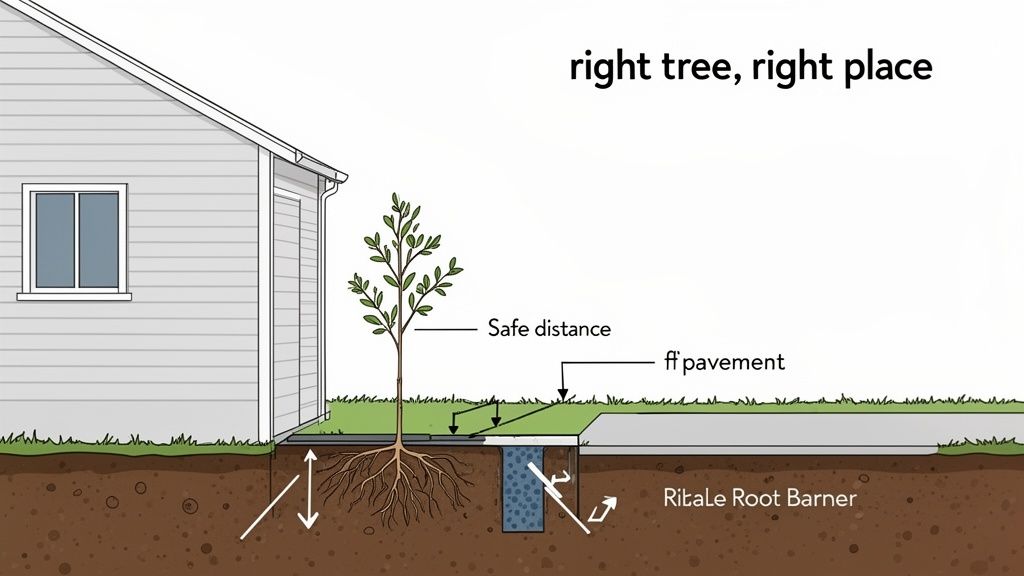
It all boils down to that timeless landscaping principle: right tree, right place. Before you even think about digging a hole, you have to consider the tree's future. That tiny sapling might look innocent sitting a few feet from your house, but fast forward 20 years, and its massive, sprawling root system could become your worst nightmare.
Calculating Safe Planting Distances
A bit of planning now can save you a fortune in repairs later. The trick is to use the tree's expected mature size—both its height and its canopy spread—as your guide.
A solid rule of thumb is to keep these minimum distances from your home's foundation, driveway, or patio:
- Small Trees (under 30 feet tall): Plant them at least 10-15 feet away.
- Medium Trees (30 to 70 feet tall): Give them a buffer of 15-25 feet.
- Large Trees (over 70 feet tall): These giants need 25-30 feet of breathing room, sometimes even more.
These distances aren't just for buildings. You should also apply them to underground utilities. Always call 811 before you dig to get your utility lines marked. The last thing you want is to plant a water-loving tree directly over a sewer line. This is just as critical when you're building near existing trees; knowing the right techniques for protecting trees during construction can prevent you from accidentally killing them.
Training Roots to Grow Deep
Once you've picked the perfect spot, you can actually encourage the tree's roots to grow down, not out. It's all about how you water. Many homeowners rely on sprinkler systems that deliver a light, frequent spray. This teaches roots to stay right near the surface where the easy water is.
Instead, switch to deep, infrequent watering. Lay a soaker hose at the tree's base or just let a regular garden hose trickle for an hour or so. This forces water to soak deep into the soil, and the roots will follow it down to get a drink.
This one simple change trains the root system to build a deep, strong anchor. Not only does this make the tree more resilient to drought, but it also makes it far less likely to send those pesky surface roots searching for your driveway.
Using Root Barriers as a Last Resort
What if you have no choice but to plant a bit closer to a sidewalk, or you want to protect an existing patio? In these tight spots, root barriers can be a helpful tool. These are typically solid panels of plastic or fabric that you install vertically into the ground to physically block roots and redirect them downward, away from hardscapes.
But be warned, barriers aren't a foolproof fix. If they're installed improperly, they can end up choking the tree's main roots or just fail completely over time. Think of them as a targeted, surgical solution for a specific problem, not a go-to strategy for every tree. For tricky situations like these, your best bet is to have a certified arborist take a look and decide if a root barrier is the right call for your property.
Answering Your Top Questions About Tree Roots
Navigating the complexities of tree roots can feel a bit overwhelming, but you don't need to be an arborist to make smart decisions. A few key insights can give you the confidence to manage the unseen world beneath your feet.
Here, we'll tackle some of the most common questions we hear from homeowners across the Atlanta area. Getting clear answers helps demystify how deep tree roots really grow and what you can do to protect your property.
How Far Should I Plant a Tree From My House?
This is a classic question, and the answer comes down to planning for the future. The safe distance depends entirely on the tree's mature size, not the little sapling you bring home from the nursery.
A good rule of thumb to follow is:
- Small Trees (growing under 30 ft tall) need at least 10 feet of space from your foundation.
- Medium Trees (between 30-70 ft) should have 15-20 feet of clearance.
- Large Trees (towering over 70 ft) ought to be planted a good 25-30 feet away to be on the safe side.
Can I Cut a Large Tree Root Damaging My Driveway?
Tackling a major tree root yourself is incredibly risky. Any root over two inches in diameter is likely a primary structural root. Cutting it can seriously destabilize the entire tree, turning it into a major fall hazard, especially during one of our Georgia storms.
Beyond the stability risk, a large cut creates a gaping wound. This is an open invitation for disease and decay to enter the tree, which can lead to its decline and eventual death.
Before you grab a saw, it's essential to get a professional opinion. An expert can help you understand the risks and explore safer alternatives. For a proper diagnosis, it's always best to work with a certified arborist in the Atlanta GA area who can accurately assess the tree’s stability.
Do All Trees Have a Deep Taproot?
This is probably one of the biggest myths in the world of tree care. While it's true that some trees, like pines and oaks, start their lives with a dominant taproot, this feature often becomes less important as the tree matures—and sometimes it disappears completely.
That prominent taproot is usually replaced by a sprawling network of lateral roots, which are far more efficient at soaking up water and nutrients from the upper layers of soil. Here in Georgia, our compacted clay soil or a high water table can prevent a deep taproot from ever developing in the first place.
If you're facing root-related issues or just have questions about the trees on your property, don't wait for a small problem to become a costly disaster. The team at Richmond Tree Experts GA has the knowledge and equipment to assess your situation and provide effective, safe solutions. Contact us today for a professional consultation.
Need a tree taken down safely? Richmond Tree Experts has worked on Marietta and Metro Atlanta trees since 1985, and every job is looked at by an ISA Certified Arborist before it is priced. Start with tree removal, or see everything we do: tree removal, stump grinding and arborist services across Cobb, Fulton, Cherokee, Gwinnett and DeKalb counties (service areas).
Call (770) 974-3964, 7am to 11pm every day, or request an estimate online.

